ChatGPT Ads can work for a Singapore bank, but only with a narrow scenario, measurement set up before spend, and compliance review of every creative variation. Start with one buyer scenario and judge the channel on qualified enquiries, not clicks.
Banks in Singapore are now asking whether a regulated lender should put its products in front of customers inside a conversational AI assistant. The channel rewards planning around buyer scenarios and conversational creative rather than keywords. It also rewards patience. A bank that treats the channel as a staged investment, and sets up measurement before it spends, will learn far more from a small test than one that buys reach it cannot evaluate.
Working with financial services clients, MediaOne typically finds that the planning work comes first. Our experience is that most banks underestimate how much groundwork a chatgpt ads for banking test needs. This guide sets out how the channel works in practice, from the compliance backdrop to a worked budget, so you can decide whether and how to start.
Key Takeaways
- ChatGPT Ads reward planning around buyer scenarios, not keywords. Map each customer question the bank wants to answer, such as a first-time account opener, a personal loan enquirer or a wealth-product prospect, before writing any creative.
- Measurement comes before spend. Set up the pixel and Conversions API first, so you can tell a qualified enquiry from a stray click. Without that, the first 30 days of reporting prove very little.
- Compliance review is part of the creative process. Every conversational variation for a regulated product needs a check that claims are accurate and not misleading, and that fees and eligibility are stated clearly. The full explanation is in the compliance section below.
- Pick the tier by scenario count and risk appetite. Starter from S$850/month suits two scenario sets with two creative variations. Growth from S$1,245/month adds up to five sets, bid optimisation and event quality monitoring. Enterprise from S$3,550/month adds unlimited sets and cross-channel integration. Confirm current tiers with the provider before budgeting.
- Treat the channel as a staged investment. Test a narrow scenario set, review qualified enquiries rather than clicks, and scale only when the measurement supports it.
Table of Contents
What ChatGPT Ads Are and Why Banks Are Paying Attention
ChatGPT Ads are paid placements that appear inside conversations with the ChatGPT assistant. A user asks a question, and the answer can include a sponsored message the advertiser has bid for. For a bank, the ad meets the prospect while they work through a financial question, not while they scroll a feed or type a generic search term.
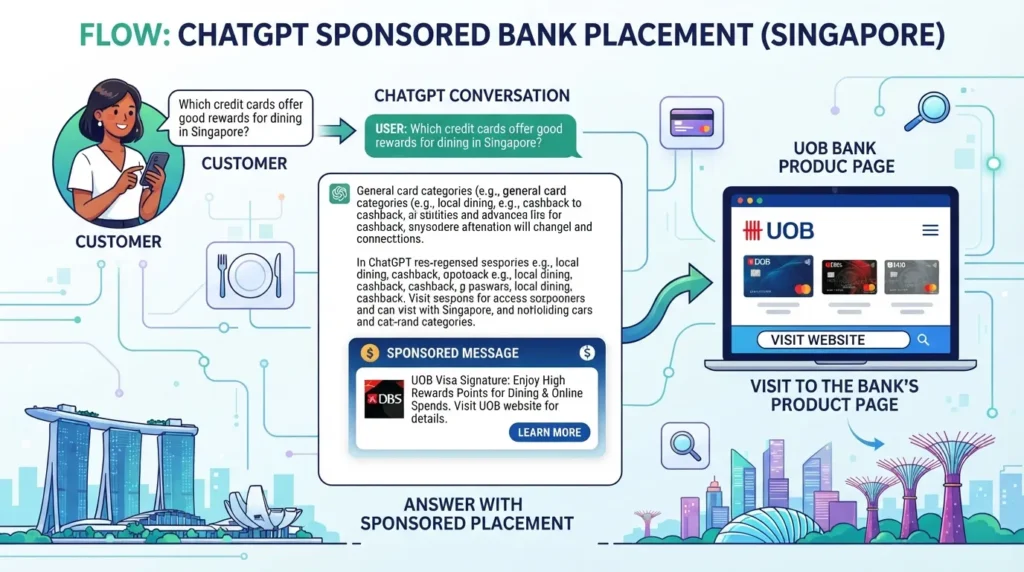
Banks are paying attention for three reasons:
- Customers already ask conversational tools to compare savings rates, explain loan eligibility and draft budgets.
- The format places a brand inside that exchange.
- The buyer is often in research mode, which suits a product that needs careful explanation.
What ChatGPT Ads currently allow for financial products
Financial products can be promoted in conversational placements, but the rules that govern any financial promotion still apply in full. Under MAS guidance, a promotion must not be misleading, must state the material conditions that affect a claim, and must match the approved product terms. A conversational format does not loosen any of this. It makes the discipline harder, because the answer is short and a condition can disappear in compression. Confirm the current permitted ad formats and any category restrictions with the provider before planning, since these change.
The three formats ask different things of the advertiser.
| Dimension | Search ads | Social ads | ChatGPT Ads |
|---|---|---|---|
| Trigger | Typed keyword | Interest or audience profile | Conversational question and context |
| User mindset | Looking for a destination | Browsing, often passively | Actively reasoning through a problem |
| Creative | Short text headlines | Image or video | Conversational responses and variations |
| Targeting unit | Keyword and match type | Audience segment | Buyer scenario |
| Measurement | Click and conversion tags | Pixel and platform events | Pixel and Conversions API events |
The most important shift is the unit of planning. Search is planned around keywords, and social around audiences. Conversational ads are better planned around a buyer scenario: a specific situation a prospect is in, such as “a first-time saver comparing accounts” or “a salaried professional asking about a personal loan.” A keyword tells you what someone typed. A scenario tells you what they are trying to decide.
That changes the creative brief. A search headline has to earn a click in a few words. A conversational ad has to fit inside an answer, sound like it belongs there, and still carry the product’s terms accurately. For regulated products, that is a harder writing task, which is why creative is treated here as a compliance question as well as a marketing one.
Where ChatGPT Ads sit in a Singapore bank’s marketing mix
For most Singapore banks, ChatGPT Ads will add to the existing mix rather than replace it. Most banks already run paid search, paid social, organic search, content and referral channels.
The sensible role for ChatGPT Ads is as an early-stage research channel. It reaches prospects who are weighing options, which is where a bank’s product explanation matters most. It is not yet a proven substitute for the capture that a search ad does when someone types a product name and is ready to apply.
Two questions decide whether the channel earns its place:
- Does the bank have products with clear, comparable features that a prospect would ask an assistant about?
- Does the bank already measure qualified enquiries well enough to tell whether a new channel adds them?
If the answer to the second question is no, the channel should wait until measurement is in place. Spending before tracking is configured produces activity the bank cannot judge.
Related analysis is available in chatgpt ads vs google ads and chatgpt ads vs Facebook ads.
The compliance backdrop: MAS rules on financial promotions
Singapore banks promote products under the oversight of the Monetary Authority of Singapore (MAS). The core obligations for any channel are these:
- Not misleading: claims about rates, fees, eligibility and risk must be accurate.
- Material conditions stated: a claim must not omit a condition that changes its meaning, such as a minimum balance, an introductory period or an eligibility threshold.
- Consistent with product terms: the ad must match the approved product disclosures.
The official MAS guidelines on advertising and marketing for financial products set out the detailed requirements. The bank’s compliance team should map each obligation to each buyer scenario before launch. The principle to hold onto is simple: a conversational answer compresses information, and compression is where a condition gets dropped.
The compliance review should therefore cover every buyer scenario and every creative variation before launch, not only the headline offer. The launch framework later in this guide shows how to run that review.
A sound starting point: if a sentence in an ad would need a footnote in a print brochure, it needs the same condition attached in the conversational version. A reader who sees only the answer should not walk away with a wrong idea about cost or eligibility.
“””
Why Banking Ads Are a Hard Case for Conversational Formats
Banking is one of the hardest categories for a new ad format. A conversational ad has to answer a question, and in banking every answer carries an obligation. Most ad formats can get away with a headline and a click. A chat answer cannot.
Regulated claims, disclosures and the limits of a chat answer
A conversational ad writes its own copy in response to each question. The bank cannot rely on one fixed sentence that legal has already approved. Instead, the bank must approve the boundaries within which an answer can move. These include which rates may be quoted, which eligibility conditions must appear alongside them, and which fees must be disclosed.
Singapore banks operate under the oversight of the Monetary Authority of Singapore (MAS). MAS expects advertising for financial products to be accurate and not misleading. Confirm the current requirements in the MAS guidelines before launch. These obligations do not relax because the format is new.
Treat each approved claim as a unit with its conditions attached. A savings rate is rarely meaningful on its own. It depends on the balance tier, the minimum monthly deposit and any promotional period. A chat answer that quotes the rate without those conditions gives an incomplete picture, which is exactly what compliance teams are trained to flag. The limit of a chat answer is therefore not its length. It is whether it can carry the full set of conditions in a form the customer sees and understands before acting.
Buyer intent in banking: comparison, eligibility and product research
Banking queries are rarely impulse purchases. A customer asking about a personal loan is usually comparing lenders, checking whether they qualify and trying to understand the total cost. An ad that only pushes an application misses most people who are still deciding.
Take a salaried professional asking an assistant whether a personal loan is worth it. The likely outcome of a well-built answer is a qualified visit to the eligibility page, not a loan application. A bank that expects an immediate application from that person will judge the channel as a failure when it is working as intended.
This shapes how a bank structures its buyer scenarios. A first-time account opener, a credit-line enquirer and a wealth-product prospect each ask a different question, with different product knowledge and different tolerance for detail. One generic message across all of them tends to satisfy none. Each scenario needs its own answer path, and each path should move the customer toward a qualified next step, such as checking eligibility or booking a conversation.
What a conversational ad must do in the first exchange
The first exchange carries most of the weight. Within a few lines, the ad should confirm it understands the question, name the product or category it covers, and show the key condition before any claim is made. A useful test: a customer who reads only the first response should know what the bank offers, who it is for and what they need to check next.
Campaigns that run conversational formats for financial clients tend to find that compliance and performance issues appear in the same first exchange. Responses that open with a strong rate attract clicks, but they also attract review challenges. Responses that lead with eligibility and conditions give up some attention but produce enquiries that are easier to qualify. In our experience across bank enquiry campaigns, the second pattern is the one that holds up when the enquiries reach the sales team, so banks should judge the first exchange on qualified enquiries as well as clicks.
Buyer scenario sets: mapping customer questions to ad flows
A buyer scenario set is a group of related customer questions that lead to one product decision. Instead of targeting a keyword such as “savings account”, the bank maps the question a prospect asks in a chat, then designs the ad flow that answers it. ChatGPT ads for banking work best when each set is built around a real question.
For a Singapore retail bank, three scenarios might look like this:
| Buyer scenario | Typical question | Ad flow goal |
|---|---|---|
| First-time saver | Which account helps me start saving? | Explain features, then direct to eligibility check |
| Salaried professional | Can I get a personal loan with my salary? | Confirm eligibility criteria, then route to application |
| Business owner | Which account suits a small business? | Qualify the need, then pass to a relationship manager |
Keep each scenario narrow enough that one ad flow can answer it fully. A scenario that covers “anyone interested in banking” produces vague responses and weak enquiries. The number of scenario sets a bank needs determines the tier. Two sets fit the Starter Plan, up to five fit the Growth Plan, and an unlimited number fits the Enterprise Plan.
Conversational creative: writing variations that stay within bounds
Conversational creative is written as a dialogue, not a headline and image. Each variation sets up a question, gives a short, accurate answer and offers a next step. Every variation for a bank must carry the terms a customer needs to understand the offer.
Apply these rules to every variation:
- State eligibility conditions in the first exchange, not in a footnote the customer may never reach.
- Avoid superlatives and comparative claims the approved product terms do not support.
- Show fees, minimum balances and rate conditions wherever the customer would expect to find them.
- Keep one product per flow. A flow that switches between a savings account and a loan confuses both the customer and the reviewer.
Log each approved variation with the product terms it relies on. When terms change, review the affected variations before they run again.
Measurement: pixel and Conversions API setup for banking funnels
Measurement is where many first tests fail. The pixel captures browser activity on the bank’s own site, while the Conversions API sends conversion events from the bank’s server. Using both gives a fuller picture, because browser-side tracking alone loses events when customers block cookies or switch devices. Tracking coverage and bid-strategy behaviour can change, so confirm the current options in the OpenAI ads documentation before you design the funnel around them. What is confirmed there is what the platform states; anything not stated should be treated as an assumption to test.
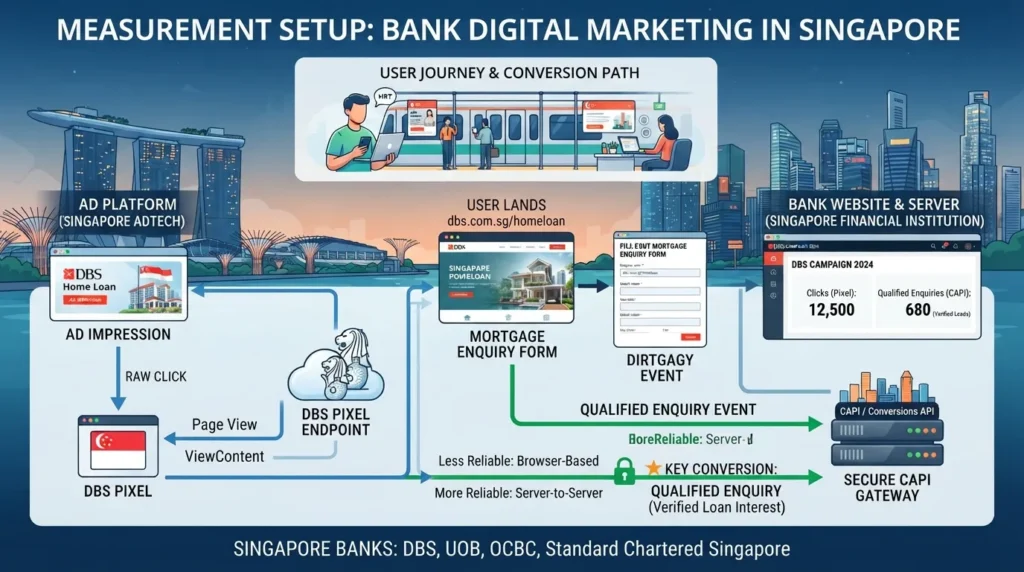
For a banking funnel, define conversion events that match the real business outcome, not just the easiest event to track:
- Enquiry submitted: the customer completes a contact or callback form.
- Eligibility check completed: the customer finishes the eligibility questions.
- Application started: the customer begins the product application.
- Application approved: the bank confirms the outcome, sent from the back office where possible.
Test each event before launch by completing the journey yourself and confirming every step is recorded. Compare recorded conversions against the bank’s own lead log for the first two weeks. A large gap usually points to a broken event, a duplicate fire or a missing parameter. Fix it before making budget decisions.
Choosing an Engagement Model
Before a bank spends on ChatGPT Ads, it has to decide how much of the service it needs. That choice drives the monthly cost, the number of buyer scenarios you can run, and how much hands-on management you receive.
The most common mistake is buying the highest tier because it looks like the most reach. A better approach is to match the tier to the number of products, the level of risk your compliance team will accept, and the size of the team that will run the campaign.
Starter, Growth and Enterprise compared side by side
Our three engagement tiers are priced as follows. All figures are in S$ as set out in our published pricing.
| Tier | From (per month) | Buyer scenario sets | Conversational creative | Bid optimisation | Account management |
|---|---|---|---|---|---|
| Starter | S$850 | Up to 2 | 2 variations | Not included | Monthly performance reporting |
| Growth | S$1,245 | Up to 5 | 5 variations | CPM, oCPC, oCPM | Dedicated account manager |
| Enterprise | S$3,550 | Unlimited | Full creative library | Included | Quarterly strategy sessions |
All three tiers include OpenAI Ads account setup and verification, and pixel and Conversions API setup. Enterprise also adds cross-channel integration with SEO/GEO and Google or Meta Ads, plus AI-powered campaign management.
Matching scope to product count, risk appetite and team size
The right tier depends on three questions.
- How many distinct products will you promote? Each product that needs its own audience and message usually needs its own buyer scenario set. A bank promoting one savings account and one personal loan has two scenarios, which fits Starter.
- How much compliance review can your team absorb? Every creative variation needs approval. A bank with a lean legal review process should start with fewer variations, even if a higher tier would allow more.
- Who will run the campaign day to day? If you have no in-house paid media specialist, the dedicated account manager in Growth may matter more than the extra scenario sets.
A practical rule: if you can name every scenario you want to test and approve the copy quickly, Starter is likely enough. If you need to test several segments in parallel, or want bid optimisation to learn from conversions, Growth is the more realistic entry point. Enterprise suits organisations that already run SEO, GEO and paid search or social as one coordinated programme.
Bid strategy options (CPM, oCPC, oCPM) and when each fits
Bid strategy determines what the platform optimises for. Choose it according to your conversion goal, not your familiarity with the acronym.
- CPM (cost per thousand impressions): You pay for reach. This suits awareness goals, such as introducing a new product to a defined audience, where a qualified enquiry is not yet the immediate target.
- oCPC (optimised cost per click): The platform bids to deliver clicks at a set cost while aiming for the action you define. This fits a bank whose main goal is driving visitors to an application page.
- oCPM (optimised cost per thousand impressions): In conversion-optimised campaigns, you can optimise for an event on your website, such as a completed application, and track that performance back to a specific ad, audience and campaign. This fits a bank with reliable conversion tracking that wants the system to find people more likely to apply.
oCPC and oCPM work well only when the Conversions API feeds accurate events. Without clean event data, the optimisation has little to learn from, and a bank may pay for activity that never becomes a qualified enquiry. Confirm the current OpenAI documentation on how conversion events are attributed before relying on these bid options, since platform behaviour can change. Put measurement in place before moving beyond CPM.
Go or no-go thresholds to set internally: Before scaling beyond CPM, agree two figures with the bank before launch: a target cost per qualified enquiry and a minimum number of qualified enquiries per month. Set both figures with your finance and marketing teams so they reflect the economics of your product and your sales capacity. Decide in advance how many conversions are needed before bid optimisation is switched on. If a scenario misses both thresholds for two consecutive review periods, pause it and review the creative and tracking before adding budget.
Event Match Quality and what it tells a bank
Event Match Quality is Meta’s scoring system for how well your server-side conversion events can be matched back to real Facebook users. It is a Meta concept, so it belongs only to Meta campaigns and is not part of ChatGPT Ads reporting. The Event Quality Score monitoring included in Growth and above is the signal to read for ChatGPT Ads, and it shows how reliable your conversion events are.
For a bank, the score is diagnostic. A low score usually points to a tracking problem, not an audience problem. Read it alongside your own funnel. If clicks are healthy but application starts are not being recorded, the score and event mapping will show where the break is. Fix that gap before scaling spend. A rising score over the first 30 days suggests the setup is working, but it does not prove the campaign is generating good customers. Treat it as a necessary condition for judging results, not as a result in itself.
Conclusion and Next Steps
The case for ChatGPT Ads in banking comes down to discipline. The channel rewards banks that plan around buyer scenarios and conversational creative, not a list of keywords. It pays back only once measurement is in place. Based on how we set up campaigns for clients, a bank should treat ChatGPT Ads as a staged investment with clear checkpoints, not as a switch to flip for maximum reach.
Start small and be specific. Pick one or two customer journeys that matter most, such as a first-time savings account or a personal loan for salaried professionals. Build the test around those alone. Once measurement works and every creative variation has cleared review, you have a basis for widening the scope.
Follow this sequence:
- Confirm your entry tier. Map each buyer scenario to the scenario sets and creative variations it needs. Two scenarios with two variations each fits the Starter Plan from S$850/month. A wider test that needs bid optimisation points to the Growth Plan from S$1,245/month. The Enterprise Plan from S$3,550/month suits banks that need unlimited scenario sets, a full creative library and cross-channel integration.
- Set up measurement before you spend. Pixel and Conversions API configuration should be live before the first impression. Without it, you cannot tell a qualified enquiry from a stray click.
- Clear compliance before launch. Every conversational ad must be accurate, must not overstate product benefits, and must carry the fees, eligibility terms and disclosures your bank’s approval process requires.
- Review after 30 days, then decide. Thirty days of reporting is enough to spot tracking gaps and weak scenarios. It is not enough to prove long-run acquisition cost, so judge the first month on data quality and enquiry quality, not final conversions.
Buying the highest tier will not fix a weak measurement set-up or an unreviewed creative library. More scenarios and variations add value only when you can measure and approve each one.
If you are ready to scope a pilot, start with the ChatGPT ads agency page, which outlines how each service tier is structured. Before you commit, review the questions to ask a chatgpt ads agency so you know what a sound proposal should include.
Frequently Asked Questions
Are ChatGPT Ads permitted for bank products in Singapore?
Advertising a bank product in Singapore is possible, but the copy must be accurate, balanced and not misleading. Treat ChatGPT Ads like any other financial promotion. Every claim about rates, fees, eligibility or features needs approval before it goes live. The product claims are the constraint, not the channel. Confirm the approval route with your compliance team before the first buyer scenario is written.
How long does account setup and verification take?
Setup covers the OpenAI Ads account, verification and the tracking work that follows. Timelines depend on how quickly your team supplies approved product information and how fast verification completes on the platform side. Confirm the expected timeline with your provider when scoping. All three tiers include account setup and verification, so your team’s time goes mainly to approvals and product inputs.
What is the difference between CPM, oCPC and oCPM for a bank?
CPM means you pay for each thousand impressions, so it suits awareness goals such as introducing a new savings account. oCPC (optimised cost per click) and oCPM (optimised cost per thousand impressions) let the platform tune delivery toward a conversion event you define, such as a completed enquiry. The choice depends on whether the goal is reach or qualified response. Bid strategy optimisation is included from the Growth tier upward.
Do I need a dedicated account manager for a first test?
Not always. A focused first test with one or two buyer scenarios can often run without one, since the Starter Plan covers up to two scenario sets and monthly performance reporting. A dedicated account manager is included in the Growth Plan from S$1,245/month and becomes more useful once you run several scenario sets, need faster approval cycles, or want bid optimisation reviewed regularly. Ask how many moving parts the test has, not how large the bank is.
How should a bank measure whether a ChatGPT Ads campaign is working?
Measure qualified enquiries, not clicks. First confirm the pixel and Conversions API are capturing the events you have defined, because a campaign cannot be judged on missing or duplicated data. In the first 30 days, monthly reporting shows whether scenarios reach the right people and generate responses, but it cannot prove long-term acquisition cost. Set a decision point at around 90 days, once you have enough volume to compare cost per qualified enquiry against your other channels.
Can ChatGPT Ads run alongside existing Google and Meta spend?
Yes. Many banks run ChatGPT Ads alongside Google and Meta campaigns, but overlap matters. The same prospect may see conflicting offers across channels, which damages trust and muddies attribution. Before launch, agree which product each channel promotes and how audiences are separated. Cross-channel integration with SEO/GEO and Google or Meta Ads is part of the Enterprise Plan from S$3,550/month, and is the tier to consider if coordinating these channels is a priority.