Brand loyalty has moved beyond punch cards and generic discounts. Today, it’s a sophisticated blend of data-driven personalisation, emotional connection and frictionless experience that separates market leaders from competitors.

This guide walks you through the five core pillars of an effective loyalty strategy, shows you how to build and measure a structured programme, and reveals why emotional loyalty now outlasts transactional incentives. Whether you run a retail, SaaS, hospitality or financial services business, you’ll find actionable frameworks and current KPIs to guide your next loyalty investment.
By the end, you’ll know which loyalty model fits your business, how to segment your customer base, what to measure and when to expect ROI. You’ll also understand the regulatory context, particularly Singapore’s Personal Data Protection Act, and avoid the pitfalls that cause significant member inactivity.
Key Takeaways
- Research indicates emotionally loyal customers typically spend more per year than transactional buyers and are less price-sensitive. Loyalty is an emotional attachment that drives repeat purchases and advocacy, not just repeat behaviour.
- Quality, personalisation, values alignment, reward design and frictionless experience are the five non-negotiable pillars. Programmes that address all five consistently outperform single-lever initiatives on retention and advocacy metrics.
- Most loyalty programmes achieve profitability within 18 to 36 months, depending on enrolment velocity and early segmentation. Retail and e-commerce see faster payback than financial services or SaaS.
- Emotional loyalty outlasts transactional incentives. Brands that build community, tell authentic stories, and recognise members as individuals create a defensible advantage that discounts cannot match.
- Technology, including data platforms and personalisation tools, is now essential for success. Compliance with privacy regulations, such as Singapore’s Personal Data Protection Act, is a foundation of trust, not a barrier; transparent data stewardship often increases enrolment.
- Segmentation and personalisation are key to preventing the leading failure mode: programme abandonment. Loyalty programme dormancy is common; programmes without strong engagement design often see significant member inactivity.
- Start with customer segmentation analysis, design reward mechanics matched to your industry, then measure enrolment, redemption and repeat-purchase rates weekly. Retention improvements can significantly impact profitability, with effects varying by industry model.
What Is Brand Loyalty, and Why Does It Matter to Your Bottom Line?
Defining brand loyalty beyond repeat purchases
Brand loyalty means a customer choosing your brand repeatedly, even when cheaper or more convenient alternatives exist. It is more than a transactional one-off purchase or a discount-driven repeat.
True brand loyalty has three layers. The first is repeat purchase behaviour, which any discount can temporarily trigger. The second is emotional attachment: the customer feels something about your brand. They trust it, enjoy the experience, or align with its values. The third layer is advocacy. Loyal customers actively recommend your brand to others, amplify your message on social media, and defend it against criticism.
This distinction matters operationally. Transactional repeat buyers abandon you when a competitor offers a better deal. Retaining them requires escalating discounts. Emotionally loyal customers are less price-sensitive. They stay because switching feels like a loss, not a gain. They are also far more profitable per unit of marketing spend.
Lifetime value captures this difference. A transactional repeat buyer might purchase five times in two years. An emotionally loyal customer might purchase fifteen times over five years, spend more per transaction, and generate referrals that recruit similar high-value customers at zero acquisition cost.
The financial impact of loyalty on business growth
Customer Acquisition Cost (CAC) in Singapore’s competitive retail and e-commerce sectors typically ranges from SGD 15 to SGD 50 per customer, based on reported industry benchmarks and varying by channel and industry. Retention costs run 5 to 25 per cent of acquisition cost.
That creates a straightforward leverage point: acquiring one customer costs five to ten times more than retaining them. Yet most businesses invest 80 to 90 per cent of their marketing budget on acquisition and 10 to 20 per cent on retention. Loyalty programmes reverse this ratio.
Retention improvements can significantly impact profitability, with effects varying by industry model. In fast-moving consumer goods (FMCG) and hospitality, the gains trend toward the lower end; in financial services and SaaS, toward the higher end.
For a practical example, a Singapore-based online grocer with SGD 10 million in annual revenue and 3 per cent annual churn could reduce churn to 2 per cent through a structured loyalty programme. Assuming an average customer lifetime value of SGD 2,000, that 1 per cent churn reduction saves SGD 20,000 annually while freeing up the acquisition budget for growth.
This example uses illustrative assumptions and is not a forecast of guaranteed results.
Programmes that successfully deepen emotional connection typically increase customer lifetime value by 20 to 40 per cent within 12 to 24 months. Repeat purchase frequency rises, average transaction value rises through cross-selling and upselling, and churn declines.
In Singapore and Australia, loyalty programme members show repeat purchase rates 30 to 50 per cent higher than non-members, based on typical industry benchmarks. In Southeast Asia more broadly, the uplift often reaches 40 to 60 per cent, partly because programme membership remains less saturated.
A simple points-based programme launched by a mid-market retailer typically achieves a positive return on investment within 18 to 24 months if enrolment exceeds 20 per cent of the customer base and redemption rates stay between 40 and 60 per cent. Programmes that fail to segment, personalise or communicate often never break even.
Disclaimer
This article provides general guidance on loyalty strategy and is not legal, tax, financial or regulatory advice. Reward structures and data practices may attract regulatory considerations under Singapore’s Personal Data Protection Act and potentially payment services regulations. Consult compliance and legal specialists before implementing any loyalty programme.
The Five Core Pillars of Effective Brand Loyalty Strategies
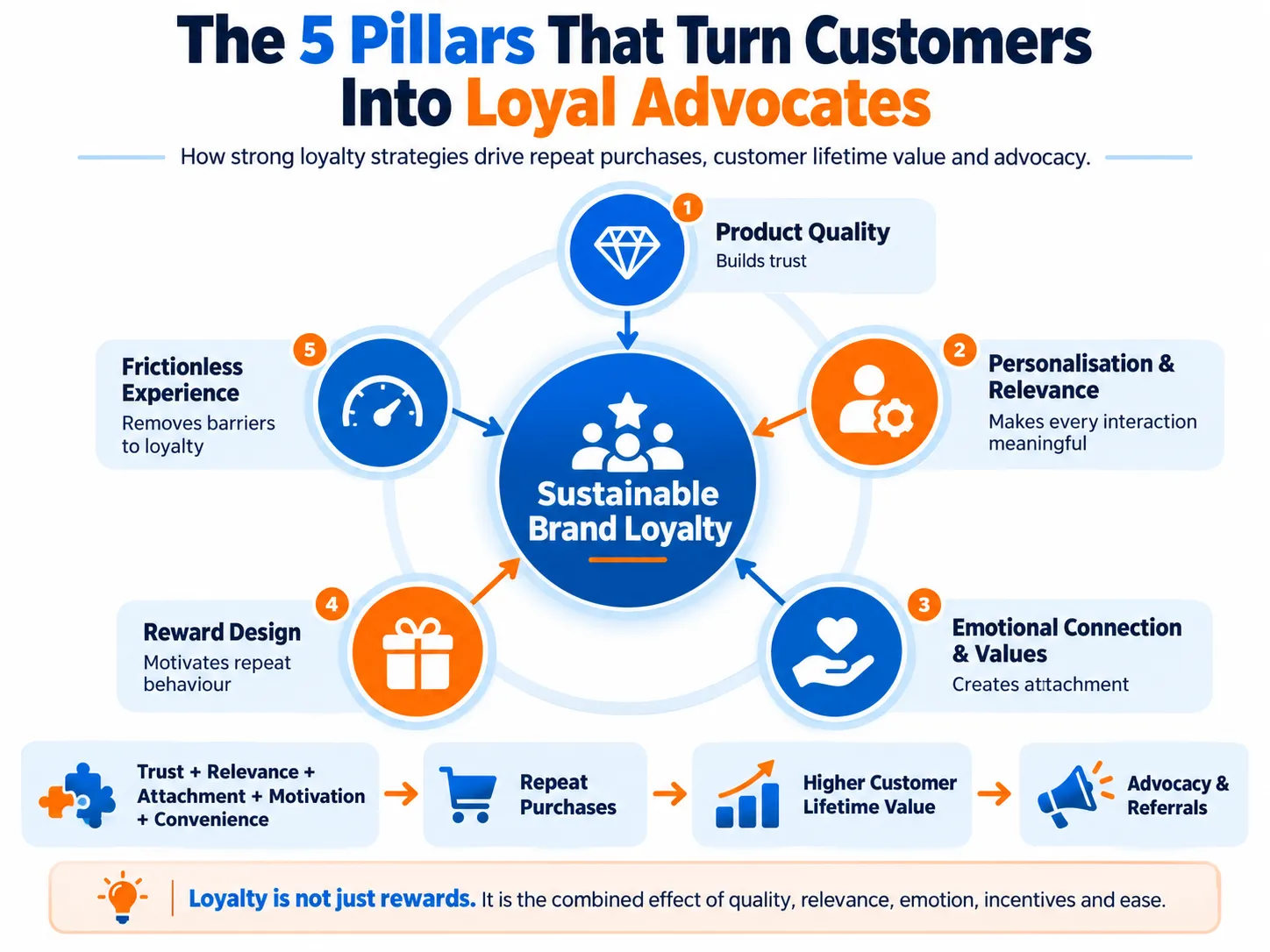
Every loyalty programme succeeds or fails based on five pillars. These are independent but reinforcing. Weakness in any one significantly reduces the effectiveness of the others.
1. Product Quality
Loyalty begins before a loyalty programme exists. A customer cannot become emotionally attached to a poor product, no matter how generous the rewards. Quality is the foundation. Loyalty programmes built on weak products fail because they are built on unstable ground.
Quality means consistently delivering on a customer’s needs and expectations. For a luxury brand, it might mean craftsmanship and exclusivity. For a low-cost retailer, it means reliable stock, correct sizing and predictable delivery. For a SaaS platform, it means uptime, speed and intuitive design.
A retail chain offering double points on defective stock might drive a redemption spike. It will not drive loyalty. When the customer uses the voucher, they will discover the product is poor. The entire emotional association with the brand deteriorates.
You can measure quality through product return rates, customer satisfaction scores, and Net Promoter Score (NPS). NPS measures how likely customers are to recommend your brand. If your NPS is below 30, invest in product improvement before or alongside your loyalty programme. If it is above 50, your loyalty programme can amplify the existing emotional connection.
2. Personalisation and Relevance
Generic loyalty offers alienate members. Personalisation means giving each member rewards, communications and experiences that match their actual purchase history and preferences.
Personalisation starts with data capture at enrolment. Collect purchase category preferences, frequency, price sensitivity, and communication preferences. Deepen it through behaviour tracking: which products members browse, which they buy, which they abandon, how often they visit.
The simplest personalisation tactic is segmentation. Divide your base into clusters:
- High-frequency, high-value buyers
- New members
- At-risk members (no purchase in 60 days)
- Dormant members (no purchase in 180 days)
Each segment receives different offers.
High-value members respond to exclusivity: early access, VIP tiers, and invitation-only events. New members respond to encouragement: first-purchase bonuses, easy redemption. At-risk members respond to urgency: expiring offers and “we miss you” campaigns. Dormant members often do not respond to normal offers. They need either a reactivation incentive or a clean exit from the programme.
Advanced personalisation uses machine learning to predict which product categories each member is most likely to buy next. It also predicts which offer (discount, points multiplier, free shipping) will drive that purchase. This level of sophistication requires a marketing automation platform and data science capability. The return on investment justifies the cost.
3. Emotional Connection and Values Alignment
Brands with the highest customer lifetime value build emotional attachment beyond transactions. This means aligning your brand values with your customer’s values, telling authentic stories, and building community.
Emotional connection starts with clarity. What does your brand stand for? What problem do you solve that matters to your customer? If you sell groceries, do you stand for convenience, sustainability, supporting local farmers, or health? Your loyalty programme should reinforce this narrative.
Brands that stand for nothing attract only price-sensitive customers. Those that stand for something attract believers. Believers will pay premium prices and overlook occasional stumbles. Research indicates emotionally loyal customers typically spend more per year than transactional buyers.
Community building deepens these bonds. Loyalty programmes that enable peer interaction through forums, events, or user-generated content create network effects. Members feel they belong to something larger than a transaction. This is common in fitness brands, gaming platforms, and financial institutions.
Authentic storytelling matters. Customers quickly detect corporate inauthenticity. If your brand says it values sustainability, but your packaging is plastic and non-recyclable, members will call that out. Loyalty is not trust. It is enforced transparency.
4. Reward Design That Matches Behaviour
Rewards must be valuable to your members, attainable within a reasonable timeframe, and aligned with your business model. Badly designed rewards can destroy loyalty programmes.
There are five main reward mechanics:
- Points systems: Members earn one point per dollar spent (or per unit, or per action). Points accumulate and convert to discounts, products or experiences. Points work when redemption thresholds feel achievable (typically 40 to 80 per cent of average transaction value), and the reward catalogue is relevant.
- Tiered programmes: Members unlock higher benefits as they spend more. Silver members get 1 point per dollar; Gold get 1.5; Platinum members get 2. Tiering is psychologically powerful because it gives members a goal and a sense of progression. However, tiers only work if the gap between each tier is achievable within 12 to 24 months for a significant portion of your base.
- Cashback programmes: A percentage of spending is returned directly to members as account credit or real money. Cashback is transparent and immediately valuable, but it reduces your effective margin. It works best for high-frequency, high-ticket categories like fuel, groceries, or dining.
- Exclusive access: Members receive early access to new products, sales, or limited editions. Exclusivity is emotionally powerful and costs nothing to deliver. It works especially well for fashion, beauty, and luxury goods.
- Experiential rewards: Members receive experiences rather than products: priority customer service, personal styling sessions, event invitations, or trips. Experiences create memories and deeper emotional attachment than products. They are effective across hospitality, luxury retail, and premium financial services.
The most effective programmes layer these mechanics together. A fashion retailer might combine a tiered points system (accumulate points from purchases) with exclusive early access (for higher tiers) and seasonal experiential rewards (VIP shopping events). This creates multiple reasons to stay engaged.
5. Frictionless Experience
Loyalty only works if joining, engaging and redeeming are effortless. Friction is the enemy of retention.
Joining should take less than two minutes. Use one-page enrolment (not a form that requires scrolling) with only optional fields. Digital capture is fastest. Follow physical forms (in-store) with automatic digital activation.
Engaging should require no special effort. If members must open a separate app to see their balance or find offers, many will not bother. Integrate loyalty status into your main product experience. Show the point balance at checkout. Display personalised offers on the homepage or in the post-purchase confirmation email.
Redeeming should be one click. If a member has 500 points and wants to apply them to their next purchase, that should be a single action at checkout, not a process requiring manual code entry.
Friction compounds. A programme that is slightly harder to join has lower enrolment. Lower enrolment means fewer customers to segment and personalise. Such friction reduces the programme’s effectiveness. Members who face friction when redeeming will assume it is not worth it and go dormant.
Frictionless programmes measure success using three key metrics:
- Enrolment conversion rate: Target above 25 percent of eligible customers in year one.
- Active member rate: Target at least 60 percent of enrolled members transacting in the last 90 days.
- Redemption frequency: Target at least one redemption per member per quarter.
Building a Structured Loyalty Programme: Framework and Implementation Checklist
Step-by-step framework for programme design
Building a loyalty programme follows a structured sequence. Start with customer segmentation, move to reward design, then launch with a clear measurement plan.
Stage 1: Customer Segmentation (Weeks 1–3)
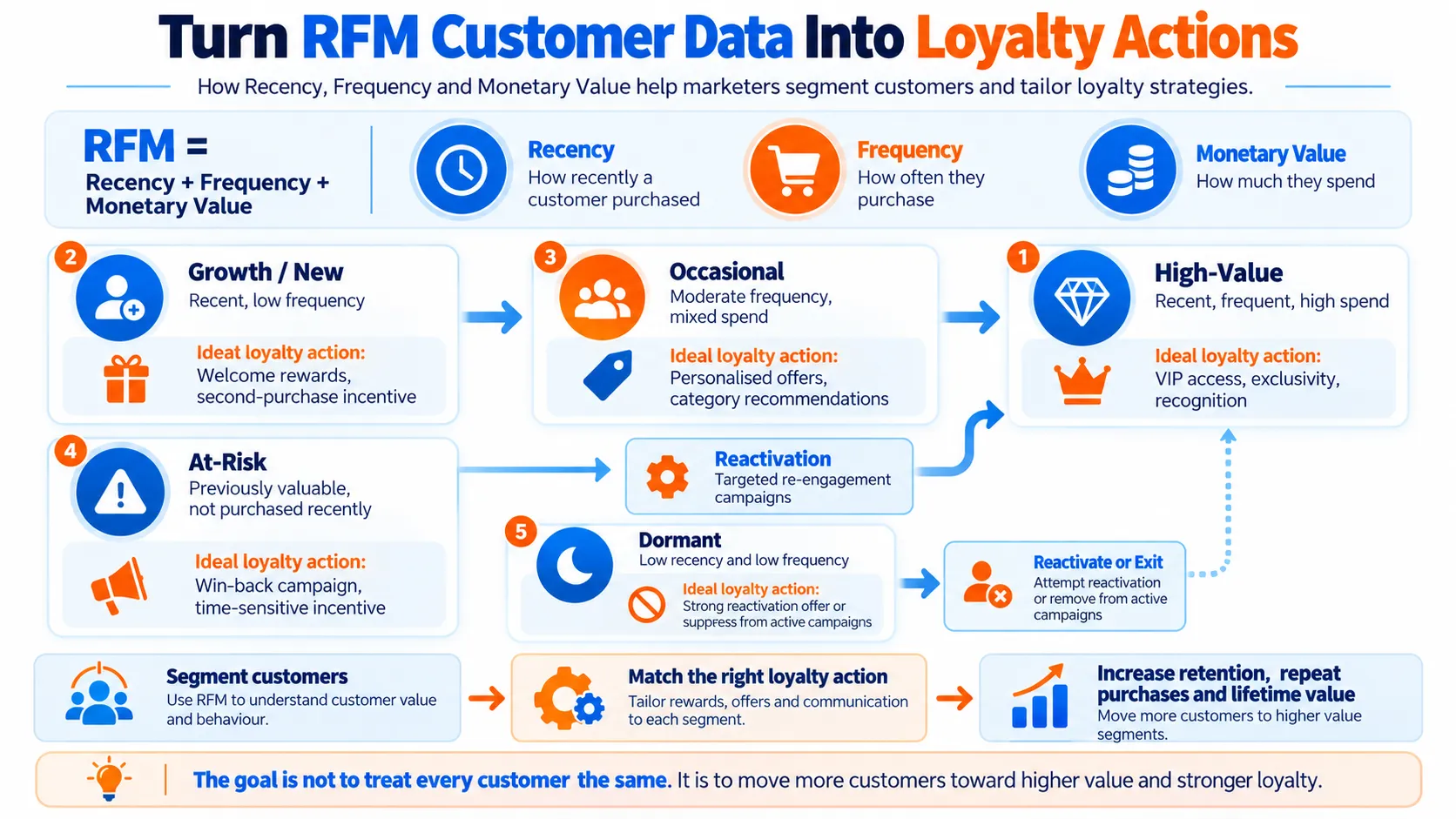
Before designing a loyalty programme, segment your existing customer base using RFM (Recency, Frequency, Monetary) analysis. This method classifies customers based on three dimensions.
Recency measures how recently a customer last purchased: 0–30 days, 31–90 days, 91–180 days, or 180+ days.
Frequency measures purchase volume: 1 purchase, 2–5 purchases, 6–10 purchases, or 10+ purchases within the last year.
Monetary measures total spending: categorise as Low, Medium, High, or Very High based on your business quartiles.
This produces a matrix. Your best customers score high across all three dimensions. Your at-risk customers score high on Monetary and Frequency but low on Recency. Your one-time customers score low across all three.
Each segment requires a different loyalty strategy:
- High-value customers need exclusive treatment to deepen their relationship
- New customers need encouragement to make repeat purchases
- At-risk customers need reactivation incentives
- Occasional customers need engagement to increase frequency
Use a spreadsheet or analytics tool to segment your base. A typical distribution from 10,000 customers might be:
- 8% are High-Value (High Recency, High Frequency, High Monetary)
- 12% are New or Growth (Low Recency and Frequency, increasing Monetary)
- 30% are Occasional (Medium to High Frequency, Medium Monetary, declining Recency)
- 25% are At-Risk (Low Recency, Medium to High Frequency and Monetary)
- 25% are One-Time or Dormant (Low across all dimensions)
Design your programme to help customers progress up this ladder.
Stage 2: Reward Mechanics Design (Weeks 4–8)
Decide which reward mechanics to use. Start with one or two; add complexity only when adoption data justifies it.
For retail or e-commerce businesses, a simple tiered points system works well:
- Members earn 1 point per SGD 1 spent
- 100 points redeem for SGD 5 discount (5% redemption rate)
- Silver tier (0–1,000 points lifetime): 1 point per dollar
- Gold tier (1,000–5,000 points): 1.2 points per dollar
- Platinum tier (5,000+ points): 1.5 points per dollar
For restaurants or cafes, a visit-based or punch-card system is more intuitive:
- Every 10 purchases earns a free item
- Customers reaching 24+ visits per year unlock VIP status with a 10% discount on all purchases
For SaaS platforms, a referral mechanic aligns programme benefits with growth:
- Members receive 30 days free for every unique customer they refer who stays more than 90 days
- Members who refer 5+ customers unlock a discounted annual plan for life
The critical principle: rewards must feel achievable. If the average customer spends SGD 50 monthly and a reward requires SGD 500 in spending, members need 10 months to earn it. That is achievable. If a reward requires SGD 5,000, it feels impossible, and members disengage within three months.
Stage 3: Technology and Data Foundation (Weeks 8–12)
Choose a loyalty platform that integrates with your POS, e-commerce, or SaaS system. The platform must capture the following core data:
- Member ID and profile information
- Purchase history (date, amount, category)
- Points balance and tier status
- Last purchase date
- Communication preferences
- Redemption history
You do not need an expensive enterprise platform. A mid-market retailer can start with platforms such as Smile.io, ReferralCandy, or Rejoiner, which integrate with Shopify, WooCommerce or standard POS systems. Financial services firms and large retailers often use Salesforce Loyalty Management or Epsilon.
The platform should enable segmentation and email campaigns. Send different messages to different segments: milestone messages to tier climbers, win-back messages to at-risk members, and expiry reminders to members with points nearing expiration.
Stage 4: Launch and Promotion (Week 13 onwards)
First, promote your programme to your existing customer base. You are formalising and deepening existing relationships rather than creating a new channel.
Use multiple promotion channels:
- In-store/in-app promotion: Place signage at checkout; include a pop-up at digital checkout; add a banner on your homepage
- Email promotion: Send a series of emails explaining the programme, the benefits of each tier, and a direct enrolment link
- Incentive promotion: Offer a bonus for joining, such as 100 bonus points with no purchase required if enrolment occurs within the first 30 days
This removes friction and creates urgency. Target 20 to 25 percent enrolment in year one from your existing customer base. If you have 50,000 annual customers, aim for 10,000 to 12,500 enrolments.
Stage 5: Ongoing Optimisation (Months 4 onwards)
Track weekly metrics (see the Measuring ROI section below). Adjust reward thresholds if redemption is too high or too low. Adjust messaging if engagement plateaus. A/B test subject lines, offer types, and redemption mechanics.
After six months, segment your members to identify those going dormant. Craft reactivation campaigns for that cohort.
After 12 months, evaluate programme profitability. If you have reached positive ROI, invest in tier benefits and experiential rewards to deepen emotional loyalty.
Implementation checklist
Pre-Launch (Weeks 1–12)
- [ ] Segment existing customer base using RFM analysis
- [ ] Define programme goals: enrolment target, redemption rate, repeat purchase uplift target
- [ ] Design reward mechanics and document in a one-page summary
- [ ] Choose a loyalty platform and configure member tracking
- [ ] Draft privacy policy and ensure compliance with the Personal Data Protection Act (Singapore)
- [ ] Create member communication plan: email templates, in-store signage, app notifications
- [ ] Set up an analytics dashboard to track enrolment, engagement, redemption, and repeat purchase rate
- [ ] Conduct internal pilot with staff enrolment and testing
Launch (Week 13)
- [ ] Announce the programme to the existing customer base via email, SMS, and in-store signage
- [ ] Activate bonus enrolment incentive valid for 30 days
- [ ] Monitor daily enrolment and technical performance
- [ ] Respond to customer support queries within 24 hours
Post-Launch (Weeks 14–26)
- [ ] Track weekly enrolment, active member rate, and redemption rate
- [ ] Identify dormant members (no transaction in 90 days) and segment for reactivation
- [ ] Send tier progression milestone emails (e.g., “You are 200 points away from Gold”)
- [ ] Test and iterate offer types and messaging based on engagement data
- [ ] Gather member feedback via survey or in-app prompt
Months 4–12
- [ ] Evaluate programme ROI: revenue from loyalty members versus programme costs
- [ ] Plan year-two enhancements such as new reward types, tiering adjustments, or community features
- [ ] Expand to underperforming segments (if Gold tier uptake is low, adjust threshold or benefits)
- [ ] Prepare year-two budget based on learnings
Emotional Loyalty: Building Brand Advocates, Not Just Repeat Buyers
Why emotional loyalty outlasts transactional incentives
Transactional loyalty is brittle. It lasts only as long as the discount. The moment a competitor offers a better deal, the customer switches. Discounts create a race to the bottom: lower margins, acquisition of price-sensitive customers, and reduced differentiation.
Emotional loyalty is durable. It rests on trust, values alignment, community and identity. An emotionally loyal customer will pay a premium, tolerate minor service failures, and actively recruit others.
The distinction shows in churn patterns. A programme relying on discounts sees spike enrolment followed by rapid decay. Members join for the deal, transact a few times, then leave when the offer expires or a competitor undercuts. A programme building emotional connection sees slower initial enrolment but sustained engagement and higher lifetime value.
Emotional loyalty lasts because humans are not rational calculators; they are driven by social identity and belonging. People want to support brands that align with their values. They seek recognition and status. A loyalty programme satisfying these psychological needs becomes sticky.
Research indicates emotionally loyal customers typically spend more per year than transactional buyers. This spending uplift, combined with lower churn and higher referral rates, translates to significant lifetime value advantages.
Tactics for building emotional connection
Tell authentic brand stories. Customers want to know who you are, what you stand for, and why you do it. A grocery brand that highlights supply chain relationships or its commitment to reducing food waste creates emotional connections. A SaaS company that shares its founding story or engineering philosophy attracts aligned customers. Customers quickly detect corporate inauthenticity, so authenticity is non-negotiable.
Build community. Loyalty members should feel they belong to something larger than a transaction. A fitness brand creates community through member-only challenges, leaderboards and events. A fashion brand does so through exclusive member forums or user-generated content campaigns. Community transforms individual customers into a network that recruits, supports and defends each other.
Recognise individuals. Send a birthday message. Celebrate a member’s anniversary with your brand. Thank them for referrals. Recognition does not require gifts; it requires acknowledgement. A personalised email from a brand founder or senior leader thanking a long-term member is more powerful than a generic 10% discount email.
Align on values. Make your values explicit and live them. If your brand stands for sustainability, ensure your supply chain, packaging and operations reflect this commitment. If you stand for inclusion, ensure your products, marketing and hiring do the same. Members will hold you accountable. Misalignment destroys loyalty quickly.
Offer progression and mastery. Humans are motivated by a sense of progress. Tiered loyalty programmes work partly because they give members a ladder to climb. Status, badges, levels and achievements create intrinsic motivation independent of discounts. A gaming platform celebrating rare achievements or a loyalty programme recognising top referrers taps into this driver.
Listen and respond. Create mechanisms for members to give feedback, suggest products, or flag problems. Then act on that feedback. Members who see their suggestions implemented become emotionally invested in the brand’s success.
Loyalty in the Digital Age: Technology and Data Integration
Loyalty programmes require a practical technology stack to capture transactions, manage member data, and deliver personalised engagement. This section outlines which platforms matter most and how to use data effectively whilst maintaining trust.
Which technology platforms are worth the investment?
A loyalty programme requires three technology layers: transaction capture, member data management, and marketing engagement.
Transaction Capture: Your point-of-sale system, e-commerce platform or SaaS billing system must capture transactions and attribute them to a loyalty member. This is foundational; most systems have native loyalty capability or integrate with third-party platforms via an application programming interface (API).
Member Data Management: A Customer Data Platform (CDP) or dedicated loyalty management system consolidates member data, calculates points, manages tier status, and triggers automations. For mid-market businesses, the best option might be Smile.io, Subbly, or built-in POS features. For larger enterprises, the best option might be Salesforce Loyalty, Epsilon, or a bespoke system.
Marketing Engagement: Once you have member data, you need to reach members with personalised offers. This requires an email marketing platform (Klaviyo, Braze, or your customer relationship management system) that integrates with your loyalty system, accepts member segmentation data, and enables triggered campaigns.
For a small business, you might start with a single platform that does all three, such as Smile.io with Shopify. For a large business, use best-of-breed tools: one system for transaction capture, a CDP for data management, and a marketing platform for engagement.
The integration imperative: If you implement three platforms that do not communicate, you will have three data silos and no single customer view. Budget for integration work or choose platforms with native integrations.
Harnessing AI and data to prevent churn
Churn prediction is one of the highest-return uses of artificial intelligence (AI) in loyalty programmes. It uses historical data to identify members likely to become inactive in the next 30, 60 or 90 days.
The model trains on past behaviour. Members who eventually churned typically showed patterns such as longer gaps between purchases, lower transaction values, fewer category purchases, or reduced app engagement. The model applies these patterns to current members to assess risk.
Once you identify at-risk members, you can intervene with targeted offers. For example: “We noticed you have not shopped in 45 days. Here is 20% off your next purchase, valid for 7 days.” Segmentation prevents you from wasting offers on already-loyal members.
Churn prediction is particularly valuable in subscription services, where monthly churn is the dominant metric. Retail churn is less predictable but still trackable using purchase history and seasonal patterns.
Implementing churn prediction requires a data scientist or an analytics vendor. Most loyalty platforms now offer it as a standard feature. The return typically justifies the investment: the cost of a few targeted interventions is often offset by revenue from retained customers.
Privacy, compliance and trust
Data stewardship is now a competitive advantage, not merely a compliance requirement. Customers increasingly expect brands to protect their data; transparency and responsible handling attract higher enrolment and engagement.
In Singapore, the Personal Data Protection Act requires explicit consent to collect and process personal data. Your loyalty programme’s privacy policy must state what data you collect, how you use it, who you share it with, and how customers can access or delete their data.
Compliance creates opportunity. Members who understand and trust your data practices are more willing to share behavioural data (purchase history, preferences, feedback). This data enables better personalisation, which drives higher engagement.
Practical steps:
- Write a clear, concise privacy policy in plain language. Explain what you do with member data, not legal abstractions.
- Offer granular consent. Let members choose which communications they want (promotions, product launches, community updates) rather than an all-or-nothing approach.
- Make data access straightforward. A member should be able to request a data export or deletion within 24 hours.
- Audit your data use annually. Confirm you are using data only for loyalty engagement, not selling it to third parties.
Members who trust your data practices feel safer sharing information. This improves personalisation, which drives better results and stronger loyalty.
Industry-Specific Loyalty Strategies
Loyalty mechanics differ significantly by industry. Tailor your programme to match your customer’s purchase cycle, price sensitivity, and what builds emotional attachment in your category.
Retail and e-commerce
Purchase cycle: Weekly to monthly for everyday items; quarterly for fashion; annually for appliances.
What works: Tiered point systems are intuitive. Members earn points on every purchase and watch the balance accumulate. For fashion and beauty, exclusive early access to new products or sales is highly valued. For groceries, personalised offers based on purchase habits (such as “extra points on organic” for members who buy organic regularly) drive engagement.
Key metric: Repeat purchase rate within the first six months of enrolment.
Realistic ROI: Retail loyalty programmes typically deliver 2:1 to 3:1 return over three years for mid-market businesses, depending on average transaction value and repeat frequency.
Hospitality (restaurants, cafes, hotels)
Purchase cycle: Weekly to monthly for restaurants and cafes; annually for hotels.
What works: Visit-based mechanics (every 10 visits earns a free item) are intuitive and feel fair. Tiering (Silver, Gold, Platinum) based on annual spend works for mid-range and upscale restaurants. For hotels, emotional loyalty often comes from recognition: personalised room amenities, birthday surprises, or suite upgrades.
Key metric: Repeat visit frequency among enrolled members.
Realistic ROI: 2:1 to 4:1 over three years, depending on average transaction value and how often members return.
SaaS and subscription services
Purchase cycle: Monthly (subscription renewal) to annual (annual plans).
What works: Referral-based loyalty (discounts for customers referred) aligns loyalty with growth and creates viral loops. Points-based systems work if they unlock tangible benefits: renewal discounts, access to premium features, or priority support. For high-churn categories such as meal kits or fitness, churn prediction and win-back campaigns are essential.
Key metric: Net retention rate (revenue from existing customers, including expansion and churn).
Realistic ROI: 2:1 to 5:1 over three years, depending on customer lifetime value and churn patterns.
Financial services (banking, insurance, investment)
Purchase cycle: Annual or triggered by life events.
What works: Tiered programmes based on assets under management or annual spending work well. Emotional loyalty comes from education (investment webinars, tax planning guides) and community (investor networks, events). Exclusive access, such as private banking or advisory services, is highly valued for high-net-worth members.
Key metric: Wallet share (percentage of a customer’s total financial assets held with you).
Realistic ROI: 3:1 to 5:1 over three years. Financial services typically see the highest return due to high customer lifetime value.
Common Pitfalls and How to Avoid Them
This section covers common implementation challenges and concrete mitigation strategies.
Pitfall 1: Launching without customer segmentation
Many programmes enrol customers and treat them identically. A high-value customer and a first-time buyer receive the same offer. Engagement drops because offers feel irrelevant.
Avoid: Segment using RFM analysis (Recency, Frequency, Monetary Value) before launch. Design segment-specific messaging. High-value members receive VIP treatment; new members receive encouragement; at-risk members receive win-back offers.
Pitfall 2: Rewards that feel unattainable
A programme where 100 points equals SGD 5 discount, but the average customer earns 50 points per year, will fail. Members realise the reward is years away and disengage after three months.
Avoid: Set reward thresholds so 40 to 60 per cent of members redeem at least once per year. The median member should earn enough points to redeem a reward within three to six months.
Pitfall 3: Generic, irrelevant offers
“Here is 10% off everything” engages new members, but loyal members want offers that reflect their unique preferences. Over time, generic offers train members to ignore communications.
Avoid: Use segmentation and behavioural data to personalise offers. For example: “You buy organic; here is 15% off organic” or “You have not shopped for 60 days; here is 20% off your next purchase, valid for 7 days.”
Pitfall 4: Poor programme communication
Members enrol but do not understand the rules or see the value. They accumulate points but do not know how to redeem them. Engagement never begins.
Avoid: Send a welcome email immediately after enrolment. Explain the programme clearly and offer a quick redemption path, such as “Here is 50 bonus points; redeem for 20% off your next purchase.” Follow with quarterly tips and milestone celebrations.
Pitfall 5: Ignoring dormancy in loyalty programmes
Loyalty programme dormancy is a common challenge. Programmes without strong engagement design face significant member inactivity within the first six months.
Avoid: Monitor your active member rate (members transacting in the last 90 days) weekly. Target 60 per cent active or higher. Identify dormant members at 90 days and trigger reactivation campaigns. At 180 days, consider removing them from your active list or sending a final offer before marking them as inactive.
Pitfall 6: Underestimating the cost to run the programme
Technology costs (platform fees, integrations, data infrastructure), marketing costs (email campaigns, in-store signage, customer support), and reward costs (discounts issued, product redemptions) add up quickly. Many programmes fail because they don’t budget for ongoing operational costs.
Avoid: Build a three-year financial model before launch. Include platform costs, team costs (loyalty manager, data analyst), marketing spend, and reward costs. Scenario-plan for different enrolment and engagement rates. Validate that the programme reaches break-even by month 24.
Measuring ROI: What to Track and Realistic Benchmarks for 2026
Weekly metrics (operational health)
Enrolment rate: New members per week divided by eligible customers (new shoppers, visitors, and trials). Target: 5 to 15 percent per week during promotional periods; 1 to 3 percent ongoing.
Active member rate: Members who transacted in the last 90 days, divided by total enrolled members. Target: 60% or higher. Below 50% signals engagement problems.
Redemption rate: Members who redeemed at least once, divided by total members. Target: 40 to 60 percent. Below 30% signals rewards are unattainable; above 80% signals rewards are too generous.
Average points per transaction: Average points earned per transaction. Benchmark: 1.0 to 1.5 points per SGD 1 spent (adjust for your reward structure).
Monthly metrics (business impact)
Repeat purchase rate: Percentage of loyalty members who made a repeat purchase within 30 days. Target: 30 to 50 percent (varies by industry).
Average transaction value (ATV): Average spend per transaction. Calculate separately for members and non-members. Target: loyalty members typically spend 15 to 25 percent more per transaction than non-members.
Customer lifetime value (CLV): Total profit expected from a customer over their relationship with you. Calculate as (Average Transaction Value × Purchase Frequency × Retention Period) minus Acquisition Cost. Target: loyalty members show 30 to 40 percent higher CLV than non-members within 12 months.
Churn rate: Percentage of members who made no purchase for 180 days. Target: below 40 percent at 12 months (keep active member rate at 60% or higher).
Quarterly metrics (ROI and strategic health)
Programme cost per member: (Total programme costs / Total enrolled members). Includes platform, team, marketing, and rewards. Target: SGD 5 to SGD 20 per member per year, depending on industry and reward generosity.
Revenue per loyalty member: Total revenue from loyalty members divided by enrolled members. Benchmark: SGD 100 to SGD 500 per member per year (varies widely by industry and average transaction value).
Loyalty programme ROI: (Revenue from members minus programme costs) divided by programme costs. Retention improvements can significantly impact profitability, with effects varying by industry model. Target ranges: 2:1 to 3:1 by month 18; 3:1 to 5:1 by month 36.
Net Promoter Score (NPS) uplift: Net Promoter Score of loyalty members minus NPS of non-members. Target: 10 to 20 point uplift. This indicates loyalty members are significantly more likely to recommend you. Note: an NPS threshold of 30 is a suggested benchmark rather than an absolute industry standard.
Timeline to profitability and realistic payback periods
Most well-designed loyalty programmes reach positive ROI between month 18 and month 36. The timeline depends on three factors:
Enrolment velocity: How quickly you sign up members. Aggressive enrolment (25+ percent of the customer base in year one) accelerates payback. Slow enrolment (under 15 percent) delays it.
Engagement depth: What percentage of members actively transact and redeem. High engagement (60%+ active rate) speeds payback. Low engagement (below 40%) extends it or prevents breakeven.
Reward economics: How much you discount or give away through rewards. Generous rewards (10+ percent of revenue) reduce margins and delay ROI. Moderate rewards (3 to 8 percent of revenue) allow faster payback.
Retail and e-commerce typically break even fastest: 12 to 20 months. Hospitality: 18 to 28 months. SaaS and subscription: 20 to 32 months (due to longer sales cycles). Financial services: 24 to 36 months. Financial services programmes often achieve higher ROI once established, frequently reaching 4:1 to 5:1 returns.
Disclaimer: This article provides general guidance on loyalty programme strategy and metrics. It is not financial, legal, or tax advice. Specific programme costs, timelines, and ROI outcomes vary by business model, industry, market conditions, and execution quality. Reward structures may attract regulatory conditions under Singapore payment-services frameworks. Consult with financial or legal advisers before committing to specific programme investment or design decisions.
Frequently Asked Questions
How much does it actually cost to set up and run a loyalty programme?
Platform costs range from SGD 500 to SGD 5,000+ per month, depending on features and member volume. A mid-market retailer (50,000 annual customers) should budget SGD 8,000 to SGD 15,000 in year one (platform, setup, initial marketing). Year two onwards: SGD 6,000 to SGD 12,000 annually, plus variable reward costs (typically 3 to 8 percent of revenue from members). Total three-year cost: SGD 25,000 to SGD 50,000. For a business generating SGD 1 to 2 million per year from loyalty members, this yields an approximate 2:1 to 5:1 ROI if execution is solid. These figures are illustrative models based on typical Singapore retail and e-commerce scenarios; your actual costs will depend on programme complexity, member volume, and reward generosity.
Is a loyalty programme necessary if my customers already repurchase?
Not necessarily. If your repeat purchase rate is already 70%+ and customer lifetime value is stable, a programme may not move the needle significantly. However, if you suspect dormancy risk (customers go elsewhere occasionally) or if competitive pressure is rising, a programme can deepen stickiness. It can also unlock higher spending per customer. The real value lies in understanding why customers repeat. If it is habit or convenience, a programme adds little. If it is emotional connection and community potential, a programme can amplify that significantly.
What is the difference between emotional loyalty and transactional loyalty, and how do I know which my customers have?
Transactional customers repeat only when incentivised. They will switch if a competitor offers a better deal. Emotional customers repeat even without incentives and actively recommend you. To test: run a short-term discount for some members and hold others at the regular price. If the discount-free cohort’s purchase rate does not drop significantly, you have emotional loyalty. If it does, you have transactional loyalty. You can also survey. Ask members, “Would you recommend us to a friend?” and “Would you switch to a competitor if they offered 20% off?” Emotional customers say yes to the first and no to the second.
Why do loyalty members go dormant, and what can I do about it?
Loyalty programme dormancy is a common challenge. Programmes without strong engagement design face significant member inactivity. Dormancy often happens because the programme is not communicated clearly, so members forget about it. Offers may feel irrelevant or unattainable. Or the member’s purchasing pattern changed (moved, changed lifestyle, switched brands). Prevention: segment before launch and personalise offers. Send a welcome series that explains the programme and includes a quick win (bonus points with no purchase required). Monitor active members weekly. Identify dormancy at 90 days and trigger reactivation campaigns (targeted offer, “we miss you” message). If a member is dormant at 180 days, a final offer or exit survey often clarifies whether they are lost or just inactive.
Should I launch with a complex multi-tier programme or start simple?
Start simple. A straightforward points-per-pound system with one or two tiers is easier to explain. It reduces operational complexity and lets you learn before scaling. Complexity often creates confusion. Confused members do not engage. Launch with a single tier (everyone earns 1 point per pound; redeem at 100 points = SGD 5 off). After 6 months of data, introduce a second tier for high-value members (1.2 points per pound if they have spent more than SGD 1,000 lifetime). This staged approach reduces launch risk and lets you optimise before adding features.
What happens if my reward redemption rate is too high (above 80%)?
High redemption means rewards are too generous relative to what members earn. This erodes margin and makes the programme unsustainable. Adjust: increase the points required per reward (for example, 100 points = SGD 3 instead of SGD 5). Lower the percentage discount offered (8% instead of 10%). Or increase the earning rate so members feel they are accumulating faster (1.2 points per pound instead of 1). Test changes incrementally by segment to avoid shocking the broader base.
What happens if my reward redemption rate is too low (below 30%)?
Low redemption means rewards feel unattainable or irrelevant. Members accumulate points but never redeem, get discouraged, and go dormant. Action: lower the redemption threshold (50 points = SGD 5 instead of 100). Add lower-tier instant rewards (every 10 purchases earns a free coffee). Or introduce category-specific offers (extra points on products the member buys). Communication helps too. Send “You are halfway to a reward!” emails to encourage progression.
Can I run a loyalty programme without collecting data, or is that a compliance nightmare?
A loyalty programme fundamentally requires data: member name, purchase history, points balance. In Singapore, the Personal Data Protection Act requires you to collect data with explicit consent and to be transparent about how you use it. This is not a nightmare if you are transparent. It is actually an advantage. Members who trust you will share more detailed preferences, which improves personalisation and engagement. Write a clear privacy policy. Offer granular consent options (let members opt out of promotional emails). Make it easy to access or delete data. Compliance and transparency often increase enrolment rather than reducing it.
Is a loyalty app necessary, or can I run everything through email and SMS?
An app is not necessary, but it is valuable if adoption is high. For most businesses, start with email and SMS. These are cheaper, reach wider audiences, and do not require members to download anything. Use a loyalty platform that manages the backend. Members access their balance via an email link or SMS code. After 6 to 12 months, if you have 5,000+ active members and strong engagement, invest in a mobile app. Apps create stickier experiences (push notifications, gamification, social features) and reduce email unsubscribe risk. For very high-engagement categories (fitness, gaming, fast-casual dining), an app is worth launching with. For others, it is a nice-to-have after proof of concept.
How do I balance discounting (to drive immediate sales) with building emotional loyalty (which is slow)?
Use layering: discounts for new members or dormant members (short-term leverage), and exclusive experiences or recognition for loyal members (long-term deepening). A new member might get “20% off your first purchase,” but a member who has spent SGD 5,000 gets “exclusive early access to the new collection” and a handwritten thank you. The former moves the revenue needle quickly. The latter builds defensible advantage. Segments so discounts go to transactional members and experiences go to emotional members.
Can I measure emotional loyalty, or is it just a feel-good concept?
Emotional loyalty is measurable. Track Net Promoter Score (NPS) uplift among loyalty members. Track repeat purchase rate without active promotions (remove discounts for a cohort for one month; compare to baseline). Track unsolicited referrals (how many new customers cite an existing member’s recommendation). Research indicates emotionally loyal customers typically spend more per year than transactional buyers. Over time, emotional customers also reduce churn and support price increases. They are harder to win initially but far cheaper to retain.