| AI Summary
Brand guidelines define how a business presents its visual identity, messaging and tone of voice across different channels. They typically cover logo usage, colours, typography, imagery and brand values. For Singapore businesses, clear guidelines help maintain consistency, reduce design errors and improve collaboration with employees, freelancers and agencies. Effective brand guidelines should be practical, accessible and regularly updated to reflect business needs. |
Brand guidelines explain how your business should look, sound and communicate wherever customers encounter it. They define approved logos, colours, typography, imagery and messaging so employees and external partners can create consistent work without guessing.
For Singapore businesses working with designers, agencies or regional teams, clear brand guidelines reduce repeated corrections and make approvals easier. We recommend starting with a concise, usable guide rather than a lengthy presentation that nobody opens. This article explains what to include, how to prioritise the rules and how to keep them useful as your business grows.
Key Takeaways
-
Document the rules people need to produce accurate, recognisable work.
-
Include brand positioning, logo usage, colours, typography, imagery and tone of voice.
-
Support each important rule with approved examples and accessible assets.
-
Choose a one-page guide, compact manual or detailed system based on operational needs.
-
Assign an owner, test the guidelines with actual work and update them when something changes.
What Are Brand Guidelines?
Brand guidelines, sometimes called a brand style guide or brand manual, document the standards for presenting a business consistently. They explain which visual elements to use, how to write in the brand’s voice and where approved materials can be found.
A brand is the broader impression people form through their experiences with a company. Brand identity refers to the elements the business deliberately creates to express itself. Guidelines govern how those elements are applied. A logo alone cannot explain how a complaint response should sound or which photography suits a campaign.
Adobe’s guide to brand guidelines identifies visual and verbal standards as central components. The document becomes a shared reference for marketing teams, sales staff, suppliers and anyone publishing on the company’s behalf.
Why Brand Guidelines Matter for Singapore Businesses
Consistency helps customers recognise a business across websites, advertisements, proposals and physical locations. It also simplifies internal decisions. A designer can select the correct logo immediately, while a copywriter can check whether a headline matches the intended tone.
Guidelines can also reduce rework. When the approved files and examples are available from the start, teams spend less time requesting replacements or resolving subjective disagreements. That benefit is especially relevant when Singapore-based companies coordinate work with freelancers or overseas colleagues.
There is an important distinction between consistency and uniformity. A LinkedIn announcement need not look identical to an Instagram story. Both should still express the same brand identity through appropriate design and language choices.
What Should Brand Guidelines Include?
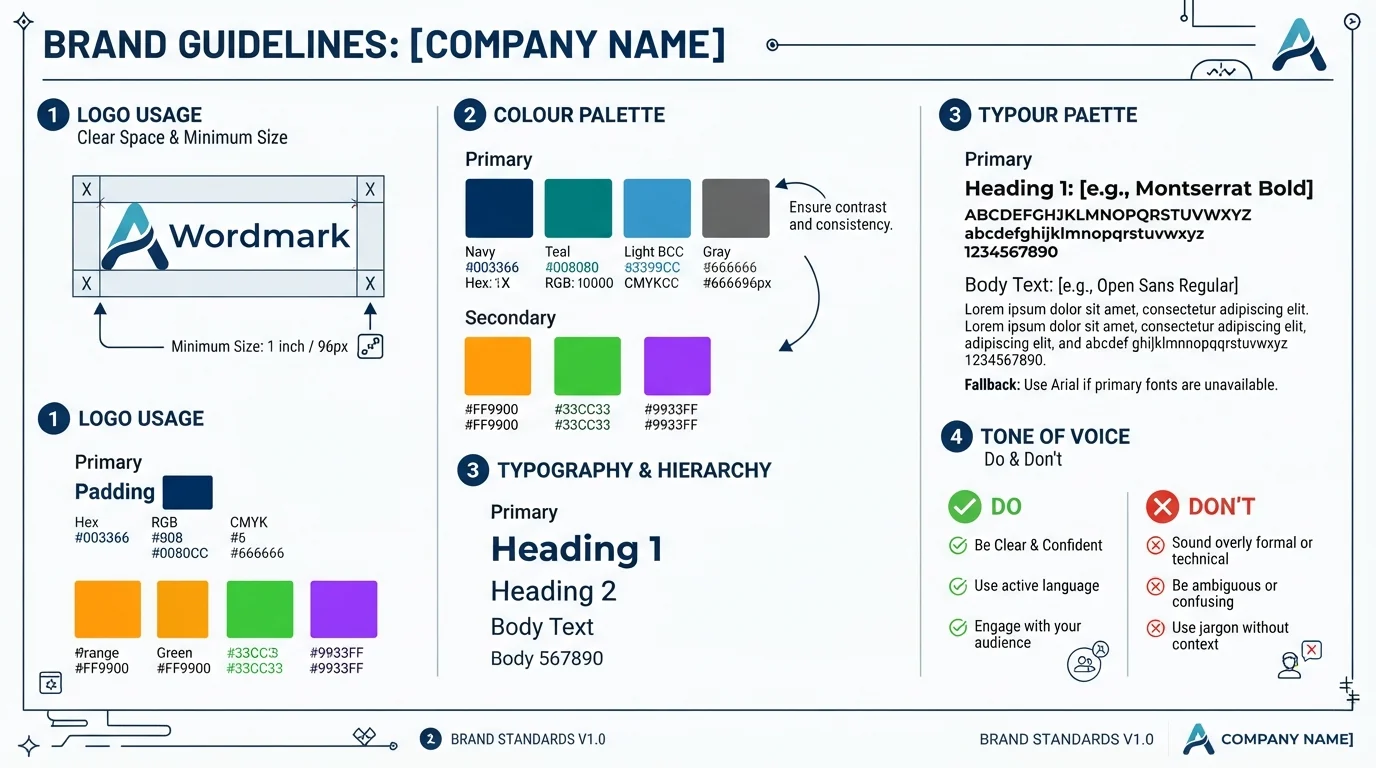
The right contents depend on what your organisation produces. A service consultancy may prioritise proposals and writing style, while a consumer brand may need detailed packaging and photography standards. The following elements form a useful foundation.
Brand purpose, positioning and audience
Begin with a short description of who you serve, what you offer and how you want to be perceived. Include your mission, vision and values when they meaningfully guide decisions.
For example, a renovation business might define its mission as helping homeowners understand project costs before committing. A value such as transparency can then influence quotation templates, website copy and customer service responses.
Avoid inspirational statements that provide no direction. A useful positioning statement should help someone decide whether a proposed campaign fits your business. If every competitor could use the same statement, make it more specific.
Logo versions, spacing and misuse
Include approved primary, secondary, monochrome and reversed logos where those variations exist. Explain which backgrounds suit each version, along with minimum sizes and clear-space requirements.
Clear space is the protected area surrounding a logo. The required amount should come from your approved design specification, not an arbitrary universal measurement. Show examples of stretching, recolouring, distortion and poor placement so suppliers know what to avoid.
Brand colours and accessible combinations
List primary, secondary and neutral colours with the values needed for your production channels. HEX and RGB support digital use; print suppliers may also require CMYK specifications or other production references.
Do not assume a converted CMYK value will reproduce identically on every printer or material. Confirm important printed colours through the relevant supplier and proofing process. Explain which colours are suitable for text, backgrounds, buttons and charts.
For digital text, accessibility belongs in the guide. The Web Content Accessibility Guidelines (WCAG) 2.2 set a Level AA contrast threshold of 4.5:1 for ordinary text and 3:1 for qualifying large text, with specified exceptions. Document approved pairings rather than expecting staff to judge readability by eye.
Typography and layout hierarchy
Specify heading and body typefaces, available weights, fallback fonts and basic size relationships. State where different styles belong, such as reports, presentations, advertisements and web pages.
Check font licensing before sharing files with outside partners. A licence that allows one designer to use a font does not automatically authorise every supplier to install or redistribute it.
Photography, illustrations and icons
Explain which subjects, lighting, compositions and visual treatments suit your brand. A professional services firm might prefer authentic workplace photography, while a children’s product brand may choose illustrations with warmer shapes and brighter colours.
Identify approved image libraries and illustration sets. Include guidance on cropping, overlays, filters and consistent icon weights. If people appear in content, follow applicable permission, privacy and usage requirements instead of assuming that a publicly available photograph is free to reuse.
Show acceptable and unacceptable examples. Phrases such as “modern imagery” are too vague without illustrations of what the organisation means.
Brand voice, tone and messaging
Brand voice describes your consistent communication personality. Tone is how that voice adjusts to the situation. A helpful, confident business may sound celebratory in a product launch but measured and reassuring when responding to a complaint.
Define three or four voice characteristics and translate them into writing instructions. For example, “clear” might mean short sentences, explained technical terms and direct answers. Include wording examples for headlines, emails and customer replies.
Add preferred terminology, spelling conventions and claims that require approval. Businesses communicating across Singapore and other markets should also explain which terms can be localised without changing the core message.
Templates, assets and ownership
Link approved presentation decks, proposal layouts, document headers, social media designs and email signatures. Record where the latest logos, photography and fonts are stored.
Finish with a document owner, version number and review date. These operational details prevent an old PDF from remaining in circulation after a redesign. Keep the authoritative master version easy to identify.
How to Prioritise Brand Guidelines Without Overcomplicating Them
Not every rule needs equal prominence. We recommend a simple Use-Test Decision Matrix to determine which instructions should appear first. This is a practical editorial framework, not an industry-standard scoring model.
Score each element from one to three for frequency of use and from one to three for the impact of getting it wrong. Add the scores to produce a total out of six. The result helps organise the document; it does not measure brand value.
| Guideline element | Frequency | Error impact | Total | Suggested treatment |
|---|---|---|---|---|
| Logo selection | 3 | 3 | 6 | Prominent rules and examples |
| Tone for customer replies | 3 | 3 | 6 | Accessible examples and templates |
| Colour palette | 3 | 2 | 5 | Quick-reference specifications |
| Corporate history | 1 | 1 | 2 | Brief background or appendix |
These sample scores are illustrative. A company handling sensitive customer enquiries may rank tone above logo placement. A packaging manufacturer may prioritise production artwork specifications instead.
For every high-scoring element, ask whether a new employee can apply it without a meeting. Then check whether the supporting files are accessible. Even an excellent rule is ineffective when nobody can locate the approved asset.
How to Create Brand Guidelines Step by Step
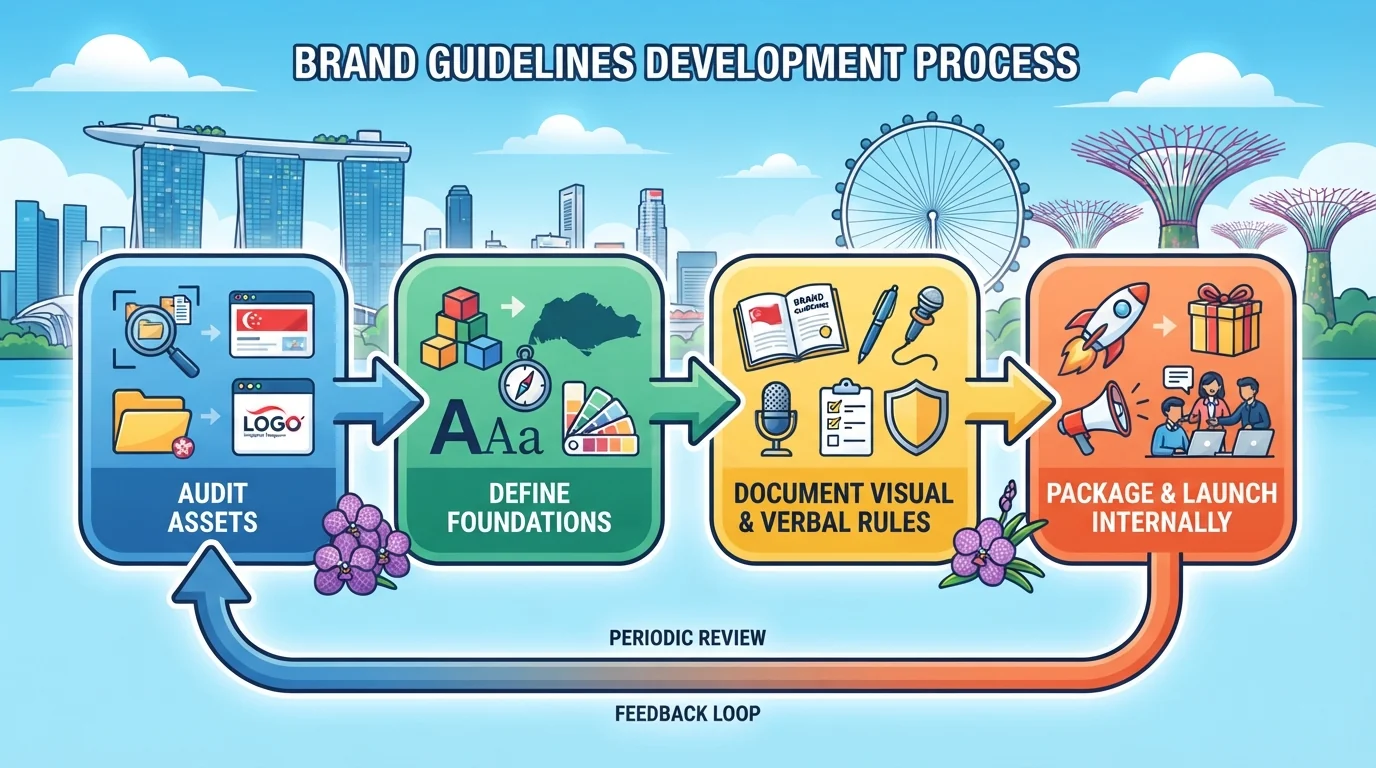
Building a useful guide begins with decisions about your business, not with choosing a presentation layout. Follow this process to turn scattered brand materials into instructions people can apply.
Step 1: Audit your existing brand materials
Collect logos, websites, brochures, business cards, advertisements, email signatures and social media templates. Record the fonts, colour values and messages currently used. Ask employees and suppliers which files they treat as official.
Look for conflicting versions and recurring corrections. You may discover an old logo in proposals or three competing templates for sales presentations. Identify which materials are approved before creating new rules.
Step 2: Clarify your brand foundations
Describe the target audience, the problem your business solves and the qualities customers should associate with it. Review existing positioning with decision-makers rather than inventing a new identity inside the guidelines document.
Keep mission, vision and values concise. For each value, write one example of a decision it should influence. This connects the brand’s stated principles with daily behaviour.
Step 3: Set the essential visual rules
Approve the correct logo variations, colours, typography and image treatments. Specify any technical requirements suppliers need, such as minimum logo size or print-ready file formats.
Use the decision matrix to identify which rules warrant detailed illustrations. Avoid lengthy design theory. People using the guide usually need a definitive answer, not an explanation of every alternative considered during development.
Step 4: Define voice and content standards
Gather real website copy, sales emails and social posts. Identify language that matches your intended personality and examples that do not. Rewrite a few typical messages to demonstrate the difference.
Include guidance for common situations: product descriptions, service enquiries, promotional campaigns and customer complaints. If approvals are required for legal, financial or performance claims, identify who must review them.
Step 5: Choose a usable format
Use a one-page reference for simple operations, a compact PDF for small cross-functional teams or a searchable online guide for organisations with many contributors. The most effective format is the one employees can access while doing their work.
Add links to live templates and assets rather than embedding files that quickly become outdated. Make the first section useful for everyday tasks, then place specialised instructions deeper in the guide.
Step 6: Test the guide before launching it
Give the draft to someone who did not help create it. Ask that person to make a social post, proposal page or customer email using only the document and linked assets.
Observe where questions arise. Missing logo files, unclear colour names and vague voice rules are easier to identify during a real task than during a management review. Improve the guide before distributing it widely.
Step 7: Publish, assign ownership and review
Store the master guide in a shared location with appropriate permissions. Announce where to find it and which old versions should stop being used. Include links in creative briefs and employee onboarding materials.
Assign one person to approve changes, with input from relevant teams. Review the document at least annually and whenever a new channel, product line or visual identity change makes existing instructions incomplete.
Brand Guidelines Template: Choosing the Right Format
A template can save layout time, but it cannot determine your strategy. Whether you use a free download, a paid design file or a custom document, judge it by how clearly it communicates your actual rules.
| Format | Best suited to | Main limitation |
|---|---|---|
| One-page reference | Small teams with a few repeatable assets | Limited space for exceptions |
| Compact PDF | Growing businesses and regular freelancers | Can become outdated when files change |
| Online brand portal | Multiple teams, markets or suppliers | Requires ownership and maintenance |
For a one-page version, include the approved logo, key colour codes, primary typefaces, voice characteristics and links to assets. A fuller guide can add campaign examples, detailed accessibility standards, templates and market-specific adaptations.
Choose editable formats that your team can maintain. A template requiring specialist design software for every small revision may create unnecessary delays.
Tools can make asset access easier. Adobe Express explains how brand kits store logos, colours, fonts and templates. These features support consistency, but the decisions about which assets are correct still belong to your organisation.
Brand Guidelines Examples and What They Teach
Useful examples illustrate different aspects of a branding system. They should inspire practical decisions rather than encourage businesses to copy another company’s identity.
Adobe: Make approved assets easy to use
Adobe Express provides tools for organising brand assets and applying selected colours and fonts to designs. Its brand check documentation also describes a beta feature for checking logos, colours and fonts in a design.
The lesson is operational: provide approved files where content creators already work. Automation may catch certain inconsistencies, but human review remains necessary for tone, context and overall quality.
Singapore Government Design System: Document accessibility
The Singapore Government Design System publishes guidance on typography, accessibility and interface components. Its accessibility guidance addresses contrast, labels, navigation and alternatives for images and media.
A private business need not adopt the government’s visual identity. It can, however, learn from the practice of documenting measurable, reusable design decisions. Accessibility should be built into normal brand rules rather than treated as an optional finishing check.
Your own business: Show genuine usage examples
A familiar brand can be visually recognisable, but recognition alone does not prove which internal guidelines produced it. Rather than attributing success to an unseen manual, collect examples from your own approved website, advertisements and proposals.
Place correct and incorrect treatments side by side. Employees can then see how the guidelines apply to the materials they produce every week. This is often a stronger training resource than a collection of famous logos.
Common Brand Guidelines Mistakes to Avoid
The most frequent problems arise when guidelines are too vague, too difficult to access or disconnected from daily work. Watch for the following warning signs.
-
Writing abstract rules: “Be premium” does not tell a writer what words to choose. Provide observable examples of the intended style.
-
Using incorrect colour conversions: Screen values and print output serve different purposes. Verify important colours in their production context.
-
Ignoring accessibility: Attractive colour combinations can still produce unreadable text. Check contrast and do not communicate essential information through colour alone.
-
Treating every channel identically: Preserve the brand’s identity while adjusting format and tone for the audience and situation.
-
Sharing outdated assets: A guide linking to obsolete folders can spread mistakes faster. Maintain one clear source of approved materials.
-
Overloading the first page: Put common instructions upfront and reserve detailed exceptions for sections where users can find them.
How to Measure Whether Your Brand Guidelines Work
Brand consistency is difficult to assess through a single metric. Instead, evaluate whether the guide improves the accuracy and efficiency of routine production.
Start with a small quarterly sample of published materials. Review logo choice, approved colours, typography, imagery and messaging against the documented rules. Record the types of mistakes, not merely the number.
Track repeated corrections during approvals. If partners regularly use the wrong logo, investigate whether they received the correct link. If several writers misinterpret the voice, revise the examples instead of simply reminding them to follow instructions.
Ask new hires to complete a short brand task without verbal guidance. Note which decisions remain unclear. We favour this test because it reveals whether the document works independently of the people who created it.

Brand Guidelines and Trade Mark Protection in Singapore
Brand guidelines establish internal usage standards. They do not, by themselves, register a business name or logo as a trade mark or grant exclusive legal protection.
The Intellectual Property Office of Singapore explains that registering a business name is not the same as obtaining trade mark protection. It also distinguishes the TM symbol from the registered trade mark symbol, ®, which should only be used when the mark is registered.
If you have registered marks, document the approved presentation and any usage requirements relevant to your business. Ask a qualified adviser about registration and enforcement questions. Brand guidelines support correct application; intellectual property rights are a separate matter.
Turn Your Brand Guidelines Into a Working Business Standard
Effective brand guidelines give people clear decisions, reliable assets and practical examples. Start with the rules used most often, then expand when your business develops new channels or more complex production needs.
For a small Singapore business, we recommend creating a concise guide and testing it on one genuine task before investing in a larger manual. For organisations coordinating several agencies or regional teams, a maintained online system may make access and version control easier.
When your brand standards are ready, apply them consistently across your website, campaigns and customer communications. We can help businesses connect brand direction with their wider digital marketing work, so published materials communicate a coherent identity and support commercial goals.
Frequently Asked Questions
What is the difference between brand guidelines and brand identity?
Brand identity comprises the deliberate visual and verbal elements that express a business. Brand guidelines explain how those elements should be used across different materials and situations.
What should a basic brand guidelines document include?
Include approved logo variations, colour values, typography, imagery direction and tone of voice. Add brief positioning statements, usable templates, asset links and a named document owner.
How long should brand guidelines be?
There is no universal page requirement. A one-page guide may suit a small business, while a company working with many suppliers may need detailed rules and examples.
Can I use a free brand guidelines template?
Yes, provided you can customise it for your actual assets, messaging and workflows. Check whether your team can edit it easily and whether it accommodates examples and links to approved files.
How often should brand guidelines be updated?
Review them at least annually and whenever significant branding, product or channel changes occur. Update unclear rules sooner if repeated production mistakes reveal a problem.
Who should manage brand guidelines?
Assign one accountable owner, typically a marketing lead, brand manager or business owner. Other teams can contribute, but one person should maintain the master version and communicate approved changes.
Do small businesses in Singapore need brand guidelines?
A short guide can help even a small company maintain consistency when staff and freelancers produce content. Start with the assets and messages used most frequently, then add detail as operations become more complex.