AI marketing is the use of machine learning and generative AI to plan, create, deliver and measure marketing work. It can draft copy, predict which customer is likely to buy, or handle repetitive reporting without manual effort.

To start, pick one repetitive, low-risk task, such as resizing images or drafting first-pass captions. Audit the subscriptions your team already pays for, then hand that task to AI with a person checking the result.
Most Singapore businesses do not need more AI marketing tools. They need to decide which recurring tasks go to AI first, and which stay with people. That decision separates teams that save time from teams that pay for overlapping subscriptions.
This guide covers what AI marketing is, how to sequence adoption using the Task Handoff Matrix, the channels that matter locally, and the human checks that protect your brand.
Key Takeaways
- AI marketing is a workflow decision, not a tool purchase. Start with repetitive, low-risk tasks.
- Score each recurring task on repetitiveness and risk before choosing any tool.
- Audit existing subscriptions first. Zapier’s research finds 26% of professionals cite overlapping tools as a barrier.
- Keep pricing, claims and complaints under human approval.
- Measure success by how many recurring tasks you can hand off without losing quality control.
- Chinese or Malay content needs native-speaker review.
The Core Benefits of AI Marketing for Singaporean Businesses
Efficiency gains that leadership expects
Efficiency is the benefit leadership teams already expect. A Fortune/Deloitte survey of CEOs found that 79% say accelerating innovation is a top use case for generative AI. For a small Singapore business with three or four marketers, this case is easier to make in a budget meeting because it points to hours returned to the team. That matters most when a service team is stretched.
The practical gain comes from repetitive production work: resizing assets, drafting first-pass captions for each social media post, and summarising weekly traffic reports. These tasks are frequent, rule-based and low risk when a person checks the result. Teams can automate them, freeing time for judgement-heavy work, such as shaping the brand’s content strategy and planning each campaign.
Growth opportunities and personalised customer experience
Efficiency alone does not grow a business. Personalisation can. Think with Google’s e-Conomy SEA 2025 report counts 243 million people across Southeast Asia using generative AI — 58% of the region’s working population. Many of them see AI-enabled recommendations and personalised feeds as part of that routine. This matters for Singapore retailers selling across Shopee, Lazada, Instagram and WhatsApp, where shoppers compare options quickly. The same recommendations can also support an email follow-up.
The growth gain depends on the data behind the recommendation. A shop with clean purchase history can personalise product suggestions. A shop with fragmented records cannot. Clean customer data is a precondition for this benefit. Check that your data supports the performance you expect before buying a tool.
Measurable cost and time savings
Savings are easiest to prove against a baseline. The Digital Marketing Institute reports that a property company using Wayfarer smart glasses cut its rental turnaround from 4.5 weeks to 2 weeks. This is a large-company case. Treat it as evidence of what automation can do, not as a forecast for a café or a boutique. Other published case studies can help you explore what is possible in your own sector.
Smaller teams should time one recurring task before and after a change. Illustrative example only: a team spending six hours a week on a social report by hand, reduced to two hours after automation, saves four hours a week. Multiply that saving by the team’s hourly cost to compare it against the tool’s price. A practical rule is to set the monthly budget at no more than the value of the hours saved. Measure your own volumes rather than relying on published figures. Review the figures in your own reports to confirm the savings are real.
Risks of overlapping tools and how to avoid wasted spend
Savings disappear when subscriptions overlap. Zapier’s research found that 86% of professionals expect their AI spending to rise. In the same research, 26% already cite overlapping tools as a barrier to value. Two tools that both write captions, or both handle marketing automation, are a common source of this waste.
Before adding any tool, list the tasks it will cover. Check which existing subscription already does them, then cancel the duplicate before the new one starts. This audit protects the budget and makes return on spend easier to read. It also helps you identify which cases deserve paid tools and which can be handled in-house.
Why the next step is matching tasks to tool types
Once the benefits are clear, the question becomes where the savings come from. The answer is the task, not the tool. Each recurring job needs a decision: hand it to AI, have AI assist a person, or keep it with people. The next section scores each task so that tool choice follows from that decision.
AI Marketing Tools by Task: Where Handoff Makes Sense
Most small teams start by asking which tool to buy. A better question is which task to hand off. The Task Handoff Matrix scores each recurring task before any product is chosen, so the choice starts from the job rather than the brand name. Teams that score tasks first avoid buying tools for work that does not need them. Scoring also shows where artificial intelligence can help and where human support is still needed, and the scored records give teams usable insights into which tasks are worth automating, with performance tracked against each decision.
The Task Handoff Matrix: scoring each task
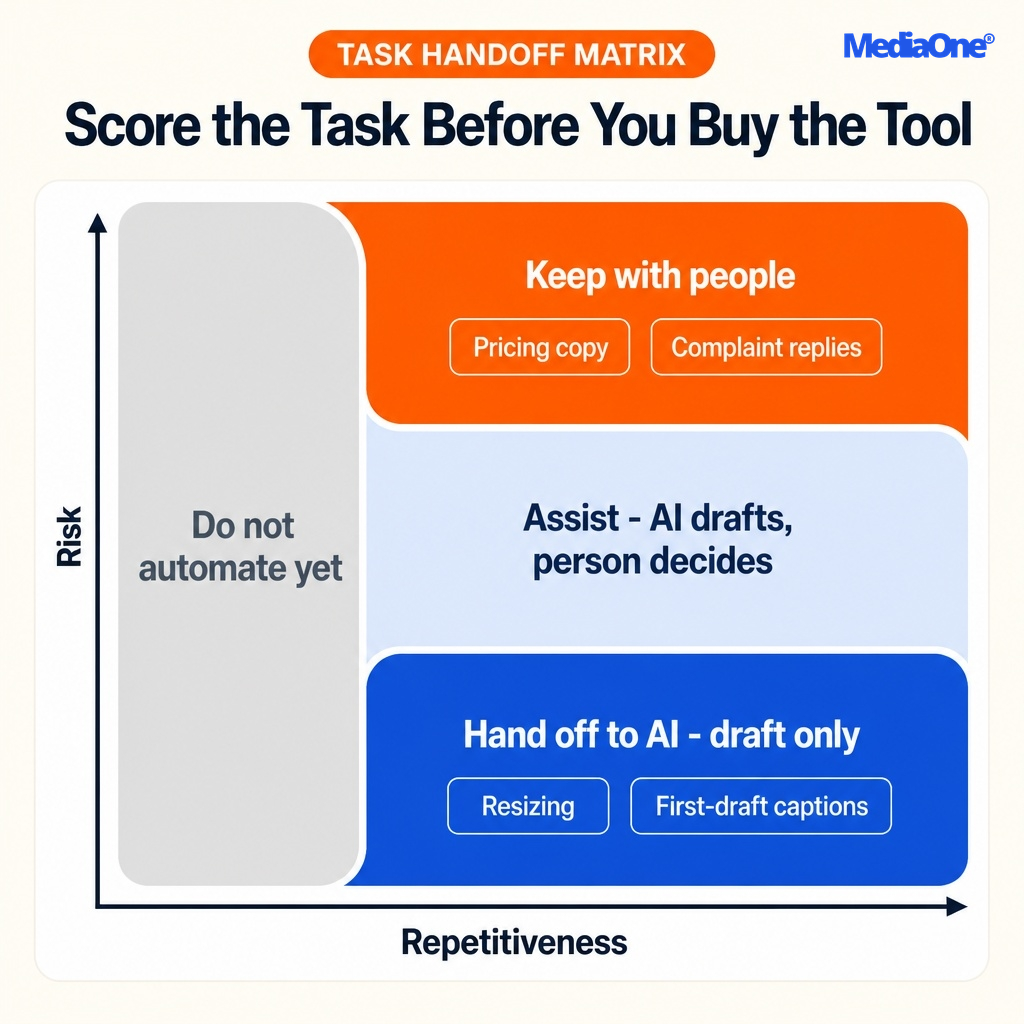
Score every recurring task on two axes, each from 1 to 3. Good data quality in the task records makes the scores more reliable.
|
Score |
Repetitiveness (how often and how alike) |
Risk (cost of a wrong output) |
|
1 |
Occasional, varies each time |
Low: easily fixed, no customer impact |
|
2 |
Regular, partly follows a template |
Medium: visible to customers, quick to correct |
|
3 |
Daily or weekly, rule-based and identical |
High: affects pricing, claims, money or complaints |
Decision bands:
- Hand off to AI (draft only): repetitiveness 3 and risk 1 or 2. A person checks the output before it goes out.
- Assist (AI drafts, person decides): repetitiveness 2 and risk 2.
- Keep with people: risk 3 at any repetitiveness. Pricing, claims and complaint replies stay under human approval.
- Do not automate yet: repetitiveness 1. The set-up effort outweighs the savings.
Worked example: a Singapore café’s Instagram report
A café in Tiong Bahru reports engagement every Monday. The owner spends about six hours a week copying numbers and writing a summary. This is a hypothetical case, and the time figures are not a measured result. The weekly report scores repetitiveness 3 and risk 1, so it is a clear handoff. A tool drafts the summary, and the owner reviews it for ten minutes. Time saved: roughly four hours a week, based on the owner’s own timing. A reply to a late-order complaint scores risk 3 and stays with the owner, so the café can explore a similar split for its own campaigns and brand content, where the cases differ, and the experience of customers stays under human judgement.
Tasks, Not Tools: Where Each Job Fits

The table below lists common recurring tasks, their scores, and the decision band. Tool types appear only as the means of doing the work.
|
Recurring task |
Repetitiveness |
Risk |
Decision |
|
Resizing assets for multiple channels |
3 |
1 |
Hand off to AI, quick review |
|
First-draft captions from a brief |
3 |
1 |
Hand off to AI, person edits for voice |
|
Weekly engagement summary |
3 |
1 |
Hand off to AI, person checks figures |
|
Ad visual variants for testing |
2 |
2 |
Assist, person picks the final |
|
Voiceover for a product walkthrough |
2 |
2 |
Assist, person listens to full output |
|
Pricing and promotion copy |
2 |
3 |
Keep with people |
|
Replies to customer complaints |
2 |
3 |
Keep with people |
Connecting tasks with workflow automation
Marketing automation removes repetitive work across marketing strategy and campaigns. As of late 2025, Zapier could connect ChatGPT with thousands of apps, so a workflow can start from the chat window, according to Zapier. Connector counts and product features change, so confirm current integrations before you plan around them. For example, a new Shopee order can trigger a thank-you message draft. The draft waits for staff approval before sending, which keeps the customer relationship and service quality under control.
Visual and voice tasks in practice
Canva offers millions of templates, from LinkedIn carousels to Instagram Stories, as Zapier notes. Use these for resizing and quick variants across brands. Keep product photography and any price or claim under human sign-off. Feature sets change, so check the current plan before you rely on a specific capability. ElevenLabs’ Voice Design generates custom AI voices using its Text-to-Speech v3 model, as Zapier reports. Listen to every voiceover at full length, since small pronunciation errors in product names are easy to miss.
AI image and video generation in practice
Image and video generation suits variant production, not final brand assets. A team can generate three background options for a product post and pick one, which is an Assist task. A short product clip drafted from a script is a handoff for a first cut, but a person reviews every frame that shows a price or a claim. Product photography of the real item stays with people. Generated visuals that depict the product inaccurately are a risk-3 output and must not go out unchecked.
Content creation and handoff rules
AI content creation covers first drafts, outlines and variants of existing copy. Each has a handoff rule:
- Captions and short posts: hand off the first draft (repetitiveness 3, risk 1). A person edits for brand voice.
- Blog outlines and brief summaries: assist (repetitiveness 2, risk 2). A person chooses the angle.
- Promotion and pricing copy: keep with people (risk 3).
Teams that use AI for content should keep a record of which drafts were edited heavily. Heavy edits signal that the task belongs in the Assist band, not the handoff band.
Choosing tools without buying duplicates
Work through these steps before adding any subscription:
- List every tool your team already pays for, including trials that quietly renewed.
- For each candidate, name the single task it will take over.
- Check whether an existing tool already does that task, even partly.
- Assign one owner who can cancel any tool unused for 30 days. A tool with no logged use in 30 days is a cancellation candidate.
- Set a monthly budget in S$. Calculate it as the team’s hourly cost multiplied by the hours the tool is expected to save each month. Review spend against it each quarter.
Cost brackets vary by vendor and plan, so confirm current pricing on each vendor’s page before budgeting. Audit before you buy, and the budget goes further.
Segmentation, personalisation and forecasting all depend on clean, consistent customer records. Check which audience data you already hold before choosing a tool. A well-maintained content library and reliable records help each tool perform as expected, and keep the insights they produce trustworthy. Good records also mean every campaign’s results can be read clearly, so the marketing strategy improves with each cycle. Teams can also use past cases to see which kinds of tasks have worked well and which have needed heavy correction.

AI-Powered Personalisation, Audience Segmentation and Predictive Analytics
How audience segmentation works with AI
Traditional segmentation groups customers by fixed fields such as age band, postcode or purchase category. AI segmentation looks at many signals at once: browsing paths, order frequency, basket size and response to past messages. It sorts customers by behaviour rather than demographics, which is useful when the same shopper appears under three different names across three channels.
This suits a Singapore SME selling through Shopee, Lazada and its own WhatsApp catalogue. AI can help link those records, but only if the linking is done carefully. A shopper whose records stay unlinked across channels produces a distorted segment, and the model will reflect that distortion.
Start by unifying the customer list before adding any model. Export order data from each channel, match records on phone number or email, and remove duplicates. Groups built on fragmented data will simply reproduce those gaps. Identify the fields that match reliably before building segments on them.
Personalised recommendations and dynamic content
Recommendation engines decide which product, article or offer each visitor sees. Think with Google’s e-Conomy SEA 2025 report counts 243 million GenAI users across the region — 58% of the working population. Shoppers are therefore used to AI-driven experiences, and recommendations work best when they are relevant.
Dynamic content applies the same logic to email subject lines, banners and landing page blocks. Keep the rules simple at first. Swap one block per segment, measure click-through against a control group, and expand only once the lift is clear. Judge each campaign by its performance against that control group, not by how busy the dashboard looks. Marketers at brands can read these results as one input to a wider marketing strategy.
Predictive analytics: forecasting demand and churn
Predictive models estimate what a customer is likely to do next, such as reorder, lapse or respond to a discount. Two uses pay back fastest for small teams: forecasting stock demand for promotional periods, and flagging customers whose purchase gap is growing so a reminder can go out before they leave.
A churn or propensity model learns from past customers. Give it each customer’s order dates, order values, product categories and responses to past offers. Label each customer as stayed or lapsed over a set period. To check the model, hold back a sample of customers it has not seen, predict their behaviour, and compare the predictions with what actually happened.
Three measures show how good the model is. Precision is the share of flagged customers who really lapsed. Recall is the share of all lapsed customers the model caught. Lift compares the hit rate of the top-ranked group with the hit rate of the whole customer list. A model with strong lift in its top decile is worth acting on, even if precision is modest.
Segments also decay. Customer behaviour shifts with seasons, new products and competitor promotions, so a segment that predicted well last year can drift. Re-run the validation every quarter, and rebuild segments when precision or lift falls.
Treat predictions as ranked priorities rather than certainties. A list of the customers most likely to churn is useful even if the model is right only two times in three, because the team can act on the top of the list first. Use the ranked list to direct attention to the highest-priority customers.
Programmatic advertising and why The Economist turned to it
Programmatic advertising uses software to buy ad placements in real time, matching impressions to audience profiles instead of negotiating fixed slots. The Economist offers a useful case. Its audience began to dwindle around 2017, which led it to adopt AI-driven programmatic advertising to reach the readers it still had, as the Digital Marketing Institute reports.
The lesson for smaller firms is that programmatic buying rewards good first-party data. Test with a small daily budget, track cost per qualified visit, and pause segments that do not convert. Early campaigns also show which audiences respond, which sharpens the next round of targeting. Published case studies like this one can help marketers set expectations before they commit budget.
AI Social Media Marketing, Chatbots and Virtual Shopping Assistants
Social media and chat tools are where a small team can hand off the most repetitive work, and where careless automation can damage a brand quickly. Listening and reporting are low-risk. Public replies and complaints should stay with people.
Scheduling is the easiest win. Drafting captions, reformatting one post for Instagram, LinkedIn and WhatsApp Channels, and queuing them is rule-based work. It supports steady content creation without adding headcount.
Listening is where AI earns its keep. A Marketing AI Institute example describes an AI model analysing hundreds of LinkedIn comments in minutes, work that could take a three-person team days by hand. Export your own comments, ask a model to group them into praise, questions, complaints and product requests, then review the groups yourself. The resulting insights feed directly into the next content plan.
AI chatbots as the first point of contact
For most Singapore SMEs, the first point of contact is WhatsApp or Instagram direct messages. A chatbot handles predictable questions well, such as opening hours, delivery areas, stock levels and rebooking. Anything involving a refund, a damaged order or an upset customer should pass to a person within the same thread.
Set the handoff rule before launch. If a wrong answer would cost money or trust, the bot escalates. A rising escalation rate usually means the knowledge base is out of date.
Virtual shopping assistants and voice commerce
Voice is changing how people find products. According to the Digital Marketing Institute, some 60 million adults use voice search at least once a day. Voice queries run longer and are more conversational. A query such as “where can I buy vegan bento boxes near Tanjong Pagar” is a typical example, and keyword plans built on short typed phrases tend to miss it.
Write product and FAQ pages the way people speak. Give plain answers to “what”, “where” and “how much” questions, and keep prices and stock current. A voice assistant reads one answer aloud and rarely offers a list.
Tracking AI chatbot referral traffic
Visits from AI assistants now appear in analytics, but many teams do not separate them. Zapier notes that Similarweb offers an AI Chatbot Traffic report that identifies which generative AI chatbots are driving traffic to a site, as of its current product documentation (checked 2026). Create a segment for these referrers, record the landing page and conversion rate, and review it monthly. To win that traffic in the first place, read our guide to getting your brand recommended by ChatGPT, Gemini and Perplexity.
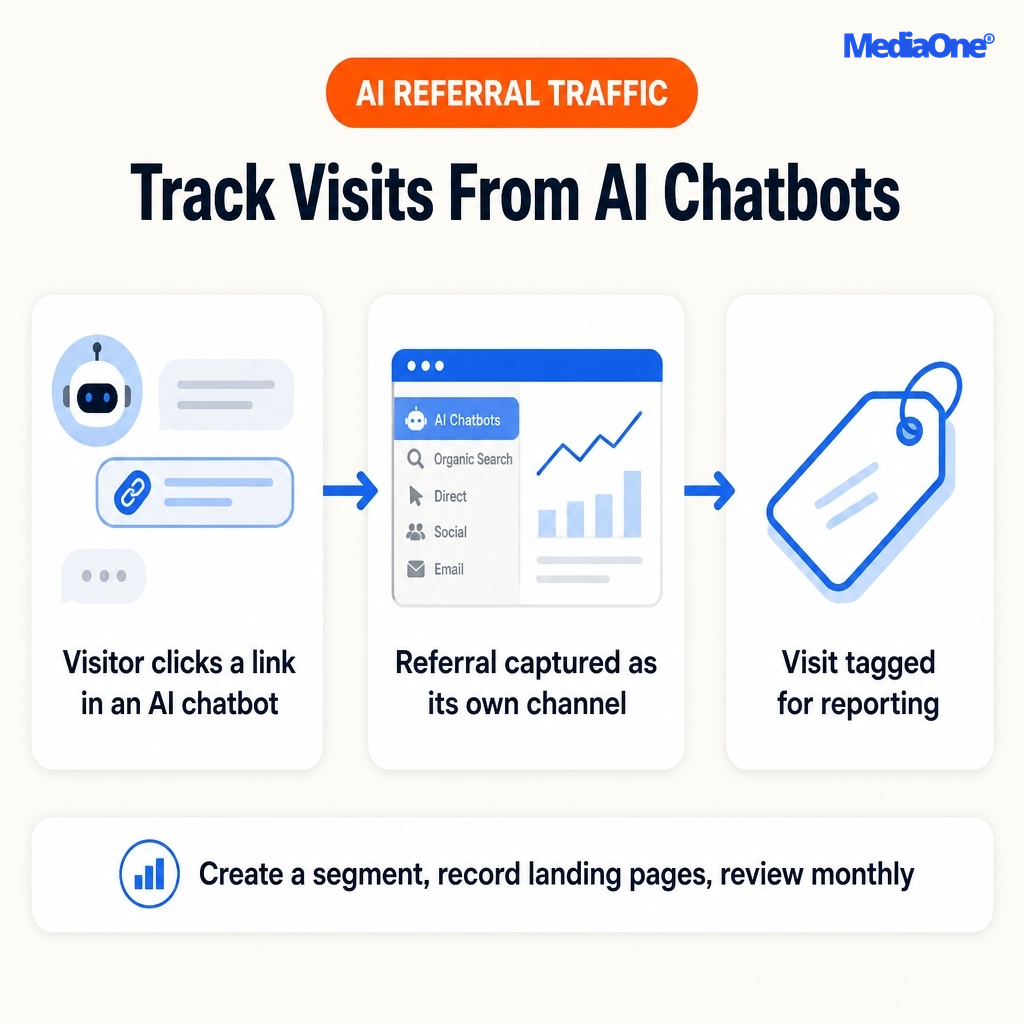
Volume will often be small for a local business, so judge the segment by quality rather than size. A handful of visits that convert to bookings is worth more than a spike of bounces.
A Step-by-Step Framework for Launching AI Marketing in Your Business
Most small businesses that struggle with AI marketing do not lack tools. They buy too many, automate the wrong tasks, and cannot tell whether anything improved. The six steps below run in order, so every purchase is tied to a measurable result. Marketers and support teams can follow this sequence without specialist technical knowledge.
Step 1: Audit current marketing processes and data
List every recurring task in a typical month, such as captions, resized banners, weekly reports and product listings for Shopee or Lazada. Note who does each one, how long it takes and where the source data lives. Poor data quality causes rework later, so fix data gaps first. Reviewing past campaigns and customer experience feedback at this stage helps you identify which recurring tasks drain the most time.
Step 2: Pick one measurable use case
Choose a single task with a clear before-and-after number, such as hours spent on weekly reporting. One use case gives you a result you can defend to leadership. Track the performance of that one task so the result is easy to judge.
Step 3: Choose tools and check for overlap
Before buying, check what you already pay for. Zapier’s research found that 86% of professionals expected AI spending to rise over the next year, yet 26% cite overlapping tools as a barrier to value. Where possible, connect tools rather than adding new ones. Zapier can link ChatGPT with thousands of apps, so a workflow can run from one place. Connector counts and product features change, so confirm the current figure before you buy.

Step 4: Set guardrails for data, brand voice and disclosure
Write three rules before the pilot starts: what customer data may enter an artificial intelligence tool, the brand voice the output must match, and which outputs need human approval before publishing. Chinese or Malay content needs a native-speaker review, because AI drafts can miss tone and idiom. These guardrails protect the brand’s service standards and reputation.
Step 5: Run a pilot and measure against a baseline
Run the chosen use case for four to six weeks and compare it with your Step 1 numbers. Record time saved, output volume and any change in quality or customer response. If the gain is small or quality dropped, adjust or stop. A pilot without a baseline proves nothing.
Step 6: Scale, retrain staff and review quarterly
Expand only the workflows that passed the pilot. Retrain staff, redirect time saved toward strategy and customer work, and review the tool stack each quarter to remove anything unused. Quarterly reviews keep the stack lean and show which tools still earn their cost. Use the quarterly insights from each review to decide what to keep.
Putting AI Marketing to Work in 2026
The businesses that gain most from AI marketing in 2026 will not have the longest tool list. Start with the Task Handoff Matrix, delegating high-repetition, low-risk tasks first, and keep pricing, brand claims and complaints with people.
Measure the whole effort the same way you measured the pilot: set up conversion tracking so every handed-off task is judged on outcomes, not activity.
Frequently Asked Questions
What is AI marketing?
AI marketing uses machine learning and generative tools to plan, create, deliver and measure marketing work. It can draft copy, resize images, sort customers into groups, forecast demand and answer customer questions. The useful question is not whether a business uses AI, but which recurring tasks it hands off. Start with repetitive, low-risk work, then keep strategy and brand judgement with people.
How much does AI marketing cost for a small business in Singapore?
Costs vary widely, so set a budget by task rather than by tool. Many entry-level subscriptions for writing, design or automation carry modest monthly fees. The hidden cost is paying for overlapping tools. Zapier’s research found that 26% of professionals already cite overlapping tools as a barrier to value. Audit what you already pay for before you add anything new, and check each price on the vendor’s own page. Prices change, so confirm them before you commit.
Which AI marketing tools should a beginner start with?
Begin with one tool for content drafting and one for design or asset resizing. These are high-repetition, low-risk tasks. Canva, for example, offers a large library of templates for formats ranging from LinkedIn carousels to Instagram Stories (Zapier). Add an automation tool once you have a clear workflow to connect. Pick the tool your team will use every week.
Will AI replace marketers?
AI is more likely to change the shape of marketing roles than to remove them. Paul Roetzer of the Marketing AI Institute argues that future work may centre on three emerging roles: the architect, the orchestrator and the apprentice (Marketing AI Institute). Staff who set strategy, check brand quality and direct tools will remain essential. Routine production is what shrinks first.
How do I measure whether AI marketing is working?
Measure against a baseline taken before you start. Record how long a task took and what it cost, then compare the same metrics after the pilot. For a clearer picture, track referral traffic from AI chatbots. Similarweb offers an AI Chatbot Traffic report that identifies which generative AI chatbots are driving traffic to a site (Zapier). Review results quarterly and drop any tool that does not move a metric you care about. Whether savings appear depends on how much each team uses a tool, so measure your own usage rather than assuming a result.