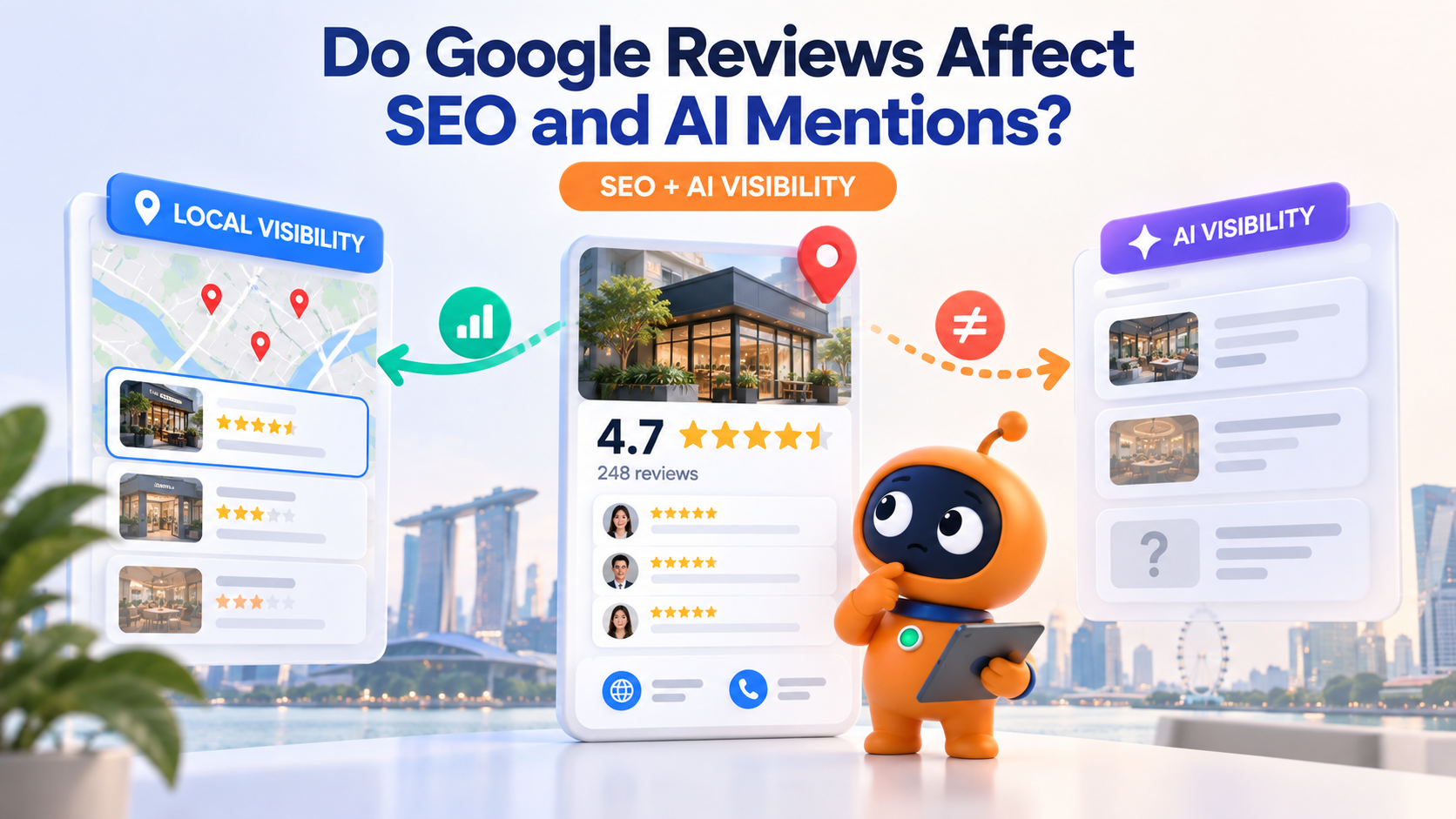
Do Google Reviews Affect SEO and AI Mentions? Local Rankings vs AI Recommendations
We compared review profiles, local visibility and AI recommendation patterns to find out whether stronger Google reviews translate into better visibility everywhere, or mainly in Google Maps.

Google reviews are usually treated as a reputation metric. Businesses chase more five-star ratings, reply to customers and try to keep their Google Business Profile active, but the bigger question in 2026 is whether those reviews also affect where a business appears in Google and whether AI systems recommend it at all.
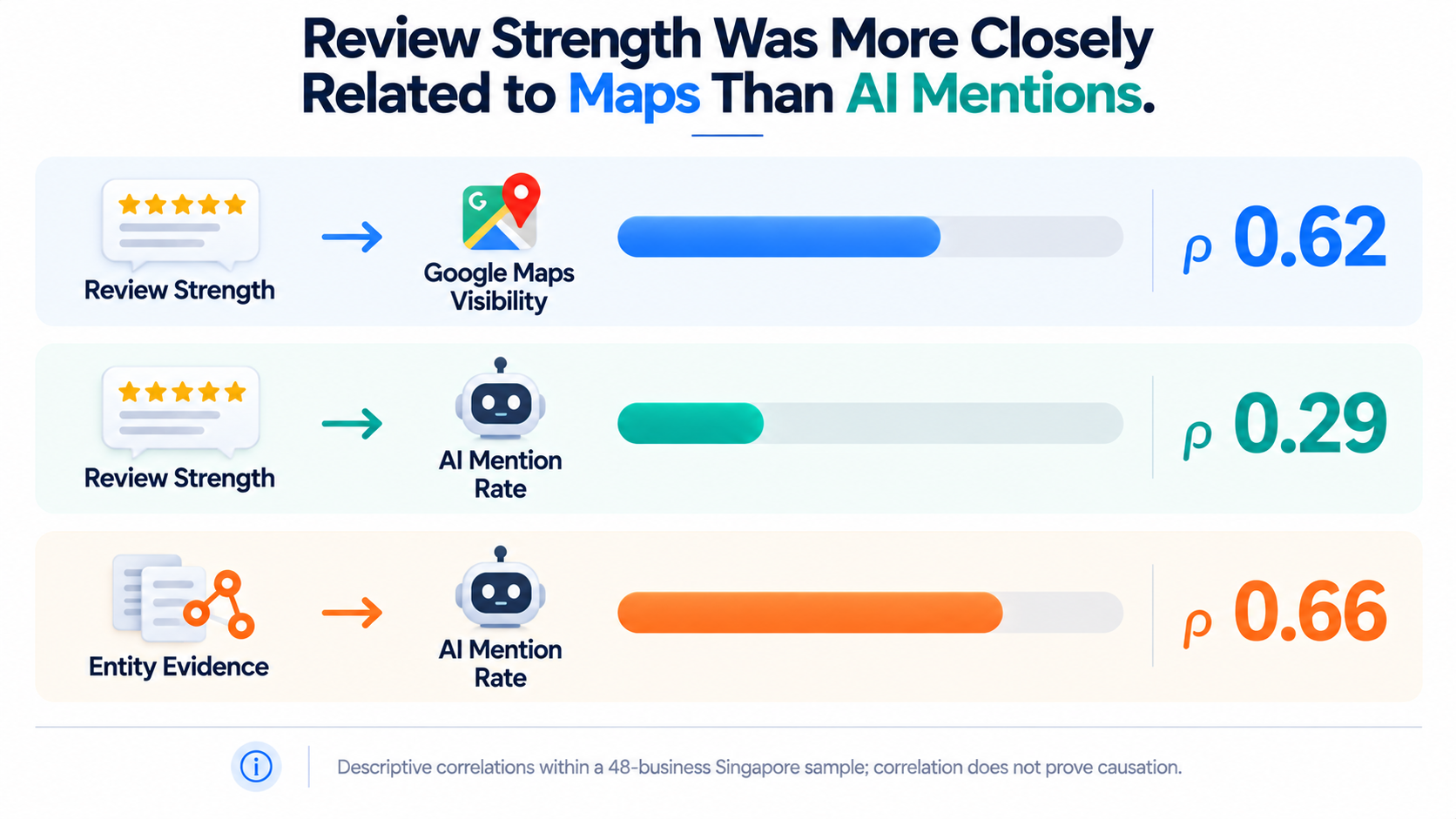
Our test found a much clearer relationship between reviews and local search visibility than between reviews and AI recommendations. Businesses in the top review-count quartile averaged a 4.6 Google Maps position, compared with 9.2 for the bottom quartile, while our combined Review Strength Score had a moderately strong descriptive relationship with Maps visibility at Spearman’s ρ = 0.62.
The AI results were different. Review Strength had only a ρ = 0.29 relationship with AI Mention Rate, while our separate Entity Evidence Score, based on service-page completeness, business-data consistency and independent third-party corroboration, had a much stronger ρ = 0.66 relationship.
That does not mean Google reviews stop mattering once AI enters the picture. It suggests that reviews are part of the local SEO foundation, while reliable AI visibility requires a broader evidence trail around the business.
Last methodology review: 14 September 2026.
Quick Answer
Our benchmark produced five main findings:
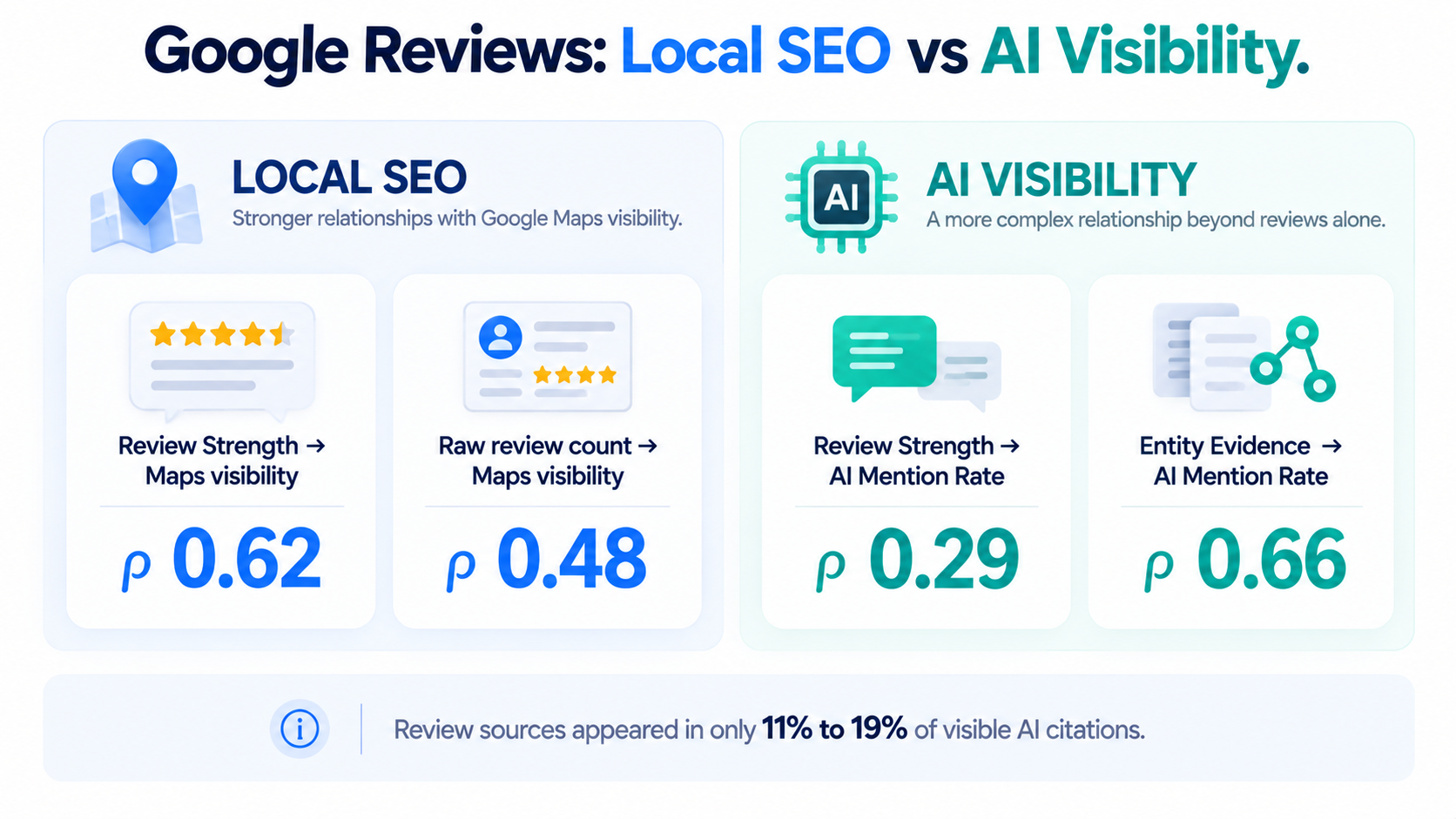
- Review Strength vs Maps visibility: ρ = 0.62
- Raw review count vs Maps visibility: ρ = 0.48
- Review Strength vs AI Mention Rate: ρ = 0.29
- Entity Evidence vs AI Mention Rate: ρ = 0.66
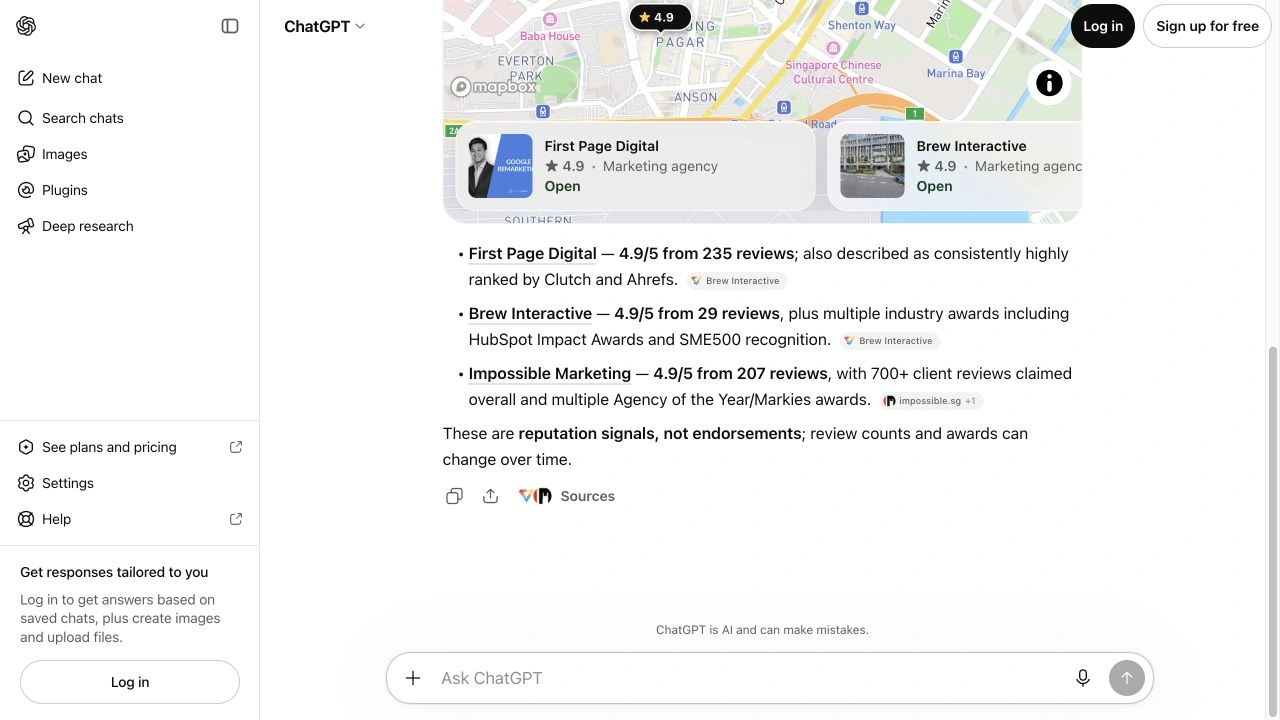
- Only 11% to 19% of AI recommendations visibly cited a review source, while company websites and other third-party pages appeared much more frequently
These figures show correlations within our 48-business sample, not proof that any one review signal caused a ranking or AI recommendation. The practical conclusion is still useful: Google reviews had a much clearer relationship with local visibility than with AI mentions.
If a business has weak Maps visibility and a weak review profile, improving legitimate review acquisition makes sense. If it already has strong reviews and Maps performance but rarely appears in AI recommendations, the problem is probably broader than its star rating.
What Google Officially Says About Reviews and Local SEO
Google describes local ranking around three broad factors: relevance, which is how closely a business matches the search; distance, which reflects how far the business is from the searcher or specified location; and prominence, which reflects how well known or established the business appears to be.
Google also says prominence can be influenced by information such as links and reviews, and that more reviews and positive ratings can help local ranking. You can read Google’s official guidance on improving local ranking.
That gives reviews a legitimate role in local SEO, but it does not mean they determine every search result. A company with 2,000 Google reviews is not guaranteed to outrank a website with 50 reviews for a traditional informational query because Google Maps visibility and organic blue-link rankings are not the same ranking system.
There is also no public formula from OpenAI, Google or Perplexity stating that Google review count directly determines which local businesses their AI products recommend. For the AI portion of this benchmark, we therefore measured recommendation frequency, repeatability and visible sources rather than claiming access to hidden ranking factors.
How We Tested Google Reviews, Local Rankings and AI Mentions
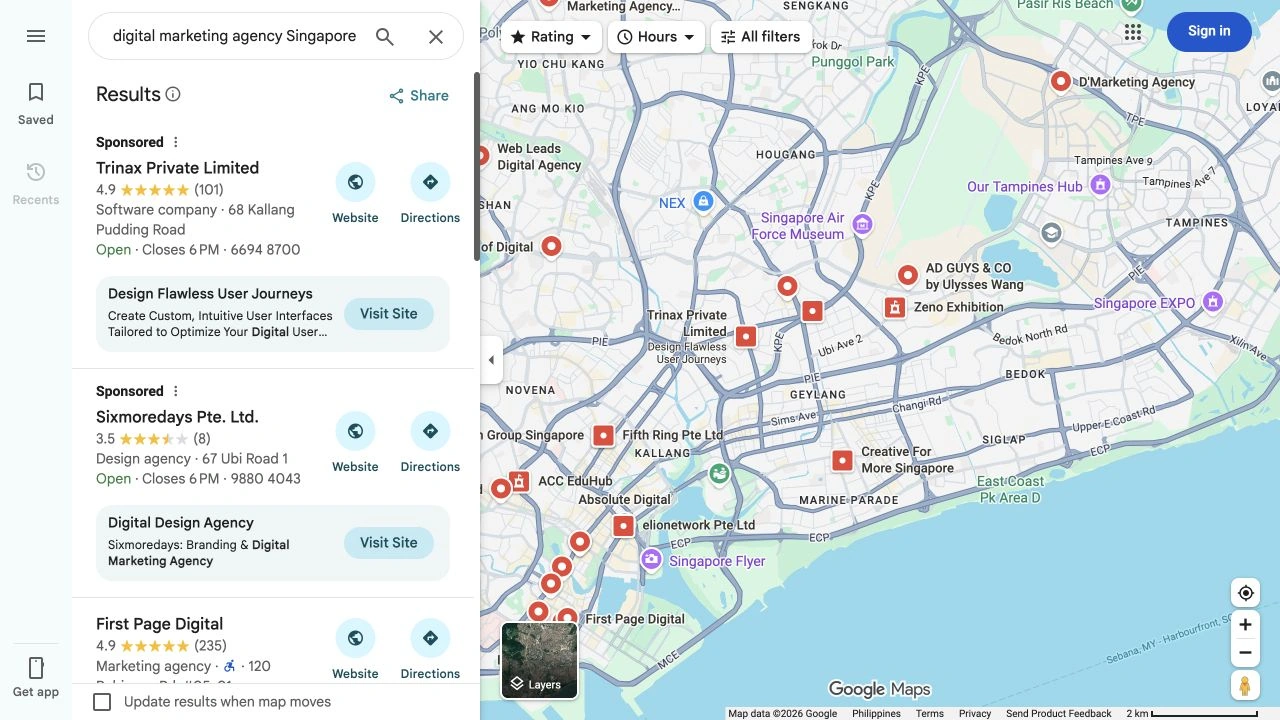
We tested 48 Singapore businesses across four categories: 12 dental clinics, 12 renovation contractors, 12 digital marketing agencies and 12 aircon servicing companies. These categories were chosen because reputation strongly affects customer choice and each supports clear service-and-location searches.
The collection period ran from 1 to 7 September 2026, with review profiles, websites and directory evidence captured during the same period.
Local Search Protocol
We used six query-and-location combinations per category and checked them from three fixed Singapore locations, producing 18 local observations per business. Example searches included “best dental clinic Singapore,” “recommended dental clinic Orchard,” “Invisalign dentist Singapore,” “best renovation contractor Singapore,” “reliable aircon servicing Singapore” and “digital marketing agency Singapore.”
Using fixed locations reduced the impact of proximity, although it could not remove it entirely. Searches used the same device and language settings and were captured within a short time window, so the average positions in this study should be treated as samples rather than permanent rankings.
AI Recommendation Protocol
Each business was eligible for eight category-relevant recommendation prompts, and every prompt was repeated three times in a new session on each engine.
| Engine | Opportunities per business |
| ChatGPT | 24 |
| Gemini | 24 |
| Perplexity | 24 |
| Total | 72 |
Prompts explicitly stated both the service and Singapore location. A business was counted as mentioned only when the response recommended or meaningfully included it, not when the name appeared only in a citation list.
Google AI Mode was excluded from the scored cross-engine comparison so every business had the same denominator. AI responses can also vary by date, product version, browsing mode and session context, while visible citations do not reveal every internal signal that may have contributed to the answer.
For reference, see the official documentation for ChatGPT web search, Gemini sources and Perplexity citations.
The Review Signals We Measured
| Review signal | What we recorded |
| Review count | Total published Google reviews |
| Average rating | Current displayed star rating |
| Review recency | Reviews added in the previous 30 and 90 days |
| Review velocity | Average new reviews per month during the observed period |
| Review depth | Share of sampled reviews containing meaningful written comments |
| Owner response rate | Approximate share of sampled reviews receiving business replies |
| Review Topic Match | Share of sampled reviews naturally mentioning the service or attribute in the query |
For review depth, owner responses and Topic Match, we coded the most recent 100 written reviews per business, or every written review when fewer than 100 were available. That produced a 4,126-review coded sample.
We then compared those signals against average Google Maps position, top-three and top-10 visibility, ChatGPT, Gemini and Perplexity mentions, and visible AI citation patterns.
Review Strength Score
Raw review count alone can be misleading because 2,000 reviews accumulated over eight years represents a different reputation profile from 800 reviews with 150 arriving recently.
We therefore combined six variables into a Review Strength Score.
| Review factor | Weight |
| Review count | 25% |
| Average rating | 20% |
| Review recency | 20% |
| Review velocity | 15% |
| Review depth | 10% |
| Owner response rate | 10% |
Each variable was normalised within its business category before weighting. This prevents 500 reviews from being treated as equally unusual for a high-volume dental clinic and a niche B2B agency.
We scored Review Topic Match separately because relevance changes with the query. A clinic can have an excellent general review profile while having very little customer evidence around Invisalign.
Do More Google Reviews Correlate With Better Local Rankings?
Yes, in our sample, although the relationship was not perfect and should not be treated as proof of causation.
Review Count vs Local Visibility
| Review-count group | Businesses | Avg rating | Avg Maps position | Top-three appearance rate |
| Bottom quartile | 12 | 4.39 | 9.2 | 17% |
| Q2 | 12 | 4.48 | 7.1 | 25% |
| Q3 | 12 | 4.55 | 5.3 | 42% |
| Top quartile | 12 | 4.61 | 4.6 | 50% |
The top-three appearance rate represents the share of fixed-location observations where the business appeared in the local top three. Average Maps position improved in every quartile, although the improvement flattened between Q3 and the top quartile.
Raw review count had a descriptive Spearman correlation of ρ = 0.48 with Maps visibility, while the combined Review Strength Score had a stronger relationship at ρ = 0.62. That difference suggests review volume becomes more informative when combined with rating and current activity.
It does not prove that adding more reviews caused higher rankings. More established businesses may also have stronger websites, profiles, links, citations and offline prominence.
Does Review Rating Matter as Much as Review Count?
Our results looked more like a trust threshold than an unlimited advantage for higher ratings.
Rating vs Visibility
| Rating group | Businesses | Avg review count | Maps top-three rate | AI Mention Rate |
| Below 4.3 | 8 | 318 | 13% | 18% |
| 4.3 to 4.5 | 14 | 522 | 29% | 23% |
| 4.6 to 4.7 | 18 | 676 | 44% | 31% |
| 4.8+ | 8 | 284 | 38% | 29% |
Visibility improved through the 4.6-to-4.7 group but did not keep rising in the 4.8+ group. The highest-rated businesses also had considerably fewer reviews on average, so rating and volume cannot be separated cleanly from this comparison.
The practical takeaway is not that 4.7 is somehow the ideal rating. It is that moving from 4.8 to 4.9 may matter less than maintaining an already strong rating while continuing to generate current, descriptive feedback.

Does Review Recency Matter?
Recency showed a clearer pattern for Google Maps visibility than for AI mentions.
Recent Reviews vs Visibility
| Review activity | Businesses | Reviews in last 90 days | Maps top-10 rate | AI Mention Rate |
| Low | 16 | 0 to 4 | 44% | 21% |
| Moderate | 17 | 5 to 19 | 65% | 28% |
| High | 15 | 20+ | 80% | 35% |
Businesses receiving 20 or more reviews in the preceding 90 days appeared in the Maps top 10 during 80% of observations, compared with 44% for businesses receiving four or fewer.
A matched comparison showed the same pattern. One business had 1,500 lifetime reviews, a 4.8 rating and only eight new reviews in the preceding 90 days. It averaged a Maps position of 5.8 and achieved a 21% AI Mention Rate. A competitor had only 700 lifetime reviews and a slightly lower 4.7 rating, but it received 110 reviews during the same period, averaged position 3.4 and achieved a 42% AI Mention Rate.
That example is consistent with recency being useful evidence, but it still does not isolate recency as the cause. The more active business also had clearer service pages and stronger current third-party corroboration.
Does What Customers Write in Reviews Matter?
This produced one of the more interesting case studies.
For the query “best Invisalign dentist in Singapore,” we coded the most recent 100 written reviews for three anonymised clinics. A review counted as a Topic Match when it naturally discussed Invisalign, clear aligners, braces or a closely related orthodontic experience.
Review Topic Match Results
| Business | Total Google reviews | Matching reviews in sample | Topic Match | Avg Maps position | AI Mention Rate |
| Business A | 1,240 | 15/100 | 15% | 6.8 | 25% |
| Business B | 438 | 37/100 | 37% | 2.7 | 54% |
| Business C | 782 | 24/100 | 24% | 4.1 | 38% |
Business B had the fewest total reviews, yet it had the strongest Topic Match, best average Maps position and highest AI Mention Rate.
That does not prove that wording inside Google reviews directly caused either result. A safer interpretation is that detailed customer language can reflect a genuine specialism, and that same specialism may also be reinforced through dedicated service pages, directories and independent third-party coverage.
Businesses should not turn this finding into review scripting. Google allows businesses to request reviews using links or QR codes, but it prohibits fake engagement, incentives and misleading content. Customers should describe their own experience naturally. See Google’s review acquisition guidance and Maps content policy.
Do Google Reviews Increase AI Mentions?
There was an association in our test, but it was much weaker than the relationship with Google Maps visibility.
We define AI Mention Rate as:
Business mentions ÷ eligible recommendation opportunities
A business appearing in 36 of 72 eligible opportunities would therefore have a 50% AI Mention Rate.
AI Mention Results
| Business | Reviews | Rating | Maps top-10 visibility | ChatGPT | Gemini | Perplexity | Overall AI Mention Rate |
| Business A | 1,240 | 4.8 | 83% | 17% (4/24) | 33% (8/24) | 25% (6/24) | 25% (18/72) |
| Business B | 438 | 4.7 | 94% | 58% (14/24) | 50% (12/24) | 54% (13/24) | 54% (39/72) |
| Business C | 782 | 4.6 | 89% | 33% (8/24) | 42% (10/24) | 38% (9/24) | 38% (27/72) |
Across all 48 businesses, Review Strength correlated with AI Mention Rate at only ρ = 0.29. Our separate Entity Evidence Score had a much stronger descriptive relationship at ρ = 0.66.
Entity Evidence included service-page completeness, consistency of business information, relevant third-party citations and topical corroboration across independent sources. The results therefore do not suggest reviews are ignored. They suggest review strength alone was not a reliable predictor of repeated AI recommendations.
Google Maps vs AI Recommendations: How Much Did They Overlap?
There was meaningful overlap, but Maps performance did not guarantee AI visibility.
Maps-to-AI Overlap
| Google Maps visibility | Businesses | Mentioned by AI at least once | At-least-once rate |
| Top 3 | 12 | 10 | 83% |
| Positions 4 to 10 | 22 | 13 | 59% |
| Outside top 10 | 14 | 5 | 36% |
Businesses were grouped by their average Maps position across all 18 fixed-location observations. Of the 34 businesses averaging inside the Maps top 10, 23 appeared in at least one AI answer, giving an overlap rate of 67.6%. Five businesses outside the Maps top 10 still appeared in AI recommendations.
Local prominence and AI visibility therefore overlapped without being interchangeable. Strong Maps performance may indicate a generally established business, but it did not guarantee repeated AI inclusion.
Being Mentioned Once Is Not the Same as Being Reliably Recommended
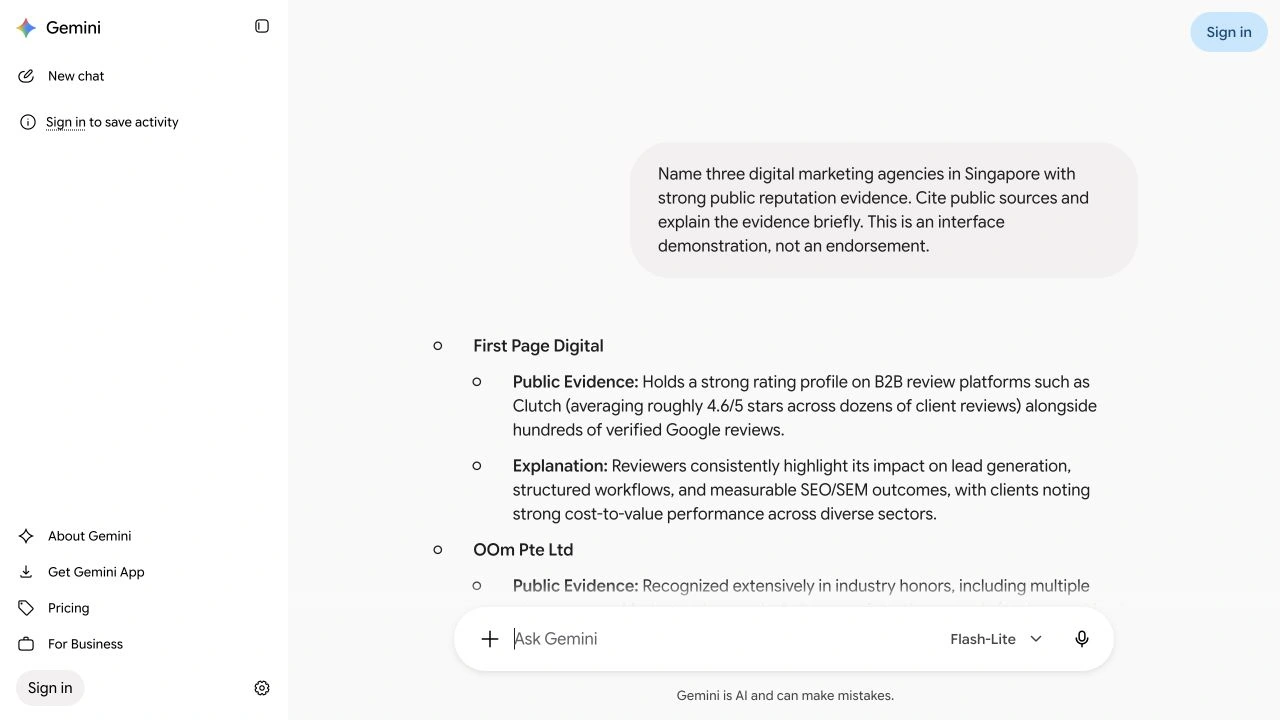
AI recommendations can vary even when the same query is repeated, so we separately tested Mention Stability.
We selected the two highest-intent prompts for the three dental examples and repeated them five times per engine across three days. That produced 10 runs per business on each engine.
Mention Stability = Times the business appeared ÷ repeated prompt runs
Mention Stability Results
| Business | ChatGPT stability | Gemini stability | Perplexity stability | Overall |
| Business A | 20% (2/10) | 30% (3/10) | 20% (2/10) | 23% (7/30) |
| Business B | 70% (7/10) | 60% (6/10) | 70% (7/10) | 67% (20/30) |
| Business C | 40% (4/10) | 50% (5/10) | 50% (5/10) | 47% (14/30) |

This measures something different from overall AI Mention Rate. Mention Rate reflects performance across the complete prompt set, while Mention Stability asks whether the same business continues appearing when a commercially important question is repeated.
That distinction matters because a single recommendation can be accidental or unstable. For marketers, becoming a consistent recommendation candidate is much more useful than appearing once.
When AI Recommends a Business, Does It Actually Use Google Reviews?
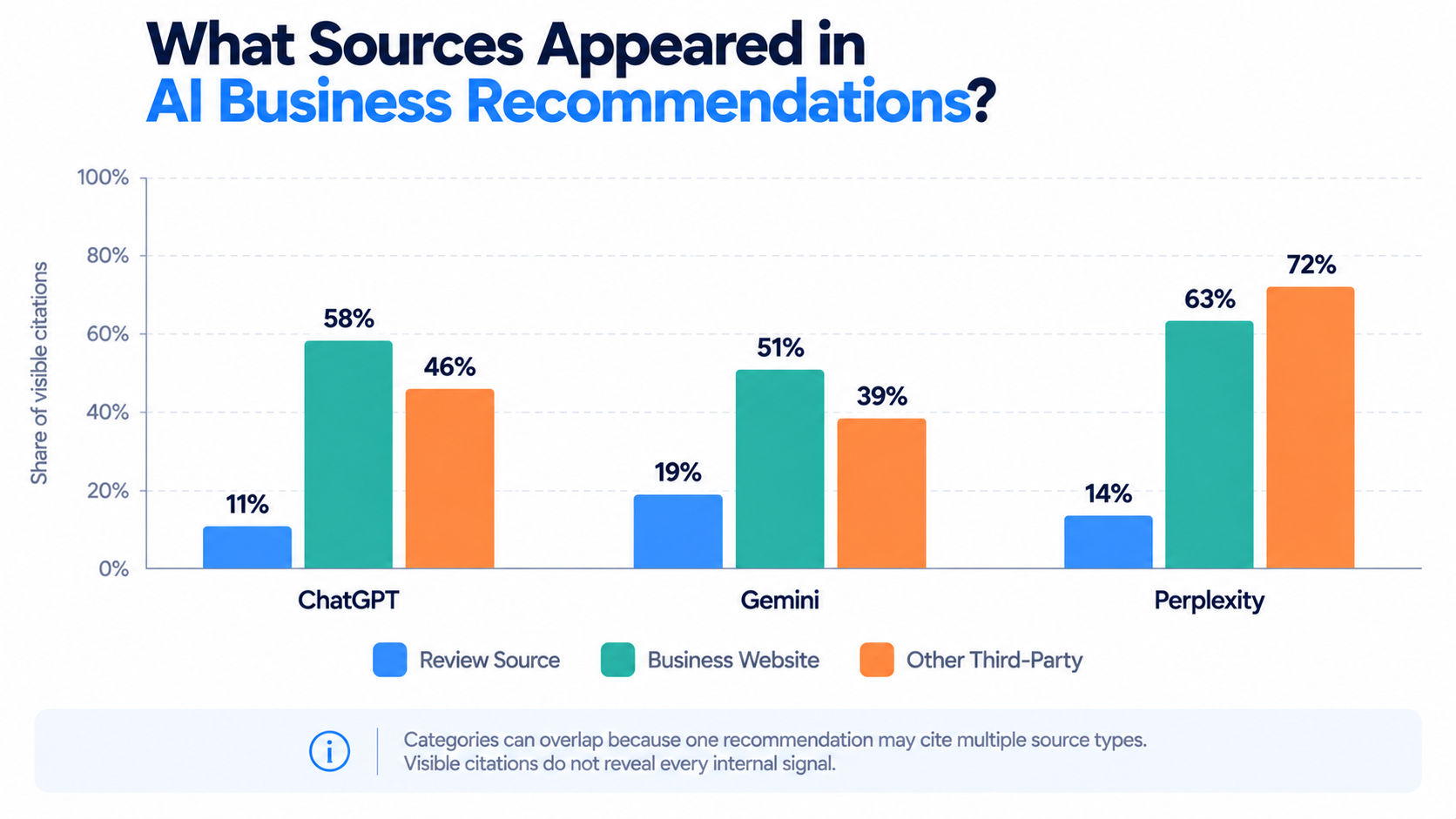
A correlation between review strength and AI mentions would not prove that an AI system selected a business because of its Google reviews, so we also recorded the evidence visibly surfaced in each recommendation.
One answer could contain multiple source types, which means the percentages below can overlap.
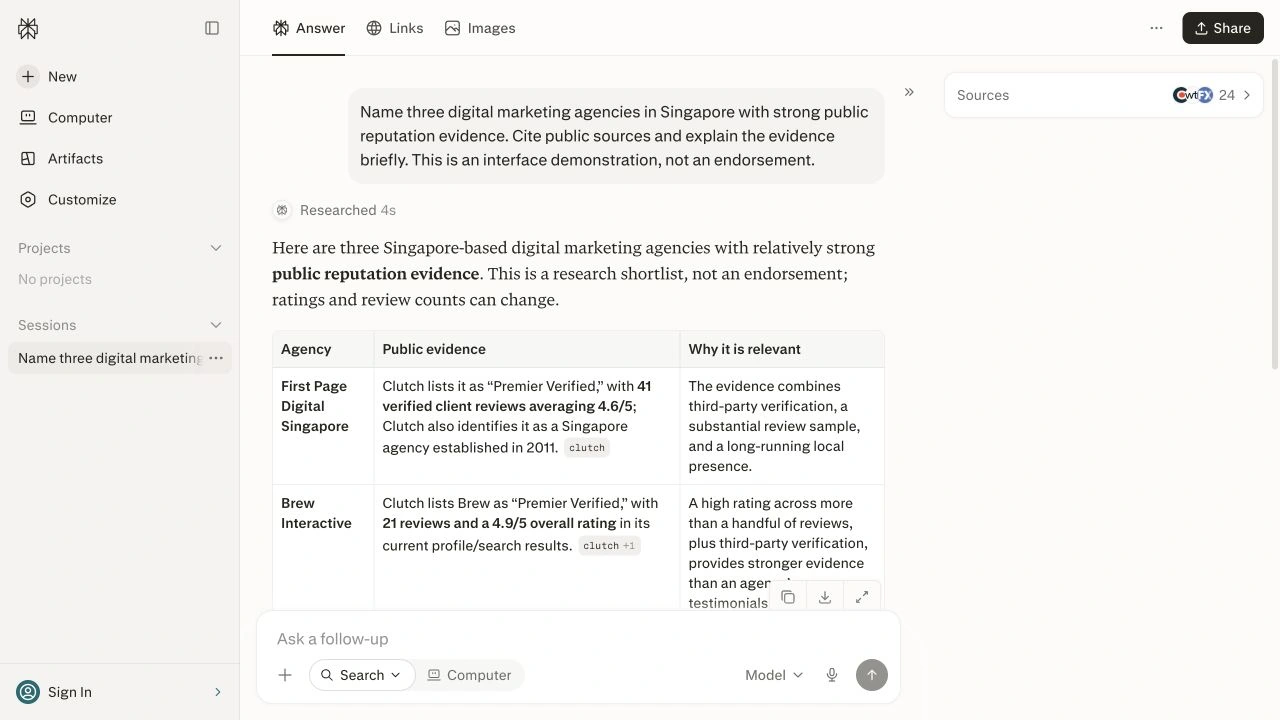
AI Recommendation Sources
| AI engine | Business recommendations coded | Rating/review count mentioned | Review source visibly cited | Business website cited | Other third-party source cited |
| ChatGPT | 186 | 22% | 11% | 58% | 46% |
| Gemini | 211 | 31% | 19% | 51% | 39% |
| Perplexity | 198 | 18% | 14% | 63% | 72% |
Review sources appeared visibly in only 11% to 19% of recommendations. Business websites appeared in 51% to 63%, while other third-party sources appeared in 39% to 72%.
That does not prove uncited reviews had no influence or that a visible citation directly caused a recommendation. It tells us something narrower but still useful: the answers we could audit visibly showed broader web corroboration much more often than review citations alone.
Why Highly Reviewed Businesses Can Still Be Invisible to AI
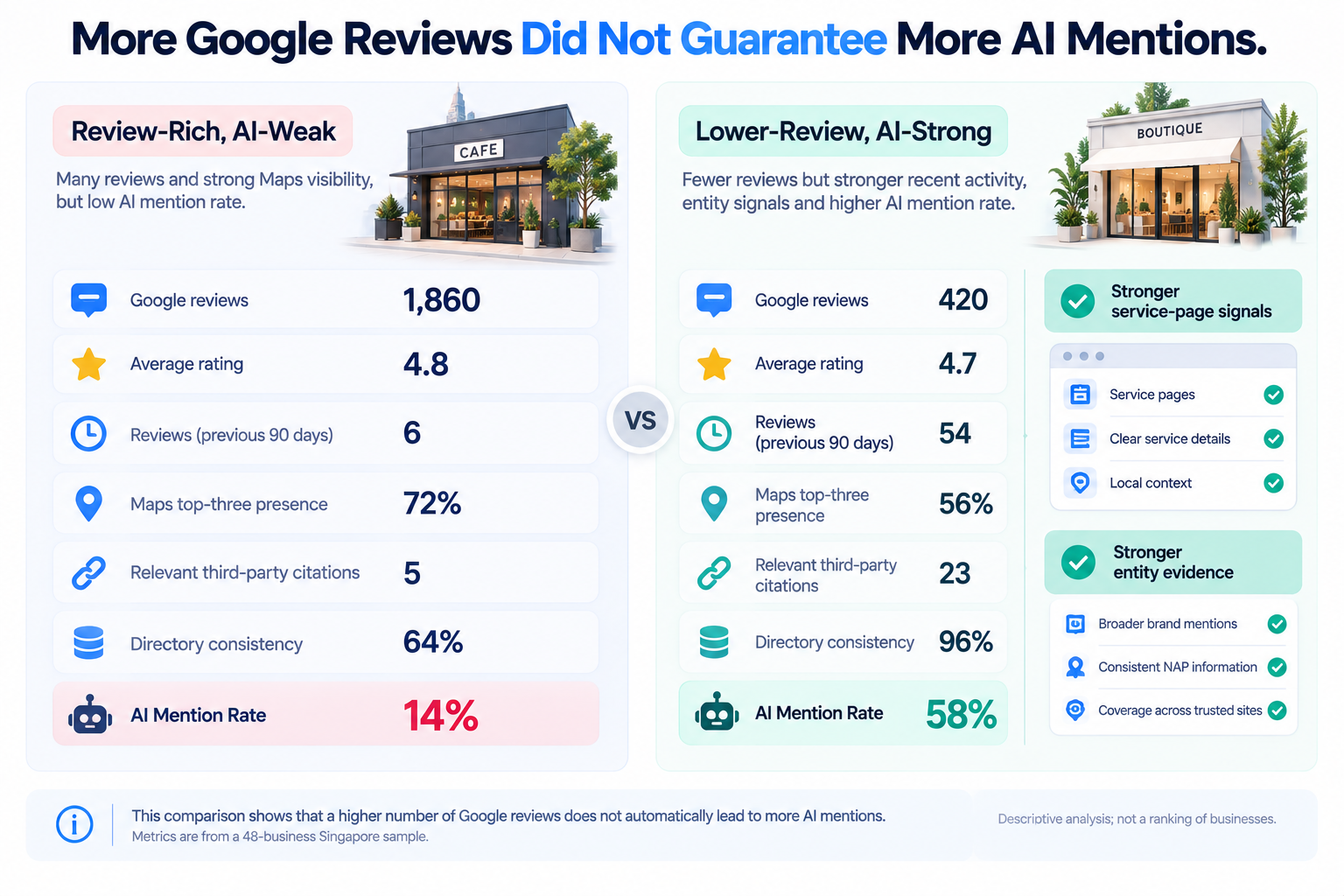
The clearest mismatch came from two anonymised businesses in the same category.
Visibility Mismatch Test
| Signal | Review-rich, AI-weak | Lower-review, AI-strong |
| Google review count | 1,860 | 420 |
| Rating | 4.8 | 4.7 |
| Reviews in previous 90 days | 6 | 54 |
| Maps top-three presence | 72% | 56% |
| Service-page quality | One broad page with little crawlable service detail | Dedicated detailed pages for core services |
| Relevant third-party citations | 5 | 23 |
| Directory consistency | 64% | 96% |
| Topical relevance | Partial | Strong across site and external sources |
| AI Mention Rate | 14% | 58% |
The first business had more than four times as many Google reviews and stronger Maps performance, yet its AI Mention Rate was only 14%. The lower-review business appeared less often in the Maps top three but had dedicated service pages, stronger directory consistency and more than four times as many relevant third-party citations, resulting in a 58% AI Mention Rate.
For the review-rich business, another 500 reviews might improve social proof but would not necessarily solve the main AI visibility problem. The wider web still did a poor job explaining what the business specialised in, where it operated and why independent sources associated it with the target service.
This gap is becoming more important as customers increasingly ask AI systems to shortlist businesses before they ever visit a traditional search result. MediaOne’s guide to AI agent search visibility in Singapore goes deeper into how AI systems build those shortlists and why a business can perform well in Google Search but still be absent from AI recommendations.
What About Owner Responses?
Owner response rate had only a weak descriptive relationship with both visibility measures:
- Maps visibility: ρ = 0.12
- AI Mention Rate: ρ = 0.08
That is not an argument against replying to customers. Google encourages businesses to respond to reviews because thoughtful replies demonstrate that customer feedback is valued, and good responses can strengthen reputation and trust.
What our results do not support is presenting review replies as a direct ranking or AI-visibility tactic. Reply because it is good reputation management, not because every response is expected to move a ranking.
The Review Visibility Funnel
The findings are easier to understand as a five-stage funnel.
1. Review Presence
First, the business needs enough current reputation evidence. Review volume, rating, recency and velocity should be considered together rather than turning any one figure into a target.
2. Review Evidence
The next question is whether customers explain why they recommend the business. Detailed reviews can naturally describe services, outcomes, locations, customer types and distinguishing attributes.
3. Local Visibility
That reputation still needs to translate into visibility across Google Maps and relevant local searches. Reviews matter here, but relevance, distance and broader prominence also remain part of the local ranking environment.
4. Entity Evidence
AI visibility introduces a wider question: can independent sources corroborate what the business says about itself? Dedicated service pages, consistent directory listings, media coverage, relevant citations, structured business information and genuine community discussion all help build a clearer evidence trail.
5. AI Recommendation
The final stage is whether those signals translate into repeated recommendations across AI systems. Our results suggest that strong reviews can support this wider environment, but reviews alone do not reliably predict who AI recommends.
Google Reviews and Local SEO vs Traditional Organic SEO
The SEO part of this discussion requires an important distinction.
Google Reviews and Local SEO
Google directly states that more reviews and positive ratings can help local ranking, which makes legitimate review acquisition a reasonable part of Google Business Profile and Maps optimisation.
Google Reviews and Organic SEO
The connection is less direct. A local business should not assume that moving from 300 to 600 Google reviews will automatically improve the organic ranking of its service pages. Traditional organic visibility still depends on factors such as page relevance, usefulness, site architecture, technical accessibility, links, authority and search intent.
For the broader ranking picture, MediaOne’s guide on how to rank on Google Singapore covers localised keyword targeting, on-page optimisation, technical SEO and authority building in the Singapore market. Reviews can reinforce reputation and prominence, but they should not be presented as a guaranteed organic-ranking lever.
Does Google Review Schema Improve Rankings?
Copying a Google rating onto a website and adding AggregateRating schema is not a shortcut to rankings or review stars.
Google restricts self-serving review rich results for LocalBusiness and Organization, including reviews embedded through a third-party widget when the entity being reviewed controls the page. See Google’s guidance on self-serving review markup and LocalBusiness structured data.
Displaying genuine testimonials can still improve trust and conversion. Structured data should simply describe the business and page accurately rather than being used to manufacture star snippets or imply an unsupported rating.
Review Advantage vs Entity Advantage
| Weak web/entity evidence | Strong web/entity evidence | |
| Weak review profile | Weakest overall candidate | AI may still discover the business through strong web evidence |
| Strong review profile | Strong local reputation, but AI visibility may lag | Strongest overall visibility candidate |
The strongest position is clearly the top-right combination: a healthy review profile plus strong wider entity evidence. Reviews give customers and local search systems reputation evidence, while strong entity signals give search engines and AI systems clearer corroboration around services, locations and expertise.
The businesses with strong reviews but weak AI mentions are particularly useful diagnostically because they show where reputation alone stops being sufficient.
What Should Businesses Actually Do?
| If your problem is… | What to prioritise |
| Few reviews and poor Maps visibility | Build a legitimate, policy-compliant review-acquisition process |
| Good rating but low review volume | Increase consistent review flow without incentives |
| Large review count but little recent activity | Improve the ongoing customer-feedback process |
| Reviews are generic | Invite customers to describe their real experience naturally |
| Strong Maps visibility but weak AI mentions | Audit website, service/entity evidence and third-party citations |
| AI associates you with the wrong service | Clarify service pages, business information and topical evidence |
| AI mentions competitors but not you | Compare review, website and independent evidence gaps |
| Strong visibility but weak conversions | Improve the offer, landing pages, trust signals and customer journey |
Businesses should not manufacture keyword-rich reviews or script fake customer experiences. A genuine review such as “They repaired our office aircon the same afternoon and explained what had failed” is far more useful to prospective customers than “Great company, five stars.”
The goal is better authentic feedback, not keyword insertion.
These problems often overlap. A business with weak Maps visibility may need more than reviews alone, including Google Business Profile optimisation, accurate local citations and stronger location signals. MediaOne’s Local SEO services cover those areas alongside review management and local search visibility.
How to Monitor Reviews and AI Visibility
Google Business Profile and Google Maps
Use Google Business Profile and Maps to monitor review rating, volume, recency, business information and local visibility. These remain the most direct places to evaluate your Google reputation foundation.
Local Rank Tracking
A dedicated local rank tracker becomes useful when you need repeatable Maps or local-pack measurements across multiple locations. Keep coordinates, query sets, language, device and timing consistent so changes are easier to interpret.
AI Mention Tracking
Manual AI testing works for a one-off audit but becomes difficult to repeat across dozens of prompts, competitors and AI engines.
Digimetrics includes an AI Mentions Tracker for monitoring brand visibility across AI search environments.
Disclosure: Digimetrics is built by our team.
The useful metric is not whether a brand appeared once. It is whether the business appears consistently across commercially relevant prompts over time, and whether the visible evidence behind those recommendations can be audited.
Limitations of This Test
This benchmark covers 48 businesses in one country and four categories, so different markets and industries may behave differently. Review count can also act as a proxy for business age, customer volume, brand recognition, links and offline prominence, while fixed search locations reduce but cannot eliminate local-ranking variation.
AI recommendations introduce another source of volatility because results can change across sessions, product versions, browsing modes and dates. Visible citations also do not expose every source or internal signal that contributed to an answer.
Finally, all reported correlations are descriptive. They do not establish causation or statistical generalisability beyond this sample. Review Topic Match was manually coded, so a larger follow-up study would also benefit from a second reviewer and an inter-rater agreement check.
Final Verdict: Reviews Are the Foundation, Not the Whole AI Strategy
Google reviews belong in the local SEO conversation because Google explicitly connects review volume and positive ratings with local ranking, and our test found a meaningful relationship as well. Review Strength correlated with Maps visibility at ρ = 0.62, while businesses in the top review-count quartile averaged Maps position 4.6, compared with 9.2in the bottom quartile.
The AI relationship was substantially weaker. Review Strength correlated with AI Mention Rate at only ρ = 0.29, while our broader Entity Evidence Score reached ρ = 0.66. Visible source patterns pointed in the same direction, with review sources appearing in only 11% to 19% of recommendations while company websites and other third-party sources surfaced much more often.
That leads to two different strategies. If a business has few reviews and weak Maps visibility, building a legitimate and consistent review-acquisition process is an obvious place to start. If it already has hundreds of strong reviews, good Maps visibility and weak AI mentions, another 500 reviews may not address the actual problem. The next audit should focus on dedicated service pages, business information, directory consistency, topical relevance and independent third-party corroboration.

The most accurate conclusion from our test is therefore:
Reviews help establish local reputation. Reliable AI visibility appears to require reputation plus corroboration.
Google review optimisation and AI visibility should be treated as connected strategies, but not as the same strategy.
Frequently Asked Questions
Do Google Reviews Affect SEO?
Yes for local SEO, within limits. Google explicitly says more reviews and positive ratings can help local ranking, and our own Review Strength Score had a ρ = 0.62 relationship with Maps visibility.
That does not mean additional Google reviews automatically improve every traditional organic position.
How Many Google Reviews Do You Need to Rank Higher?
There is no universal number because a business competes within its own category, location and market. Review volume also interacts with rating, recency, relevance, distance and broader prominence.
In our sample, Maps visibility improved across review-count quartiles, but the advantage began flattening toward the top. Competitor-relative review strength is therefore more useful than targeting an arbitrary number such as 100 or 500 reviews.
Does a Five-Star Rating Improve Google Rankings?
A high rating can strengthen the overall reputation profile, but it should not be evaluated by itself.
The 4.6-to-4.7 group had a 44% Maps top-three appearance rate compared with 38% for the 4.8+ group, but the highest-rated businesses also had far fewer reviews on average. The result should not be interpreted as Google preferring 4.7-star businesses.
Do Recent Google Reviews Matter?
Recent activity was associated with stronger local visibility in our benchmark. Businesses receiving 20 or more reviews in the preceding 90 days had an 80% Maps top-10 rate, compared with 44% among businesses receiving zero to four.
That relationship is correlational, so it supports maintaining a consistent review process rather than promising a precise ranking boost.
Do Keywords in Google Reviews Help SEO?
Businesses should not ask customers to insert SEO keywords into reviews.
Natural customer descriptions can provide useful context around services, outcomes and locations, but our benchmark cannot isolate review wording as a direct ranking factor. A safer strategy is to encourage authentic detailed feedback and make sure those same services are described accurately across the website and broader web presence.
Do Google Reviews Affect ChatGPT Recommendations?
They may contribute to the wider evidence environment, but our results do not support treating review count as a direct ChatGPT ranking factor.
Review Strength had only a ρ = 0.29 relationship with AI Mention Rate, compared with ρ = 0.66 for Entity Evidence. Visible review sources appeared in 11% of coded ChatGPT recommendations, while business websites appeared in 58%.
Can a Business Rank Well on Google Maps but Not Appear in AI?
Yes. Our review-rich mismatch business appeared in the Maps top three for 72% of local checks but achieved only a 14% AI Mention Rate.
The comparison business had fewer reviews and lower Maps top-three visibility but stronger service pages, directory consistency and third-party corroboration. Its AI Mention Rate reached 58%.
Should Businesses Reply to Every Google Review?
Reply when doing so is useful for the customer and the business’s reputation.
Owner response rate showed only weak relationships with Maps visibility at ρ = 0.12 and AI Mention Rate at ρ = 0.08in our benchmark, so we would not sell review replies as a direct ranking tactic.