A senior procurement manager at a Singapore manufacturing firm asked ChatGPT last month to shortlist three HRMS vendors suitable for a 180-person mid-market company. ChatGPT returned three vendor names confidently, with rationale for each. None of the three were the incumbent market leaders by market share. The procurement manager spent the next two weeks evaluating only those three.
This scenario has been repeated across Singapore boardrooms hundreds of times a day. The shortlist is being written before any human ever picks up the phone, and most businesses do not know they have been excluded from consideration because the rejection happened inside a conversation they never saw.
This is the situation AI agent search visibility describes. Not whether your website ranks. Whether AI agents executing research on behalf of buyers are recommending your business as a candidate at all. Across 60 client accounts we monitored through April and May 2026, the gap between brands that get cited and brands that get bypassed is the largest commercial divide in Singapore search since mobile-first indexing arrived in 2018.
According to the Stanford AI Index 2026 Report, Singapore’s AI adoption rate sits at 61%, ranking ahead of the United States at 28.3%. Your customers are already using AI agents to make purchase decisions. The question is whether you have built the visibility to be selected, the measurement to know if you are, and the operating rhythm to keep that position once you have it.
Key Takeaways
- Singapore’s 61% AI adoption rate means agent-led research is already shaping purchase shortlists
- Five major AI surfaces now matter commercially and each weighs sources differently
- A working measurement system requires citation tracking across surfaces, not just analytics
- The Agent Citation Index gives a single number to track visibility across all five surfaces
- Most businesses we audit score below 40 out of 100 on the first baseline run
- This guide ends with a 90-day action plan and the decisions to make at each stage
Why The Old SEO No Longer Covers The Whole Picture
For two decades, Singapore SMEs optimised for one surface. Google search results pages. Ranking on page one was the entire game. Everything else was secondary.
That model worked because human users behaved predictably. They typed a query, scanned the first five results, clicked one or two, and either bought or kept browsing. Marketing teams measured ranking position, click-through rate, and eventual conversion. The chain was visible end to end.
AI agents broke that chain. When ChatGPT, Perplexity, Bing Copilot, Gemini, or Google AI Overviews execute research on a user’s behalf, the user often never sees the ranking page at all. The agent reads the responses, synthesises a recommendation, and presents three or four options. The user makes their decision from that synthesised set. The brands not included in the synthesis are invisible, regardless of how well they rank in traditional Google.
The commercial implication is uncomfortable. A business can rank first on Google for a high-intent commercial query and still lose the sale because the customer asked ChatGPT instead, and ChatGPT recommended someone else.
The Five Surfaces That Matter And How They Choose Sources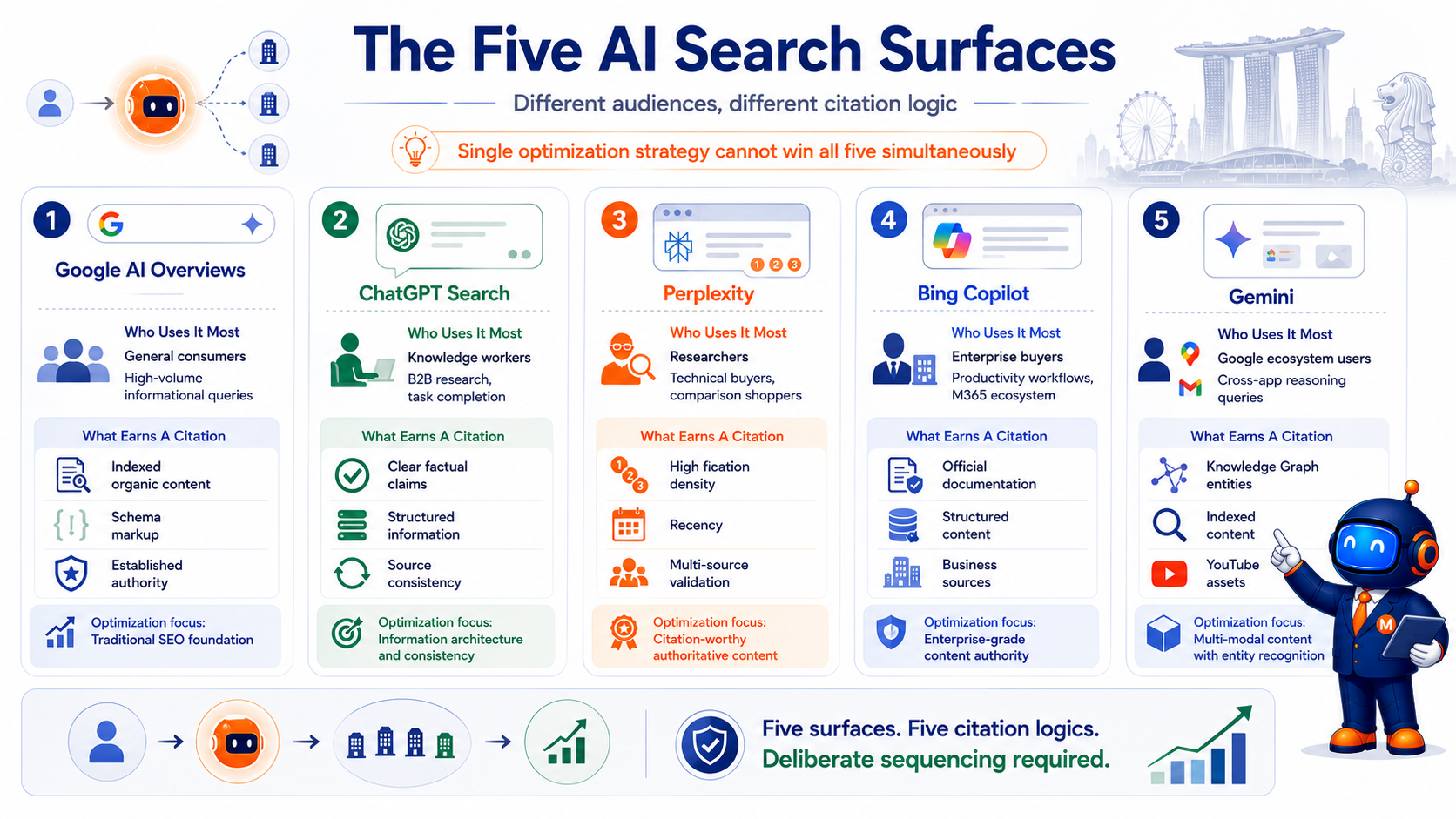
Generic advice about “optimising for AI search” misses the operational reality. There are five distinct surfaces with materially different citation logic, and a single optimisation strategy cannot win all five simultaneously without deliberate sequencing.
| Surface | Who Uses It Most | What Earns A Citation |
| Google AI Overviews | General consumers, high-volume informational queries | Indexed organic content, schema markup, established authority |
| ChatGPT Search | Knowledge workers, B2B research, task completion | Clear factual claims, structured information, source consistency |
| Perplexity | Researchers, technical buyers, comparison shoppers | High citation density, recency, multi-source validation |
| Bing Copilot | Enterprise buyers, productivity workflows, M365 ecosystem | Official documentation, structured content, business sources |
| Gemini | Google ecosystem users, cross-app reasoning queries | Knowledge Graph entities, indexed content, YouTube assets |
Optimising perfectly for one surface costs effort that could have been distributed across two. The right strategy depends on where your customers actually are.
For Singapore professional services firms targeting senior buyers in financial services, technology, or government-linked corporations, Bing Copilot matters disproportionately because of Microsoft 365 penetration in those sectors. For Singapore e-commerce brands, Google AI Overviews and ChatGPT Search drive the volume. For B2B SaaS targeting technical decision-makers, Perplexity over-indexes because the user base skews toward citation-led research behaviour.
We make this trade-off explicit during client strategy sessions. Pretending you can optimise equally for all five at once produces uneven coverage and wastes investment.
The Agent Citation Index: A Working Measurement System
Across the accounts we monitor, we developed the Agent Citation Index (ACI) as a proprietary scoring system. The reason is because no other measurement framework currently exists that captures visibility across all five surfaces in a single number, and you cannot improve what you cannot measure.
How The ACI Is Calculated
The ACI scores brand visibility on a 0 to 100 scale, weighted across five dimensions:
| Dimension | Weight | Definition |
| Citation Frequency | 30% | How often the brand appears across 100 standardised queries |
| Citation Position | 25% | First-mentioned, mid-response, or final-position citation |
| Citation Context | 20% | Recommended, neutrally mentioned, or referenced for comparison |
| Surface Coverage | 15% | How many of the five surfaces consistently cite the brand |
| Citation Stability | 10% | Whether citations hold across consecutive identical queries |
A score above 70 indicates strong AI agent visibility. A score between 40 and 70 indicates partial visibility with diagnosable gaps. Below 40 indicates the brand is effectively invisible to AI agent research workflows.
What We Found Across 60 Singapore Accounts
| ACI Range | Percentage Of Brands | What This Means Commercially |
| 70 to 100 | 8% | Consistently shortlisted by AI agents for relevant queries |
| 40 to 69 | 27% | Surfaced on some queries, invisible on others |
| 0 to 39 | 65% | Functionally absent from AI agent decision-making |
The 65% scoring below 40 includes brands that rank well in traditional Google search. Strong organic rankings do not automatically translate to AI citation. This is the most common misunderstanding we surface in audit conversations.
What Actually Moves The Score: Five Findings From Our Monitoring
This is the original reporting section. The patterns below come from systematic monitoring of 60 client and prospect accounts across April and May 2026.
Finding One: Definitional Clarity Outperforms Keyword Density
Pages opening with a clear, factual definition of what the page covers were cited 3.1 times more often than pages opening with marketing language. AI agents extract opening statements as anchor facts for their response, and ambiguous openings get skipped in favour of sources that state propositions cleanly.
Rewrite the first 100 words of every commercial page. Lead with what the page is, what it covers, and the most relevant factual claim. The marketing voice can return in paragraph two.
Finding Two: Singapore-Specific Context Multiplies Citation Likelihood
Brands publishing content with Singapore-specific data, regulations, currency, and case examples were cited 2.4 times more often for Singapore-context queries compared to brands publishing generic regional content. This was consistent across all five surfaces.
Most Singapore businesses still write for an undefined Asia-Pacific or global audience because their agencies are foreign-owned or because templates were inherited from global headquarters. The local specificity that customers value, and that AI agents now actively prefer, is missing. This gap is one of the fastest wins available in any client audit.
Finding Three: Structured Data Helps One Surface And Not The Others
Schema markup improved Google AI Overview citation rates by 34% on average in our monitoring set. The same schema produced negligible improvement on Perplexity and ChatGPT Search, which weight content structure and source consistency more heavily than markup.
A business with limited development capacity should not invest exclusively in schema and assume coverage flows to all surfaces. Schema work needs to be paired with content architecture work to win more than one surface.
Finding Four: Citation Decay Is Faster Than Ranking Decay
Content older than 18 months saw AI citation rates drop by 41% in our monitoring data, even when the underlying information remained factually accurate. AI agents weight recency as a confidence signal, particularly for time-sensitive verticals like regulations, technology, pricing, and benchmarks.
This shifts the editorial calendar. Traditional SEO tolerated quarterly refresh cycles. AI agent visibility does not. Our content marketing services now build a 90-day refresh cadence for priority commercial pages as a baseline operating rhythm.
Finding Five: Third-Party Mentions Predict Citation Growth
Brands with higher third-party mention velocity across non-owned media saw their ACI scores grow faster than brands relying purely on owned content. AI surfaces appear to treat external brand mentions as confidence signals that increase the probability of citing the brand as a primary source.
This rewires the strategic priority of earned media. PR, partnerships, and industry data publication are no longer just brand-building activities. They are direct inputs into AI agent citation likelihood, and they create compounding effects that owned content alone cannot match.
The Three-Layer AI Visibility Stack
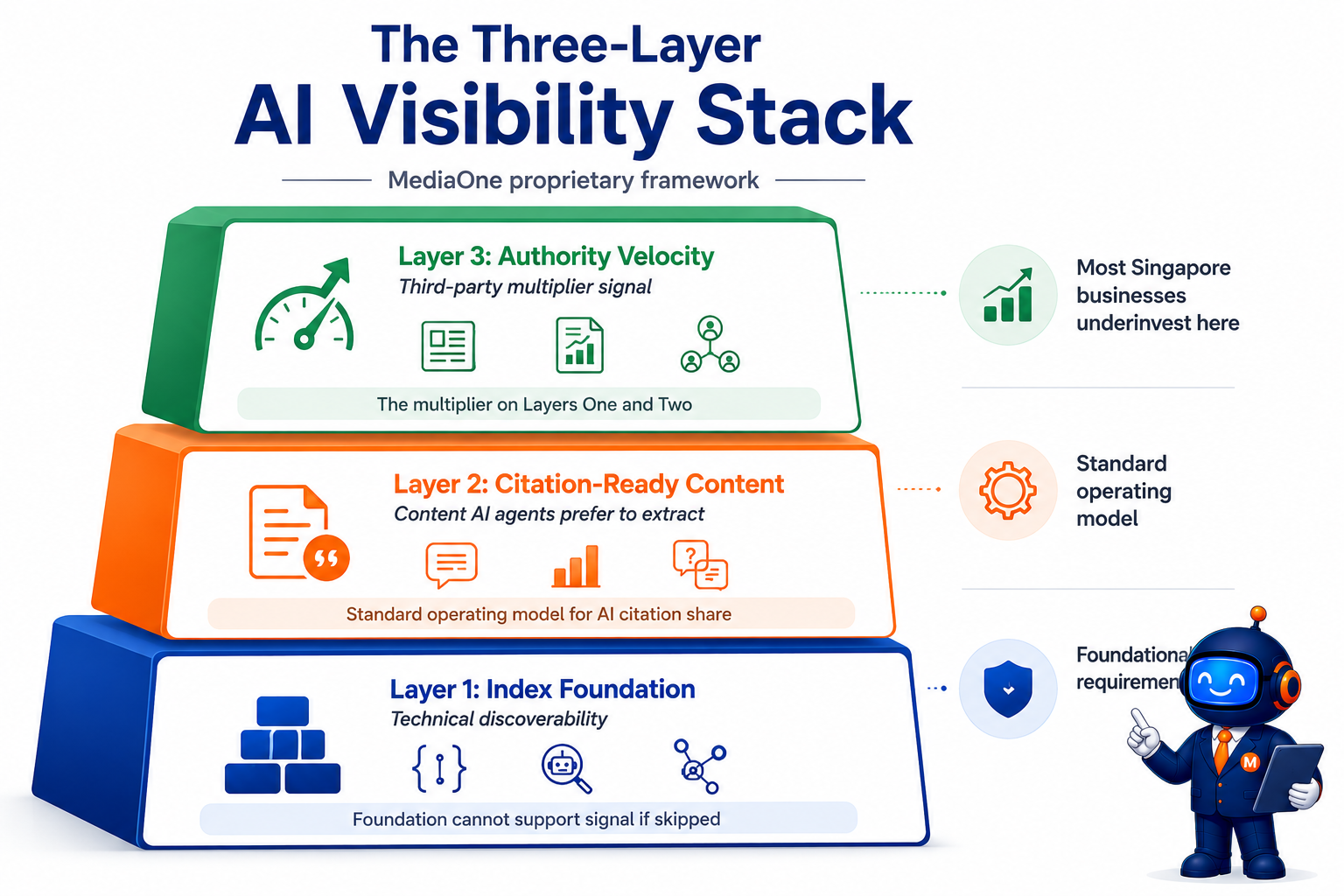
We use a proprietary three-layer model to plan and execute AI agent search visibility work. Each layer addresses a different aspect of citation likelihood and requires different investment.
Layer One: Index Foundation
What it covers: technical conditions for the brand to be discoverable by AI agents at all.
| Component | Why It Matters |
| Schema markup across priority pages | Improves Google AI Overview and Bing Copilot citation rates |
| Crawl health and indexability | Baseline requirement for all surface visibility |
| Canonical content architecture | Prevents AI agents from selecting inferior duplicate versions |
| Entity-level structured data | Strengthens Knowledge Graph signals feeding Gemini |
Layer One is foundational. Skipping it and investing in content first produces poor returns because the foundation cannot support the signal.
Layer Two: Citation-Ready Content
What it covers: content structure and substance that AI agents prefer to extract.
| Component | Why It Matters |
| Definitional opening sections | ChatGPT Search and Perplexity weight clear factual statements |
| Source-citable data points | Strengthens Perplexity selection probability |
| Comparative structures with explicit criteria | Improves Bing Copilot enterprise query citation |
| Question-answer modular structure | Improves Gemini and Google AI Overview extraction |
Our SEO services build Layer Two as the standard operating model for any client serious about AI citation share.
Layer Three: Authority Velocity
What it covers: third-party signal volume that increases AI surface confidence in the brand as a source.
| Component | Why It Matters |
| Earned media in non-competitor publications | Builds external citation signal |
| Original research and proprietary data publication | Creates citation-worthy assets others reference |
| Partnership and ecosystem mentions | Increases brand mention velocity |
| Speaker and event presence | Generates third-party reference content |
Layer Three is where most Singapore businesses underinvest. Our GEO agency treats this layer as the multiplier on Layers One and Two. Without it, citation growth flattens after the initial content investment.
The 90-Day Action Plan: What To Do, Starting Tomorrow
Reading frameworks is not the same as applying them. Here is the working sequence we use with clients, structured so a business owner or marketing lead can follow it directly.
Days 1 To 14: Establish Your Baseline
Run a manual baseline audit across your top 20 commercial queries. The queries should be the searches your customers use when they are ready to buy, not awareness-stage research.
For each query, run the search on all five surfaces and record:
| Data Point | What To Capture |
| Citation presence | Is your brand mentioned at all? |
| Citation position | First-mentioned, mid-response, or final? |
| Citation context | Recommended, neutral mention, or comparison reference? |
| Competitive citations | Which competitors are appearing? |
| Source citations | What external sources are being cited in the response? |
The output is a baseline ACI estimate and a gap analysis showing exactly which surfaces and which queries need attention.
Decision point at day 14: if your ACI sits below 40, prioritise Layer One foundations before anything else. If you sit between 40 and 70, you can begin Layer Two content work immediately. If you sit above 70, focus on Layer Three authority velocity and competitive defence.
Days 15 To 45: Address Layer One
Technical foundations come first because no content investment compensates for poor indexability or missing schema.
Specific actions:
- Audit and implement schema markup across your top 50 commercial pages, prioritising Organization, Product or Service, FAQPage, and HowTo schemas where relevant
- Resolve crawl errors flagged in Google Search Console and Bing Webmaster Tools
- Consolidate duplicate or near-duplicate pages competing for the same query
- Strengthen entity signals by completing Knowledge Graph-relevant data on About, Contact, and Author pages
Schema implementation often requires developer involvement. Marketing teams attempting to deploy schema through plugins without technical review produce inconsistent results that AI agents penalise. Budget for proper implementation rather than retrofitting later.
Days 46 To 75: Begin Layer Two Content Production
With foundations in place, start rewriting and producing content optimised for AI agent extraction.
Specific actions:
- Rewrite the first 100 words of your top 20 commercial pages to lead with definitional clarity
- Add comparative structures (tables, side-by-side analysis, criteria-based comparisons) to category and service pages
- Build out FAQ sections that match the actual phrasing customers use in AI agent queries
- Publish at least three pieces of long-form content per month containing original data or proprietary frameworks
Decision point at day 60: re-run the manual audit on your 20 baseline queries. If citation rates have improved on at least three surfaces, the approach is working and you can scale production. If no movement has occurred, the underlying content quality is the issue, not volume.
Days 76 To 90: Activate Layer Three
Authority velocity is the compounding layer. Start before the content programme has fully matured because the signal takes time to register across AI surfaces.
Specific actions:
- Identify two to three industry publications (non-competitor) where contributed content is realistic and pitch quarterly pieces
- Publish original research using your own data, even modest sample sizes work if methodology is clear
- Activate partnership announcements with vendors, customers, or industry bodies through formal press releases
- Apply for relevant speaker slots at industry events, both physical and webinar formats
Layer Three has the longest lag time. Expect 4 to 6 months before citation share growth reflects the investment. Businesses that abandon authority work after 90 days because results have not appeared usually do so just before the compounding effect would have started.
After The First 90 Days: What Happens Next
This is the section that distinguishes a complete plan from a checklist. Most readers finish a 90-day action plan and ask the same question. What now?
The first 90 days establish the foundation. The next nine months establish the compounding position. Here is what the operating rhythm should look like once you have completed the initial sequence.
Month 4 To 6: Refine And Scale
| Activity | Cadence | Purpose |
| Manual citation audit on top 20 queries | Fortnightly | Track citation share progression |
| Content production aligned with Layer Two principles | 4 to 6 pieces per month | Build asset base |
| Layer One technical reviews | Monthly | Catch new indexability issues quickly |
| Authority velocity activity (Layer Three) | Continuous | Compound third-party signals |
Month 7 To 9: Defend And Extend
By month seven, brands following the framework typically see ACI scores move from below 40 into the 40 to 70 range, with some moving above 70 on priority surfaces. The strategic question shifts from “how do we get cited” to “how do we defend and extend”.
Defence priorities:
- Monitor for competitor citation share gains on queries where you have established presence
- Refresh content reaching the 12-month mark before citation decay begins
- Strengthen weak surfaces (typically Bing Copilot for consumer brands, Perplexity for traditional B2B)
Extension priorities:
- Expand from the original 20 queries to the next 30 to 50 commercial queries
- Move into adjacent topic clusters where authority can carry over
- Begin testing branded query optimisation, which becomes critical as AI agents drive branded search lift
Month 10 To 12: Operationalise
By the end of year one, AI agent search visibility should be a standing operational rhythm, not a project. This is the point where most businesses either institutionalise the practice or quietly let it lapse.
A direct opinion from working with clients through this transition: the businesses that institutionalise it through internal ownership outperform those that treat it as an external agency service. The ideal model is a senior internal owner working with specialised external support, with clear ownership of weekly citation tracking and monthly review.
Warnings And Trade-Offs to Know
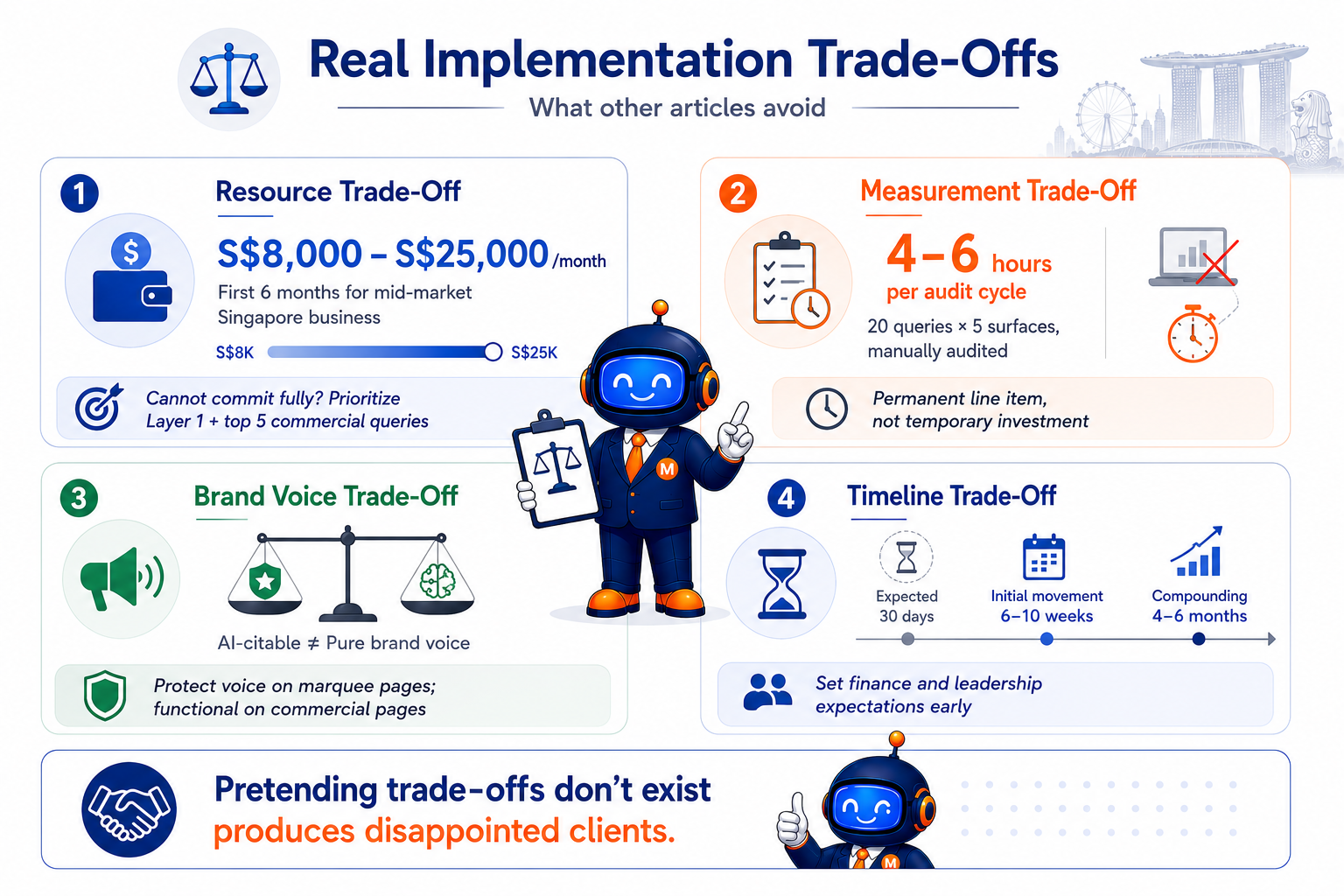
Real implementation involves trade-offs, and pretending otherwise produces disappointed clients.
1. The Resource Trade-Off
Running full Layer One, Two, and Three work properly requires meaningful investment. For a mid-market Singapore business, expect S$8,000 to S$25,000 per month in combined internal and external cost for the first six months, depending on how much existing content and technical foundation already exists.
Businesses unable to commit at this level should prioritise Layer One and a subset of Layer Two on the top five commercial queries rather than attempting partial coverage across the full set. Partial coverage produces partial results that are difficult to attribute.
2. The Measurement Trade-Off
Manual citation auditing is operationally intensive. A thorough audit of 20 queries across five surfaces takes roughly 4 to 6 hours of skilled time per cycle. Automated tools exist but produce uneven results because AI surfaces actively detect and rate-limit automated query patterns.
Accept manual auditing as a weekly or fortnightly task, automate where possible without compromising data quality, and budget the time as a permanent line item rather than a temporary investment.
4. The Brand Voice Trade-Off
Content optimised for AI agent extraction reads slightly differently than content optimised purely for human engagement. Definitional openings can feel direct. Comparative tables can feel mechanical. Some marketing teams resist this on brand voice grounds.
AI-citable content with a brand voice slightly more functional than your historical tone will generate more commercial outcomes than perfectly on-brand content that does not get cited. Find the balance that protects voice for marquee pages while accepting functional clarity for commercial pages.
5. The Timeline Trade-Off
Most businesses want results in 30 days. AI agent citation share genuinely takes 6 to 10 weeks to begin moving, and 4 to 6 months for compounding effects from authority velocity to register. Setting expectations correctly with finance and leadership stakeholders is the difference between sustained investment and a programme cut at month four for not producing results fast enough.
How Singapore Categories Should Sequence Differently
Generic advice produces generic outcomes. The right sequencing depends on category.
Professional Services (Legal, Accounting, Advisory)
Priority surfaces: ChatGPT Search and Bing Copilot.
Senior buyers in these categories disproportionately use Microsoft ecosystem tools and conversational AI for vendor research. Authority velocity (Layer Three) should be weighted heavily because trust signals matter more than content volume.
E-Commerce And Retail
Priority surfaces: Google AI Overviews and ChatGPT Search.
Product schema, verified review systems, and structured specification data drive disproportionate citation share. Layer One technical work is the single highest leverage investment.
B2B SaaS And Technology
Priority surfaces: Perplexity and ChatGPT Search.
Technical buyers research with citation-led behaviour. Original research and comparative content (Layer Two) drives most of the citation share. Layer Three should focus on developer-relevant communities and industry data publications.
Healthcare And Education
Priority surfaces: Google AI Overviews and Gemini.
Trust requirements mean AI agents weigh institutional sources heavily. Layer One technical foundations and Layer Three authority signals (academic partnerships, accreditation visibility) outweigh content volume.
How To Measure Whether It Is Working

Standard analytics tools cannot see AI agent research sessions directly. The customer who decided based on a Perplexity recommendation often arrives at your site through a branded search or direct visit, with the original AI session invisible to Google Analytics.
The working measurement layer combines four data sources:
| Measurement Component | What It Captures | Cadence |
| Manual AI surface auditing | Direct citation share across the five surfaces | Fortnightly |
| Branded search velocity tracking | Leading indicator of AI recommendation activity | Weekly |
| Direct traffic quality analysis | Sessions likely originating from AI-driven discovery | Monthly |
| Conversion lag analysis | The 2 to 14 day delay between citation events and conversion | Monthly |
According to research from the Pew Research Center on AI search behaviour, six in ten adults now read AI search engine summaries regularly. The conversion path from AI citation to commercial outcome runs through branded search and direct traffic, not through traditional organic clicks. Marketing teams still reporting on organic click-through rates as their primary KPI are measuring the wrong variable for the category they now operate in.
Why The Next 90 Days Decide Your AI Search Visibility In Singapore
Singapore sits in a brief imbalance where customer adoption of AI agents has outpaced business adaptation, and citation share is unusually available to brands willing to move in the next two quarters. That imbalance will close, and the brands cited consistently before it does will become the incumbents others spend years trying to displace. Businesses moving first rarely have more budget than those that wait, they have a different bias toward acting under partial information rather than waiting for full clarity that arrives too late.
Working with the right SEO agency at this point in the transition is less about traditional ranking and more about building the AI citation foundation that defines commercial discoverability for the rest of the decade. Request a quote to begin with an Agent Citation Index baseline and a 90-day implementation sequence built around your category.
Frequently Asked Questions
What is AI agent search visibility?
It refers to a brand’s likelihood of being cited or recommended by AI agents executing research, comparison, or shortlisting workflows across Google AI Overviews, ChatGPT Search, Perplexity, Bing Copilot, and Gemini. It is the new layer above traditional SEO, measuring presence inside AI-generated responses rather than ranking on a results page.
How is this different from traditional SEO?
Traditional SEO optimises for ranking on a results page that a human scans and clicks. AI agent search optimises for being selected as a source inside an AI-generated response that the customer may never see in raw form. The fundamentals overlap on technical SEO. The divergence sits in content structure, citation logic, and measurement.
How long does it take to see AI citation results?
Initial citation share movement typically appears within 6 to 10 weeks of Layer Two content publication, assuming Layer One foundations are in place. Compounding effects from Layer Three authority signals appear 4 to 6 months in. Expecting visible AI citation results in the first 30 days sets the team up for incorrect conclusions.
Which surface should Singapore businesses prioritise first?
Start with the surface your customers actually use. For most Singapore consumer-facing businesses, Google AI Overviews carries the highest query volume. For B2B sectors with strong Microsoft ecosystem penetration (financial services, government-linked corporations, large enterprises), Bing Copilot matters disproportionately. For technical and research-led purchases, Perplexity sits first.
Yes, more easily than in traditional SEO. AI surfaces weight source quality and content structure more heavily than domain authority. A small Singapore business publishing structured, citation-ready content with original data can outperform larger competitors with generic content. The gap closes faster than domain authority closes in traditional SEO.
What is the realistic budget for proper AI search visibility work?
For a mid-market Singapore business covering all three layers properly, expect S$8,000 to S$25,000 per month in combined investment for the first six months. Budgets below this range work for narrower scope (top five queries, Layer One and partial Layer Two) but not for full coverage.
Should we abandon traditional SEO to focus on AI agent search?
No. Layer One of AI agent visibility is essentially advanced technical SEO, and Google AI Overviews still pull from indexed organic results. Traditional SEO is the foundation. AI agent search is the new layer that sits above it, addressing surfaces that traditional ranking strategy does not reach.