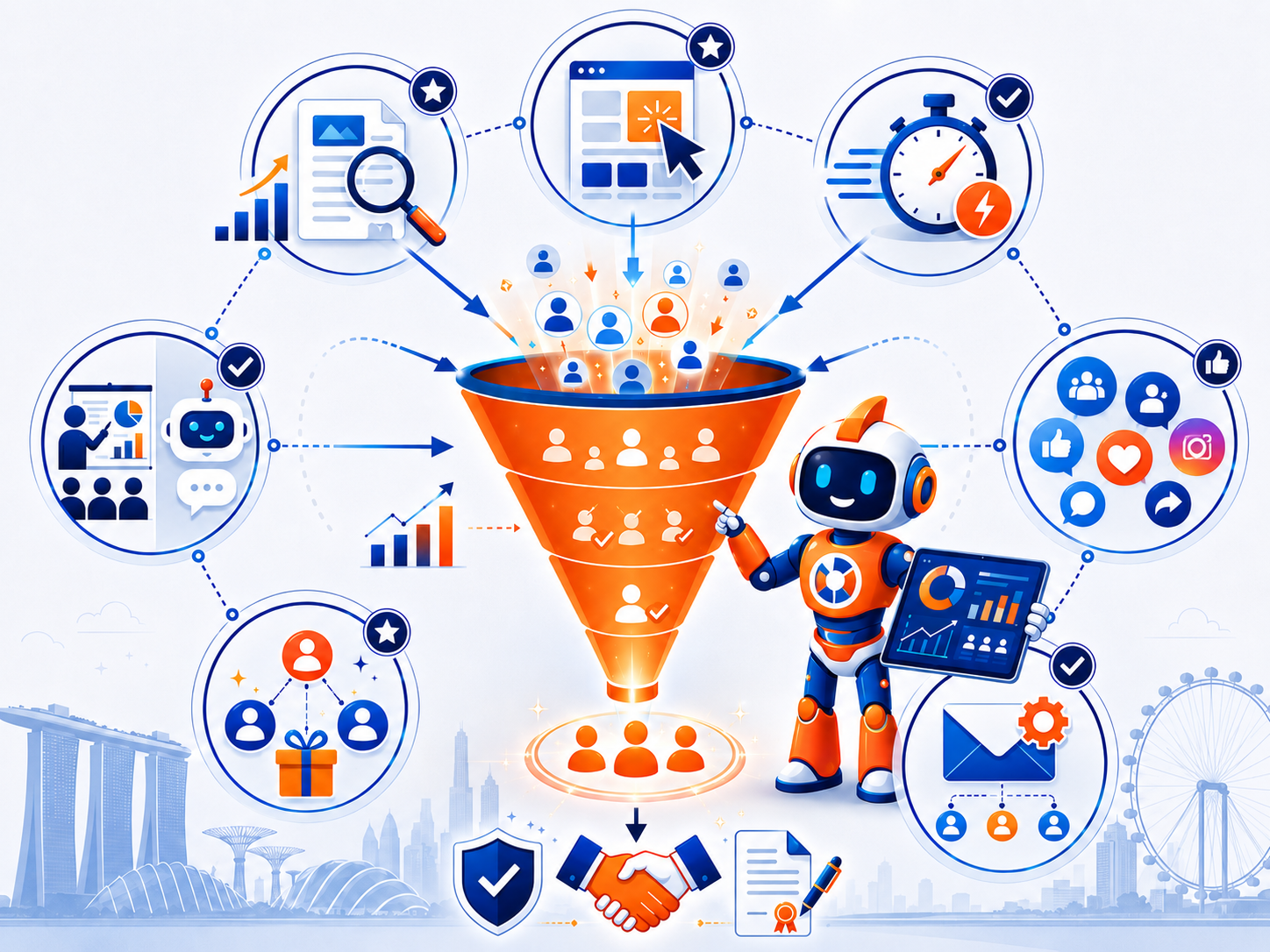
After 15 years building lead generation services in Singapore, the pattern across most agencies in this market is consistent. They optimise for cheap CPL, celebrate funnel volume, and hand sales teams a daily queue of unqualified enquiries. The dashboards look healthy, though the pipeline does not.
The Singapore buyer of 2026 has moved on from the assumptions baked into most lead generation advice. According to Forrester’s 2026 Buyer Insights research on trust as B2B currency, trust has become the ultimate currency for B2B buyers, with purchase decisions increasingly made by groups of six or more stakeholders who validate vendors through peer networks before any sales conversation happens. In a market like Singapore, where WhatsApp reaches roughly four in five people every month according to Digital 2026 Singapore data, trust and speed have become the dominant conversion levers.
This article sets out the seven lead generation methods that actually drive qualified pipeline in Singapore in 2026, with the frameworks, channel benchmarks, regulatory edges and contrarian calls we have made on hundreds of accounts.
Key Takeaways
- Lead economics outperform lead volume. Ten qualified enquiries can fund a business while one hundred cheap form fills can drain it.
- Speed-to-lead is the most underused conversion lever in a market where messaging is the dominant communication channel.
- Google Search continues to deliver the highest intent quality. LinkedIn quietly outperforms when judged by close rate. Meta lead forms now work only for narrow consumer use cases.
- Referral programmes remain the most under-built, highest-ROI channel in a network-driven market like Singapore.
- The chatbots most Singapore businesses deploy actively reduce qualified pipeline. The fix is design, not removal.
- The Productivity Solutions Grant from Enterprise Singapore can fund up to fifty percent of qualifying lead generation projects, yet most agencies fail to structure scopes that qualify.
The Lead Value Equation: Why Volume Quietly Drains Sales Teams
Most Singapore businesses treat lead generation methods as a volume problem, ranking channels by cost per lead instead of close rate. After auditing more than two hundred funnels across professional services, healthcare, F&B and B2B SaaS, we have found a more useful frame.
We call it the MediaOne Lead Value Equation (LVE). It is the only formula we trust to score a channel honestly.
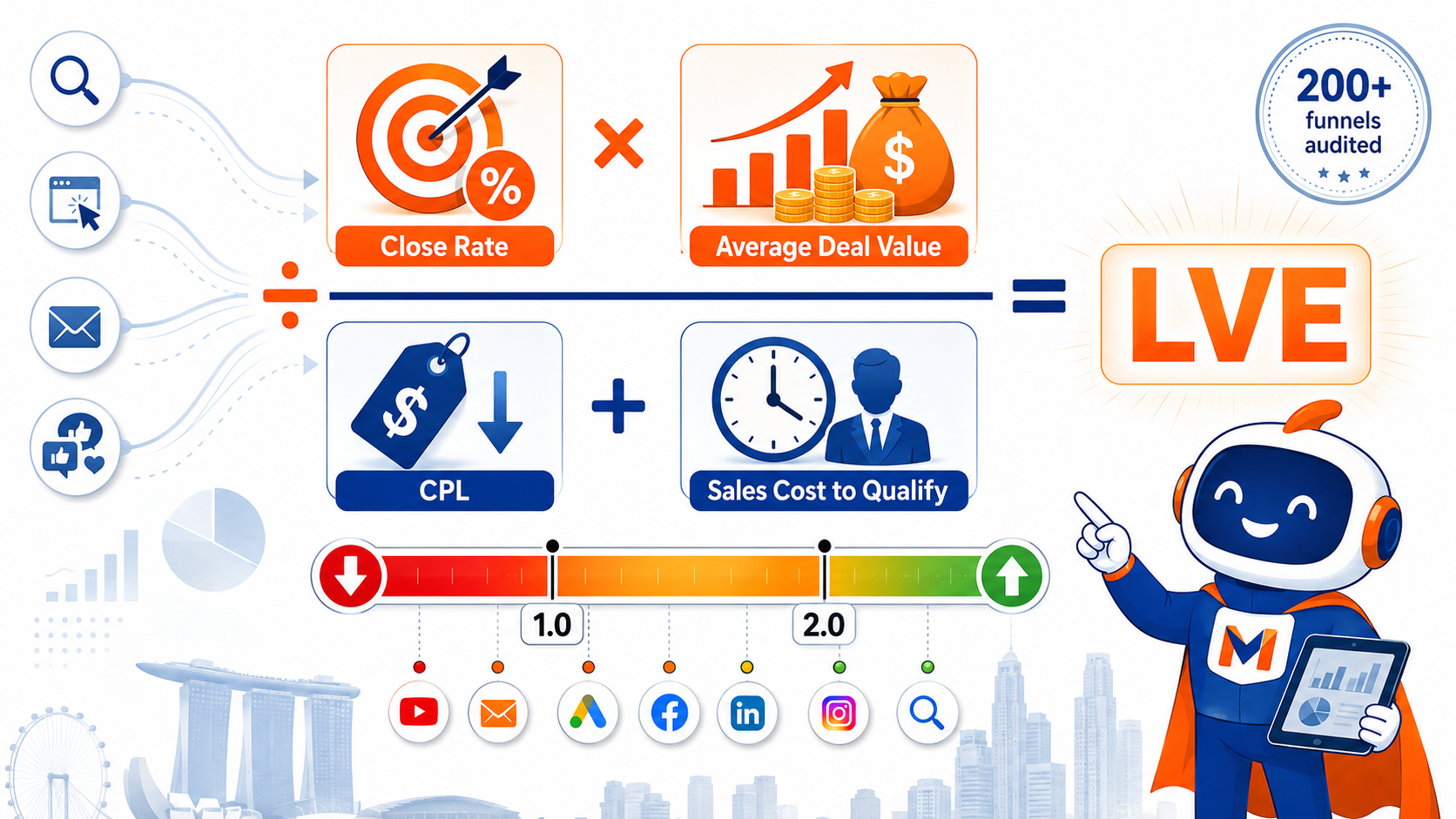
LVE = (Close Rate × Average Deal Value) ÷ (CPL + Sales Cost to Qualify)
Any score below 1.0 indicates a channel losing money on contribution margin. A score above 2.0 indicates a channel worth scaling.
| Source | CPL | Close Rate | Deal Value | Sales Cost | LVE | Rationale |
| Meta lead form | $5 | 2% | $1,000 | $20 | 0.8 | Low friction attracts unqualified volume; sales team burns hours qualifying |
| Google Search Ads | $50 | 15% | $1,000 | $10 | 2.5 | High commercial intent filters for buyers ready to act |
| LinkedIn Lead Gen Forms | $80 | 14% | $1,000 | $8 | 2.8 | Verified profile data reduces qualification time |
| Referral programme | $30 | 22% | $1,000 | $5 | 6.3 | Pre-qualified by trust; minimal sales effort needed |
The Meta source costs ten times less per lead than the Google source and still loses money. Nine out of ten dashboards we audit flag the cheaper source as the winner because CPL is the only metric being tracked. This is the single most expensive blind spot in Singapore lead generation today.
Real Cost-Per-Qualified-Lead Benchmarks (MediaOne Account Data, 2024–2026)
| Industry | Qualified Lead Cost Range | Why The Range Exists |
| Professional Services | $80–$250 | Wide variation by specialisation and average deal size |
| B2B SaaS | $100–$400 | Enterprise targeting compresses cost-effective audience pools |
| Renovation & Home Services | $30–$120 | High search intent volume keeps costs moderate |
| Healthcare | $40–$150 | Strong WhatsApp conversion offsets paid acquisition cost |
| Financial Services | $150–$500 | Regulatory friction and long consideration cycles |
Qualified leads cost more than form fills. They also close at five to ten times the rate. Any agency quoting a $5 CPL for B2B SaaS is selling form submissions, and the sales team will quietly resent the marketing team within ninety days.
Audit Snapshot: A Renovation Client Losing Money on a Winning Dashboard
A renovation client came to us off the back of an agency delivering 400+ leads a month at $8 CPL. The dashboards looked excellent. The close rate sat under one percent. The sales manager had stopped attending Monday meetings.
We rewrote landing page qualification logic, added a budget question that filtered window-shoppers, introduced response-time SLAs, and shifted spend toward higher-intent Google Search clusters. Lead volume dropped sixty percent to 160 leads a month. CPL rose to $25.
The close rate jumped to eight percent. Revenue tripled. The sales manager later described it as the first quarter in two years where his team could focus on closing instead of triaging.
The Intent Stack: A Layer Most Singapore Agencies Are Not Building
Here is the angle we believe deserves more attention in Singapore marketing. The local market is saturated at both ends. Awareness content competes for attention at the top of the funnel. Performance ads compete viciously at the bottom. Both layers carry rising costs and falling returns.
The space we have built consistent client wins on sits between these two layers. We call it the MediaOne Intent Stack. It is the layer where a buyer has identified a problem but has not yet defined a solution category. They are searching for things like “why are my Google Ads not generating leads in Singapore” and reading vendor-neutral comparison content while still some distance away from a service page.
Most Singapore agencies refuse to publish at this layer because the keywords do not look like buyer keywords. That is exactly why it works. We have built entire pipelines for clients on Intent Stack content that meets the buyer in the diagnostic phase before they have written down a vendor shortlist. By the time those readers reach a service page, they arrive pre-educated and pre-qualified, with close rates three to five times higher than direct paid traffic in our portfolio.
If you take one structural idea from this article, take this one. Build the Intent Stack layer in between awareness and conversion. It is the closest thing to uncontested territory left among Singapore lead generation methods today.
Method 1: SEO and Content Built for Commercial Intent
SEO content built for traffic and SEO content built for leads are different products. Most agencies in Singapore ship the first while invoicing for the second.
| Content Type | Example Keyword | Typical Reader | Commercial Value |
| Traffic content | “What is lead generation?” | Students, junior marketers, overseas researchers | Low. High volume, low conversion |
| Lead content | “Lead generation services Singapore” | Buyers with budget authority | High. Lower volume, high conversion |
| Intent Stack content | “Why is my SEO not generating leads” | Diagnostic-phase buyers | Very high. Pre-qualified, ready for service page |
Across our portfolio, service pages outperform blog posts by approximately three to one on qualified lead capture. Service pages target bottom-of-funnel commercial keywords and assume a buyer is reading. If a monthly SEO report is full of blog traffic but light on demo bookings, the wrong asset class is being funded.
Lead Magnets That Filter for Buyers
A lead magnet should filter for buyers. The asymmetry between magnet types is substantial.
High-intent lead magnets that convert:
- Free audits scoped to a specific channel such as SEO, paid media or sales process
- ROI calculators built around a measurable business outcome
- Strategy session bookings with calendar handoff
- Scoped proposals with indicative pricing
Low-intent magnets that inflate lists without producing pipeline:
- Generic eBooks with no commercial framing
- “Ultimate guide” PDFs covering broad topics
- Unqualified newsletter sign-ups
- Downloadable templates with no follow-up structure
The first group attracts people with budget and a problem. The second group attracts everyone, including job seekers and competitors. We have seen six-figure marketing teams operate for years on lead magnets that were systematically attracting their competitors’ interns.
For deeper guidance on this approach, see our piece on interactive content for online lead generation.
Method 2: Paid Advertising With Channel Source Truth
The MediaOne Lead Source Quality Matrix
| Channel | Typical Close Rate | Best Use Case | Rationale |
| Google Search Ads | 8–15% | B2B, high-ticket services | Captures buyers in active solution-seeking mode |
| LinkedIn Ads | 10–18% | B2B, professional services | Verified profile data filters by role and seniority |
| Meta Lead Forms | 1–3% | Low-ticket consumer offers under $100 | Low friction attracts low-commitment audiences |
| TikTok Lead Gen | 1–2% | Brand awareness layer only | Audience intent rarely matches commercial moment |
| Xiaohongshu (influencer-led) | 5–9% | Chinese-speaking lifestyle, F&B, beauty | Trust signal from creators outperforms paid ads |
Why Meta Lead Forms Stopped Working for B2B in Singapore
Meta lead forms in Singapore have degraded into low-intent capture mechanisms for B2B. Friction is too low. Bot traffic too high. Buyer mindset too passive. Across B2B accounts in our portfolio, Meta lead form close rates sit between one and three percent compared to eight to fifteen percent on Google Search.
There are narrow use cases where Meta still produces returns. Gym memberships, beauty trials, F&B promotions, and other low-ticket consumer offers below $100 remain workable. Outside of these scenarios, the strong opinion we share with every client is to stop running Meta lead forms for B2B in 2026. The economics no longer pencil out.
LinkedIn’s Quiet Outperformance
LinkedIn CPCs in Singapore look expensive at first glance. CPCs of $8 to $20 against $1 to $5 on Meta are why most agencies under-invest here. They are reading the wrong number.
A professional services client we onboarded last year had seventy percent of paid social spend on Meta. We inverted the ratio. CPL rose from $15 to $60, which looks alarming on a CPL dashboard. Cost-per-customer dropped because the close rate jumped from two percent to twelve percent. The CFO ran the LVE himself the following month and asked us to push another twenty percent of the budget into LinkedIn.
LinkedIn outperforms every other paid social channel for Singapore B2B and most agencies still under-invest because the CPC headline looks expensive. That gap is the opportunity.
Method 3: Speed-to-Lead and the Singapore 5-Minute Rule
Perfect targeting and award-winning creative can still bleed pipeline if a sales team takes thirty minutes to respond. In a messaging-first market, response speed is the single highest-ROI lever we deploy.
Why Singapore Is a Speed Market
According to DataReportal’s Digital 2026 Singapore report, the country sits at near-universal smartphone and messaging adoption. A lead who submits a form at 9:47am has likely contacted two or three competitors by 10:00am. By 10:30am, the deal has been emotionally awarded to whoever responded first.
We have benchmarked this across hundreds of campaigns. The pattern is uncomfortably consistent.
| Response Window | Conversion vs Baseline | Practical Implication |
| 0–5 minutes | Baseline | Lead is still in active decision mode |
| 5–30 minutes | 30–50% drop | Buyer has begun comparing alternatives |
| 30–60 minutes | 60–80% drop | Buyer has emotionally shortlisted competitors |
| 1+ hour | 80–90% drop | Recovery requires significant nurture investment |
WhatsApp Business as the Primary Lead Channel
Email response time is measured in hours. WhatsApp response time is measured in seconds. This has a hard implication that most agencies still ignore. The landing page is not the conversion point. The WhatsApp acknowledgement is.
The workflow we install on every new client looks like this:
- Lead submits the landing page form
- WhatsApp Business auto-message fires within sixty seconds, acknowledging the enquiry and confirming next steps
- Human handoff to a sales representative within five minutes during business hours
- After-hours leads receive a scheduled callback window the buyer selects
The Handoff Gap That Quietly Kills Deals
Across every new client we audit in the first thirty days, average lead response time sits between two and four hours. Marketing teams assume the funnel is broken. Sales teams assume the leads are bad. Both are looking past the actual issue, which is handoff design.
A clinic client we worked with had an average response time of 45 minutes. We tightened SLAs to under five minutes with no change to CPL or ad targeting. Bookings doubled. The owner described it as the cheapest performance gain he had ever made. We agree. Speed-to-lead is the highest-ROI lever in Singapore lead generation, and very few agencies sell it because it is not billable as media spend.
For tactical guidance on building this layer of the funnel, see our work on landing page optimisation in Singapore.
Singapore social channels split cleanly into two camps. The platforms that produce pipeline and the platforms that produce awareness. Most agencies treat them as interchangeable. They are usually not.
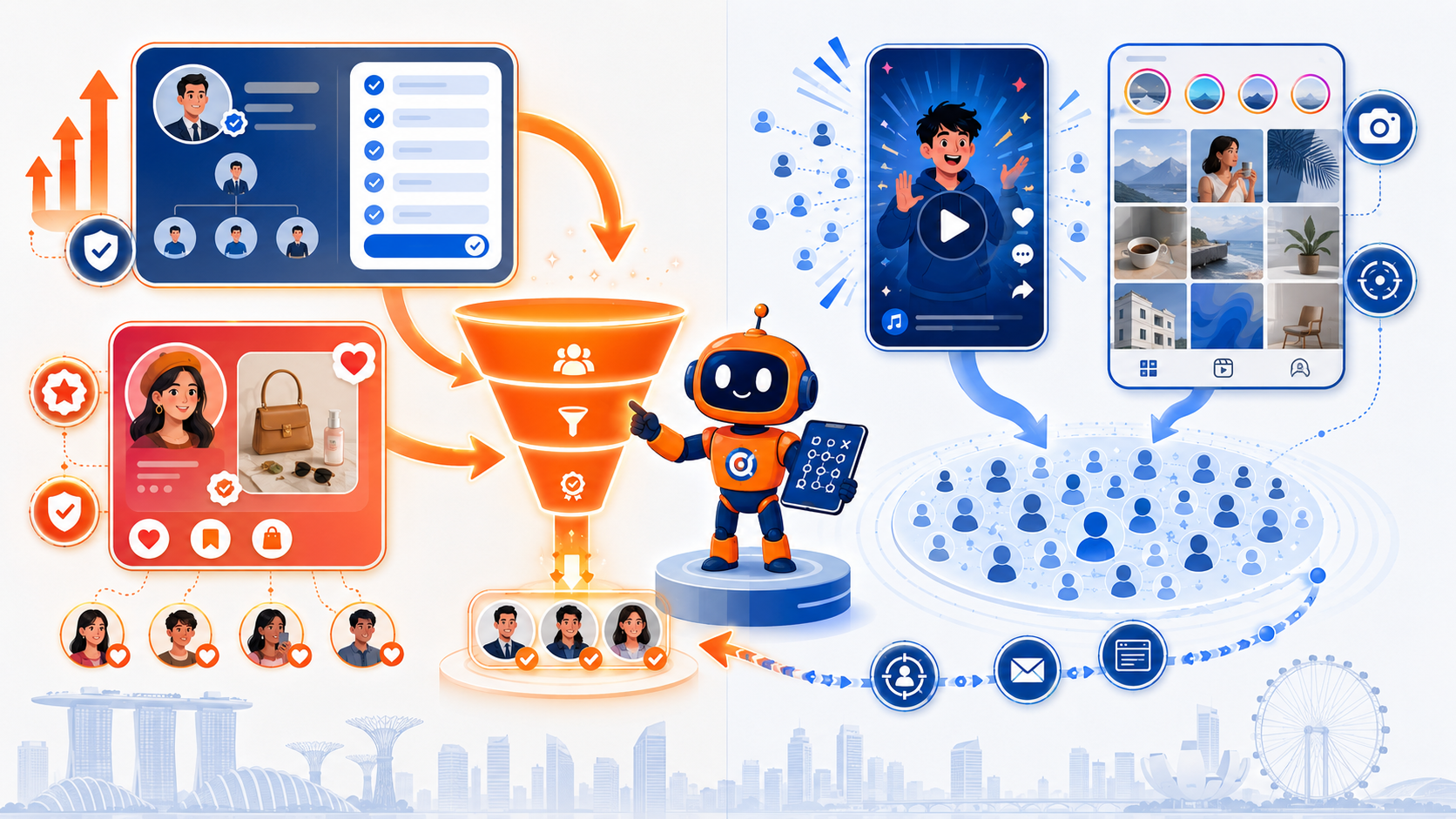
LinkedIn: The Most Under-Invested B2B Channel
LinkedIn is the most under-invested B2B channel in Singapore. Native Lead Gen Forms convert at roughly two to three times the rate of external landing pages because they pre-fill verified profile data. The platform also gives access to seniority and function-level targeting unavailable on any other paid social channel. For most B2B brands, organic LinkedIn from senior leadership outperforms paid LinkedIn from the brand handle by a wide margin.
Xiaohongshu (Little Red Book) for Chinese-Speaking Audiences
Xiaohongshu is a serious channel for Chinese-speaking audiences in beauty, fashion, lifestyle and F&B. Paid ads on the platform underperform. Influencer collaborations carry the channel.
TikTok and Instagram as Awareness Layers
TikTok and Instagram remain effective at the awareness layer. Their lead forms suffer the same low-intent issue as Meta and should be treated as discovery channels feeding into other capture mechanisms. Budgeting them as pipeline channels is a category error that we see repeatedly in audits.
| Platform | Best Role | Rationale |
| Pipeline channel for B2B | Verified targeting, high commercial intent | |
| Xiaohongshu | Pipeline channel for Chinese-speaking lifestyle | Trust-based influencer commerce |
| TikTok | Awareness and discovery | Algorithm rewards entertainment over intent |
| Brand-building and remarketing | Strong visual identity layer, weak lead capture |
Method 5: Email Marketing With PDPA Discipline
The Personal Data Protection Commission’s Advisory Guidelines on Requiring Consent for Marketing Purposes require clear consent before marketing emails are sent. The most common compliance failure we see is agencies scraping LinkedIn contacts or using purchased lists and claiming legitimate interest as a defence. Legitimate interest as a general justification does not exist in Singapore the way it does under GDPR. This is a commercial risk, not a paperwork issue.
The structural fix is to stop broadcasting and start segmenting by pipeline stage.
| Pipeline Stage | Content Type | Rationale |
| Cold | Educational content, industry insights | Build authority before any sales motion |
| Warm | Case studies, product demos, comparison content | Buyer is evaluating options actively |
| Hot | Pricing, testimonials, urgency framing | Buyer is selecting a vendor |
When we restructure email programmes around pipeline stages instead of broadcast lists, we typically see open rates lift twenty to forty percent, click-through rates lift thirty to sixty percent, and lead-to-opportunity conversion improve fifty to one hundred percent. The lift is consistent enough that we now expect it on every engagement.
For the full regulatory perimeter on Singapore-compliant marketing communications, see our Singapore digital marketing laws compliance guide.
Method 6: Referral Programmes Built for Trust Currency
Singapore is a high-trust, network-driven market. Singaporeans ask their network before buying high-value services. This is the single most underexploited commercial fact in this market.
The implication is straightforward. A properly designed referral programme delivers higher close rates and higher lifetime value than almost any paid channel. Yet referral remains the most under-built channel we see in audits, typically a forgotten line item with no dedicated budget, tracking, or incentive structure.
A hard opinion we will defend is that cash incentives cheapen premium brands. Service credits, exclusive access tiers, charitable donations on behalf of the referrer, or early-access product invitations carry more weight in Singapore. The referrer’s motivation is rarely the money. It is the reputational signal of recommending something good.
| Incentive Type | Best Fit | Rationale |
| Service credits | Subscription and recurring services | Reinforces the value of the product without devaluing it |
| Exclusive access tiers | Premium and luxury brands | Signals status to both referrer and referee |
| Charitable donations | Mission-led and ESG-conscious brands | Aligns the referral act with brand values |
| Early-access product invitations | Tech, fintech and product-led brands | Creates anticipation and word-of-mouth velocity |
| Cash incentives | Mass-market, transactional offers only | Effective when brand positioning is price-led |
Method 7: Webinars and Chatbots Designed for Qualification
Webinars Designed as Qualification Filters
Most Singapore webinars are designed for registration volume. They open registration to anyone, deliver generic content, and end with a soft CTA. The result is predictable. High registration, low attendance, no pipeline.
The contrarian design uses webinars as qualification filters:
- Add friction at registration with two or three qualifying questions
- Build content around a specific buyer challenge with measurable outcomes
- Close with a direct CTA such as “Book a strategy call now”
- Follow up with attendees within twenty-four hours using a personalised note referencing the specific challenge they registered with
Webinar attendees who survive that filter convert to opportunities at three to five times the rate of generic form fills.
The Chatbot Contrarian Call
A strong opinion, said plainly. Most Singapore businesses deploying chatbots in 2026 are accidentally reducing the quality of their pipeline.
Chatbots are useful in three narrow scenarios. After-hours enquiry capture. FAQ deflection. Low-value high-volume enquiries. Outside these scenarios, they degrade trust. High-value B2B prospects expect a human within two clicks. Premium brands cheapen themselves by routing a $50,000 buyer through a scripted dropdown menu. Complex services lose nuance the moment a bot mis-routes a qualifying question.
The data supports the opinion. Leads captured via direct form fill or human chat convert at roughly two to three times the rate of generic chatbot flows in our portfolio.
If a chatbot is necessary, the MediaOne Chatbot Qualification Ladder is the only design we deploy.
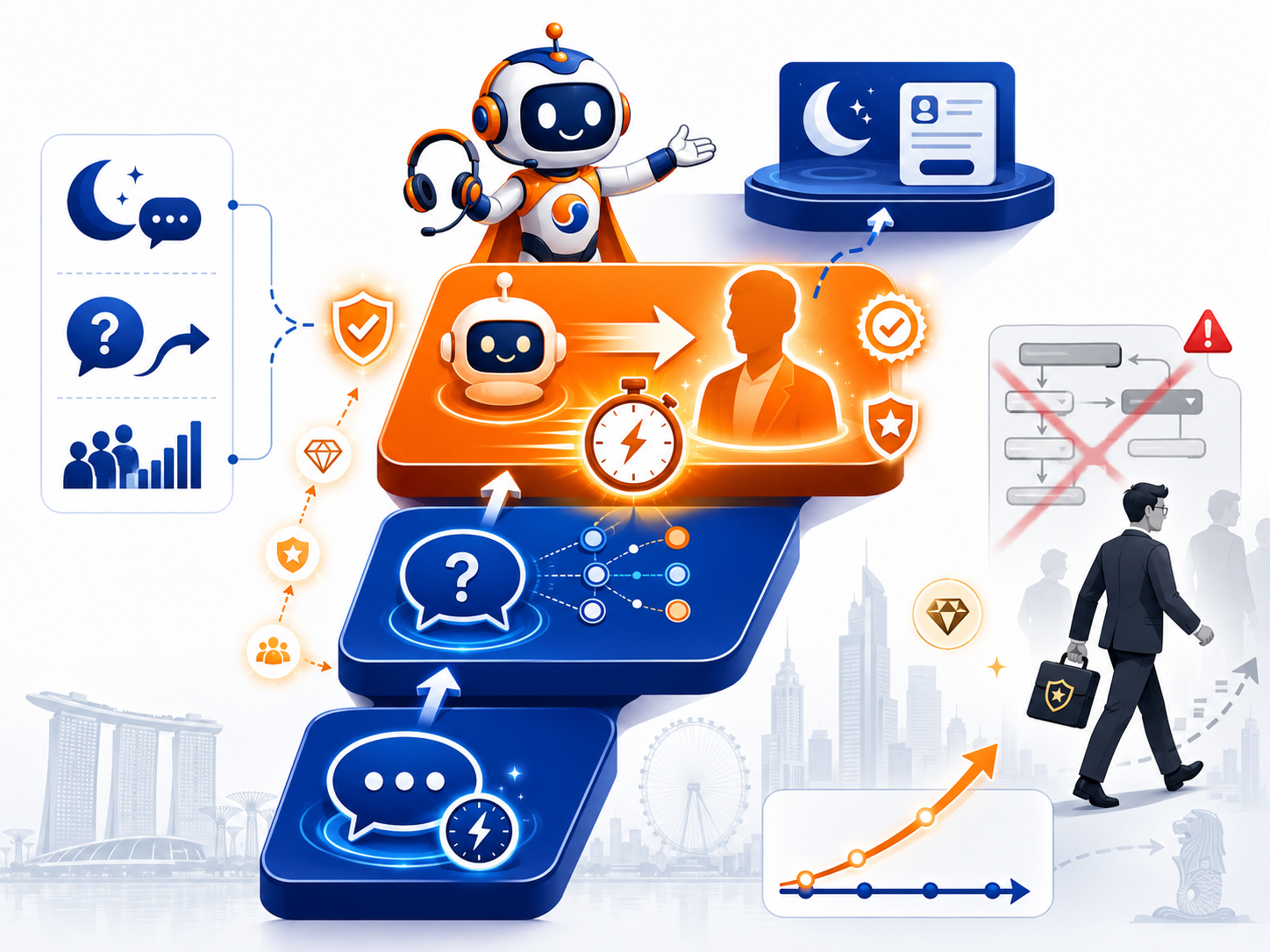
| Step | Action | Purpose |
| 1 | Acknowledge enquiry in one sentence | Confirm receipt without scripted friction |
| 2 | Ask one open-ended qualifying question | Capture intent signal without interrogation |
| 3 | Offer immediate human handoff within two minutes | Preserve high-value enquiries |
| 4 | Capture contact details only if a human is unavailable | Maintain continuity for after-hours leads |
A chatbot should support a human conversation, never substitute for one.
The Singapore-Specific Compliance and Funding Position
PDPA Discipline Most Agencies Get Sloppy About
| Requirement | Common Mistake | What Should Happen |
| Opt-in consent | Pre-checked boxes on forms | Checkboxes must be unchecked by default |
| Consent language | Vague “we may contact you” | Purpose-specific consent for each use |
| Unsubscribe handling | Manual removal taking days | Automated, immediate honouring |
| Do Not Call Registry | Skipping check before phone or SMS outreach | Mandatory check before any voice or text outreach |
PSG: The Fifty Percent Funding Most Agencies Do Not Bother Structuring For
The Productivity Solutions Grant from Enterprise Singapore can fund up to fifty percent of qualifying digital projects for eligible SMEs. Eligibility is clear:
- Business registered and operating in Singapore
- At least thirty percent local shareholding
- Annual revenue below $100M or fewer than 200 employees
- Solution purchased from an IMDA pre-approved vendor under the SMEs Go Digital programme.
| What Qualifies | What Does Not |
| Projects with defined scope, deliverables and KPIs | Vague monthly retainers |
| Solutions purchased through PSG pre-approved vendors | Solutions from non-listed vendors |
| Digital transformation work building owned systems | Pure media spend with no system implementation |
Any Singapore SME running paid lead generation in 2026 without checking PSG eligibility is leaving half its budget on the table. The fact that most agencies do not structure campaigns to qualify is a commentary on the agency, not the grant.
The MediaOne Lead Stack Blueprint
Most agencies recommend tools based on commission. Here is the stack we actually deploy.
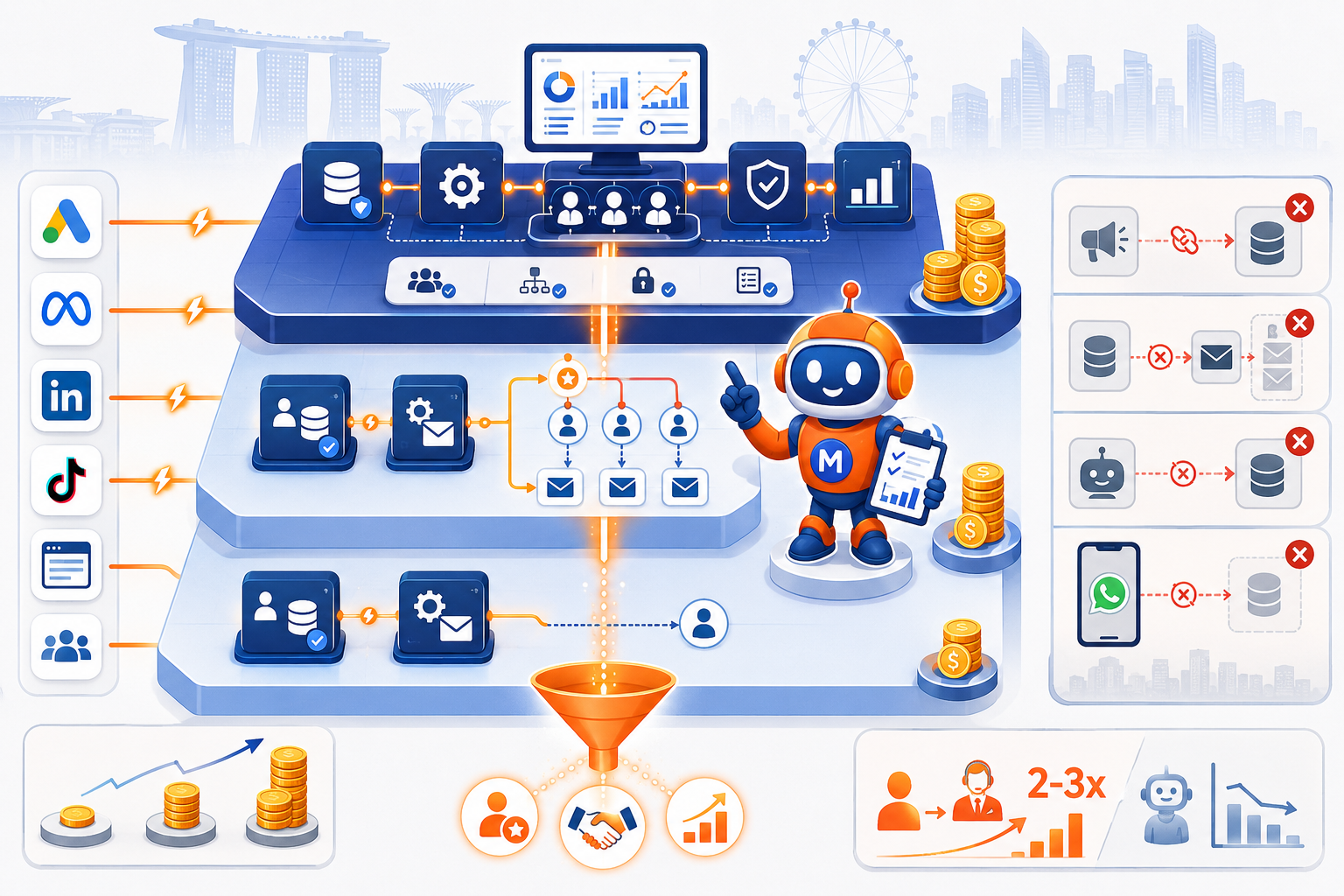
| Business Size | CRM Recommendation | Email and Automation | Realistic Monthly Cost | Rationale |
| SME (1–20 staff) | HubSpot Free or Pipedrive | Mailchimp or ActiveCampaign | $200–$800 | Lightweight stacks match simple funnels |
| Mid-Market (20–200 staff) | HubSpot or Salesforce Essentials | HubSpot or ActiveCampaign | $1,000–$5,000 | Workflow complexity justifies tighter integration |
| Large (200+ staff) | Salesforce or Dynamics 365 | Marketo or Pardot | $5,000–$20,000+ | Multi-team governance and reporting needs dominate |
For a deeper comparison, see our HubSpot CRM Singapore review and our guide to selecting the right CRM for your business.
The HubSpot opinion few say out loud. HubSpot is over-recommended in Singapore. Many agencies push it because partner commission structures are generous. For SMEs with simple funnels, lighter stacks like Pipedrive plus ActiveCampaign deliver the same outcomes at a third of the cost. We will tell you when HubSpot is the right choice. We will also tell you when it is not.
Common integration failures we fix in the first thirty days of every engagement:
- Ad platforms failing to sync leads to CRM in real time
- CRM status changes failing to trigger email sequences
- Chatbots not logging leads in the CRM at all
- WhatsApp Business conversations sitting on a single phone instead of the CRM
Channel Compounding: Why Single-Channel Strategies Underperform
The most effective lead generation methods in Singapore do not compete with each other. They compound. A typical winning journey we see on integrated accounts:
- Prospect discovers the brand through SEO-ranked Intent Stack content
- Does not convert. Leaves the site
- Gets retargeted with a PPC ad three days later
- Lands on a service page. Downloads a free audit
- Enters an email nurture sequence segmented by industry
- Books a strategy call after the third nurture email
Single-channel attribution would record this as “email converted the lead”. The honest answer is that the channels compounded. The conversion would not have happened without all five touchpoints.
An e-commerce client we worked with was running SEO, PPC and email as separate workstreams with separate agencies. We restructured them around sequenced journeys. Revenue grew sixty percent with no increase in spend. The leads were not new. The choreography was.
Future Trends for Lead Generation in Singapore
Looking into 2027 and beyond, four shifts will reshape the lead generation methods that build qualified pipeline in Singapore. We are already adjusting client roadmaps around them.
-
Generative Search Will Replace Top-of-Funnel SEO Volume
Generative search experiences across Google, Perplexity and Bing already answer informational queries inside the results page. Top-of-funnel blog traffic will continue to compress. The winning move is to invest in commercial-intent service pages and Intent Stack content where buyers still click through. For brands wanting to win citations inside AI answers, see our work on GEO optimisation services.
-
Group Buying Decisions Will Lengthen B2B Cycles
Forrester’s 2026 research on B2B buying group dynamics confirms that buying groups of six or more stakeholders are now the norm. Lead generation systems will need to capture and nurture multiple stakeholders within a single account, with content tailored to each role. Single-contact nurture sequences will underperform account-based sequences by an increasing margin.
-
Messaging Channels Will Absorb More of the Funnel
WhatsApp Business and Telegram will continue to absorb steps that used to live on landing pages and in email sequences. Qualification, scheduling, document exchange and even contract signing will increasingly happen inside messaging threads. Brands that build proper messaging infrastructure will outpace brands still relying on email-first nurture.
-
AI-Native Buyers Will Reward Specificity and Punish Generic Content
Buyers using AI assistants to research vendors will increasingly demand specific case studies, named outcomes, and verifiable proof points. Generic positioning copy will lose ground to content that names the client, the metric and the timeframe. The brands publishing the most specific evidence will be the ones AI tools cite and recommend.
The MediaOne Lead Generation Readiness Checklist
| No. | Checklist Item |
| 1 | Track cost-per-qualified-lead, not just CPL |
| 2 | Calculate the Lead Value Equation for every channel monthly |
| 3 | Know close rate by lead source, not just by campaign |
| 4 | Respond to Tier 1 leads within five minutes during business hours |
| 5 | PDPA consent validated on every form, with no pre-checked boxes |
| 6 | Do Not Call Registry checked before any phone or SMS outreach |
| 7 | PSG eligibility confirmed before any major campaign build |
| 8 | Budget allocated by close rate, not CPL |
| 9 | Ad platforms sync leads to the CRM automatically |
| 10 | Chatbot offers human handoff within two minutes |
Brands ticking eight or more of these run lead generation methods that compound. Brands ticking five or fewer run lead generation methods that leak.
Build Qualified Pipeline With MediaOne
Lead generation in Singapore in 2026 is about building qualified pipelines that closes, scales revenue, and justifies every dollar spent. MediaOne has spent fifteen years building lead generation systems that compound. SEO foundations that generate leads for years. Referral programmes that turn customers into advocates. Response-speed systems convert at three to five times the market average. Channel strategies sized by close rate.
Move beyond vanity metrics with a qualified pipeline system built around your buyer, your sales motion, and your unit economics. As a geo agency engineering lead generation that compounds for Singapore brands, MediaOne is ready when you are. Request a quote to scope your system.
Frequently Asked Questions
What Is A Qualified Lead In Singapore?
A qualified lead matches your ideal customer profile, has buying authority, has budget, and has a defined timeline. Most agencies report lead volume. MediaOne reports qualified pipeline.
How Fast Should Sales Follow Up?
Within five minutes for Tier 1 leads. Beyond that, conversion drops thirty to fifty percent. Beyond an hour, eighty to ninety percent of the opportunity has gone.
Can Lead Generation Be Claimed Under PSG?
Yes. The Productivity Solutions Grant covers up to fifty percent of eligible projects. MediaOne is PSG pre-approved and has helped dozens of clients structure qualifying scopes.
What Is A Realistic Cost-Per-Qualified-Lead?
It varies by industry. Professional services sit at $80–$250. B2B SaaS at $100–$400. An agency reporting $5 CPL on B2B SaaS is measuring form fills, not qualified leads.
How Do You Measure Lead Quality?
By tracking cost-per-qualified-lead after sales scrubs out junk, lead-to-opportunity conversion by channel, close rate by channel, and revenue per lead source. Then we calculate the Lead Value Equation for each channel to determine true profitability. Anything else is a vanity metric.