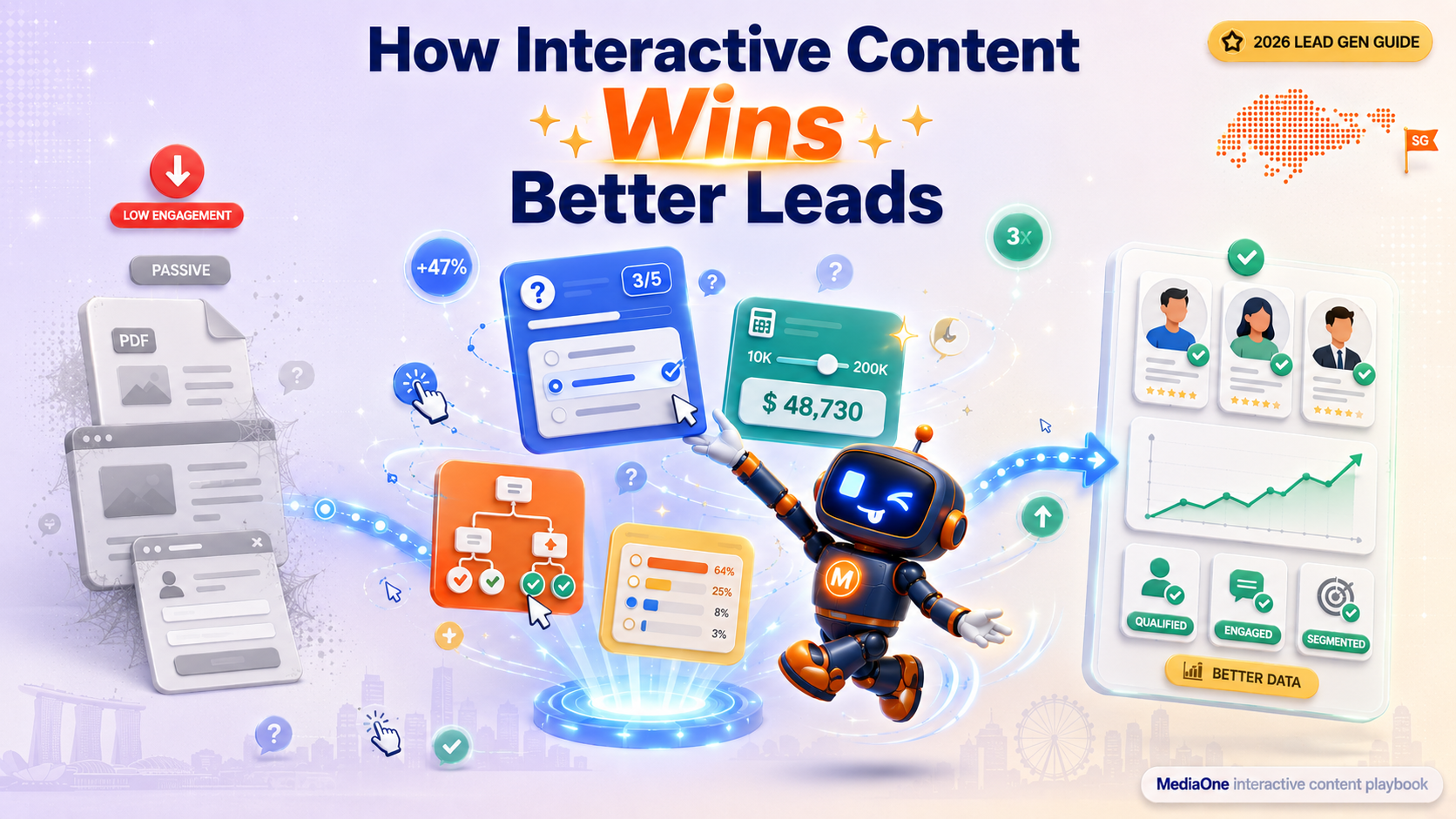
If you are still pouring budget into blog posts and downloadable PDFs to drive online lead generation for your business, you are watching attention and intent slip past you. Static content still has a role, but it can no longer carry qualification and conversion on its own. Buyers today want clarity about their own situation, not another restatement of a problem they already understand.

Interactive content shifts that dynamic. Instead of passively scrolling, users answer questions, enter numbers, or assess their current state, and in return they receive personalised insights. That exchange is what gives interactive content its commercial value, and it is the reason so many Singapore businesses are searching for how to generate online leads without cold calling or relying purely on paid traffic.
Buying behaviour has changed. Gartner research on the B2B buying journey shows that B2B buyers spend only around 17 per cent of their total buying time meeting with all potential suppliers combined, and when that time is split across three vendors, any single supplier may get as little as 5 to 6 per cent of the buyer’s attention. If your content does not help buyers self-diagnose early, you lose relevance before a sales conversation ever begins.
At MediaOne, we call this the Self-Diagnosis Gap, the space between what a buyer already suspects and what they can prove with data. Businesses that close that gap early tend to enter sales conversations from a stronger position, while businesses that ignore it often find themselves competing on price rather than value.
For businesses in Singapore that want to close that gap, working with an experienced lead generation company can turn interactive content into a system that produces qualified enquiries, not just clicks.
This guide is written for business owners and marketers in Singapore who want better leads, not more traffic. It focuses on B2B and service-based growth, with examples that translate to B2C where relevant.
Key Takeaways
- Online lead generation works best when content helps buyers self-diagnose, rather than simply explaining concepts they already grasp.
- Quizzes, tools, and assessments each serve a different stage of the funnel: awareness, mid-funnel intent, and bottom-of-funnel qualification.
- Interactive content improves lead quality because user inputs reveal budget, urgency, and readiness before the first sales call.
- Progressive profiling outperforms aggressive gating, and it aligns with Singapore’s PDPA expectations around purpose limitation.
- Integration is where the real value sits. When results flow into the CRM, interactive content becomes a repeatable process for generating qualified leads online rather than a one-off campaign.
What Counts as Interactive Content in Lead Generation?
Interactive content is any digital asset that adapts based on user input and delivers a tailored result, whether that is a score, a projection, a recommendation, or a diagnostic summary.
Static content delivers the same message to every visitor, while interactive content responds to the visitor’s context, and that response is what creates perceived value. It is also why users searching for the best lead generation strategy for small businesses in Singapore increasingly land on quizzes and calculators rather than on generic service pages.
Three formats consistently produce results:
- Quizzes that identify traits, readiness, or preferences.
- Tools and calculators that answer cost, ROI, or feasibility questions.
- Assessments and diagnostics that evaluate maturity, risk, or fit.
Engagement formats such as polls, games, or AR experiences are excluded from this guide unless they are directly tied to lead capture. Across the lead funnels we have audited at MediaOne, most “fun” interactive experiences drive vanity metrics rather than revenue, a pattern we also flagged in our breakdown of the hidden funnel gaps that quietly stall lead generation in Singapore.
Using Quizzes for Lead Generation
Quizzes are often dismissed in B2B because they are associated with lightweight consumer marketing, but that assumption is expensive. When designed with commercial intent, quizzes become one of the most efficient ways to attract, qualify, and segment leads before a sales conversation begins, which is exactly what people are asking when they search how to use quizzes for B2B lead generation or do quizzes actually work for lead generation.
A well-built quiz walks the prospect through a short decision process and helps them articulate a problem they already sense but have not fully defined, so by the time they reach the result screen, they arrive at your sales team with context rather than as a cold enquiry.
What Makes a Lead-Generating Quiz Work
A quiz must begin with a clear promise of outcomes, because a vague outcome drops completion rates and lead quality. You are not testing trivia. You are helping the user understand a specific aspect of their business, performance, or readiness.
High-performing quizzes consistently share four traits, and removing any one of them weakens conversion:
- A narrow, problem-focused topic that reflects a real buying trigger.
- Six to ten questions, which most studies associate with strong completion rates without sacrificing insight.
- A logical flow that starts broad and becomes more specific as intent becomes clearer.
- Results that feel personalised, practical, and tied to a next step.
According to industry data reported by interactive content platforms such as Outgrow’s quiz benchmarks, well-built quizzes can achieve completion rates of around 65 per cent, with roughly 40 per cent of quiz takers converting into a lead, well above what most static landing pages produce. Shorter, conversational quizzes consistently outperform long or overly formal ones, which is especially relevant for B2B audiences who value efficiency.
Every question must earn its place. If a question does not influence segmentation, scoring, or follow-up, it should not be in the quiz.
Types of Quizzes That Generate Leads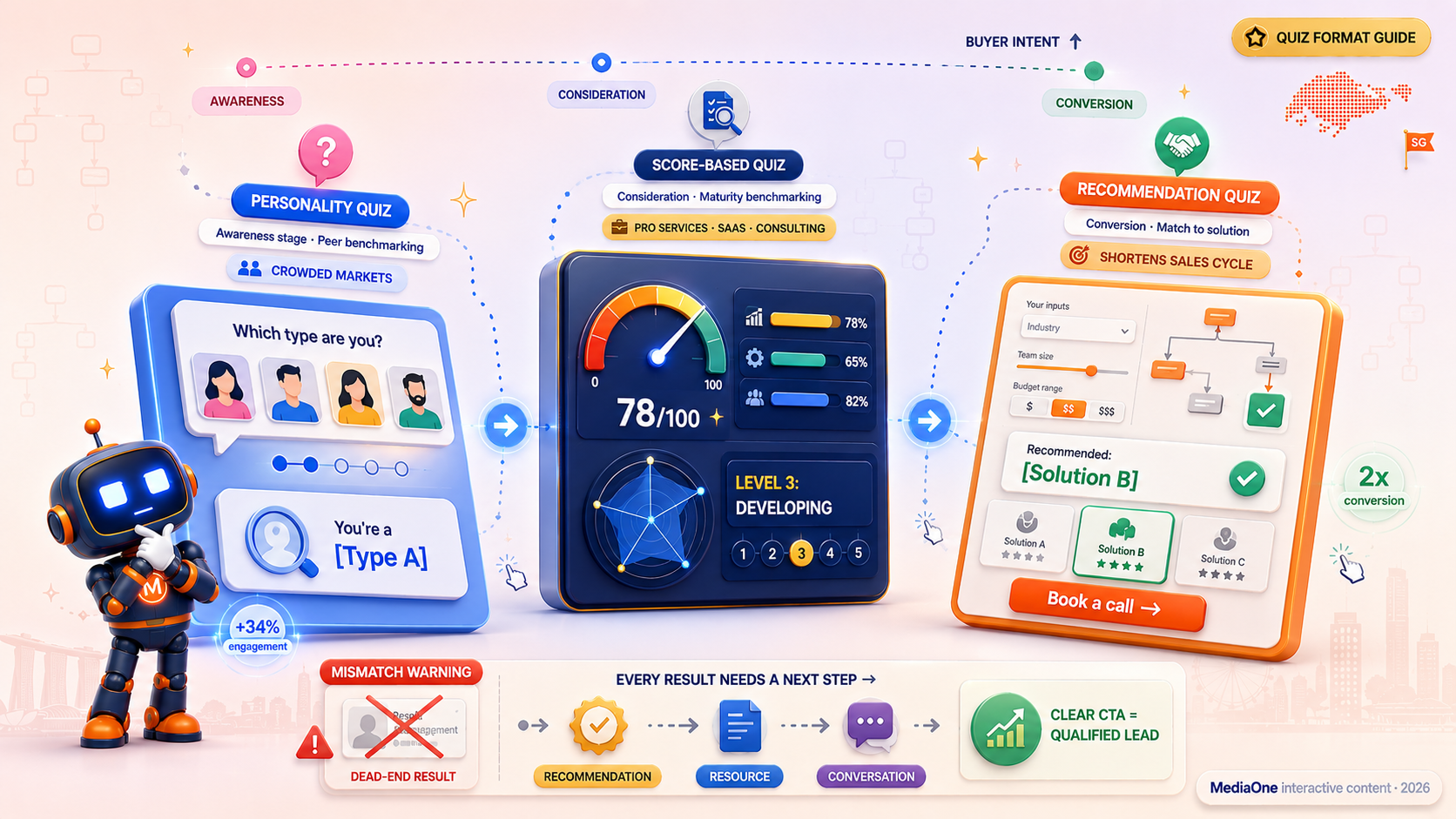
The format you choose should align with where your prospect sits in their decision process, which is where many businesses go wrong when they search for best type of quiz for lead generation and copy a competitor without matching format to intent.
- Personality-style quizzes work best at the awareness stage, helping prospects identify where they sit relative to peers or best practices. These are effective when the market is crowded or when buyers struggle to articulate their needs.
- Score-based quizzes are analytical and benchmark performance, maturity, or readiness against defined criteria. These work particularly well for professional services, consulting, and SaaS, where buyers want validation before committing time or budget.
- Recommendation quizzes are closer to conversion, matching users to services, plans, or solutions based on inputs. Done well, they reduce friction and shorten sales cycles by setting expectations early.
Every quiz must map to a clear next step, because a result screen without direction is a missed opportunity. The outcome should naturally lead to a recommendation, a resource, or a conversation.
Lead Capture Strategies for Quizzes
How and when you capture lead information determines whether the quiz helps or hurts performance. Gating everything up front often reduces completion rates, especially for first-time visitors, so a more effective approach is progressive profiling, letting users answer questions and experience value before requesting contact details, so the email field feels like a fair exchange rather than a barrier.
Form design plays a significant role here:
- Optional fields reduce friction and increase completion.
- Required fields should be limited to what your follow-up process genuinely needs.
- The reason for data collection should be explicit, not implied.
This approach aligns with Singapore’s Personal Data Protection Act, particularly the Purpose Limitation Obligation under Section 18 of the PDPA, which requires organisations to collect personal data only for purposes a reasonable person would consider appropriate in the circumstances. We have covered this in detail in our compliance write-up on the digital marketing laws Singapore businesses need to follow.
Example Use Cases in Practice
To show how this works outside theory, here is a recent engagement, anonymised for confidentiality.
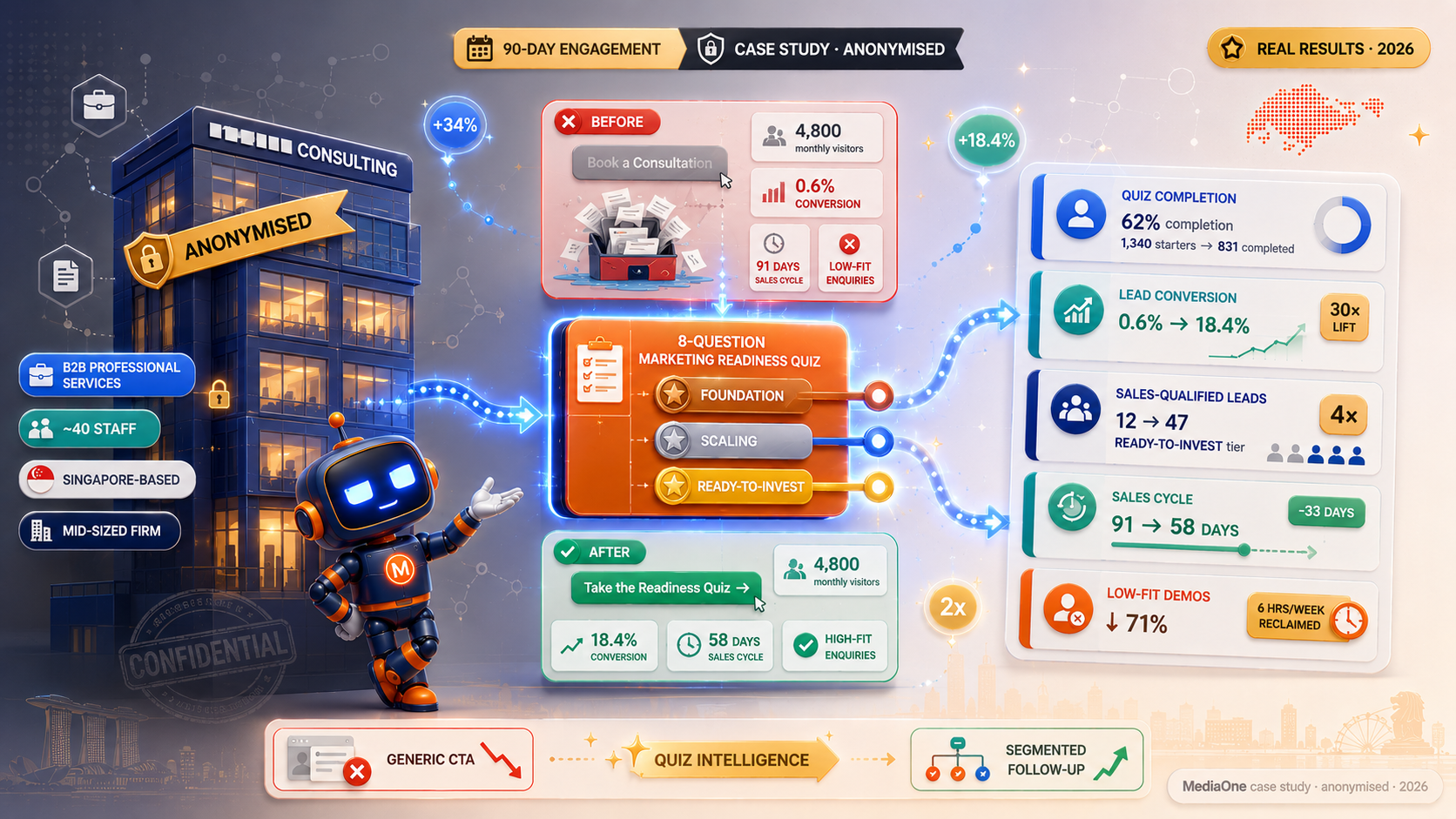
A Singapore-based B2B professional services firm, mid-sized with roughly 40 staff, came to us with a familiar problem. Their website was pulling in around 4,800 monthly visitors from a mix of SEO and LinkedIn content, but their contact form was converting at just under 0.6 per cent. The sales team was drowning in low-fit enquiries, and their average sales cycle had stretched past 90 days because every conversation started from zero context.
We replaced their generic “Book a Consultation” CTA with an eight-question marketing readiness quiz targeting SMEs exploring growth beyond referrals and word-of-mouth. The quiz segmented respondents into three tiers based on budget indication, current channel maturity, and internal capacity: Foundation, Scaling, and Ready-to-Invest. Each tier triggered a different follow-up path in HubSpot.
The results over a 90-day period:
| Quiz completion rate: | 62 per cent across 1,340 starters, giving 831 completed responses. |
| Lead-to-quiz conversion: | 18.4 per cent, meaning nearly one in five quiz takers submitted contact details for a personalised report, compared to the 0.6 per cent baseline on the old contact form. |
| Sales-qualified leads (Ready-to-Invest tier): | 47, versus 12 in the previous 90-day window. |
| Average sales cycle: | Dropped from 91 days to 58 days for quiz-originated leads, because the sales team walked into the first call already knowing budget range, current pain points, and readiness score. |
| Demos with early-stage prospects: | Down 71 per cent, freeing roughly six hours per week for the sales team to spend on higher-fit accounts. |
The interesting part was not the volume lift but the segmentation. The Foundation tier respondents, who would previously have been dismissed or nurtured poorly, now entered a dedicated educational email sequence covering fundamentals. Six months later, 14 of them had progressed into the Scaling tier and eventually converted, revenue that would otherwise have been missed entirely.
Two other patterns we see consistently across similar engagements:
- SaaS companies deploying software fit quizzes typically report a 30 to 45 per cent reduction in unqualified demo requests within the first quarter, because the quiz routes leads to the appropriate product tier before the sales rep is involved. This works best when paired with a stronger content marketing strategy in Singapore that brings the right traffic to those quizzes in the first place.
- Wellness and fitness brands using profile quizzes to personalise programmes and pricing tend to see retention improve by 15 to 25 per cent in the first six months, because expectations are aligned before the first session, not after.
In each case, the quiz acts as a filter, not a product. It does not generate demand from nowhere. It qualifies and structures the demand that already exists, so your sales team spends time on prospects who can actually buy.
Using Tools and Calculators to Capture High-Intent Leads
Tools and calculators attract a very different type of prospect, because these users are no longer exploring a topic out of curiosity. They are evaluating feasibility, cost, or upside.
That shift in mindset is exactly why tools drive high-quality online lead generation when used correctly. When someone is willing to enter their own numbers, they are signalling intent and looking for clarity, not inspiration. That is the same reason searches like how to build a lead generation calculator for my business and ROI calculator for lead generation have grown steadily among Singapore SMEs.
Why Tools Capture Higher-Intent Online Leads
Tools require effort, and that effort creates psychological buy-in while filtering out casual traffic, so the leads you capture are fewer but significantly higher in quality.
Common intent signals tools capture:
- Budget awareness, shown through cost or spend inputs.
- Urgency, reflected in timelines or growth targets.
- Readiness, revealed through current performance metrics.
From a sales perspective, this data is genuinely useful. It lets the team prioritise follow-up, personalise conversations, and avoid burning time on leads that are not yet viable. Internally, we call this the Intent Density Signal, the ratio of qualifying data points captured per completed session. The higher the density, the shorter the sales cycle tends to be.
Where Tools Fit Best in the Funnel
Tools and calculators perform strongest in the middle of the funnel, where prospects are comparing options and pressure-testing claims. They are particularly effective for:
- Services with variable pricing.
- Solutions where ROI justification is required for the buyer’s internal committee.
- Decisions that involve internal approval or budgeting.

At this stage, static content often stalls progress, while a calculator creates forward motion by helping the buyer build a business case internally. When a marketing manager can walk into a meeting with numbers rather than a blog link, decisions get made.
Why Calculators Outperform Blogs for Online Lead Generation
Calculators succeed because they answer the question prospects care about most, “What does this mean for me?”, turning marketing messages into decision-support tools that qualify, segment, and move prospects closer to a buying conversation without forcing one prematurely.
The result is not just more leads. It is better leads, entering your pipeline with context, intent, and momentum already in place. This is why, when clients ask us how to get more qualified leads through my website, we almost always recommend a calculator before another blog post, a pattern also reflected in our roundup of lead generation methods that drive qualified pipeline.
Using Assessments and Diagnostics for Lead Qualification
If quizzes spark interest, assessments make decisions easier. An assessment is not designed to entertain or generate curiosity clicks. It is built to evaluate, and when done well, it helps your prospect answer a hard question they are already asking themselves: are we actually ready for this?
By the time someone completes a diagnostic, they are pressure-testing their options and seeking confirmation before committing time, budget, or internal buy-in. This is where assessments quietly outperform almost every other content format for lead qualification, because they reframe the sales conversation. Instead of you telling the prospect why they need your service, they identify the gaps themselves.
How Assessments Differ from Quizzes
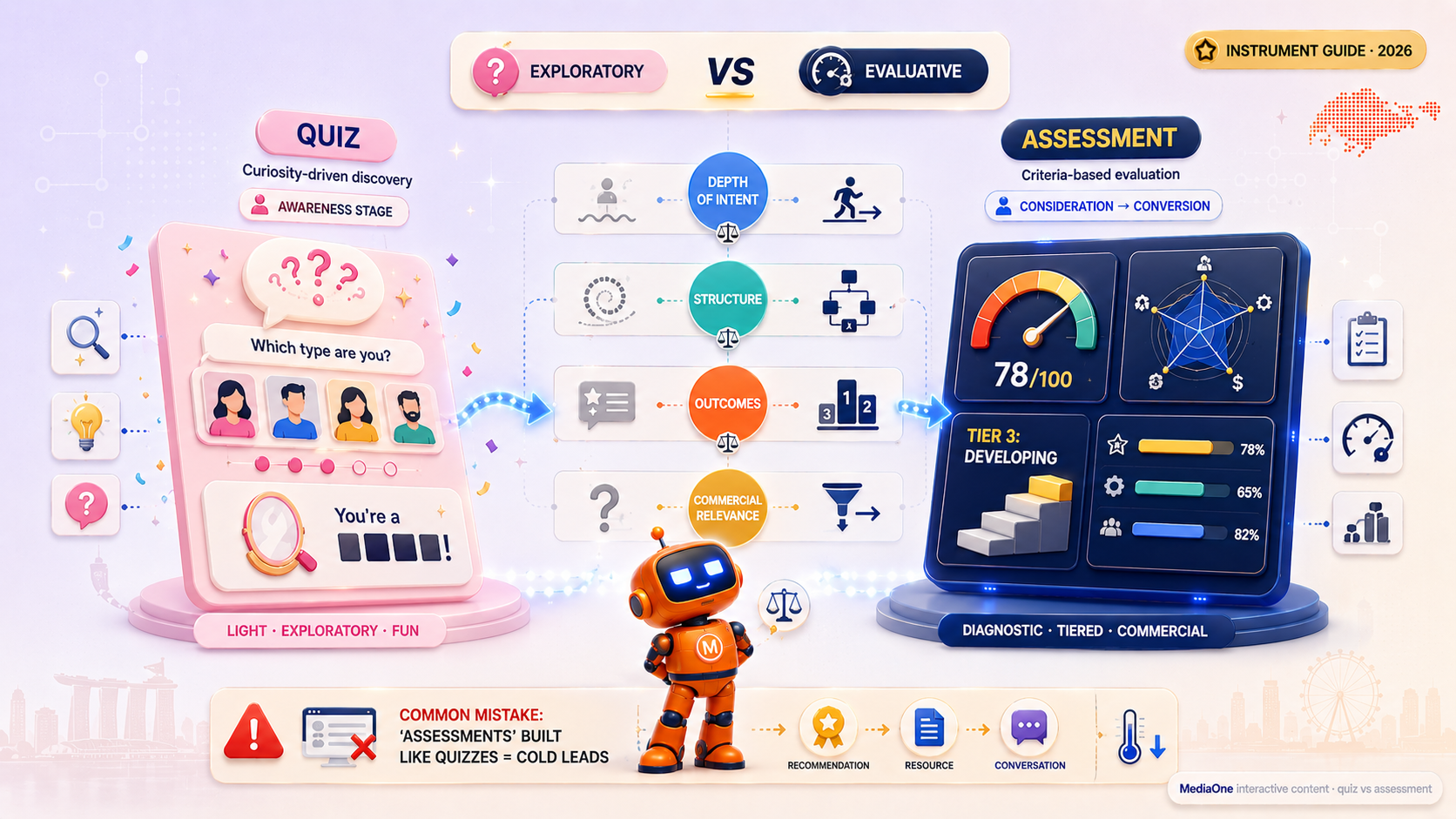
Quizzes are exploratory, assessments are evaluative. A quiz helps a user discover something about themselves in a light, low-stakes way, while an assessment diagnoses readiness, risk, or maturity against defined criteria. This distinction is one most articles skip, which is why so many businesses build “assessments” that behave like quizzes and then wonder why the leads are cold.
Key differences:
- Depth of intent. Assessments attract prospects who are already considering action.
- Structure. Questions follow a logical framework rather than a curiosity arc.
- Outcomes. Results are scored, categorised, or tiered, not descriptive or playful.
- Commercial relevance. Each outcome aligns to a clear next step in your funnel.
Assessments are most effective in the mid to bottom stages of the funnel, where buyers want clarity more than inspiration.
When to Use Assessments
Assessments work best when decision-making is complex and the stakes are high, specifically when:
- Your service is high-ticket or strategic.
- The sales cycle involves multiple stakeholders or long consideration periods.
- Prospects vary widely in readiness, sophistication, or risk profile.
- A wrong-fit customer would be costly for both sides.
For example, a digital marketing agency offering full-funnel growth retainers gains far more value from an assessment than from a generic contact form, and the same applies to consulting firms, enterprise software providers, financial services, and training organisations.
In these cases, the assessment acts as a filter that protects your team’s time while giving serious prospects a structured way to self-qualify.
Building an Effective Assessment
A strong assessment answers three questions for the user: Where am I now? What does that mean? What should I do next?
To achieve that, several elements must be in place:
- Clear scoring or classification logic. Your assessment needs an underlying model, whether that is a maturity scale, risk tier, or readiness score. The logic should be consistent and defensible so users feel that their result reflects their inputs, not a vague algorithm.
- Criteria aligned with real success factors. Questions must map to factors that genuinely influence outcomes in your industry, so avoid vanity metrics or surface-level checks. If your service succeeds or fails based on budget, leadership buy-in, or internal capability, those dimensions should be reflected.
- Actionable recommendations tied to results. A score alone is not enough. Each outcome should come with specific, relevant guidance, and this is where authority is built.
- Segmentation that informs next steps. Assessment results should segment users behind the scenes so different scores trigger different content paths, offers, or conversations.
When these elements are aligned, the assessment feels credible rather than sales-driven. At MediaOne, we refer to this as the Diagnose–Prescribe–Route model, the same framework we apply when auditing a client’s own lead funnels before rebuilding them.
Lead Capture and Sales Alignment
Assessments deliver the most value when they are tightly integrated with your sales and marketing systems, so assessment data should flow directly into your CRM along with the final score and key inputs. This context transforms follow-up: a sales call becomes a continuation of the assessment, not a cold introduction.
- High-scoring leads can be routed to immediate sales follow-up because readiness is already established.
- Mid-range scores may enter targeted nurture sequences that address specific gaps identified in the diagnostic.
- Lower-scoring users can be guided toward educational content rather than a premature sales pitch.
For teams still shortlisting the right stack, our review of the top lead generation tools that Singapore SMEs are using breaks down which CRMs and automation platforms handle this routing well.
Why Interactive Content Converts Better Than Static Content
Interactive content converts more effectively because it mirrors how people actually think, evaluate options, and commit to decisions. Buyers do not want more information. They want clarity about their situation, and interactive formats deliver that clarity faster than static pages ever can. This is the honest answer to the common search query why is interactive content better than blog posts for lead generation.
1. Participation Changes Attention and Behaviour
When a user must answer a question or enter a number, they stop skimming and start participating, and industry research consistently shows that interactive content generates significantly more conversions than passive content because users stay engaged longer and are less likely to bounce.
This is significant because attention is the currency of conversion. Time on page increases not because the content is longer, but because the user is invested in seeing their result, and that investment creates momentum which static content struggles to replicate.
2. Self-Relevance Makes the Insight Feel Credible
People place greater value on insights derived from their own input than on generic examples. A calculator that uses a company’s actual ad spend, revenue targets, or headcount feels grounded in reality, while a case study, no matter how well written, still feels borrowed.
You are not telling the prospect what could happen. You are showing them what might happen based on their data, and that distinction is decisive when buyers are cautious or overwhelmed with options.
3. Value Exchange Builds Trust and Consent
Interactive content creates a clear value exchange, where users provide information and receive a useful output such as a score, forecast, or recommendation, which improves perceived transparency and consent.
In markets like Singapore, where data protection expectations are high, this becomes even more relevant. Under PDPA guidelines, organisations must clearly state their purpose and limit data collection to what is necessary, and interactive content supports this by making the purpose obvious and the benefit immediate.
4. Better Engagement Leads to Better Leads
From a commercial perspective, interactive content does more than lift conversion rates. It improves lead quality:
- A calculator that requires a minimum monthly budget naturally filters out prospects who are not ready to invest.
- An assessment that segments readiness allows sales teams to prioritise follow-up based on intent rather than guesswork.
Instead of treating every enquiry the same, your team gains context before the first conversation.
5. Structured Data Fuels Smarter Follow-Up
Interactive content produces structured first-party data, answers, inputs, and scores that can be passed directly into CRMs and marketing automation platforms, which enables more accurate segmentation, lead scoring, and personalised nurturing without relying on third-party data.
As privacy regulations tighten and Google phases out third-party cookies in Chrome, this capability is no longer optional. It is foundational.
Example Online Lead Generation Tools that Translate to the Singapore Market
Tools are especially effective in markets like Singapore, where decision makers are data-driven and risk-aware. From experience running campaigns for SMEs across F&B, professional services, education, and B2B SaaS, the calculators that consistently generate quality enquiries include:
- Digital marketing ROI calculators, used to help SMEs evaluate paid media or SEO investments before committing budgets.
- Hiring cost estimators, used by HR consultancies to compare in-house hiring versus outsourcing or contract roles, which is particularly useful given Singapore’s tight labour market.
- Sustainability and resource usage calculators, aligned with initiatives such as Singapore’s Green Plan 2030, helping businesses quantify environmental impact and compliance costs.
These tools do not replace sales conversations. They improve them. By the time a lead reaches your team, the conversation is grounded in shared data rather than vague expectations.
Where Interactive Content Fits in the Lead Funnel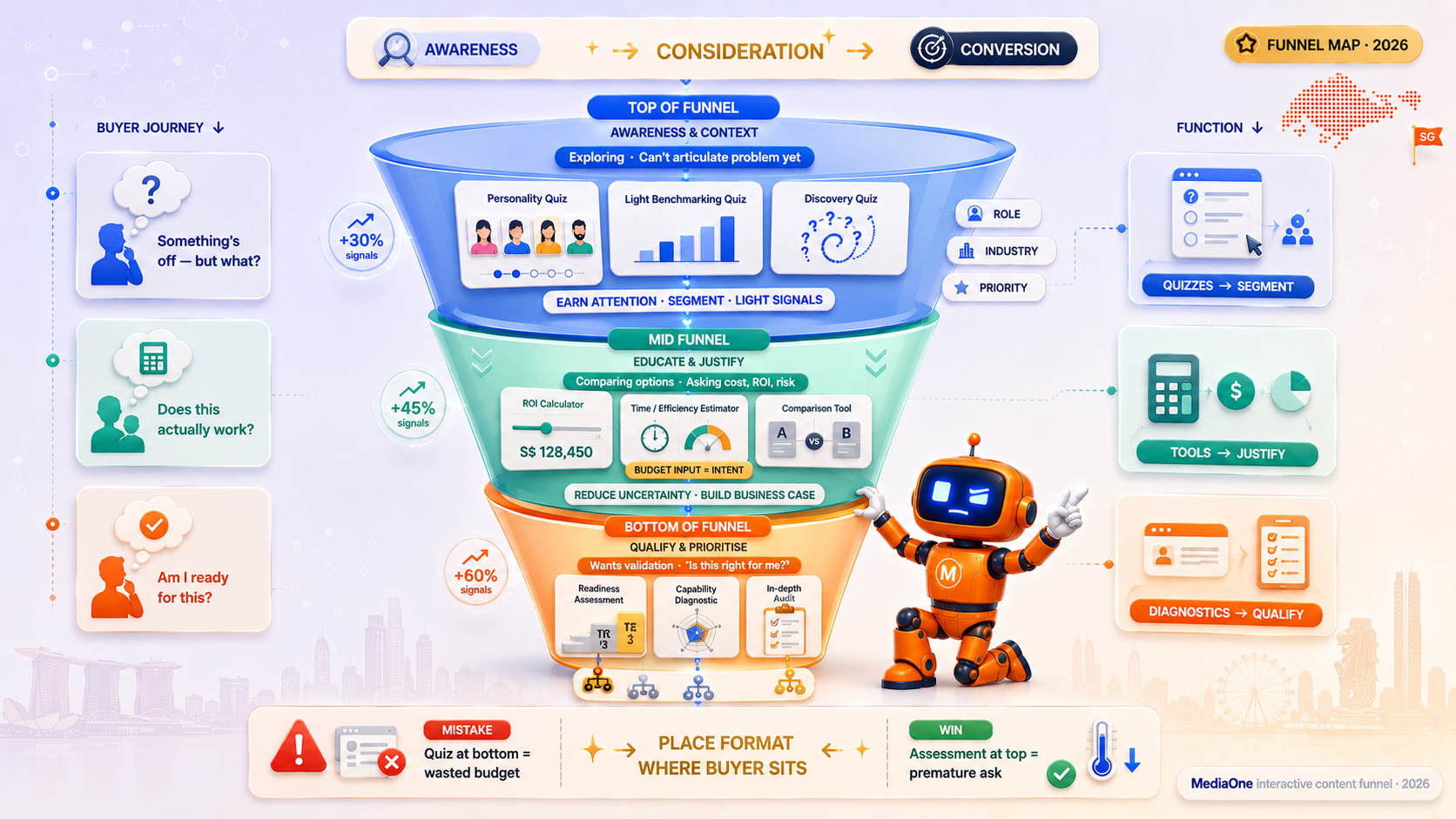
Interactive content only works when it is placed deliberately in the funnel, so treat it as strategic infrastructure rather than a clever add-on. Each format serves a different purpose depending on where your buyer is in the decision-making process, not where you want them to convert. This is the piece most guides on online lead generation for service-based businesses leave out, and it is one of the first things we address when we take on lead generation Singapore projects for SMEs that have been running quizzes or calculators without a clear funnel map.
Top of Funnel: Create Awareness and Context
At the top of the funnel, your prospect is exploring. They know something is not working, but they cannot yet clearly articulate the problem, and this is where quizzes perform best. A marketing maturity quiz, for example, helps a business owner understand whether their issue is visibility, conversion, or scalability, and that framing alone builds trust because you are helping them think, not selling to them.
At this stage, your goal is to earn attention, segment the audience, and collect light signals such as role, industry, or priority.
Best formats to use here:
- Awareness and personality-style quizzes
- Light benchmarking quizzes
- Discovery-based interactive content
Mid Funnel: Educate and Justify Decisions
Mid-funnel prospects are comparing options and asking practical questions about cost, ROI, feasibility, and risk, which is where tools and calculators become powerful. A well-built calculator connects your solution to the prospect’s real numbers, so the output feels grounded and credible.

This is also where you start filtering for seriousness, because people willing to input budget or volume are signalling intent. Mid-funnel interactive content should reduce uncertainty and help prospects build an internal business case, creating a natural bridge to conversation rather than forcing one prematurely.
Best formats to use here:
- ROI and cost calculators
- Time or efficiency estimators
- Comparison tools
Bottom of Funnel: Qualify and Prioritise
At the bottom of the funnel, prospects want validation. They are asking “Is this right for me?”, and assessments and diagnostics are most effective here because they evaluate readiness, fit, and risk. Assessments let you shift from persuasion to diagnosis, while protecting your sales team’s time by separating high-fit leads from those who need more education. When aligned with CRM workflows, assessments can trigger different follow-up paths based on score or category.
Best formats to use here:
- Readiness assessments
- Capability or compliance diagnostics
- In-depth audits
The Strategic Mistake to Avoid
The most common error is trying to make one interactive asset serve the entire funnel. A single quiz cannot replace a calculator, and a calculator cannot replace an assessment. Each format has a specific job, and when interactive content is mapped to intent rather than volume, it stops being a marketing experiment and becomes a system.
Five Execution Errors That Quietly Kill Interactive Lead Generation
Interactive content can be one of your strongest levers for conversion, but only if it is designed and deployed with restraint. Many teams adopt quizzes, calculators, or assessments with good intentions, then undermine performance through avoidable execution errors that rarely show up in dashboards immediately. They surface later as low completion rates, weak lead quality, or stalled pipelines. Below are the patterns we see most often when auditing existing lead funnels, and what to do instead.
Error 1: Overcomplication is the fastest way to lose momentum
When an interactive asset tries to do too much, users immediately feel friction, because long question sets, unnecessary branching logic, or overly technical language all increase cognitive load. Most prospects are not looking to complete a survey; they want clarity, so if your quiz or tool cannot be completed in a few minutes with clear progress cues, completion rates will drop sharply.
Error 2: Asking for too much information too early erodes trust
Early-stage visitors are still assessing you, so requesting company size, budget range, phone number, and job title before delivering value creates resistance. Interactive content works best when it earns the right to ask, and progressive profiling lets you gather essential data over time rather than requiring upfront disclosure, an approach that also aligns with the PDPA’s purpose limitation principle.
Error 3: Aggressive gating hides value instead of creating it
Locking all results behind a form often backfires. If users cannot see any meaningful insight before being asked to convert, many will abandon the experience. A more effective pattern is partial disclosure: show a preview, summary score, or directional insight, then offer deeper analysis in exchange for contact details.
Error 4: Treating interactive content as a one-off campaign limits ROI
Many businesses launch a quiz or calculator, promote it briefly, then move on, and that mindset wastes the asset. High-performing teams treat interactive content as evergreen infrastructure, embedding it into blog posts, using it in paid campaigns, referencing it in sales conversations, and refining it based on performance data.
Error 5: Ignoring follow-up is the most expensive misstep of all
Interactive content without integration is just engagement. Leads need context-driven follow-up: quiz outcomes should inform email sequences, calculator results should shape sales conversations, and assessment scores should trigger routing and prioritisation in your CRM. Interactive content fails not because the format is flawed, but because execution lacks strategy.
Keep experiences simple, earn trust before requesting data, reveal value incrementally, and integrate outcomes into your marketing and sales workflows. When those pieces are in place, interactive lead generation stops being an experiment and starts becoming a repeatable growth process.
Which Interactive Format Should You Use for Online Lead Generation?
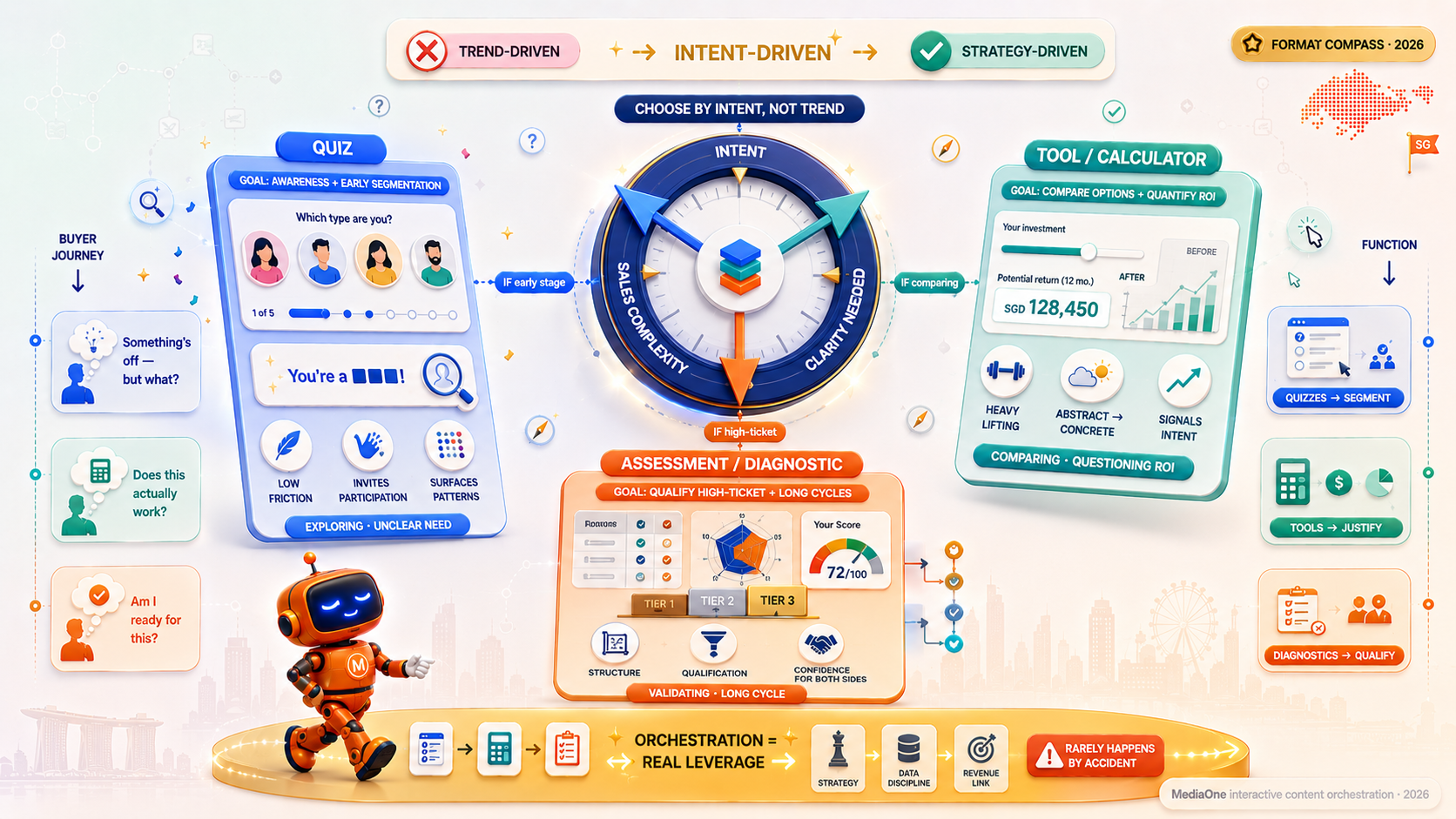
Choosing the right interactive format is about intent, sales complexity, and the level of clarity your buyer needs before they are ready to talk, not about trends or what looks impressive in a pitch deck. This is the question behind searches like which interactive content works best for lead generation and quiz vs calculator vs assessment for B2B leads.
- If your goal is awareness and early segmentation, quizzes are usually the most effective starting point because they reduce friction, invite participation, and surface patterns in audience behaviour.
- If your prospects are actively comparing options or questioning ROI, tools and calculators do the heavy lifting, translating abstract value into concrete numbers and signalling buying intent.
- If you are selling higher-ticket services or navigating longer sales cycles, assessments and diagnostics provide the structure, qualification, and confidence both parties need.
The real leverage comes from orchestration. Interactive content performs best when each format plays a defined role across the funnel, supported by clear follow-up and measurable outcomes. That level of integration rarely happens by accident; it requires strategy, data discipline, and a clear understanding of how digital touchpoints influence revenue.
Conclusion
Interactive content is not a trend. It is how modern buyers prefer to engage, evaluate, and commit. When quizzes, calculators, and assessments are matched to the right stage of the funnel and connected to a disciplined follow-up process, they can shift passive traffic toward qualified pipeline.
If you want interactive assets that do more than engage, our team at MediaOne, a Singapore-based lead generation firm working with SMEs and enterprise clients, can help you design, build, and integrate quizzes, tools, and assessments that align with your commercial goals. Explore our full range of services at a premier digital marketing agency in Singapore to see how interactive content fits alongside SEO, paid media, and content strategy.
Frequently Asked Questions
What is the difference between lead generation and demand generation?
Lead generation focuses on capturing identifiable prospects who have shown interest and can be contacted for follow-up. Demand generation builds broader awareness and interest over time so that future online lead generation efforts attract warmer, better-informed buyers. The two work best when demand generation feeds the top of the funnel and lead generation captures the demand as it matures.
How do you measure the success of online lead generation?
Success is measured by lead quality, conversion rates, and revenue impact rather than traffic volume alone. Common indicators include qualified leads generated, cost per lead, pipeline contribution, and the number of leads that progress into sales conversations. For interactive content, completion rate and score distribution are also useful early signals.
What role does SEO play in online lead generation?
SEO supports online lead generation by making content discoverable when buyers actively search for solutions. Ranking for intent-driven queries increases the likelihood that visitors arrive with context and readiness, which improves lead quality and conversion performance. Interactive assets often rank well because they attract stronger engagement signals than static pages.
Social media can support online lead generation by distributing content and driving traffic to lead capture experiences. It is most effective when used to guide users towards high-intent assets such as tools, assessments, or targeted landing pages rather than relying on engagement metrics alone. LinkedIn tends to perform strongly for B2B services in Singapore.
What is lead validation, and why is it important in online lead generation?
Lead validation is the process of confirming that a lead is genuine, relevant, and aligned with your ideal customer profile. In online lead generation, validation improves sales efficiency by reducing time spent on poor-fit or low-intent enquiries. Interactive content simplifies validation because inputs from the user already reveal much of what a sales team needs to qualify a lead.