Want to boost revenue and stay ahead of the competition? Understanding performance SEO helps you move beyond vanity metrics and focus on the outcomes that matter, including stronger rankings, more qualified traffic, and higher revenue potential.

For businesses managing growth internally or working with an SEO agency, performance SEO offers a more measurable way to connect search visibility with real business results. This article breaks down the essentials, layered with proprietary frameworks and first-hand patterns drawn from years of working with enterprise and high-growth clients. You will learn how to optimise your SEO approach so traffic growth translates into meaningful business gains, and how to measure performance SEO in a way that earns boardroom attention.
Key Takeaways
- Performance SEO is the practice of tying every search optimisation decision to a measurable commercial outcome, including revenue, conversion rate, average order value, and customer lifetime value.
- Traffic alone is a misleading metric. The brands winning at performance SEO measure revenue per organic visitor and cost per acquired customer through organic search.
- AI Overviews, voice search, and entity recognition have reshaped what performance SEO needs to optimise for in 2026. Citation in AI answers is becoming as important as ranking position.
What Performance SEO Actually Means
Performance SEO is search engine optimisation done with a profit-and-loss perspective applied to every decision. The discipline integrates keyword research, on-page enhancements, technical foundations, and link building, while every activity ties back to a commercial outcome the business actually cares about.
The objective involves improving your position on search engine results pages so prospects discover you, while simultaneously ensuring the visitors who arrive are the ones most likely to convert into customers.
Organic traffic remains the foundation. Approximately 75% of internet users do not look beyond the first page of search results, which makes top-of-page visibility commercially decisive. McKinsey’s analysis of winning in the age of AI search puts the revenue at stake even higher, projecting that AI-powered search could influence US$750 billion in revenue by 2028.
Enhancing online visibility involves more than ascending in search engine ranks. It includes amplifying brand awareness, drawing precise leads toward your site, and understanding where competitors excel or fall short so you can outshine them effectively. An optimised site aids crawlers from various search engines in comprehending and cataloguing content properly, which expands opportunities for organic traffic inflow.
The Performance SEO Profit Equation
Most performance SEO articles stop at “track conversions” and call that strategy. The brands that actually grow revenue from organic search treat performance SEO as a profit equation with five inputs that compound on each other.
The MediaOne Performance SEO Profit Equation:
Organic Revenue = Qualified Traffic × Conversion Rate × Average Order Value × Repeat Rate × Margin
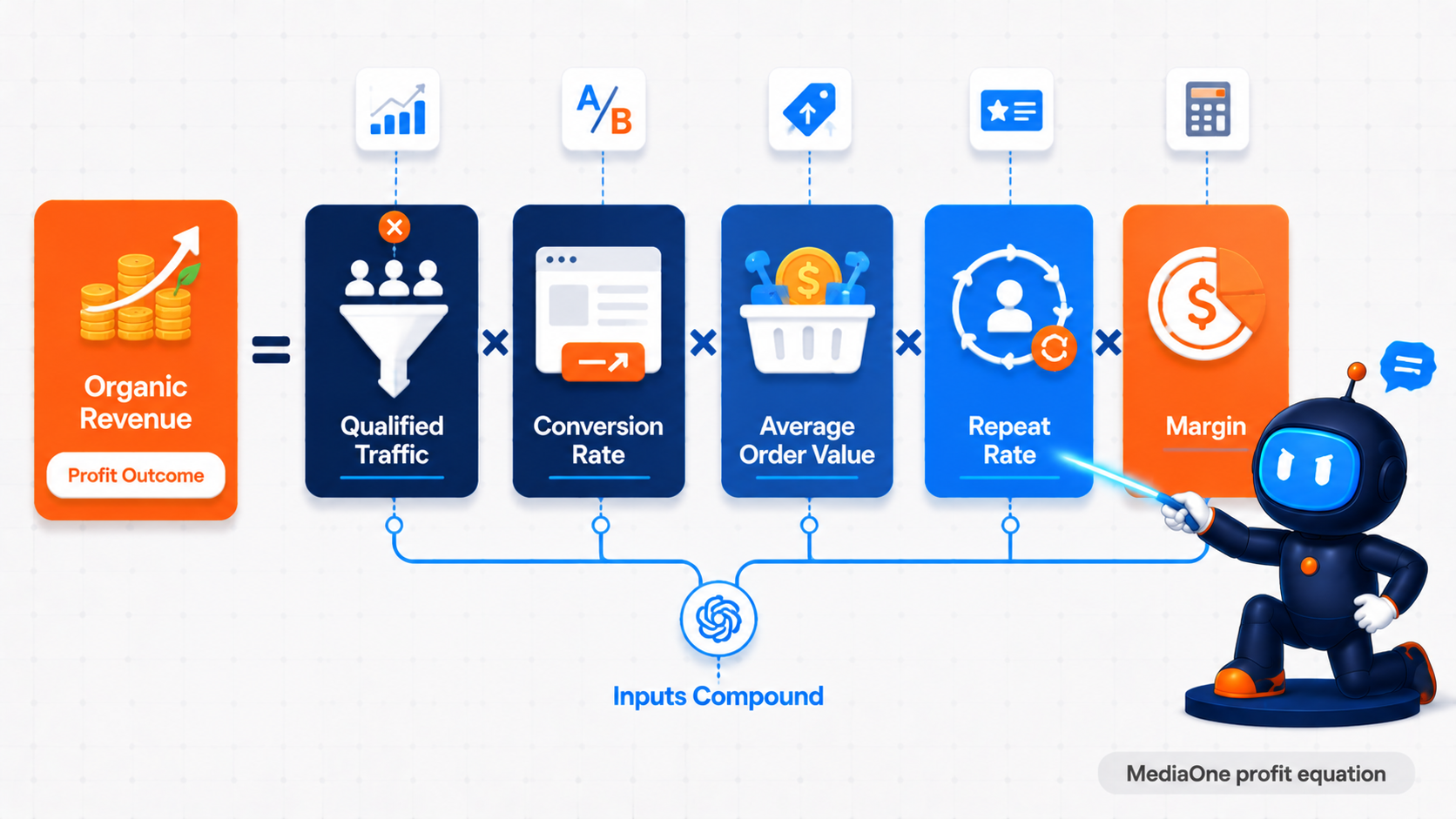
Where most teams obsess over the first variable, the brands winning at performance SEO move all five at once. Pulling the wrong lever can shrink revenue while traffic climbs.
|
Variable |
What Most Teams Do |
What Performance SEO Teams Do |
|
Qualified Traffic |
Chase search volume |
Chase commercial intent at the keyword level |
|
Conversion Rate |
Tweak CTAs on landing pages |
Match search intent to page format before any CTA work |
|
Average Order Value |
Treat as a paid media metric |
Optimise category pages to surface higher-value SKUs first |
|
Repeat Rate |
Treat as a CRM metric |
Build content that earns email subscribers, alongside clicks |
|
Margin |
Ignore entirely |
Prioritise keywords tied to high-margin SKUs and services |
|
Strategic Suggestion |
Rationale |
|
Map every priority keyword to one of the five variables before writing the brief |
Forces the team to articulate which lever each piece of content moves |
|
Report on revenue contribution by variable monthly |
Reveals which lever is currently capped and where to invest next |
|
Decline to publish content that cannot be tied to at least one variable |
Eliminates vanity content that absorbs budget without moving the equation |
Performance SEO writing rarely states plainly that traffic growth can quietly destroy revenue. The pattern shows up consistently in the audits our team runs for high-growth clients.
A site adds 50,000 monthly visitors over six months. Senior leadership applauds the chart. Closer inspection reveals the new visitors landed on informational pages, bounced within 12 seconds, dragged down site-wide engagement signals, and triggered an algorithm reassessment that demoted the commercial pages quietly in the background. Net revenue impact arrives in negative territory.
This is the trap MediaOne calls Traffic Inflation Syndrome, and it accounts for a meaningful share of the “our SEO stopped working” cases that land on our desks.
The symptoms to watch for:
- A widening gap between traffic growth and revenue growth.
- Rising bounce rates on the site overall while individual page bounce rates look stable.
- Commercial pages dropping in rankings even when no content changes were made.
- A growing share of traffic from queries with zero commercial intent.
|
Diagnostic Question |
What A Healthy Answer Looks Like |
|
What share of organic traffic lands on commercial pages? |
At least 40% for most B2B and B2C sites |
|
What is the revenue per organic visitor trend over 12 months? |
Flat or rising |
|
What is the ratio of branded to non-branded traffic on commercial queries? |
Branded share should be growing |
|
How often do informational pages link contextually to commercial pages? |
Every informational page should pass equity to at least one commercial destination |
Any agency or in-house team reporting traffic growth without revenue-per-visitor context is reporting the wrong number.
Keyword Research As A Commercial Filter
Effective performance SEO strategies hinge on thorough keyword research. The process involves scrutinising the search terms users input into Google and other engines to pinpoint queries that map onto your commercial goals.
Delving into keyword research yields multiple advantages. It bolsters organic search traffic while simultaneously offering profound marketing insights and boosting customer acquisition efforts. Through meticulous research, you can discover optimal yet less fiercely contested keywords capable of delivering substantial outcomes, taking into account aspects such as relevance, authority, and search volume.
To remain competitive within an ever-changing digital landscape, frequent evaluation of how your target keywords perform is essential, alongside necessary adjustments in your performance SEO strategy to align with shifting trends and consumer search patterns. The detailed walkthrough lives in our SEO keyword research strategy guide.
The MediaOne Commercial Intent Ladder
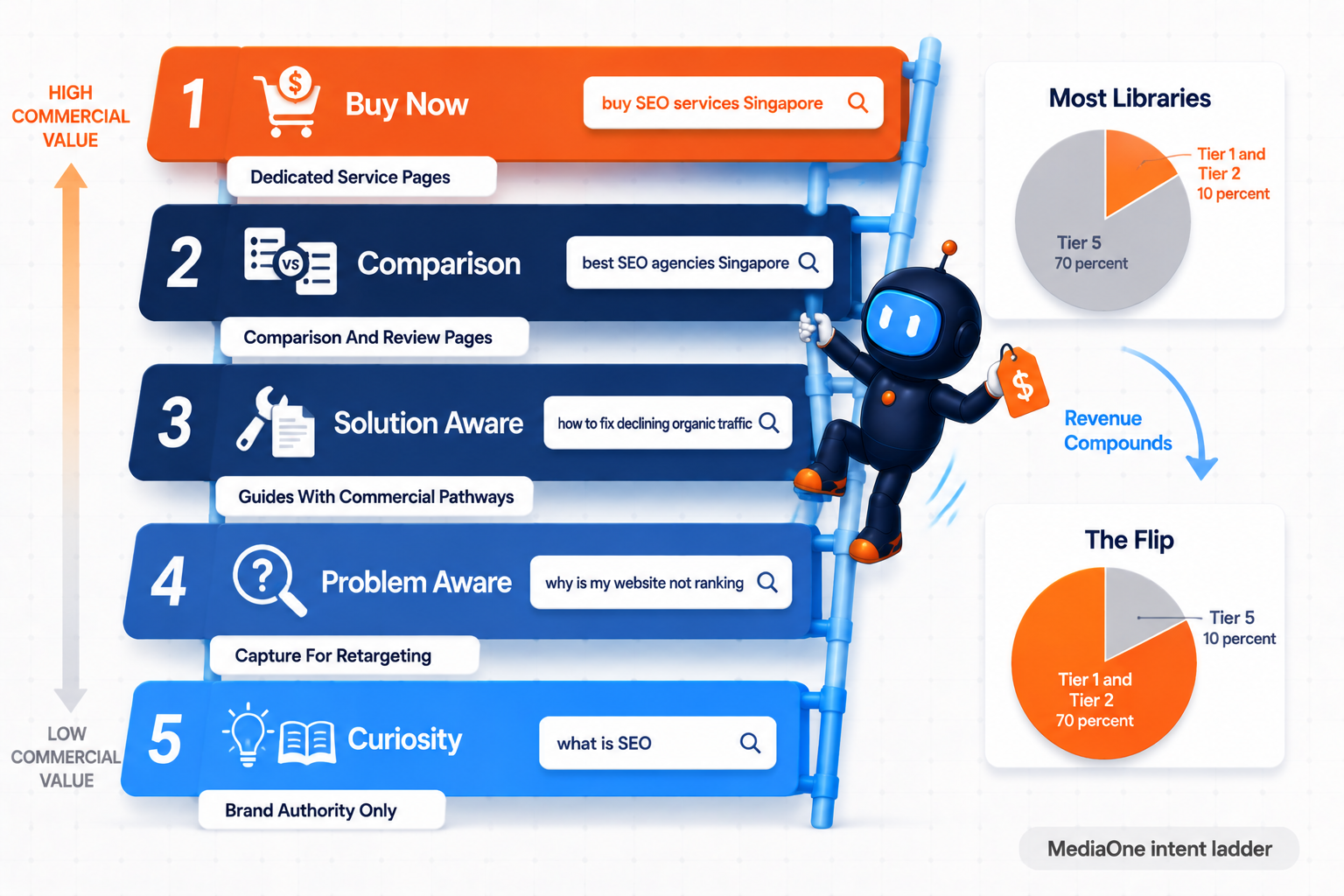
The performance SEO conversation usually treats search intent as a content classification (informational, navigational, transactional, commercial investigation). This framing misses the commercial reality of how money actually flows through search. Search intent should function as a commercial filter applied before any content gets written.
|
Tier |
Intent Type |
Example Query |
Commercial Priority |
|
1 |
Buy now |
“buy SEO services Singapore” |
Highest, build dedicated service pages |
|
2 |
Comparison |
“best SEO agencies Singapore” |
High, build comparison and review-style pages |
|
3 |
Solution-aware |
“how to fix declining organic traffic” |
Medium, build guides with strong commercial pathways |
|
4 |
Problem-aware |
“why is my website not ranking” |
Low to medium, capture for retargeting |
|
5 |
Curiosity |
“what is SEO” |
Lowest, only build if it supports brand authority |
Most content libraries are inverted, with 70% of effort going into Tier 5 content and 10% into Tiers 1 and 2. The teams that flip that ratio see revenue compounding faster than traffic, which is the actual goal of performance SEO.
The Margin-Weighted Keyword Strategy
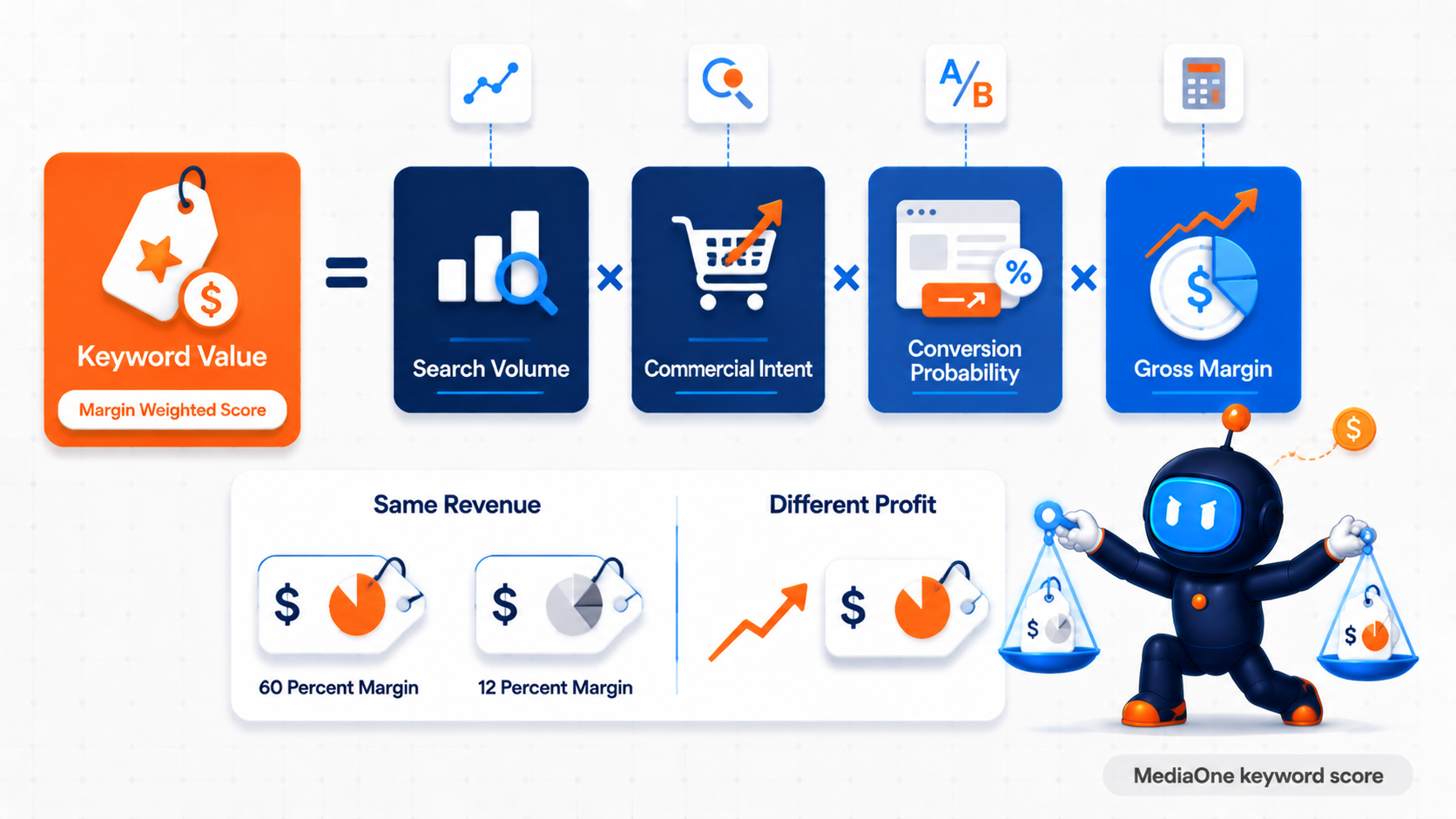
Every performance SEO article talks about keyword research. Almost none discuss which keywords are actually worth ranking for from a margin perspective. Two keywords can drive the same revenue. One delivers 60% margin, the other 12%. A traditional keyword tool shows them as equivalent. A performance SEO strategy should differentiate sharply.
The MediaOne Margin-Weighted Keyword Score:
Keyword Value = Search Volume × Commercial Intent × Conversion Probability × Gross Margin
This single recalibration changes which keywords get prioritised, which content gets commissioned, and which pages receive internal link equity. Brands that adopt margin-weighted keyword scoring routinely discover that 20% to 30% of their previous keyword priorities were actively destroying profitability while looking healthy in traffic reports.
|
Strategic Suggestion |
Rationale |
|
Audit existing content against the five tiers before commissioning anything new |
Surfaces gaps where money is being left on the table |
|
Cap Tier 4 and Tier 5 content at 30% of editorial output |
Forces investment in the queries that convert |
|
Apply margin weighting to every keyword on the priority list |
Reveals which keywords compound profit, alongside revenue |
On-Page SEO And The Conversion Surface
On-page SEO centres on optimising individual web pages to elevate their positioning in search engine results and draw more appropriate traffic from search engines. Foundational moves include compelling meta descriptions and title tags incorporating relevant keywords, accurate reflection of page subject matter through title tags, and well-optimised meta descriptions that boost click-through rate.
Page load speed remains critical to performance SEO while playing a significant role in shaping user experience. Pages plagued by slow load times often see higher bounce rates and may suffer from decreased visibility in search engine rankings. Boosting your website’s loading speeds includes image compression, code minification, leveraging browser caching, and securing dependable hosting services. URLs should stay concise yet descriptive enough to encompass target keywords effectively.
Equally important within on-page SEO strategies is internal linking. This facilitates smoother navigation for search engines across your site while improving the standing of internally linked pages within search results. Our enterprise internal linking strategy guide walks through the full methodology.
The Conversion Surface, A Concept Most Performance SEO Articles Miss
A page does not have a conversion rate. A page has a conversion surface, which is the total area where commercial intent can be captured and converted across the entire user journey.
The conversion surface for a single piece of content includes:
- The primary CTA above the fold.
- Contextual in-content links to commercial pages.
- Sidebar offers and related service callouts.
- Exit-intent capture for email subscription.
- Internal links passing the visitor to higher-intent destinations.
- Schema-driven enhancements that surface offers inside search results before the click happens.
Most performance SEO writing treats conversion as a landing-page problem. The brands actually winning treat it as a surface design problem spanning every touchpoint the searcher encounters.
Pick your top ten organic landing pages by traffic. Count the conversion surface elements on each one. Most teams discover their highest-traffic pages have a conversion surface area of one or two elements, when the same page could comfortably support six to eight.
|
Conversion Surface Element |
Typical Lift When Added Correctly |
|
Contextual in-content link to commercial page |
8% to 15% increase in commercial page traffic from that source |
|
Sidebar service callout matched to article topic |
3% to 7% lift in form submissions |
|
Email capture with topic-specific lead magnet |
12% to 20% subscriber growth |
|
Schema markup surfacing offers in SERPs |
5% to 12% CTR lift on the SERP itself |
The foundation of successful on-page SEO sits with premium content that captures audience attention. Strategic placement of keywords throughout titles, headers, body text, and meta descriptions, without resorting to excessive use or concealment, completes the framework required for proficient page-level optimisation efforts.
Off-page SEO covers external efforts to elevate search engine rankings. Securing high-quality backlinks, which function as endorsements from credible sources, enhances your website’s authority and boosts its appeal to search engines. In pursuit of valuable links, prioritising quality over quantity stays essential.
The off-page SEO moves that compound for performance:
- Ethical link-building practices alongside guest posting on credible sites within your industry.
- Active engagement on industry-specific forums and communities where your target audience already gathers.
- Content tailored to audience interests, designed to elicit organic linking behaviour naturally.
- Targeted outreach to domains with robust Domain Authority and Page Authority scores.
- Social media engagement that produces likes, shares, and brand exposure, which indirectly influences search rankings through traffic and discovery.
Vigilant management of off-page efforts ensures these activities substantially contribute to broader SEO achievements. The detailed approach lives in our white hat SEO link building strategies guide.
Technical SEO: The Foundation Everything Else Sits On
A technically optimised website ensures search engines can efficiently traverse and index your content. The result enhances visibility in search engine rankings while improving accessibility for users. Periodic reviews to uncover broken links remain vital because these flaws disrupt the user experience and negatively impact how search engines value your website.
The technical SEO essentials for performance:
- Precise XML sitemaps configured correctly so search engine bots can locate and catalogue webpages with ease.
- Appropriate robots.txt configuration that supports crawling priorities.
- Coherent page hierarchy structure paired with consistent internal linking.
- Prompt rectification of crawl errors including misconfigured URLs and server issues.
- Page loading speed and Core Web Vitals monitoring as part of ongoing technical health checks.
Google considers page loading speed and overall user experience during ranking decisions. Continuous monitoring of technical SEO indicators is essential for identifying problems that hinder proper crawling or indexing. Our technical SEO audit checklist for 2026 covers the full diagnostic process.
The 18-Month Performance SEO Compounding Curve
Performance SEO writing tends to promise quick wins inside three to six months. The honest version of the timeline looks different, and stating it clearly builds trust with senior stakeholders.
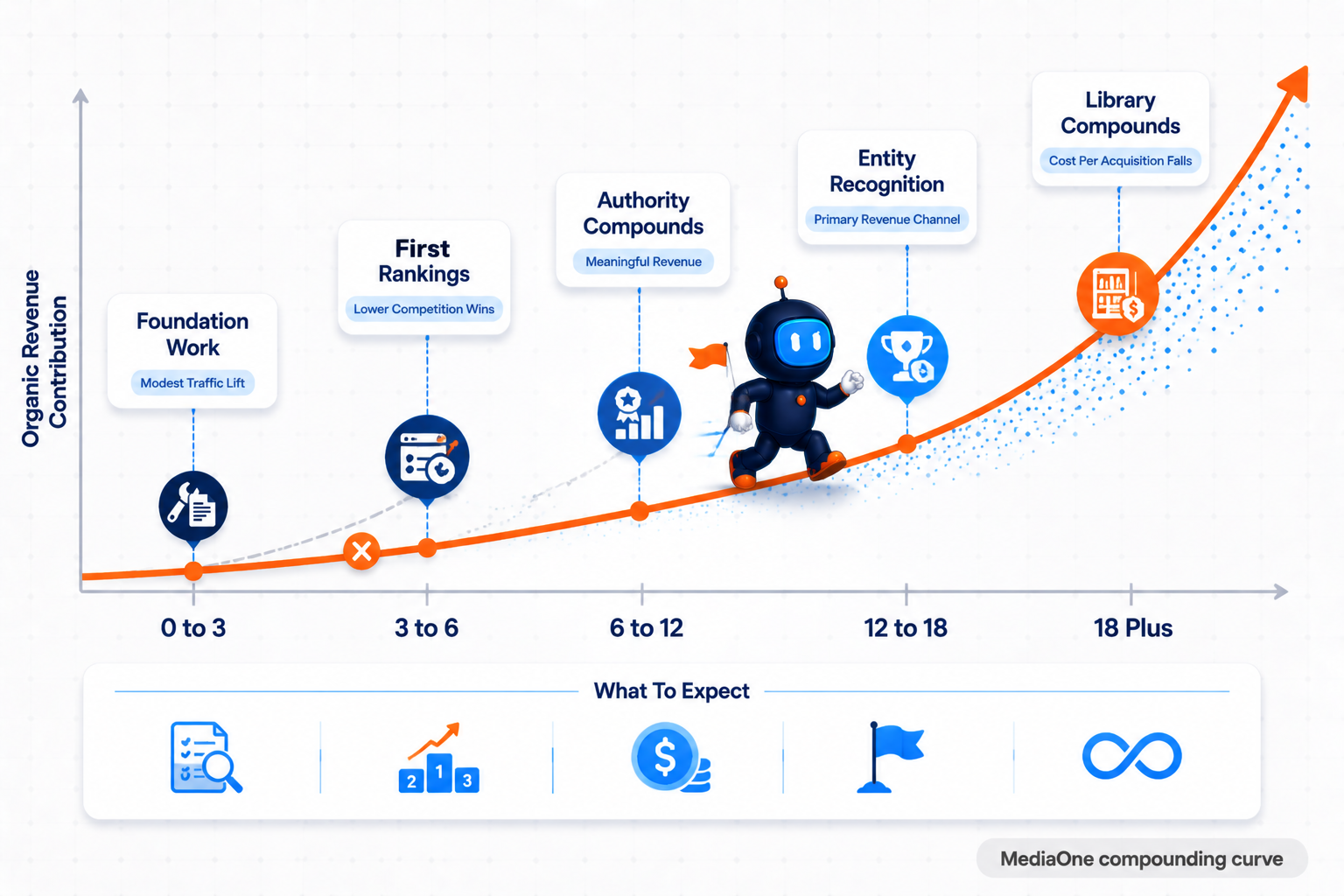
The MediaOne Compounding Curve:
|
Months |
What Happens |
What To Expect |
|
0 to 3 |
Foundation work, audits, technical fixes, quick refreshes |
Modest traffic lift, mostly on existing rankings |
|
3 to 6 |
New commercial pages indexing, first batch of refreshed pages re-ranking |
Visible ranking gains on lower-competition terms |
|
6 to 12 |
Authority signals compounding, mid-competition rankings emerging |
Meaningful revenue contribution from organic search |
|
12 to 18 |
High-competition rankings stabilising, brand entity recognition solidifying |
Performance SEO becomes a primary revenue channel |
|
18+ |
Compounding effect kicks in fully, content library doing the heavy lifting |
Cost per organic acquisition continues falling |
Any agency promising significant performance SEO results inside 90 days is either operating on an exceptionally low-competition keyword set or overstating what is achievable. Real performance SEO compounds, and that compounding is exactly why it eventually beats every other channel on cost per acquisition.
Why Updating Old Pages Outperforms Writing New Ones
Performance SEO writing rarely quantifies the comparative ROI of refreshing existing content versus producing new content. The numbers reshape budget allocation when stated clearly.
A refreshed page typically reaches its new ranking position within four to eight weeks. A new page typically takes six to nine months to mature. The economic implication is that refreshing is roughly five to ten times faster to revenue, on the same editorial spend.
The Refresh Premium Calculation MediaOne applies for performance SEO clients scores every existing page on four variables:
|
Variable |
Weight |
What It Measures |
|
Existing backlink profile |
30% |
The link equity already invested in the URL |
|
Historical ranking trajectory |
25% |
Whether the page was ever a top performer |
|
Commercial intent of target keyword |
25% |
Whether the page sits on a money keyword |
|
Effort required to update |
20% |
The hours needed to refresh, weighted inversely |
Pages scoring above 70 on this composite get refreshed before any new content commission is approved. The discipline shifts editorial spend toward the work that pays back fastest.
|
Strategic Suggestion |
Rationale |
|
Score every page in the top 100 by traffic against the Refresh Premium variables |
Creates a ranked queue of the highest-ROI refresh targets |
|
Assign refresh ownership to senior writers |
Junior writers tend to over-edit and accidentally damage existing rankings |
|
Track the lift on each refresh for 90 days before declaring it complete |
Reveals which refresh techniques deliver the strongest premium |
Creating Content That Performs
Sustained SEO triumph depends on developing content that prioritises the needs and interests of users. Grasping user intent is key, since it significantly impacts a web page’s ranking within search engines. Content that is useful, enlightening, and worthy of sharing fosters greater user engagement, which leads to an uptick in organic traffic.
The content habits that drive performance:
- Regular updates that keep web pages aligned with current search engine standards.
- Content audits that maintain authoritative status with fresh, pertinent information.
- Pillar and cluster structures that provide organised navigation for effective on-page SEO.
- High-quality material that naturally earns backlinks from diverse websites.
- Guest blogging that showcases expertise while expanding reach to wider audiences.
Content captures audience interest in ways that align with what search engine algorithms seek when determining rankings.
Local SEO: Capturing Regional Markets
Businesses seeking organic search traffic from specific geographic regions must prioritise local SEO strategies. By refining their approach to local SEO, companies can boost the influx of pertinent visitors with a higher propensity for conversion.
The local SEO essentials:
- Amplifying your Google Business Profile to elevate prominence on Google Maps, which fosters increased phone inquiries and storefront visits.
- Optimising for local pack rankings on commercially relevant queries.
- Building location-specific landing pages for multi-location businesses.
- Earning reviews on Google and industry-specific platforms.
- Maintaining consistent NAP (name, address, phone) data across the web.
Concentrating on strategies tailored for local SEO enables businesses to augment their digital footprint and heighten visibility amongst consumers situated in proximity. The full guide lives in our local SEO statistics and strategies resource.
Performance SEO For AI Search in 2026
Performance SEO writing from 2023 and 2024 focused entirely on Google’s blue links. The 2026 reality includes AI Overviews, ChatGPT, Perplexity, and Gemini, each of which now intercepts queries before they ever reach a traditional results page.
Gartner’s forecast on traditional search engine volume dropping 25% by 2026 as users shift to AI chatbots signals the scale of the disruption. Coverage from The Guardian on publishers fearing AI search summaries mean the end of the traffic era confirms that search traffic to news and commercial sites has already taken a substantial hit, with publishers expecting a 43% drop over the next three years. Reuters’ reporting on the UK regulator enforcing new competition requirements that let publishers opt out of AI search underscores how seriously the shift is being treated at policy level.

The performance SEO question for 2026 has shifted. The challenge is no longer “how do we rank on page one.” The challenge is “how do we get cited in the AI answer that prevents the click from happening at all.”
What changes for performance SEO in an AI search world:
|
Old Performance SEO |
2026 Performance SEO |
|
Rank on page one |
Get cited in the AI answer |
|
Optimise meta titles for CTR |
Optimise opening sentences for AI extraction |
|
Build backlinks for authority |
Build entity signals for AI recognition |
|
Track keyword rankings |
Track AI citation rate across the four major surfaces |
|
Measure organic traffic |
Measure organic revenue plus AI-attributed revenue |
Google’s own Search Console generative AI performance reports documentation confirms the shift, with dedicated views now available for impressions inside AI Overviews and AI Mode.
The position worth committing to is that any brand treating AI search visibility as a 2027 problem will be rebuilding visibility from scratch by 2027. The window to establish entity recognition with AI tools is open now, and it closes faster than most teams realise.
Adapting To Search Engine Algorithm Changes
Remaining competitive in the SEO landscape requires keeping pace with changes in search engine algorithms. Success hinges on ongoing commitment to learning and evolving your methods.
The adaptation habits that performance SEO teams build in:
- Continuous monitoring of recent algorithm shifts and their impact on website performance metrics.
- Forward-thinking SEO strategy that combines perpetual education with willingness to conform to emerging best practices.
- Post-update analysis that pinpoints which areas need enhancement after any algorithm change.
- Regular tracking of key performance SEO indicators to assess adaptation effectiveness.
- Flexibility to adjust tactics as the digital environment shifts.
The pursuit of continual advancement is central to mastering performance SEO. Staying informed and flexible ensures that SEO efforts persistently yield fruitful outcomes over time.
The Reporting Reframe: From Activity Reports To Profit Reports
Performance SEO reports usually list activity, including pages published, keywords ranked, and backlinks earned. None of these are performance metrics. They are activity metrics dressed up as performance metrics.
A genuine performance SEO report answers four questions and nothing else:
- How much revenue did organic search contribute this period?
- What was the cost per acquired customer through organic search?
- Which pages and keywords drove that revenue?
- What is the trajectory for the next 90 days, with the actions required to hit it?
|
Activity Metric |
Profit Metric That Replaces It |
|
Pages published |
Revenue per published page |
|
Keywords ranked |
Revenue per ranked keyword |
|
Backlinks earned |
Revenue contribution from referring domain types |
|
Average position |
Cost per acquisition from organic search |
|
Organic traffic |
Organic revenue and revenue per visitor |
When clients first see a report formatted this way, the conversation shifts from “is SEO working” to “where should we invest next.” That shift is the genuine deliverable of performance SEO.
Tracking And Measuring Performance SEO Success

Keeping tabs on keyword rankings remains pivotal for performance SEO success, since top positions in search results boost visibility and bring more visitors. Google Analytics and Google Search Console provide key insights that enhance your strategies around on-page SEO. Google Search Console specifically aids in tracking how a website fares within Google’s search results which explains the core metrics in depth.
The fundamental measurements every performance SEO programme tracks:
- Organic traffic flow and revenue per visitor.
- Keyword positioning within search engines, including AI Overview citations.
- Click-through ratios across traditional and AI-surfaced results.
- Bounce rates segmented by page type and intent tier.
- Inbound link profile growth.
- Page loading speeds and Core Web Vitals scores.
- Conversion rate by traffic source and landing page.
- Cost per acquired customer from organic search.
Engaging in competitive benchmarking by evaluating your site against competitor metrics ensures you stay abreast of prevailing industry norms. Proficient analysis coupled with robust reporting lays the groundwork for decisions rooted in data when considering performance SEO initiatives.
Enhancing User Engagement And Experience
Metrics tracking user behaviour offer valuable insight into visitor actions on your website and highlight specific improvements that foster better engagement and stronger performance SEO outcomes.
The engagement levers that move performance SEO metrics:
- Visual content including infographics and captivating videos that stimulate emotional responses and aid information retention.
- Mobile optimisation that delivers a frictionless experience, since substandard mobile experiences increase bounce rates.
- Social platform activity that elevates site visibility and incoming referral traffic.
- Quality material paired with a gratifying online experience that bolsters interaction depth.
- Browser caching and mobile performance optimisation that produce swift page experiences.
Quality material coupled with a gratifying online experience augments both user interaction and SEO outcomes simultaneously.
Performance SEO In The Singapore Market
Singapore’s e-commerce market continues expanding. Statista’s market forecast on e-commerce revenue in Singapore projects sustained growth through 2026, while the Singapore Department of Statistics retail sales index for 2026 shows Retail Trade sales rising 5.4% year-on-year in April 2026, with Supermarkets, Computer & Telecommunications Equipment, and online retail among the strongest contributors.
What Singapore-specific performance SEO looks like in practice:
- Bilingual and multilingual considerations for the local market.
- Local pack optimisation for the Singapore market.
- Mobile-first execution, given Singapore’s smartphone penetration.
- Cross-border SEO strategy for businesses serving regional markets.
- Schema markup tailored for local business listings.
Singapore B2B businesses typically see healthy organic conversion rates between 2% and 5%, while e-commerce sits between 1% and 3%. Benchmarking against these ranges helps you understand whether your performance SEO programme is operating at, above, or below market.
Integrating Performance SEO Together
Navigating the path to robust performance SEO requires a holistic strategy that includes diligent keyword research, both on-page and off-page SEO practices, technical enhancements, and consistent monitoring for success. Grasping how search engines operate and utilising appropriate tools markedly elevates your website’s prominence and attracts substantial traffic.
The significance of crafting premium content centred around users stays paramount. Updating your site with fresh content and conducting regular audits maintains relevance and credibility. Engaging actively on social media platforms combined with a sharp focus on local SEO amplifies your online presence and effectiveness.
In the dynamic landscape of SEO optimisation, staying current with trends while remaining flexible is essential for continued success. Persistently refining tactics and adopting innovative strategies places you at an advantage over rivals in achieving enduring excellence.
Performance SEO is more akin to running a marathon than sprinting. One must continue learning, adapting methods continually, and optimising processes. The reward is a channel that compounds in value over time, eventually beating every other acquisition route on cost per customer.
If your organisation is ready to apply these performance SEO frameworks in practice, our team at MediaOne is a results-driven SEO agency Singapore businesses trust to convert search visibility into measurable revenue. Request a quote to see how the approach maps to your business.
Frequently Asked Questions
How can performance SEO help increase my revenue?
Performance SEO drives targeted traffic to your website, focusing on high-intent users who are more likely to convert. By improving user experience, optimising for key conversion points across the full conversion surface, and weighting keyword priorities by margin, businesses boost sales and overall revenue contribution from organic search.
What does performance SEO mean in 2026?
Performance SEO in 2026 means optimising for revenue across both traditional search results and AI-surfaced answers, including AI Overviews, ChatGPT, Perplexity, and Gemini. Citation in AI answers has become as important as ranking position, alongside entity recognition and structured data signals.
Can performance SEO be used for any type of business?
Yes. Performance SEO is versatile and adaptable to any industry, whether you operate an e-commerce store, a service-based business, or a content-focused website. Implementing performance SEO frameworks maximises the commercial results you achieve from organic search.
How long does it take to see results from performance SEO?
Results vary depending on website age, competition, and the quality of your performance SEO strategy. Most businesses see significant improvements within three to six months on lower-competition terms, with full compounding effects emerging between 12 and 18 months. The honest timeline involves longer payback for higher-competition commercial keywords.
Is performance SEO only about improving rankings?
No. Performance SEO goes beyond rankings by focusing on metrics that directly contribute to business goals. It centres on enhancing the user experience, improving conversion rates, expanding the conversion surface across each page, and maximising ROI, alongside achieving stronger positions in search results.
What tools can help measure performance SEO success?
Google Analytics, Google Search Console, and conversion tracking software track performance metrics such as traffic, bounce rates, engagement, AI citation impressions, and conversions. The right reporting structure transforms these tools from activity dashboards into profit reports.
How does performance SEO differ from traditional SEO?
Traditional SEO measures success by rankings and traffic. Performance SEO measures success by revenue, cost per acquired customer, and contribution to business goals. Every optimisation decision in performance SEO ties to a commercial outcome the business actually cares about.
Why is content refreshing so important for performance SEO?
Refreshing existing pages typically reaches new ranking positions within four to eight weeks, while new content takes six to nine months to mature. The economic implication is that refreshing is roughly five to ten times faster to revenue on the same editorial spend, which makes it one of the highest-ROI activities in performance SEO.