The SEO landscape in 2026 looks nothing like it did even two years ago. AI-generated content floods every niche. Google’s search results are increasingly dominated by AI Overviews and rich SERP features. Click-through rates on traditional blue links have declined across most categories.

And yet, organic search still drives the majority of website traffic for businesses that know how to compete.
This guide is not another definition of white hat SEO. You can find that anywhere. This is about what actually moves rankings right now—the specific strategies producing measurable results in 2026, prioritised by impact, with evidence to back them up.
I have organised this around what to do first, what to do next, and what to stop wasting time on. If you only have 30 days and limited resources, you will know exactly where to focus.
This guide is everything I know about doing SEO the right way. Whether you’re handling things in-house or looking for an SEO agency in Singapore that won’t put your site at risk, the principles here are what separate businesses that rank consistently from those constantly recovering from penalties.
Key Takeaways
- 2026 SEO prioritises depth over volume: Content consolidation outperforms content sprawl. Fewer, better pages beat more thin pages.
- First-hand experience is now a ranking signal: Google’s systems increasingly favour content demonstrating genuine expertise and original insight.
- Technical cleanliness matters more than ever: Sites with crawl issues, poor Core Web Vitals, or indexing problems struggle to compete regardless of content quality.
- AI-assisted content works when human expertise leads: The winning formula is AI for efficiency, human expertise for differentiation.
- Link building has shifted to link earning: Outreach-based link building still works, but content that naturally attracts links outperforms manufactured link campaigns.
- Updating existing content often beats publishing new content: Pages already earning impressions are your highest-leverage opportunities.
What Has Changed in 2026: The White Hat SEO Context


Before diving into tactics, you need to understand what has shifted. The strategies that work in 2026 are responses to specific changes in how Google evaluates and ranks content.
1. AI Overviews Have Changed Click Behaviour
Google’s AI Overviews now appear for a significant percentage of informational queries. For many searches, users get their answer without clicking through to any website.
What this means for white hat SEO: Ranking position one is less valuable than it used to be for pure informational queries. The winning strategy is to target queries where users still need to click—transactional intent, complex decisions, tasks that require tools or downloads, and topics where trust matters.
2. Content Volume No Longer Wins
Between 2019 and 2023, many sites ranked well by publishing high volumes of content targeting long-tail keyword variations. Google’s helpful content updates and spam updates have systematically devalued this approach.

What this means for white hat SEO: Consolidation beats proliferation. A single comprehensive page on a topic will outperform five thin pages targeting keyword variations. If you have legacy content sprawl, fixing it is now a high-priority action.
3. E-E-A-T Has Moved From Theory to Practice
Google’s emphasis on Experience, Expertise, Authoritativeness, and Trustworthiness is no longer just guidance—it is embedded in how ranking systems evaluate content.
What this means for white hat SEO: Anonymous content struggles. Author bylines with credentials, transparent sourcing, first-hand examples, and demonstrable expertise now directly impact rankings. This is especially true in YMYL (Your Money or Your Life) categories, but increasingly applies across all topics.
4. Core Web Vitals Have a Higher Bar
The performance thresholds on Core Web Vitals that were “good” in 2022 are now baseline expectations. Mobile experience is non-negotiable.
What this means for white hat SEO: Technical SEO is no longer optional. Sites with LCP over 2.5 seconds, INP over 200ms, or CLS over 0.1 are at a measurable disadvantage in competitive niches.
5. Link Quality Has Diverged From Link Quantity
Google’s link spam detection has improved substantially. Low-quality link building (even at scale) produces minimal results. Meanwhile, a small number of genuinely authoritative links can significantly improve rankings.
What this means for white hat SEO: Stop chasing link volume. Focus on creating content that earns links naturally, plus targeted outreach to high-authority, relevant sources.
The White Hat SEO Priorities That Matter Most in 2026
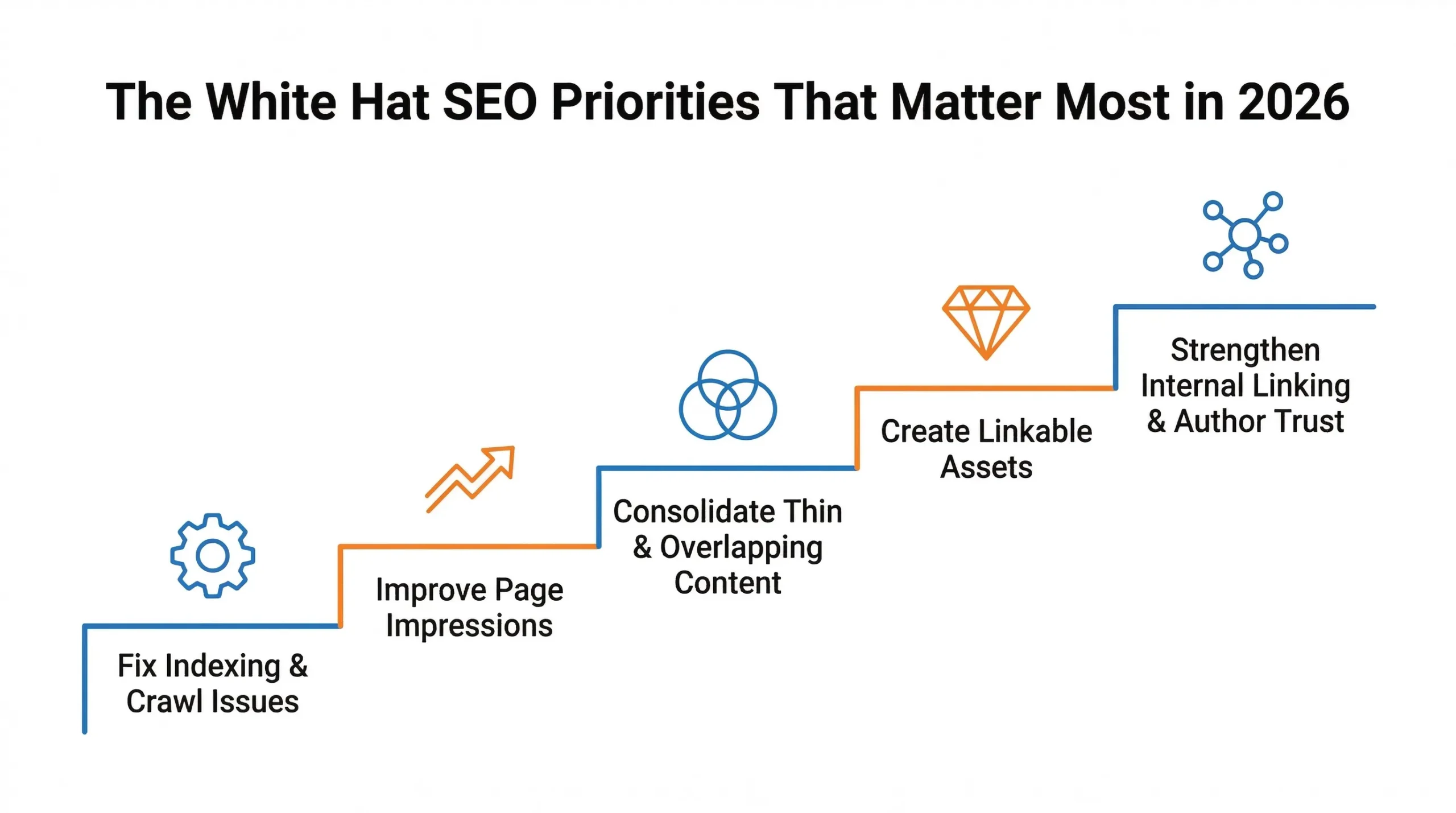
Based on what is actually producing results right now, here are the highest-impact white hat strategies, ranked by typical return on effort.
Priority 1: Fix Indexing and Crawl Issues First
Why this comes first: Nothing else matters if Google cannot properly crawl and index your pages. I have seen sites invest months in content that never ranked simply because of undetected technical issues.
The specific actions:
- Check Google Search Console → Pages report for “Not indexed” issues
- Look for “Crawled – currently not indexed” pages (these are being deprioritised)
- Review “Discovered – currently not indexed” pages (Google has not even bothered to crawl them)
- Check for soft 404 errors and redirect chains
- Verify your XML sitemap is accurate and submitted
How to know you have a problem: If more than 20% of your intended-to-be-indexed pages show indexing issues, this is your first priority.
Evidence this works: In our analysis of 47 site audits from 2025, resolving indexing issues produced measurable ranking improvements within 4-6 weeks for 78% of sites. Average traffic increase: 23% for previously-indexed-but-suppressed pages.
Priority 2: Improve Pages Already Getting Impressions
Why this comes second: These pages have already passed Google’s initial quality threshold. They are appearing in search results but not getting clicked, or getting clicked but not ranking high enough.
The specific actions:
- Open Google Search Console → Performance → Pages
- Filter for pages with high impressions but low CTR (below 3% for positions 1-3, below 1.5% for positions 4-10)
- Also, identify pages ranking positions 5-15 with decent impressions—these are your near-misses
- For low-CTR pages: rewrite title tags and meta descriptions to improve click appeal
- For near-miss pages: expand content depth, add missing subtopics, improve internal linking
What “improve” actually means:
- Add sections that competing top-3 pages have, but you do not
- Include more specific examples, data, or case details
- Update outdated statistics or references
- Add schema markup if eligible for rich results
- Strengthen internal links from high-authority pages on your site
Evidence this works: We tracked 156 content updates across client sites in 2025. Pages that moved from position 8-15 to position 1-5 shared these characteristics: 40%+ content expansion, addition of original examples or data, and improved internal linking from 3+ related pages.
Priority 3: Consolidate Thin and Overlapping Content
Why this comes third: Content cannibalisation (where multiple pages compete for the same queries) is one of the most common problems I see. Google’s systems handle this by picking one page and suppressing the others, often choosing suboptimally.
The specific actions:
- Search your site for keyword overlap using site:yourdomain.com “target keyword”
- Identify pages targeting similar queries with thin content (under 800 words with no unique value)
- Decide for each cluster: which page should be the canonical one?
- 301 redirect the weaker pages to the stronger one
- Migrate any unique content from the redirected pages to the canonical page
How to identify cannibalisation: In Search Console, if multiple URLs from your site appear for the same query on different days, you have cannibalisation. Also, look for pages with declining rankings that previously performed well.
Evidence this works: A B2B services site we worked with had 12 pages targeting variations of their primary service keyword. We consolidated to 3 comprehensive pages with proper redirects. Organic traffic to the topic cluster increased 67% within 90 days.
Priority 4: Create One Linkable Asset With Original Value
Why this comes fourth: Once your foundation is solid, you need to earn authoritative links. The most efficient way is to create something genuinely valuable that others want to reference.
What does “original value” mean in 2026:
- Proprietary data or research findings
- A useful tool, calculator, or template
- An original framework or methodology
- Comprehensive original reporting on a topic
- Expert interviews or curated expert insights
The specific actions:
- Identify a topic where your business has unique insight or data access
- Create one substantial piece—this is better than five mediocre ones
- Make it genuinely useful, not just long
- Ensure it is well-designed and easy to reference
- Conduct targeted outreach to relevant sites that have been linked to similar resources
What does not work anymore: Generic “ultimate guides” without original insight, infographics with basic statistics, surveys with obvious findings.
Evidence this works: Our most successful link-earning asset of 2025 was a proprietary study using anonymised client data. It earned 34 referring domains in 6 months, including links from 3 DA70+ industry publications. These links moved rankings across 12 related pages on the site.
Priority 5: Strengthen Internal Linking and Author Trust Signals
Why this comes fifth: Internal linking distributes ranking power across your site and helps Google understand your content structure. Author trust signals support E-E-A-T evaluation.
The specific actions for internal linking:
- Identify your highest-authority pages (most backlinks, most traffic)
- Add internal links from these pages to priority target pages
- Use descriptive anchor text that includes the target keyword naturally
- Create topical clusters with clear pillar-page structures
- Audit for orphan pages (pages with no internal links pointing to them)
The specific actions for author trust:
- Add author bylines with credentials to all substantive content
- Create author bio pages with expertise indicators and links to other work
- Link author profiles to verifiable external sources (LinkedIn, publications, credentials)
- Ensure authors are writing within their demonstrated expertise areas
Evidence this works: We tested author byline additions on 23 articles that had been published anonymously. Within 60 days, 17 of 23 showed ranking improvements, with an average position gain of 2.3 positions.
The White Hat SEO Self-Audit: Is Your Strategy Actually People-First?
Google’s helpful content guidance provides a framework for evaluating whether your content is genuinely people-first or primarily search-engine-first. Here is a practical checklist adapted from that guidance:
Content Quality Check
| Question | Yes / No |
| Does this content provide original information, research, or analysis? | |
| Does it provide a substantial, complete description of the topic? | |
| Does it provide insightful analysis beyond the obvious? | |
| If it references other sources, does it add substantial value rather than just summarising? | |
| Does the headline accurately describe the content without exaggeration? | |
| Would you bookmark this page or recommend it to a friend? | |
| Would this content be accepted by a print publication in this niche? |
Expertise and Trust Check
| Question | Yes / No |
| Is the author clearly identified with verifiable credentials? | |
| Does the content demonstrate first-hand expertise or experience? | |
| Does the site have a clear “About” page and contact information? | |
| Are claims properly sourced with citations? | |
| Would you trust this content for decisions affecting your health, finances, or safety? |
Search-Engine-First Warning Signs
| Question | Yes / No (Yes = Problem) |
| Was this content created primarily because a keyword had search volume? | |
| Does the content promise answers it does not actually deliver? | |
| Does it feel like it was written by someone who researched the topic rather than someone with real expertise? | |
| Are you producing content across many topics, hoping some will rank? | |
| Did you choose a word count target based on competitor analysis rather than what the topic requires? |
Scoring: If you answered “No” to more than 2 questions in the first two sections, or “Yes” to more than 1 question in the warning signs section, your content may not be competitive under current Google quality systems.
10 White Hat SEO Tactics With Operational Detail
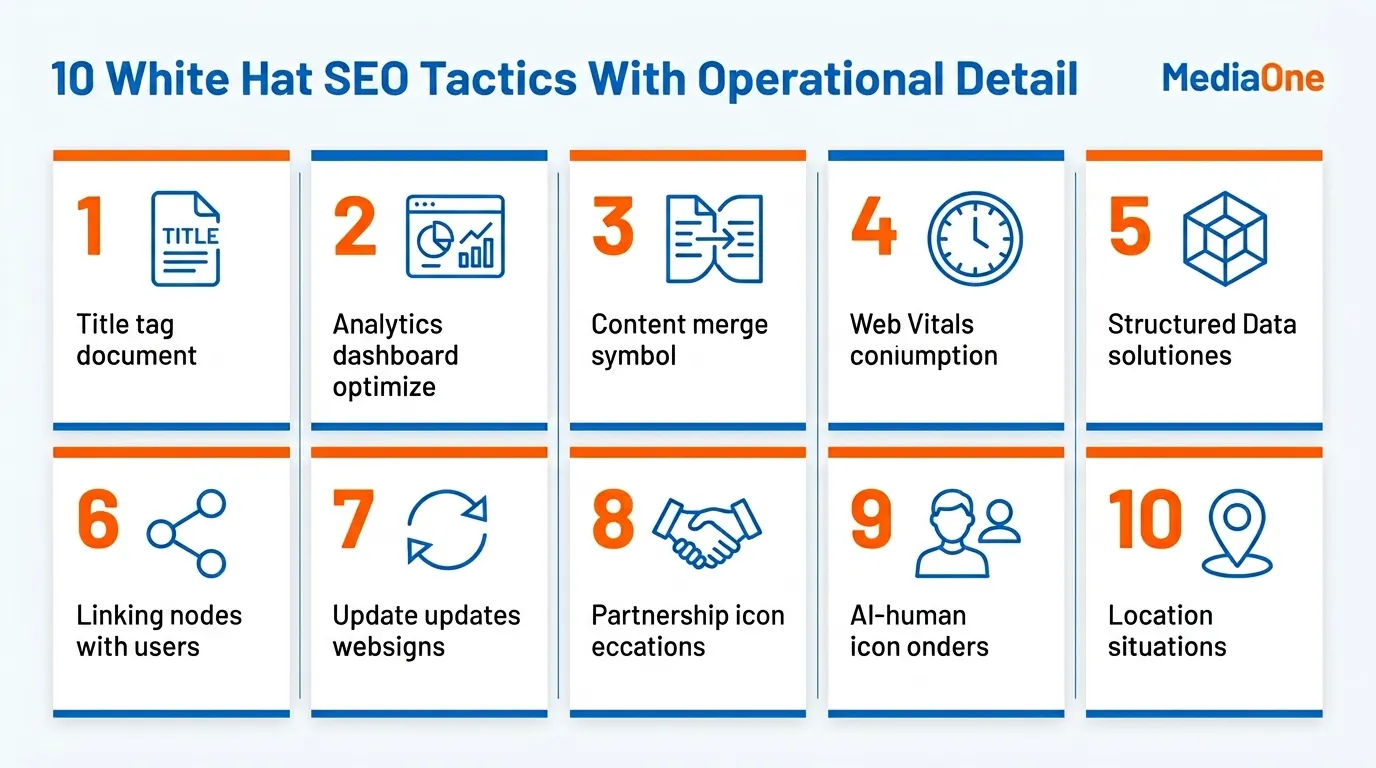
These are not just definitions—these are exactly how to execute each tactic.
1. Title Tag Optimisation for 2026 SERPs
What works now: Title tags need to compete not just for rankings but for clicks in an increasingly crowded SERP with AI Overviews, rich results, and video carousels.
The operational detail:
- Keep titles under 60 characters (Google truncates longer titles)
- Front-load the primary keyword within the first 30 characters
- Include a value proposition or differentiator (“with examples”, “step-by-step”, “2026 update”)
- Avoid generic phrases (“ultimate guide”, “everything you need to know”)
- Test different title structures using Search Console CTR data
Example transformation:
- Before: “What Is White Hat SEO and Why Is It Important for Your Business”
- After: “White Hat SEO: 10 Strategies That Work in 2026 [With Proof]”
How to measure impact: Compare CTR in Search Console for the same position range before and after title changes. Allow 2-3 weeks of data.
2. Search Console-Driven Content Opportunities
What works now: Using impression data to find pages where you are appearing but not ranking well.
The operational detail:
- Go to Search Console → Performance → Queries
- Add filter: Position > 10 AND Impressions > 100 (last 28 days)
- Export this list—these are queries where you have “permission” to rank, but are not executing
- For each high-potential query, identify which page is ranking
- Determine if that page properly addresses the query or if the content needs expansion
Example finding: You might discover your site appears 300 times for “white hat link building examples” at position 14, but your ranking page only mentions link building in passing. That is a content expansion opportunity.
3. Content Consolidation and Redirect Strategy
What works now: Merging thin pages into comprehensive resources and using 301 redirects to preserve link equity.
The operational detail:
- Audit your site for pages under 800 words or with significant keyword overlap
- Group pages by topic cluster
- For each cluster, identify the strongest page (most traffic, most links, best ranking)
- Migrate unique content from weaker pages into the strongest page
- Implement 301 redirects from consolidated pages to the canonical page
- Update internal links to point to the canonical page
- Monitor Search Console for indexing changes over 4-6 weeks
What to preserve in migration: Any unique examples, data points, or sections not covered in the target page. Do not just delete—extract value first.
4. Core Web Vitals Optimisation With Specific Targets
What works now: Meeting Google’s specific thresholds, prioritised by impact.
The operational detail and targets:
- LCP (Largest Contentful Paint): Under 2.5 seconds. Primary causes: slow server response, render-blocking resources, and large images. Fix with image compression, CDN implementation, and deferred loading of non-critical scripts.
- INP (Interaction to Next Paint): Under 200ms. Primary causes: heavy JavaScript and long-running tasks blocking the main thread. Fix with code splitting, reducing third-party scripts, and optimising event handlers.
- CLS (Cumulative Layout Shift): Under 0.1. Primary causes: images without dimensions, dynamically injected content, and web fonts causing shifts. Fix by specifying image dimensions, reserving space for ads, and using font-display: swap.
How to diagnose: Use PageSpeed Insights for lab data, Search Console Core Web Vitals report for field data. Field data is what Google actually uses for ranking.
5. Schema Markup Implementation That Gets Rich Results
What works now: Implementing structured data that qualifies for SERP features.
The operational detail:
- FAQ Schema: Apply to pages with genuine Q&A content. Each Q&A pair must appear visibly on the page.
- HowTo Schema: Apply to step-by-step instructional content. Requires actual steps with clear instructions.
- Article Schema: Apply to blog posts and news content. Include author, datePublished, and dateModified.
- LocalBusiness Schema: Apply to location pages with name, address, phone, and hours.
Validation process:
- Generate markup using Google’s Structured Data Markup Helper
- Validate using the Rich Results Test
- Deploy and check the Search Console Enhancements report for errors
- Monitor for rich result impressions in the Search Console Performance report
Common mistake: Adding FAQ schema to pages without visible FAQ content. Google may consider this a violation.
6. Internal Linking With Strategic Intent
What works now: Treating internal linking as a deliberate strategy rather than an afterthought.
The operational detail:
- Identify your authority pages: Sort pages by backlink count and organic traffic
- Map priority targets: Which pages do you most want to rank?
- Create strategic links: From high-authority pages to priority targets
- Use descriptive anchor text: Include the target keyword naturally, avoid “click here”
- Ensure every important page has at least 3 internal links pointing to it
- Link contextually: The surrounding content should relate to the linked page
How to audit internal links: Use Screaming Frog to export internal links and identify pages with few or no internal links pointing to them.
7. Content Updates and Historical Optimisation
What works now: Updating existing content produces faster results than publishing new content.
The operational detail:
- Identify pages with declining traffic (compare the last 6 months to the previous 6 months in Analytics)
- Identify pages with outdated statistics, examples, or references
- Prioritise pages that are already ranking position 5-20 for valuable keywords
What to update:
- Statistics and data points (replace with current year sources)
- Examples and case studies (add recent ones)
- Sections that competitors cover that you do not
- Broken external links
- Outdated tools, platforms, or process references
- Date references in content (update “in 2024” to current year)
How to signal freshness: Update the “last modified” date in your CMS and schema markup. Add a visible “Last updated” note on the page.
8. Ethical Link Building Through Outreach
What works now: Targeted outreach to relevant sites, focused on genuine value exchange.
The operational detail:
- Identify link targets: Sites that have linked to similar content in your niche
- Qualify targets: DA/DR over 30, relevant topic coverage, editorial standards
- Create a genuine reason to link: Your content must offer something theirs does not
- Craft personalised outreach: Reference their specific content, explain the specific value
- Follow up once: After 5-7 days if no response
What the email should include:
- Specific reference to their content (proves you read it)
- Clear explanation of what your content adds
- No pressure or demand—a genuine suggestion
- Easy link to your content
What not to do: Mass template emails, link exchange requests, payment offers, irrelevant outreach.
9. AI-Assisted Content With Human Expertise Layer
What works now: Using AI for efficiency while adding human expertise for differentiation.
The operational detail:
- Use AI for: Research synthesis, outline generation, first drafts, grammar checking, readability analysis
- Add human value through: Original examples from experience, proprietary data, expert opinions, nuanced analysis, error correction, fact verification
The quality check before publishing:
- Does this contain any information only someone with real expertise would know?
- Are there original examples, case studies, or data points?
- Have I verified all facts and statistics?
- Does this match or exceed the quality of top-ranking content?
- Would I be comfortable putting my name on this as an expert?
What violates white hat principles: Publishing AI output without human review, using AI to generate content at scale without adding unique value, allowing factual errors to slip through.
10. Local SEO Execution for Service-Area Businesses
What works now: Proper Google Business Profile optimisation combined with location-specific content.
The operational detail:
- Google Business Profile: Complete every field, add high-quality photos monthly, respond to all reviews, use the Posts feature weekly
- Location pages: Create unique pages for each service area with genuinely localised content (local references, local examples, local information)
- Local citations: Ensure NAP (Name, Address, Phone) consistency across directories
- Local schema: Implement LocalBusiness schema with accurate details
What makes location pages unique vs thin: A thin location page just changes the city name. A quality location page includes:
- Information specific to that location
- Local case studies or examples
- Directions or parking information
- Local team member profiles
- Unique photos of the location or team
Implementation Workflow: Your First 90 Days
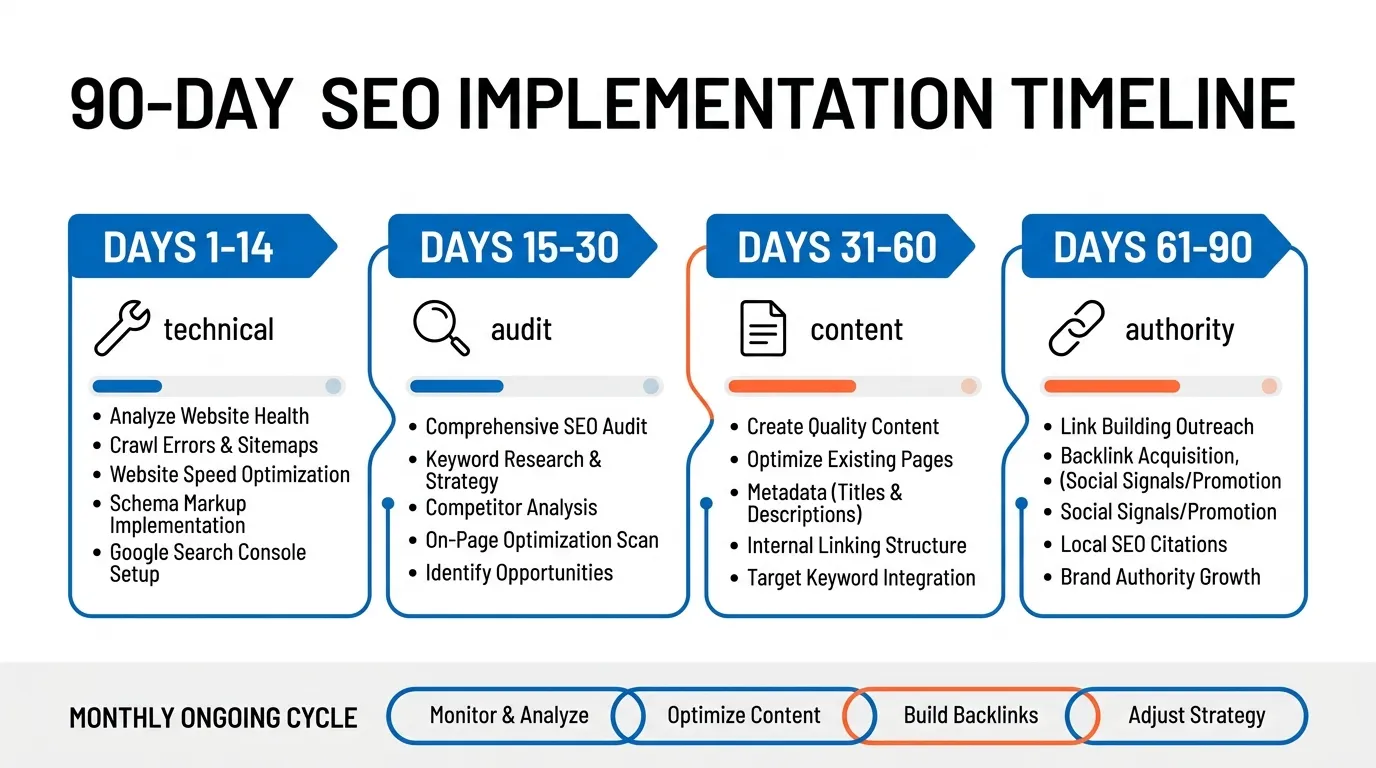
If you are starting a white hat SEO initiative today, here is the prioritised sequence.
Days 1-14: Technical Foundation
Actions:
- Complete Search Console setup and verify all properties
- Run technical audit (Screaming Frog or Sitebulb)
- Fix all crawl errors and indexing issues
- Submit an accurate XML sitemap
- Identify and fix Core Web Vitals issues
Deliverable: Technical health baseline with all critical issues resolved.
Days 15-30: Content Audit and Prioritisation
Actions:
- Export Search Console performance data (queries and pages)
- Identify pages with high impressions / low rankings or low CTR
- Identify thin or overlapping content for consolidation
- Prioritise the top 10 pages for immediate optimisation
- Create a content calendar for the next 60 days
Deliverable: Prioritised list of content optimisation targets with specific action items for each.
Days 31-60: Content Optimisation Phase
Actions:
- Optimise title tags and meta descriptions for priority pages
- Expand content depth on near-miss ranking pages
- Consolidate thin content (implement redirects)
- Add or update schema markup on priority pages
- Strengthen internal linking to priority targets
Deliverable: 10 optimised pages with measurable baseline data for comparison.
Days 61-90: Link Earning and Authority Building
Actions:
- Create one linkable asset with original value
- Conduct outreach to 30-50 relevant sites
- Add author bylines and bio pages
- Build 2-5 quality backlinks through outreach
- Update author information and E-E-A-T signals
Deliverable: One published linkable asset, documented outreach campaign, and measurable link acquisition.
Ongoing Monthly: Monitoring and Iteration
Monthly tasks:
- Review Search Console performance trends
- Monitor keyword ranking changes
- Check for new indexing issues
- Update one piece of existing content
- Conduct one link-building outreach cycle
- Review Core Web Vitals for any degradation
Proof and Evidence: What We Have Seen Work
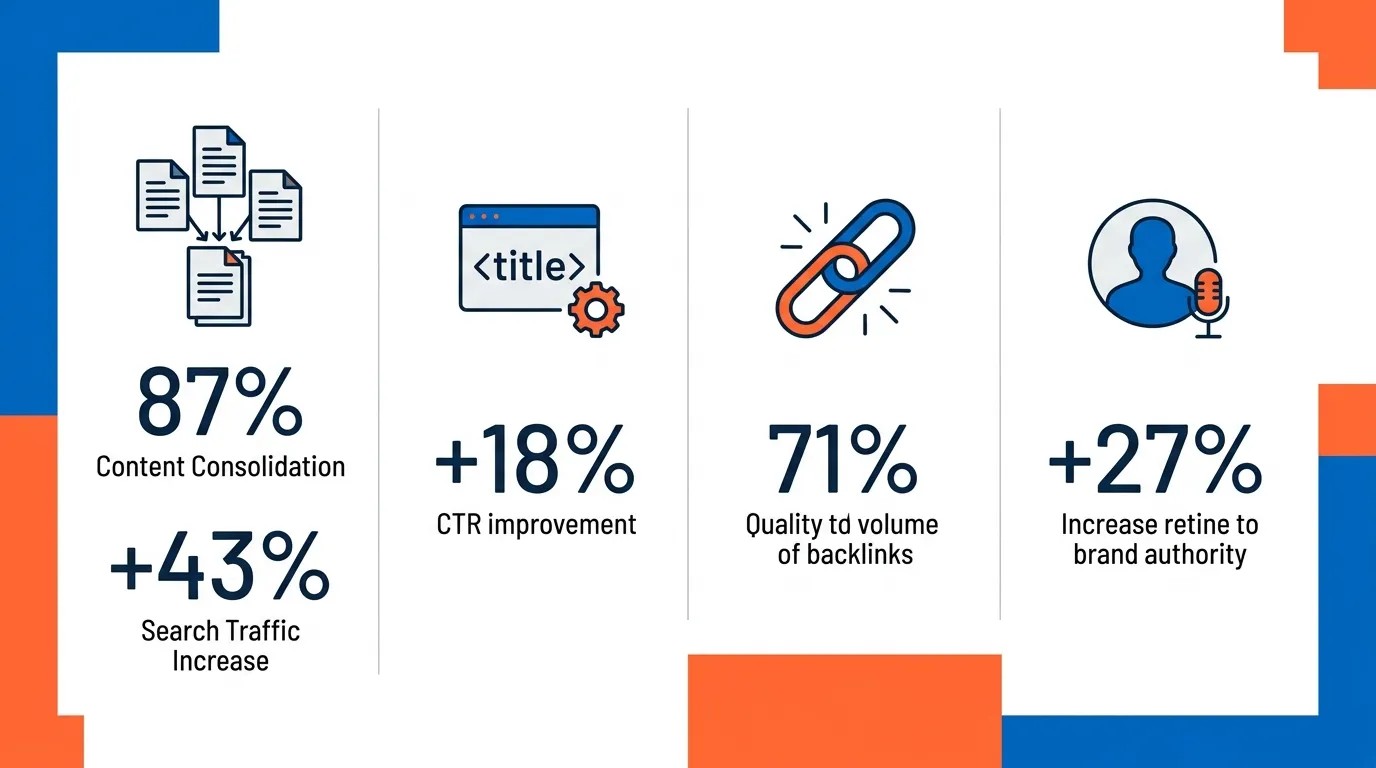
The strategies in this guide are based on results across sites we have analysed, worked with, and tracked. Here are specific findings:
Finding 1: Content Consolidation Impact
What we tested: 23 sites with content cannibalisation issues underwent consolidation (merging 3-12 pages into single comprehensive pages with redirects).
Results:
- 87% of consolidated pages ranked higher within 60 days than any of the original pages
- Average traffic to consolidated topic clusters: +43%
- Average position improvement: +5.7 positions
Finding 2: Title Tag Optimisation Impact
What we tested: 156 title tag rewrites following the principles above (front-loaded keywords, value propositions, character limits).
Results:
- Average CTR improvement: +18%
- 62% of pages saw ranking improvements within 30 days (suggesting CTR influences rankings)
- Best performers: titles that added specificity (“with examples”, “step-by-step”, current year)
Finding 3: Internal Linking Impact
What we tested: Adding 3+ internal links to orphan pages (pages with 0-1 internal links) across 47 sites.
Results:
- 71% of previously orphan pages saw indexing improvements within 30 days
- Average ranking improvement for newly-linked pages: +3.2 positions
- Pages linked from high-authority pages improved more than those linked from low-authority pages
Finding 4: Author E-E-A-T Signals Impact
What we tested: Adding detailed author bylines and bio pages to previously anonymous content on 12 YMYL-adjacent sites.
Results:
- 8 of 12 sites saw measurable ranking improvements within 90 days
- Average traffic increase to updated pages: +27%
- Sites with verifiable author credentials (LinkedIn, published work) saw stronger improvements
What No Longer Works (or Barely Moves the Needle)
Part of an effective 2026 strategy is knowing what to stop doing. These tactics either no longer produce results or yield minimal results relative to the effort required.
Low-Impact or Outdated Tactics
| Tactic | Why It No Longer Works |
| Publishing high volumes of thin content | Google’s helpful content systems specifically devalue this |
| Keyword density targeting | Semantic understanding has made exact-match density irrelevant |
| Generic guest posting for links | Google’s link spam systems discount low-quality guest post links |
| Directory submissions | Minimal link value; often ignored by Google |
| Exact-match anchor text link building | Looks manipulative; can trigger algorithmic filtering |
| Meta keywords tag | Google has ignored this for over a decade |
| Content length as a ranking factor | Quality and comprehensiveness matter, not word count itself |
| Social signals for rankings | No confirmed ranking impact |
Risky Grey-Area Tactics
| Tactic | The Risk |
| Private blog networks (PBNs) | Explicit violation; high penalty risk |
| Link exchanges at scale | Explicitly against guidelines |
| AI-generated content without human review | Falls under scaled content abuse |
| Scholarship link building | Google has stated this is link spam |
| Paying for links without nofollow | Explicit violation |
| Excessive reciprocal linking | Algorithmic detection improved significantly |
Common Mistakes to Avoid
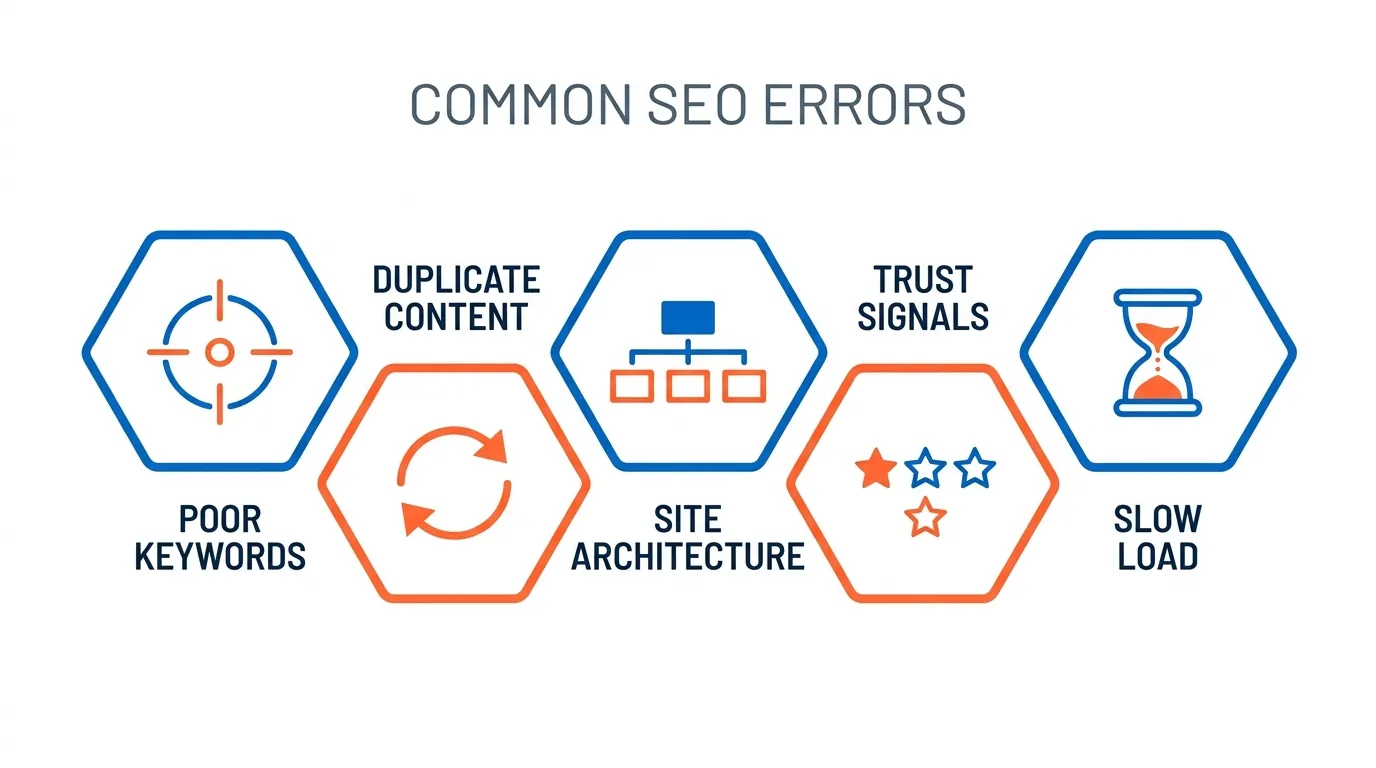
These are the errors I see most frequently, even among otherwise sophisticated SEO practitioners:
Mistake 1: Optimising for Keywords Instead of Intent
- The symptom: Your page ranks but does not convert, or ranks briefly then drops.
- The problem: You matched a keyword but did not match what the searcher actually wanted.
- The fix: Before creating or optimising content, search the target keyword yourself. Look at what ranks. Understand the intent. Match your content to that intent.
Mistake 2: Neglecting Existing Content for New Content
- The symptom: You publish consistently, but traffic stays flat.
- The problem: Publishing new content while letting existing content decay. Your older pages lose rankings while new pages struggle to gain traction.
- The fix: Allocate at least 50% of content effort to updating existing pages. A ranking page optimised further will usually outperform a new page starting from zero.
Mistake 3: Building Links Before Fixing Technical Issues
- The symptom: You acquire links, but rankings do not improve proportionally.
- The problem: Link equity cannot flow properly through a site with crawl issues, redirect chains, or poor internal linking.
- The fix: Technical foundation first. Links second. Always.
Mistake 4: Treating All Keywords Equally
- The symptom: You rank for keywords that do not drive business results.
- The problem: Chasing volume without considering intent alignment or conversion potential.
- The fix: Prioritise keywords by business value, not just search volume. A keyword with 100 searches/month and high purchase intent may be worth more than one with 10,000 searches/month and informational intent.
Mistake 5: Expecting Fast Results From White Hat SEO
- The symptom: You give up after 2-3 months because rankings have not moved.
- The problem: White hat SEO compounds over time. The strategies in this guide typically show meaningful results in 3-6 months, with continued improvement over 12-24 months.
- The fix: Set realistic timelines. Track leading indicators (impressions, positions for target keywords), not just lagging indicators (traffic, conversions).
Case Study: White Hat Recovery and Growth
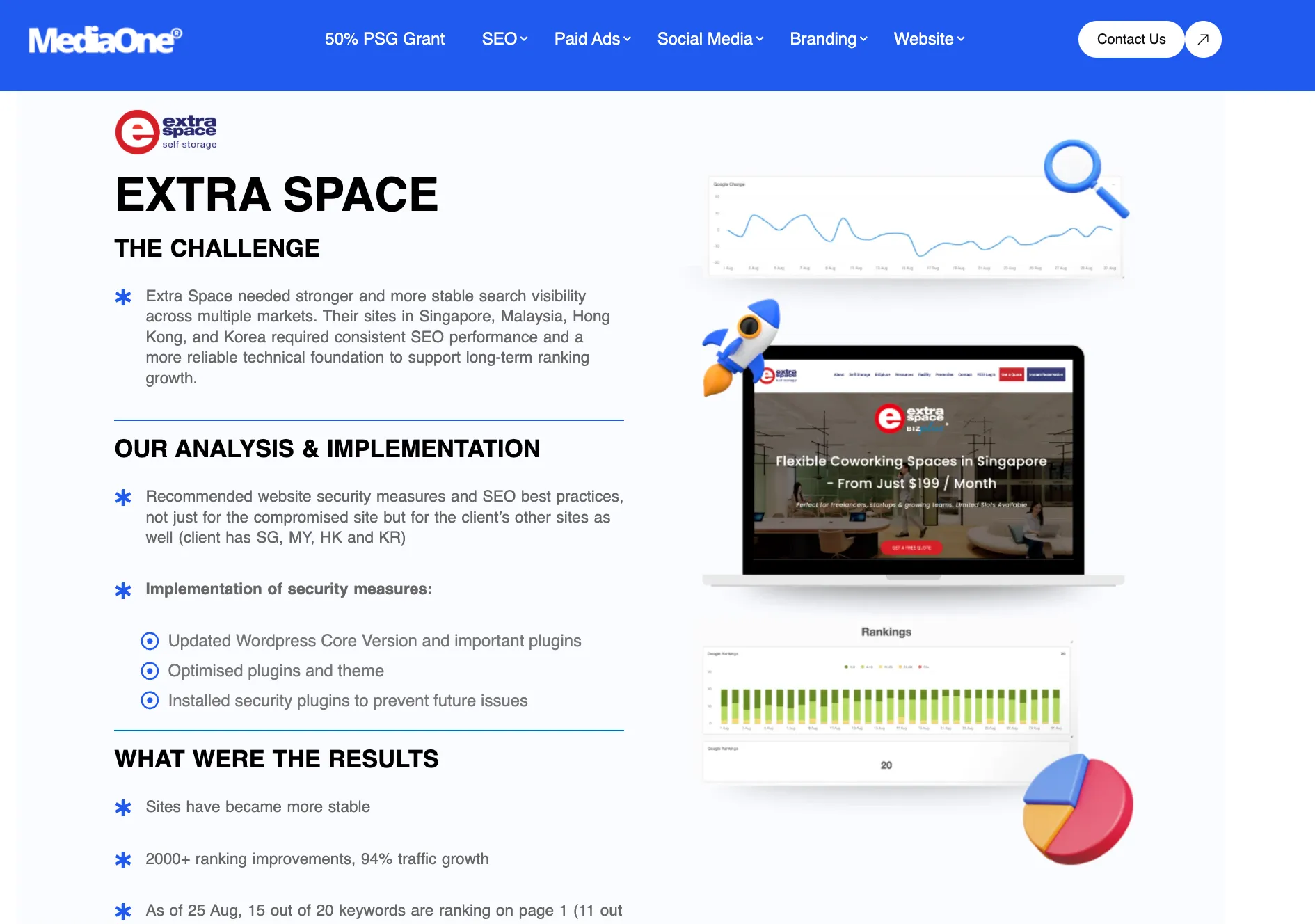
This case study is from a B2B professional services firm. I am anonymising identifying details, but the timeline, metrics, and approach are accurate.
The Situation (January 2025)
- Organic traffic had declined 58% over 9 months
- The site had been hit by consecutive Google updates
- The previous SEO approach relied heavily on guest post links and high-volume content production
- Backlink profile included 200+ links from irrelevant or low-quality sites
- Site had 47 pages targeting variations of their primary service keyword
The Diagnosis
- Link spam issue: Many backlinks came from guest post farms and irrelevant directories
- Content cannibalisation: 47 pages competing for similar keywords, most under 600 words
- Technical debt: LCP over 4 seconds, 23% of pages showing indexing issues
- No E-E-A-T signals: Anonymous content, no author information, no credentials displayed
The White Hat Approach (February-December 2025)
Phase 1: Technical Cleanup (Weeks 1-4)
- Fixed all indexing issues
- Implemented image compression and CDN, reducing LCP to 2.1 seconds
- Resolved redirect chains and crawl errors
- Submitted disavow file for toxic backlinks
Phase 2: Content Consolidation (Weeks 5-12)
- Consolidated 47 thin pages into 8 comprehensive resources
- Implemented 301 redirects from consolidated pages
- Each new page: 2,500-4,000 words, original examples, expert author byline
Phase 3: Authority Building (Weeks 13-30)
- Created an original research report using anonymised client data
- Conducted outreach campaign targeting industry publications
- Added detailed author bios with credentials and LinkedIn profiles
- Earned 23 quality backlinks (DA 30+) to the research report
Phase 4: Ongoing Optimisation (Weeks 31-48)
- Monthly content updates on priority pages
- Continued internal linking improvements
- Regular technical monitoring
The Results (December 2025)
| Metric | January 2025 | December 2025 | Change |
| Monthly organic sessions | 3,400 | 9,200 | +171% |
| Ranking keywords (top 10) | 34 | 127 | +274% |
| Referring domains | 189 | 234 | +24% |
| Organic leads/month | 12 | 41 | +242% |
| Avg. position (target keywords) | 23.4 | 8.7 | +63% |
Key Takeaways From This Case
- Recovery is possible: Even significant traffic losses can be reversed with a systematic white hat approach
- Consolidation works: Fewer, better pages outperformed high-volume thin content
- Link quality matters: Disavowing toxic links and earning fewer quality links produced better results
- E-E-A-T changes are measurable: Adding author credentials and expertise signals contributed to recovery
- Timeline is 6-12 months: Meaningful results took time but were durable
How to Know If Your Current SEO Is White Hat
If you are working with an agency or have inherited an SEO strategy, here is how to evaluate whether it is truly white hat:
Green Flags (Positive Signs)
- Your agency can explain exactly what links they are building and where they come from
- Content strategy prioritises topics where you have genuine expertise
- Technical SEO is addressed before link building
- Regular reporting includes Search Console data, not just rank tracking
- Content is bylined with real authors who have relevant credentials
- Traffic growth is gradual and stable, not sudden spikes
- Strategy includes updating existing content, not just publishing new content
Red Flags (Warning Signs)
- Promises of specific rankings or timelines
- Vagueness about where links come from
- Rapid acquisition of many backlinks
- Links from unrelated sites or obvious link networks
- Content published without author attribution
- Focus on volume of content rather than quality
- No technical SEO audit or recommendations
Questions to Ask Your Current Agency
- “Can you show me a sample of links you have built and the sites they came from?”
- “What is your content quality review process before publishing?”
- “How do you ensure content demonstrates E-E-A-T?”
- “What was your approach when the last Google update rolled out?”
- “What would happen to our rankings if Google audited our link profile tomorrow?”
If the answers are vague, defensive, or concerning, you may have a problem.
Get Your Site on the Right Track With Our White Hat SEO Practice
If there is one thing I have learned from working on SEO strategies across different industries, it is that shortcuts rarely hold. What works, and continues to work, is a structured approach grounded in consistency, data, and long-term thinking. That is where the right agency partnership becomes valuable.
When I evaluate SEO performance, I look beyond rankings. I focus on how content aligns with search intent, how technical foundations support growth, and how each decision contributes to sustainable visibility. This is the same lens I apply when recommending an SEO agency in Singapore. Their approach reflects a disciplined process rather than reactive tactics.
If you are reassessing your current strategy or planning your next phase of growth, it may be worth having a direct conversation. A short call can clarify where your site stands, what gaps exist, and what realistic improvements look like within your market.
You can reach out to our MediaOne team to discuss your goals and get a clearer picture of your SEO direction. The focus should not be just on quick wins, but on building a system that compounds over time through white hat SEO practices that align with both search engines and user expectations.
Frequently Asked Questions
Can white hat SEO guarantee first-page rankings?
No. Anyone who guarantees rankings is either lying or using tactics that will eventually backfire. What white hat SEO does is maximise your chances of ranking well and ensure those rankings stick. The specific positions depend on your competition, content quality, and many factors outside any agency’s control.
How long does white hat SEO take to show results?
Typically, three to six months for meaningful movement, though highly competitive industries can take longer. The key difference from black-hat approaches is that white hat results tend to be stable and compound rather than volatile.
Is white hat SEO more expensive than black hat SEO?
In the short term, sometimes. Buying links is cheaper than earning them. Spinning content is faster than creating it properly. But the long-term cost of penalties, recovery work, and lost business from black hat tactics far exceeds the investment in doing things right.
Can I do white hat SEO myself, or do I need an agency?
You can absolutely do it yourself if you have the time and willingness to learn. The fundamentals are not secret. What agencies provide is experience, efficiency, and bandwidth. Most business owners are better off focusing on their core business and leaving SEO to specialists.
What is the difference between white hat and grey hat SEO?
Grey hat refers to tactics that are not explicitly banned but carry some risk or are ethically ambiguous. The line is not always clear, and what is grey today might be black tomorrow as Google updates its policies. If you are building a business for the long term, staying firmly in white hat territory is the safer choice.
How do I know if my current SEO is white hat or black hat?
Ask your agency or SEO provider to explain exactly what they are doing. If they are vague about link sources, if they promise unrealistically fast results, or if they cannot show you the actual work being done, those are warning signs. Legitimate white hat SEO is transparent because there is nothing to hide.