If you run a business in Singapore, you know that finding quality leads is one of the toughest challenges. Even the best products can go unnoticed if you don’t have a steady stream of people looking for what you offer. Meanwhile, competitors with better lead generation can easily take the lead, even if their products aren’t as strong.

In Singapore’s fast-paced digital market, partnering with a professional lead generation agency can make a significant difference for your business. But with so many agencies promising big results, it can be tough to know which one to trust.
This guide breaks down everything you need to know about lead generation services in Singapore. You’ll find practical tips on costs, how different methods work, choosing the right platforms, picking the best agency, and what results you should expect for your investment.

Whether you’re new to lead generation or looking to improve your current campaigns, this guide will help you make smarter decisions for your business.
Key Takeaways
- Lead generation isn’t instant. You might see some early results in the first month or two, but real improvements and lower costs usually show up after three to four months as your campaigns get smarter.
- Quality leads drive better ROI than high volumes. Fewer qualified prospects who match your ideal customer profile and demonstrate genuine intent deliver better business outcomes than large quantities of unqualified contacts.
- The best lead generation strategies use a mix of channels. By combining search ads, social media, and other platforms, you can reach people at different stages of their buying journey and avoid relying on just one source for leads.
- Pick agencies that can show real results and explain their process clearly. Look for case studies, certifications, and a team with the right skills. Be careful with agencies that make big promises or offer prices that seem too good to be true.
What Are Lead Generation Services?

Lead generation services help you find, attract, and convert people who are actually interested in what you offer.
Instead of advertising to everyone and hoping for the best, lead generation targets people who are already looking for solutions like yours.
A professional lead generation service typically encompasses:
- Strategic audience targeting across multiple digital channels
- Conversion-optimised landing pages designed to capture prospect information
- Persuasive ad, creative, and copywriting that speaks directly to your ideal customer’s pain points
- Multi-platform campaign management including Google Ads, Meta (Facebook/Instagram), LinkedIn, and TikTok
- Lead qualification and scoring to prioritise high-intent prospects
- Comprehensive analytics and reporting demonstrating campaign performance and ROI
The majority of Singaporean consumers consult at least three digital sources before making purchasing decisions.
This is why passive marketing isn’t enough anymore. If you want to stand out in Singapore, you need to actively generate leads.
Why Singapore Businesses Need Lead Generation Services

Singapore is one of the most digitally connected places in Asia, giving you access to tech-savvy consumers and business buyers. But this also means it’s harder than ever to get noticed.
The Singapore Advantage
Singapore businesses benefit from several factors that make lead generation particularly effective:
- High internet penetration: With over 90% internet usage rates, digital channels offer unparalleled reach
- Mobile-first consumers: Singaporeans spend an average of 8+ hours daily on digital devices
- Multichannel buyers: Local consumers seamlessly switch between online research, social media, and direct engagement
- Regional gateway position: Singapore serves as the ideal testing ground for broader APAC expansion
Common Challenges of Lead Generation Services
Despite these advantages, many Singapore businesses struggle with:
- Rising advertising costs: Platform competition has driven up cost-per-click rates across Google, Meta, and LinkedIn. Shift budget toward high-intent channels and complement paid ads with organic SEO and content strategies to reduce cost-per-acquisition over time.
- Ad fatigue: Audiences exposed to countless daily messages require increasingly creative approaches. Rotate creative assets every 2–3 weeks, test video and interactive formats, and use dynamic ads that personalise messaging based on user behaviour and stage in the buying journey.
- Attribution complexity: Multiple touchpoints make it difficult to track which channels drive actual conversions. Implement multi-touch attribution models (e.g., U-shaped or time-decay) using platforms like Google Analytics 4, HubSpot, or Ruler Analytics, and establish closed-loop reporting between marketing and sales.
- Resource constraints: Small and medium enterprises often lack in-house expertise to manage sophisticated campaigns. Partner with a specialist lead generation agency that provides end-to-end strategy and optimisation, allowing internal teams to focus on closing deals rather than campaign management.
- Lead quality issues: Generating volume is easy; attracting genuinely interested, qualified prospects is the real challenge. Introduce lead scoring based on demographic fit and engagement behaviour and establish clear MQL definitions with sales teams to filter out unqualified prospects early.
A good lead generation agency addresses these challenges by bringing in the right expertise, proven strategies, and ongoing improvements that are hard to manage on your own.
Types of Lead Generation Services Available in Singapore
Not all lead generation services work the same way. Knowing your options makes it easier to pick the right fit for your business.
1. Paid Advertising Lead Generation

Paid advertising is the fastest way to generate leads. Instead of waiting months for organic strategies to gain traction, paid campaigns put your business in front of potential customers immediately, allowing you to test messaging, refine targeting, and scale results based on what works.
Paid advertising is all about getting quick results. It uses paid channels to bring in traffic and leads right away:
- Google Search Ads: Capturing prospects actively searching for your solutions
- Display Advertising: Building brand awareness and retargeting interested visitors
- Social Media Advertising: Leveraging Meta, LinkedIn, TikTok, and other platforms to reach targeted demographics
- YouTube Video Ads: Engaging audiences through video storytelling
Best for: Businesses seeking immediate results and scalable lead volume with measurable ROI.
2. Content Marketing Lead Generation

Content marketing attracts leads by providing value first. Rather than interrupting people with ads, you create helpful resources that answer their questions and solve their problems, naturally drawing interested prospects to your business over time.
Content marketing brings in leads by sharing helpful and educational content:
- Blog articles and guides: Establishing thought leadership while improving search visibility
- Downloadable resources: eBooks, whitepapers, and templates offered in exchange for contact information
- Webinars and virtual events: Interactive sessions that educate whilst capturing qualified leads
- Email nurture sequences: Multi-touch campaigns that build relationships over time
Best for: B2B companies, professional services, and businesses with longer sales cycles requiring trust-building.
3. SEO-Driven Lead Generation

SEO builds a foundation for long-term lead generation by making your business easy to find when people search online. Unlike paid ads that stop working when you stop paying, SEO continues delivering results over time, often becoming your most cost-effective lead source.
SEO is a long-term strategy that helps your business get found online and build trust over time:
- Technical SEO optimisation: Ensuring search engines can properly crawl and index your site
- Keyword targeting: Ranking for terms your ideal customers actually search
- Local SEO: Dominating “near me” searches and Google My Business listings
- Link building: Establishing authority through quality backlinks
Best for: Businesses committed to sustainable, cost-effective lead generation over 6-12 month timeframes.
4. LinkedIn Outbound Lead Generation

LinkedIn outbound turns cold prospecting into warm conversations. Instead of blasting generic emails or making intrusive cold calls, you connect directly with decision-makers in a professional context where business conversations are expected and welcomed.
This targeted B2B approach directly reaches decision-makers:
- Profile optimisation: Positioning your team as industry experts
- Connection campaigns: Building networks with ideal customer profiles
- InMail outreach: Direct messaging to key prospects
- Content engagement: Thoughtful commenting and sharing to increase visibility
Best for: B2B service providers, SaaS companies, and professional services targeting specific industries or roles.
5. Conversion Rate Optimisation (CRO)
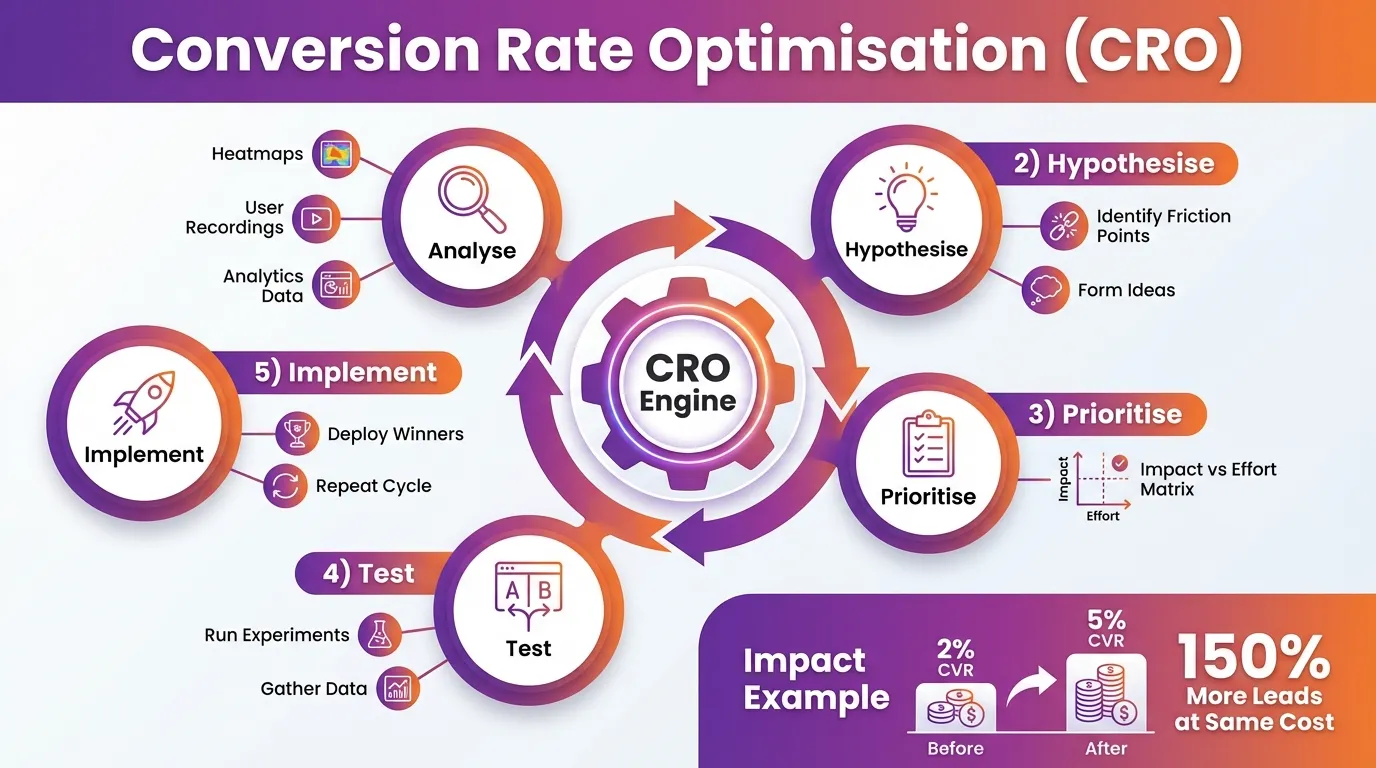
CRO focuses on getting more from the traffic you already have. Rather than spending more money to attract more visitors, you improve your website and landing pages to convert a higher percentage of existing visitors into leads, often delivering better results at a fraction of the cost.
This analytical approach maximises results from existing traffic:
- Landing page testing: A/B testing headlines, layouts, and calls-to-action
- Form optimisation: Reducing friction in the lead capture process
- User experience improvements: Identifying and eliminating conversion barriers
- Heatmap analysis: Understanding how visitors interact with your pages
Best for: Businesses already driving traffic but experiencing poor conversion rates.
Lead Generation Pricing in Singapore: What to Expect
Knowing how much lead generation costs can help you plan your budget and set the right expectations. Prices can vary widely depending on your industry, your target audience, the complexity of your campaigns, and the services you need.
Monthly Retainer Models
Most established agencies in Singapore operate on monthly retainer agreements:
| Investment Tier | Monthly Fee | Best For | What’s Included |
| Entry-Level |
|
|
|
| Standard |
|
|
|
| Premium |
|
|
|
According to industry benchmarks, Singapore’s average B2B cost per lead hovers around S$250, though this varies dramatically by sector. Technology and professional services might see S$150-300 per lead, whilst financial services and real estate can exceed S$400-600 per qualified lead due to higher lifetime customer value.
Performance-Based Pricing
Some agencies offer results-oriented pricing models:
- Cost per lead (CPL): You pay a fixed amount for each qualified lead delivered, typically S$50-300, depending on industry
- Cost per appointment (CPA): For appointment-setting focused campaigns, expect S$150-900 per booked meeting
- Revenue share: In rare cases, agencies might accept a percentage of closed deals (typically 10-20%)
What Influences Lead Generation Services Costs?
Several factors impact your investment requirements:
- Industry competitiveness: Healthcare, legal, finance, and education face higher advertising costs due to intense competition
- Target audience specificity: Niche B2B audiences cost more to reach than broad consumer markets
- Geographic targeting: Singapore-wide campaigns differ from region-specific or international targeting
- Lead quality requirements: Highly qualified leads with specific criteria cost more to generate
- Campaign complexity: Sophisticated funnels with multiple touchpoints require greater resources
Additional Costs to Consider
Don’t forget to budget for more than just agency fees. You’ll also need to consider:
- Advertising spend: Your actual media budget (separate from agency management fees)
- Landing page development: Custom pages may cost S$2,000-8,000 depending on complexity
- Marketing automation tools: Platforms like HubSpot, Salesforce, or Marketo (S$500-2,000+/month)
- Creative production: Professional photography, videography, or graphic design
Pro tip: A realistic total budget typically allocates 20-30% to agency management and 70-80% to actual advertising spend. For example, with a S$10,000 monthly budget, expect approximately S$2,500 for agency services and S$7,500 for ad spend.
What Results Should You Expect From Lead Generation Services?
It’s important to set realistic expectations for lead generation. Your results will depend on your industry, the strength of your offer, your sales process, and the maturity of your campaigns.
Timeline Expectations
Lead generation takes time to mature. Understanding the typical timeline helps you set realistic expectations and avoid pulling the plug on campaigns too early.
Months 1-2: Foundation and Testing
- Campaign infrastructure setup
- Initial audience testing and data gathering
- Learning phase with platforms
- Expect a higher cost per lead as algorithms optimise
- Focus on gathering insights rather than volume.
Months 3-4: Optimisation and Improvement
- Data-driven refinements to targeting and creative
- Cost per lead typically decreases 20-40%
- Lead quality assessment and feedback loops
- Scaling of winning campaigns
Months 5-6+: Maturity and Scale
- Consistent, predictable lead flow
- Optimised cost per lead stabilises.
- Expansion to additional channels
- Advanced testing of new approaches
Key Performance Metrics
Professional agencies track and report on these critical metrics:
Volume Metrics:
- Total leads generated: Raw number of prospects captured
- Lead generation rate: Leads per 1,000 impressions or visitors
- Cost per lead (CPL): Total spend divided by leads generated
Quality Metrics:
- Marketing Qualified Leads (MQLs): Prospects meeting predefined criteria (typically 25-35% of total leads)
- Sales Qualified Leads (SQLs): MQLs vetted and accepted by sales teams (typically 13-26% of MQLs)
- Lead-to-opportunity conversion: SQLs advancing to active sales opportunities (typically 50-62%)
- Lead-to-customer conversion: Ultimate percentage of leads becoming paying customers (varies widely, typically 2-10%)
Campaign Performance:
- Click-through rate (CTR): Percentage of ad viewers clicking (2-5% is standard for search, 0.5-1.5% for display)
- Landing page conversion rate: Percentage of visitors submitting forms (average 2-5%, excellent campaigns achieve 10%+)
- Cost per acquisition (CPA): Total cost to acquire a paying customer
- Return on ad spend (ROAS): Revenue generated divided by advertising costs (target 3:1 minimum, 5:1+ excellent)
Industry Benchmarks for Lead Generation Services in Singapore
Based on recent data, here are typical performance ranges:
| Industry | Average CPL | Lead-to-Customer Rate | Average Customer Value |
| Technology/SaaS | S$150-300 | 3-8% | S$5,000-50,000+ |
| Professional Services | S$100-250 | 5-15% | S$3,000-15,000 |
| Education | S$80-200 | 10-25% | S$2,000-10,000 |
| Real Estate | S$300-600 | 1-3% | S$10,000-100,000+ |
| Healthcare | S$150-400 | 5-12% | S$2,000-8,000 |
| E-commerce | S$20-80 | 2-5% | S$80-500 |
| Financial Services | S$200-500 | 2-8% | S$5,000-30,000+ |
Important: These benchmarks represent averages. Your specific results depend on numerous factors, including offer strength, brand reputation, sales process efficiency, and campaign execution quality.
What Constitutes Success?
Rather than fixating on vanity metrics, focus on business outcomes:
- Pipeline contribution: Is lead generation filling your sales pipeline with opportunities worth pursuing?
- Sales team satisfaction: Are sales representatives happy with lead quality and conversion rates?
- Customer acquisition cost (CAC): Is your CAC sustainable relative to customer lifetime value (LTV)?
- Revenue impact: Are campaigns generating positive ROI within acceptable timeframes?
A campaign delivering 20 high-quality leads worth S$200 each that convert at 15% is far superior to 200 low-quality leads at S$20 each converting at 2%, despite the second scenario appearing more impressive numerically.
How to Choose the Right Lead Generation Agency in Singapore

Selecting the wrong partner wastes money and opportunity. Here’s how to evaluate potential agencies:
1. Proven Track Record
Start with evidence, not promises. Request case studies showing specific results for businesses similar to yours, look for actual metrics like cost-per-lead, conversion rates, and revenue impact, not vague success stories.
Client testimonials matter, with 50+ positive reviews across Google or Facebook serving as a reliable quality signal. Industry awards and years in operation provide additional confidence; agencies that have survived multiple platform changes and economic cycles demonstrate resilience that new firms can’t claim.
2. Platform Partnerships and Certifications
Official partnerships reveal technical proficiency and ongoing investment in expertise. Google Partner status confirms the agency meets spending thresholds and maintains certified specialists. Meta Business Partner shows Facebook and Instagram capabilities.
LinkedIn Partner indicates B2B expertise, whilst TikTok Partner signals understanding of emerging platforms. These certifications matter because partner agencies receive early access to new features, dedicated platform support for troubleshooting, and ongoing training on algorithm updates.
These advantages translate directly into better campaign performance and faster problem resolution than uncertified competitors can deliver.
3. In-House Expertise
Strong agencies maintain dedicated specialists rather than expecting generalists to handle everything. Look for teams covering campaign strategy, certified media buying, conversion copywriting, landing page design and development, and data analysis.
This structure enables holistic problem-solving. When campaigns underperform, they can simultaneously refine targeting, improve creative, optimise pages, and adjust nurture sequences.
Avoid agencies that outsource core functions like creative development or strategic planning. Outsourcing fragments accountability and slows response times when problems arise. In-house teams respond immediately and maintain institutional knowledge that compounds into sustained advantage.
4. Transparent Processes
Professional agencies demonstrate confidence through transparency. They explain their methodology clearly, without jargon that would be confusing.
They set realistic timeline expectations, typically 90–120 days for meaningful results, rather than promising immediate outcomes. They provide explicit breakdowns of included services versus additional costs, preventing surprise charges.
Transparency extends to reporting. Look for agencies that commit to regular updates focused on business outcomes, such as cost-per-lead and conversion rates, not vanity metrics like impressions.
They should establish clear communication protocols: response times, meeting frequency, escalation processes, and whether you’ll access strategists directly or only through account coordinators.
5. Industry Specialisation vs. Generalist Approach
Industry specialists bring immediate domain expertise, understanding buyer journeys, effective messaging, and regulatory constraints specific to your sector.
They deploy proven playbooks from day one rather than experimenting. However, specialists sometimes become entrenched in conventional thinking and may resist fresh approaches.
Generalists with diverse experience import successful strategies from other markets and bring fresh creative perspectives unconstrained by sector conventions. They offer strategic flexibility and cross-industry innovation. However, they require more time to understand your specific market dynamics and may lack deep domain knowledge.
Highly specialised or regulated industries (healthcare, financial services, legal) often benefit from specialists who understand compliance requirements.

Companies in straightforward sectors (professional services, e-commerce) might prefer generalists who bring cross-industry innovation. The key is ensuring the agency’s background specifically positions them to solve your unique problems, not accepting generic claims of expertise.
Questions to Ask Potential Lead Generation Agencies in Singapore
During discovery calls, ask:
- “Can you share 2-3 case studies from businesses similar to ours?”
- “What platforms do you recommend for our specific objectives, and why?”
- “How do you define and measure lead quality?”
- “What’s included in your management fee vs. media spend?”
- “How frequently will we receive updates and reports?”
- “Who specifically will be working on our account?”
- “What’s your typical timeline to seeing meaningful results?”
- “How do you handle underperforming campaigns?”
- “What makes you different from other agencies we’re considering?”
- “Can you provide 2-3 current client references I can contact?”
The quality of their responses reveals professionalism, expertise, and cultural fit.
Note: You can still tweak your questions based on your preferred needs.
Maximising Your Lead Generation Investment

Even if you hire the best agency, your own involvement makes a big difference. Here are some ways to get the most out of your investment:
1. Define Clear Objectives
Vague goals lead to vague results. Specific, measurable objectives give your agency a clear target and provide benchmarks to evaluate performance.
Replace vague goals like “generate more leads” with specific targets:
- “Generate 50 qualified leads per month at maximum S$200 CPL.”
- “Achieve 5:1 ROAS within six months.”
- “Fill pipeline with 20 sales-qualified opportunities monthly.”
Clear goals help your agency create the right strategy and measure success effectively.
2. Understand Your Customer Journey
Your agency can create compelling campaigns, but only you truly understand what your customers think and need at each buying stage. This insight transforms generic campaigns into precisely targeted ones.
Map how prospects progress from awareness to purchase:
- What problems do they recognise?
- Where do they search for solutions?
- What information influences decisions?
- What objections prevent conversions?
- How long does the typical sales cycle take?
Understanding your customer journey helps you target the right people, craft better messages, and build a stronger sales funnel.
3. Provide Agency Access and Assets
Delays in providing brand guidelines, testimonials, or access to analytics directly translate into delayed campaign launches. The faster you provide what your agency needs, the faster they can start generating results.
Enable your agency to succeed by promptly providing:
- Brand guidelines and approved messaging
- Product/service details and pricing
- Existing customer testimonials and case studies
- Access to analytics platforms (Google Analytics, CRM systems)
- Competitor information and market positioning
- High-quality images, videos, and other creative assets
If you take too long to provide assets, your campaigns will be delayed too.
4. Establish Feedback Loops
The most successful campaigns improve continuously based on real-world feedback from your sales team. This intelligence allows your agency to refine targeting, adjust qualification criteria, and focus on what actually works.
Create processes for:

- Lead quality feedback: Sales teams reporting on lead quality helps agencies refine targeting.
- Closed-loop reporting: Tracking which leads actually became customers reveals which sources and messages perform best
- Regular strategy sessions: Monthly or quarterly meetings to review performance and adjust strategy
5. Be Patient But Demanding
Lead generation requires patience to allow campaigns time to mature, combined with high standards that hold agencies accountable. Expecting overnight success sets everyone up for failure, but accepting mediocre performance wastes your investment.
Be patient, but also hold your agency accountable:
- Allow time for optimisation: Expect 90-120 days before campaigns mature.
- Demand transparency: Insist on clear reporting and honest communication
- Accept that not everything works: Expect 30-40% of tests to fail—learning from failures drives eventual success.
- Know when to pivot: If campaigns show no improvement after 3-4 months despite iterations, reconsider strategy or partnership.
6. Align Sales and Marketing
Lead generation campaigns can deliver perfectly qualified prospects, but if your sales team takes days to follow up or doesn’t nurture leads properly, those leads go cold. True ROI comes from tight coordination between marketing and sales.
Lead generation only delivers value when sales teams effectively convert leads:
- Define lead qualification criteria collaboratively: Ensure marketing and sales agree on what constitutes a quality lead.
- Establish SLAs: Set expectations for how quickly sales contacts new leads (ideally within 1 hour)
- Create nurture sequences: Not all leads are immediately sales-ready; develop systems to maintain engagement.
- Regular sales-marketing meetings: Weekly alignment prevents misunderstandings and enables continuous improvement
Your agency brings expertise and execution capability, but you bring irreplaceable knowledge about your customers and business model. The businesses that achieve the best results treat lead generation as active collaboration rather than passive outsourcing.
When you combine a skilled agency with your own strategic input and timely support, you create the conditions that justify every dollar invested.
The Future of Lead Generation in Singapore
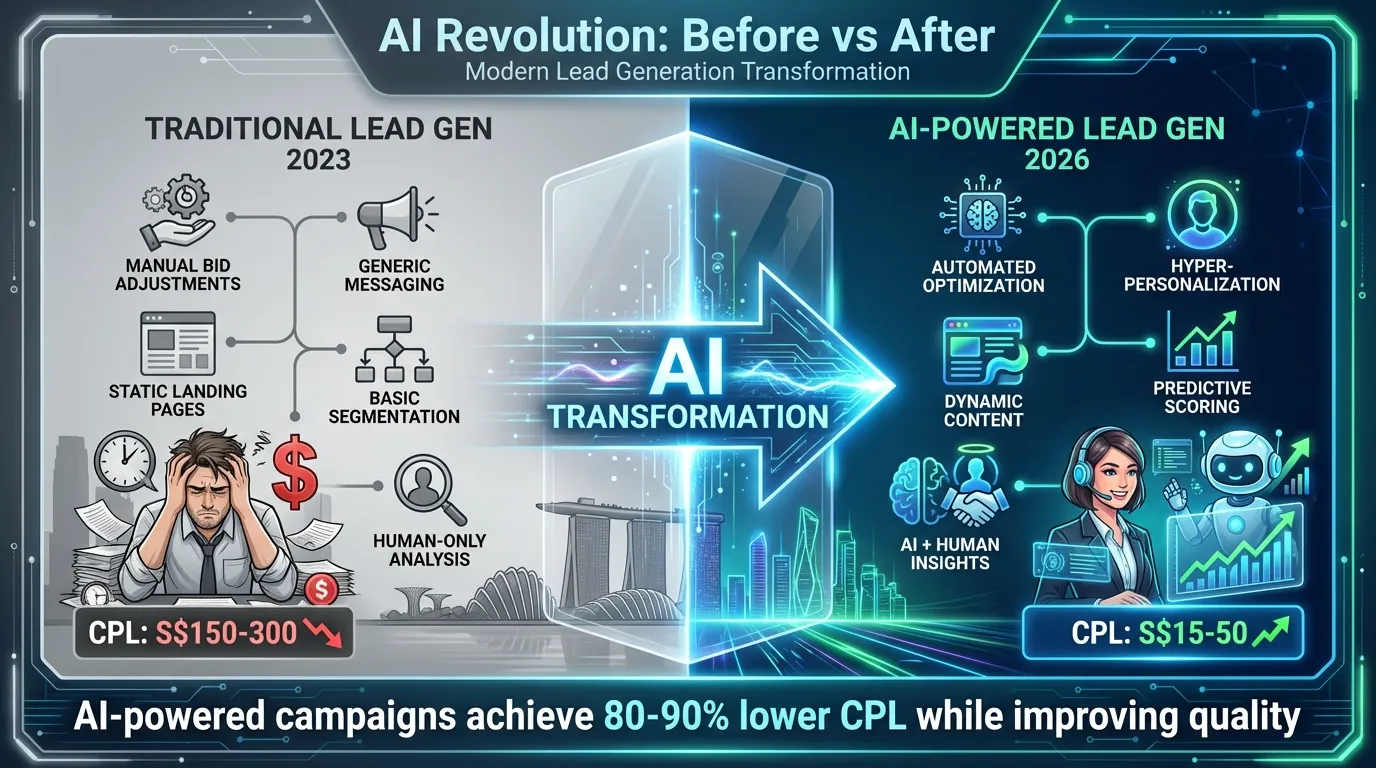
Looking ahead to 2026, here are some key trends that are changing the way businesses generate leads:
AI and Automation
Artificial intelligence is transforming lead generation through:
- Predictive lead scoring: Machine learning identifies which prospects are most likely to convert
- Conversational AI: Chatbots and virtual assistants engage visitors 24/7, qualifying leads before human involvement
- Dynamic personalisation: AI tailors website content, ads, and emails to individual visitor behaviours and preferences
- Automated A/B testing: Platforms continuously test variations and automatically allocate budget to winners
According to recent analysis, AI-powered lead generation now costs S$15-50 per qualified lead compared to S$150-300 for traditional cold calling—a dramatic efficiency improvement.
Privacy and Compliance
Evolving regulations are impacting lead generation:
- Stricter personal data protection requirements
- Diminishing third-party cookie availability
- Increasing consumer privacy expectations
- Greater emphasis on first-party data collection
The best agencies are shifting to value-driven lead magnets that make people want to share their information, instead of relying on tracking.
Video-First Content
Video dominance continues accelerating:
- Short-form video (TikTok, Instagram Reels, YouTube Shorts) drives engagement.
- Live streaming creates authentic connections.
- Video testimonials and case studies outperform text alternatives.
- Platforms prioritise video content in algorithms.
Account-Based Marketing (ABM)
For B2B lead generation, hyper-targeted ABM approaches are becoming standard:
- Focusing resources on high-value target accounts
- Coordinating marketing and sales efforts around specific organisations
- Personalised campaigns addressing individual company challenges
- Multi-stakeholder engagement strategies
Multi-Touch Attribution
As customer journeys grow more complex, sophisticated attribution models help organisations understand which touchpoints truly drive conversions, enabling smarter budget allocation.
Transform Your Singapore Business with Strategic Lead Generation Services
Lead generation services can help your business in Singapore grow faster, but only if you have the right partner, set realistic expectations, and keep working to improve your results.
The most successful businesses treat lead generation as an ongoing process, not a one-off project. They take time to understand their customers, test new ideas, learn from what doesn’t work, and double down on what does.
No matter if you’re just starting out, looking to grow your SME, or expanding into new markets, working with a lead generation agency can help you reach your goals faster.
The real question isn’t if you should invest in lead generation, but how to pick the right partners, platforms, and strategies for your business.
Ready to take your lead generation to the next level? Start by reviewing your current strategy, setting clear goals, and talking to a few agencies to find the one that best fits your needs. If you need help, reach out to us today.
Frequently Asked Questions
How long does it take to see results from lead generation services?
Expect initial results within 30–60 days, with campaigns reaching maturity around 90–120 days. Cost-per-lead typically decreases 20–40% between months 2 and 4 as optimisation takes effect. B2B and high-ticket industries may require 6–12 months to fully evaluate ROI due to longer sales cycles.
What’s the difference between lead generation and demand generation?
Lead generation captures contact information from interested prospects through forms, landing pages, and campaigns. Demand generation creates broader awareness and interest before prospects are ready to share information through content marketing, SEO, and brand building. Demand generation creates the market; lead generation captures it.
How many leads do I need per month?
Work backwards from your revenue goals. If you need 10 new customers per month with a 5% lead-to-customer conversion rate, you need 200 leads. Also consider sales team capacity—if each rep can effectively manage 20 conversations simultaneously with a 30-day sales cycle, they can handle roughly 20 new leads monthly.
Should I hire an agency or build an in-house team?
Agencies offer better value for most SMEs initially. Building an in-house team costs S$250,000+ annually (campaign specialist, copywriter, designer, strategist) before tools and management overhead, whilst agencies provide complete teams for S$24,000–60,000 annually. Consider in-house once you’re consistently spending S$50,000+ monthly on advertising.
What happens to leads that don’t convert immediately?
Implement nurture sequences including educational emails, retargeting campaigns, periodic sales check-ins, and ongoing content (blogs, webinars, guides). Research shows 50% of leads are qualified but not yet ready to purchase. Systematic nurture programmes typically convert 5–15% of these leads over 6–12 months.
How do I know if my leads are high quality?
Quality leads respond promptly to outreach, provide complete and accurate information, match your ideal customer profile (company size, industry, role), demonstrate engagement through multiple page visits or resource downloads, have budget authority, and show near-term purchase intent. Implement lead scoring