Influencer marketing now plays a central role in Singapore’s marketing landscape. According to DataReportal’s Digital 2025 Singapore report, Singapore had 5.16 million social media user identities in January 2025, equivalent to 88.2% of the population.
We Are Social’s digital trends report found influencer ad spend in Singapore hit US$106 million, up 13.6% year on year. That growth matters because creator marketing is no longer treated as a light-touch awareness tactic. Brands now expect influencer campaigns to support reach, traffic, leads, conversions, stronger positioning, and more accountable reporting.
The issue is not whether influencer marketing works. The issue arises when campaign complexity exceeds what an internal team can manage efficiently. Once campaigns involve multiple factors, in-house coordination often becomes harder to scale.
That is where the top influencer marketing agency in Singapore becomes more than a sourcing partner. It becomes an operating model for running creator campaigns with more structure, speed, and accountability.
In this article, we look at when in-house influencer management still makes sense, when it starts to break down, and why more brands are outsourcing once creator marketing becomes commercially important.
Key Takeaways
- Influencer campaigns often start in-house, but complexity rises quickly once brands need stronger coordination, approvals, reporting, and governance.
- The real decision is not agency versus no agency. It is whether the current operating model can still support campaign quality, speed, and accountability.
- A strong influencer marketing agency in Singapore offers more than creator access. It helps brands run campaigns through a more structured workflow.
- Outsourcing tends to create more value when campaigns involve multiple creators, lean teams, higher reporting expectations, or stricter approval needs.
- Local market knowledge matters because creator fit, tone, and audience response are not always transferable from one market to another.
Why More Brands Are Outsourcing Influencer Campaigns
Influencer marketing is no longer treated as a light-touch awareness tactic.
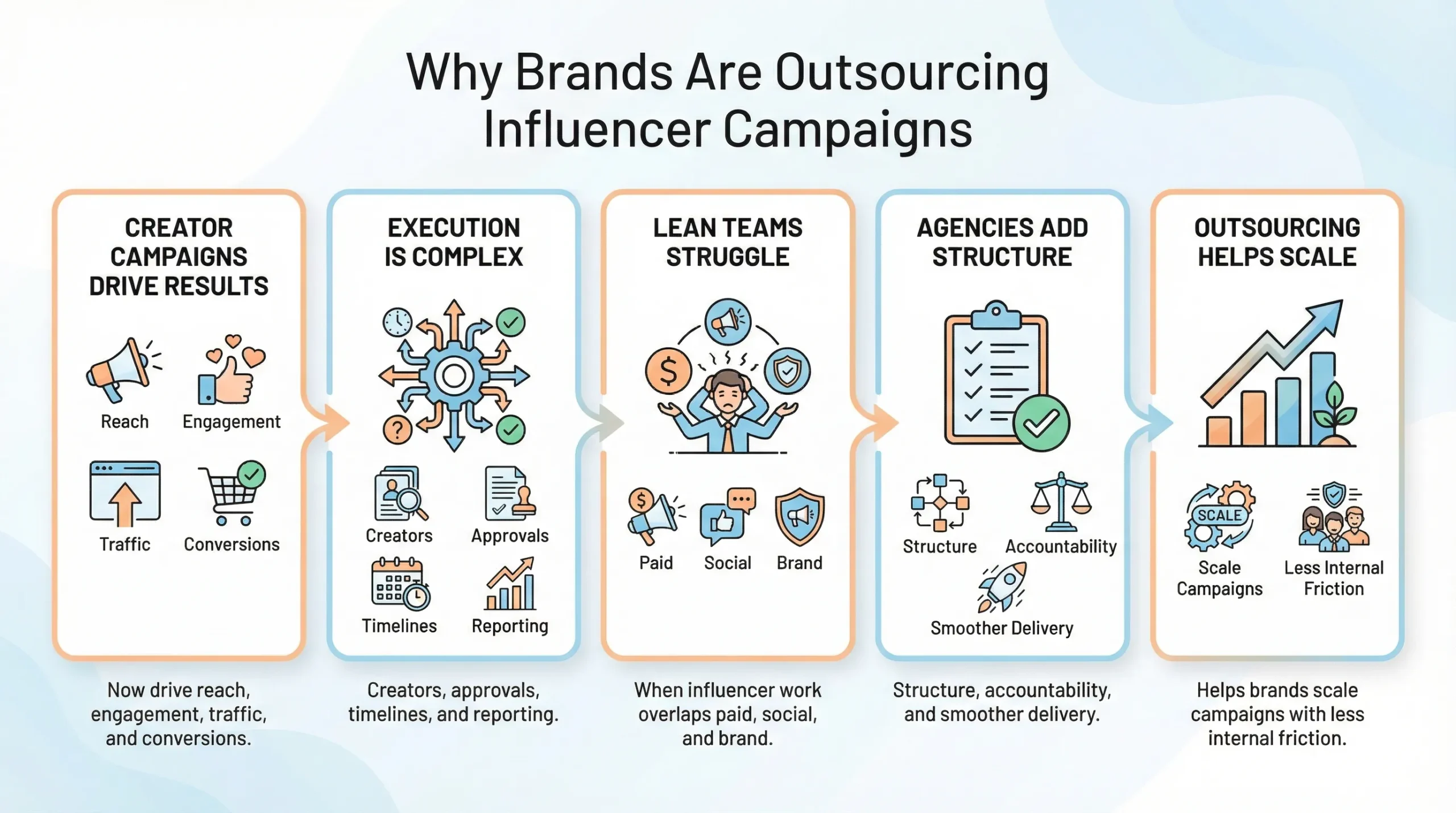
Brands now expect creator campaigns to drive real business outcomes, such as stronger reach, engagement, more website traffic, lead generation, conversions, or sharper brand positioning. As these expectations grow, campaign execution becomes more complex.
A typical influencer campaign involves far more than finding a creator and approving a post. It often includes:
- Creator research and shortlisting: Identifying creators who are relevant to the brand, audience, and campaign objective.
- Audience-fit assessment: Reviewing whether the creator’s followers, content style, and credibility align with the target market.
- Negotiations and commercial terms: Discussing rates, deliverables, timelines, exclusivity, and usage rights.
- Briefing and approvals: Aligning creators on messaging, content requirements, brand guardrails, and revision expectations.
- Content scheduling: Coordinating publishing timelines across creators, platforms, and campaign phases.
- Usage rights and repurposing decisions: Clarifying whether the brand can reuse creator content for paid media, landing pages, or future campaigns.
- Reporting and post-campaign analysis: Measuring results, reviewing creator performance, and identifying what should be improved or scaled next.
That coordination level is hard for lean internal teams, especially when influencer work overlaps with paid media, social media, content, and brand management.
This is why more businesses are seeking influencer marketing agencies in Singapore for better structure, smoother execution, and clearer accountability.
What an Influencer Marketing Agency in Singapore Actually Handles
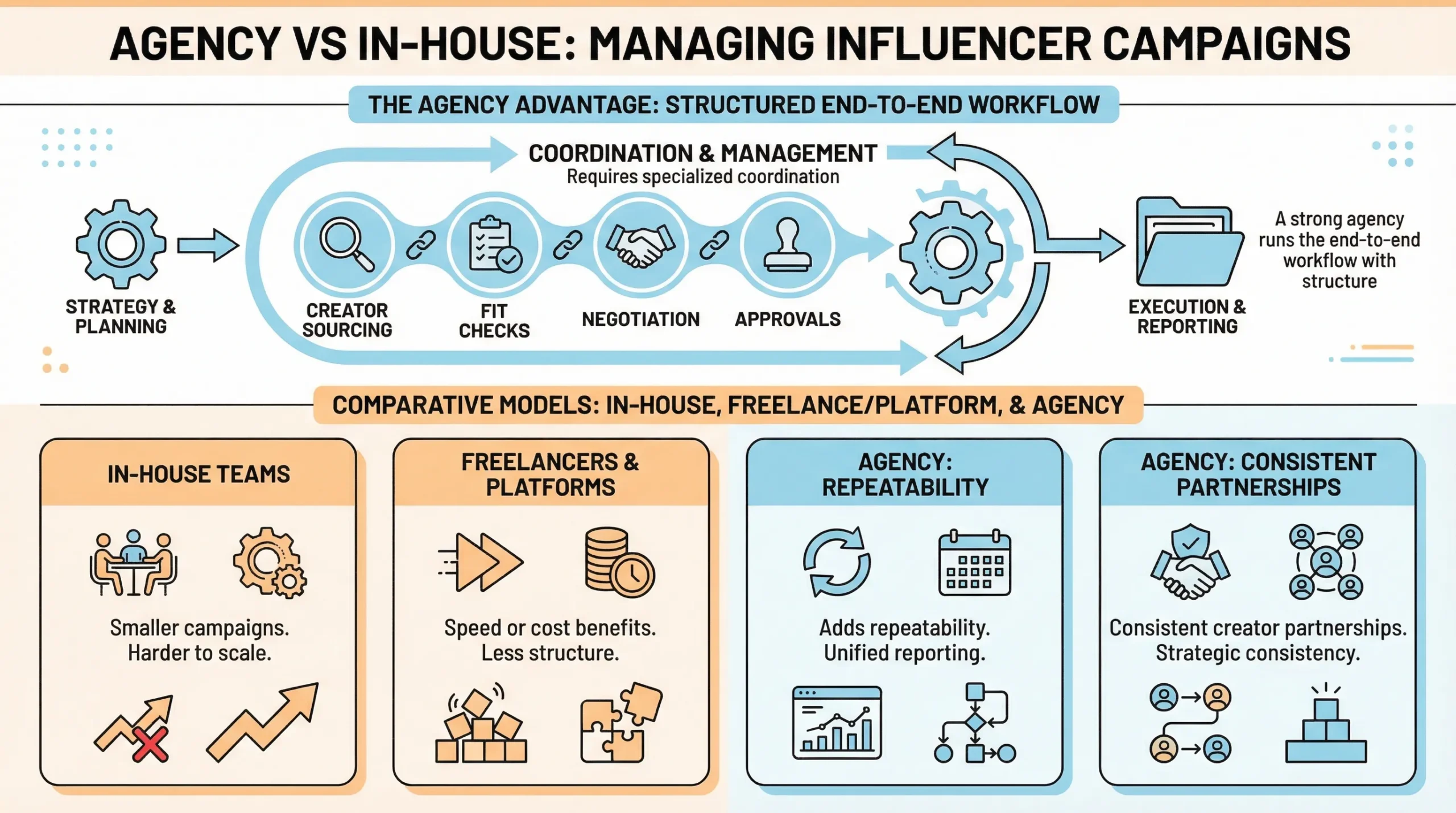
A strong influencer marketing agency in Singapore manages the entire campaign workflow, guiding brands from strategy to execution with structure and measurable results.
Typical responsibilities include sourcing creators, evaluating audience fit, conducting outreach, negotiating, briefing, managing approvals, reporting, and providing post-campaign recommendations.
Influencer campaigns seem simple, but often involve many unseen moving parts, especially when there are tight timelines or multiple creators.
| Campaign stage | What the agency handles |
| Strategy | Campaign goals, target audience, platform focus, KPI direction |
| Creator selection | Research, shortlisting, fit assessment, outreach |
| Execution | Briefs, timelines, approvals, and content coordination |
| Reporting | Performance tracking, campaign insights, next-step recommendations |
By working with an agency, brands gain access to specialised expertise, streamlined processes, and a more repeatable system for running creator campaigns, rather than relying on ad hoc coordination.
In-House vs Agency: Which Model Makes More Sense?
There is no universal answer. Some brands can manage influencer campaigns internally, especially when the scope is small, the creator pool is familiar, and the reporting expectations are relatively light.
But once campaigns become more commercially important, the decision becomes less about preference and more about execution capacity.
The real question is not whether an agency is always better. It is whether the current in-house setup can still manage the workload, maintain execution quality, and support the level of reporting the business now expects.
Here’s a comparison for easier reference:
| Area | In-house team | Agency model |
| Creator sourcing | Often manual and time-intensive, especially when comparing creators across platforms | More structured shortlisting based on audience fit, relevance, and campaign objective |
| Briefing workload | The internal team usually writes, sends, clarifies, and revises briefs while handling other marketing work | Briefing is handled through a more repeatable process with clearer creator communication |
| Contract handling | Rates, deliverables, timelines, exclusivity, and rights are often managed on a case-by-case basis | Commercial terms are usually handled more consistently through a defined workflow |
| Content review cycles | Feedback can become fragmented when multiple stakeholders are involved | Review and approval steps are usually easier to coordinate and standardise |
| Disclosure checks | Often handled late or inconsistently across creators | Disclosure checks are more likely to be built into the workflow earlier |
| UTM or promo-code setup | Tracking may be added inconsistently or too late | Tracking frameworks are more likely to be planned and applied upfront |
| Reporting cadence | Reporting may be delayed or limited to surface metrics | Reporting is usually more structured and tied more closely to campaign goals |
| Usage-rights negotiation | Reuse rights may only be discussed after strong content is created | Usage rights are more likely to be clarified earlier in the campaign |
| Post-campaign optimisation | Learning may stay informal and not shape the next campaign clearly | Results are more likely to feed into creator refinement and future planning |
Where in-house management usually starts to strain
In-house influencer management can become more challenging when the campaign involves multiple creators, tighter timelines, or greater internal accountability. The first problem is usually not outright failure. It is an operational strain.
Creator research starts taking longer than expected. Outreach and follow-ups become harder to track. Briefs are interpreted differently.
Review rounds create more back-and-forth than planned. Tracking is not always set up consistently. Reporting becomes harder to standardise once the business wants clearer visibility into traffic, leads, conversions, and potential for content reuse.
At that point, the internal team is no longer just managing creator relationships. It is trying to run a more complex campaign system without a dedicated operating model.
What usually improves with agency support
An agency usually creates value by reducing inconsistency across the campaign. The advantage is not just creator access. It is tighter coordination, clearer ownership, and a more repeatable process. That can lead to faster shortlisting, cleaner briefing, more controlled review cycles, earlier handling of usage rights, stronger tracking setup, and more reliable post-campaign reporting.
These improvements matter because small execution gaps can become expensive once campaigns grow in scale or commercial importance.
Which model tends to make more sense
An in-house model can still work when campaigns are occasional, approval chains are simple, and the team already knows the creator pool.
An agency model usually becomes more useful when campaigns involve multiple creators, internal teams are lean, reporting expectations are higher, and influencer activity is expected to support broader business outcomes rather than just visibility.
7 Signs You’ve Outgrown In-House Influencer Management
Not every brand needs agency support immediately. Some can manage creator campaigns internally for a time, especially when the campaign scope is small and reporting expectations are light. The issue is not whether in-house management is possible. The question is whether the current model still works well enough given the level of complexity involved.
If the same operational problems keep appearing, it may be a sign that influencer marketing has become too important to manage informally.
- Creator sourcing is taking too much internal time: If your team is spending excessive time manually searching, comparing, and chasing creators, the campaign may already be running with too much friction before execution begins.
- Campaign timelines keep slipping: When outreach, approvals, content submissions, or publishing dates keep moving, the issue is often not effort. It is a workflow that is no longer sufficiently structured for the campaign’s size.
- Reporting is still limited to likes and reach: If the business wants clearer visibility into traffic, leads, conversions, content reuse value, or creator-level performance, a lighter in-house setup may no longer be enough.
- Approvals have become inconsistent: If creator content goes through too many rounds, feedback is fragmented, or internal stakeholders are not aligned on what to approve, campaign quality and speed usually suffer.
- Usage rights and repurposing are being handled too late: When strong creator content is delivered, but the team has not clarified reuse rights, paid usage, or licensing terms, the campaign loses flexibility and often creates avoidable delays later.
- Influencer activity feels disconnected from the wider campaign: If creator content is running separately from paid media, social, CRM, product launches, or broader brand activity, the channel may be underperforming, not because of the creators but because of weak integration.
- The team is reacting more than it is planning: If the campaign constantly feels like a series of follow-ups, fixes, and deadline recovery exercises, the internal model is probably no longer strong enough to support scale.
These signs do not automatically mean in-house management has failed. But they do suggest that influencer marketing may now require a more structured operating model.
What Experienced Teams Check Before a Campaign Goes Live
One of the clearest differences between informal influencer management and a more experienced campaign process is what gets checked before the first post is approved. Many campaign issues do not start with weak content. They start earlier, when the creator fit, tracking, usage rights, approvals, or disclosure expectations are not handled properly.
A more disciplined pre-launch review usually covers the basics below before content goes live.
| Area | What needs to be checked |
| Creator fit | Audience relevance, content style, credibility, and past brand partnerships |
| Brief quality | Clear objective, deliverables, timeline, and brand guardrails |
| Content review | Accuracy of claims, tone, call to action, and platform fit |
| Disclosure | Whether the sponsored nature of the content is clear enough |
| Tracking setup | UTM links, promo codes, landing-page mapping, and attribution plan |
| Usage rights | Whether the brand can reuse the content across paid, owned, or future campaign channels |
| Approval ownership | Who signs off internally, and how revisions will be handled |
This matters because many campaign problems are not creative failures. A creator may look relevant, but the audience fit is weak.
The content may perform well, but the brand may not have the rights to reuse it. The campaign may launch on time, but tracking may be too weak to show whether it drove any meaningful results.
That is why experienced campaign management tends to focus on execution discipline before launch, not only on what gets posted. The stronger the pre-launch process, the lower the risk of avoidable mistakes once the campaign is live.
What Changes After Outsourcing?
The difference usually becomes clearest after the first few in-house campaigns. At the start, a lean team may be able to manage creator sourcing, outreach, approvals, and reporting internally. But once the campaign expands, the pressure points start to show.
Shortlisting takes longer, follow-ups become harder to track, approvals get messy, and reporting often stays focused on likes and reach rather than business outcomes.
After outsourcing, the biggest change is not just access to creators. It is a more structured operating model.
Creator sourcing becomes more systematic, timelines are easier to control, approvals are handled through a clearer process, and reporting is more closely tied to campaign objectives.
That usually gives internal teams more consistency, less coordination burden, and better visibility into what the campaign is actually delivering.
Benefits of Working With a Singapore-Based Influencer Marketing Agency
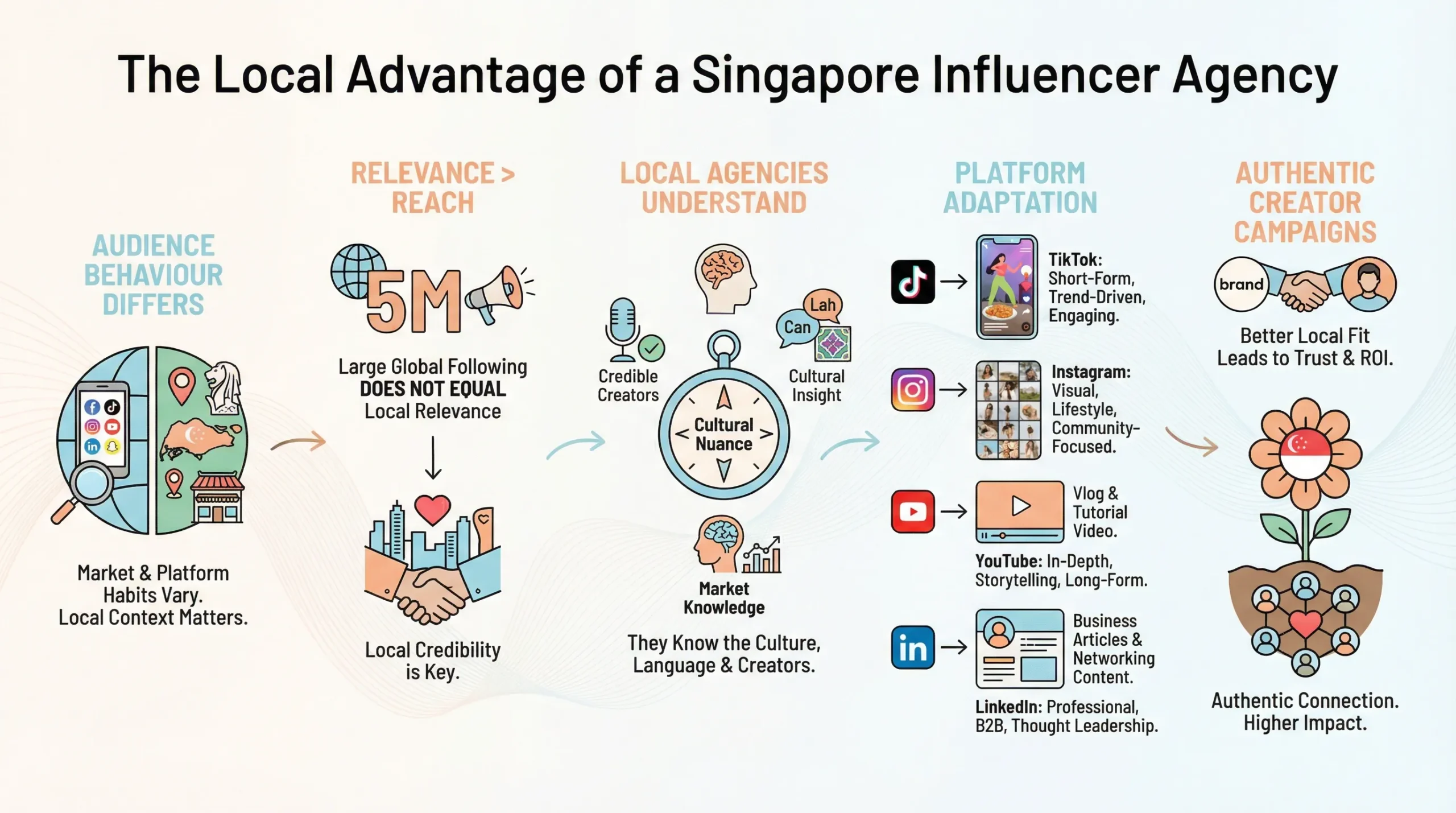
Local context matters in influencer marketing. A Singapore-based agency is better placed to build campaigns that are relevant, credible, and commercially sensible for the local market.
That local advantage usually comes from a stronger understanding of:
- Local audience behaviour: A Singapore-based agency is more likely to understand how local consumers discover, evaluate, and respond to creator content across different platforms.
- Creator relevance in the Singapore market: Not every creator with a large following will be the right fit for a local campaign. Agencies with in-market knowledge can better assess which creators are actually influential, trusted, or culturally relevant in Singapore.
- Local humour, tone, and cultural nuance: Messaging that works in another market may feel awkward, forced, or out of touch in Singapore. A local agency can help shape content that feels more natural to local audiences.
- Platform habits among Singapore consumers: Different audiences engage differently across TikTok, Instagram, YouTube, LinkedIn, and other channels. A Singapore-based agency is more likely to understand how platform behaviour differs locally and how that should affect campaign planning.
- What feels credible or out of touch locally: Creator campaigns succeed when content is authentic. A local agency helps brands avoid mismatched creators, off-brand messaging, or cultural references that do not resonate with Singaporean audiences.
That local understanding is especially useful when campaigns use localised messaging, culturally relevant content, or creators with strong in-market recognition.
A strong influencer marketing agency Singapore businesses choose should know creators and understand how the local audience responds to influencer content styles.
That local relevance matters even more on visual-first platforms. DataReportal reported that Instagram had 3.15 million users in Singapore in early 2025, with ad reach equivalent to 53.8% of the total population, underscoring the importance of platform-specific audience behaviour when planning local creator campaigns.
Signs Your Brand Should Hire an Influencer Marketing Agency in Singapore
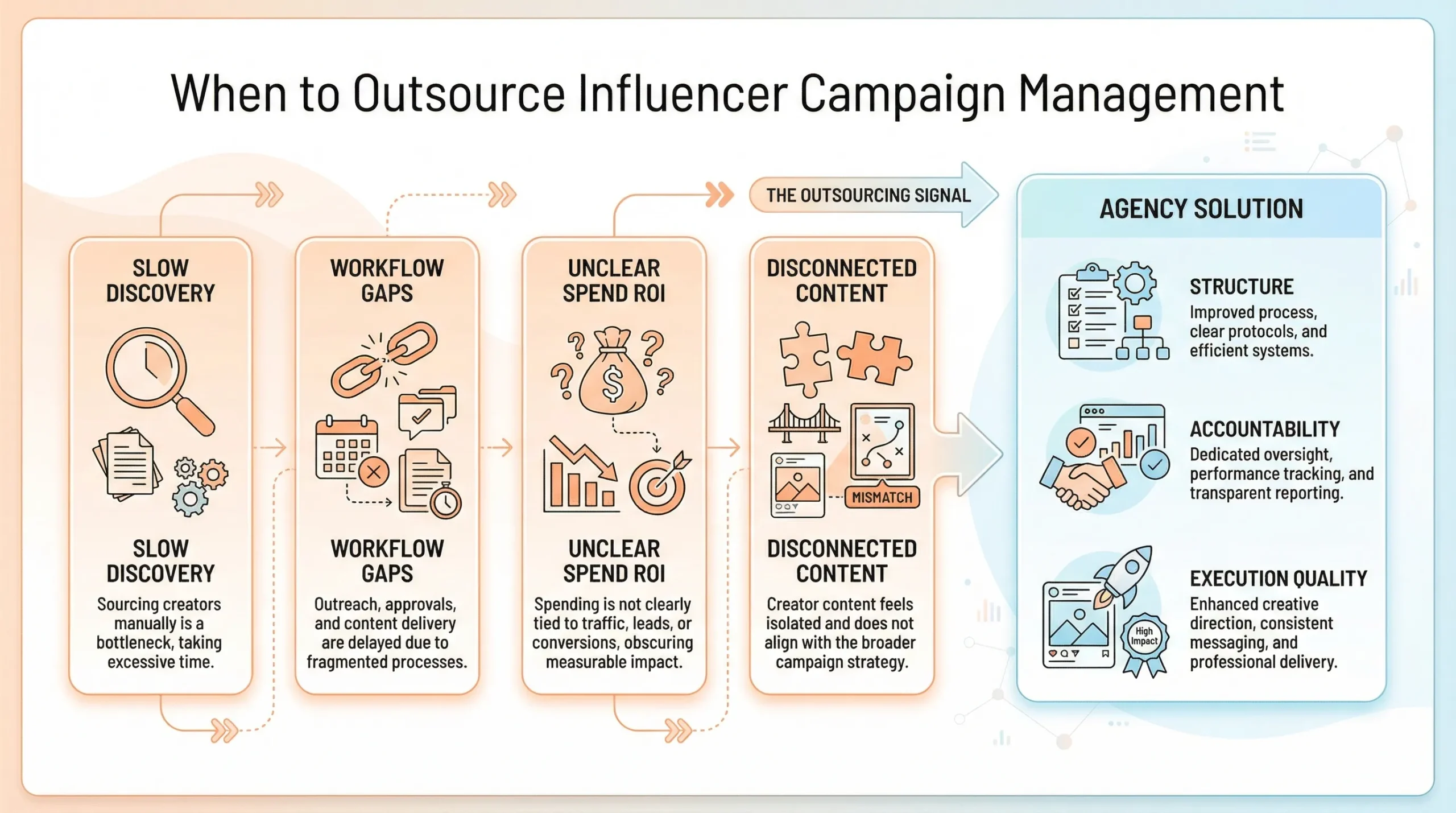
Many brands do not outsource because influencer marketing is unmanageable in-house, but because internal friction affects campaign quality, speed, and consistency. The core issue is often how the channel is managed.
Common signs include:
- Your team is spending too much time sourcing creators manually: If influencer discovery is taking up too much internal time, the campaign may be slowing down before it even begins.
- Campaign timelines are slipping: Delays in outreach, approvals, content submissions, or publishing schedules often point to workflow gaps rather than a lack of effort.
- Approvals are inconsistent or messy: If content reviews feel unclear, repetitive, or rushed, it usually means the campaign lacks a strong approval process.
- Reporting lacks commercial depth when results are measured primarily by likes and reach rather than showing how campaigns drive traffic, leads, or conversions. The reporting framework may be too weak.
- Influencer spend is not tied clearly enough to outcomes: When the business cannot see how creator activity connects to actual objectives, it becomes harder to justify ongoing investment.
- Creator content feels disconnected from the wider campaign strategy: If influencer posts feel isolated from the rest of your marketing activity, the campaign is likely missing strategic integration.
- The team is reacting to campaign issues rather than following a repeatable process: constantly chasing creators, fixing timeline problems, or resolving avoidable issues are usually signs that the campaign needs a stronger operating model.
If these problems keep appearing, hiring an influencer marketing agency in Singapore may help improve campaign structure, execution quality, and overall accountability.
How to Choose the Right Influencer Marketing Agency in Singapore
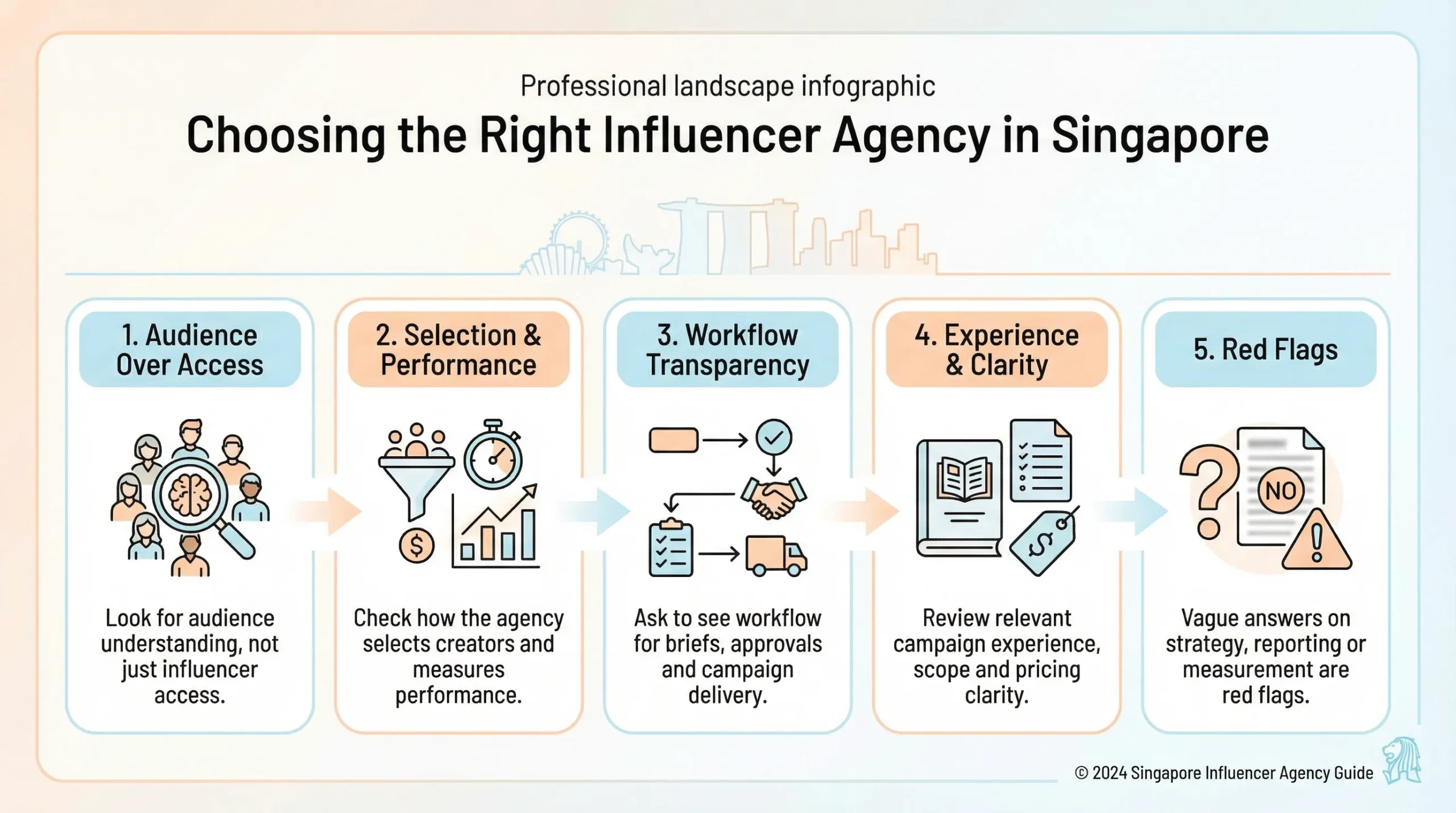
Not every agency will be the right fit. The best agency for your brand should be able to explain not just who they know, but how they work.
A good shortlist should help you evaluate:
- whether the agency understands your audience
- how it selects influencers
- how it measures campaign performance
- what its workflow looks like
- whether it has relevant campaign experience
- how clearly it explains pricing and scope
Quick agency evaluation checklist
- Experience in Singapore or similar markets
- Relevant influencer campaign examples
- Clear KPI and reporting methodology
- Sensible creator selection logic
- Structured workflow for briefs and approvals
- Transparent pricing model
- Ability to link campaigns to business outcomes
One red flag is when an agency talks mostly about access to influencers but gives vague answers on reporting, strategy, or measurement. A strong influencer marketing agency Singapore brands hire should be able to explain all three clearly.
Common Mistakes Brands Make When Hiring an Influencer Marketing Agency
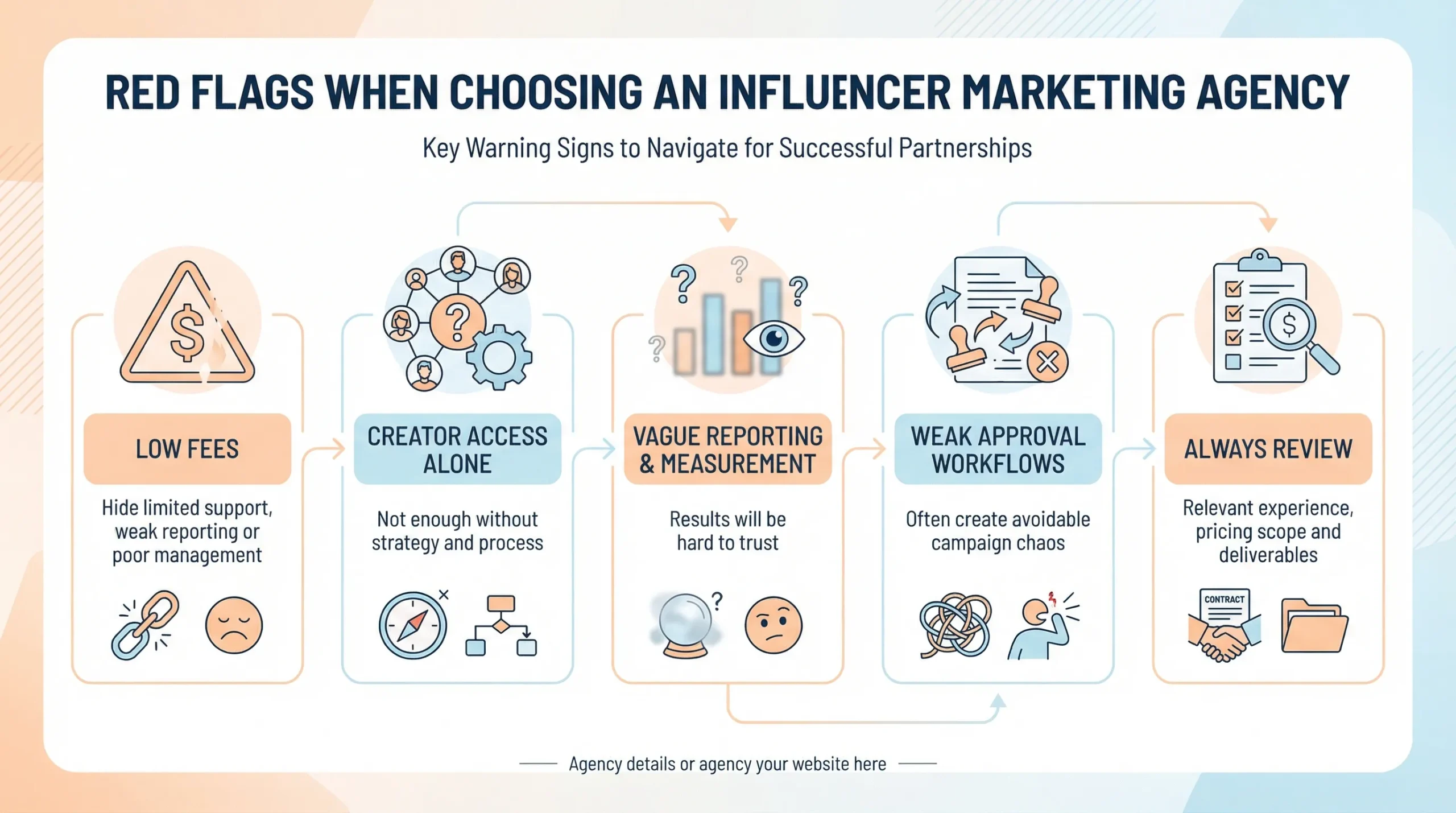
Not every agency will be the right fit. The strongest agency relationships usually come from choosing based on capabilities and workflows, not just on creator access or cost. Before shortlisting an agency, it helps to understand where brands often go wrong.
Some of the most common mistakes include:
- Choosing based on price alone: A lower fee may look attractive at first, but it can also mean weaker reporting, less strategic support, or limited campaign management.
- Focusing too heavily on influencer access: Access to creators matters, but it is not enough on its own. A strong agency should also be able to explain how it selects creators, manages workflow, and measures results.
- Not checking whether the agency understands your audience: An agency may have experience in influencer marketing generally, but still lack the market or category understanding needed for your specific audience.
- Accepting vague answers on reporting and measurement: If an agency cannot clearly explain how it tracks success, compares creator performance, or links campaigns to business outcomes, that is a warning sign.
- Overlooking approval workflow and campaign process: A campaign can become messy very quickly if briefing, revisions, and approvals are not handled through a clear process.
- Not reviewing relevant campaign experience: Agencies should be able to show examples of work that align with your market, campaign type, or business goals.
- Ignoring pricing scope and deliverables: Brands sometimes compare quotes without verifying what is actually included, leading to misunderstandings later.
Quick agency evaluation checklist
When evaluating an agency, look at:
- whether it understands your audience
- how it explains creator selection
- how it measures campaign performance
- what its approval workflow looks like
- whether it has relevant campaign experience
- how clearly it explains pricing and scope
A useful shortlist should include agencies that can demonstrate:
- experience in Singapore or similar markets
- relevant influencer campaign examples
- clear KPI and reporting methodology
- sensible creator selection logic
- structured workflow for briefs and approvals
- transparent pricing model
- ability to connect campaign activity to business outcomes
One red flag is when an agency talks mostly about access to influencers but gives vague answers on reporting, strategy, or process. A strong influencer marketing agency Singapore brands hire should be able to explain all three clearly.
How Pricing Usually Works With an Influencer Marketing Agency in Singapore
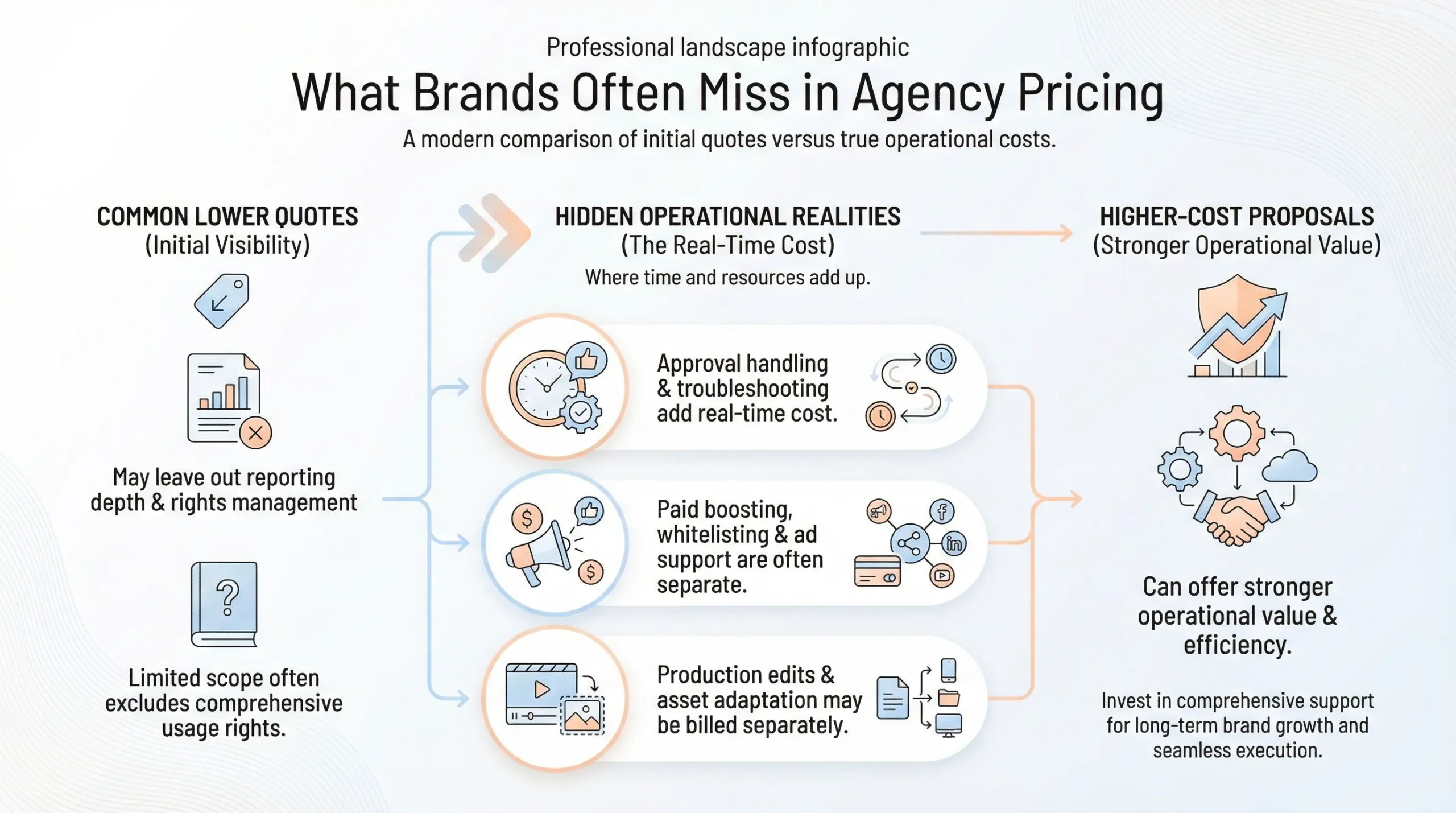
Pricing is one of the biggest decision points for brands, but it is also one of the easiest areas to misunderstand. The total cost of an influencer campaign usually does not come from one line item. It typically comprises several moving parts, including agency management, creator fees, paid amplification, production support, and usage rights.
That is why brands should treat pricing as a campaign-planning benchmark rather than a fixed market rate. The final cost will vary depending on creator tier, number of deliverables, campaign complexity, platform mix, turnaround time, exclusivity, content licensing, and whether paid media support is involved.
What brands are usually paying for
| Cost area | What it usually covers | Why it changes |
| Agency fee | Strategy, planning, creator sourcing, negotiation, campaign management, reporting | Varies by campaign scope, creator volume, workflow complexity, and reporting depth |
| Creator fee | Talent cost and agreed deliverables | Changes by creator tier, content format, usage terms, and exclusivity |
| Paid amplification | Boosting creator content or supporting campaign media spend | Depends on campaign duration, audience size, targeting, and platform |
| Production support | Editing, resizing, subtitles, cutdowns, or extra asset adaptation | Increases when the campaign needs more creative variation or repurposing |
| Usage rights | Reuse of creator content across paid, owned, or future campaign channels | Often increases with duration, paid usage, and number of channels |
A practical way to think about a budget
A useful budgeting approach is to separate the campaign into four questions:
- how much is being paid for management
- how much is being paid to creators
- how much is going into media support
- how much is needed for reuse rights or extra production
This matters because two campaigns with the same headline budget can have very different structures. One may prioritise more creators and lighter management. Another may use fewer creators but include paid amplification, usage rights, and heavier reporting support.
Example campaign budget scenarios
| Budget level | What it usually includes | Typical use case |
| Around S$5,000 | Small agency fee, a few micro-creators, basic reporting, limited or no paid amplification | Small test campaign, niche audience activation, or one-off creator push |
| Around S$15,000 | Mid-level campaign management, broader creator mix, stronger reporting, some paid support, possible usage-rights planning | Product push, seasonal campaign, or multi-creator campaign with more structure |
| Around S$30,000 | Full campaign management, larger creator roster or stronger creator tier, clearer paid media support, more robust reporting, possible licensing and repurposing support | Major launch, multi-phase campaign, or brand campaign where creator activity needs tighter control and clearer measurement |
Note: These figures are estimates only and should be treated as indicative rather than fixed rates. Actual pricing will vary depending on campaign complexity.
Where brands often underestimate cost
The most common mistake is focusing only on creator fees. In practice, that is only one part of the campaign cost. Brands also need to consider management time, briefing rounds, review cycles, paid support, reporting depth, and whether the content needs to be reused later.
Usage rights are another area that is often underestimated. A creator fee may cover content creation and posting, but not necessarily paid usage, website placement, or long-term reuse. Those decisions can materially affect the final budget.
What matters more than the headline price
A lower-cost proposal is not always the better-value option if it leaves out rights management, revision handling, tracking setup, or post-campaign reporting. Likewise, a higher-cost proposal may create better operational value if it reduces internal workload and produces content that can be reused more effectively across channels.
The better comparison is not just price. It is scope, control, reporting quality, and how well the campaign structure supports the business objective.
Compliance and Risk Considerations Brands Should Not Ignore
Campaign execution in Singapore is not just about creativity. It also needs to be transparent, supportable, and operationally sound.
The ASAS Guidelines on Interactive Marketing Communication and Social Media state that the guidance applies to advertising and marketing communication that uses social media to promote goods and services or influence consumer behaviour.
If a campaign involves forms, giveaway entries, sign-ups, or remarketing, the Personal Data Protection Act also applies, as it governs the collection, use, disclosure, and protection of personal data in Singapore.
For financial services, the compliance threshold is higher. The Monetary Authority of Singapore’s Guidelines on Standards of Conduct for Digital Advertising Activities were published on 25 September 2025 and apply to financial institutions and their marketers who advertise financial products and services via digital channels.
MAS also states that the Guidelines set out safeguards that financial institutions should implement when conducting such activities.
Pre-launch compliance checklist
- Is the sponsored nature of the content clear enough?
- Are all campaign claims accurate and supportable?
- Will the campaign collect personal data through forms, giveaways, or sign-ups?
- Have usage rights and content permissions been reviewed?
- Is there a clear internal approval owner on the brand side?
- Does the category require stricter sector-specific checks?
- A capable agency should be able to build these checks into campaign planning rather than raising them only at the final approval stage.
When Hiring an Influencer Marketing Agency in Singapore, Delivers the Most Value
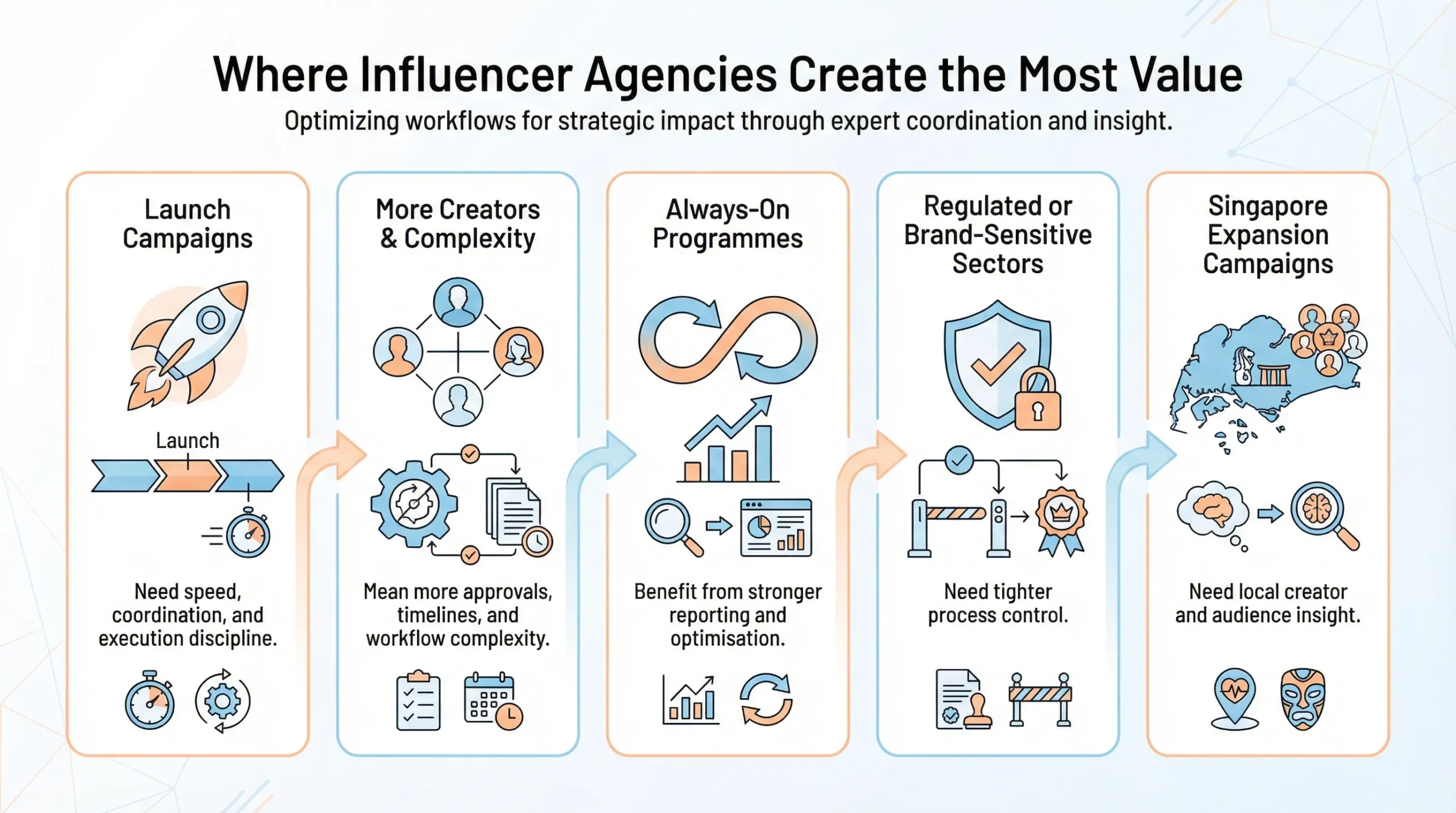
Hiring an influencer marketing agency in Singapore tends to create the most value when the campaign carries enough commercial weight that informal coordination is no longer good enough.
In those situations, the brand is not just paying for access to creators. It is paying for structure, speed, execution control, and a better chance of turning influencer activity into measurable business results.
- Product launches: Product launches often involve tight timelines, multiple stakeholders, and a strong need for coordinated messaging. If the campaign includes teaser content, launch-day posts, creator seeding, event attendance, or paid amplification, the workload can become difficult to manage internally. An agency can help align creator selection, campaign timing, approvals, and reporting to make the launch feel coordinated rather than fragmented.
- Multi-creator campaigns: The more creators involved, the more complicated the workflow becomes. Brands may need to manage multiple rates, content formats, publishing schedules, revision rounds, and approval requirements simultaneously. In these cases, agency support becomes valuable because it reduces the operational burden and helps maintain consistency across the full creator roster.
- Always-on influencer programmes: Some brands do not run influencer campaigns as one-off activations. They use creators on an ongoing basis to support awareness, launches, seasonal pushes, community engagement, or social proof. In those cases, an agency can help build a more repeatable programme with clearer reporting, stronger creator relationship management, and more structured optimisation over time.
- Brands with lean internal teams: A lean team may be strong strategically, but still struggle to handle the day-to-day workload of influencer execution. Tasks such as creator research, outreach, negotiation, briefing, approvals, and performance tracking can quickly consume time that should be spent on higher-level marketing decisions. Hiring an agency helps relieve that pressure and gives the brand access to a more dedicated delivery structure.
- Campaigns requiring stronger reporting: Some campaigns are too important to be judged solely by likes and reach. If the business needs clearer visibility into traffic, leads, conversions, usage rights, content performance, or return on spend, agency support can help bring more rigour to campaign measurement. This is especially useful when influencer marketing is expected to support broader commercial goals rather than just social engagement.
- Regulated or brand-sensitive industries: Campaigns in sectors such as finance, healthcare, education, or other trust-led categories require more caution than standard lifestyle campaigns. The brand may need tighter approval workflows, more careful claims handling, and better control over how creators communicate offers or product benefits. In these situations, an agency can help reduce execution risk by building more discipline into campaign planning and review.
- Businesses scaling into Singapore or growing locally: For brands entering Singapore or expanding their local presence, creator marketing can help build awareness and credibility quickly. However, local audience expectations, tone, and creator relevance are not always obvious to an external or newly expanding business. A Singapore-based agency can help close that gap by recommending creators, messaging angles, and execution approaches that are more likely to resonate with the local market.
In all of these situations, the decision is not just about convenience. It is about whether the campaign is important enough to require a stronger operating model. When launches are bigger, teams are leaner, reporting expectations are higher, or category risk is greater, agency support often creates value by improving campaign consistency, execution quality, and accountability.
Build More Effective Creator Campaigns With an Influencer Marketing Agency in Singapore
More brands are hiring an influencer marketing agency in Singapore that they can trust, as creator marketing has become more demanding, measurable, and operationally complex. Strong campaigns now require planning, workflow management, reporting discipline, and closer attention to content quality, disclosure, and data handling.
That is why agency support is increasingly a strategic decision rather than a convenience play. A strong agency helps brands do more than launch creator content. It helps them plan smarter campaigns, select creators more deliberately, manage execution more efficiently, and measure performance with greater clarity.
For businesses that want influencer marketing to become a repeatable growth channel rather than an occasional experiment, working with MediaOne can provide the structure, local insight, and campaign discipline needed to turn creator activity into stronger business outcomes.
Ready to build more effective creator campaigns? Speak with MediaOne to plan a strategy that aligns with your brand, audience, and growth goals.
Frequently Asked Questions
What does an influencer marketing agency in Singapore do?
An influencer marketing agency in Singapore usually helps with campaign strategy, sourcing creators, outreach, negotiations, briefings, approvals, reporting, and optimisation. The value is not just access to influencers, but a more structured campaign process. A stronger agency should also help align creator work with business objectives.
How do I know if my brand should hire an influencer marketing agency in Singapore?
You should consider agency support when campaigns become too time-consuming to manage internally, reporting is inconsistent, or the team struggles to link creator activity to outcomes. It is often a sign that influencer marketing has become important enough to need a stronger process. That is usually when outsourcing becomes more efficient.
Is it better to manage influencer campaigns in-house or through an agency?
That depends on your internal team, the campaign’s complexity, and your reporting needs. In-house can work for smaller campaigns, especially if you already have creator relationships. Agency support becomes more useful when scale, speed, and process consistency matter more.
How much does an influencer marketing agency in Singapore cost?
There is no single standard rate. Pricing usually depends on strategy scope, management time, creator fees, content support, amplification, and usage rights. Brands should carefully compare the scope rather than focusing solely on the lowest quote.
What should I look for when choosing an influencer marketing agency in Singapore?
Look for relevant campaign experience, a clear workflow, sensible creator selection logic, strong reporting practices, and transparent pricing. The agency should also be able to explain how it ties creator activity to business goals. That is usually a better sign than simply claiming access to a large influencer network.
Do influencer campaigns in Singapore need to follow disclosure rules?
Yes. ASAS guidance applies to advertising and marketing communication on social media used to promote goods and services or influence consumer behaviour. That means campaigns should be handled transparently and responsibly.
When does hiring an influencer marketing agency in Singapore create the most value?
It tends to create the most value for large launches, multi-creator campaigns, always-on programmes, and campaigns that need stronger reporting or tighter governance. It is also useful when internal teams lack bandwidth or specialist experience. In those cases, agency support often improves both speed and consistency.
If you want, I can now polish this into a final blog-ready version with a stronger CTA to MediaOne, a refined intro hook, and internal linking placements beyond the pillar page.