
Likes and comments feel good. But they do not pay the bills.

For years, brands poured budgets into influencer campaigns and called it a win when a post racked up thousands of hearts. Today, that approach is no longer sufficient. Modern marketers demand proof in the form of clicks, conversions, pipeline value, and revenue.
The shift toward measurable influencer marketing performance has fundamentally changed how campaigns are planned, executed, and evaluated.
Whether you are a startup running your first micro-influencer campaign or an enterprise brand managing dozens of creator relationships, the ability to tie influencer activity to real business outcomes is now non-negotiable.
In this guide, we break down everything you need to know, from the core principles of influencer marketing to the 10 metrics that matter most, plus 3 advanced ones, Singapore-specific budgeting frameworks, full-funnel integration, and the tools that make tracking more actionable.
If you need deeper support, we can help as an influencer marketing analytics agency in Singapore to strengthen your attribution, reporting, and campaign performance.
Key Takeaways
- Likes and follower counts are vanity metrics. The metrics that matter are conversion rate, CPA, ROI, CLV, and EMV.
- Singapore influencer ad spend grew 13.6% to US$106 million in 2024, but only 5.5% of total digital ad spend goes to influencer marketing, leaving significant headroom.
- Micro-influencers (10K–50K followers) deliver a higher ROI per dollar in Singapore, with brands earning an average of SGD $8.70 per dollar invested in this tier.
- Always budget 20–40% beyond base influencer fees for hidden costs: usage rights, production, amplification, and tools.
- ASAS compliance is mandatory in Singapore; all paid or gifted influencer content must carry a clear #ad or #sponsored disclosure.
What Is Influencer Marketing and Why Does It Matter

Influencer marketing is a form of social media collaboration in which brands partner with individuals who have established credibility, audiences, and trust within a specific niche or community.
Rather than broadcasting a message directly to consumers, brands leverage an influencer’s authentic voice to reach and persuade their followers.
At its core, influencer marketing rests on three pillars:
- Collaboration with Content Creators: Brands work with influencers to co-create content, whether sponsored posts, product reviews, unboxings, tutorials, or long-form YouTube features, that feels native to the platform and the creator’s style.
- Authenticity and Earned Trust: Unlike traditional advertising, influencer content does not feel like an ad. A beauty creator recommending a skincare routine or a food blogger sharing a restaurant experience taps into a pre-established relationship of trust between influencer and audience.
- Platform-Native Distribution: Influencer marketing thrives across Instagram, TikTok, YouTube, Xiaohongshu (Little Red Book), and LinkedIn. Each channel has its own content language, algorithm, and audience behaviour, making platform selection a strategic decision.
According to research, 76% of Americans follow at least one influencer, and half have made a purchase based on an influencer recommendation, a statistic that reflects the outsized commercial power of creator-driven content.

Why Influencer Marketing Drives Real Business Results
Influencer marketing is no longer a niche add-on within social media. Archive reports that the global influencer marketing platform market was valued at $23.59 billion in 2025 and is projected to reach $89.90 billion by 2034, reflecting how seriously brands now treat creator-led performance as part of their broader digital growth strategy.
That scale helps explain why more brands are demanding clearer attribution, stronger reporting, and more commercially accountable influencer campaigns.
- Impact on Brand Awareness and Reach: Influencers extend your brand’s reach into communities that may be inaccessible through traditional paid channels. A single well-matched creator can introduce your product to tens of thousands of high-intent consumers overnight.
- Role in Consumer Purchase Decisions: Consumers trust peer recommendations far more than branded advertising. Influencer content mimics word-of-mouth at scale, moving audiences through awareness, consideration, and purchase stages in ways that display ads cannot.
| Business Type | Primary Benefit | Best Influencer Tier |
| Small Businesses | Affordable reach, community trust | Nano and Micro |
| Mid-Market Brands | Audience expansion and conversions | Micro and Macro |
| Enterprise Corporations | Mass awareness and brand authority | Macro and Mega/Celebrity |
How to Measure Influencer Marketing Performance Effectively
Measuring influencer marketing performance remains one of the biggest challenges in digital marketing. Many brands are still operating with incomplete data, looking at surface-level metrics while missing the signals that actually correlate with business growth.
In 2025, 71% of DTC brands increased their influencer marketing budgets, but the demand for precise ROAS (Return on Ad Spend), CPA (Cost Per Acquisition), and LTV (Lifetime Value) metrics followed in lockstep. Budget growth without measurement infrastructure is a liability.
Common Challenges in Measuring Effectiveness
| Challenge | Description |
| Multi-touch attribution complexity | Consumers interact with multiple influencer posts before converting. Crediting the right touchpoint requires sophisticated tracking. |
| Platform data silos | Instagram, TikTok, and YouTube each serve different analytics dashboards, making cross-platform comparison difficult. |
| Lag between content and conversion. | Audiences may see a post and convert days or weeks later, creating attribution gaps. |
| Fake engagement inflation | Without audience quality auditing, high engagement numbers can mask a bot-inflated audience. |
This challenge is not theoretical. Archive reports that 56% of marketers say ROI measurement is their most critical obstacle, while 60% struggle to determine what returns their campaigns generate.
EMARKETER adds that 32% of marketers worldwide say measuring creator performance is the top roadblock to a successful influencer programme, which shows why better tracking is now a commercial requirement, not just a reporting preference.
Tools for Tracking Influencer Marketing Performance
| Tool | Primary Use |
| HypeAuditor | Audience authenticity and fake follower detection |
| Social Blade | Historical growth pattern analysis |
| CreatorIQ | Enterprise-level campaign management and attribution |
| InfluenceFlow | Consolidated performance dashboard across partnerships |
| Google Analytics (UTM Links) | Traffic and conversion tracking |
| Native Platform Dashboards | Real-time post-level metrics per platform |
If you are seeking end-to-end support in implementing a multi-touch attribution framework, partnering with an influencer marketing analytics agency in Singapore can help you build the tracking infrastructure from campaign kickoff to final reporting.
Real-World Campaigns That Delivered Good Influencer Marketing Performance
Case Study: Food and Beverage — Dunkin x Charli D’Amelio

Dunkin’ partnered with TikTok mega-influencer Charli D’Amelio to launch a signature drink bearing her name. The campaign was built around measurable outcomes from day one, not just awareness.
Results (according to IQFluence):
- 57% surge in app downloads on launch day
- 45% increase in cold brew sales on the day of announcement
- 20% sustained sales lift in the weeks following
- Millions of dollars in estimated total revenue
What made this work: The product was designed with the influencer, not just promoted by her. The campaign was integrated with the Dunkin’ app to drive measurable conversion, and all outcomes were tracked against pre-set KPIs.
Case Study: SaaS and Technology — Submagic x Vince Opra

In the B2B space, AI video tool Submagic partnered with creator Vince Opra on a commission-based influencer programme. The campaign generated over $1 million in revenue within 90 days, with all sales directly attributable to creator-driven traffic.
What distinguished this campaign was its attribution infrastructure. By equipping the influencer with unique tracking links and promo codes, every conversion was tied directly back to the content — proving ROI beyond any reasonable doubt.
Common Thread Across All Three: Each campaign was built around measurable outcomes from day one. Creative decisions were made in service of performance, not vanity.
10 Influencer Marketing Performance Metrics You Should Be Tracking (Plus 3 Advanced Metrics)
Moving beyond vanity metrics means tracking the indicators that connect creator content to commercial outcomes. Here are the 13 metrics that define whether a campaign truly delivered value.
Metric 0: Audience Authenticity Score
Before any performance metric matters, brands need to know whether the audience is real. If follower quality is poor, then engagement, reach, clicks, and even conversions can all be misleading.
SociaVault Labs found that 37.2% of influencer followers across Instagram and TikTok were fake or suspicious, which is why pre-campaign vetting should come before campaign measurement.
A simple screening process should check:
- audience authenticity or fake follower share
- engagement consistency over time
- suspicious follower growth spikes
- audience location and demographic fit

Tools such as HypeAuditor and Modash can help flag these risks before the campaign starts. A weak authenticity profile, especially on a large account with low engagement, is often a stronger warning sign than a smaller creator with a healthy and consistent audience.
Metric 1: Engagement Rate
Definition: The percentage of an influencer’s audience that actively interacts with their content (likes, comments, shares, saves).
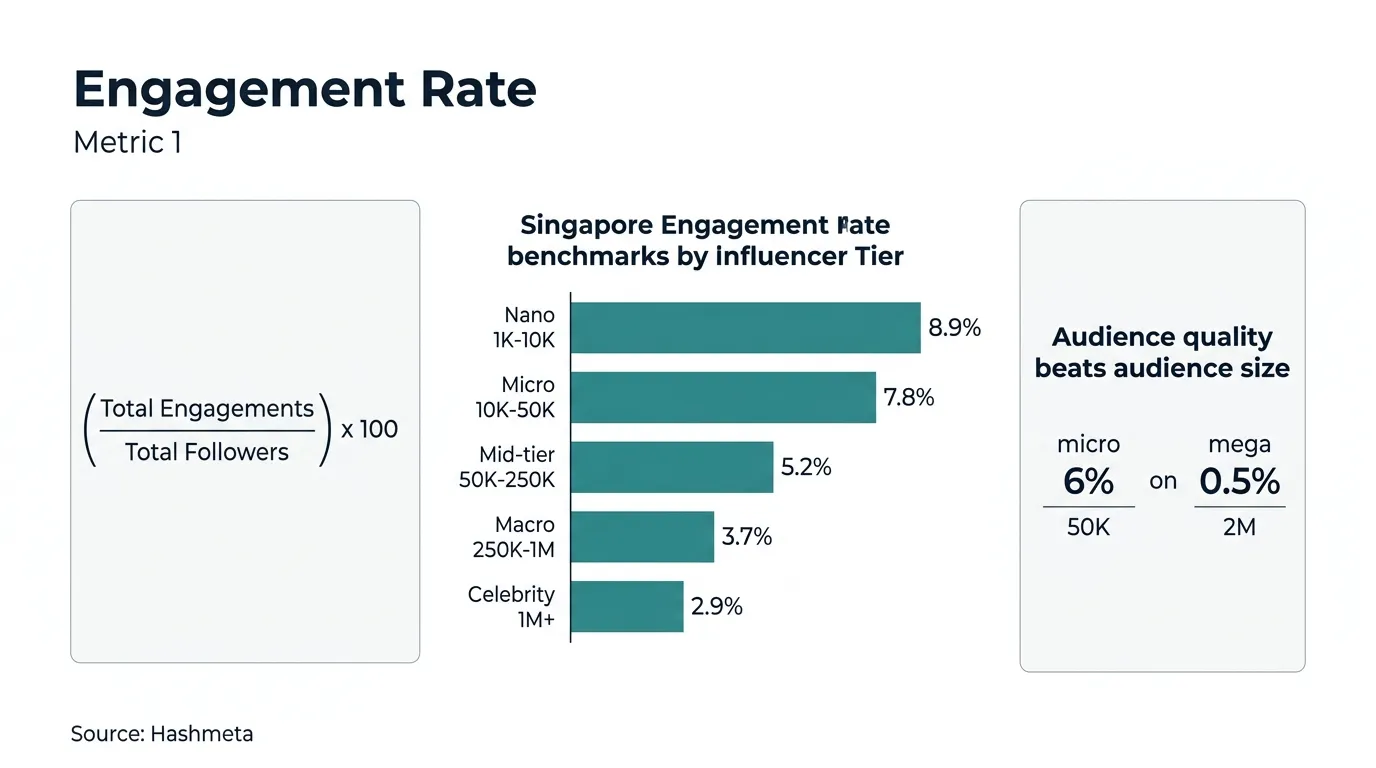
Why It Matters: Engagement rate is a proxy for audience quality and content resonance. A micro-influencer with a 6% engagement rate on 50,000 followers will almost always outperform a mega-influencer with 0.5% engagement on 2 million followers for conversion-focused campaigns.
Formula: (Total Engagements / Total Followers) x 100
Singapore Benchmarks (source: Hashmeta):
- Nano-influencers (1K–10K): 8.9%
- Micro-influencers (10K–50K): 7.8%
- Mid-tier (50K–250K): 5.2%
- Macro (250K–1M): 3.7%
- Celebrity (1M+): 2.9%
Metric 2: Reach and Impressions
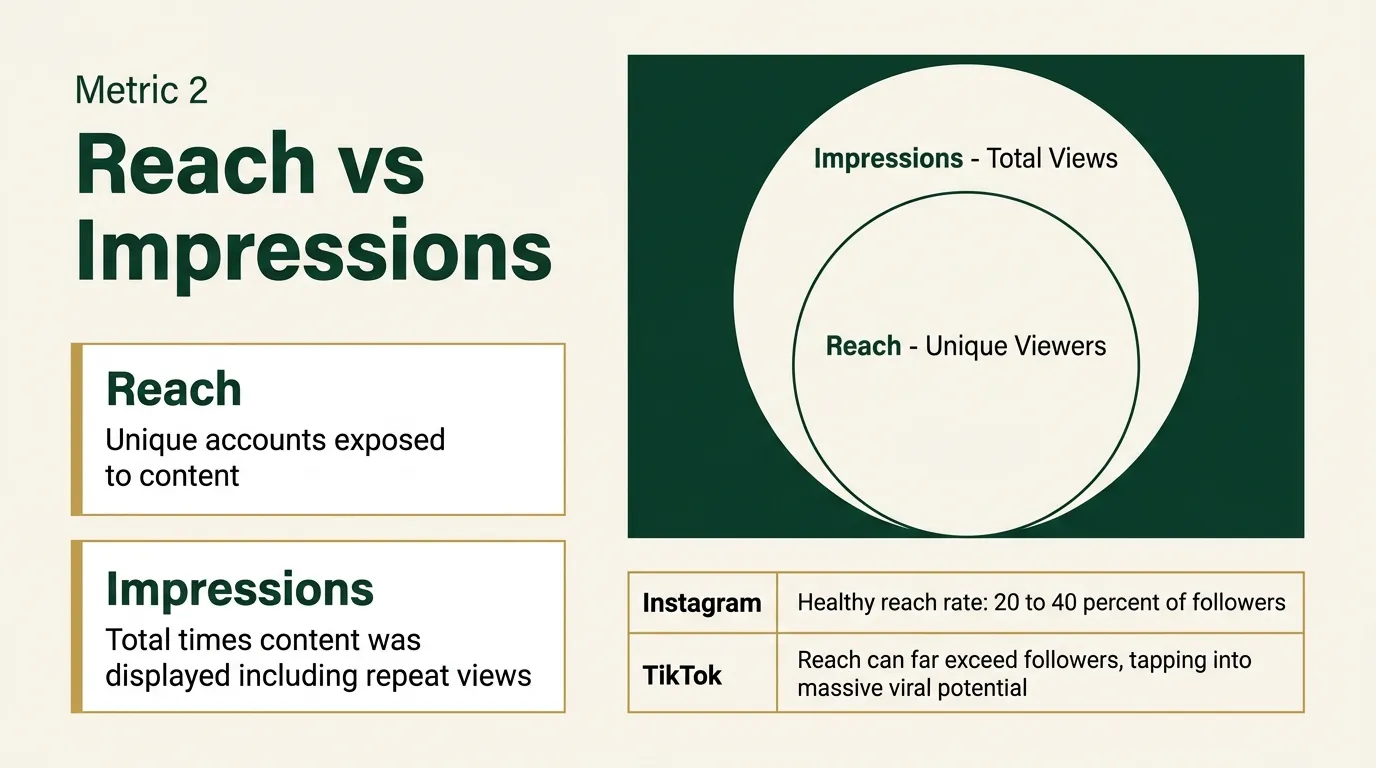
Reach = unique accounts that saw the content. Impressions = total number of times the content was displayed, including repeat views.
Reach tells you how many people were exposed to your brand. Impressions indicate how often the message was seen, important for brand awareness campaigns where frequency drives recall.
Formula:
- Reach: tracked natively per platform.
- Impressions: tracked natively per platform.
- Benchmark: Compare reach against the influencer’s total follower count.
A healthy reach rate for Instagram posts is 20–40% of followers; on TikTok, reach can far exceed the follower count due to algorithmic distribution.

Metric 3: Click-Through Rate (CTR)
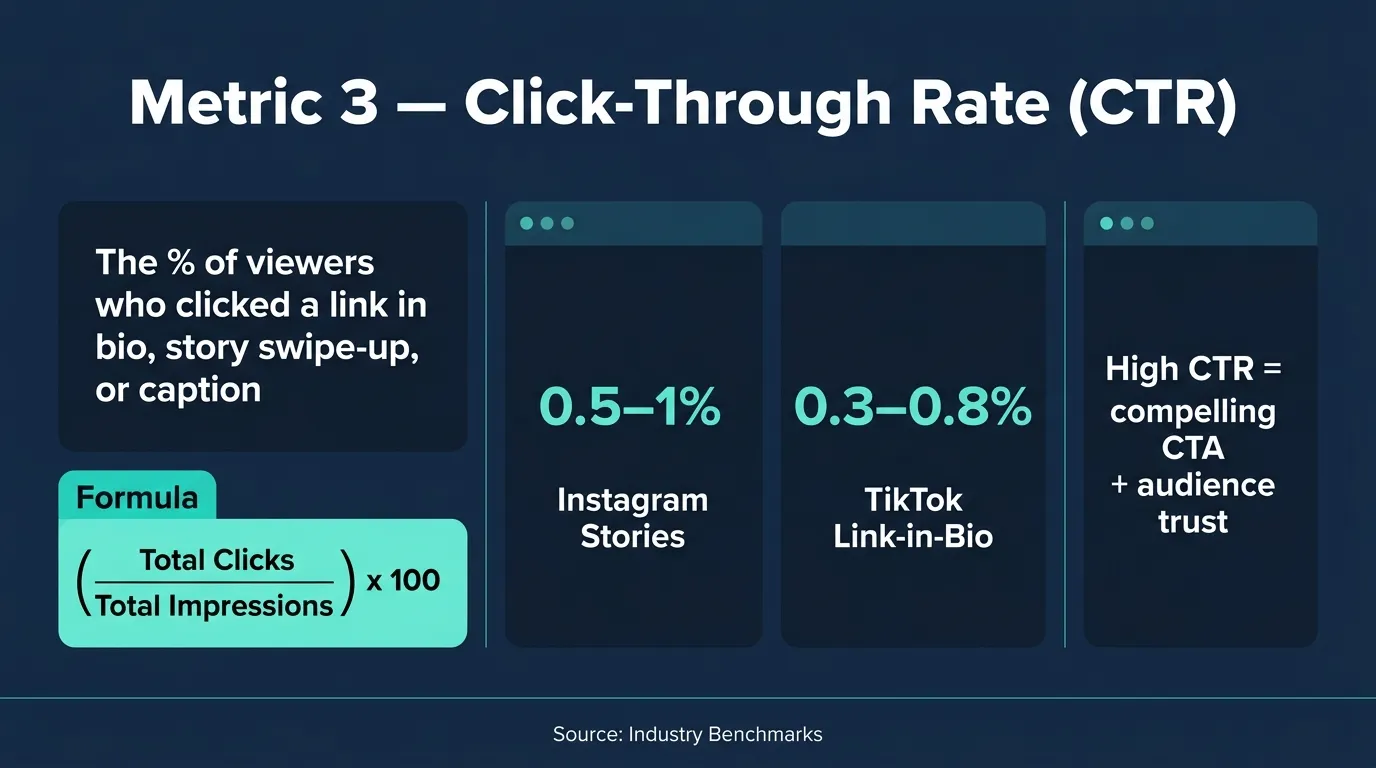
The percentage of viewers who clicked on a link in the influencer’s bio, story swipe-up, or post caption.
CTR bridges content performance and actual site traffic. A high CTR signals that the influencer’s call to action was compelling and that the audience trusted the recommendation enough to act.
- Formula: (Total Clicks / Total Impressions) x 100
- Benchmarks: Instagram Stories: 0.5–1% | TikTok link-in-bio: 0.3–0.8%
Metric 4: Conversion Rate
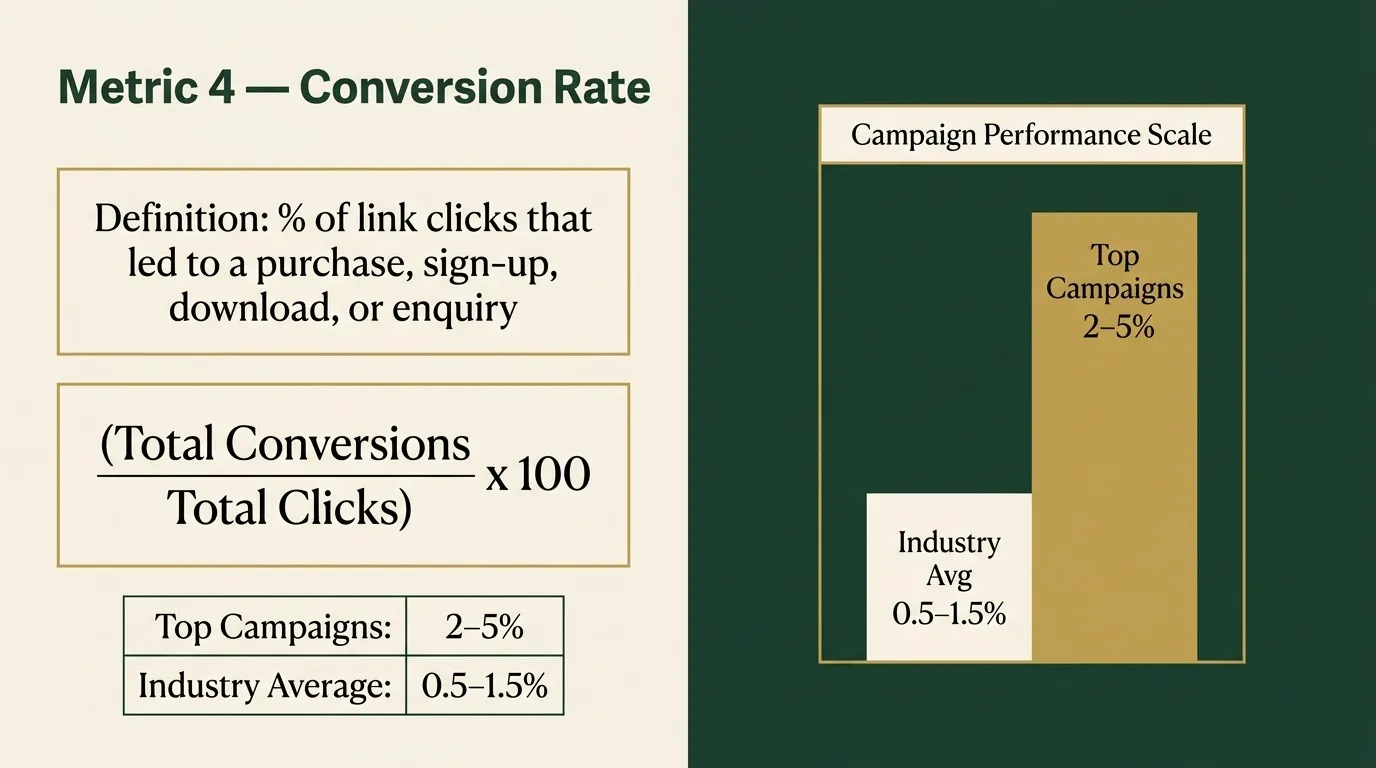
The percentage of link clicks that resulted in a desired action, a purchase, sign-up, download, or enquiry. Conversion rate is the ultimate test of influencer marketing performance. It answers the question: Did the campaign actually drive business results, or merely traffic?
- Formula: (Total Conversions / Total Clicks) x 100
- Benchmarks: Top-performing campaigns: 2–5% | Industry average: 0.5–1.5%
Metric 5: Return on Investment (ROI)
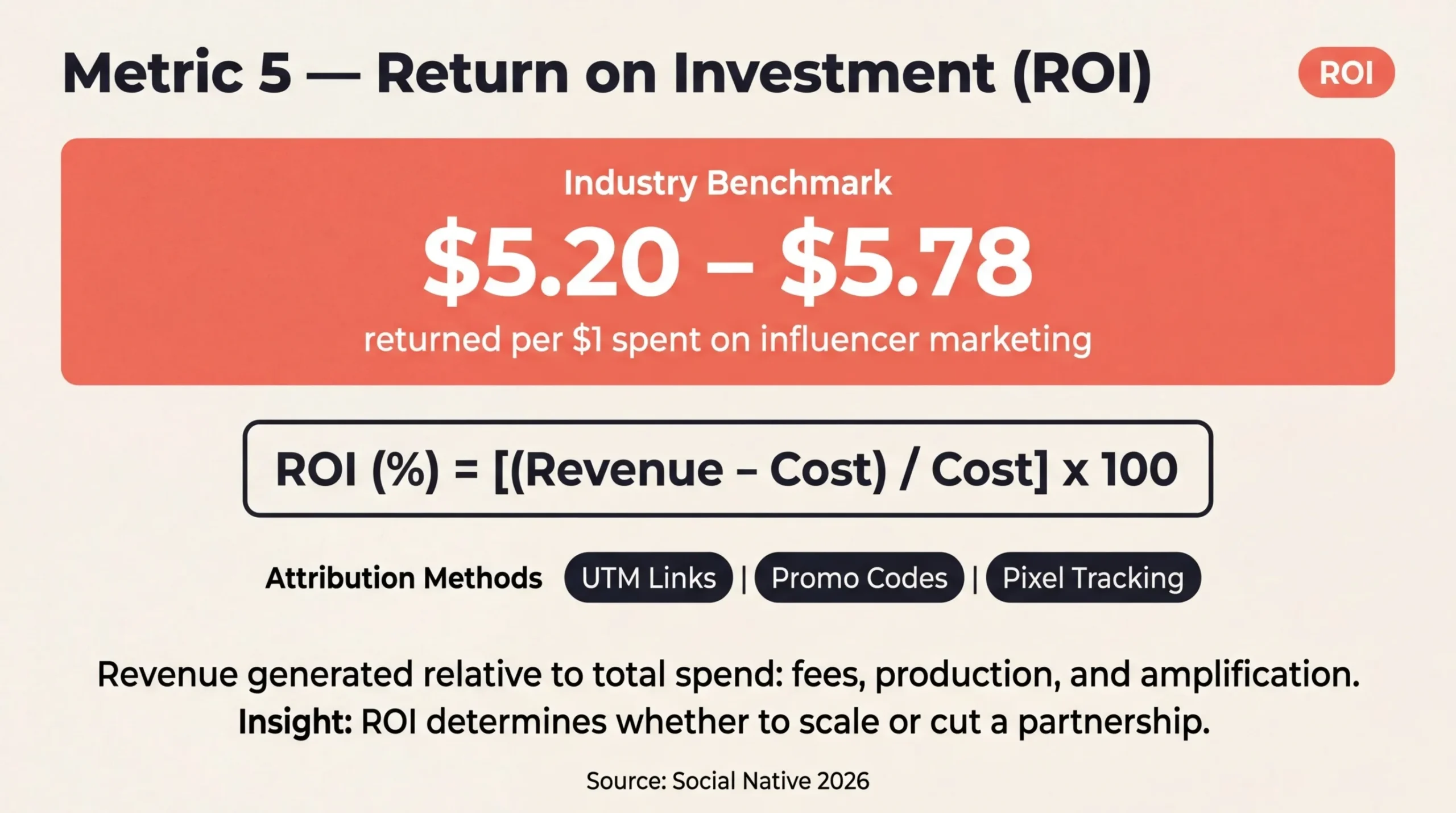
The revenue generated by a campaign relative to total spend (influencer fees + production + amplification).
ROI is the metric that justifies budget decisions and determines whether to scale or cut a partnership. Use UTM links, promo codes, and pixel tracking to build a credible attribution model.
- Formula: ROI (%) = [(Revenue – Cost) / Cost] x 100
- Benchmark: Average influencer marketing returns are strong, but they should not be treated as the ceiling. Archive cites average returns of about $5.78 for every $1 spent, while top-performing programmes can generate $18 to $20 per $1 spent when attribution, creator fit, and conversion tracking are properly set up.
Cost-Per Metrics That Matter in Influencer Marketing
Some of the most important influencer marketing metrics are not just performance outcomes, but efficiency measures. CPA, CPE, ROAS, and social ROI help show whether a campaign is generating business value at a sustainable cost, making them especially useful for comparing creators, formats, or campaign objectives.
The Cirqle’s 2025 ROI guidance also recommends setting a clear ROAS hurdle and reviewing results in weekly cohort cuts, so blended performance does not hide weak assets or weak audience quality.
- CPA (Cost Per Acquisition): Measures how much you spent to acquire each new customer.
Formula: CPA = Total Spend ÷ New Customers Acquired - CPE (Cost Per Engagement): Measures how efficiently the campaign generated interactions such as likes, comments, shares, and saves.
Formula: CPE = Total Spend ÷ Total Engagements - ROAS (Return on Ad Spend): Measures how much revenue was generated for every dollar spent on the campaign.
Formula: ROAS = Revenue Generated ÷ Total Ad / Influencer Spend - Social ROI: Measures the return relative to campaign cost, including earned value rather than direct revenue alone.
Formula: Social ROI = (Earned Value − Campaign Cost) ÷ Campaign Cost × 100
These metrics work best when matched to the campaign objective. CPE is more useful for awareness or engagement-led campaigns, while CPA and ROAS matter more for traffic, sales, and affiliate-led activity.
Social ROI is most useful when the goal is broader visibility and media value rather than direct-response efficiency alone. A practical way to apply this is to set a hard ROAS floor by objective, then review performance weekly by cohort.
Metric 6: Brand Mentions

The volume of times your brand, product, or campaign hashtag is mentioned across social platforms during and after a campaign.
Brand mentions measure organic amplification, how much conversation your campaign sparked beyond the influencer’s own posts. A spike in branded search following a campaign is a strong leading indicator of pipeline growth.
- Formula: Track with social listening tools (Brandwatch, Meltwater, Sprout Social).
- Benchmark: Compare post-campaign mention volume against a pre-campaign 30-day baseline.
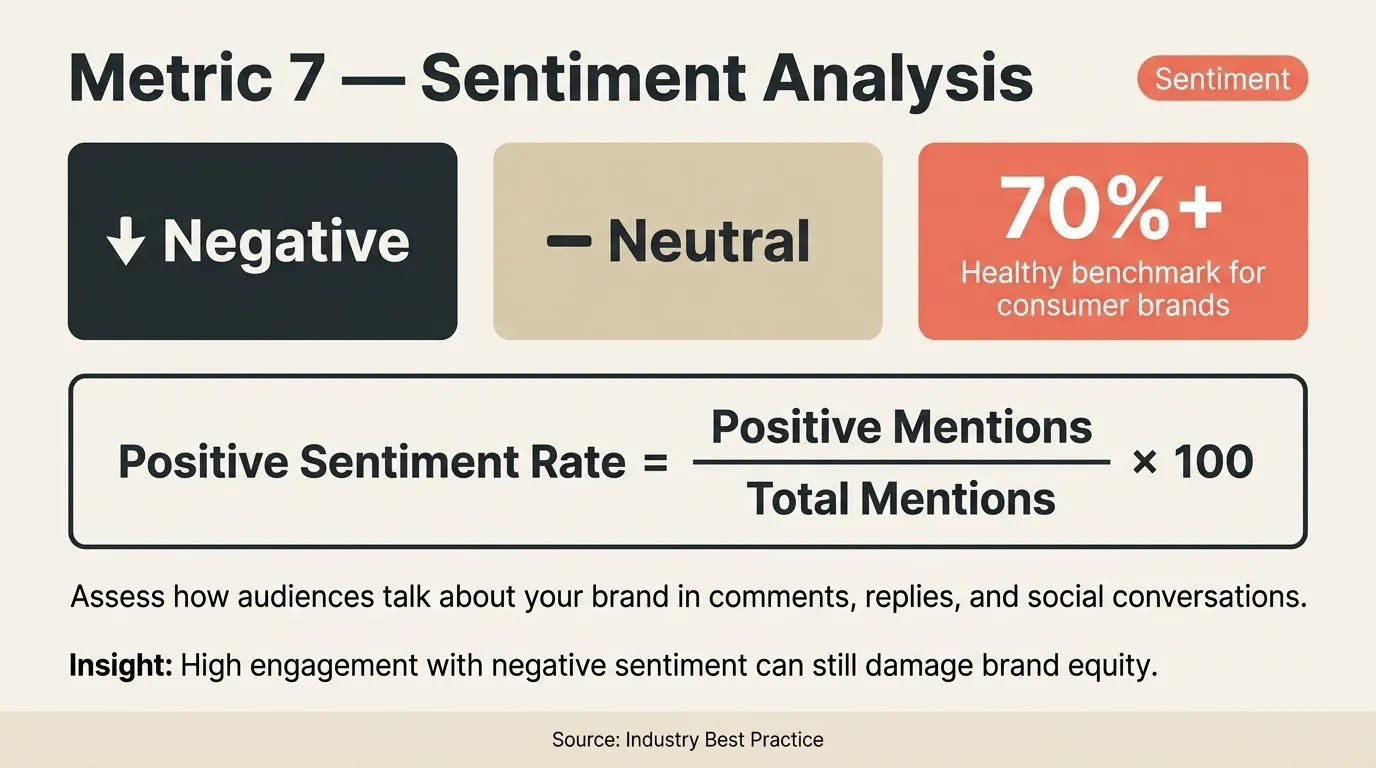
Metric 7: Sentiment Analysis
Share of Voice (SOV) measures how much of the total market conversation your brand owns compared with competitors. It is especially useful for influencer campaigns because it shows whether creator activity is expanding your brand’s presence in the category, not just generating engagement in isolation. Sprout Social defines the basic formula as:
SOV = Your Brand Mentions ÷ Total Market Mentions × 100
This metric works best when tracked before, during, and after a campaign. A pre-campaign baseline shows how visible your brand was before creators posted, while post-campaign tracking helps you see whether the campaign actually shifted your market position.
For brands in competitive Singapore verticals such as beauty, F&B, and finance, SOV is a useful way to measure whether influencer activity is building broader category visibility rather than generating isolated post-level engagement.
The easiest way to track SOV at scale is through social listening tools such as Sprout Social or Meltwater, which monitor brand and competitor mentions, as well as campaign-related conversations, across large volumes of social content. That makes SOV a stronger market-level KPI than relying solely on individual creator reports.
Additional Intent-Signal Metrics Worth Tracking
Standard engagement metrics are useful, but they do not always show how deeply the audience is engaging with the content.
That is why newer influencer reporting frameworks increasingly focus on save rate, video completion rate, and story link action metrics, which are stronger signals of intent and content quality than likes alone.
- Save Rate / Bookmark Rate: A high save rate suggests the content has lasting value and may indicate future purchase intent, especially for educational, review, or comparison-style posts. Statusphere’s measurement guidance treats saves as one of the more meaningful quality signals because they show the audience wants to come back to the content later, rather than simply react in the moment.
- Video Completion Rate: The percentage of a video that people actually watched. If completion is consistently low, the problem is often the opening hook, pacing, or creative structure rather than just weak distribution. This makes completion rate especially useful for diagnosing whether a creator’s short-form video is holding attention deeply enough to support awareness or conversion goals.
- Story Swipe-Up / Link Tap Rate: For Stories and short-form content, direct-action metrics matter because they show whether the content is driving the audience off-platform and into a measurable next step. Link taps, sticker clicks, and swipe-based actions are especially useful for campaigns focused on traffic generation, landing page visits, or direct response. A strong result here usually signals that the creator’s CTA, format, and audience fit are working together effectively.
These metrics matter even more in short-form creator campaigns, where content quality and audience retention shape everything that follows.
The Cirqle’s 2025 benchmark note says short-form videos from micro creators average an 11.4% engagement rate, which reinforces the need for deeper intent signals to sit alongside headline engagement in campaign reporting.
Metric 8: Audience Growth Rate
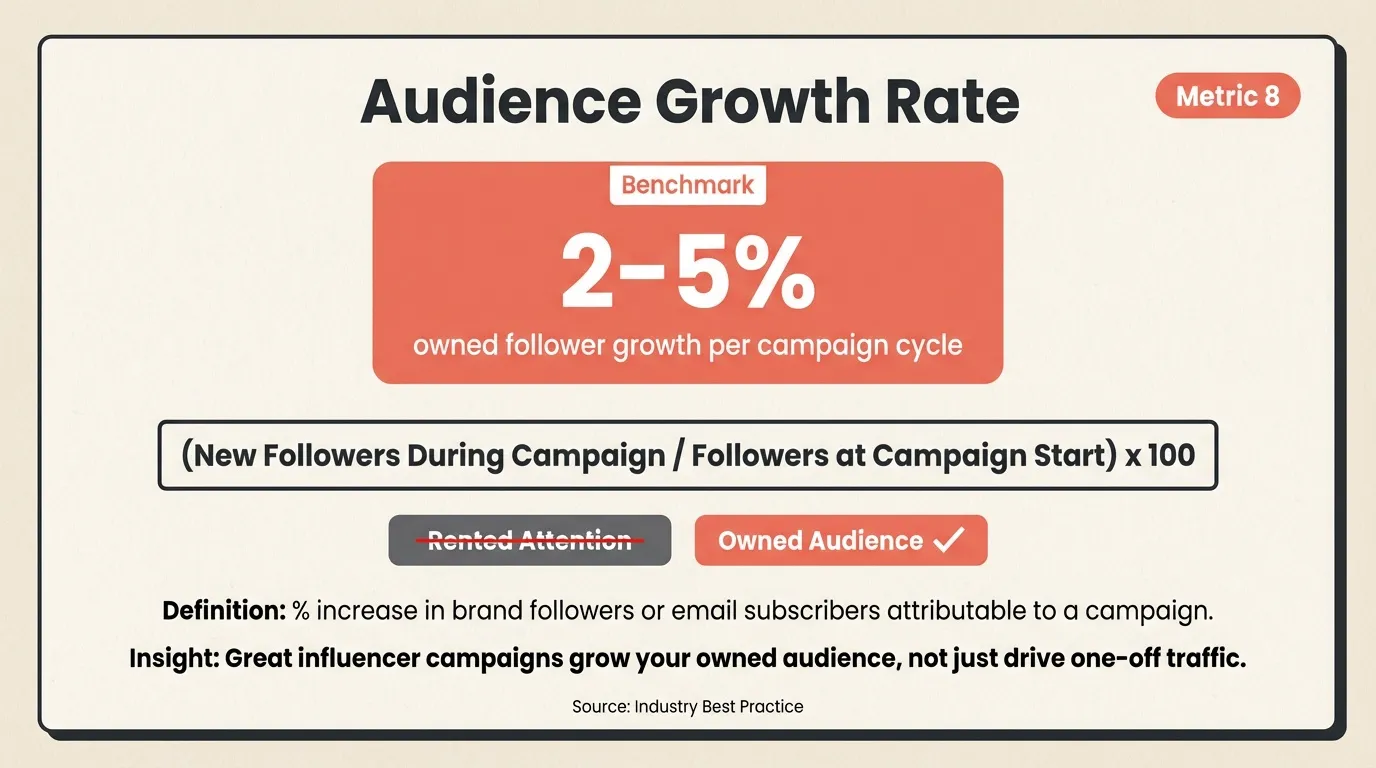
The percentage increase in your brand’s own social media followers or email subscribers attributable to an influencer campaign.
Beyond immediate conversions, effective influencer marketing performance should grow your owned audience, building a long-term asset rather than renting attention.
- Formula: (New Followers During Campaign / Followers at Campaign Start) x 100
- Benchmark: A 2–5% growth in owned followers over a single campaign cycle is a solid result for most brands.
Metric 9: Cost Per Engagement (CPE)
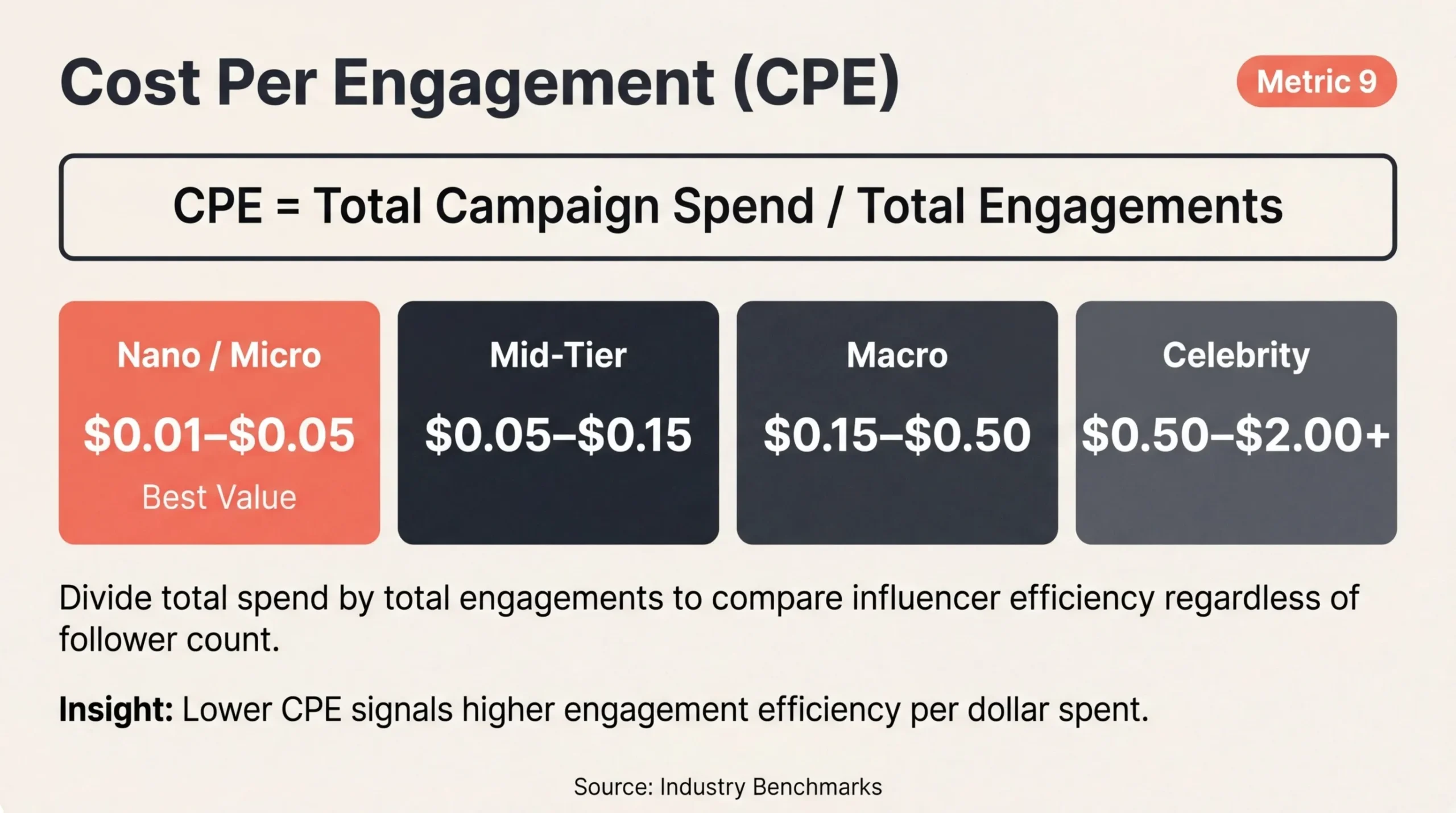
The total campaign spend is divided by the total number of engagements generated.
CPE allows you to compare the efficiency of different influencer partnerships on a like-for-like basis, regardless of follower count or fee structure.
- Formula: CPE = Total Campaign Spend / Total Engagements
- Benchmarks: Nano: $0.01–$0.05 | Macro: $0.10–$0.50
Metric 10: Customer Lifetime Value (CLV)
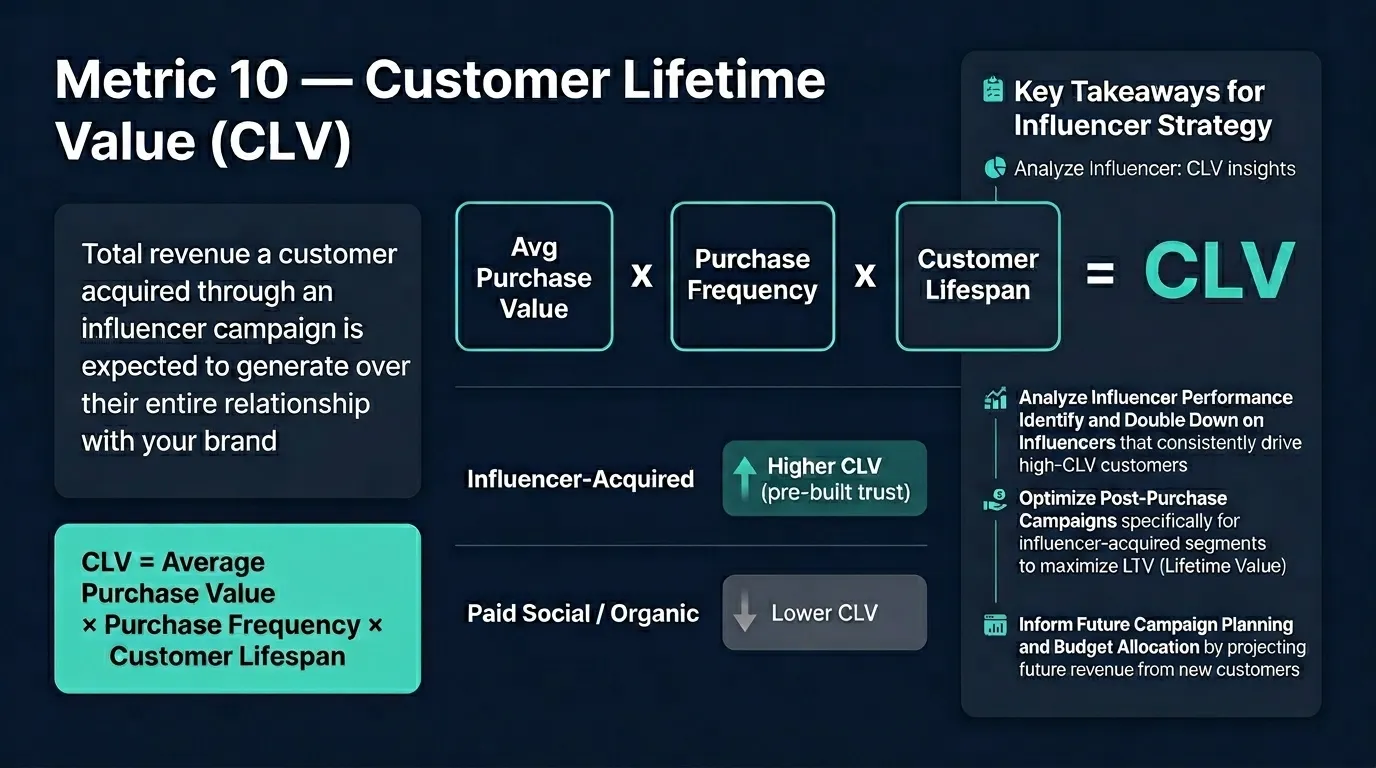
The total revenue a customer acquired through an influencer campaign is expected to generate over the duration of their relationship with your brand.
CLV shifts the evaluation from “what did this campaign cost?” to “what is this customer worth?” A campaign that drives lower-volume, higher-quality customers may deliver a superior CLV than a high-volume, low-quality acquisition campaign.
Formula: CLV = Average Purchase Value x Purchase Frequency x Customer Lifespan
This matters even more in Singapore, where GoViral Global reports that customers acquired through influencer campaigns have a 28% higher lifetime value and 34% higher retention than those acquired through paid social ads. That makes CLV one of the strongest ways to evaluate creator partnerships beyond first-purchase revenue alone.
Advanced Metric 11: Earned Media Value (EMV)
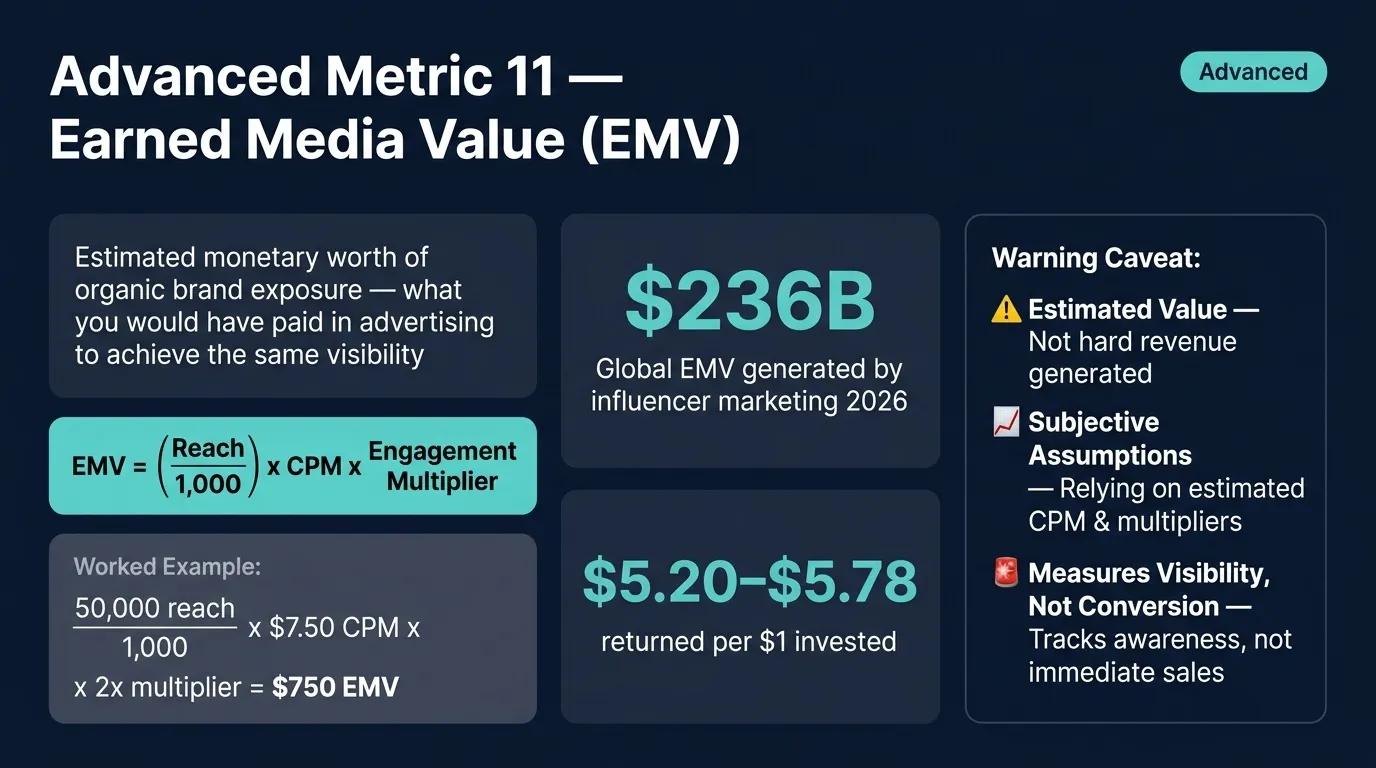
EMV estimates the monetary worth of organic brand exposure generated by an influencer; it answers the question: what would we have paid in advertising to achieve the same visibility?
Why It Matters: EMV translates influencer engagement into a language that finance teams and executives understand. It is most useful for comparing campaigns and benchmarking influencer efficiency.
Formula: EMV = (Reach / 1,000) x CPM x Engagement Multiplier
Example: An influencer’s post reaches 50,000 people. Instagram CPM baseline = $7.50. Strong engagement applies a 2x multiplier.
EMV = (50,000 / 1,000) x $7.50 x 2 = $750
Benchmarks:
- Influencer marketing generated an estimated $236 billion in Earned Media Value globally in 2026.
- Brands average $5.20–$5.78 in return for every $1 invested in influencer marketing.
Important Caveat: EMV is a comparative metric, not a revenue figure. Never use it as your sole indicator of campaign success. Pair it with conversion rate and CPA for a complete picture.
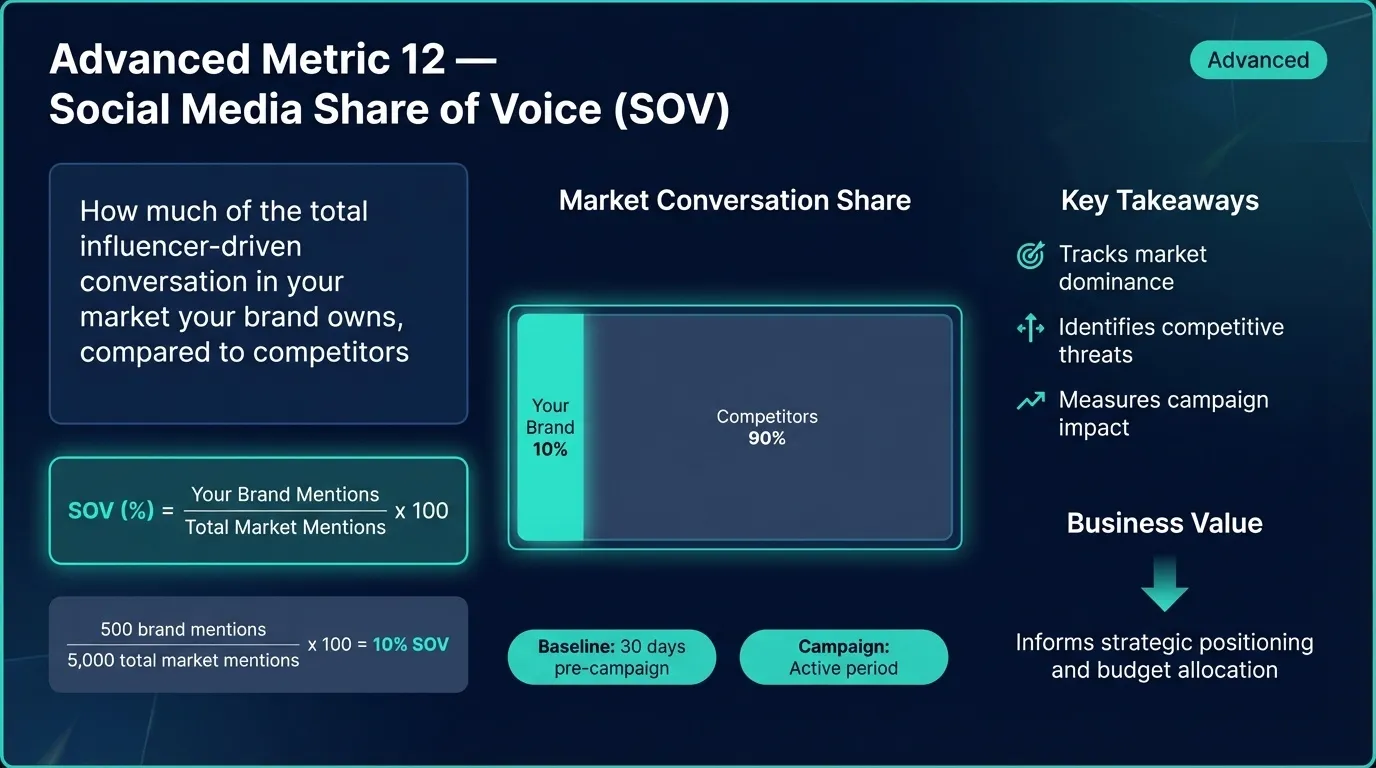
Share of Voice measures how much of the total influencer-driven conversation in your market your brand owns, compared to competitors.
SOV tells you whether your influencer programme is building market-level visibility or merely creating noise within a niche. It is one of the most powerful metrics for competitive benchmarking.
- Formula: SOV (%) = (Your Brand Mentions / Total Market Mentions) x 100
- Example: If influencers in your category generate 5,000 mentions in a month and 500 reference your brand, your SOV = 10%.
- Benchmark: Track your SOV baseline for 30 days before a campaign, then measure the lift during and after the campaign. A well-executed influencer campaign should deliver a measurable increase in SOV within your competitive set.
Advanced Metric 13: Branded Search Lift
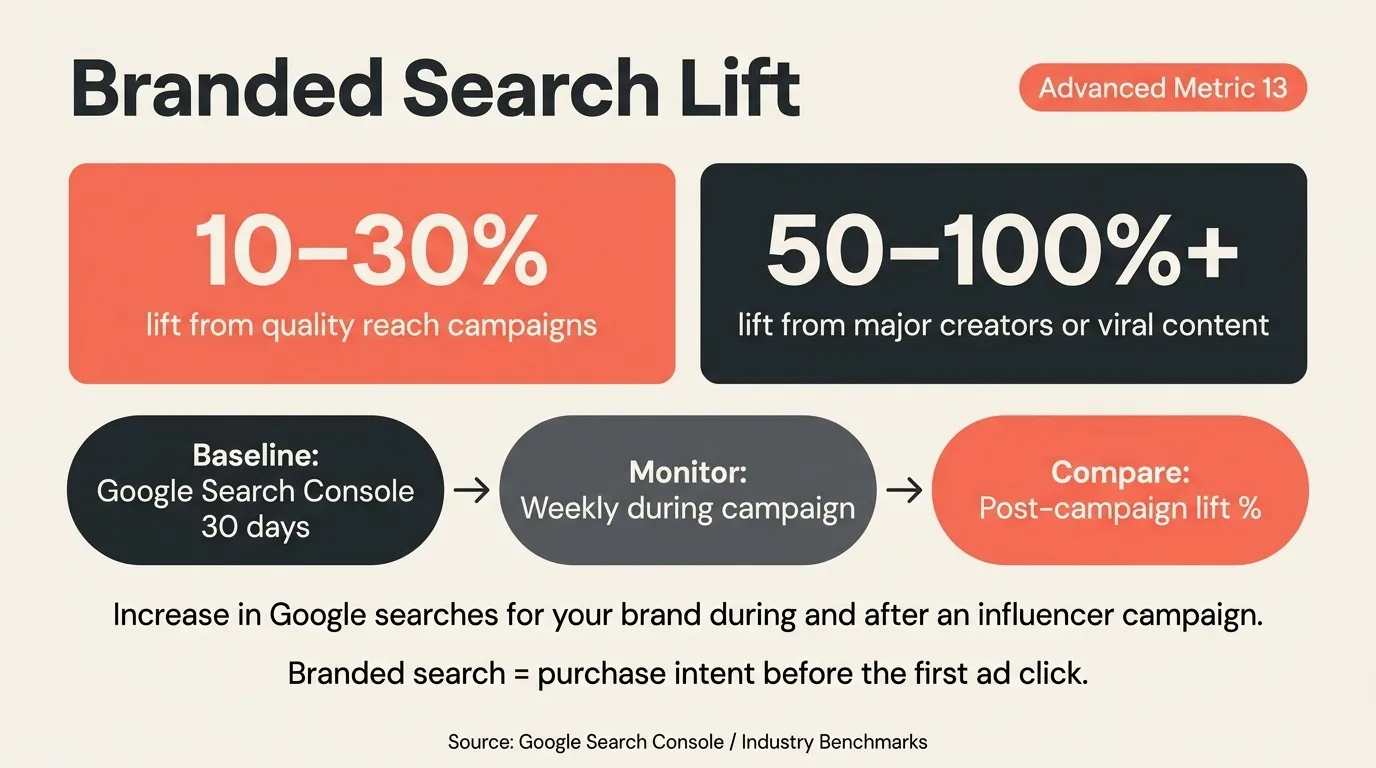
The measurable increase in Google searches for your brand name, product, or campaign hashtag during and after an influencer campaign.
Branded search lift is one of the most reliable indicators that influencer content is genuinely building brand awareness. When consumers see an influencer post and search for your brand on Google, they are demonstrating real purchase intent, even before clicking an ad or landing page.
How to Track It:
- Pull your branded keyword search volume from Google Search Console before the campaign (30-day baseline).
- Monitor weekly during the campaign period.
- Compare post-campaign search volume to the baseline to calculate lift percentage.
Benchmark: A notable influencer campaign with quality reach should produce a 10–30% branded search lift in the weeks following launch. Campaigns with major creators or viral content can produce lifts of 50–100% or more.
How to Choose the Right Influencer Marketing Performance Metrics
Not every metric applies to every campaign. The right KPI framework depends entirely on what you are trying to achieve.
| Campaign Objective | Primary Metrics to Track |
| Brand Awareness | Reach, Impressions, Brand Mentions, Sentiment, SOV |
| Audience Growth | Follower Growth Rate, Share Rate, Profile Visits |
| Traffic Generation | CTR, Sessions, Bounce Rate |
| Lead Generation | Conversion Rate, Cost Per Lead, Form Completions |
| Direct Sales | ROI, Revenue, CPA, Promo Code Redemptions |
| Loyalty and Retention | CLV, Repeat Purchase Rate, Net Promoter Score |
The Vanity Metric Trap
The single most common mistake in measuring influencer marketing performance is over-indexing on metrics that feel good but do not connect to revenue.
Likes, follower counts, and raw impression numbers are useful context, but they should never be primary KPIs for campaigns with commercial objectives. If your monthly influencer report leads with follower count gained, it is time to rebuild your measurement framework.
Align Metrics with Campaign Stage
Campaign goals shift over time. A product launch campaign starts with awareness metrics, then transitions to conversion metrics as the audience warms. Build your measurement framework to accommodate this shift. Do not lock yourself into a single KPI structure at campaign launch.
Full-Funnel Influencer Marketing Metrics Framework
Influencer marketing should not be measured by a single KPI set from start to finish. Different stages of the funnel need different metrics; otherwise, brands risk judging awareness content by conversion standards or sales content by engagement alone. A better approach is to match the KPI to the customer journey stage.
| Funnel Stage | Goal | Metrics to Track |
| TOFU (Awareness) | Reach and visibility | Reach, impressions, views, EMV, sentiment score |
| MOFU (Consideration) | Engagement and intent | Engagement rate, save rate, brand mentions, share of voice, search lift |
| MOFU to BOFU (Traffic) | Click intent | CTR, link taps, Story swipe-ups, website sessions via UTM tracking |
| BOFU (Conversion) | Revenue impact | Conversions, CPA, ROAS, promo code redemptions, affiliate revenue |
| Post-purchase | Retention and loyalty | CLV, retention rate, UGC volume, brand affinity |
This matters because awareness-stage content should be judged by visibility and interest, not immediate sales.
Once the campaign moves closer to purchase, the focus should shift to traffic quality, conversion efficiency, and revenue attribution. Post-purchase metrics then help show whether influencer-acquired customers create lasting value, rather than one-off transactions.
The simplest way to use this framework is to choose one primary KPI based on the campaign stage, then add two or three supporting metrics from the same part of the funnel. That keeps reporting focused and makes it easier to evaluate creator performance against the right objective.
Singapore Influencer Marketing Benchmarks to Reference
If your campaigns are targeting Singapore, global averages only go so far. Local platform behaviour, conversion patterns, and order values can vary meaningfully by channel, so your benchmarks should reflect the market you are actually buying in. GoViral Global’s 2025 Singapore market roundup provides a useful directional snapshot for campaign planning and performance review.
Platform Benchmarks in Singapore
| Platform | Engagement Rate (SG) | Conversion Rate (SG) | Avg. Order Value (SGD) |
| 2.2% | 3.8% | $42 | |
| TikTok | 5.4% | 2.1% | $35 |
| Xiaohongshu (RED) | — | 3.4% | $58 |
| YouTube | — | 1.8% | $67 |
These figures are useful because they show why a single reporting standard should not be applied across every platform.
TikTok tends to deliver stronger interaction, Instagram often supports more efficient mid-funnel performance, Xiaohongshu shows stronger conversion efficiency in this Singapore market summary, and YouTube tends to carry the highest average order value. That makes platform choice a performance decision, not just a content-format decision.
Influencer Tier Engagement Benchmarks in Singapore
| Tier | Followers | SG Avg. Engagement |
| Nano | 1K–10K | 5.8% |
| Micro | 10K–50K | 4.2% |
| Mid-tier | 50K–500K | 2.6% |
| Macro | 500K–1M | 1.9% |
| Celebrity | 1M+ | 1.6% |
This table is most helpful when setting realistic expectations during the creator selection process. A nano or micro influencer should not be judged by the same engagement standard as a macro or celebrity creator, especially when the campaign objective is conversion efficiency rather than broad awareness.
Used properly, these benchmarks help marketers set stronger goals before a campaign launches and assess results more fairly after it ends.
Industry-Specific Influencer Marketing Benchmarks for Singapore Brands
While platform-wide benchmarks are useful as a baseline, industry performance expectations should still be adjusted. Beauty, F&B, fashion, technology, and finance campaigns behave differently in practice, so brands should not judge every sector by the same content style or KPI mix.
For Singapore campaigns, the more practical approach is to use local platform benchmarks as the baseline, then refine platform choice and success metrics by vertical.
| Industry | Recommended Platform Focus | What to Prioritise | Practical Notes |
| Beauty & Skincare | TikTok, Instagram, YouTube | Engagement, saves, creator trust, conversion efficiency | Strong fit for demos, tutorials, routines, and review-led content. |
| Food & Beverage | Instagram, TikTok, Facebook | Reach, saves, shares, direct action | Works well with visual-first content, creator trials, and repeat product exposure. |
| Fashion & Retail | Instagram, TikTok, Xiaohongshu, where relevant | Engagement, click intent, average order value | Performs best when content is visually native, trend-aware, and easy to shop. |
| Technology | YouTube, LinkedIn | Watch quality, click intent, lead quality, thought leadership | Tech products often need more explanation, so educational and credibility-led content usually performs better than trend-led content. |
| Finance | LinkedIn, YouTube | Trust, clarity, lead quality, and compliant education | Finance campaigns should be measured more conservatively and require tighter compliance controls under MAS and ASAS rules. |
The key takeaway is simple: local platform benchmarks tell you what is normal in the market, but industry context tells you what is realistic for your category.
Beauty and F&B campaigns may justify stronger short-form and creator-native expectations, while technology and finance campaigns should place more weight on trust, education, and downstream lead or revenue quality rather than raw engagement alone.
How to Budget for Influencer Marketing Campaigns in Singapore
Budgeting for influencer campaigns is part science, part negotiation, and part contingency planning. That budget context matters because Singapore is already a high-response market. GoViral Global estimates the Singapore influencer market at SGD 285 million in 2025, with average campaign ROI around 5.8x, and says top-performing beauty and fashion campaigns can exceed 11x.
Singapore Influencer Rate Benchmarks
| Tier | Follower Range | Rate Per Post (SGD) | Avg Engagement Rate |
| Nano | 1K–10K | SGD $150–$400 | 8.9% |
| Micro | 10K–50K | SGD $400–$1,200 | 7.8% |
| Mid-tier | 50K–250K | SGD $1,200–$5,000 | 5.2% |
| Macro | 250K–1M | SGD $5,000–$15,000 | 3.7% |
| Celebrity | 1M+ | SGD $15,000+ | 2.9% |
Note: TikTok micro-influencer rates in Singapore typically run 30–50% higher than equivalent Instagram rates due to higher organic reach potential.
Phase Budget Allocation
| Phase | Recommended Allocation |
| Pre-Campaign (strategy, vetting, contracting) | 10–15% |
| Execution (influencer fees, content production) | 60–70% |
| Amplification (paid boosting) | 10–15% |
| Measurement and Reporting | 5–10% |
The Hidden Costs Most Brands Miss
Budget an additional 20–40% beyond base influencer fees to cover:
- Content Usage Rights: Exclusive rights (your brand only) cost 2–3x more than non-exclusive. If you plan to repurpose influencer content in paid ads, negotiate usage rights upfront.
- Original Content Production: Photography, videography, and editing beyond the influencer’s standard deliverable can add SGD $700–$4,000 per piece.
- Paid Amplification: Allocate 10–15% of your influencer budget to boost top-performing content via paid social.
- Analytics and Tools: Budget SGD $700–$7,000/month for tracking infrastructure.
- Agency or Management Fees: Professional campaign management typically runs 10–20% of total spend.
Note: These figures are estimates only. Consult a trusted influencer marketing analytics agency in Singapore for specific figures.
ASAS Compliance for Influencer Marketing Performance in Singapore
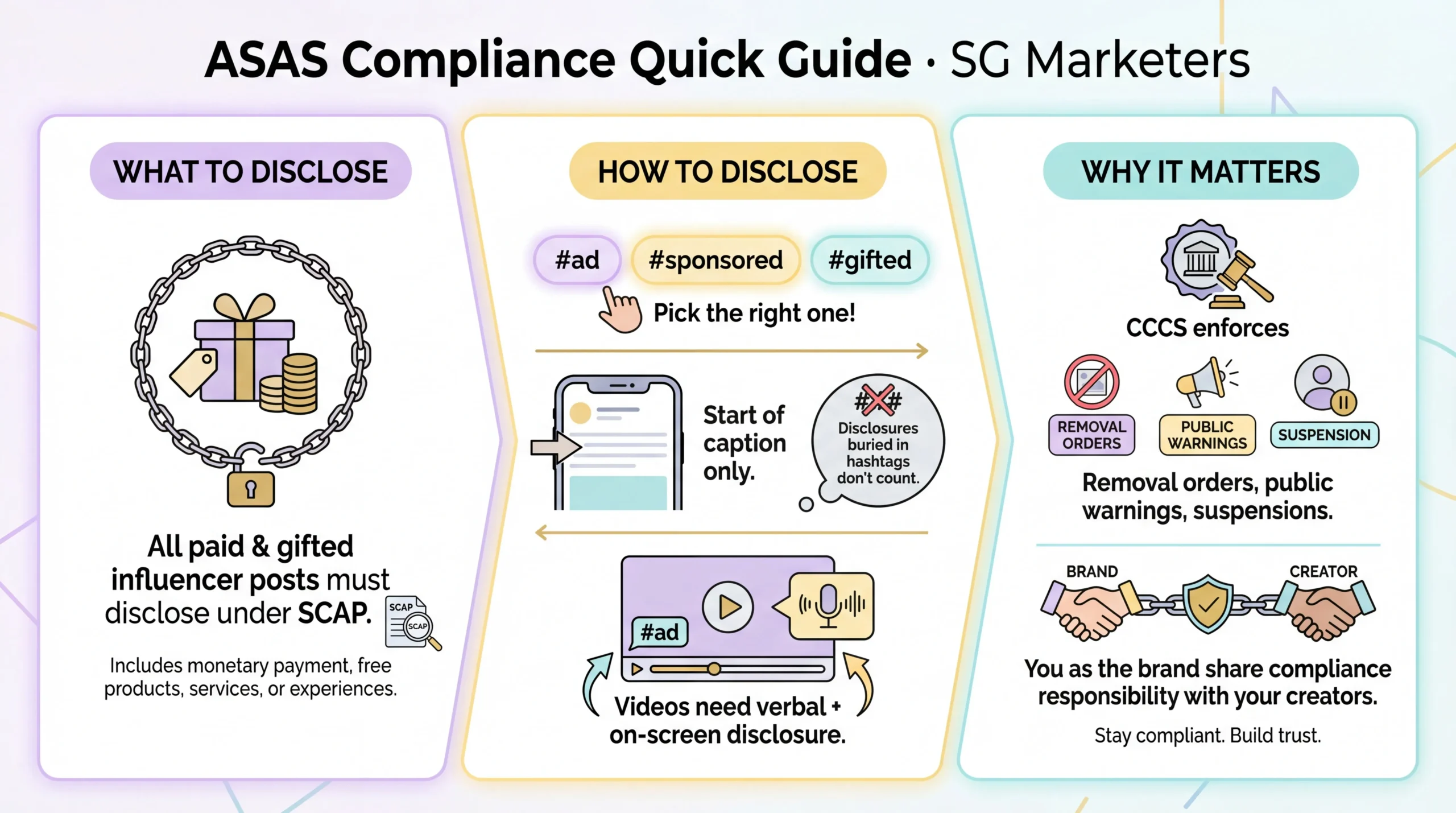
Compliance should be built into the campaign from the start, not added after content is already live. In Singapore, ASAS requires influencer marketing to be clearly identifiable as advertising, which means paid, gifted, affiliate, and other incentivised content should be disclosed properly and presented in a way audiences can recognise easily.
For finance, insurance, investment, and fintech campaigns, the rules are now stricter. MAS’s Guidelines on Standards of Conduct for Digital Advertising Activities took effect on 25 March 2026, so financial influencer content now needs tighter approval controls, clearer disclosures, and stronger guardrails around claims, benefits, and risk presentation.
Brands should also factor in privacy obligations when campaigns use UTM links, pixels, landing pages, or lead forms to capture personal data. Under Singapore’s PDPA, organisations must notify individuals of the purposes for collecting, using, or disclosing personal data and obtain consent unless an exception applies.
Three Advanced Influencer Marketing Performance Strategies
Beyond the standard metrics framework, these three strategies separate high-performing influencer programmes from average ones.
Strategy 1: Repurpose Influencer-Generated Content in Paid Channels
Influencer-generated content (IGC) does not have to live only on the creator’s page. By licensing the content and deploying it in Meta Branded Content Ads and TikTok Spark Ads, brands can amplify the reach of their best-performing influencer content to custom audiences far beyond the creator’s followers.
Research indicates that influencer-generated content can increase paid ad efficiency compared to standard brand-produced creative, at a fraction of the cost of studio production. The reason: audiences respond more authentically to creator-style content than to polished brand advertising.
Implementation: Negotiate content usage rights at the contract stage. Budget for a 10–15% paid amplification layer on top of your base influencer fees.
Strategy 2: Choose the Right Attribution Model
Attribution is where many influencer campaigns break down. A creator may drive awareness, traffic, and even conversions, but if the tracking setup is weak, the final report will understate the real impact. That is why influencer attribution needs more than one method.
It should combine UTM links, promo codes, deep links, and a clear GA4 attribution model to make it easier to capture both click-based and assisted conversions.
Use a Consistent UTM Structure
UTM parameters are among the simplest ways to accurately track influencer traffic. InfluenceFlow’s 2026 UTM guide recommends using all five standard parameters so traffic can be cleanly broken down by creator, campaign, content type, and tier in GA4.
A practical structure looks like this:
- utm_source = influencer name or platform
- Example: influencer_alexchen_tiktok
- utm_medium = channel type
- Example: social
- utm_campaign = campaign name
- Example: brandname_summer2025
- utm_content = post type or asset variation
- Example: tiktok_video or ig_reel
- utm_term = influencer tier or audience segment
- Example: micro or macro
This structure keeps reporting cleaner because it tells you not just which campaign worked, but also which creator, format, and tier contributed to the result.
Choose the Right GA4 Attribution Model
Tracking is only half the job. The other half is deciding how credit should be assigned once multiple touchpoints are involved. InfluenceFlow’s attribution guide explains the core models clearly, and these are the ones most relevant to influencer campaigns:
| Model | How Credit Is Assigned | Best Use Case |
| First-click | 100% of credit goes to the first touchpoint | Awareness campaigns |
| Last-click | 100% of credit goes to the final touchpoint | Direct-response campaigns |
| Linear | Credit is distributed equally across all touchpoints | Multi-creator or full-funnel campaigns |
| Data-driven | Credit is assigned algorithmically based on observed conversion patterns | Best default choice for most brands with enough data |
For most brands, data-driven attribution is the strongest long-term option because customer journeys are rarely simple. When data volume is low, linear attribution is often a more realistic alternative to last-click, especially when multiple creators influence the same purchase path.
Combine Promo Codes with Deep Links
Promo codes are useful, but they do not capture everything. Airbridge notes that coupon-code-only tracking usually misses buyers who saw the creator content, remembered the offer, and converted later without clicking the original link.
That is why a stronger setup is to combine promo codes inside deep links or tracked links, so the campaign can capture both direct click-through purchases and some non-click purchase behaviour more reliably.
In practice, that means:
- the creator shares a tracked link with the promo code embedded
- the link opens the right product or landing page directly
- the code still works even if the user returns later through another path
This gives the campaign a better chance of capturing both click and purchase intent, rather than forcing all attribution through a single narrow mechanism. (airbridge.io)
Simple Attribution Setup for Most Campaigns
For most influencer campaigns, a practical setup looks like this:
- use UTM-tagged links for every creator
- assign a unique promo code to each influencer
- use deep links where relevant so users land on the right product or page
- review results in GA4 using a model that matches the campaign objective
That combination will not eliminate every attribution gap, but it gives you a much stronger foundation than relying on platform metrics or promo code redemptions alone.
Strategy 3: Track Branded Search Lift Via Google Search Console
Set up a pre-campaign baseline by pulling 30 days of branded keyword data from Google Search Console.
During and after the campaign, monitor weekly for spikes in branded search volume. Cross-reference these spikes with your influencer post calendar to identify which creators and content types are most effective at driving purchase intent.
This method captures conversions that UTM links and promo codes cannot. The dark social traffic that arrives via direct URL entry or Google search after a consumer sees influencer content in their feed.
Map Influencer Marketing Performance Across Your Marketing Funnel
One of the most common strategic mistakes is treating influencer marketing as a top-of-funnel-only tactic. In reality, influencer content can activate audiences at every stage of the buyer journey.
Influencer marketing should not be treated solely as a top-of-funnel tactic. In Singapore, GoViral Global cites findings that 72% of consumers have purchased after an influencer recommendation, which supports the idea that creator content can influence awareness, consideration, and conversion rather than just engagement.
A proper measurement framework should therefore map influencer activity across the full funnel rather than treating it as a pure awareness channel.
| Funnel Stage | Content Type | Primary KPIs | Goal |
| Top of Funnel (Awareness) | Lifestyle posts, brand intro reels, “Did you know?” TikToks | Reach, Impressions, Brand Mentions, SOV | Introduce your brand to new audiences |
| Middle of Funnel (Consideration) | Product reviews, tutorials, comparison videos, Q&A stories | Watch Time, CTR, Saves, Comment Quality | Build trust and educate the audience |
| Bottom of Funnel (Conversion) | Promo code posts, limited-time offers, and unboxing with direct CTAs | Conversion Rate, CPA, Revenue, CLV | Drive purchase or sign-up |
| Post-Purchase (Retention) | Community posts, loyalty features, re-engagement stories | Repeat Purchase Rate, CLV, NPS | Turn customers into brand advocates |
Integrating Activity Into a Single Performance View
Use UTM parameters for every link, unique promo codes per influencer, and pixel tracking on your website to connect influencer content to actual conversions, regardless of where in the funnel the touchpoint occurred.
This full-funnel approach transforms influencer marketing performance from a one-dimensional metric exercise into a genuine business intelligence function.
Why Post-Purchase Surveys Are Critical for Influencer Marketing Performance
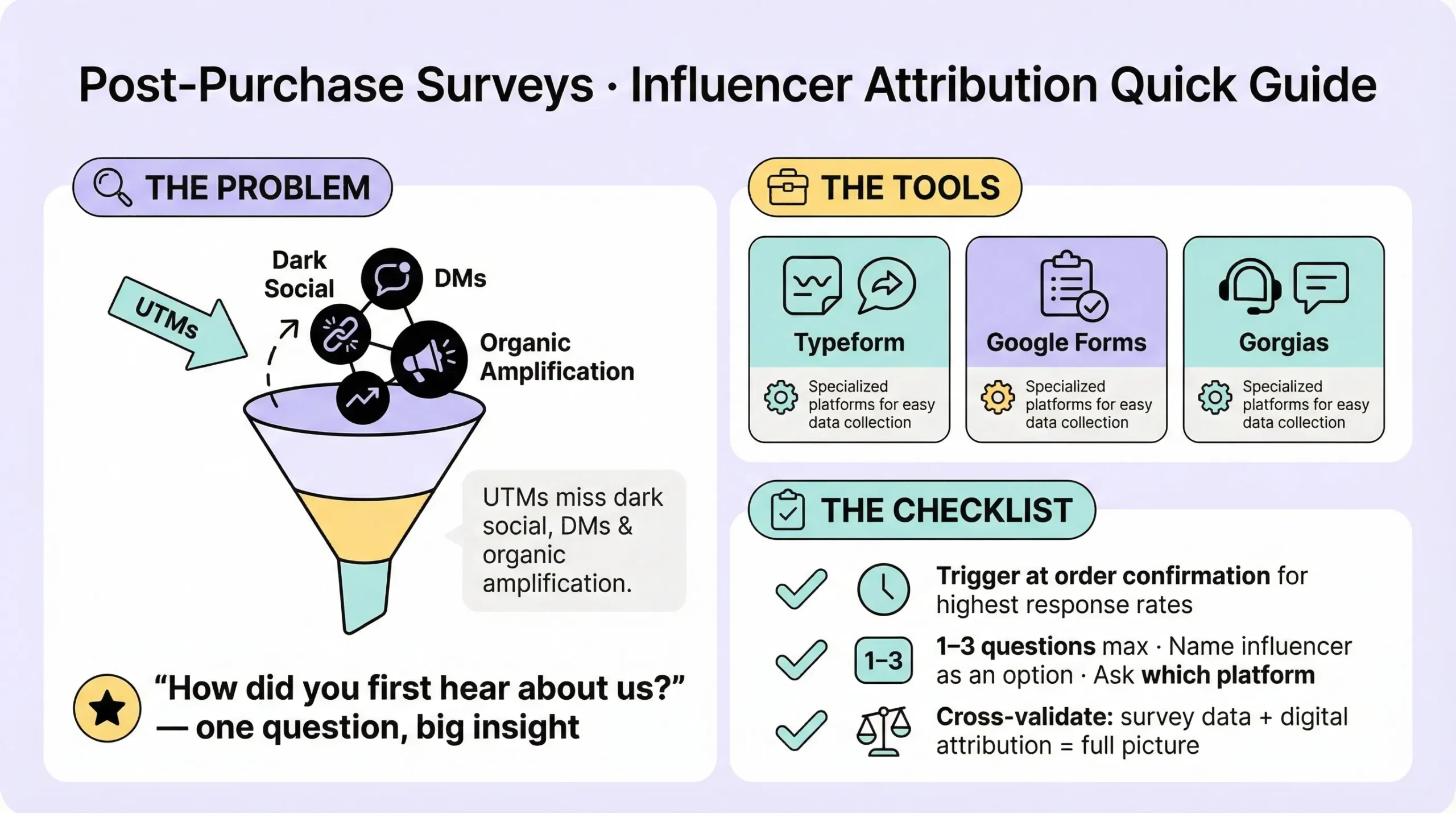
There is a gap in most influencer attribution models that even the best UTM tracking cannot fully close: the customer’s own memory of where they discovered you.
Post-purchase surveys are a simple but powerful tool for capturing this data.
How They Improve Attribution
Ask every new customer: “How did you first hear about us?” The answers will frequently reveal that a significant percentage came from influencer content that your analytics tools did not fully capture, particularly for organic shares, word-of-mouth amplification, or dark social (content shared via direct messages and private groups).
Recommended Survey Tools
- Typeform: clean UX, high completion rates, integrates with Shopify and most CMS platforms
- Google Forms: free, simple, easy to embed in order confirmation pages
- Gorgias: post-purchase survey via customer support workflows for e-commerce brands
Checklist for Better Surveying
- Keep it to 1–3 questions maximum. Longer surveys destroy completion rates.
- Include “Social Media / Influencer” as a named response option, not buried under “Other.”
- Add a follow-up: “Which influencer or platform?” for granular attribution.
- Deploy surveys immediately after purchase via email or the order confirmation page for the highest response rates.
- Feed survey data back into your influencer performance reporting to cross-validate digital attribution.
Sample Question Template for an Influencer Marketing Performance Survey
“How did you first discover [Brand Name]?”
- Google / Search
- Instagram or TikTok influencer
- YouTube video
- Friend or family referral
- Paid advertisement
- Other (please specify).
*Use this template to build connections with your clients. Tweak the sections to align with your goals.
Track Your Influencer Marketing Performance To Maximise Your Reach
The era of measuring influencer marketing performance by likes and follower counts is over. Today’s brands demand, and can access, a much richer picture of what their influencer investments are actually delivering.
The pressure to measure properly is not going away. Impact reports that 98% of marketers say attribution is crucial, yet many still struggle to reliably connect creator activity to strategic outcomes. That is why influencer marketing performance now needs to be treated as a measurement discipline, not just a content reporting exercise.
From engagement rate and CTR to conversion rate, CLV, EMV, and full-funnel attribution, the metrics that matter connect creator content to commercial outcomes. That requires the right tools, the right tracking infrastructure, and a strategic mindset that treats influencer marketing not as a creative exercise, but as a performance channel.
At MediaOne, we use a clear framework: move measurement from the vanity base of likes and impressions, through the engagement middle of saves, CTR, and watch time, to the revenue apex of conversions, CPA, ROI, and CLV. That upward progression is where budget accountability matters most.
If you are ready to build an influencer programme that is optimised for growth, working with an influencer marketing analytics agency in Singapore is the most direct path to measurable results. Get in touch with us today and tell us how we can help you!
Frequently Asked Questions
What Is the Average Cost of an Influencer Marketing Campaign in Singapore?
The cost of influencer marketing can vary based on factors such as influencer tier, platform, content type, and usage rights. Here are the typical price ranges for influencer posts in Singapore:
- Nano-Influencers: SGD $150–$400 per post
- Micro-Influencers: SGD $400–$1,200 per post
- Mid-Tier Influencers: SGD $1,200–$5,000 per post
- Macro-Influencers: SGD $5,000–$15,000 per post
- Celebrity Influencers: SGD $15,000 and above per post
Additionally, it’s important to allocate an extra 20–40% in your budget to cover hidden costs, such as content production, tool subscriptions, and amplification spend.
Is It Necessary to Work With Influencers on Multiple Platforms for Maximum Impact?
While it’s not mandatory, working with influencers across multiple platforms can increase brand visibility. Ensure that the platforms align with your audience’s preferences. For example, if your target market is younger, TikTok might be more effective, while Instagram may work better for lifestyle brands.
What Are the Most Common Misconceptions About Influencer Marketing?
The biggest misconception is that more followers automatically means more impact. Nano and micro-influencers consistently drive higher engagement rates and more cost-effective conversions than mega-influencers. A second common myth: that influencer marketing is only for B2C brands. B2B brands across SaaS, finance, and professional services have achieved significant ROI through LinkedIn creators and niche YouTube channels.
What to Do When an Influencer’s Performance Does Not Meet Expectations
Diagnose before making decisions. Review post-level content performance to identify where the funnel broke. Was the brief too restrictive? Was the CTA unclear? Did the post go live at an off-peak time?
Share specific, data-backed feedback with the creator and offer to revise the deliverable. If performance consistently underdelivers across multiple posts with the same creator, re-evaluate whether the audience alignment was accurate at the selection stage.
How to Continuously Improve Your Influencer Marketing Strategy Over Time
Treat every campaign as a source of performance data, not just content output. EMARKETER reports that 32% of marketers globally say measuring creator performance is the top roadblock to a successful influencer programme, which is why structured reporting matters so much.
Build a database of results by creator, format, platform, and objective so each new campaign benefits from what the last one taught you.
How Do I Ensure My Influencer Campaign Complies With Advertising Regulations?
Ensure that influencers clearly disclose any paid partnerships using the platform’s tools, such as Instagram’s “Paid Partnership” tag. Adhere to guidelines provided by local authorities, such as Singapore’s ASAS and MAS regulations, to avoid misleading content.
How Do I Measure the ROI of an Influencer Campaign Effectively?
To measure ROI properly, compare total campaign cost against attributable revenue, not just clicks or engagement. Use UTM links, promo codes, post-purchase surveys, and platform analytics together so the reporting reflects both direct and assisted conversions.
The archive cites average influencer returns of about $5.78 per $1 spent, which is a useful benchmark, but top-performing campaigns can exceed that when attribution is set up properly.
What is a good engagement rate for an influencer in Singapore?
A good engagement rate depends on both platform and creator tier. GoViral Global’s 2025 Singapore roundup cites average engagement of 5.8% for nano influencers, 4.2% for micro influencers, and 5.4% on TikTok at the platform level, which makes those useful local reference points when judging creator performance.
Use them as directional benchmarks, not absolute pass-fail thresholds, since format, category, and audience quality still matter.
What ROAS should I expect from influencer marketing?
Average returns are often quoted at $5.78 per $1 spent, while GoViral Global also cites a 5.8x average campaign ROI in Singapore. That gives you a reasonable benchmark floor, but the right target still depends on your objective, margin structure, and whether you are measuring first-order revenue or longer-term customer value.
The safest approach is to set a clear ROAS floor before launch and review it by cohort, rather than relying solely on blended averages.
How do I track influencer sales without e-commerce integration?
The simplest setup is to combine unique promo codes with UTM-tagged links so you can capture both attributed clicks and code-based purchases. Where possible, use deep links so users land directly on the right product or landing page instead of a generic homepage. That gives you a stronger attribution setup than relying on platform metrics or promo codes alone.
How do iOS privacy changes affect influencer attribution?
Privacy changes have made attribution less precise, especially when users move across apps, browsers, and devices before converting. Direct Agents says 73% of marketers report significant attribution challenges since iOS 14.5, which is why brands now need stronger first-party tracking and more realistic measurement models.
In practice, that means combining UTMs, on-site analytics, pixel data where allowed, post-purchase surveys, and modelled attribution rather than relying on one data source.
What’s the Difference Between Reach and Impressions in Influencer Campaigns?
Reach is the number of unique people who saw the content at least once. Impressions are the total number of times the content was displayed, including repeat views from the same person. Reach is more useful for exposure, while impressions help show frequency and message repetition.