Most businesses don’t struggle with social media. They struggle to know which platforms generate revenue. With limited budgets, rising ad costs, and increasing competition, choosing the wrong platform is expensive.
According to the HubSpot State of Marketing Report 2026, 43% of marketers rank Facebook among the highest ROI-driving social media platforms, followed closely by Instagram and YouTube. This shows that while multiple platforms compete for attention, some consistently deliver stronger returns.
But here’s the challenge: the “best” platform depends entirely on your business model, audience behaviour, and funnel structure. Many brands turn to a structured strategy guided by an experienced social media marketing agency to align platform selection with revenue goals rather than trends.
Before diving into platform-by-platform insights, it’s important to understand what drives results. In this guide, we break down how major social media platforms compare in 2026, what truly drives ROI, and how to determine which one aligns with your growth goals, so you invest based on data, not trends.
Key Takeaways
- There is no one-size-fits-all platform. ROI depends on accurately matching your platform to your audience and business needs, not just popularity.
- Successful strategies align platform behaviour with users’ readiness to buy, sharply increasing conversions and profitability.
- For predictable growth, prioritise structured paid advertising. Organic activity builds trust, but paid strategy drives scalable ROI.
- High-quality, platform-specific creative is essential to success. Continuous creative testing outperforms detailed targeting alone.
- Measurement determines optimisation. Tracking revenue, CPA, and customer lifetime value ensures investment decisions across social media platforms are data-driven rather than assumption-based.
What Are Social Media Platforms?
Social media platforms are digital networks that enable content distribution, audience engagement, and paid advertising within structured ecosystems. For businesses, they function as acquisition channels, brand-building environments, remarketing engines, and customer relationship touchpoints.
Each platform operates under different algorithmic priorities. Some prioritise engagement velocity (TikTok), others relationship networks (Facebook), professional relevance (LinkedIn), or search-discovery hybrid behaviour (YouTube). These structural differences influence cost efficiency, audience intent, and conversion probability.
Understanding social media platforms requires looking beyond user numbers. ROI depends on how platform behaviour aligns with your customer journey.
What Determines ROI on Social Media Platforms?
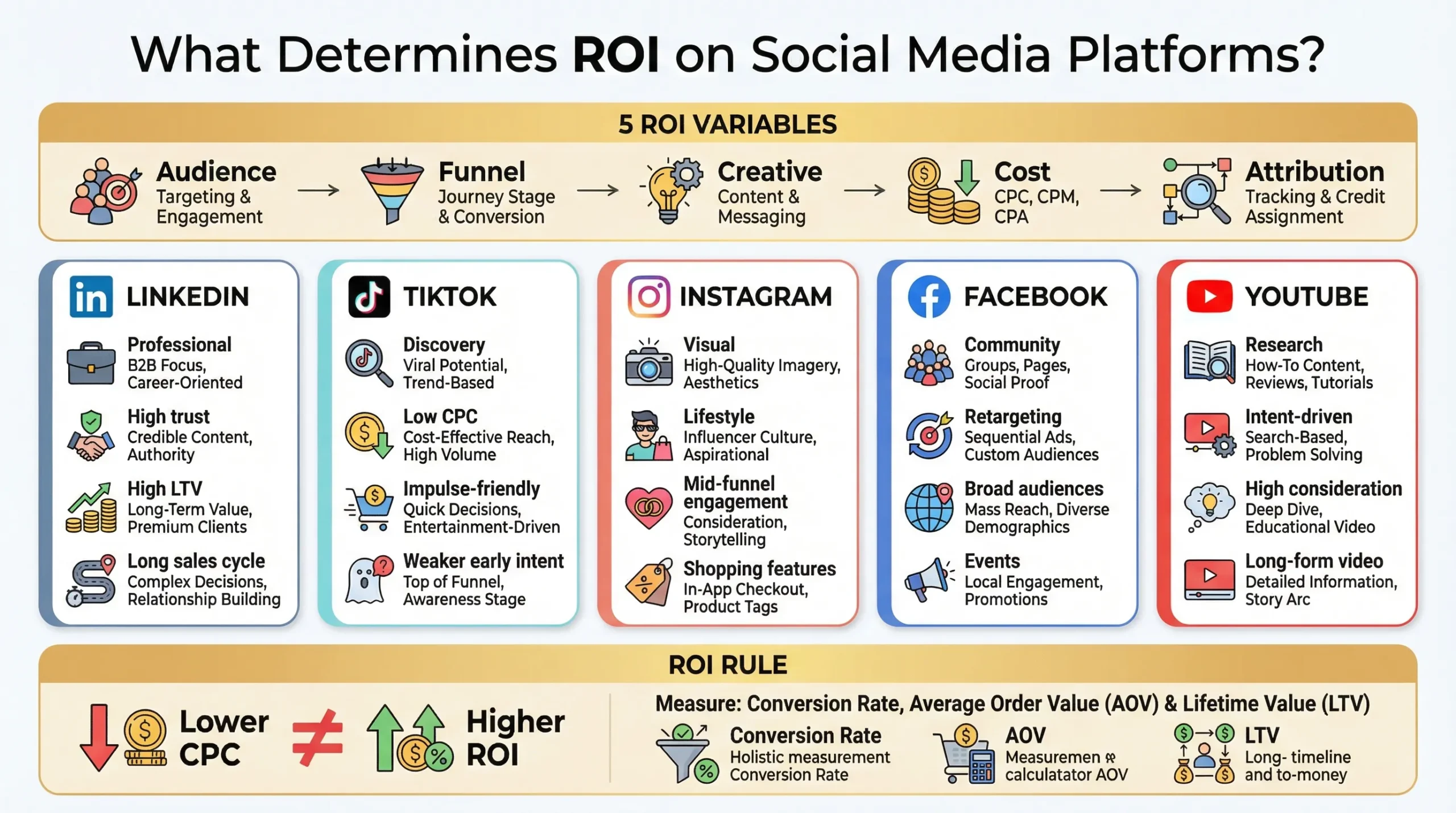
ROI on social media platforms is determined by five core variables: audience alignment, funnel positioning, creative quality, cost structure, and attribution modelling.
Audience Intent vs Platform Behaviour
Every platform attracts users in a different psychological state.
- LinkedIn: Professional, career-focused, decision-making mindset.
- TikTok: Entertainment-driven, discovery mode.
- Instagram: Visual inspiration and lifestyle engagement.
- Facebook: Community interaction and retargeting-friendly behaviour.
- YouTube: Research, learning, and intent-driven consumption.
If your offer requires high trust and long sales cycles, LinkedIn or YouTube may outperform high-virality platforms. If your product is impulse-friendly, TikTok or Instagram may drive faster conversions.
ROI improves when the platform mindset matches buying readiness.
Organic Reach vs Paid Leverage
Organic reach across major social media platforms has steadily declined due to algorithm prioritisation of paid distribution and content saturation.
Organic still plays a role in brand authority and community trust, but to achieve predictable ROI, paid amplification is required. Businesses that combine organic credibility with structured paid funnels outperform those that rely solely on unpaid reach.
Paid strategies allow:
- Controlled audience targeting
- A/B testing
- Scalable retargeting
- Measurable conversion tracking
ROI becomes calculable only when amplification is deliberate.
Cost Structure vs Conversion Value
Lower CPC does not automatically mean higher ROI. What matters is:
- Conversion rate
- Average order value
- Customer lifetime value
For example:
- LinkedIn may have a higher CPC, but B2B clients often carry a higher lifetime value.
- TikTok may offer lower CPC, but conversion intent may be weaker at early funnel stages.
Always evaluate ROI against revenue impact, not just media cost.
Comparison of Major Social Media Platforms in 2026
Before deciding where to allocate your marketing budget, it is essential to understand how each major social media platform performs in 2026, including differences in audience behaviour, cost structure, conversion potential, and overall funnel strength.
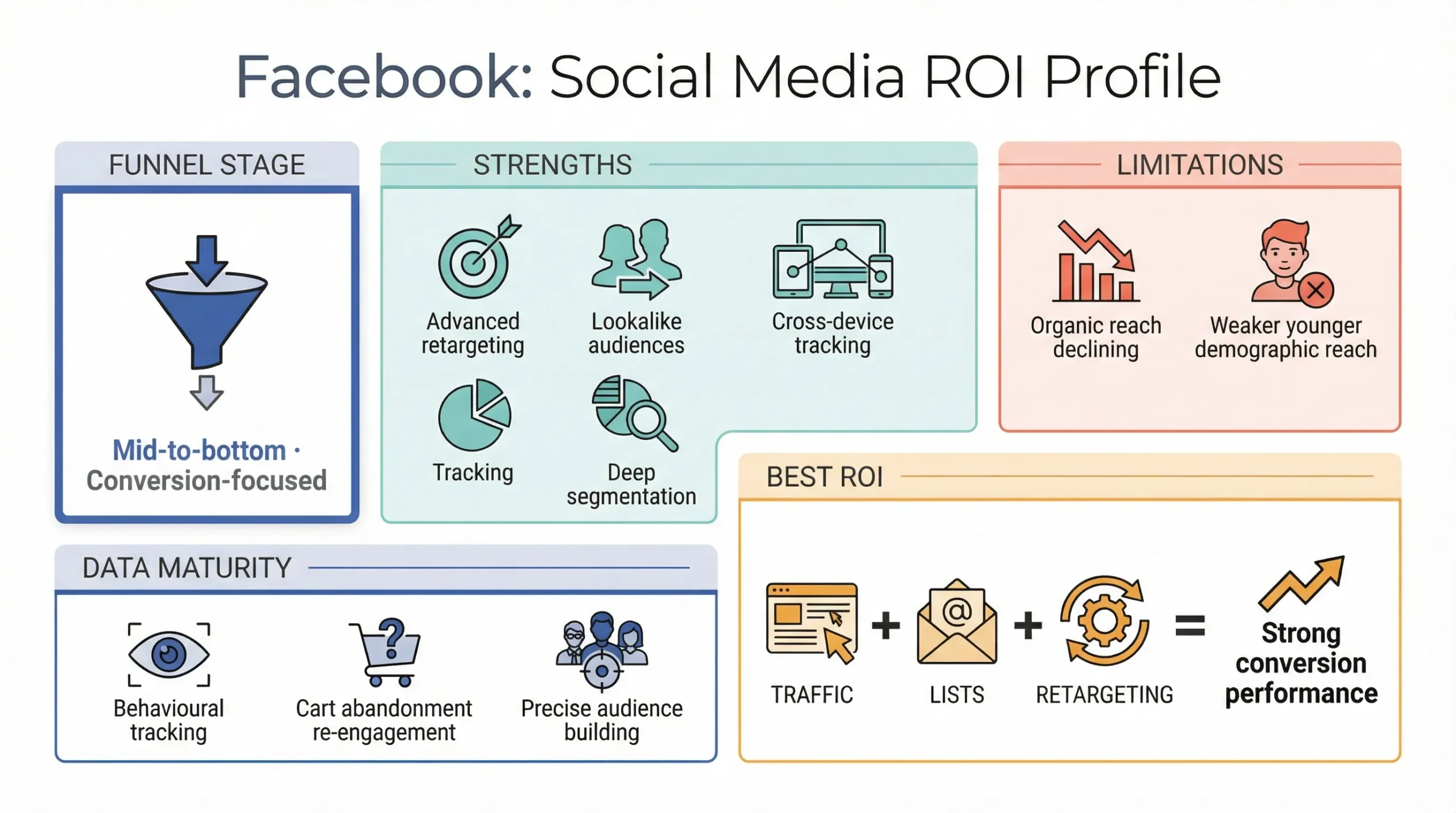
Facebook remains one of the most powerful social media platforms for mid- to bottom-of-funnel performance. While organic reach has declined, its advertising infrastructure within the Meta ecosystem makes it structurally strong for revenue-driven campaigns.
Facebook’s strength lies in its data maturity. Years of behavioural tracking enable advertisers to build precise lookalike audiences, retarget website visitors, and re-engage users who abandoned their carts. For businesses already generating traffic, Facebook often becomes the primary conversion engine.
Strengths
- Advanced retargeting capabilities
- Strong mid-to-bottom funnel conversion performance
- Cross-device tracking across Facebook, Instagram, and Messenger
- Detailed audience segmentation
Limitations
- Declining organic reach
- Reduced dominance among younger demographics
Best ROI Use Case
Businesses with existing website traffic, email lists, or funnel infrastructure typically see strong ROI through retargeting and conversion-focused campaigns.
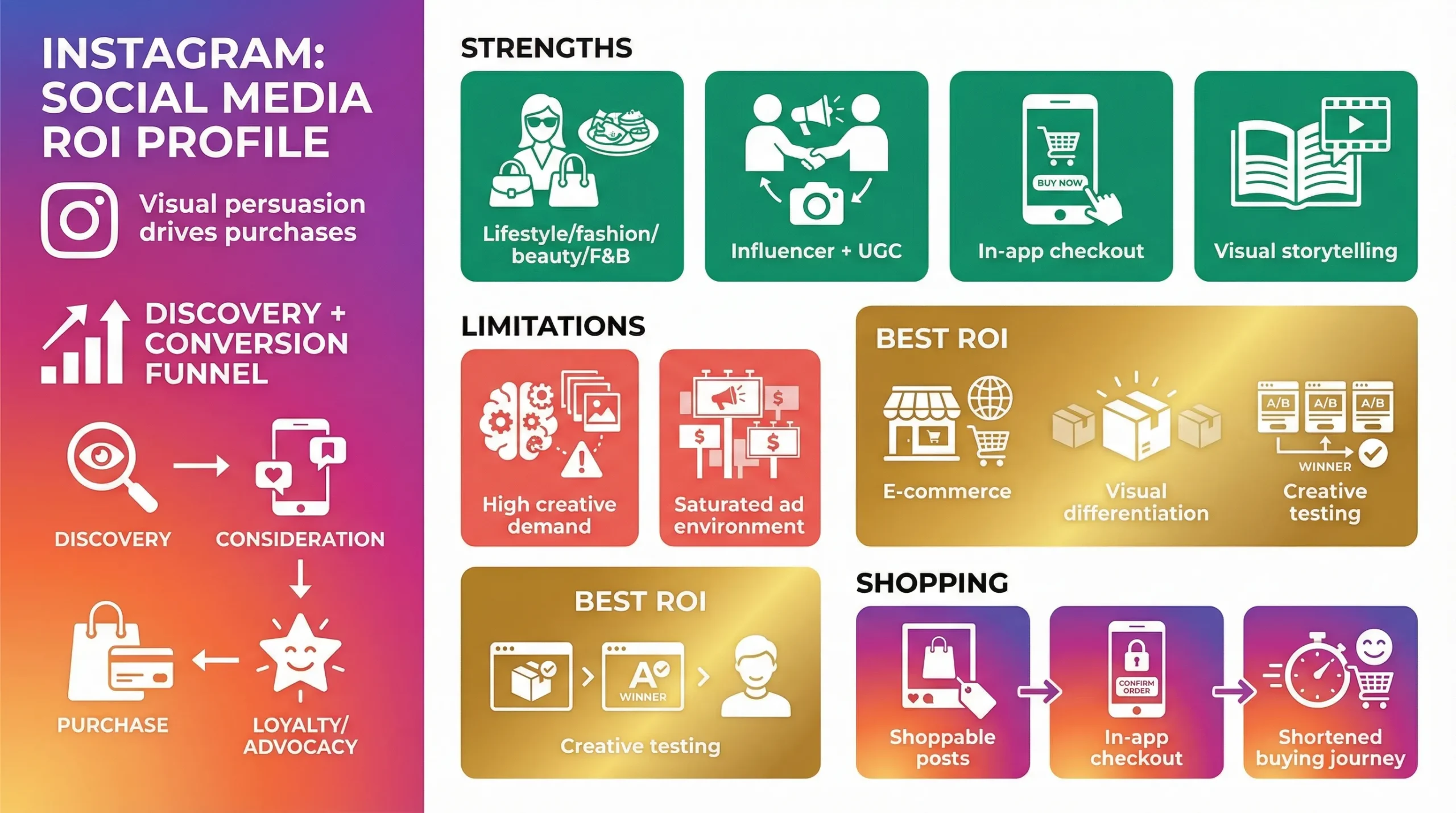
Instagram thrives on visual persuasion and lifestyle positioning. It is particularly powerful for product-led businesses where emotional appeal drives purchasing decisions.
Instagram blends discovery with direct shopping. Features such as in-app checkout, shoppable posts, and influencer collaboration shorten the buying journey. For brands with strong creative direction, Instagram functions as both an awareness and conversion channel.
Strengths
- High engagement in lifestyle, fashion, beauty, and F&B sectors
- Strong influencer and user-generated content ecosystem
- Integrated shopping features
- Visual storytelling capability
Limitations
- High creative production demand
- Competitive ad environment in saturated industries
Best ROI Use Case
E-commerce brands with strong visual differentiation and consistent creative testing see measurable returns.
TikTok
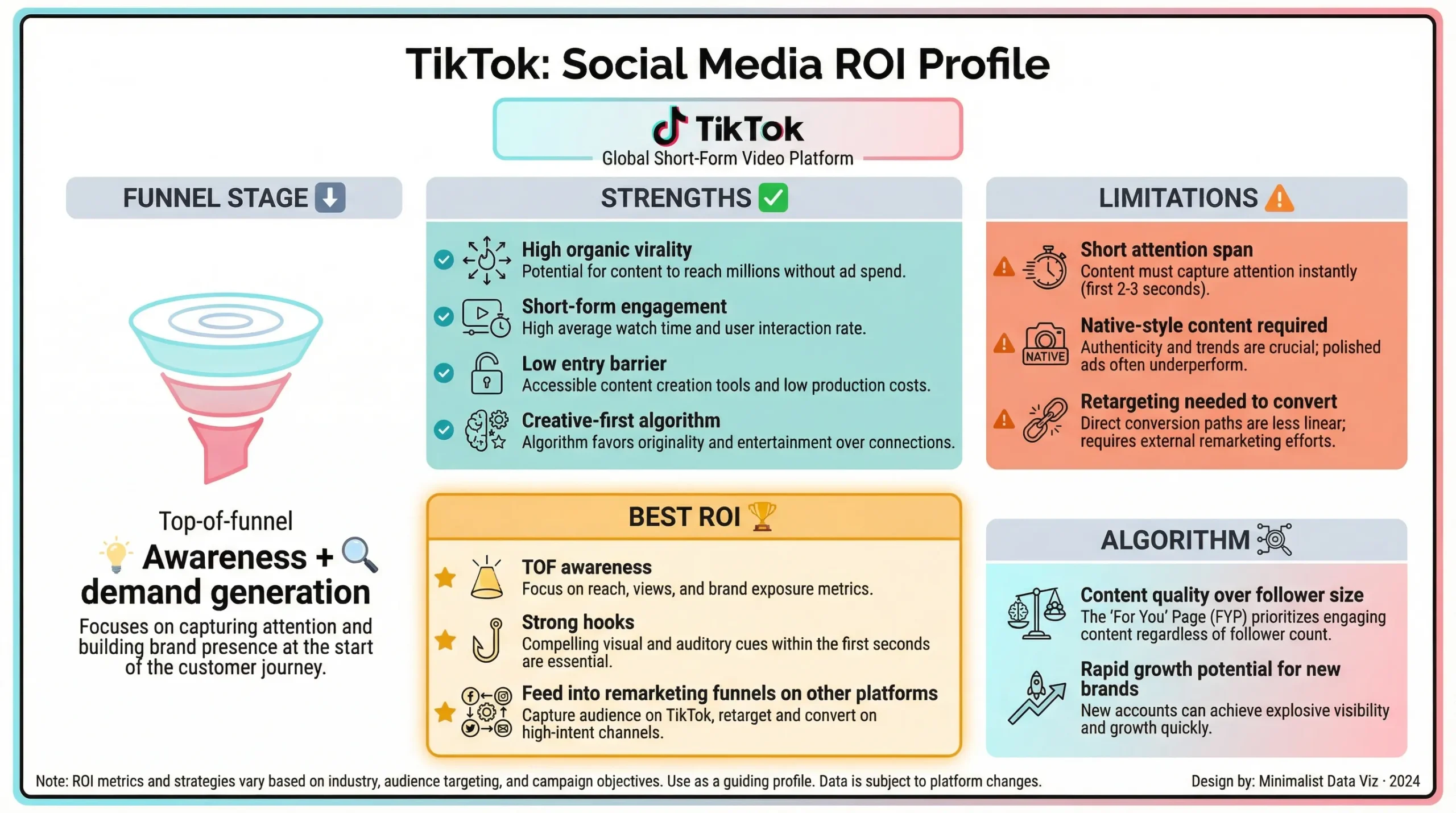
TikTok has shifted from an experimental platform to a serious acquisition channel. Its algorithm prioritises content quality over follower size, allowing rapid organic growth for well-crafted videos.
TikTok excels at attention capture. It introduces brands to audiences at scale through short-form storytelling. While conversion intent may initially be lower, TikTok is highly effective at fuelling upper-funnel demand that can later be converted through retargeting on other social media platforms.
Strengths
- High organic virality potential
- Strong engagement for short-form content
- Lower entry barrier for new brands
- Creative-first algorithm
Limitations
- Short user attention span
- Requires native-style content adaptation
- May need retargeting to close conversions
Best ROI Use Case: Top-of-funnel awareness campaigns with strong hooks that feed into structured remarketing funnels.
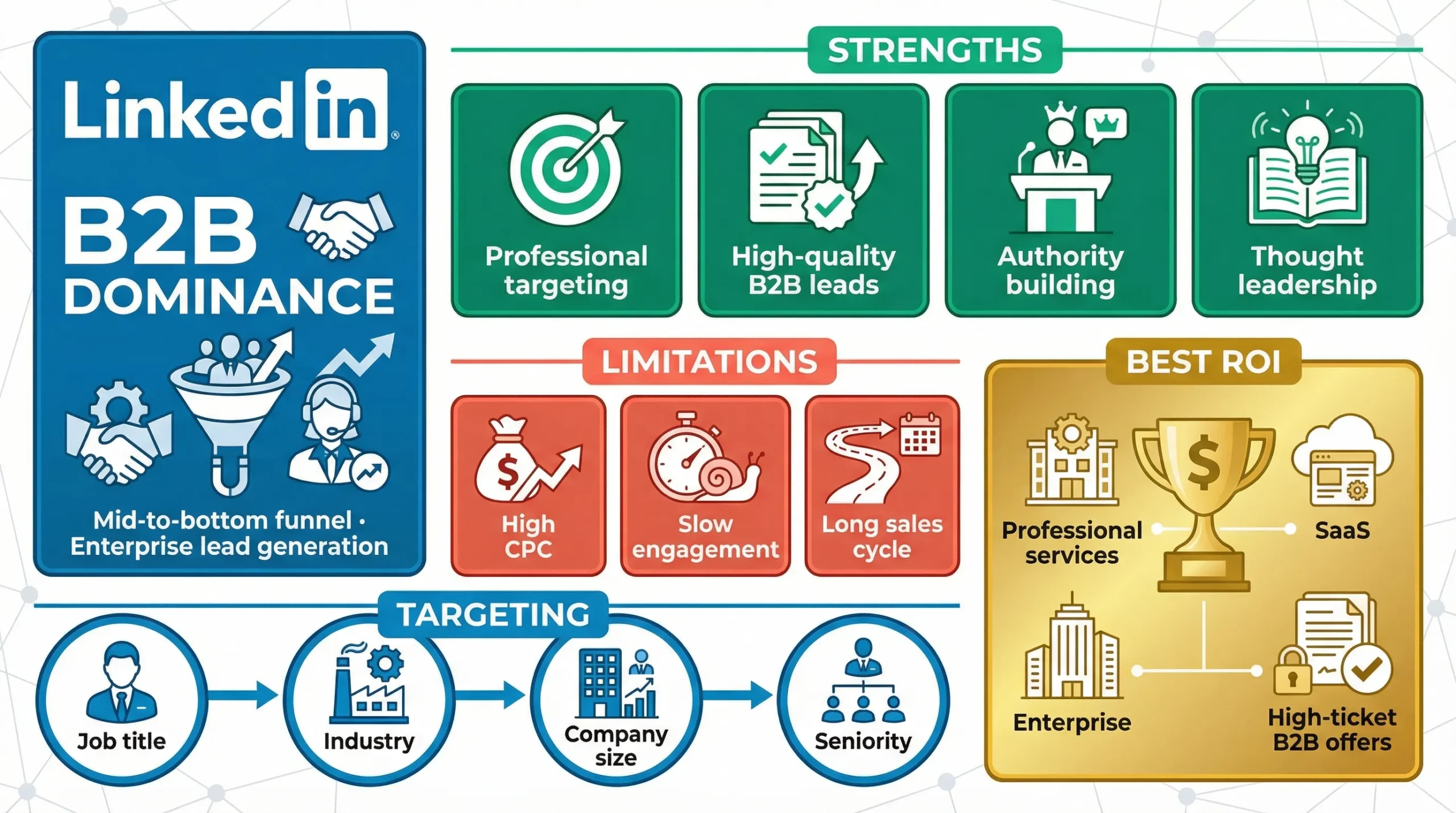
LinkedIn dominates B2B marketing among social media platforms. Although advertising costs are typically higher, lead quality often offsets cost concerns.
LinkedIn allows targeting based on job title, industry, company size, and seniority. This precision makes it highly effective for high-value services and enterprise solutions, where a single conversion can justify significant ad spend.
Strengths
- Professional targeting filters
- High-quality B2B lead generation
- Authority-building environment
- Strong thought leadership ecosystem
Limitations
- Higher CPC compared to other platforms
- Slower engagement cycles
- Longer sales funnel
Best ROI Use Case: Professional services, SaaS, enterprise solutions, and high-ticket B2B offers.
YouTube
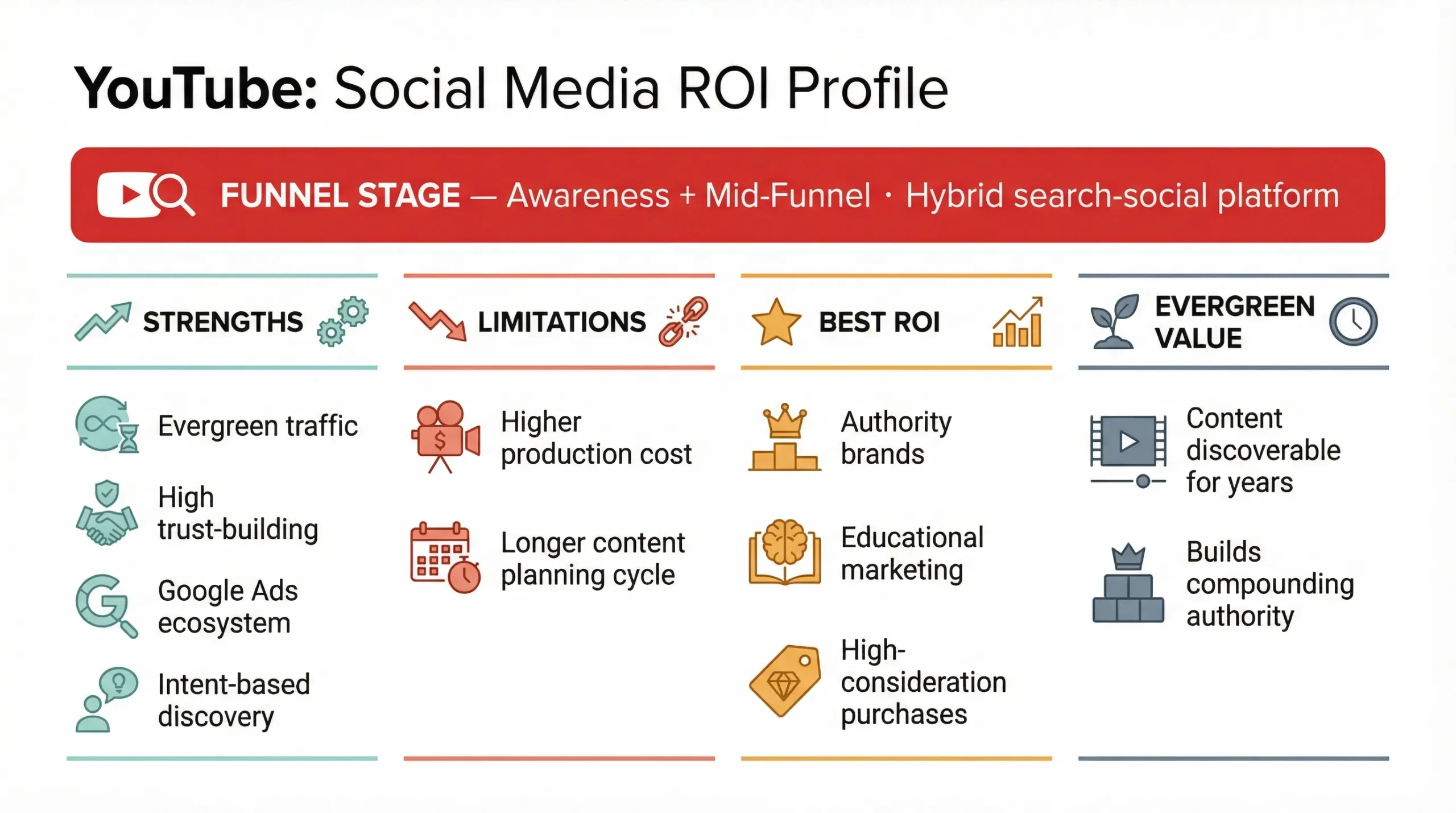
YouTube operates as both a search engine and a social media platform. Its hybrid nature provides unique long-term ROI potential.
YouTube content remains discoverable for years, unlike short-lived social posts. Educational videos, product demos, and explainers build trust and authority over time. Combined with Google Ads retargeting, YouTube supports both awareness and mid-funnel nurturing.
Strengths
- Evergreen traffic potential
- High trust-building capability
- Integration with the Google Ads ecosystem
- Strong intent-based discovery
Limitations
- Higher production cost
- Longer content planning cycle
Best ROI Use Case: Authority-driven brands, educational marketing, and high-consideration purchases.
X (formerly Twitter)
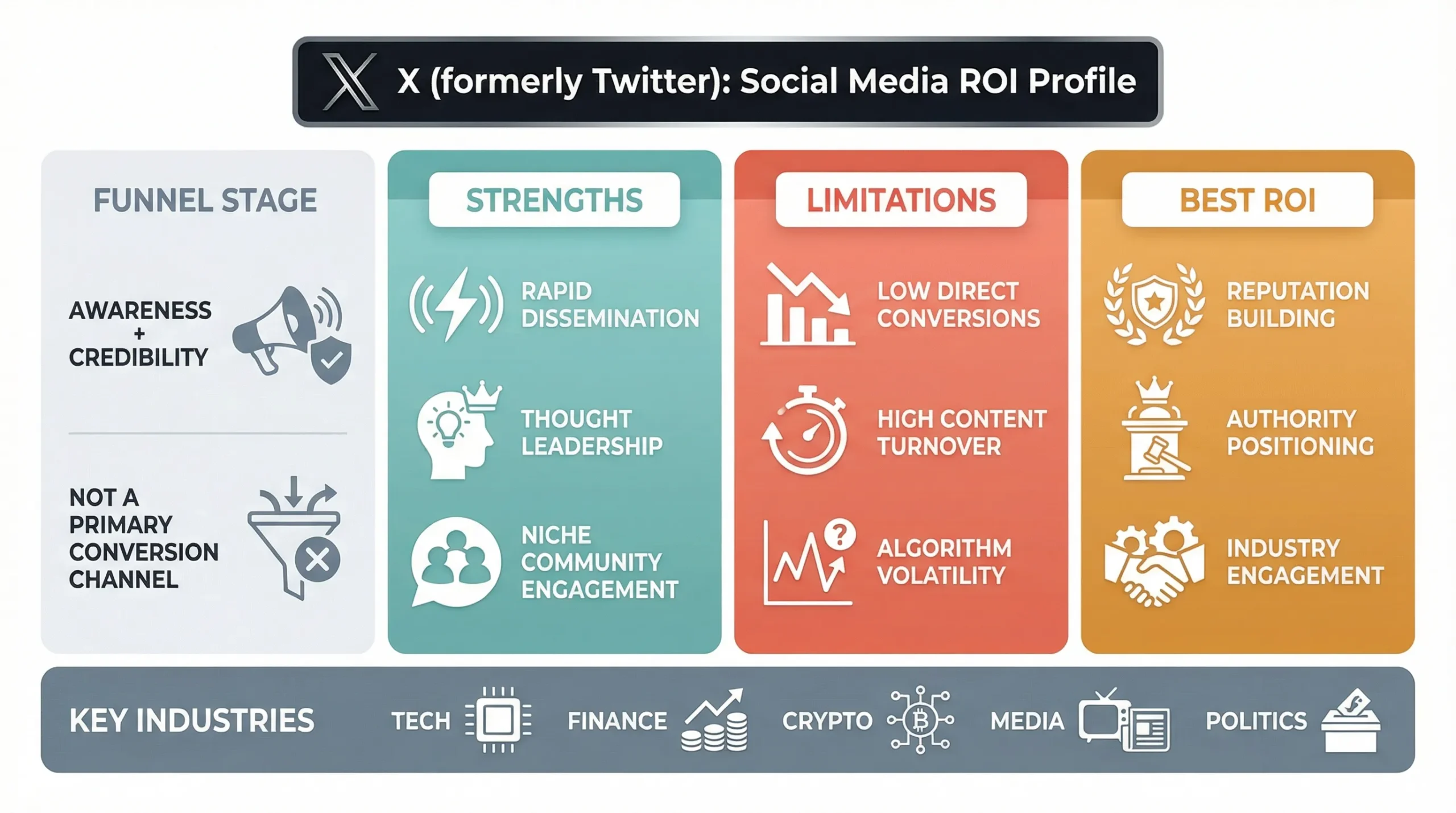
X remains relevant for real-time commentary and niche communities. While it may not always drive direct sales, it plays a strategic role in influence positioning.
For industries such as tech, finance, crypto, media, and politics, X acts as a credibility amplifier. It supports brand voice, thought leadership, and rapid dissemination of updates.
Strengths
- Rapid information dissemination
- Industry thought leadership
- Active niche communities
Limitations
- Lower direct conversion rates
- High content turnover
- Algorithm volatility
Best ROI Use Case: Reputation building, authority positioning, and industry engagement.
ROI Comparison Table of Social Media Platforms
Here is a table for quick comparison of the following top social media platforms:
| Platform | CPC Level | Conversion Intent | Organic Growth | Best For | Funnel Strength |
| Low–Medium | Medium–High | Medium | Retargeting & Local | Mid–Bottom | |
| Medium | Medium | Medium | E-commerce | Top–Mid | |
| TikTok | Low–Medium | Low–Medium | High | Awareness | Top |
| High | High | Low | B2B Lead Gen | Mid–Bottom | |
| YouTube | Medium | Medium–High | Medium | Authority | Top–Mid |
| X | Medium | Low | Medium | Thought Leadership | Top |
ROI depends more on funnel integration, creative quality, and audience alignment than on platform popularity. The most profitable brands do not rely on a single platform; they assign each channel a defined funnel role and measure contribution systematically.
Which Social Media Platform Is Best for Your Business Type?
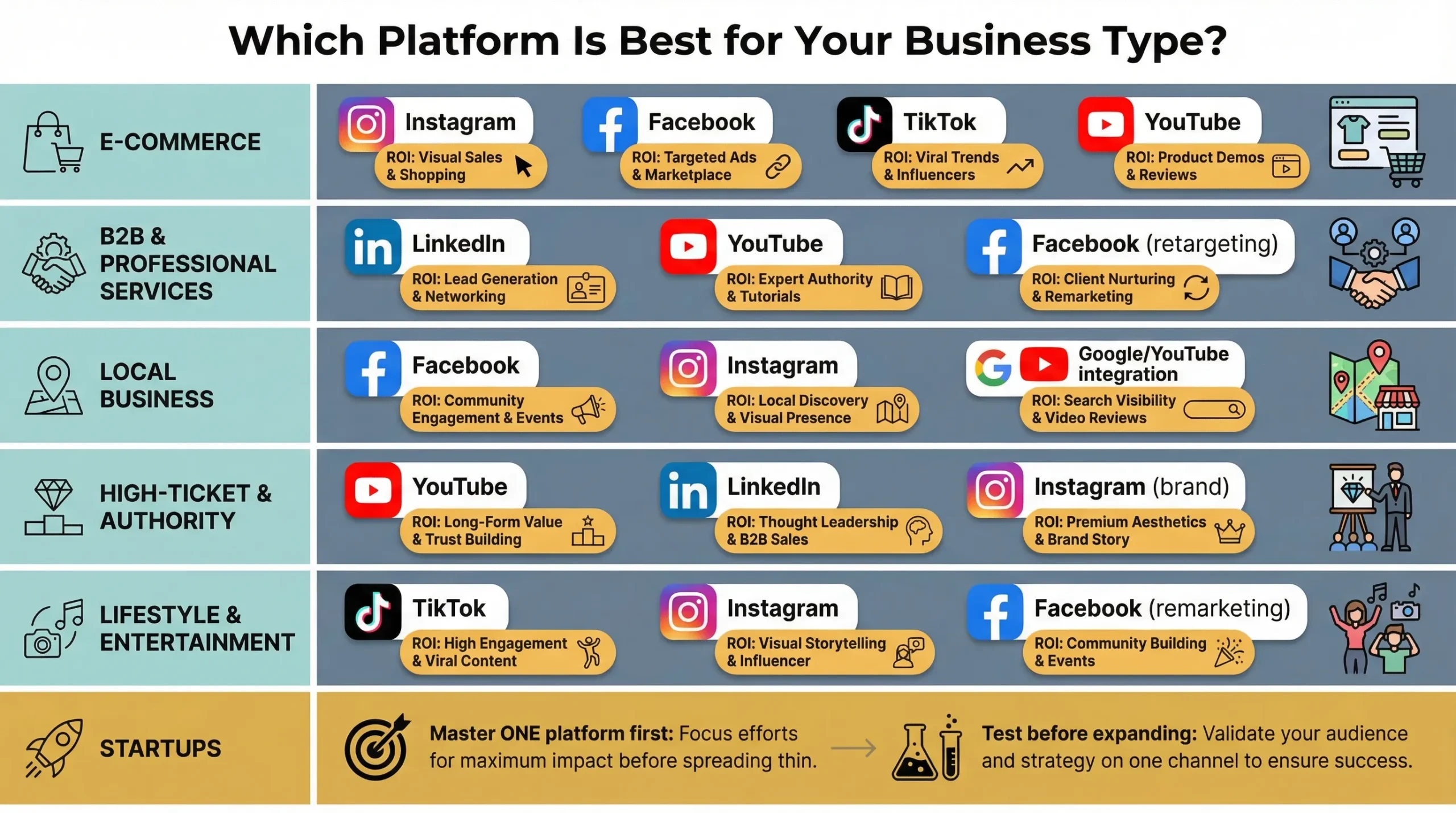
Choosing a social media platform should never be based solely on popularity. The correct platform depends on your business model, sales cycle length, customer lifetime value, creative capability, and budget tolerance.
Below is a structured breakdown by business type, with the ROI rationale for each recommendation.
1. E-Commerce Brands
Best Platforms: Instagram, Facebook, TikTok
Supporting Channel: YouTube (for reviews and demos)
E-commerce businesses benefit from visually driven platforms that shorten the path between discovery and purchase. Instagram supports product tagging and in-app checkout, while Facebook excels at retargeting abandoned carts. TikTok generates top-of-funnel attention quickly, especially when creative content resonates.
ROI improves when TikTok fuels awareness, Instagram nurtures interest, and Facebook retargets visitors to close conversions. For higher-priced products, YouTube can help build trust through detailed product demonstrations and testimonials.
2. B2B & Professional Services
Best Platforms: LinkedIn, YouTube
Supporting Channel: Facebook (retargeting)
B2B buyers require trust, authority, and educational content. LinkedIn enables precise targeting by job role, seniority, and company size, making it effective for lead generation. Although CPC is higher, the deal value often justifies the investment.
YouTube strengthens ROI through long-form education, webinars, and explainer videos that influence decision-making over extended sales cycles. Facebook can then retarget visitors who engage with content.
ROI in B2B is less about immediate conversion and more about lead quality and long-term contract value.
3. Local Businesses
Best Platforms: Facebook, Instagram
Supporting Channel: Google/YouTube integration
Local businesses benefit from geo-targeting features and community engagement. Facebook ads allow radius-based targeting, while Instagram supports location-based discovery and visual engagement.
For restaurants, clinics, gyms, and retail outlets, consistent retargeting campaigns combined with promotional offers often drive measurable ROI. Integration with Google ecosystem platforms enhances conversion probability.
4. High-Ticket & Authority-Based Brands
Best Platforms: YouTube, LinkedIn
Supporting Channel: Instagram (brand reinforcement)
Brands selling high-value services or products require credibility before conversion. YouTube provides long-form educational authority that builds trust, while LinkedIn supports professional positioning and executive targeting.
ROI is driven by depth of engagement rather than click volume. Educational content, case studies, and thought leadership content significantly influence long-term purchasing decisions.
5. Consumer Lifestyle & Entertainment Brands
Best Platforms: TikTok, Instagram
Supporting Channel: Facebook for remarketing
Lifestyle brands thrive on short-form storytelling and visual impact. TikTok drives awareness rapidly, while Instagram reinforces brand identity through curated aesthetics and influencer partnerships.
ROI improves when viral content is supported by structured paid retargeting campaigns that convert attention into sales.
6. Startups with Limited Budgets
Best Approach: Master One Platform First
Instead of spreading resources thinly across multiple social media platforms, startups often achieve stronger ROI by focusing on a single channel aligned with audience behaviour. Testing and optimising a single platform thoroughly yields clearer performance data and prevents budget fragmentation.
Strategic Insight
There is no universally superior platform. The best ROI emerges when:
- Platform behaviour aligns with customer intent.
- Creative format matches user expectations.
- Paid strategy integrates with the funnel structure.
- Performance is measured beyond vanity metrics.
Businesses that approach platform selection strategically rather than reactively consistently achieve stronger returns. Working with a structured social media marketing agency ensures platform choice aligns with revenue objectives, not trends.
Common Mistakes When Choosing Social Media Platforms
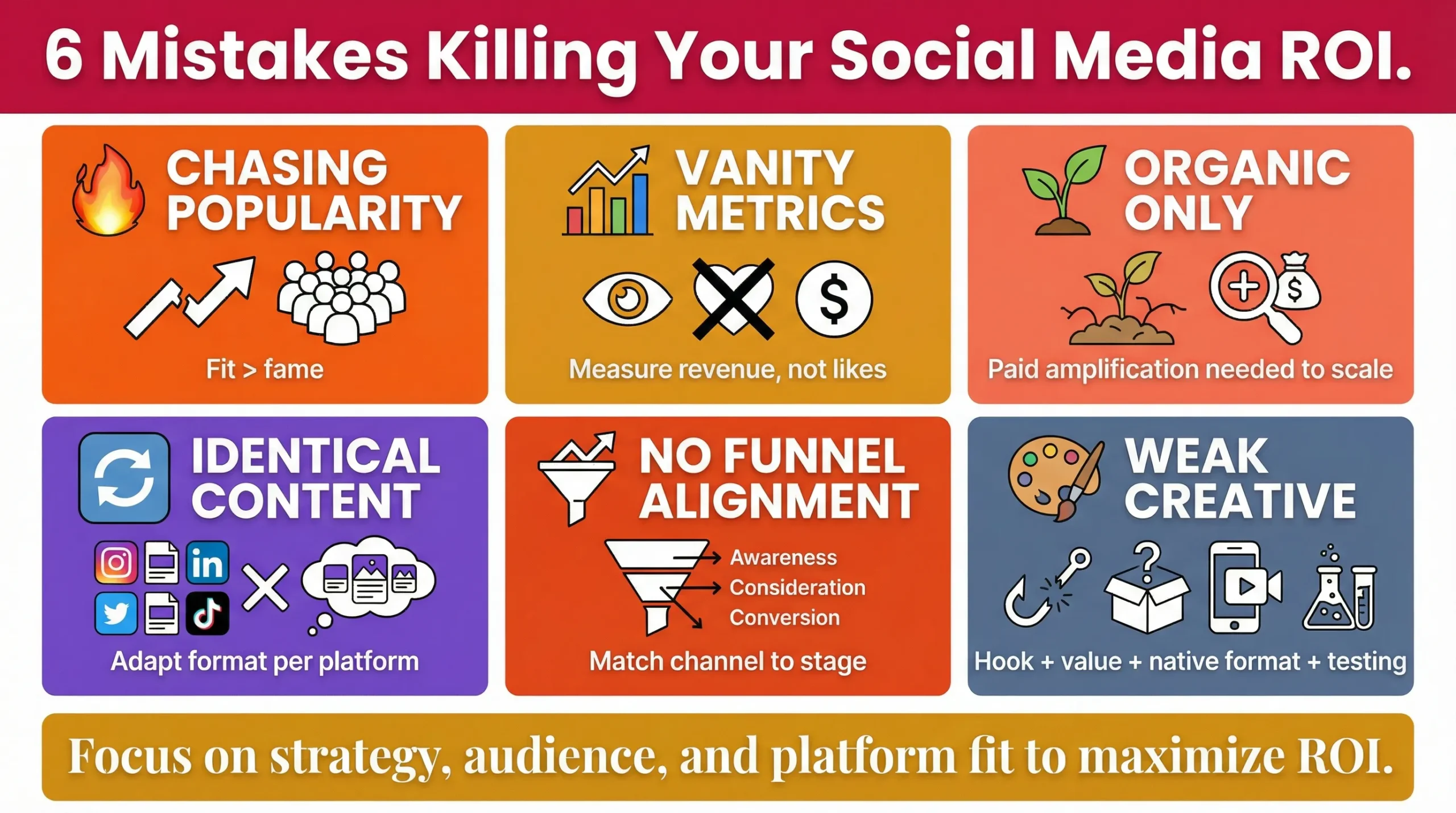
Choosing the right social media platforms is a strategic decision. Yet many businesses approach it reactively, driven by trends, competitor activity, or internal preference rather than data. Below are the most common mistakes that reduce ROI and how to avoid them.
- Chasing Popularity Instead of Audience Fit: Many businesses ask, “Which platform is trending?” instead of “Where does my customer spend time in buying mode?” A platform with high global user numbers does not automatically translate to a strong ROI for your specific offer.
- For example, TikTok may generate massive reach, but if your target audience consists of senior decision-makers in enterprise companies, LinkedIn may produce stronger results despite higher costs. Platform choice must align with customer intent and decision-making context.
- Measuring Vanity Metrics Instead of Revenue: High likes, views, and follower counts can create a false sense of success. These metrics measure visibility, not profitability. ROI should be evaluated based on:
- Cost per acquisition
- Conversion rate
- Revenue generated
- Customer lifetime value
- Businesses that prioritise engagement metrics without tracking revenue often misallocate budgets across social media platforms.
- Relying Too Heavily on Organic Reach: Organic content builds credibility and trust, but it rarely scales predictably in competitive markets. Algorithms increasingly prioritise paid distribution, limiting the growth potential of organic-only strategies. Without paid amplification and retargeting integration, many brands struggle to convert attention into measurable revenue.
- Using Identical Content Across All Platforms: Each platform has distinct content norms and behavioural expectations. Posting identical content across Instagram, TikTok, LinkedIn, and Facebook reduces effectiveness.
- LinkedIn favours an insight-driven, professional tone.
- TikTok rewards short, dynamic, native-style videos.
- Instagram prioritises strong visual storytelling.
- YouTube requires structured, long-form value delivery.
- Adapting content format to platform behaviour significantly improves engagement and conversion probability.
- Ignoring Funnel Alignment: Not all social media platforms serve the same funnel stage. TikTok often performs well in awareness, while Facebook retargeting drives mid- to bottom-of-funnel conversions. Businesses that expect every platform to convert directly may prematurely abandon effective awareness channels. Strategic integration across funnel stages maximises cumulative ROI.
- Underestimating Creative Quality: Algorithms reward content that holds attention. Weak creative execution reduces reach and inflates cost per click. High-performing campaigns typically invest in:
- Strong hooks within the first 3 seconds
- Clear value propositions
- Platform-native storytelling
- Continuous creative testing
- Creative quality often determines performance more than targeting precision alone.
The most costly mistakes stem from misalignment between platform behaviour and audience intent, between metrics and revenue, and between creative format and algorithm expectations.
Selecting social media platforms strategically requires structured analysis, testing discipline, and performance measurement beyond surface-level engagement.
How to Calculate ROI on Social Media Platforms
Calculating ROI on social media platforms requires more than tracking likes or impressions. To determine whether a platform is truly profitable, you must measure revenue against total investment and evaluate performance within the context of your sales funnel.
Below is a structured, practical framework.
Step 1: Define What “Return” Means for Your Business
Return is not always immediate sales. Depending on your model, return may include:
- Direct e-commerce revenue
- Qualified leads generated
- Booked consultations
- App installs
- Customer lifetime value growth
Clarify whether you are measuring short-term revenue or long-term pipeline contribution before calculating ROI.
Step 2: Track Attributable Revenue
To calculate ROI accurately, you must track conversions through:
- Meta Pixel (Facebook & Instagram)
- TikTok Pixel
- LinkedIn Insight Tag
- Google Ads / YouTube tracking
- CRM integrations
Revenue attribution should capture:
- Direct conversions
- Assisted conversions
- Retargeting influence
Without conversion tracking, ROI calculations become guesswork.
Step 3: Calculate Total Investment
Include all associated costs, not just ad spend:
- Paid media spend
- Creative production (video, design, copywriting)
- Agency or internal management fees
- Software tools
Many businesses underestimate cost by excluding creative and management time, leading to inflated ROI assumptions.
Step 4: Apply the ROI Formula
The standard ROI formula is:
ROI=Revenue – Total CostTotal Cost×100\textbf{ROI} = \frac{\text{Revenue – Total Cost}}{\text{Total Cost}} \times 100ROI=Total CostRevenue – Total Cost×100
For example:
- Revenue generated: S$50,000
- Total campaign cost: S$10,000
ROI = (50,000 – 10,000) ÷ 10,000 × 100 = 400%
This means every S$1 invested returned S$4 in profit.
Step 5: Evaluate Cost Per Acquisition (CPA)
CPA provides deeper insight than ROI alone.
CPA=Total Ad SpendNumber of Conversions\textbf{CPA} = \frac{\text{Total Ad Spend}}{\text{Number of Conversions}}CPA=Number of ConversionsTotal Ad Spend
If your CPA is lower than your average profit per customer, the platform is profitable. If it exceeds lifetime value, ROI will decline over time.
Step 6: Factor in Customer Lifetime Value (LTV)
For subscription businesses or B2B services, initial revenue may not reflect full value.
Example:
- CPA = S$200
- Average customer LTV = S$2,000
Even if upfront revenue is small, long-term ROI remains strong.
Platforms like LinkedIn often appear expensive on CPC metrics but deliver high ROI because their customers have higher LTV.
Step 7: Consider Funnel Contribution
Not all social media platforms convert directly.
- TikTok may drive awareness.
- Instagram may nurture interest.
- Facebook retargeting may close the sale.
Multi-touch attribution models provide a more accurate view of ROI than last-click tracking.
Turn Social Media Platforms Into Measurable Revenue Channels
There is no universal winner among social media platforms; there is only alignment or misalignment. The businesses that achieve consistent ROI are not the ones chasing viral moments; they are the ones that match platform behaviour to buyer intent, structure paid campaigns strategically, and measure performance beyond vanity metrics.
Social media is about precision. When platform choice, creative execution, and funnel integration work together, social media becomes a scalable revenue channel rather than a marketing expense.
If you want to move beyond experimentation and build a structured, ROI-driven strategy, partnering with an experienced social media marketing agency like MediaOne ensures your social media platforms are selected, optimised, and scaled with measurable growth as the objective, not guesswork. Contact us today!
Frequently Asked Questions
ROI timelines vary depending on industry and funnel structure. E-commerce campaigns may show measurable signals within 4–6 weeks, while B2B or high-ticket services often require 2–3 months of structured testing before consistent returns emerge.
No. Budget allocation should reflect platform performance data, audience intent, and funnel role. Higher-performing channels should receive scaled investment, while underperforming ones should be optimised or paused.
Both can be effective, but they serve different purposes. Paid ads offer controlled targeting and predictable scaling, while influencer marketing strengthens trust and brand perception, particularly in lifestyle and consumer sectors.
Yes. Platforms such as YouTube and LinkedIn support authority building and thought leadership, which contribute to long-term trust and customer lifetime value beyond immediate campaign returns.
How often should businesses review platform performance?
Performance should be reviewed weekly for active campaigns and monthly for strategic adjustments. Continuous optimisation is essential because algorithms, audience behaviour, and competitive activity change frequently.