Key Takeaways
- ChatGPT ads are not yet self-serve for Singapore agencies, so confirm your access route first.
- Score your readiness on five checks and hold your advertising budget below 6 out of 10.
- Install first-party pixel and server-side attribution now, so bookings can be measured from the first click.
- Map buyer scenarios to specific prompts, such as Singapore-departure trips, rather than to keywords.
- Judge your chatgpt ads for travel agency campaign on cost per booking and ROAS, not clicks alone.
- Weigh in-house against a managed plan, with our Starter plan from $850/month as a reference.
Table of Contents
Can a Singapore Travel Agency Run ChatGPT Ads Today?
Self-serve ChatGPT ads are not yet open to Singapore businesses, so the real decision is whether your agency will be ready when access arrives. Most agencies should spend the coming months on tracking, landing pages and buyer-scenario content. A paid campaign launched without those in place will burn budget before it shows a return.
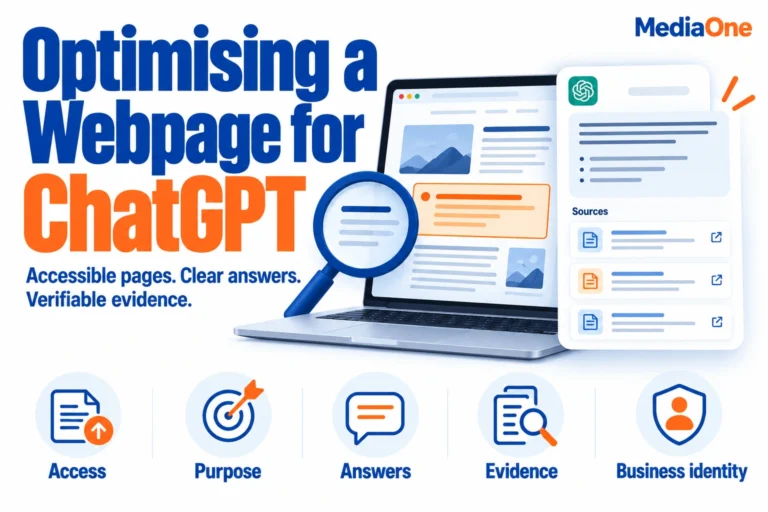
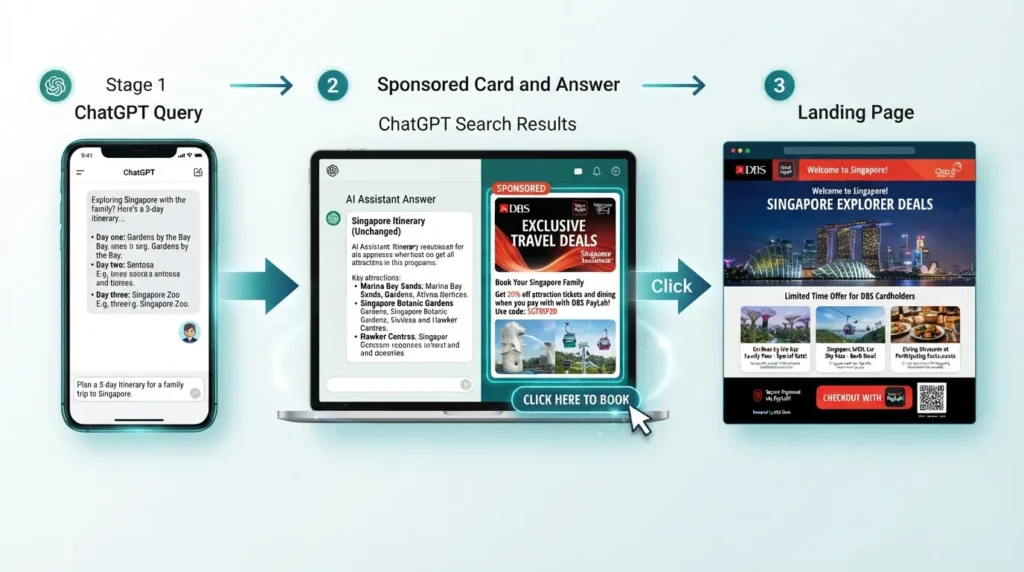
ChatGPT ads are sponsored cards beside the assistant’s answer, each with a headline, description, image and link. The answer itself is not altered. OpenAI launched the format in February 2026 for Free and lower-tier users in the United States, and it has since expanded to Canada, Australia, New Zealand and the United Kingdom.
For Singapore, self-serve access is open in the GCC, but no confirmed date has been set. Until then, campaigns can run only through a US-registered entity or a partner able to operate the account. Treat that as a bridge, not a permanent setup.
Travel suits the format because roughly 20% of ChatGPT conversations carry shopping or commercial intent, and OpenAI names travel alongside retail and beauty. Travellers already research destinations and itineraries there, which makes it a natural channel for travel marketing.
How ChatGPT Ad Auctions, Placement and Targeting Work
The ad auction ranks bids against relevance, so a well-matched card can win placement without the highest bid. Advertisers choose between CPM, oCPC and oCPM bidding, based on current OpenAI documentation, which may change. CPM charges per thousand impressions. oCPM and oCPC optimise toward a conversion goal, which suits online travel buyers when bookings matter more than reach. For most travel agencies, start with CPM or a simple click-based goal, because a new paid campaign has too few bookings for conversion optimisation to learn from. Move to conversion bidding once cost per booking is stable.
Matching the Travel Prompt, Not the Profile
Targeting works on intent, not on a demographic profile. A user asking for a three-day Phuket itinerary from Singapore sends a clear signal, and that prompt is what your advertising card competes to match. A user who has asked for a plan in a conversation is close to a decision.
Campaign Types for a Travel Business
- Brand awareness puts your agency’s name in front of planners during early research on hotels and destinations.
- Product recommendation promotes a specific package, such as a Japan autumn tour or a Bali family trip.
- Enquiry or booking drive sends clicks to an enquiry form or booking page. Judge this type of ChatGPT ads campaign by bookings.
Setting Up a ChatGPT Ad Campaign Step by Step
Before spending anything, run every prospective client through a five-part readiness scorecard. Score each part 0 to 2:
| Readiness Check | Score 0 | Score 1 | Score 2 |
|---|---|---|---|
| Access | No US-registered entity or partner | Route identified, not yet confirmed | Route confirmed and account eligible |
| Tracking | No pixel or attribution | Pixel installed, bookings not reconciled | Pixel and server-side attribution reconciled weekly |
| Buyer scenarios | No mapped travel prompts | Some prompts mapped, not tested | Scenarios mapped to specific prompts and packages |
| Landing pages | Generic homepage only | Some package pages | Each ad lands on a matching page with dates and price |
| Unit economics | No break-even figure | Break-even estimated | Break-even per booking agreed and tested |
An agency scoring under 6 out of 10 should not spend money yet. A total below 6 usually means access or tracking is still at zero, and without a confirmed route and reconciled bookings, no later spend can be measured. For travel brands and hotels, this check matters most, because a booking-driven campaign that cannot be tracked to a booking has no measurable result.
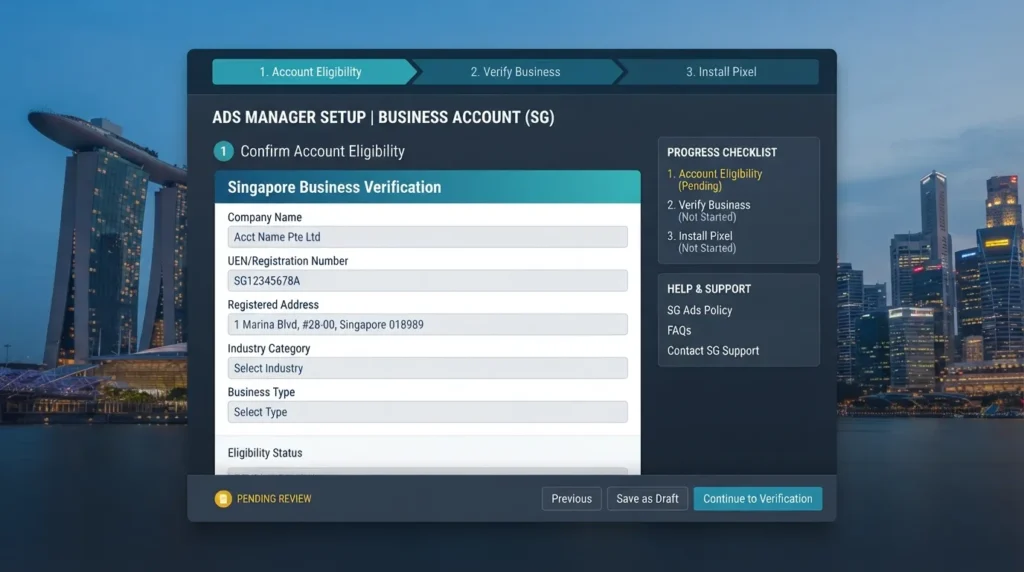
Step 1: Confirm eligibility and the account route. Self-serve ChatGPT ads are open in the GCC, but Singapore availability has not been confirmed. Until it opens, a campaign can only run through a US-registered entity or a partner able to operate the account. Expected output: a named route and written confirmation of eligibility.
Step 2: Set up and verify the account in Ads Manager. Create the advertiser account and complete verification. Start early, as verification must be done before launch.
Step 3: Install the first-party pixel and server-side attribution. OpenAI provides both for conversion tracking. Expected output: the pixel firing on test bookings and attribution reaching your booking system. Without them, you cannot tell which clicks became bookings, and a business cannot judge whether the channel for travel is paying off.
Step 4: Define buyer scenarios and choose the campaign type. Map each package to a specific travel prompt, such as “family itinerary to Bali from Singapore in June,” so that when a user starts a conversation about a trip, your ad answers the question they are asking. Pick brand awareness, product recommendation or enquiry-driving to match each scenario.
Step 5: Write creative around destinations and trip types. Expected output: a headline, description, image and link for each scenario. State prices and deals accurately.
Step 6: Set budget and bidding. Some reports cite a minimum daily spend of about ₹725 for self-service ads in India. Treat this as a figure to verify with OpenAI, not a Singapore rate. Size your test budget from your own margin per booking: divide your planned test spend by your maximum cost per booking to get the bookings it must produce. Expected output: a daily cap and a cost ceiling per booking, both written down before launch.
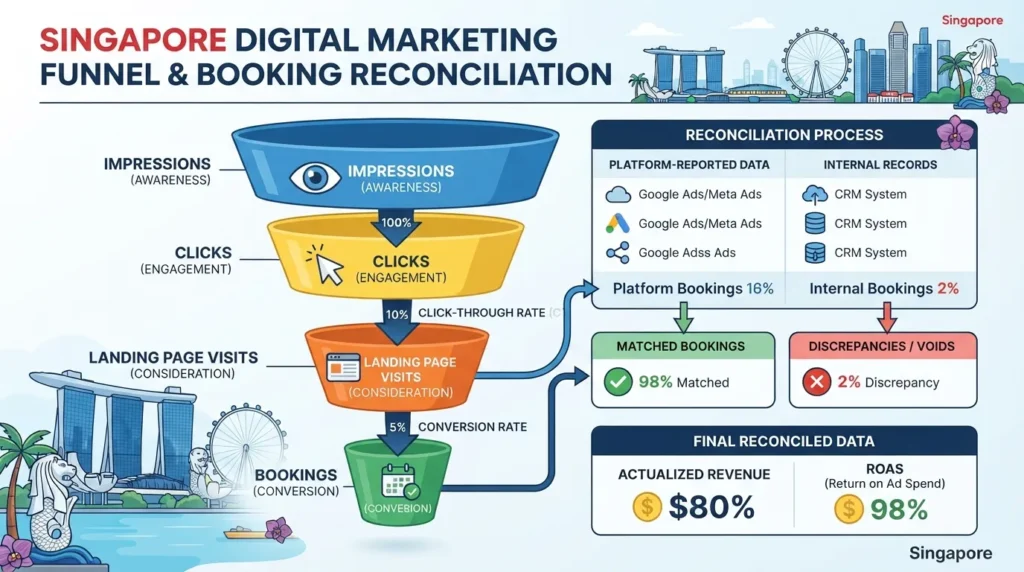
Step 7: Launch and read the metrics. Track CTR, conversion rate and ROAS. For example, 30 clicks from 1,000 impressions gives a 3% CTR. Expected output: a weekly report comparing platform-reported bookings with your own records and your Google Analytics data for the same period, so the results can be checked against Google and Meta reporting. For a broader view, see our digital marketing services.
Converting Clicks into Bookings: Landing Pages, CTAs and Measurement
A click is only worth paying for if it reaches a page that matches what the traveller asked. Each ad should land on a page that repeats the destination and offer named in the ad. If the ad promises a five-day Bali package, the visitor should see that package, its dates and its price within one screen. For a travel agency running paid campaigns, this match is what turns a click into a booking.
Calls to action should match the research stage. Most travellers using an assistant are still comparing, so “Compare this itinerary” or “Download the day-by-day plan” often works better than “Book now”. Keep a firm booking CTA for pages where price and dates are fixed.
Track the whole path, not just the click. Connect OpenAI’s first-party pixel and server-side attribution to your booking system, then reconcile reported bookings against your own records each week. Gaps usually point to tracking or form problems, not a weak channel.
Can a Singapore travel agency run ChatGPT ads today?
Self-serve access is open in the GCC, but it is not yet confirmed for Singapore. Meanwhile, build tracking and landing pages, so access is the only thing left to switch on.
Do ChatGPT ads change the answer the assistant gives?
No. Each ad appears as a headline, short description, image and link beside the answer, and the answer itself stays unchanged. Write creative that matches the destination the traveller is already exploring.
How do I measure whether ChatGPT ads bring bookings?
Track the full path from click to confirmed booking. Install OpenAI’s first-party pixel and server-side attribution, then compare platform reports with your own booking records. Conversion rate is bookings divided by clicks, multiplied by 100. ROAS is attributed revenue divided by ad spend. Five bookings from 1,000 clicks gives a 0.5% conversion rate.
What should I budget for a first ChatGPT ad campaign?
Budget for the test, not the scale. Confirm any minimum spend with OpenAI before committing. Judge results against your break-even margin per booking, not the platform’s headline ROAS. Set the test budget to cover at least 30 clicks at your expected conversion rate.
Which travel products suit ChatGPT ads best?
Products with long research phases suit the format best, because travellers already ask the assistant to plan, compare and draft itineraries. Multi-destination packages, regional leisure trips and corporate itineraries fit well.
Conclusion
ChatGPT ads are a real travel channel, but access for Singapore agencies is not yet confirmed as self-serve. Run the readiness scorecard honestly. If you score under 6 out of 10, hold the budget and build tracking, landing pages and buyer-scenario content first. Start with the access route and the pixel, since they decide whether spend can be measured.
Sales note: our Starter, Growth and Enterprise plans start from $850, $1,245 and $3,550 a month. Confirm what each includes before you commit. To build this groundwork with a team, speak to our ChatGPT ads agency.