Is it worth putting budget into ChatGPT ads yet? For most Singapore e-retailers, the answer is a qualified yes, if you approach the channel differently from Google Ads or Meta. Ads appear inside a conversation, where the buyer has already described their need. That intent is valuable, but a careless setup wastes money quickly.
This guide sets out five readiness gates to show whether your business is ready to spend. It covers how ChatGPT ads work, account setup, bidding, budgets and measurement. The aim is a small, measured test before any larger commitment.
Key Takeaways
- ChatGPT ads opened to all US businesses on 5 May 2026 with no minimum spend, and reached more than 60 countries by 23 September 2026.
- Treat ChatGPT ads as a small, measured intent test, not a replacement for Google or Meta budgets.
- Some new accounts may advertise only at home until identity verification is approved.
- Set up the pixel or Conversions API and buyer scenarios before spending.
- Early reports put clicks at $3 to $5, so judge results over the 7-day average.
- Commit budget only when all five readiness gates pass.
Table of Contents
What ChatGPT Ads Are and Why Intent Differs
ChatGPT ads are paid placements shown inside conversations with ChatGPT. Users have often described their situation in detail, which gives advertisers a clearer read on purchase intent than a search keyword or a social feed. Ad units can show one or more items, so the format is closer to a product recommendation than a banner. For retailers, chatgpt ads for retail should be treated as a separate channel, not an extension of search, and the same best practices used for google ads do not transfer cleanly.
The rollout has moved quickly. Testing began in the United States on February 9, 2026, and the expansion to Southeast Asia and Taiwan by September 23, 2026 brought Singapore into scope. Singapore retailers are early entrants in the region, not the first movers.
For most Singapore retailers, ChatGPT ads are a measurement and intent-capture test, not a replacement for existing budgets. Early reports suggest clicks are priced around $3 to $5, though some advertisers report higher costs. A small, instrumented test answers the key question: do conversational buyers convert on your site at a cost you can justify? Teams that set up tracking before spending get a readable signal within a few weeks. Teams that copy feed-based creative tend to overpay for weak clicks.
How Ads Appear and How Ad Selection Works
ChatGPT ads sit alongside the answer rather than above a list of links. According to Scaleyai’s breakdown of ChatGPT ads, one ad unit can show one or more items, from one advertiser or several. For ecommerce retailers, a single unit can present a product set, so users see options while they explore and compare.
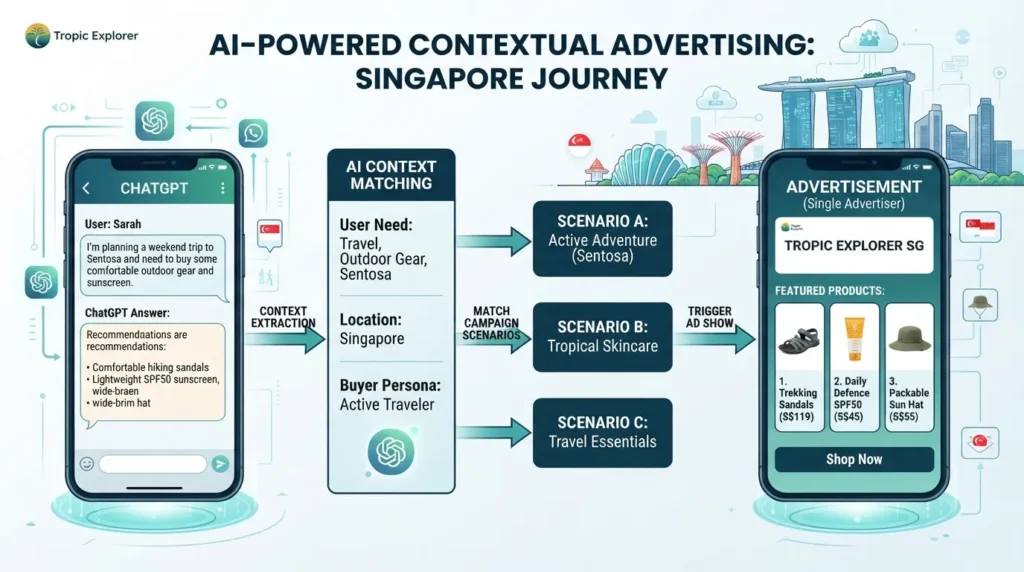
Selection follows the conversation. The model reads what the user is trying to do and matches that intent against advertiser context hints, which describe the buyer scenario a campaign targets. Advertisers do not bid on keywords as they would on Google Ads. Vague scenarios rarely earn delivery. “Shoes” is too broad, while “waterproof running shoes for a first trail race” gives the system something specific and relevant to match, signalling strong purchase intent.
Write advertising creative as a sentence a helpful assistant might say, not as a banner headline. Strong example: “For a first trail race, a grippy, waterproof running shoe with a firm heel is a sensible pick.” Weak example: “BIG SALE!!! Best shoes ever, buy now!!!” OpenAI says ad content should reflect the tone of the conversation, so sales-style banners will underperform. Avoid price claims that might change mid-campaign. Following these best practices keeps creative aligned with how ChatGPT’s answers are written.
If your catalogue is organised only by SKU, the system has less to work with. Group products by the problem they solve, and make sure titles and descriptions say clearly what each item does. Item-level detail is what lets a multi-item unit show the right three products rather than three loosely related ones, which improves the user experience.
Account Setup and Verification
Before any budget is spent, the account has to be ready. OpenAI opened Ads Manager, its self-serve tool, in beta on 5 May 2026. Partner buying is available for advertisers who prefer a managed route.
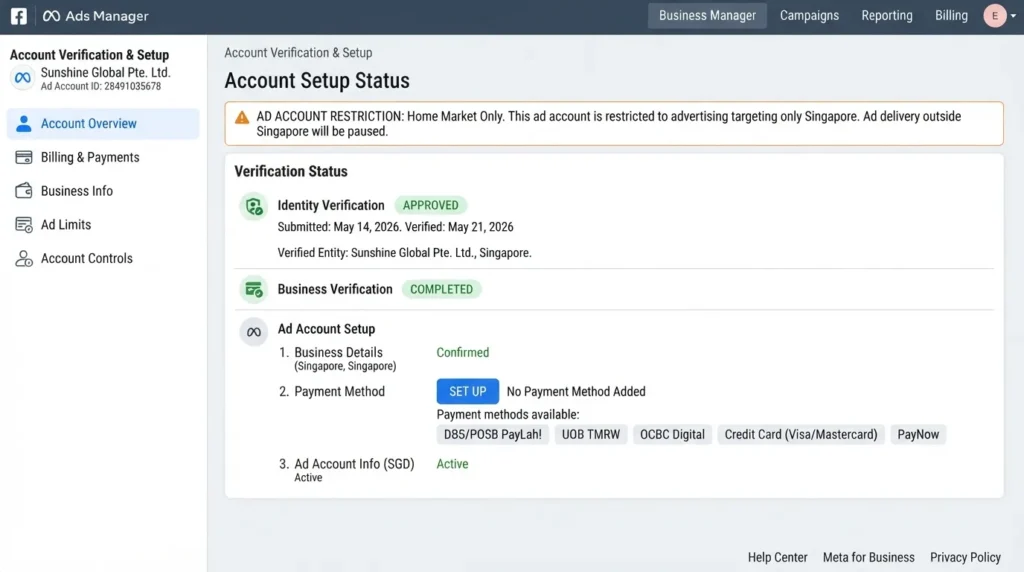
New self-serve accounts may only advertise in their home country at first. According to Scaleyai, they can run ads at home only until identity verification is approved and the required spend in that market is reached. Singapore ecommerce retailers should allow for that delay in their launch date, and check the OpenAI help center for the latest eligibility rules.
Setup Checklist
- Account: create the Ads Manager account and complete identity verification.
- Measurement: install the pixel or Conversions API so every purchase is recorded before launch.
- Buyer scenarios: group your catalogue into a small number of scenarios, such as gift shoppers or repeat buyers, within your plan’s limit.
- Creative: prepare two clear, conversational ad variations for the chatgpt ads for retail test.
- Budget and launch: set a modest daily budget and launch only after the first four steps pass.
Our Starter Plan, from $850/month, covers account setup, up to 2 buyer scenario sets and pixel or Conversions API setup. Our ChatGPT ads agency can take on the setup work.
Pricing, Bidding and Budget Thresholds
ChatGPT advertising can be bought on three bases: cost per click (CPC), cost per mille (CPM) and conversion-based bidding. The self-serve Ads Manager at ads.openai.com opened more broadly from May 2026, with low daily budget minimums such as $25 in many cases. CPC appears there as “Clicks: Each valid click (CPC)”. Most retail tests will start with CPC, because it shows the cost of each user who reaches a relevant landing page on your ecommerce site, and it lets you explore which product pages earn the most clicks before committing a larger budget.
The $50,000 minimum spend was removed on May 5, 2026, according to Flyweel’s launch analysis. Earlier thresholds should not feature in any budget you plan today.
Early reports suggest clicks are priced in the $3 to $5 range, and lower bids struggled for delivery at launch. Compare these figures with your own Google Ads benchmarks, and check how the platform’s best practices and help center guidance apply to your account, before drawing conclusions.
For a Singapore retailer, set a test budget that yields enough clicks to judge conversion rate within a few weeks. Daily budgets average over 7 days, so a single day’s spend can look irregular without signalling a fault.
| Bidding basis | Best for retail goal | Trade-off |
|---|---|---|
| CPC | Driving product page visits on a small budget | Cost rises with competition |
| CPM | Building awareness across a range | Spend accrues without guaranteed clicks |
| Conversion-based | Purchases once tracking is reliable | Needs enough conversion data to optimise |
Measuring Performance: Pixels, Conversions API and Decision Criteria
Measurement decides whether a ChatGPT Ads test tells you anything. OpenAI’s self-serve channel supports pixel-based measurement and a Conversions API. Set up both before you spend, because untracked clicks cannot be recovered. Check the exact setup in the current ChatGPT Ads documentation before you launch.
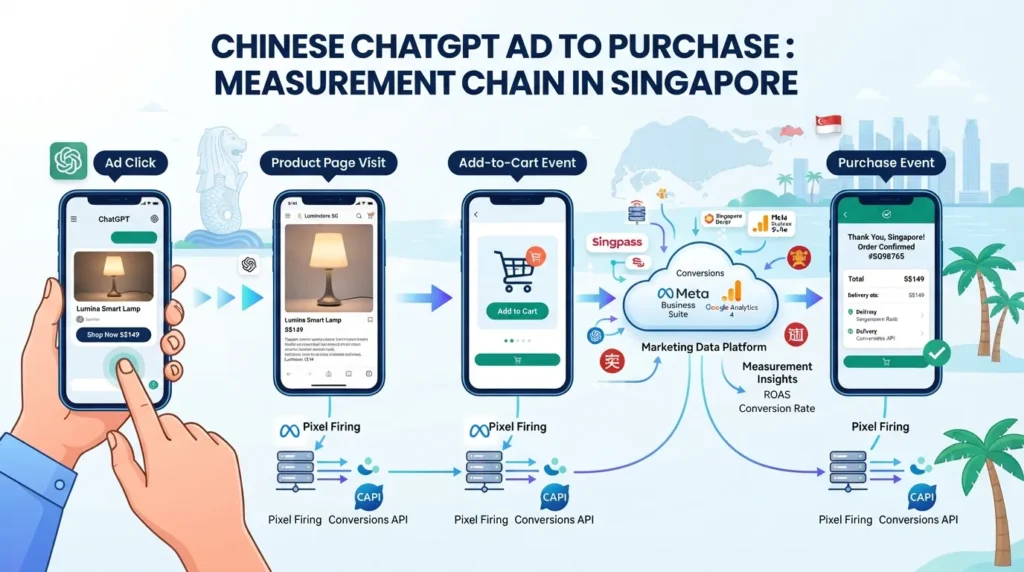
The pixel covers the browser journey, while the Conversions API sends purchase events from your server, which holds up better when browsers block cookies. Run both where your platform allows, and confirm a test order registers as a conversion in Ads Manager. If it does not, fix tracking first. Compare results against your Google Ads benchmarks.
| Symptom | Likely cause | Fix |
|---|---|---|
| Clicks but no conversions | Pixel or API not firing on the order page | Place a test order, then confirm the purchase event |
| High CPC with few clicks | Bid below delivery threshold | Move toward the $3 to $5 starting range |
| Spend stalls early | Daily budget read as a hard daily cap | Allow for the 7-day averaging before judging |
Decision rules for the test
Decide in advance when you will act.
- Scale only when conversions track cleanly and cost per purchase sits within your margin over a full test window.
- Pause when clicks arrive but purchases do not, after a fair test.
- Move budget back to search and social when the same product sells more cheaply there.
Judge the channel on purchases, not clicks.
Conclusion and Next Steps for Singapore Retailers
For most Singapore retailers, ChatGPT ads are a small, measured test rather than a budget shift. The channel is young, buyer intent inside a conversation is real, and measurement tools are still maturing. Work through the five readiness gates below. Commit spend only once every gate passes, and judge results on conversions, not click volume.
ChatGPT ads should sit beside your Google Ads and Meta spend, not replace it. Keep proven channels funded at their current level, and hold the ChatGPT budget as a separate line you can switch off. If you cannot yet trust conversion data from an existing channel, fix that first.
Five-gate readiness checklist
| Gate | Pass criteria |
|---|---|
| 1. Market access | Account is verified and the home-country spend requirement is met, or account status is confirmed in Ads Manager |
| 2. Tracking | Pixel and Conversions API are set up, and a test order is recorded as a conversion |
| 3. Buyer scenarios | Two or three buyer scenarios are mapped from your catalogue, each with matching creative that helps users explore their options |
| 4. Budget | A daily budget is set that gives a readable signal over the 7-day average |
| 5. Decision rules | Scale, pause and budget-move thresholds are written down before launch |
Practical next steps:
- Confirm market access and verification status with the account owner.
- Set up the pixel and Conversions API, and check that test purchases are recorded.
- Map two or three buyer scenarios from your catalogue and write matching creative that reflects the purchase intent of each.
- Set a budget that gives a readable signal, and review performance once the 7-day average settles.
If you would rather not build this yourself, our ChatGPT ads agency can handle account setup, tracking and the first creative sets. The Starter Plan from $850/month covers account setup and verification, up to 2 buyer scenario sets, two creative variations, pixel and Conversions API setup, and monthly reporting. The Growth Plan from $1,245/month adds up to 5 buyer scenario sets, 5 creative variations, bid strategy optimisation (CPM, oCPC, oCPM), Event Quality Score monitoring and a dedicated account manager. The Enterprise Plan from $3,550/month adds unlimited buyer scenario sets, a full creative library, cross-channel integration with SEO/GEO, Google and Meta Ads, AI-powered campaign management through Digimetrics, and quarterly strategy sessions.
Are ChatGPT ads available to Singapore businesses?
OpenAI announced on 23 September 2026 an expansion to Southeast Asia and Taiwan, and the channel is now available in more than 60 countries. Availability for a local advertiser still depends on account verification. Some new self-serve accounts can advertise only in their home country at first, until identity verification is approved and the required spend is reached. Confirm your account status in Ads Manager before planning a launch date.
What is the minimum spend for ChatGPT ads now?
There is no minimum spend for self-serve accounts today. The $50,000 minimum was removed on 5 May 2026, according to Flyweel’s launch analysis. A low daily budget is therefore a practical test size, though the home-country verification step still applies.
How much does a click on ChatGPT ads cost?
Early reports suggest clicks are priced in the $3 to $5 range. Check OpenAI’s own starting guidance in its Ads Manager Help Center. Lower bids were reported to struggle for delivery at launch, so do not start below that range. Set your test budget to cover enough clicks for a readable signal, rather than chasing the lowest CPC.
Do I need the pixel or Conversions API to run ChatGPT ads?
Yes, if you want to judge the channel on sales rather than clicks. Without them you cannot tie purchases back to ads. Tracking is a gate that must pass before spending.
How long does it take before ChatGPT ads show results?
Allow at least a few weeks of spend before judging performance. A daily budget is averaged over 7 days, so one day’s spend can look irregular, and early conversion data is thin. Set decision points in advance, and review results only once enough purchases have come through.