Many Singapore manufacturers are asking whether ChatGPT ads belong in their 2026 plan. For most, not yet as a lead generation channel: buyer intent is early and targeting and measurement are still maturing. A small, measured test can still yield useful data for firms with clear buyer scenarios and proper tracking. This guide covers whether a test suits your business, how to set a cost-per-acquisition ceiling, and what the platform can do for industrial sales.
Key Takeaways
- For most Singapore manufacturers, ChatGPT advertising is an early-stage test, not a lead engine yet. Buyer intent is still forming and measurement is immature.
- OpenAI suggests starting bids of $3 to $5 per click. Set a cost-per-acquisition ceiling before spending.
- Score readiness with the Test-Readiness Scorecard. A total of 7 or more supports a pilot; 4 to 6 means build tracking first; below 4 means stay with current channels.
- Conversion bidding (June 2026) and customer-list audiences suit firms with a clean CRM.
- Judge any pilot on cost per enquiry, not click volume.
Lead With a Worked Example: Testing a Precision Parts Line
A Singapore firm making precision-machined components wants to know if a buyer searching for a corrosion-resistant part in ChatGPT could become an enquiry. The Test-Readiness Scorecard below shows whether a pilot of chatgpt ads for manufacturing companies is justified.
The Test-Readiness Scorecard
Score each factor from 0 to 2 (0 = absent, 1 = partial, 2 = in place). This scorecard is the argument for a test-first approach. Some marketers argue ChatGPT ads should be bought now, before competitors arrive. This guide rejects that view for manufacturers without tracking, because a maturing platform can produce clicks without any traceable enquiries.
- Defined buyer scenario. Can you name one specific buying question, such as which alloy suits a corrosive environment? Score 2 if yes, 1 if vague.
- Tracking in place. Are enquiry forms, call tracking and the pixel or Conversions API set up and tested end to end?
- Clean CRM. Can you match enquiries to outcomes and export a customer list?
- Sales follow-up capacity. Can your team respond to a new enquiry within one working day?
- Budget with a ceiling. Have you set a cost-per-acquisition ceiling and a fixed test budget?
Decision bands:
- 7 or more: a pilot is supported. Start with one buyer scenario.
- 4 to 6: build tracking and your CRM first, then reassess.
- Below 4: stay with your current channels.
The precision parts firm scores 5: it has a defined scenario and a working enquiry form, but no CRM outcome export and no fixed ceiling yet. Its answer is to build tracking first.
How to Launch a First Test: Step by Step
If your score supports a pilot, follow this sequence before any money is spent.
- Verify the account. Confirm the business name and contact details match company records, so billing does not stall.
- Set a cost-per-acquisition ceiling. Work out the most you can pay for one enquiry, then set the bid to match.
- Install the pixel. Confirm tracking fires on the enquiry form and thank-you page.
- Run one buyer scenario. Launch the precision parts question only, and review early enquiries against sales follow-up.
Derive the ceiling from your own figures: cost-per-acquisition ceiling = gross profit per sale × expected close rate ÷ enquiries per sale. Replace the bracketed figures with your own numbers before setting any bid.
Account Access and Billing for Singapore Advertisers
Self-serve access means manufacturers can test this channel without a sales conversation. OpenAI removed its minimum commitment on 5 May 2026, and self-serve access beyond the US opened on 31 August 2026. For a Singapore manufacturer, the barrier is now operational, not financial.
Before you launch, check:
- Business verification. Confirm the business name, legal entity and contact details match your company records.
- Payment method. Confirm which payment methods the Ads Manager accepts for a Singapore-registered entity.
- Currency. Budgets may be charged in US dollars, so convert planned spend into S$ and allow for exchange-rate movement.
- Account ownership. Set up the account under a company email that a second person can access.
Self-serve accounts have a minimum spend of $25 in US dollars per day. At a $5 CPC, that covers roughly five clicks, so treat it as the floor for a technical check, not a campaign budget.
What Is Known, What Is Unknown, and Your First 30 Days
What is known: the Ads Manager is open to self-serve advertisers, and conversion bidding is available for paid marketing and performance campaigns. What is unknown: typical cost per enquiry for Singapore manufacturing, as no reliable public benchmark exists. Build your own baseline in 30 days by logging clicks, enquiries and closed sales for one buyer scenario.
Table of Contents
- Pricing: What ChatGPT Ads Cost Manufacturers
- ChatGPT Ads vs Google Ads for Manufacturers
- Conclusion and Summary
- Frequently Asked Questions
Pricing: What ChatGPT Ads Cost Manufacturers
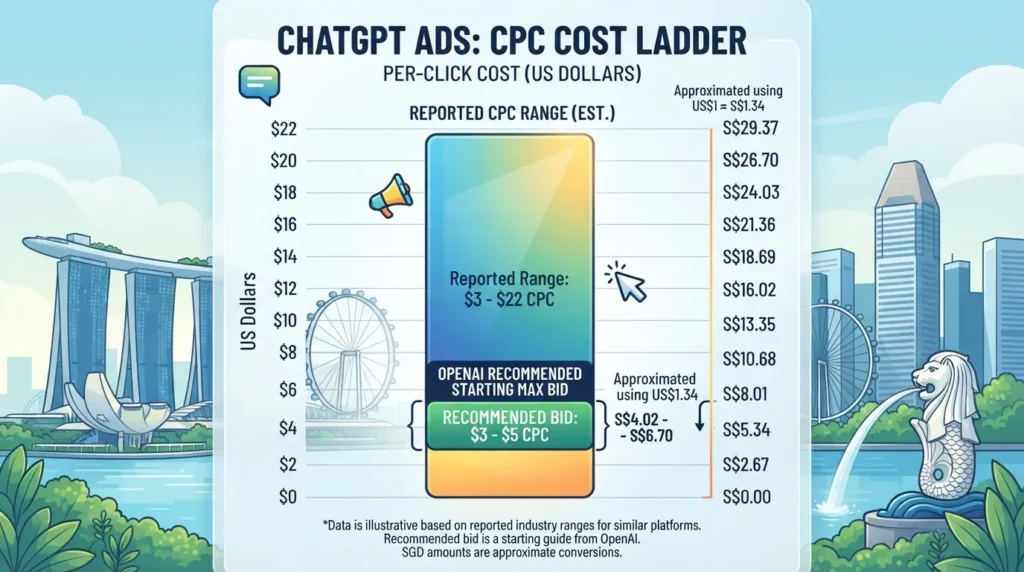
CPC vs CPM: choosing the right cost model
For most manufacturers, cost-per-click (CPC) is the better starting point. You pay when someone visits your site, so spend follows interest rather than visibility. Cost-per-thousand-impressions (CPM) suits awareness goals, but industrial buyers rarely decide from a single view of an ad. Choose the model that matches the goal of the test before you set the bid.
| Model | You pay for | Better suited to |
|---|---|---|
| CPC (cost-per-click) | Each click to your site | Enquiry-driven B2B tests |
| CPM (cost-per-thousand-impressions) | Each 1,000 views of the ad | Awareness campaigns |
OpenAI recommends a starting max bid of $3 to $5 per click. Advertisers who have shared their numbers report CPCs from about $3 to $22, according to the same source. The spread depends on category, competition for a given conversation and landing page quality. Check the ads manager regularly, because bid performance shifts as competition changes.
Pilot figures are hard to read. One reported pilot recorded an overall click-through rate of 0.68%, so a campaign may produce only a few dozen clicks in its first weeks. Most published figures come from consumer and software advertisers. We have not seen Singapore manufacturing CPC data, and none is public. Build your own baseline in the first 30 days and set a cost-per-acquisition ceiling from your own numbers.
Agency vs self-serve cost comparison
Self-serve costs are your ad spend plus your team’s time. A managed service adds a monthly fee on top. The plans below are a vendor offer, not neutral market data. Prices are indicative and exclude GST where applicable. Confirm them with the provider before budgeting.
| Plan | Starting price | What it includes |
|---|---|---|
| Self-serve | Ad spend only | You set up the account, build creative and manage bids |
| Starter | From $850/month | Account setup and verification, up to 2 buyer scenario sets, 2 conversational creative variations, Pixel / Conversions API setup, monthly reporting |
| Growth | From $1,245/month | Everything in Starter, plus up to 5 buyer scenario sets, 5 creative variations, bid strategy optimisation (CPM / oCPC / oCPM), Event Quality Score monitoring, a dedicated account manager |
| Enterprise | From $3,550/month | Everything in Growth, plus unlimited buyer scenario sets, a full conversational creative library, cross-channel integration with SEO/GEO and Google/Meta Ads, AI-powered campaign management, quarterly strategy sessions |
Sponsored Agents and CRM links launched on 16 September 2026. They are worth considering once you have a working campaign and a CRM to connect. Before then, the extra cost rarely pays back.
A simple decision framework: budget, team capacity and campaign complexity
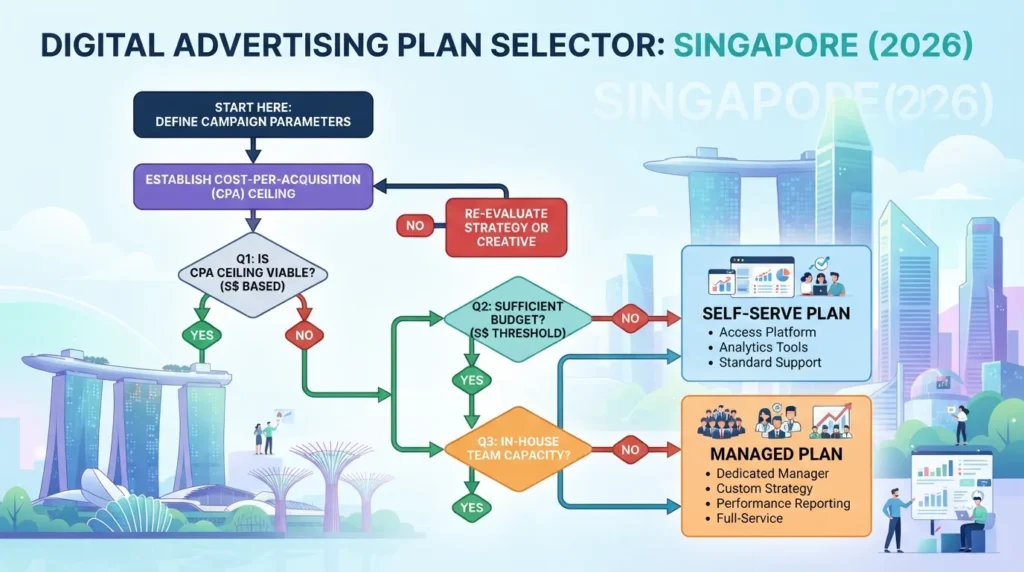
- Budget: Can you absorb a monthly fee on top of media spend for at least three months?
- Team capacity: Does someone in-house have time each week to review bids, creative and reports?
- Campaign complexity: Are you testing one product line and one buyer scenario, or several products across industries?
If the first two answers are no, or you need more than two scenario sets, a managed plan makes more sense. Otherwise, self-serve keeps costs lower. Either way, set a cost-per-acquisition ceiling before the first click, and let that ceiling, not click volume, decide whether the test continues.
Setting your cost-per-acquisition ceiling
- Gross profit per sale = average order value × gross margin %.
- Enquiries needed per sale = 1 ÷ close rate.
- Maximum cost per enquiry = gross profit per sale ÷ enquiries needed per sale.
Replace the placeholders with your own figures. If the result is below the CPC you are paying, the ad is losing money on each enquiry. Revisit the ceiling each quarter, because margin and close rate change as the product mix does.
Benefits of advertising on ChatGPT for industrial B2B
Most manufacturing searches still start on traditional search engines with a short phrase, such as “stainless steel fabrication Singapore”. ChatGPT changes that pattern. Users type long, open-ended questions, such as which alloy suits a corrosive chemical line. These are research tasks, and they happen before anyone has a shortlist. A ChatGPT ad can appear while a user is still framing the problem, which is earlier than most paid search reaches them.
ChatGPT has more than 1 billion weekly active users, so visibility at this stage can be valuable. For a niche manufacturer, the quality of that moment matters more than raw scale. Specification-heavy products tend to benefit most, provided the marketing answers a real question rather than shouting a slogan.
Mapping ChatGPT ads to the B2B buying journey
The most common mistake is treating a ChatGPT ad as a sales close. In an industrial sale that may run six to eighteen months, the ad’s job is to get your company onto the shortlist. The enquiry form, sample request and quotation belong to later channels.
| Stage | Typical buyer question | Right ChatGPT ad role |
|---|---|---|
| Problem framing | “What material handles this temperature range?” | Educate and name your capability |
| Shortlisting | “Which Singapore suppliers do this to ISO standards?” | Earn a place on the list |
| Vendor evaluation | “What is the lead time and minimum order?” | Hand off to email, sales or a catalogue |
Different people in the buying group ask different questions. Engineers want tolerances and material grades, procurement wants payment terms and certifications, and decision makers want the risk of switching. Each group needs its own creative.
Build a buyer scenario set before writing any ad. Start with one product line, list the applications and industries that buy it, then write two or three questions a real buyer might type for each combination. Narrow sets keep results readable.
Side-by-side comparison
| Factor | ChatGPT ads | Google Ads |
|---|---|---|
| Intent signal | Early research, often in open-ended conversation | Stated search intent, often a short keyword |
| Query length | Long, multi-part questions with technical context | Typically short keyword phrases |
| Targeting | Conversational context and customer-list audiences (available by July 2026) | Keywords, audiences, locations and placements, with mature options |
| Measurement | Conversion bidding (launched June 2026) | Long-established conversion tracking and reporting |
| Pricing | OpenAI recommends a starting max bid of $3 to $5 per click | Established auction benchmarks across many industries |
| Maturity | Launched in early 2026, with frequent product changes | Mature, with decades of benchmark data |
Most published ChatGPT CPC figures come from advertisers in other sectors, so Singapore manufacturers should not treat them as benchmarks for their own category.
Google Ads still wins on scale and predictability. Search volume for industrial terms is measurable, so you can see how many people search for a given part, grade or specification before you spend. ChatGPT ads have no equivalent search-volume tool yet. Where the buyer’s question is too complex for a keyword, however, a conversational ad can appear inside the research. That suits buyers still exploring, but it does not replace a request for quote.
Running both channels together
Treat the two channels as a pair with different jobs. Use ChatGPT ads to test which messages land, then move the strongest messages into Google Ads, where volume is easier to buy. Keep traditional search presence running alongside both, so buyers who look up your brand still find accurate, current content. Review the platform mix every quarter.
Measuring overlap and avoiding double-counted conversions
The main risk is counting one enquiry twice. A buyer may see a ChatGPT ad, then search your brand on Google and submit a form through the Google click, and both platforms may claim the conversion. To prevent this:
- Use a single CRM as the source of truth for enquiries, and record the first and last touchpoint on each lead.
- Tag every campaign with a consistent UTM structure so you can trace sources in analytics.
- Compare platform-reported conversions against CRM enquiries each month, and reconcile the gap before deciding budget.
- Agree on attribution rules in advance, such as last-click for budget decisions, and apply them consistently.
At MediaOne, our ChatGPT ads agency work starts from this reconciliation step, because a channel that cannot be measured cleanly cannot be fairly compared with Google Ads.
Targeting limitations and audience reach
ChatGPT ads do not yet offer the targeting depth that manufacturers are used to. Google Ads lets you bid on exact search terms, match by location, and layer in audience segments. ChatGPT’s options are thinner: advertisers can target by conversation context and, since mid-2026, customer-list audiences. There is no equivalent of a detailed job-title or company-size filter.
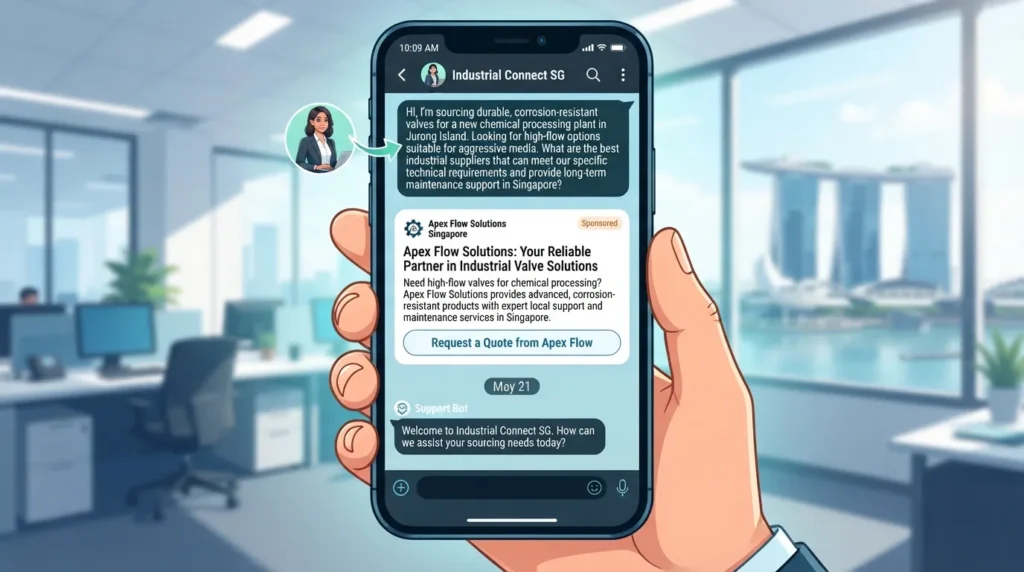
For a manufacturer, that gap matters. If you cannot narrow your audience to, say, maintenance engineers in the food processing sector, a large share of your spend will reach people who will never specify your equipment.
Early metrics also need careful reading. The pilot benchmarks published so far, such as a $60 CPM and a 0.91% click-through rate, come from small samples. Set a minimum sample size before judging any result. Niche industrial audiences may not generate enough conversational volume to justify a campaign, so confirm the audience exists before you spend. Traditional search remains the baseline for most industrial buyers, and ChatGPT ads should be judged against it.
Other limitations of ChatGPT advertising
ChatGPT advertising is young. Ads began appearing inside ChatGPT in February 2026, and the platform has changed quickly since, with new formats and access rules introduced within months. Document what you set up and why, because a campaign structure that works today may need rebuilding in a quarter.
Measurement is the second concern. Reporting maturity still lags established marketing platforms, and advertisers rely on third-party measurement partners, which adds cost. Confirm that your pixel and Conversions API setup will record enquiries accurately, and reconcile platform figures against your CRM each month. Free trial credits can mask the true cost of a test, so track spend from the first day. Performance data from the performance reports should be read alongside your own CRM figures rather than taken at face value.
Brand safety and placement control are less developed in a conversational setting. Keep your creative factual and specification-led.
Conclusion and Summary
ChatGPT ads are an early, high-intent channel for manufacturers, with real limits. Targeting is thin, measurement is young, and most published cost figures come from other sectors, so for most Singapore manufacturers this is a test, not a reliable lead source.
Settle three decisions before spending: a cost-per-acquisition ceiling and a sustainable monthly budget, the pixel or Conversions API linked to your CRM before launch, and whether campaigns run in-house or with a partner. MediaOne’s ChatGPT ads service follows the same test-first logic, with plans from $850 to $3,550 a month.
Treat ChatGPT ads as a supplement to existing demand generation, not a replacement. Keep Google Search running, pilot against a clear ceiling, and let results decide whether to scale.
Frequently Asked Questions
Can a small Singapore manufacturer start ChatGPT ads with a small budget?
Yes, if the budget is sized to learn rather than to generate volume. MarTech reports a minimum daily budget of $25 in US dollars for self-serve entry. At OpenAI’s recommended starting bid of $3 to $5 per click, run a small budget against one buyer scenario and one conversion goal.
Do I need a minimum spend to advertise on ChatGPT?
No. The minimum commitment floor dropped from $200K to $50K in April and then to zero on May 5, 2026, according to Flyweel. You still need a payment method and a verified account.
Is cost-per-click or cost-per-thousand-impressions better for B2B manufacturing?
For most manufacturers, cost-per-click is safer. Long industrial sales cycles mean paying for visits rather than impressions, and conversion bidding, launched in June 2026, lets you optimise toward enquiries.
How do ChatGPT ads compare with Google Ads for industrial leads?
Google Ads still wins on search volume and mature targeting. ChatGPT ads add value on complex, multi-part questions, such as comparing materials or sourcing a specific machine type. Treat ChatGPT as a test channel and Google Ads as the scale channel.
Which metrics should a manufacturer track in the first month?
Track cost per click, click-through rate, enquiries per 100 clicks and cost per enquiry. Set a cost-per-acquisition ceiling before launch, and wait for a meaningful sample of clicks before changing bids, since early figures such as a $60 CPM and 0.91% CTR rest on small samples.
Should I hire an agency or run ChatGPT ads in-house?
Run it in-house if you already have conversion tracking, a clear buyer scenario and staff time for weekly reviews. Otherwise, consider an agency. MediaOne’s Starter Plan from $850/month covers account setup, up to two buyer scenario sets and pixel or Conversions API setup. Compare those fees with your own cost per enquiry before deciding.