Most fashion brands we speak to ask the same question: should we spend on ChatGPT ads yet? For most Singapore fashion brands, ChatGPT ads for fashion brands are a measurement and catalogue-readiness test before they become a growth channel in their wider marketing mix. Click-through rates alone will not show whether the channel pays, and the content of your product pages and reviews shapes what the ads can say. Ask whether your clothing brands’ product pages answer the questions shoppers are likely to type into a chat prompt.
Before you spend, create an account on the self-serve Ads Manager Beta, confirm your Shopify product feed, write context hints for one buyer scenario, launch two creative variations, and review profit after returns before adding budget. The Ads Manager Beta opened at ads.openai.com in May 2026 with no minimum lifetime spend, but product feed ads need at least 100 SKUs, so check your catalogue first.
Key Takeaways
- ChatGPT ads are a measurement and catalogue-readiness test before they are a growth channel for most Singapore fashion brands.
- A 0.9% chatbot CTR can still be commercially useful if the traffic converts better, so judge the channel on order value, not clicks.
- Only Free and Go users see ads, so plan reach realistically from the start.
- Product feed ads need at least 100 SKUs, and the feed must be kept current as seasons change.
- Work out first-order profit after a 20% return rate and roughly $12 handling cost per return.
- Score your brand on feed, creative, returns economics and measurement before committing spend.
Table of Contents
Fashion shoppers now research outfits, fabrics and fits inside ChatGPT, not only on search engines or social feeds. The early signals are mixed, and how you read them matters more than the headline numbers.
Where shoppers are researching fashion in 2026
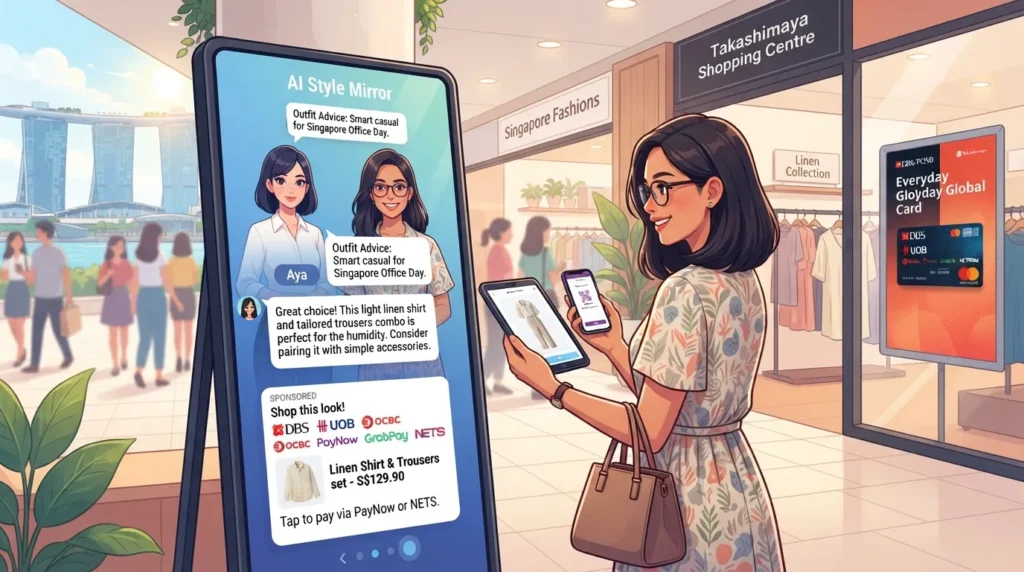
Many buyers ask an assistant for help with an occasion, a fabric or a fit before they open a store page. That moment of advice is commercially valuable, but the question is whether a paid placement inside that conversation reaches the right person at the right time.
What the early numbers say about chatbot ad performance
eMarketer puts chatbot ad click-through rates around 0.9%, against roughly 6.4% for Google search (eMarketer, 2026). Adobe found AI-referred visits to US retail sites convert 60% better than non-AI traffic in July 2026 data. Fewer clicks can still produce better buyers, but test that against your own order data.
The thesis: treat ChatGPT ads as a conversion channel priced on returns, not a traffic channel judged on CTR
Our counter-intuitive claim is this: a channel with a weak click rate can still be the better buy if its clicks return more profit after returns. Test that claim with your own order data, not with benchmarks.
Our falsifiable position: if your return-adjusted first-order profit cannot cover acquisition cost at your own return rate, do not run the test. In the worked model later in this guide, the first order breaks even near a 20% return rate on a two-pair bundle, so fix returns before spending on ads. The claim would be proven wrong if clicks from ChatGPT ads returned more often than your other paid traffic, or if first-order profit stayed below acquisition cost even after you reduced returns.
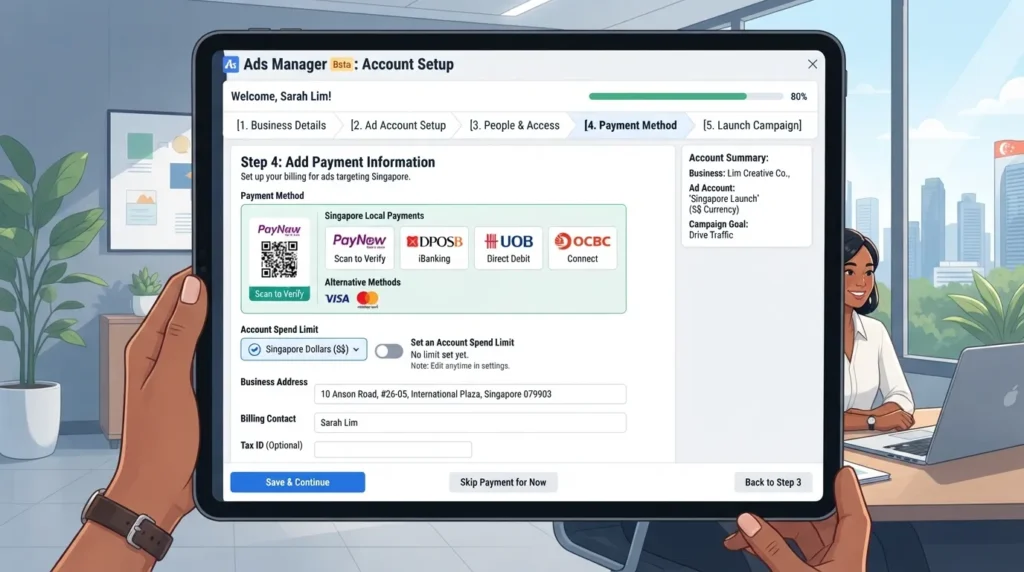
Most fashion brands will first meet ChatGPT ads through the self-serve Ads Manager Beta, which opened with no minimum lifetime spend.
Free and Go users only: who sees your ad and who does not
Ads reach only Free and Go users. Shoppers on Plus, Pro, Business, Enterprise and Education plans never see them. As TrySecondWin‘s guide to ChatGPT ads for fashion notes, ads run only for logged-in adults on these plans. For a Singapore label, your reach is a subset of ChatGPT’s audience, skewing toward price-sensitive shoppers. Plan volumes against that narrower pool.
Singapore shoppers use both paid and free-tier plans, and the market has grown quickly. We have not verified the local share on each plan, so check the original research before relying on any precise figure.
Why ads never influence ChatGPT’s answers, and what that means for trust
OpenAI has said repeatedly since February 2026 that ads never influence ChatGPT’s answers. Your card must earn the click on its own merits, so write for a buyer who already trusts the answer and is deciding whether your product fits their need.
Self-serve Ads Manager Beta and the path to first campaign
Start with the account, then the buyer scenarios, then the first conversational ad. Keep the first campaign small enough to read clearly, because a narrow test teaches more than a broad one.
Product Feeds, Catalogue Structure and Creative Standards
Most fashion brands arrive at ChatGPT ads for fashion brands with a Shopify store and assume the feed will sort itself out. It rarely does. Product feed ads need a 100 SKU minimum and accept up to 1M SKUs, according to TruCommerce‘s breakdown of the format, so a small capsule range may not qualify for clothing brands seeking marketing reach.
Seasonal catalogue limitations and how to plan around them
Seasonal ranges cause the most friction. Remove sold-out sizes, retire old collections and refresh imagery before each drop. Treat the feed as a weekly task, because a stale catalogue sends the customer to a product that can no longer be bought.
Ad card specifications and imagery
Chat cards are tight. Headlines run 3 to 50 characters and bodies about 100, according to Second Win’s guide to fashion ads. Lead with the occasion or fit (“Linen shirt for hot Singapore office days”), then the detail that closes the sale. A prompt written this way helps shoppers see the product as the answer to their situation.
Use clean product imagery on a plain background, showing the garment in full and in the colour listed in the feed. A mismatched photo loses a click that has already been earned.
Context hints work like a briefing note for the ad system, describing the situation a shopper is in. OpenAI recommends 5 to 15 hints per ad group, each one or two sentences long, according to TruCommerce.
Targeting and Context Hints for Apparel
Matching hints to buyer scenarios
Write each hint around one lever: occasion, fit, fabric or price. “Linen shirt for a humid Singapore wedding, breathable, under S$120” gives the system far more to work with than “men’s shirts”. Keep each hint to a single scenario so a shopper’s question maps cleanly onto one ad group. Clothing brands that test one scenario at a time learn which copy converts customers, and that clarity supports higher return on marketing spend.
Group hints by buyer scenario, not by SKU. Each ad group stays readable, and underperforming scenarios are easy to spot. Shopify merchants can build these groupings directly in their product feed, so each scenario carries its own copy and product descriptions. Working professionals who shop for workwear by occasion, such as a client meeting or a long day in the office, can be grouped the same way so each scenario carries its own content.
A checklist before launch
- Each ad group holds 5 to 15 hints.
- Every hint names an occasion, fit, fabric or price point.
- No hint repeats another in different words.
- Price claims match the product feed exactly.
- Each hint maps to an in-stock product.
Measuring Performance Against Fashion Returns Economics
Judge ChatGPT ads on order profit, not click-through rate. Benchmarks put chatbot CTR near 0.9% against a roughly 6.4% Google search benchmark, according to eMarketer’s 2026 data. A lower CTR can still pay if clicking visitors buy more. Adobe found AI-referred visits to US retail sites convert 60% better than other traffic, but test that against your own order data.
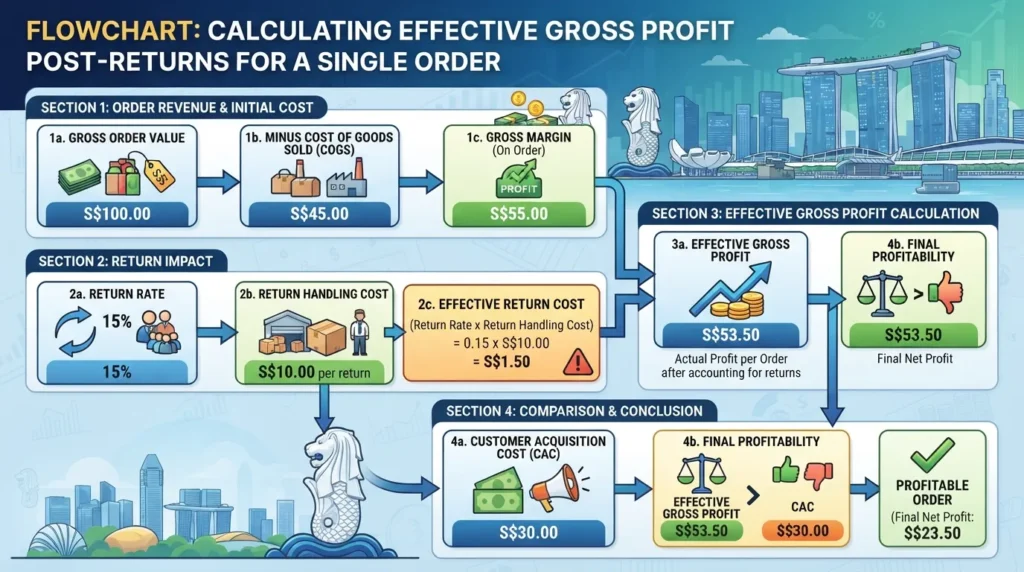
Apparel margins shrink once returns are counted. This hypothetical example uses illustrative inputs from TrySecondWin’s example, not a verified result:
- Start with a $57 margin on the order.
- Assume a 20% return rate.
- Apply about $12 lost per return in shipping and handling.
- Effective gross profit per order is roughly $43.20 ($57 minus 20% × $12 = $57 − $2.40 handling… see note below).
Note on the arithmetic: the $43.20 figure is TrySecondWin’s worked result for a 60% gross margin before returns, not a figure derived from the $57 margin in step 1. Applied to a $57 margin, the same 20% return rate and $12 handling cost give a different result, so check which margin base your own model uses before comparing numbers.
On a two-pair bundle averaging $170 at a 5% conversion rate, effective gross profit is roughly $79.20 against an $80 acquisition cost, about break-even on the first order.
Replace these inputs with your own: margin, return rate, handling cost, average order value and conversion rate. Set acquisition cost per order as your target, test over 30 days, and aim for effective gross profit at or above acquisition cost. If first-order profit is negative, plan for repeat purchases before scaling.
Practical Launch Plan and Decision Framework
Before spending, score your brand on four axes: product feed quality, creative and context-hint quality, unit economics after returns, and measurement setup. Rate each axis as follows:
- Not ready: the axis is missing or failing, for example a feed below 100 SKUs, untested hints, unknown return cost, or no conversion tracking.
- Partly ready: the axis works but has gaps, for example a feed current for only some collections.
- Ready: the axis meets the standard in full: a feed above 100 SKUs kept current, hints covering each buyer scenario, first-order profit priced after returns, and live tracking.
A brand Ready on feed and economics but Not ready on measurement should fix tracking first. Brands Ready on all four can move to a small, time-boxed test.
A step-by-step rollout for a first 30 days
- Week 1: Confirm your account at ads.openai.com and set up conversion tracking.
- Week 1 to 2: Build your feed (at least 100 SKUs, synced from your Shopify store) and write 5 to 15 context hints per ad group for your clothing brands. Ask ChatGPT to help fashion draft hints, then check each one against your own product data.
- Week 2 to 3: Launch two creative variations on a single buyer scenario, using clear, customer-focused copy that shows how the garment will wear.
- Week 4: Review conversion rate and effective gross profit per order, not CTR alone, and check how product reviews and returns affect your marketing results.
Diagnostic table: symptom, likely cause, fix
| Symptom | Likely cause | Fix |
|---|---|---|
| Impressions but few clicks | Weak card copy or imagery | Rewrite the headline and swap the product image |
| Clicks but no purchases | Hints do not match buyer intent | Tighten hints to occasion, fit or fabric |
| Sales but losses after returns | Return rate erodes margin | Adjust pricing or bundle offers |
When to scale and when to pause
Scale only when effective gross profit per order clears your acquisition cost. Pause if the campaign does not reach break-even within the 30-day test window.
Conclusion: What to Do Next
Start with the audit, not the ad. Score your brand against the four axes of the Readiness-to-Scale Matrix: product feed quality, creative and context-hint quality, unit economics after returns, and measurement setup. Rate each as Not ready, Partly ready or Ready. Start with your product descriptions, since the feed is the first thing the channel reads.
If you are Ready on feed and economics but Not ready on measurement, fix tracking before spending. If you are Ready on all four, run a small, time-boxed test with a written break-even target and a fixed review date.
Judge the channel on what it earns, not its click-through rate. Compare cost per order against your returns-adjusted margin, and check reviews alongside the numbers.
If you want help with the setup, our ChatGPT ads agency can take it on while you keep control of the economics. Plans start from $850 per month (Starter), $1,245 (Growth) and $3,550 (Enterprise).
Frequently Asked Questions
Can Singapore fashion brands run ChatGPT ads without a minimum spend?
Yes. The self-serve Ads Manager Beta opened at ads.openai.com in May 2026 with no minimum lifetime spend. Set a test budget you can afford to lose and judge it against your returns-adjusted break-even target.
Which ChatGPT users see ads, and can paid subscribers be targeted?
Ads reach only Free and Go users. Plus, Pro, Business, Enterprise and Education users never see them, so the audience is smaller and skews toward price-sensitive shoppers.
Do ChatGPT ads affect the answers the assistant gives?
OpenAI says ads do not influence responses, so your creative has to earn the click on relevance.
How do returns change the profitability of a chatbot-driven apparel order?
Returns can turn a profitable first order into a loss. Using the example from Second Win’s guide to ChatGPT ads for fashion, a 60% gross margin, a 20% return rate and about $12 lost per return reduce a $57 margin order to an effective gross profit of $43.20. This is hypothetical, so run the calculation with your own return rate and handling cost.
Is a product feed mandatory for fashion brands?
No, but it is the most relevant format for catalogue-heavy apparel. Product feed ads require a 100 SKU minimum and support up to 1M SKUs. Smaller catalogues can still run conversational ads, but each creative and context hint must be written by hand.
How should a brand measure ChatGPT ad performance from day one?
Set up conversion tracking before spending. Install the pixel or Conversions API, tag each campaign so orders match to ad groups, and track return rate by source. Judge the channel on net gross profit per order rather than CTR alone.