Short answer: ChatGPT Ads can suit a dental clinic in Singapore, but only once the clinic has one clear buyer scenario, consent-compliant tracking and a way to judge leads by booked appointments. Our three service tiers start from S$850, S$1,245 and S$3,550 per month, indicative and subject to scope, and exclude platform ad spend. Results vary and cannot be guaranteed.
Dental clinics are starting to ask whether ChatGPT Ads belong in their marketing mix. The format is new and the platform is changing quickly. Most advice so far is written for e-commerce brands, not for clinics that sell treatments, depend on trust and can only fill so many chairs each week. This guide is for practice owners and clinic managers who want a straight answer on whether ChatGPT Ads can bring in booked consultations, what setup involves and what it costs.
We recommend testing ChatGPT Ads only after a practice has a clear buyer scenario, a tracking setup and a way to judge leads by booked appointments rather than clicks. Spend without that groundwork tends to produce numbers that look healthy on the dashboard but cannot be traced to revenue in the clinic. The sections below set out a five-gate readiness check, the three service tiers, and a 90-day plan you can adapt to your own treatment mix and capacity.
Key Takeaways
- Test ChatGPT Ads only with three things in place: one clear buyer scenario, consent-compliant tracking and a way to judge leads by booked appointments.
- Start with one treatment and one patient profile. For example, adults in the western region asking about invisible aligners.
- Track the booking, not the click. Cost per booked consultation shows whether spend works. Cost per click shows very little for a dental practice.
- Run the Five-Gate Readiness Check before committing budget. Fix any gate that returns a “no” first.
- Expect a learning period. Begin with a small number of buyer scenarios and two creative variations at the Starter level.
- Wait if capacity is short. Extra enquiries your front desk cannot answer the same working day will hurt rather than help.
- Keep every claim factual. Outcome promises, pricing and before-and-after results must be verifiable.
Table of Contents
What ChatGPT Ads Are and Why Dental Clinics Are Looking at Them
ChatGPT ads are paid placements shown inside conversational answers. A prompt returns a reply, and a sponsored message appears alongside or within it. For a dental clinic, this changes the moment a prospective patient meets the clinic.
The ad is not a banner beside a list of links. It sits in the middle of someone asking about a problem they already have.
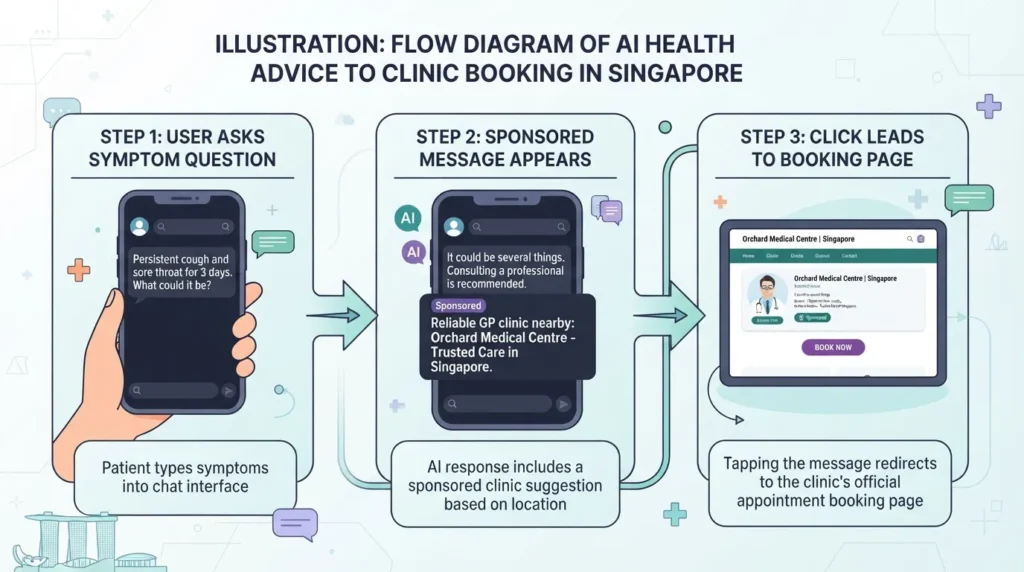
A search ad answers a keyword. A social ad interrupts a feed. A conversational ad responds to a question, so its relevance depends on what the person has just asked.
Someone who types “how long does Invisalign take for a crowded lower arch” has already named the treatment, the concern and the stage they are at. A search ad would have to guess that from a keyword list. A conversational placement can match the exact question.
The practical differences for a clinic come down to three points:
- Intent is stated, not inferred. Conversational prompts are longer and reveal the patient’s worry, budget or timeline.
- The answer format shapes the click. The person has been reading an explanation, so the ad must fit that tone.
- Measurement is less mature. Conversational formats are newer, so expect thinner reporting and build your own appointment tracking.
The strongest early use is not to copy a search campaign into a chat window. Write ads that answer the specific question a patient asked, then send them to a page that continues that answer.
Why a dental clinic’s buyer journey suits a conversational format
Dental treatment is rarely an impulse purchase. A patient researches symptoms, compares options, checks cost and location, then decides whether to book. That research phase is long and full of questions, which is where a conversational interface operates.
Consider a common path. Someone notices a chipped molar and asks a chatbot whether a crown or a filling is needed. They then ask roughly what each costs and whether a nearby clinic handles it. A clinic that appears at the right step, with an answer that fits the question, is better placed than one bidding on a single generic keyword.
Dental decisions also carry anxiety about pain, cost and trust. A conversational format lets a clinic address one concern at a time, but only if the claims stay measured. Overstated outcomes will lose the patient at the consultation, and may breach professional advertising rules, which we cover later.
What this guide covers and who it is for
This guide is for practice owners, clinic managers and the marketing lead who signs off the budget. It assumes you know what your clinic offers and want to know whether conversational advertising can fill appointments without wasting spend.
We cover how to decide whether your practice is ready, what each tier includes, how to define buyer scenarios, how to set up tracking so you count booked consultations, and how to read results over 90 days. We also cover where we think ChatGPT Ads are the wrong choice, because a clinic that cannot handle its enquiries should fix that first.
Whether you run a single-dentist practice, a small team or a group with several locations in Singapore, the framework applies. The budget and number of scenarios you can manage will differ, and we address that as we go.
Is ChatGPT Advertising Right for Your Dental Practice?
Not every dental clinic should run ChatGPT Ads. The answer depends on a few things a clinic can check today. If the practice cannot name the treatment it wants to fill, cannot track a booked consultation and cannot answer a new enquiry within a working day, the ad budget will mostly buy data the clinic cannot use.
Start with the Five-Gate Readiness Check below. Each gate is a question with a clear pass or fail. Work through them in order before any spend.
Clinic types and patient profiles that tend to fit
Clinics that get the most from conversational ads usually share a few traits. They have a clear high-value treatment, such as implants, orthodontics or invisible aligners, where one booked consultation is worth more than the monthly plan cost. They also have a defined local catchment, so the ad can speak to a named neighbourhood or MRT interchange rather than all of Singapore.
Patients who fit well tend to research before they book. They compare clinics on location, wait times and treatment range, and they often ask detailed questions first. A conversational format suits this behaviour because the patient describes their concern in their own words and receives a relevant answer.
Clinics focused on routine cleaning and walk-in emergencies usually see weaker returns. Those patients often search on the spot and book by phone or through a familiar channel, so an ad rarely adds value over an existing listing.
Signs your clinic is not ready yet
Certain warning signs suggest the clinic should fix its groundwork before spending. The most common is no defined buyer scenario. If the brief is “more patients”, the campaign has no target to optimise towards.
Other signs include:
- The booking form or phone line is not tracked, so bookings cannot be linked to the ad.
- No one responds to enquiries within a set window.
- The landing page makes claims that do not match the ad promise.
- Chairside capacity is already full, so extra leads would go unanswered.
If two or more of these apply, we recommend delaying launch. Additional clicks without booking capacity add cost but no revenue.
Decision criteria: budget, treatment mix and capacity to take bookings
Three criteria decide most cases. The first is budget. The Starter Plan starts from $850/month, and the clinic must also fund platform ad spend on top of the plan fee. Plan fees exclude platform ad spend. The clinic should confirm it can still earn a return from a handful of consultations.
The second is treatment mix. Campaigns work best when one high-value treatment anchors the buyer scenario. A clinic offering a broad menu should pick one priority treatment for the first test.
The third is capacity. Before launch, the practice should confirm it can book the consultations the ads generate within the response window it sets. The table below turns these criteria into a quick self-check.
| Criterion | Ready to proceed | Pause and fix first |
|---|---|---|
| Monthly ad budget beyond plan fee | Budget covers several target consultations | Budget only covers the plan fee |
| Priority treatment | One named, high-value treatment | No single treatment chosen |
| Booking capacity | Slots available within the agreed response window | Chairs already full for the next several weeks |
| Conversion tracking | Booking event tracked end to end | Only clicks are measured |
| Enquiry ownership | A named person responds within one working day | No owner for incoming enquiries |
The Five-Gate Readiness Check in practice
Each gate has one test. Here is how a clinic checks the booking-tracking gate. Ask the front desk to submit a test booking through the ad landing page, then confirm the booking appears in the clinic’s diary and the conversion event fires in the ad account’s event log. If either step fails, the gate is closed.
The other four gates are the priority treatment, booking capacity, enquiry ownership and budget beyond the plan fee. Work through them in order, and treat any closed gate as a reason to delay.
A clinic that passes all five gates is a reasonable candidate for a Starter test. A clinic that passes most but not all should fix the gaps and reassess before committing spend.
Understanding the Three Service Tiers
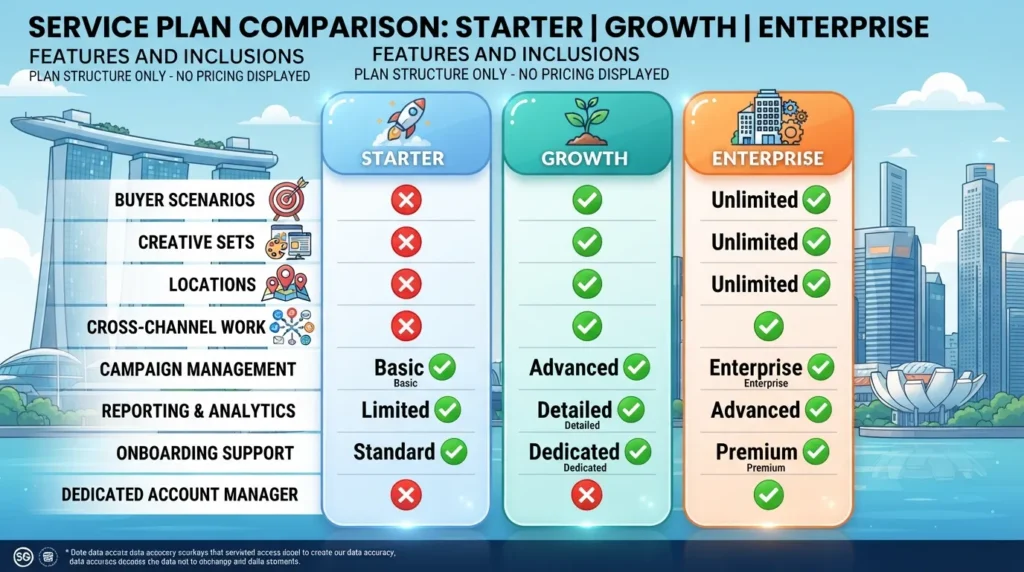
The three tiers below are our own packages, and the prices shown are indicative and subject to scope. Choosing a tier is less about the headline price and more about how many buyer scenarios, creative sets and optimisation tools you need to run a fair test. The wrong tier usually means paying for capacity you cannot use yet, or running out of room to learn before the budget is spent.
Starter Plan (from S$850/month): scope, limits and best-fit use cases
The Starter Plan starts from $850/month and is best for businesses testing ChatGPT Ads for the first time with a focused buyer scenario. It includes OpenAI Ads account setup and verification, up to two buyer scenario sets, two conversational ad creative variations, Pixel and Conversions API setup, and monthly performance reporting.
The limits matter as much as the inclusions. Two scenario sets let you test two patient profiles at most. Two creative variations leave little room to compare messages. That is enough to answer one question, such as whether adults searching for invisible aligners in one part of the island will book a consultation. It is not enough to compare several treatments at once.
Best fit is a clinic with one treatment it wants to grow, a booking process that already works, and a named person who will read the monthly report against actual appointments.
Growth Plan (from S$1,245/month): scaling buyer scenarios and creative sets
The Growth Plan starts from $1,245/month. It includes everything in Starter, plus up to five buyer scenario sets, five creative variations, bid strategy optimisation across CPM, oCPC and oCPM, Event Quality Score monitoring, and a dedicated account manager.
This tier suits a practice that has already seen one scenario convert and wants to widen the test. Five scenarios let you run implants, orthodontics and preventive cleaning side by side, each with its own creative. Bid optimisation and Event Quality Score monitoring matter once you have enough conversion volume for the platform to learn from. Watching the score helps you spot a tracking problem before it wastes a month of spend.
The step up from Starter is justified only if the first scenario has produced bookings you can count. Adding scenarios before that point multiplies the cost of an unanswered question.
Enterprise Plan (from S$3,550/month): when multi-location or cross-channel work justifies the cost
The Enterprise Plan starts from $3,550/month. It offers unlimited buyer scenario sets, a full conversational creative library, cross-channel integration with SEO/GEO, Google Ads and Meta Ads, AI-powered campaign management through Digimetrics, and quarterly strategy sessions.
Enterprise makes sense when the practice runs several clinics, or when ChatGPT Ads are one part of a wider acquisition effort that already includes search and social. Cross-channel integration is the main reason to pay this tier. It lets you compare a booking from a conversational ad with one from a search campaign on the same reporting basis. For a single-location clinic with one treatment focus, the extra scenarios and quarterly sessions are unlikely to justify the difference of S$2,300 per month above Growth.
We have found that most single-clinic practices do not need this tier in their first year. Ask whether your patient volume and reporting complexity would actually use the capacity.
Side-by-side comparison of inclusions
| Inclusion | Starter (from S$850/month) | Growth (from S$1,245/month) | Enterprise (from S$3,550/month) |
|---|---|---|---|
| OpenAI Ads account setup and verification | Yes | Yes | Yes |
| Buyer scenario sets | Up to 2 | Up to 5 | Unlimited |
| Conversational ad creative variations | 2 | 5 | Full creative library |
| Pixel and Conversions API setup | Yes | Yes | Yes |
| Monthly performance reporting | Yes | Yes | Yes |
| Bid strategy optimisation (CPM, oCPC, oCPM) | No | Yes | Yes |
| Event Quality Score monitoring | No | Yes | Yes |
| Dedicated account manager | No | Yes | Yes |
| Cross-channel integration (SEO/GEO, Google Ads, Meta Ads) | No | No | Yes |
| AI-powered campaign management (Digimetrics) | No | No | Yes |
| Quarterly strategy sessions | No | No | Yes |
If you need one scenario and two creatives, Starter covers it. If you need optimisation tools and a named contact, Growth is the step up. Enterprise is for practices that need unlimited scenarios or cross-channel reporting. Compare the tier to your patient volume and to how many treatments you genuinely plan to test.
Planning Your Buyer Scenarios for Dental Services
Before a clinic spends a dollar on ChatGPT Ads, it needs to know who it is trying to reach and for what. We have seen many dental practices start with a broad ambition, such as “get more patients”, and then struggle to tell which part of the campaign worked. A buyer scenario fixes that. It turns a vague goal into a specific, testable hypothesis for chatgpt ads for dentist that you can measure and act on.
How to define a buyer scenario for a dental treatment
A buyer scenario combines three things: a single treatment, a patient profile and the situation that brings the patient to ask about it. Each element narrows the audience. It also makes the conversational creative easier to write.
Work through these four questions for each scenario:
- Which treatment? Name one service, such as scaling and polishing, dental implants or clear aligners. Avoid bundles like “all dental services”, because they produce creative that speaks to nobody in particular.
- Which patient? Describe the person in practical terms. Note their age band, whether they are a first-time or returning patient, and whether they are likely to be a self-pay or insured patient.
- What triggers the search? Common triggers include a chipped tooth, a dentist recommendation, a changed insurance benefit or a planned life event such as a wedding.
- Where are they located? For a Singapore clinic, this usually means a neighbourhood or a nearby MRT interchange. Local phrasing matches how patients actually compare clinics.
A complete scenario reads something like this: “Working adults in the western region considering clear aligners, prompted by a dentist recommendation, who want an appointment within two weeks.” If you cannot write that sentence for a scenario, it is not ready to test.
Mapping scenarios to treatments such as cleaning, implants and orthodontics
Different treatments have very different decision cycles. That affects how you should structure scenarios.
| Treatment type | Typical decision cycle | Likely patient trigger | Scenario fit |
|---|---|---|---|
| Routine cleaning and check-up | Short, often the same week | Reminder, symptom or new-to-area move | Good for volume and first visits |
| Dental implants | Long, with consultation and planning | Missing tooth, research after a failed option | Good for high-value consultation bookings |
| Orthodontics and aligners | Medium to long, with a comparison phase | Appearance concern, career or social reasons | Good for consultation bookings with a clear next step |
Cleaning scenarios convert quickly but usually carry a lower value per patient. Implant and orthodontic scenarios take longer, so judge them by booked consultations rather than completed treatments. Most clinics miss this: a campaign for implants and a campaign for cleanings should not share the same timeline or the same cost threshold.
Prioritising scenarios by margin, demand and clinic capacity
Most clinics can define more scenarios than they can run well. Prioritise using three filters, each scored from 1 to 3:
- Margin: how much revenue a converted patient typically brings in over the course of care.
- Demand: how many people in your catchment are likely searching for this treatment, and how much competition you face.
- Capacity: whether your chairs, clinicians and front-desk team can absorb the extra enquiries within a sensible response window.
Add the scores and start with the highest total. Capacity deserves particular weight. A scenario that scores well on margin and demand but cannot be served within a day will waste spend, because enquiries that go cold rarely convert later. If your clinic has no spare consultation slots for implant patients this month, do not launch an implant scenario yet, even if the margin is high.
Start with one or two scenarios on the Starter Plan, which covers up to two buyer scenario sets. Expand only once the first scenario shows bookings that match your expectations. Our experience is that a single well-defined scenario teaches a clinic more in the first month than five loosely defined ones.
Setting Up Your Account and Tracking
Most dental clinics that struggle with ChatGPT Ads do not fail on creative. They fail on setup. A campaign launched before the account, pixel and conversion events are right will spend money and report activity, but it will not tell you which ads filled your diary. This section sets out the order we recommend, so that every dollar spent can later be traced to a booked appointment.

Account setup and verification steps
Set up the account in this order:
- Check the three account names. The internal Account Name, the public Brand Name and the registered Legal Name each serve a different purpose. Check that each one serves its intended purpose, so that the account, your landing page and your Google Business Profile tell the same story.
- Complete business verification before adding any billing details. Keep your clinic’s registration documents and a current business address ready, since verification can stall on mismatched details.
- Connect a payment method and set a monthly spend ceiling. We recommend setting the ceiling at the level you could absorb for a full month without a booking, so that a weak first month does not become an expensive one.
- Assign roles so that one named person owns the account, with any agency or colleague given the minimum access they need.
Our Starter setups include account creation and verification, so most clinics will not do steps 1 to 4 themselves. Even so, you should know what is being verified and who holds the login.
Installing the pixel and Conversions API
The pixel is a small snippet of code on your website that records when a visitor takes an action. The Conversions API sends the same signals from your server rather than the visitor’s browser. Using both gives the platform a fuller picture, because browser-based tracking loses signals when visitors use privacy settings or block scripts.
Install both in this order:
- Place the pixel on every page of your website, not only the booking page. This lets the platform build audiences from visitors to your treatment pages.
- Confirm the pixel fires with the platform’s test tool before you launch anything.
- Set up the Conversions API through your website platform or your developer. Then check that the server events match the browser events. Each event should carry a shared event ID, so the platform can match a browser event and a server event for the same action and count it once. Duplicate events inflate your reported bookings, so check for them early.
Patient-related tracking needs care. Do not pass patient names, contact details or clinical information through the pixel or the API. Send only the event name, a value and a non-identifying reference.
Defining conversion events that reflect booked appointments, not clicks
This is where most clinics go wrong. A campaign optimised for clicks will find cheap clicks, and cheap clicks are often curious readers rather than patients. Define your conversion events around outcomes that matter to the clinic:
| Event | When it fires | Use it for |
|---|---|---|
| Consultation booked | Confirmation page after a booking is submitted | Primary optimisation event |
| Enquiry form submitted | After a contact form is completed | Secondary event if bookings are rare |
| Call from ad | Tracked phone number clicked or dialled | Clinics that take most leads by phone |
| Booking attended | Confirmed in your practice management system | Quality check, reviewed monthly |
Use “consultation booked” as the primary event. Use “booking attended” in your monthly review to see whether the platform is finding people who turn up. If attendance is low, the cause is usually the offer or the targeting, not the ad.
Check the attribution window for booked-consultation events against the platform’s current documentation, since it determines how long after an ad click a booking still counts. Reconcile these figures against your booking system every month. Platform numbers and clinic records rarely match exactly, because of duplicate submissions, cancelled bookings and phone leads that never reach the system.
Checklist before launch
Work through this checklist before any money is spent. Record an owner and a date against each item.
| Item | Owner | Date | Done |
|---|---|---|---|
| Advertiser account verified and billing set, monthly spend ceiling entered | Not confirmed | Not confirmed | Not confirmed |
| Pixel installed on all pages and tested | Not confirmed | Not confirmed | Not confirmed |
| Conversions API sending events, no duplicates | Not confirmed | Not confirmed | Not confirmed |
| “Consultation booked” event firing on confirmation page | Not confirmed | Not confirmed | Not confirmed |
| Phone tracking number live (if used) | Not confirmed | Not confirmed | Not confirmed |
| Landing page matches the ad’s promise | Not confirmed | Not confirmed | Not confirmed |
| Booking form works on mobile | Not confirmed | Not confirmed | Not confirmed |
| Named person responds to enquiries within one working day | Not confirmed | Not confirmed | Not confirmed |
| Weekly review slot set in the diary | Not confirmed | Not confirmed | Not confirmed |
If any item is unchecked, do not launch. A campaign that starts with a broken event will teach you the wrong lesson about the channel.
Conclusion and Next Steps
Summary of the decision framework
Run ChatGPT Ads for a dental clinic only when four things are in place: one buyer scenario, a consent-compliant tracking setup, a way to judge leads by booked consultations rather than clicks, and a named person who reviews results every week. Without that groundwork, enquiries arrive that cannot be traced back to appointments, and the clinic judges the channel on the wrong numbers.
Use the Five-Gate Readiness Check as the final test before any budget is committed. Work through the gates in order and record an owner and a date against each one.
| Gate | Question to answer | Pass condition |
|---|---|---|
| 1 | Can we name the treatment and patient profile we want to fill? | One treatment and one patient type, written down |
| 2 | Is a conversion event (booking, enquiry form or call) tracked end to end? | Event fires and reaches the booking system |
| 3 | Can we measure cost per booked consultation, not cost per click? | Ad spend divided by confirmed bookings can be calculated |
| 4 | Does the landing page match the promise of the conversational ad? | Same treatment, price basis and call to action |
| 5 | Who owns the weekly review? | A named person with a fixed review slot |
Any “no” means the clinic should fix that gate before launch. A clinic that passes all five has a sound basis for the Starter Plan, from S$850 per month. The Starter Plan includes account setup, up to two buyer scenario sets, two creative variations, pixel and Conversions API setup, and monthly performance reporting. Whether a larger tier makes sense depends on the bookings the first scenario produces, not on the platform’s push for scale.
Two boundaries should stay in view. First, if the clinic lacks chair time or front-desk capacity to respond to the leads it generates, it should not run ads yet. Unanswered enquiries damage both the budget and the clinic’s reputation. Second, outcome claims, pricing and before-and-after results must stay factual and verifiable. Under HCSA rules, before/after and after-only images, testimonials and inducements are prohibited in a licensed dental clinic’s advertising, so the creative should describe treatments and process rather than promise results.
How to book a discovery conversation with a provider
If the readiness check shows gaps you cannot close internally, a discovery conversation with a provider is a practical next step. Our team at MediaOne can review your current tracking, your treatment mix and your booking flow before any spend is committed. You can also review our ChatGPT ads agency service to see how the work is structured.
Prepare the following before the call so the conversation produces a usable plan rather than a sales pitch:
- Your priority treatment. Name one service you most want to grow, such as implants, orthodontics or cleanings, and the patient profile you want to attract.
- Your current conversion path. Note how an enquiry reaches you today: online form, WhatsApp, phone or walk-in, and how long a reply takes.
- Your booking data. Have a sample of recent appointment records ready so the provider can see how bookings are logged.
- Your capacity. State how many new patients per week your clinic can realistically see for the treatment in question.
- Your budget range. Decide the monthly figure you are comfortable testing with, starting from the S$850 Starter tier.
- Your questions. Bring the questions you want answered before signing. Our guide on questions to ask a ChatGPT ads agency covers the points worth checking.
A good discovery conversation should leave you with a clear answer to one question: does your clinic pass the five gates today, and if not, which gate should be fixed first. If the answer is that the clinic is not ready, that is a useful outcome too, because it protects the budget until the gap is closed.
Can dental clinics in Singapore run ChatGPT Ads?
Yes, a dental clinic in Singapore can run ChatGPT Ads, but eligibility and approval depend on the platform’s current policies, which change. Confirm them with the platform before you commit budget. In our experience, the clinics that get approved and stay approved are the ones that make factual, verifiable claims and avoid promises about treatment outcomes. Our ChatGPT ads agency team handles account setup and verification for clinics, so you do not have to work through the approval process alone.
The bigger question is readiness. A clinic can be approved and still waste money if it cannot track bookings or cannot handle the enquiries the ads generate.
How much should a dental clinic budget for ChatGPT Ads?
The advertising budget is separate from the management fee. Our three tiers start at From S$850 per month (Starter), From S$1,245 per month (Growth) and From S$3,550 per month (Enterprise). These are indicative starting prices. They depend on scope, and the final figure is confirmed after a discovery conversation. Fees exclude platform ad spend.
Plan the media budget as well. Set a fixed daily spend for a single buyer scenario, run it for a full month and judge the result on cost per booked consultation. Do not scale spend until that metric is stable.
What is the difference between the Starter and Growth plans?
The Starter Plan covers account setup and verification, up to two buyer scenario sets, two conversational creative variations, Pixel and Conversions API setup and monthly performance reporting. It suits a clinic testing ChatGPT Ads for the first time with one focused treatment.
The Growth Plan adds up to five buyer scenario sets, five creative variations, bid strategy optimisation across CPM, oCPC and oCPM, Event Quality Score monitoring and a dedicated account manager. Move to Growth only when the first scenario converts reliably and you have more treatments or patient types to test.
How long before a ChatGPT Ads campaign produces bookings?
Enquiries can arrive in the first weeks. Reliable booking data takes longer, and the timing depends on your treatment, your booking flow and your patients’ decision cycle. The early weeks are for learning which creative and scenario gets attention. Judge the campaign only once tracking has captured enough consultations to show a pattern. Your provider should confirm the expected timeline for your scenario during the discovery conversation.
Do ChatGPT Ads require a Pixel or Conversions API?
Install both. The Pixel records on-site actions, and the Conversions API sends events from your server, which keeps tracking working when browsers block cookies. The Conversions API also deduplicates events by matching a shared event ID, so the same booking is not counted twice. Our Starter Plan includes Pixel and Conversions API setup, so this is handled as part of onboarding.
Tracking only works if the conversion event matches a real outcome. Define the event as a booked consultation or a confirmed enquiry, not a click, and confirm it fires end to end before spend starts.
What metrics should a clinic track each month?
Review these five metrics every month:
| Metric | What it tells you | Action trigger |
|---|---|---|
| Cost per booked consultation | Efficiency against real revenue | Above your target for two consecutive months |
| Booked consultations | Volume of qualified demand | Fewer than last month for three consecutive weeks |
| Show-up rate | Quality of bookings | More than 10 percentage points below your clinic’s normal rate |
| Enquiry response time | Whether leads are handled in time | Longer than your agreed window on more than one day in a week |
| Event Quality Score | Signal quality for the ad platform | Below the platform’s healthy range on two consecutive weekly checks |
Compare the platform’s reported conversions with appointments in your booking system each month. The two rarely match exactly, so use the booking system as the source of truth for revenue decisions.