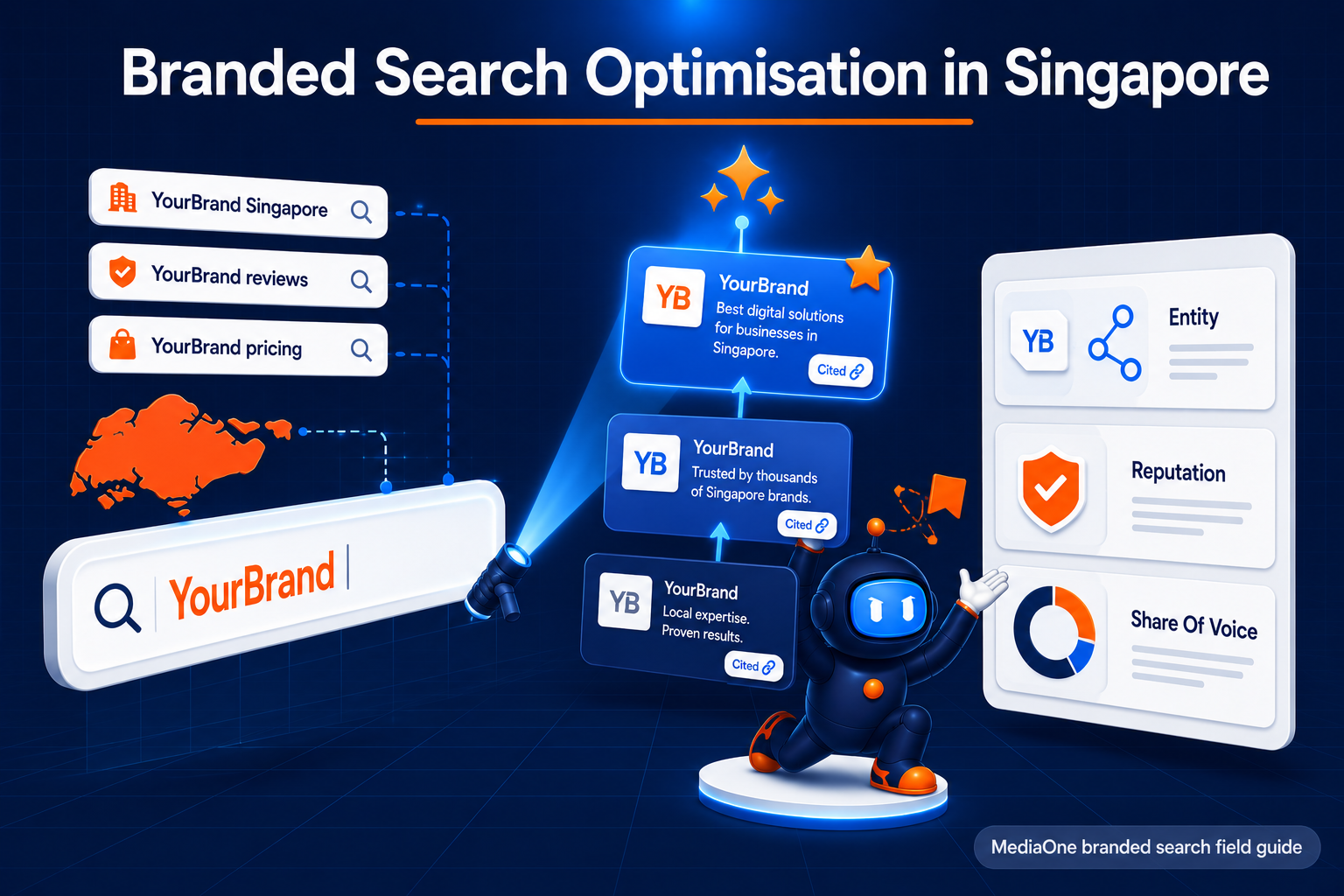
When ChatGPT recommends a brand, something measurable happens next. The reader opens a new tab, types the brand name into Google, and lands on the brand’s website through a branded search. Similarweb’s research on brands recommended through ChatGPT seeing 2.5x more site visits within seven days confirms what most Singapore SEO teams suspected without having the data to prove.
The deeper finding sits inside the methodology. Among visitors who arrived after an AI recommendation, 55.9% reached the site through branded search. Direct clicks from AI surfaces accounted for the minority. Visitors arriving through this post-recommendation branded path also viewed 12 pages and stayed 11.8 minutes on average, compared to 6.5 pages and 5.6 minutes for visitors arriving through other channels.
The behavioural pattern reshapes how Singapore brands should think about AI search investment. The question this guide answers is “What does branded search optimisation Singapore actually involve when AI tools are now generating the demand that branded search captures?”, drawn from the configuration work MediaOne has run for Singapore clients across finance, B2B, e-commerce, and professional services since AI Mode and AI Overviews became measurable surfaces.
Key Takeaways
- AI tools rarely send direct traffic. The Similarweb data shows that 55.9% of post-recommendation visits arrive through branded search, which makes branded search optimisation the bridge between AI visibility and revenue.
- Singapore brands sit inside a window where local competitors have not yet connected AI recommendation visibility to branded search infrastructure. The opportunity to claim category authority closes once the pattern becomes widely understood.
- Visitors arriving through the AI-influenced branded search path view roughly twice the content and stay roughly twice as long. The deeper engagement makes them disproportionately valuable, while it also means generic landing pages waste the opportunity entirely.
- Branded SERP defence becomes mission-critical. A competitor PPC bid, a reseller listing, or a comparison page sitting above your branded result can intercept AI-driven demand at the moment of highest conversion intent.
Why The Similarweb Research Matters For Singapore
The Similarweb dataset focuses on US desktop activity across finance, travel, and beauty industries. The behavioural pattern travels well because the underlying mechanic is universal. AI tools create curiosity, the curious user searches the brand name on Google, and the branded SERP becomes the actual conversion surface where money changes hands.
Singapore consumers follow the same pattern with several local amplifiers. Trust-driven purchase behaviour, bilingual search habits across English and Mandarin, and the heavy use of messaging platforms for verification all funnel through branded search before conversion. The MediaOne client data across the past 18 months shows branded search volume climbing 30% to 70% for clients running structured AI search programmes, with the climb correlating tightly to AI citation visibility tracked across ChatGPT, Claude, Perplexity, and Google AI Overviews.
The Three Behaviours The Research Reveals
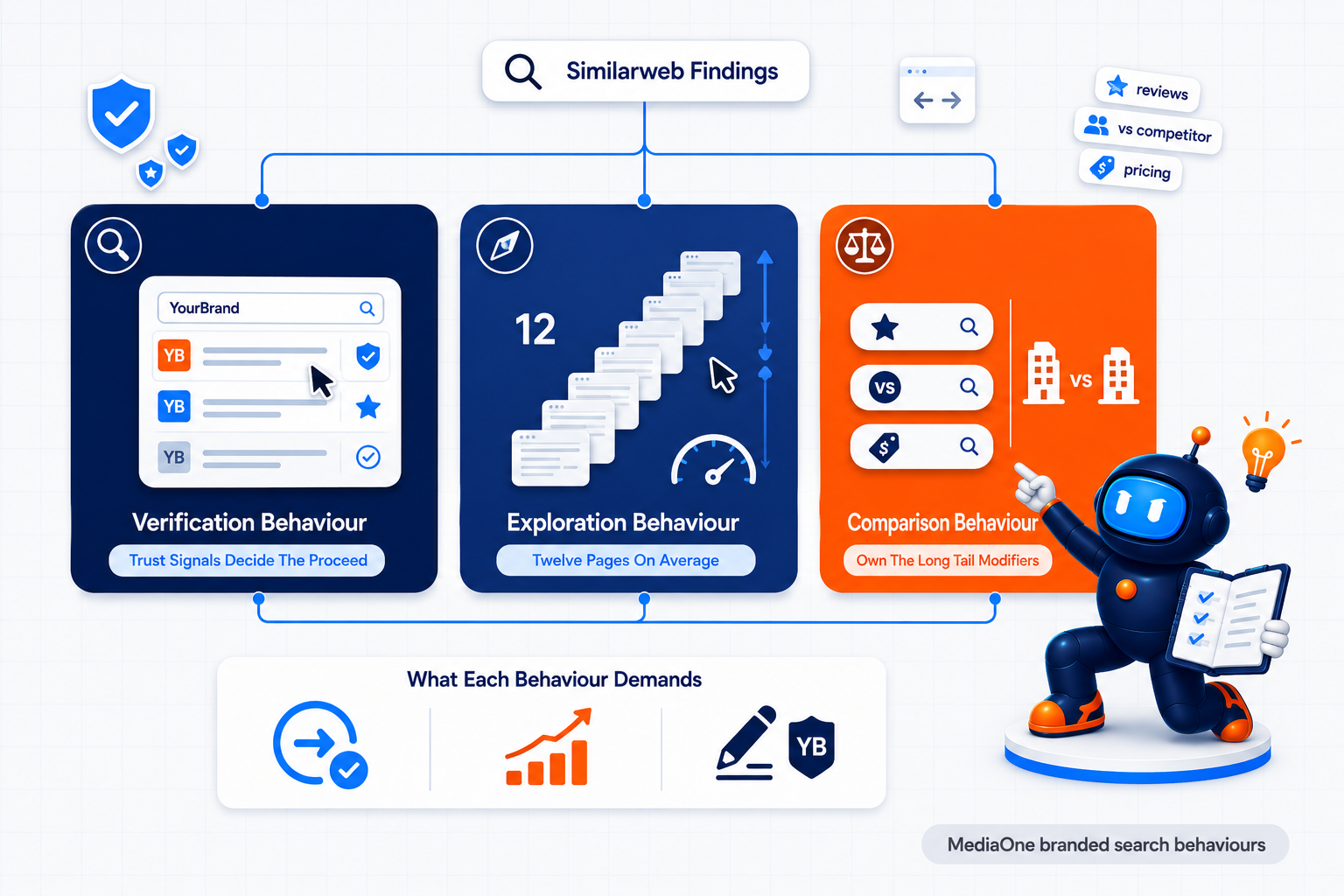
The Similarweb findings expose three distinct user behaviours that change how branded search should be configured.
1. The Verification Behaviour
After seeing a brand recommendation, the user wants to confirm the brand exists, looks legitimate, and feels safe to engage with. The branded SERP becomes the verification surface, which means trust signals across the first ten results decide whether the visitor proceeds.
2. The Exploration Behaviour
Users arriving through the AI-influenced path view 12 pages on average. They are exploring depth. A site that meets this expectation captures the conversion. A site that presents a thin homepage loses the visitor inside three minutes.
3. The Comparison Behaviour
The branded search often includes modifiers such as “reviews”, “vs competitor”, or “pricing”. Sites that own these long-tail branded variations control the comparison narrative. Sites that ignore them watch comparison sites and competitors define the brand for them.
The Strategic Shift Most Singapore SEO Teams Have Missed
Most coverage of AI search frames the conversation around direct AI traffic. The actual opportunity sits in the branded search that AI recommendations trigger downstream.
Singapore SEO teams that still treat branded search as a vanity metric are missing the largest commercial conversion surface inside the AI search shift. The position worth committing to: branded search is the conversion layer of AI visibility. Optimising one without the other leaks the entire investment to a different funnel.
The MediaOne Branded Search Capture Loop
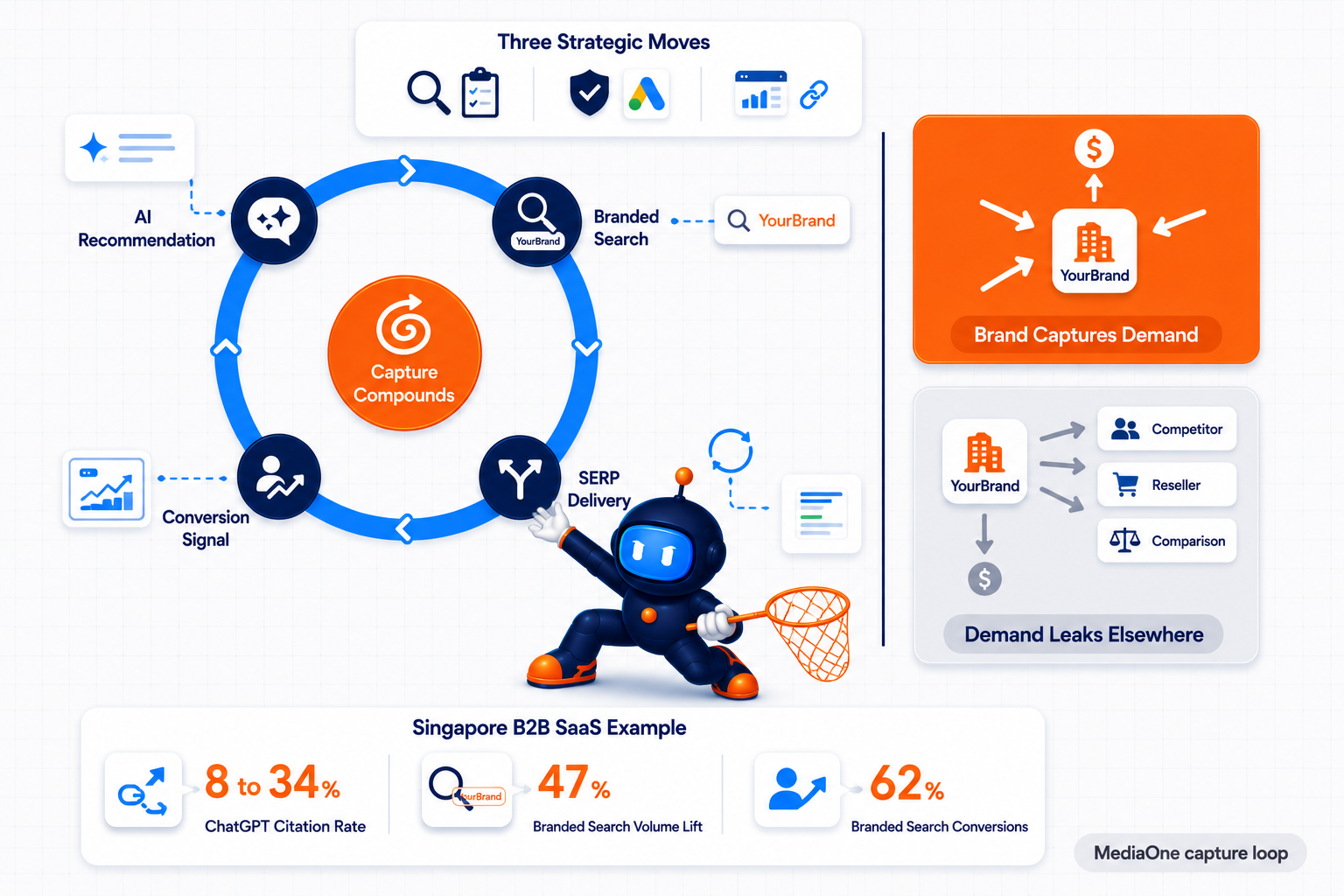
We call this dynamic the Branded Search Capture Loop. An AI tool recommends your brand. The reader searches your brand name in Google. The branded SERP either delivers them to your site or leaks them to a competitor, reseller, or comparison surface. The resulting conversion outcome then compounds back into your AI visibility through behavioural signals such as engaged sessions, low bounce rate, and direct-traffic return visits.
Brands that win this loop see compounding gains across AI citations and traditional rankings simultaneously. Brands that lose it watch their AI visibility translate into traffic for someone else’s funnel.
What This Looks Like In Practice: A Singapore B2B Example
A MediaOne client in the Singapore B2B SaaS category saw their ChatGPT citation rate climb from 8% to 34% across six months of dedicated GEO work. Branded search volume in Singapore climbed 47% over the same period. The first three months of the lift effectively benefited two competitors who were bidding on the client’s brand name through Google Ads. After the team added defensive branded PPC, configured rich snippets across the first-page organic results, and rebuilt the brand-name landing page for deeper engagement, the third quarter saw a 62% lift in branded search conversions and a 41% lift in average session duration from organic branded traffic.
The lesson translates clearly. AI visibility creates demand. Branded search captures demand. Without the second half of the equation, the first half subsidises someone else’s growth.
| Strategic Suggestion | Rationale |
| Audit your branded SERP this quarter | Surfaces interception risks before AI recommendations start sending higher volumes downstream |
| Build branded search defence campaigns across Google Ads | Protects the branded SERP against competitor bids and aggressive resellers at the moment of highest intent |
| Track AI citation visibility and branded search volume together inside one dashboard | The two metrics correlate strongly and should be measured as a single system |
Branded Search Optimisation Singapore: The Three-Track Approach
Earning branded search traffic that actually converts requires three coordinated tracks running together. Single-track approaches consistently underperform.
Track 1: Own The First Page Of Your Branded SERP
The first track involves controlling every result on the first page of a search for your brand name. The reader curious about your brand should find your site, your owned social profiles, your verified reviews, and your earned media inside the first ten results without encountering competing surfaces.
Common branded SERP issues the MediaOne team surfaces during audits:
- Outdated LinkedIn or Facebook profiles ranking ahead of current pages.
- Negative reviews from years ago dominating without counterbalancing recent positive content.
- Competitor Google Ads bids appearing above the organic brand result.
- Comparison sites ranking for the brand name with the client listed as one option among several.
- Resellers or distributors outranking the brand’s own product pages.
A surprisingly common Singapore-specific issue involves Carousell, Hardwarezone, and Reddit threads ranking for branded queries when the brand has not actively built first-page coverage. The MediaOne approach addresses these category-specific interception risks during the initial audit phase, which our SEO services for Singapore businesses sets up as standard during onboarding.
Track 2: Build The Content That AI Tools Actually Recommend
The second track involves earning the AI recommendations that trigger the branded search in the first place. How do AI tools decide which brand to recommend?
The pattern across our GEO optimisation services point to four reinforcing factors:
- Original research that AI tools treat as authoritative
Industry surveys, proprietary benchmarks, and named methodologies all earn citations that other sources can only echo. A Singapore B2B brand that publishes original local data quarterly tends to enter AI recommendation sets within nine months.
- Consistent entity signals across the web
Organization schema with sameAs properties linking to LinkedIn, Crunchbase, Wikipedia, and verified social profiles signals to AI tools that the brand is a defined entity with verifiable provenance.
- Third-party recognition from trusted publications
AI tools weight citations from established publications such as Reuters, Bloomberg, The Business Times, and Channel News Asia far more heavily than self-published content. The work of earning these citations sits closer to digital PR than to traditional SEO.
- Clear definitional content that AI extracts cleanly
Pages opening with a single sentence in the format “Brand is a [category] that [differentiator]” routinely outperform pages opening with marketing prose. The pattern reflects how AI models retrieve and synthesise answers.
Track 3: Configure The Conversion Surface To Match AI-Driven Intent
The third track involves preparing your site for the deeper engagement that AI-influenced visitors bring. These visitors view roughly twice as many pages and stay roughly twice as long. They expect depth, evidence, and specifics that match the AI recommendation that brought them in.
Sites that meet this expectation see strong conversion outcomes. Sites that present a thin homepage with shallow content lose the visitor inside the first session, which feeds back into AI tools as a negative behavioural signal that reduces future recommendation likelihood.
Concrete elements that match AI-driven intent include case studies with named clients and specific outcomes, founder or leadership content with credible bylines, original data or research embedded inside the homepage and key landing pages, and clear path-to-purchase routing without aggressive friction.
The MediaOne Branded SERP Readiness Audit
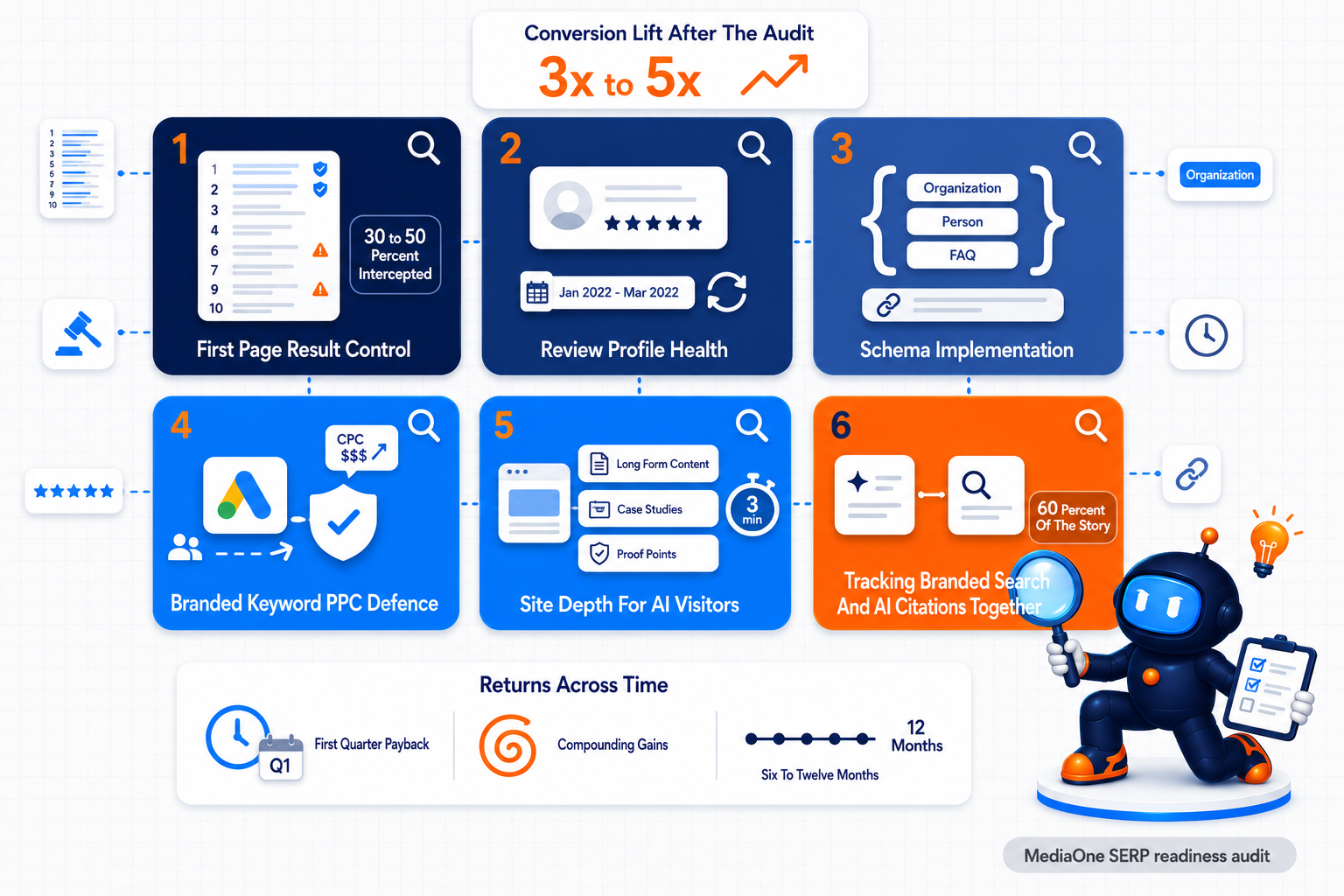
Most Singapore brands skip the diagnostic step before pursuing AI search visibility. The result is wasted citation work that drives branded searches into a SERP that cannot convert them. The MediaOne Branded SERP Readiness Audit walks through six checks before any AI visibility programme begins.
| Check | What To Look For | What It Usually Reveals For Singapore Brands |
| First-page result control | Owned and earned results dominating the first ten positions | Competitor PPC bids and comparison sites intercepting 30% to 50% of branded traffic |
| Review profile health | Positive sentiment across Google Business, industry directories, and trade publications | Outdated negative reviews from 2021 to 2023 ranking above current customer signals |
| Schema implementation | Organization, Person, and FAQ schema in place with consistent sameAs identifiers | Entity confusion preventing AI tools from confidently recommending the brand |
| Branded keyword PPC defence | Defensive bidding on brand and brand-plus-modifier searches | Competitors taking branded clicks at premium CPC inside high-intent moments |
| Site depth for AI-influenced visitors | Long-form content, case studies, and proof points reachable from the homepage | Shallow content losing high-intent visitors within three minutes of arrival |
| Tracking of branded search and AI citations together | Reporting that links the two metrics inside one view | Disconnected reporting masking the actual demand pattern and missing 60% of the story |
Brands that pass these six checks convert AI-driven branded search at three to five times the rate of brands that skip the audit. The discipline pays back inside the first quarter of consistent execution, with compounding gains visible across six to twelve months.
Where Singapore Brands Can Still Define The Category Locally
Most coverage of AI search frames the opportunity as a direct visibility play. The actual opportunity sits inside the territory that connects AI visibility to branded search and ultimately to commercial outcome. Whichever Singapore brand publishes the definitive resources on the topics below first will own the local SERP and the AI citation patterns for the next 18 months.
| Topic | Why It Sits Uncontested | Why It Matters For Singapore Buyers |
| Branded SERP defence framework for Singapore B2B | Most resources cover branded PPC and SEO separately, never as a unified defence layer | Singapore B2B brands face high competitor PPC bidding on brand names |
| Reseller and distributor interception of branded queries | The pattern affects nearly every Singapore brand, while no resource has named or systemised the fix | Direct commercial loss happening daily without owner awareness |
| Branded search behaviour across English and Mandarin segments | Global coverage assumes single-language audiences | Singapore consumer reality requires bilingual branded SERP configuration |
| AI citation lift to branded search conversion measurement | Google offers no direct measurement, so no resource has systemised the workaround | Diagnostic frameworks fill a real reader need locally |
| Defensive content against Hardwarezone, Reddit, and Carousell branded threads | Singapore-specific surface that global content cannot anticipate | Reduces friction during high-stakes purchase decisions |
The brand that publishes the definitive guide on each of these topics first will earn disproportionate citations and rankings inside the local market for the next 12 to 18 months. The territory remains open today, while the window closes once the pattern becomes widely understood.
Measuring Branded Search Optimisation For Singapore Traffic
Google has not released a unified dashboard that links AI citation visibility to branded search outcomes. The absence frustrates Singapore teams. The workaround is more tractable than most coverage suggests.
The MediaOne Branded Search Indicator Set
We track five leading indicators in parallel for Singapore client accounts.
The first indicator covers branded search volume on monthly cadence, segmented by Singapore IP. A rising line shows local readers are actively seeking your brand by name, which correlates strongly with AI citation likelihood.
The second indicator tracks branded SERP composition. A monthly screenshot of the first ten results for your brand name, with annotations on which results you control, which you influence, and which represent interception risk.
The third indicator covers AI citation rate inside ChatGPT, Claude, Perplexity, and Google AI Overviews when queried from Singapore. A monthly manual check across 20 priority topics surfaces whether your brand is gaining citation share locally.
The fourth indicator involves engaged-session growth from direct and branded organic traffic inside GA4, filtered to Singapore. AI-influenced visitors behave consistently with the Similarweb pattern, viewing more pages and staying longer than baseline visitors.
The fifth indicator covers branded PPC interception rate. The share of branded queries on Google Ads where a competitor bid appears above your organic result. The metric reveals where defensive PPC investment is most urgently needed.
| Indicator | What It Tells You | Cadence |
| Branded search volume from Singapore | Whether local readers are actively seeking your brand by name | Monthly |
| Branded SERP composition | Which first-page results you control, influence, or face interception from | Monthly |
| AI citation rate across four surfaces from Singapore queries | Whether AI tools recognise your brand as locally authoritative | Monthly |
| Engaged-session growth from branded organic traffic | Whether AI-influenced visitors are converting at expected depth | Monthly |
| Branded PPC interception rate | Where defensive PPC investment will protect the highest-intent moments | Weekly |
The set works as a leading-indicator panel until Google releases unified reporting. Singapore teams that build this discipline early will sit ahead of the curve once the measurement gap closes.
Trade-Offs And Warnings Worth Stating Plainly
Branded search optimisation requires real investment across SEO, PPC, content, and digital PR. The work compounds, while it also competes with other budget priorities. The candid view worth committing to involves three trade-offs.
- Defensive PPC costs money that some teams find hard to justify
The investment buys protection against interception at the moment of highest conversion intent. Singapore brands operating in categories with aggressive competitor bidding tend to recover the PPC spend through conversion lift inside the first quarter. Brands in less competitive categories may delay the spend without immediate downside.
- Earning AI citations takes time
The discipline rewards consistent effort across six to twelve months. Quick-fix approaches fail predictably. Brands expecting visibility inside 30 days will be disappointed, while brands committing to 12-month programmes routinely see the loop close.
- Some categories benefit more than others
The Similarweb data covered finance, travel, and beauty. Singapore B2B, professional services, and e-commerce show similar patterns in our client data. Industries with primarily offline purchase paths see weaker direct correlation, while the brand-recognition benefit still applies.
The MediaOne View On Branded Search Optimisation In 2026
Most Singapore SEO programmes still treat branded search as a vanity metric and AI visibility as a separate workstream. The Similarweb data confirms that the two are the same conversation viewed from different angles. The brands compounding visibility across the next 18 months treat them as one connected system.
| Habit | What It Looks Like In Practice |
| Track branded search and AI citations as a single system | The two metrics move together and should be measured together inside one dashboard |
| Defend the branded SERP with structured PPC campaigns | Protects the AI visibility investment from competitor interception |
| Publish original Singapore research quarterly | Creates the citation material that triggers AI recommendations downstream |
| Build content depth for AI-influenced visitors | Matches the higher engagement expectations these visitors arrive with |
| Treat branded search as a conversion channel, not an awareness metric | Reframes a previously underused metric as a primary revenue surface |
Branded search is not just a mere passive byproduct of awareness work. It acts as the conversion surface where AI-driven demand actually lands.
Turning AI Recommendations Into Commercial Outcomes
Branded search optimisation now sits at the centre of the AI search opportunity. AI recommendations create curiosity, branded searches capture the intent, and the branded SERP becomes the conversion surface that decides whether your AI visibility investment pays back inside your funnel or somewhere else entirely.
Singapore brands that move first on this work will capture a category-leadership window that closes once competitors recognise the pattern. The earlier you start, the more compounding gains you book before the territory becomes contested. The wider context for this shift sits inside our coverage of digital marketing laws in Singapore for 2026 compliance, which addresses PDPA and cross-border rules that affect how branded search data can be captured and activated.
For Singapore brands building this capability alongside paid campaigns, our high-impact digital marketing campaigns in Singapore for 2026 guide covers the bilingual creative and localisation work that strengthens branded recall before AI recommendations begin driving demand.
If your team is ready to connect AI visibility to branded search infrastructure that actually converts, our team at MediaOne can help. Our geo agency work for ChatGPT, Claude, Perplexity, and Google AI Overview is built around the same principles described throughout this guide. Request a quote to start shaping the strategy that maps to your business.
Frequently Asked Questions
What is branded search optimisation?
Branded search optimisation is the discipline of controlling the search results that appear when someone searches for your brand name in Google. The work involves owning the first page of branded results, defending against competitor PPC bids, configuring schema markup for entity recognition, and preparing the site to convert AI-influenced visitors who arrive after seeing your brand recommended inside ChatGPT, Claude, Perplexity, or Google AI Overviews.
Why does branded search matter for AI search visibility?
Similarweb research shows that 55.9% of post-AI-recommendation traffic arrives through branded search rather than direct AI clicks. The branded SERP becomes the actual conversion surface where AI-driven demand lands, which makes branded search the critical bridge between AI visibility and revenue. Without branded search infrastructure, AI visibility investment leaks into competing funnels.
How do you measure AI search visibility in Singapore?
The MediaOne approach tracks AI citation rate across ChatGPT, Claude, Perplexity, and Google AI Overviews, alongside branded search volume from Singapore IPs, branded SERP composition month over month, engaged-session growth from branded organic traffic, and branded PPC interception rate. The five metrics together surface whether AI visibility is translating into local commercial outcomes.
Can Singapore SMEs compete for AI brand recommendations?
Yes. AI tools recommend brands based on entity signals, content depth, and third-party recognition rather than raw audience size. Singapore SMEs that publish original local research, build consistent entity profiles, and earn citations from trade publications can compete effectively against larger regional players. The MediaOne SME client data confirms the pattern across B2B, professional services, and e-commerce categories.
What is the difference between AI search and traditional SEO?
Traditional SEO focuses on ranking inside Google search results. AI search optimisation focuses on earning citations and recommendations inside AI answers. The two disciplines reinforce each other through branded search, which is where most AI-driven demand actually converts. Treating them as separate workstreams leaves visibility on the table.
How long does branded search optimisation take to show results?
Initial improvements often appear within four to eight weeks for branded SERP control work, while compounding AI citation gains accumulate over six to twelve months. The discipline rewards consistency, with programmes that run continuously outperforming campaigns that pause after early wins.
Should Singapore brands invest in defensive branded PPC?
Yes for any brand operating in a category with active competitor bidding, comparison sites, or aggressive resellers. Defensive branded PPC protects the AI visibility investment from interception at the moment of highest conversion intent. The investment typically recovers itself through conversion lift inside the first quarter for brands in competitive categories.
What is branded SERP defence?
Branded SERP defence is the coordinated practice of controlling every position on the first page of search results for your brand name. The work combines organic SEO across owned and earned properties, defensive PPC against competitor bidding, schema markup that strengthens entity signals, and active management of third-party listings on Carousell, Reddit, Hardwarezone, and similar Singapore-relevant surfaces.
When should Singapore brands start working on branded search optimisation?
The honest answer involves starting within the next 30 days. AI recommendation volume is climbing month over month, while the branded SERP infrastructure that captures the resulting demand takes time to build. Brands that wait will spend the next two years watching their AI visibility benefit competitors who configured branded search infrastructure earlier.