
Online advertising platforms have transformed how businesses in Singapore reach customers, generate leads, and drive sales.
From search engines to social media feeds and eCommerce marketplaces, online advertising platforms allow brands to target specific audiences with measurable precision. Instead of relying on guesswork, businesses can track clicks, conversions, and revenue in real time.
Singapore’s digital economy continues to expand, with high internet penetration and strong mobile usage shaping consumer behaviour. Whether you run an SME, an eCommerce store, or a B2B service company, choosing the right online advertising platforms can directly influence your marketing ROI.
If you are exploring paid search specifically and searching for a reliable Google Ads agency, working with an experienced team can help you structure campaigns, optimise bids, and scale profitably without wasting budget.
Key Takeaways
- The effectiveness of online advertising platforms depends on aligning strategy with business goals and audiences.
- High-intent search campaigns often deliver strong leads, but broader platforms help brand growth.
- Ongoing testing and optimisation are essential for improving ROI.
What Are Online Advertising Platforms?
Online advertising platforms are digital ecosystems that enable businesses to promote products or services across the internet in a structured, measurable way. These platforms place paid messages in front of users on search engines, social media feeds, video platforms, news websites, mobile apps, and online marketplaces.
Unlike traditional advertising, which relies on estimated reach, online advertising platforms are built on data. Every impression, click, and conversion can be tracked. This gives businesses visibility into what is working, what is underperforming, and where to allocate budget more effectively.
At their core, online advertising platforms connect three parties:
- The advertiser who wants visibility
- The user who is browsing, searching, or consuming content
- The platform that matches ads to relevant audiences
That matching process is where sophistication comes in.
How Online Advertising Platforms Decide Which Ads Appear
Most major online advertising platforms operate on an auction system. However, it is not simply a matter of who pays the most. When multiple advertisers compete for the same audience or keyword, the platform evaluates several factors before deciding which ad appears and in what position.
Key elements typically include:
- Bid amount: The maximum amount an advertiser is willing to pay for a click, impression, or conversion.
- Ad quality and relevance: Platforms assess how closely the ad aligns with user intent or audience interests. Strong alignment improves performance and often reduces cost.
- Expected click-through rate: Historical performance data helps platforms predict whether users are likely to engage with the ad.
- Landing page experience: The quality, relevance, speed, and usability of the destination page influence ranking. A slow or misleading page can reduce visibility.
Because of this multi-factor system, advertisers with smaller budgets can still compete effectively when their targeting and messaging are strong. That balance between bid strategy and quality signals is what makes online advertising platforms performance-driven rather than purely budget-driven.
Types of Online Advertising Platforms
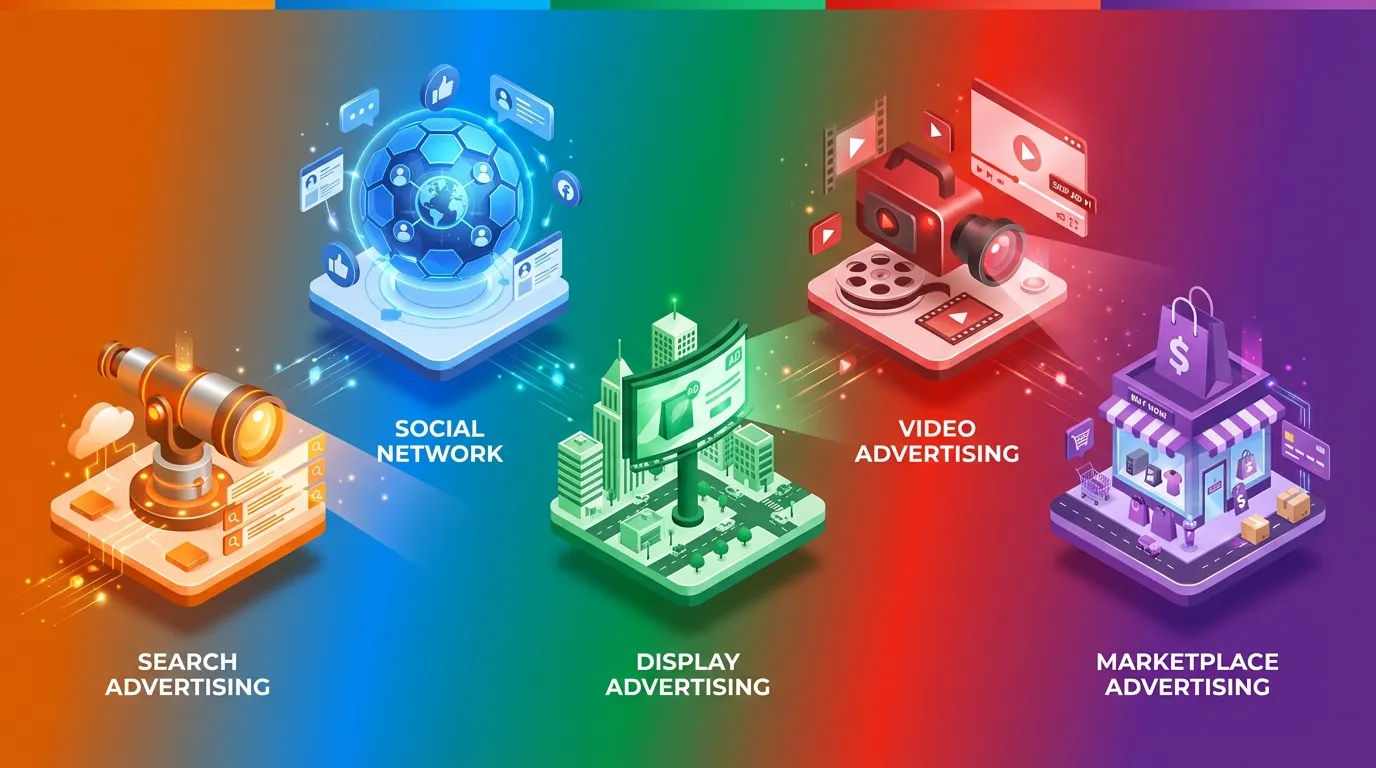
Online advertising platforms can be grouped by where and how ads are delivered.
- Search advertising platforms: These display ads when users actively search for keywords. They are often used for capturing high-intent traffic.
- Social media advertising platforms: These target users based on behaviour, demographics, and interests. They are commonly used for brand awareness, engagement, and retargeting.
- Display advertising platforms: These place banner or image-based ads across publisher websites and apps.
- Video advertising platforms: These deliver ads before, during, or alongside video content.
- Marketplace advertising platforms: These promote products within eCommerce ecosystems, helping sellers gain visibility on shopping platforms.
Each type serves a different purpose in the marketing funnel. Some focus on demand capture, others on demand creation.
The most effective strategy often involves combining multiple online advertising platforms so that awareness, consideration, and conversion work together rather than in isolation.
Why Online Advertising Platforms Matter for Modern Businesses
Today’s consumers rarely move in a straight line from discovery to purchase. They search, compare, scroll, watch, revisit, and research again. Online advertising platforms allow businesses to stay present throughout that journey.
They provide:
- Measurable performance data
- Real-time optimisation capabilities
- Audience segmentation
- Budget flexibility
- Geographic targeting precision
In practical terms, this means a local service provider can target only users in specific Singapore districts. An eCommerce brand can retarget visitors who abandoned their cart. A B2B firm can narrow campaigns to decision-makers in selected industries.
That level of control is what differentiates online advertising platforms from traditional media. Instead of paying for exposure alone, businesses invest in systems designed to drive specific outcomes.
Understanding how these platforms function is the first step toward using them strategically rather than tactically.
Why Businesses in Singapore Rely on Online Advertising Platforms

Singapore’s business environment is fast-moving, competitive, and deeply digital. Companies do not adopt online advertising platforms simply because they are modern tools. They rely on them because consumer behaviour in Singapore makes digital visibility a practical necessity rather than a marketing experiment.
Reason #1: Singapore Has a Highly Connected Population
Singapore consistently ranks among the most connected countries in the world, leading globally in internet speed and among the highest in smartphone penetration. Most residents are online daily, whether they are researching services, comparing prices, reading reviews, or making purchases.
For businesses, this means your audience is already spending time on search engines, social networks, video platforms, and eCommerce marketplaces. Online advertising platforms allow you to meet them where they are already active instead of trying to redirect attention from offline channels.
This level of connectivity shortens the customer journey. Someone can search, evaluate options, and submit an enquiry within minutes. Paid visibility ensures your brand appears during that decision-making window.
Reason #2: Mobile-First Consumer Behaviour
Singapore consumers rely heavily on smartphones. Product research, food delivery orders, appointment bookings, and even B2B enquiries often begin on mobile devices.
Online advertising platforms are built to support this behaviour. Campaigns can be optimised for:
- Mobile search intent
- App engagement
- Click-to-call actions
- Location-based targeting
Traditional advertising struggles to match this immediacy. A billboard cannot adapt to a user’s location or browsing history. A search ad can.
Reason #3: Digitally Informed Buyers
Consumers in Singapore tend to compare options carefully. They read reviews, explore alternatives, and evaluate credibility before committing. This applies to both consumer purchases and professional services.
Online advertising platforms support this research-driven mindset by allowing businesses to:
- Appear for high-intent search queries
- Retarget website visitors who did not convert
- Deliver educational video content
- Showcase testimonials and social proof
Instead of relying on one exposure, brands can build layered visibility across multiple touchpoints.
Reason #4: Measurable and Accountable ROI
One of the strongest reasons businesses favour online advertising platforms is transparency. Digital campaigns provide detailed reporting on:
- Impressions
- Click-through rates
- Cost per click
- Conversion rates
- Revenue generated
This visibility supports smarter decision-making. Marketing budgets can be shifted toward campaigns that produce results and reduced where performance lags.
Compared to traditional channels such as print or outdoor media, the level of measurement available in online advertising platforms gives business owners clearer control over their investment.
Reason #5: Precise Geographic Targeting Within Singapore
Singapore’s compact geography creates unique advertising opportunities. Businesses can narrow campaigns to specific districts, neighbourhoods, or proximity radii around physical stores.
For example:
- A tuition centre can target parents within a defined catchment area.
- A clinic can focus ads within a few kilometres of its location.
- A B2B consultancy can prioritise central business districts.
Online advertising platforms allow this level of granularity without inflating costs in irrelevant regions.
Reason #6: Budget Flexibility and Scalable Growth
Unlike long-term media contracts, online advertising platforms provide flexibility. Budgets can be adjusted based on seasonality, campaign performance, or business capacity. A growing SME might begin with a controlled monthly spend focused on search campaigns. As revenue increases, additional channels such as social or display advertising can be layered into the strategy.
Scaling becomes deliberate rather than speculative.
Reason #7: Faster Testing and Continuous Optimisation
Traditional advertising often requires committing to creative and placements before results are known. Digital campaigns allow ongoing refinement.
Businesses can:
- Test different headlines and visuals
- Compare audience segments
- Optimise landing pages
- Adjust bidding strategies
This iterative approach encourages steady performance improvements over time. Online advertising platforms reward consistency and data analysis rather than one-time creative decisions.
The Bigger Picture
Online advertising platforms align closely with how Singapore consumers discover and evaluate brands. They support precision, accountability, and adaptability in a market where competition is strong and attention spans are limited. For many businesses, digital advertising is no longer a supplementary tactic. It functions as a primary growth engine, integrated into broader marketing, sales, and customer retention strategies.
How Google Ads Dominates Online Advertising Platforms for High-Intent Leads

Among all online advertising platforms available to businesses in Singapore, Google Ads remains the most reliable channel for capturing high-intent demand. Its strength lies in timing. It places your business in front of users at the exact moment they are searching for a solution.
When someone types “emergency plumber Singapore,” “audit firm for SME,” or “best renovation contractor near me,” they are not casually browsing. They are actively evaluating options. That search behaviour signals commercial intent.
Unlike interruption-based advertising, search ads respond directly to an expressed need. This is what separates Google Ads from many other online advertising platforms. It does not rely on predicting interest. It responds to declared intent.
Why Google Ads Continues to Lead
Several structural advantages explain why Google Ads consistently outperforms other online advertising platforms for lead generation:
- Direct access to high-intent keywords: Advertisers can target exact search terms that indicate readiness to buy.
- Immediate visibility on search results pages: Paid listings appear above organic results for competitive queries.
- Granular geographic targeting: Campaigns can focus on Singapore as a whole or narrow down to specific districts.
- Full-funnel measurement: Conversion tracking links clicks to enquiries, purchases, calls, and form submissions.
- Keyword and bid control: Advertisers can adjust match types, bids, and budgets based on performance data.
These capabilities make Google Ads particularly effective for:
- Local service providers
- Professional services firms
- B2B companies
- eCommerce brands targeting purchase-ready traffic
Ad Formats Within Google Ads

Google Ads is not limited to search listings. It supports multiple formats across different stages of the customer journey:
- Search campaigns that appear when users enter keywords
- Display campaigns across websites in the Google Display Network
- Performance Max campaigns that automate placements across Google properties
- Shopping ads for product-based businesses
- YouTube ads for video engagement
Despite this range, search campaigns often deliver the most immediate return for SMEs focused on enquiries and sales. High-intent traffic tends to convert faster because users have already identified a need.
Evaluating Google Ads Against Other Online Advertising Platforms for SME Growth
While Google Ads dominates intent-driven acquisition, other online advertising platforms serve different strategic roles. SME growth rarely depends on a single channel. The right mix depends on goals, budget, and audience behaviour.
| Criteria | Google Ads | Meta Ads | LinkedIn Ads | TikTok Ads |
| Primary Strength | Captures high-intent demand | Builds awareness and interest | Targets specific professionals | Drives engagement through video |
| Targeting Basis | Search keywords and user queries | Interests, demographics, behaviour | Job title, industry, seniority, company size | Behavioural signals and content interaction |
| Intent Level | High purchase or enquiry intent | Mid to upper funnel interest | Professional and B2B intent | Discovery and engagement intent |
| Cost Structure | Competitive CPC based on keywords | Variable CPC based on audience competition | Generally higher CPC | Variable CPC, creative-driven performance |
| Best For | Service-based SMEs, local businesses, eCommerce with active demand | Retail, lifestyle, consumer brands | B2B services, corporate training, professional services | Youth-focused brands, fashion, beauty |
| Creative Requirement | Moderate. Strong copy and landing page alignment | High. Visual storytelling improves performance | Moderate. Professional messaging required | Very high. Video-first creative is essential |
| Speed of Lead Generation | Typically faster for high-intent keywords | Gradual. Often requires nurturing | Slower but targeted | More awareness-focused than lead-focused |
| Role in Funnel | Bottom-funnel conversion | Top to mid-funnel awareness and retargeting | Mid to bottom-funnel B2B targeting | Top-funnel discovery |
Google Ads vs Meta Ads
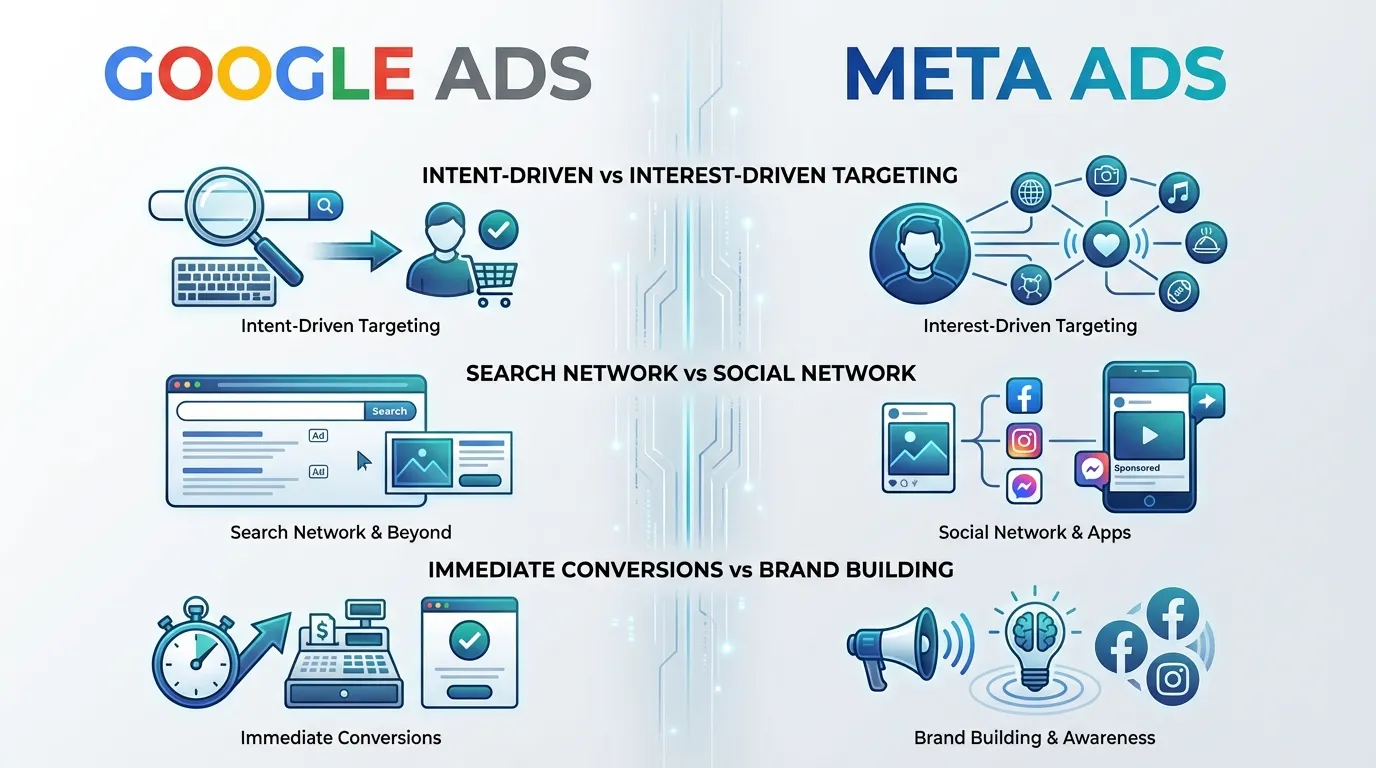
Meta Ads operates on a different logic from search-based advertising. Instead of waiting for users to declare intent, Meta introduces products and services based on interests, demographics, and behavioural signals.
The contrast is straightforward:
- Google Ads captures existing demand.
- Meta Ads stimulates new demand.
For SMEs operating with constrained budgets, prioritising high-intent traffic often stabilises cash flow. Once predictable revenue is established, Meta Ads can expand reach and nurture brand awareness.
Many successful Singapore businesses combine both approaches, using search to convert ready buyers and social media to influence earlier-stage prospects.
Meta Ads is particularly effective for:
- Visual products
- Lifestyle brands
- Retail and consumer goods
- Businesses with strong creative assets
It performs best when supported by strong storytelling and retargeting strategies.
Google Ads vs LinkedIn Ads

LinkedIn Ads serve a narrower but highly specific purpose. It enables targeting based on job title, industry, seniority, and company size. For B2B organisations selling to decision-makers, that precision can justify higher advertising costs.
Key differences include:
- LinkedIn Ads generally carry a higher cost per click.
- Targeting is based on professional identity rather than search intent.
- Campaigns are often used for lead magnets, webinars, or account-based marketing.
Google Ads may generate broader keyword-driven traffic, especially when decision-makers are searching for solutions independently. LinkedIn Ads excels when the objective is to reach a defined list of roles or industries.
For SMEs selling complex B2B services, combining the two platforms can yield stronger pipeline coverage. Search captures demand. LinkedIn builds awareness among targeted stakeholders.
Google Ads vs TikTok Ads

TikTok Ads focuses heavily on short-form video engagement. Its algorithm surfaces content based on behavioural signals and user interaction patterns.
TikTok Ads are particularly strong for:
- Youth-focused brands
- Fashion, beauty, and lifestyle categories
- Creative campaigns with strong visual storytelling
However, TikTok does not rely on search-driven intent in the same way Google Ads does. The platform excels at discovery and engagement rather than immediate solution-based searches.
Service-based SMEs that rely on direct enquiries often achieve stronger lead capture performance with Google Ads. TikTok may drive brand awareness, but it rarely replaces high-intent search traffic for professional services.
Which Platform Should You Use?
Choosing between online advertising platforms should not be framed as a competition. Each platform addresses a different stage of the buying journey. Here’s a simplified framework that helps clarify priorities:
- Need immediate leads and measurable ROI? Search-focused online advertising platforms such as Google Ads typically perform best.
- Building awareness for a new brand or product? Social platforms such as Meta Ads or TikTok Ads can accelerate visibility.
- Targeting specific job titles in B2B sectors? LinkedIn Ads offers unmatched professional segmentation.
Experienced marketers often layer these channels rather than relying on one exclusively. Search campaigns convert high-intent users. Social campaigns nurture prospects. Retargeting ties both together.
For SMEs in Singapore, the most stable growth often begins with intent-driven online advertising platforms and expands into awareness channels once conversion economics are validated.
Is Meta the Best Choice Among Online Advertising Platforms for Brand Growth?

When businesses compare online advertising platforms for brand growth, Meta consistently enters the conversation. Through Meta Ads, advertisers can reach users across Facebook and Instagram with highly visual, behaviour-driven campaigns.
In Singapore, where social media usage is deeply embedded in daily life, this creates meaningful opportunities for sustained brand exposure. However, the real question is not whether Meta is popular. It is whether it is the right platform for your specific growth objective.
Brand growth requires more than impressions. It demands attention, recall, emotional connection, and repeated visibility across the buying journey. This is where Meta distinguishes itself among online advertising platforms.
Where Meta Excels Among Online Advertising Platforms
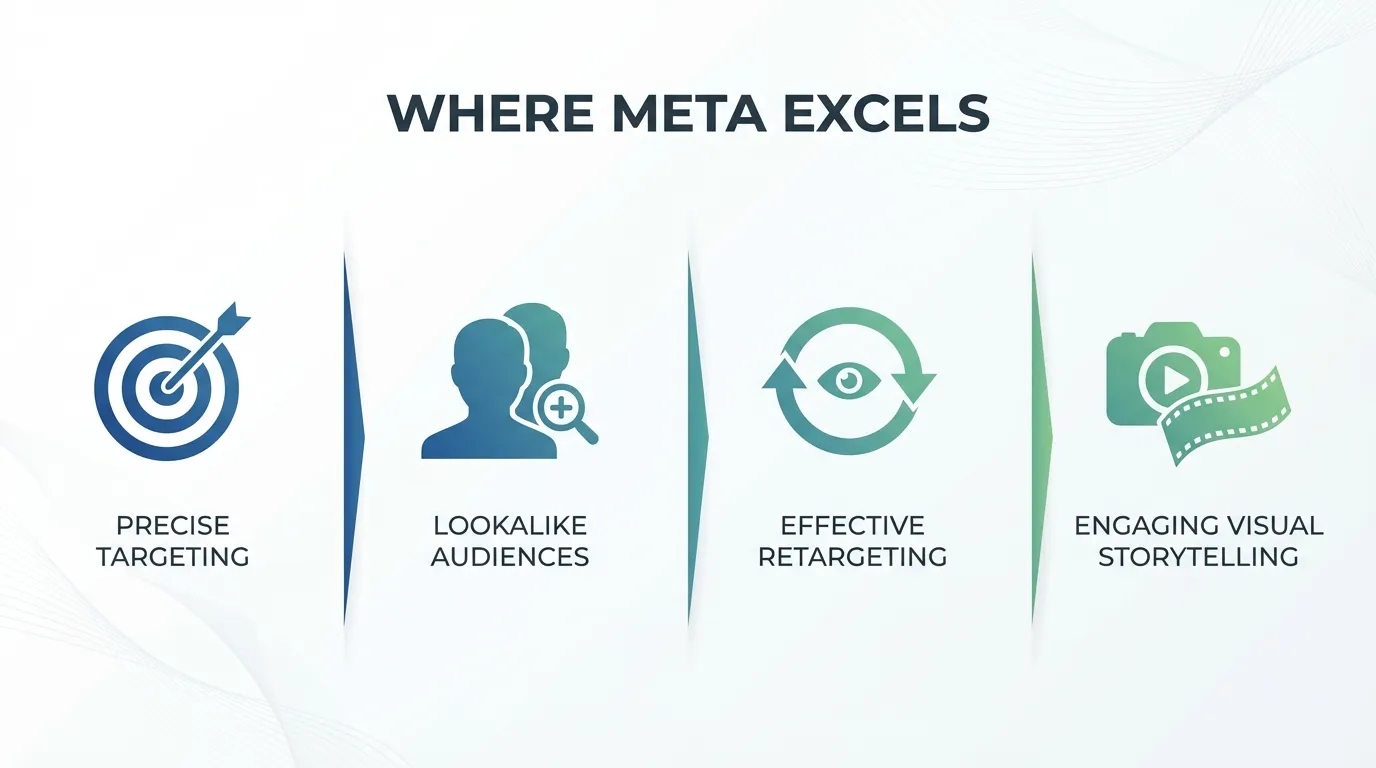
Meta’s strength lies in its depth of audience data and creative flexibility. Unlike search platforms that respond to active queries, Meta operates in a discovery environment.
Users are not necessarily looking for your product, but the platform can introduce it to them in contextually relevant ways. Here are the areas where Meta performs strongly:
1. Advanced Interest and Behaviour Targeting
Meta allows advertisers to target users based on:
- Interests and hobbies
- Purchase behaviour
- Life events
- Demographics
- Device usage
This enables brands to define audience segments with precision. For example, a skincare brand can target users interested in beauty content, skincare routines, and luxury shopping within Singapore.
2. Lookalike Audiences for Scalable Reach
Lookalike audiences allow you to expand beyond existing customers. By analysing your customer list or website visitors, Meta identifies users with similar behavioural patterns.
This is particularly useful when:
- Scaling an eCommerce brand
- Expanding into new districts within Singapore
- Growing a niche lifestyle business
Among online advertising platforms, Meta’s lookalike functionality remains one of its most practical scaling tools for brand campaigns.
3. Retargeting Capabilities
Brand growth is rarely linear. Consumers often interact with a brand multiple times before converting.
Meta’s retargeting options allow you to:

- Re-engage website visitors
- Target users who watched a percentage of your videos
- Reconnect with users who added items to the cart
- Re-market to Instagram profile visitors
This layered exposure strengthens brand recall and moves users gradually toward purchase.
4. Visual Storytelling Formats
Meta supports diverse creative formats, including:
- Short-form videos
- Carousel ads
- Collection ads
- Reels placements
- Stories placements
Brand growth depends heavily on narrative. A restaurant can showcase ambience and dishes through video. A fitness brand can share testimonials. A fashion label can highlight seasonal collections with carousels.
Static ads still have a role, but video and interactive formats often generate higher engagement in brand-driven campaigns.
Industries That Benefit Most From Meta Among Online Advertising Platforms
While Meta can support many sectors, certain industries tend to see stronger brand-building performance:
- Retail and eCommerce
- Beauty and skincare
- Food and beverage
- Lifestyle and fashion
- Fitness and wellness
These industries rely on visual appeal and emotional connection. Meta’s creative ecosystem supports that dynamic well.
For example, a café launching a new seasonal menu may not capture immediate search intent. Instead, visually compelling social ads can spark interest and drive foot traffic over time.
When Meta May Not Be the Best Primary Channel
Brand growth and lead generation are not identical goals. If your priority is capturing users who are actively searching for a solution, search-based online advertising platforms may deliver stronger short-term performance.
For example:
- A corporate tax advisory firm
- A legal consultancy
- A renovation contractor
- A B2B logistics provider
These businesses often benefit more from intent-driven search traffic than from passive social exposure.
Meta can still support retargeting and brand reinforcement. However, relying solely on social campaigns for immediate lead volume may produce slower results.
How to Decide If Meta Is Right for Your Brand Growth Strategy
Before allocating budget to Meta, consider the following:
- Are you trying to build awareness or capture existing demand?
- Does your product benefit from visual storytelling?
- Can you invest in strong creative production?
- Is your audience actively engaging on Facebook or Instagram?
If your answers align with discovery-based marketing, Meta is likely one of the more effective online advertising platforms for long-term brand growth in Singapore. But if your objective is immediate high-intent lead capture, pairing Meta with search-based campaigns creates a more balanced strategy.
Meta is not automatically the best choice among online advertising platforms. It excels when used intentionally for brand building, community engagement, and retargeting. Its targeting depth and creative flexibility provide powerful tools, but outcomes depend on strategic alignment.
In practice, the strongest growth strategies rarely rely on a single platform. Businesses that integrate Meta for awareness, search for intent capture, and retargeting for reinforcement often create a more sustainable digital presence.
Other Leading Online Advertising Platforms in Singapore
Beyond search and social giants, several other online advertising platforms play an important role in Singapore’s digital ecosystem. These platforms are often overlooked in beginner guides, yet they can unlock incremental growth when used strategically.
Instead of treating them as secondary options, it helps to understand where they fit within your marketing funnel and how they complement your primary channels.
Microsoft Advertising

Microsoft Advertising runs ads across the Microsoft Search Network, which includes Bing, AOL, Yahoo, DuckDuckGo, Ecosia, and partner sites. While its market share in Singapore is smaller compared to Google’s, that difference can actually create an opportunity.
Why Businesses Use Microsoft Advertising
- Lower competition in certain industries: Because fewer advertisers prioritise the Bing ecosystem, cost per click can sometimes be lower. This is not guaranteed and depends on the industry, but SMEs in legal, finance, and B2B sectors often test it to diversify traffic sources.
- Access to professional demographics: Microsoft’s ecosystem includes LinkedIn data integration. This allows targeting layers by company, industry, or job function. For B2B campaigns, that additional filtering can improve lead quality.
- Complementary to Google Ads strategy: Rather than replacing Google, Microsoft Advertising is typically deployed as an extension of an existing paid search strategy. Campaign structures can often be replicated and adjusted with minimal operational friction.
When It Makes Sense
- You are already profitable on Google Ads and want to scale further.
- Your target audience includes corporate decision-makers.
- You want to test incremental traffic without dramatically increasing risk.
Microsoft Advertising rarely serves as the sole traffic engine for SMEs in Singapore, but it can be a valuable secondary channel within a diversified mix of online advertising platforms.
YouTube Ads
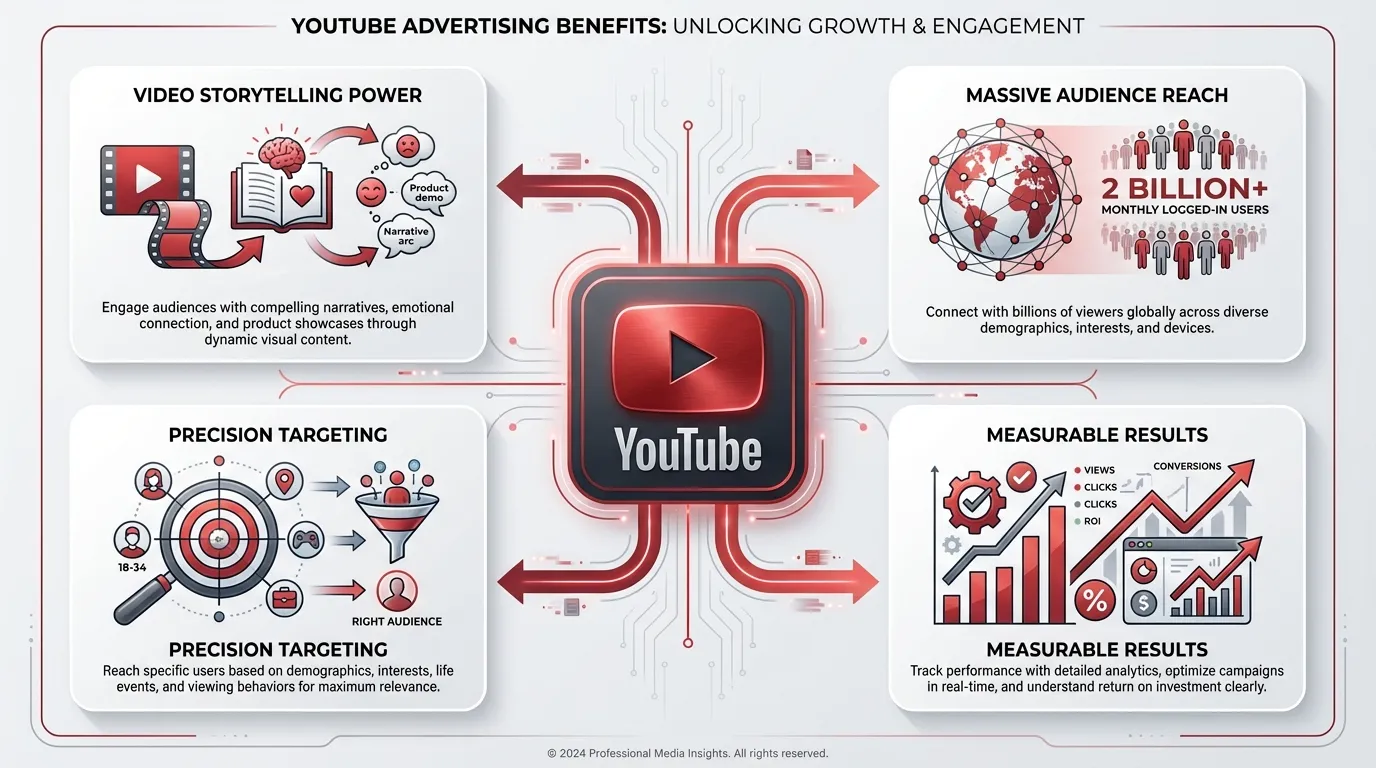
YouTube Ads allows businesses to place video ads before, during, or after video content. Since YouTube is one of the most visited platforms in Singapore, it offers a broad reach combined with strong targeting options. Unlike search ads, YouTube does not rely on immediate keyword intent. It works higher up the funnel, influencing awareness and consideration.
Main Ad Formats
- Skippable in-stream ads that viewers can skip after five seconds.
- Non-skippable ads designed for short, impactful messaging.
- Bumper ads, which are six-second, non-skippable placements, focused on recall.
Strategic Role in the Funnel
YouTube Ads perform well for:
- Brand storytelling
- Product demonstrations
- Educational explainers
- Retargeting warm audiences
For example, a tuition centre in Singapore might use Google Search campaigns to capture parents actively searching for classes, then deploy YouTube retargeting ads to reinforce credibility and testimonials.
Because YouTube is part of the Google ecosystem, audience data and remarketing lists can be integrated across campaigns. This creates continuity across different online advertising platforms within the same advertising account.
Shopee Ads
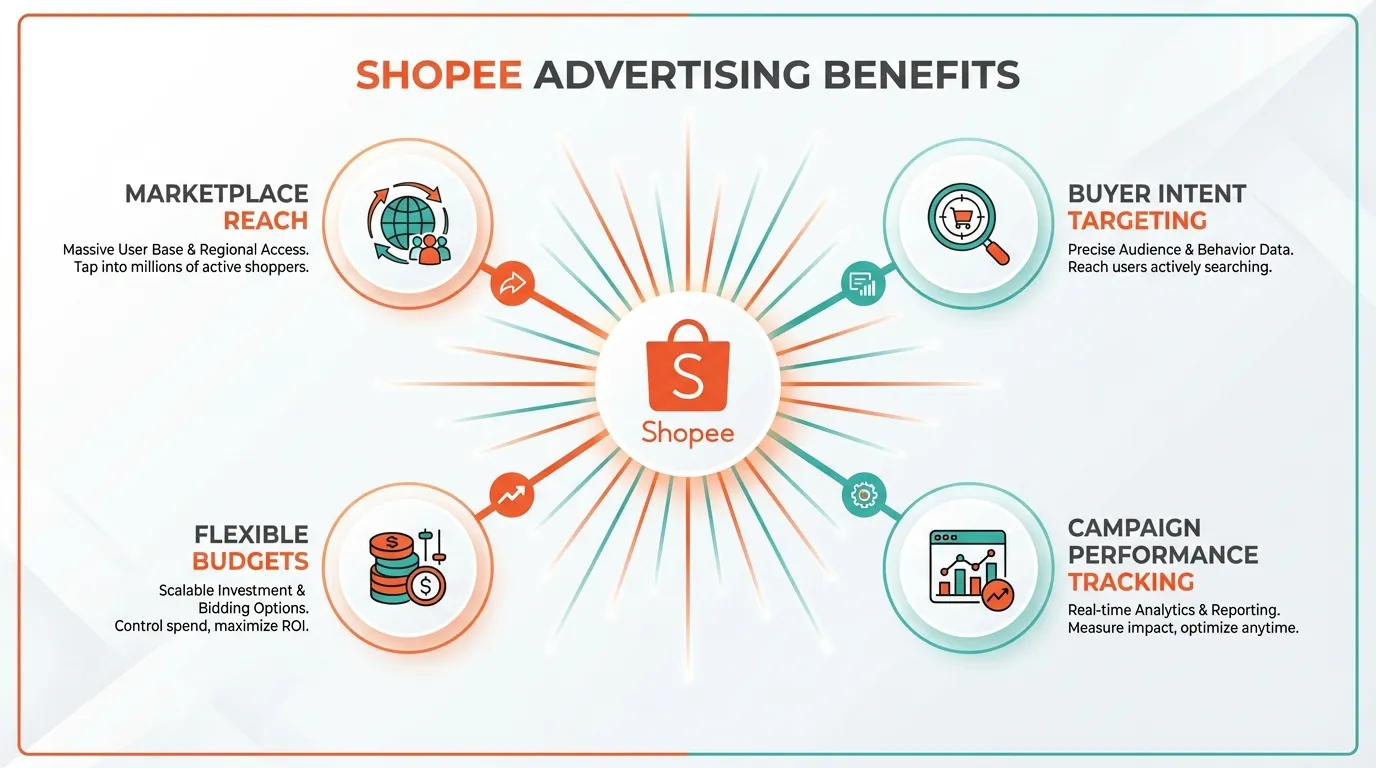
Shopee Ads is embedded within the Shopee marketplace. It is not designed to drive traffic to your standalone website. Instead, it increases visibility inside Shopee’s search results and category pages. For eCommerce brands operating in Singapore, marketplace advertising often determines whether a product is seen at all.
Why Shopee Ads Matter
Shopee’s platform is highly competitive. Organic ranking alone may not sustain visibility, especially in saturated categories such as:
- Beauty and skincare
- Consumer electronics
- Home essentials
- Fashion
Shopee Ads offers:
- Sponsored product placements
- Keyword bidding within Shopee search
- Increased exposure during campaign periods
When to Use Shopee Ads
- You rely heavily on marketplace revenue.
- You operate in competitive categories with price-sensitive consumers.
- You want to dominate visibility during sales events.
Unlike broader online advertising platforms, Shopee Ads focuses on conversion within the marketplace environment. The user’s intent is often transactional, making it effective for direct sales.
Lazada Sponsored Solutions

Lazada Sponsored Solutions provides advertising placements inside the Lazada marketplace. Similar to Shopee Ads, it increases product visibility through paid positioning.
Marketplace competition in Singapore can be intense. Visibility often influences sales velocity, which in turn affects organic ranking. This creates a feedback loop where paid visibility can indirectly support organic growth.

Key Benefits
- Sponsored product listings
- Improved placement within category pages
- Data-driven performance tracking
Strategic Importance of Marketplace Advertising
For product-based businesses, marketplace online advertising platforms are not optional add-ons. They are often central to revenue growth. If most of your transactions occur on Lazada or Shopee, allocating budget internally can generate higher direct returns than sending traffic to an external website.
However, marketplace ads should be managed carefully. Without clear margin tracking and performance analysis, it becomes difficult to determine true profitability.
How These Platforms Fit Into a Broader Strategy
Not every business in Singapore needs every platform. The decision should depend on:
- Your primary revenue channel
- Your target audience behaviour
- Your margin structure
- Your stage of growth
A B2B consultancy may prioritise Google Ads and Microsoft Advertising. A beauty brand selling primarily on Shopee might focus on marketplace ads supported by Meta and YouTube to drive awareness. A lifestyle startup could combine TikTok for discovery with retargeting across search and display.
Online advertising platforms are most effective when they are integrated rather than isolated. Search captures intent. Social builds demand. Video strengthens recall. Marketplaces convert ready buyers.
When these channels work together, performance becomes more predictable and scalable.
How to Maximise ROI From Online Advertising Platforms

Maximising ROI from online advertising platforms is not about spending more. It is about spending smarter. Many businesses in Singapore increase their budgets when results slow, assuming that scale will fix performance.
In reality, sustainable returns come from structured optimisation, disciplined testing, and consistent analysis. Below is a practical framework you can apply across search, social, display, and marketplace campaigns:
Test Multiple Ad Creatives With Clear Hypotheses
Creative fatigue is one of the most common reasons performance declines on online advertising platforms. Users see the same message repeatedly, engagement drops, and costs increase.
Instead of randomly changing headlines or visuals, approach creative testing methodically. Focus on:
- Different value propositions, such as price, speed, expertise, or guarantees
- Alternative calls to action
- Variations in tone, whether direct-response or educational
- Different visual formats, including static images, carousels, and short-form video
Run tests long enough to collect meaningful data. Avoid turning off ads prematurely unless performance is clearly underperforming across statistically relevant metrics.
Refine Keyword Targeting Based on Intent
For search-based online advertising platforms, keyword quality often matters more than volume. Broad keywords generate traffic. High-intent keywords generate revenue.
Instead of targeting “insurance Singapore,” which is broad and competitive, a business might focus on “SME liability insurance Singapore quote.” The second term signals immediate buying intent.
To refine targeting:
- Review search term reports weekly
- Add negative keywords to filter irrelevant traffic
- Segment branded and non-branded campaigns
- Separate high-intent keywords from research-stage queries
This prevents budget leakage and increases conversion efficiency.
Adjust Bids Using Performance Data, Not Assumptions
Modern online advertising platforms provide automated bidding options, but automation still requires oversight.
Review:
- Cost per acquisition
- Conversion rate
- Return on ad spend
- Device-level performance
- Geographic performance within Singapore
If mobile traffic converts poorly, investigate the landing page experience before reducing mobile bids. If certain districts perform better, consider adjusting location targeting. Data should inform bid decisions. Guesswork leads to wasted spend.
Build and Nurture Retargeting Audiences

Most users do not convert on their first visit. Retargeting allows you to reconnect with people who have already shown interest.
Effective retargeting strategies include:
- Website visitor campaigns
- Cart abandonment reminders
- Video viewer retargeting
- Lookalike audiences based on converters
For example, an eCommerce brand running ads on Shopee and Google may retarget users who viewed product pages but did not purchase. Messaging at this stage can address objections, such as delivery time or return policies.
Retargeting often delivers a stronger ROI than cold traffic because the audience is already familiar with the brand.
Improve Landing Page Speed and Clarity
Online advertising platforms can drive traffic efficiently. However, traffic does not guarantee conversions. Landing pages should:
- Load quickly on mobile devices
- Clearly state the value proposition above the fold
- Provide a simple call to action
- Minimise unnecessary distractions
- Align messaging with the ad promise
If your ad promotes “Free Consultation for SME Tax Filing,” the landing page must immediately reinforce that offer. Any disconnect increases bounce rate and reduces Quality Score in search campaigns.
Even small improvements in conversion rate can significantly impact ROI. Increasing the conversion rate from 2 per cent to 3 per cent represents a 50 per cent uplift without increasing ad spend.
Align Platform Strategy With Funnel Stage
Different online advertising platforms serve different roles in the customer journey.
- Search platforms capture demand
- Social platforms create awareness
- Marketplace platforms drive direct product sales
- Display campaigns support remarketing
Trying to use every platform for direct conversions often leads to frustration. A structured funnel approach improves clarity and performance.
For instance, a B2B consultancy might use LinkedIn to build authority, Google Search to capture active leads, and retargeting ads to close prospects who visited pricing pages.
Track What Actually Matters
Clicks are not revenue. Impressions are not growth. Ensure tracking includes:
- Form submissions
- Phone call tracking
- eCommerce purchases
- Lead quality scoring
- Offline conversion imports where relevant
Without proper tracking, optimisation decisions become unreliable. High-performing campaigns are built on accurate data.
The Real Driver of Sustainable Growth
Increasing the budget without improving efficiency only magnifies weaknesses. Sustainable growth across online advertising platforms comes from disciplined optimisation, consistent testing, and strategic allocation. When campaigns are structured properly, creative is refreshed regularly, and landing pages convert effectively, ROI improves naturally. Scaling then becomes a calculated decision rather than a gamble.
In competitive markets like Singapore, that distinction makes all the difference.
Making Online Advertising Platforms Work for Long-Term ROI

Long-term returns from paid media do not happen by accident. They are built on clear objectives, disciplined optimisation, and consistent performance analysis. Businesses that treat paid campaigns as short-term experiments often struggle with rising costs and inconsistent results. Those who treat them as strategic growth channels tend to see compounding gains over time.
The key is alignment. Your targeting, creative, bidding strategy, and landing pages must support the same business objective. Data should guide decisions, not assumptions or trends. When campaigns are structured properly, inefficiencies become visible. Once identified, they can be corrected before budgets are scaled.
For many SMEs and growth-stage companies in Singapore, search advertising plays a central role because it captures high-intent demand. However, managing these campaigns effectively requires technical precision, keyword strategy, and ongoing optimisation.
Partnering with a certified Google Ads agency like MediaOne provides structured oversight, advanced tracking implementation, and a clear roadmap for scaling performance responsibly.
If you want a clearer view of how your current campaigns are performing or whether your budget allocation across online advertising platforms is aligned with your growth targets, speak with our team. A strategic review can help you refine your approach to online advertising platforms and turn them into a reliable engine for long-term ROI.
Frequently Asked Questions
How do online advertising platforms differ from traditional advertising channels?
Online advertising platforms use digital networks to display ads across search engines, social media and websites. They provide measurable results through data such as clicks, impressions and conversions, while traditional channels like print or TV focus on broad exposure with limited tracking.
Online systems allow precise audience targeting based on behaviour and demographics, whereas traditional media targets based on estimated reach and audience profiles. This makes ROI assessment more accurate online than in traditional formats.
What common pricing models do online advertising platforms use?
Many online advertising platforms use pay-per-click (PPC), where advertisers pay only when someone clicks an ad. Other models include cost per mille (CPM), which charges per thousand impressions, and cost per acquisition (CPA), which charges when a specific action is completed, such as a sale.
These models help advertisers choose pricing that aligns with their campaign objectives and budget risk. PPC is popular on search engines like Google, while social platforms often mix PPC with CPM.
Are online advertising platforms suitable for small local businesses?
Online advertising platforms can be quite effective for local businesses because they enable precise geographic and demographic targeting. Local firms can reach nearby customers through search and social ads tailored to specific needs and budgets.
These platforms allow small advertisers to set daily budgets, monitor results in real time and adjust campaigns quickly based on performance. This flexibility is harder to achieve with traditional media.
What role does audience data play in online advertising platforms?
Audience data is central to how online advertising platforms function because it informs who sees an ad and when it appears. Platforms track user behaviour, interests and demographics to match ads with people most likely to engage with them. This targetability improves relevance and efficiency compared to generic advertising approaches. Advertisers then refine campaigns using analytics to focus on the highest-value segments.
How important is ad relevance in online advertising platforms?
Ad relevance affects both user engagement and cost. Platforms reward ads that are closely aligned with user intent and landing pages that fulfil ad promises. For search campaigns, relevance influences Quality Score, which can lower costs and improve placement.
On social platforms, relevant ads are more likely to earn clicks and conversions, improving overall campaign performance. Optimising messaging and targeting improves relevance and results.