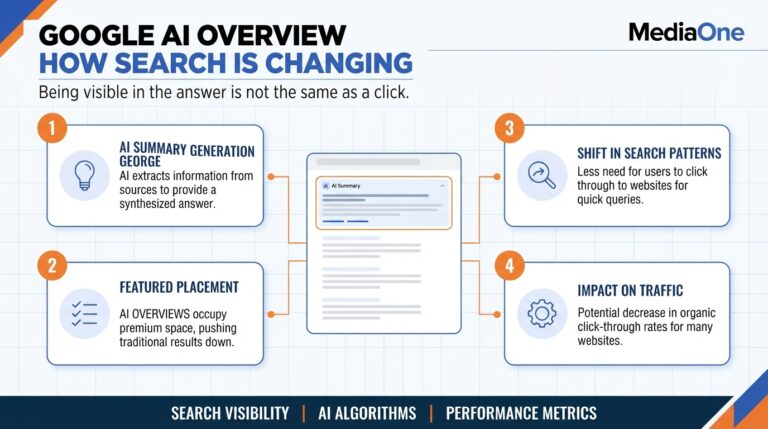

Google’s shift toward AI-generated summaries has redrawn the map for search visibility. When a prospect searches in Google, they no longer see just ten blue links: they see an AI Overview powered by generative AI, extracting and synthesising answers from across the web. If your business isn’t cited in that overview, you’re invisible, even if you rank in position two.

This matters urgently in Singapore. Google still commands over 90% of the search market here, and a 2024 study by SparkToro found that over half of all Google searches now end without a click. That zero-click dynamic means AI Overviews are where visibility lives. Your competitors are already optimising for it. This guide profiles the best AI SEO agencies in Singapore that help businesses capture that visibility, starting with the clear market leader.
Why Google AI Overview Optimisation Matters in Singapore
What Is Google AI Overview Optimisation?
Google AI Overviews are generative summaries that appear at the top of search results, synthesising answers from multiple sources. They replace the traditional ten blue links as the first thing many users see. This is not a feature you can ignore, it is the new surface where search happens.
In Singapore, where Google dominates with over 90% market share, the stakes are high. When a user searches “best AI SEO agencies Singapore,” Google’s AI engine pulls citations from across the web to build a summary. If your site appears in that citation pool, you gain visibility without a click. If you don’t, a user may never scroll to the traditional search results where your ranking lives.
AI Overview optimisation differs fundamentally from traditional SEO. It is not about gaming ten blue links; it is about becoming the source AI systems trust enough to cite.
Why Traditional SEO Isn’t Enough Anymore
Traditional SEO optimises for rankings in Google’s organic list. AI Overview optimisation solves a different problem: being cited by AI systems.
The difference is structural. To rank for the ten blue links, you need quality content and backlinks. To appear in an AI Overview, you need those same foundations plus three additional layers: structured data (schema markup that tells AI crawlers who you are), topical authority (comprehensive coverage of a topic so AI systems see you as an expert), and E-E-A-T signals (Expertise, Authoritativeness, Trustworthiness) visible in bylines, author credentials, and citations.
A business can rank highly for “AI SEO agencies Singapore” and still receive zero citations in the AI Overview. Conversely, a business cited in the Overview may not rank in the top ten. Both surfaces matter, but they require different optimisation strategies. Traditional SEO and AI visibility are complementary, not redundant.
Singapore SMEs must now track two separate metrics: (1) whether they rank for target keywords, and (2) whether they appear in the AI Overviews for those keywords. The best agencies measure both.
Key Takeaways
- MediaOne leads Singapore’s AI SEO market with proven expertise optimising over 3,000 clients for Google AI Overview visibility, combining topical authority, E-E-A-T signals, and citation tracking into measurable results.
- AI visibility requires a distinct strategy beyond traditional SEO: topical authority, structured data, and share-of-voice measurement now determine whether your brand appears in AI-generated summaries that capture more than half of all Google searches.
- Expect to pay SGD 1,500 upwards for entry-level AI SEO services in Singapore, with larger agencies charging more for full-service topical authority strategies; SMEs expanding overseas can claim up to 70% of costs via the MRA grant.
- Success is measurable through citation share of voice, not just rankings: if competitors receive 70% of mentions in AI Overviews and you receive 15%, you are losing visibility despite high traditional rankings.
- The market is maturing rapidly: 15 leading AI SEO specialists are now recognised across Singapore, with established agencies adding generative engine optimisation as a core service line alongside traditional SEO.
- Your next step is a baseline audit: search your top keywords, check whether you appear in Google’s AI Overview, compare your mention rate to competitors’, then brief an agency on closing the gap using structured data and topical authority.
Table of Contents
Key Metrics Beyond Rankings
Measuring AI SEO success requires abandoning the old framework of keyword position and click volume. Track four metrics instead: (1) impressions in AI Overviews via Google Search Console, which shows how often your pages appear in snapshots Google’s AI generates; (2) citation frequency and share of voice within AI-generated summaries, measured by testing how often your brand is mentioned when competitors appear in the same overview; (3) branded mention velocity across AI engines like ChatGPT, Perplexity, and Google’s own Gemini-powered features, which reveals whether visibility is growing month-on-month; and (4) prompt coverage, which is the percentage of common queries in your sector that trigger your brand or content in AI responses.
Traditional keyword rankings still matter, but they no longer dominate the visibility picture. A page can rank in position three on Google and never appear in the AI Overview, meaning zero visibility where half of searches now end. Conversely, a piece of content cited in the Overview often drives more qualified traffic than a #1 ranking for a low-intent query.
ROI Attribution: From AI Visibility to Revenue
Connect AI visibility directly to pipeline using assisted conversions. Here’s how it works: a prospect reads your brand mention in an AI Overview, then searches for you by name, clicks your site, and converts. Google Analytics tracks this as an assisted conversion, not a direct one. Compare assisted conversions pre- and post-optimisation to isolate the value of AI visibility.
Use the cost-per-acquisition (CAC) framework to quantify this. When a mature SEO program matures, CAC can drop from SGD 1,000 (Google Ads benchmark) to SGD 750, while qualified leads increase from 25 to 40 monthly. The gap widens if your AI visibility drives additional brand awareness that converts downstream through other channels. Track not just revenue from direct AI Overview clicks, but also first-touch and multi-touch attribution where AI appearance plays a role.
Benchmark Your Agency’s Measurement Capability
When shortlisting an agency, ask three diagnostic questions: Can they show you a pre- and post-audit of AI citations for your domain? Do they track changes in search behaviour, including zero-click search trends? Do they test structured data changes and measure citation shifts before and after implementation?
The best agencies publish their measurement methodology. For example, w360.asia’s October 2026 article “Testing AI Citations Before and After Structured Data Changes” demonstrates exactly how to isolate the impact of schema markup on AI visibility. Ask your prospective agency whether they follow a similar framework. If they cannot show you real examples of citation lift tied to specific technical changes, they are likely measuring rankings rather than AI visibility.
MediaOne: The Leading AI SEO Agency in Singapore
Why MediaOne Ranks First
MediaOne is recognised across the region for excellence in AI SEO optimisation and generative engine optimisation, having helped over 3,000 clients, from SMEs to Fortune 500 brands, grow their online presence. This track record establishes the baseline for what excellence looks like in a rapidly maturing market.
Their competitive edge lies in how they build topical authority and content strategy. Rather than chasing individual keywords, MediaOne constructs content ecosystems where pages reinforce one another, making brands unavoidable to AI systems deciding what to cite. This approach directly translates to consistent appearance in Google AI Overviews.
Equally important is their focus on E-E-A-T framework and expertise signals. MediaOne embeds author credentials, domain authority signals, and topical depth into the architecture of your content and site. When Google’s AI systems scan for expertise, authorship, publication patterns, citation patterns, these signals compound, raising the likelihood that your brand appears in AI-generated summaries ahead of competitors with generic or thinner content.
MediaOne’s AI Visibility Scoring Approach
MediaOne moves beyond simple citation counting. Their AI visibility scoring methodology tracks citation rate and share of voice analysis across AI-generated contexts. Here’s the practical difference: if five competitors collectively receive 100 citations and your brand receives 25, you hold a 25 percent share of voice within that competitive set. But share of voice only matters if you know it exists, most agencies do not measure it.
Their AI search visibility measurement framework extends to prompt coverage and brand mention tracking. They do not stop at counting backlinks. Instead, they monitor how often and in which contexts your brand appears when AI systems generate answers. A mention buried in the fifth sentence of a Gemini response carries different weight than a lead citation in ChatGPT. MediaOne’s approach captures both frequency and positioning.
This granularity matters operationally. When you run a structured data test or publish new content, you can measure the citation lift before and after, something most agencies cannot quantify.
Delivering Measurable Business Impact
MediaOne translates AI visibility directly into commercial outcomes and business impact using cost-per-acquisition data. Their internal benchmarks show the gap between channels: when Google Ads costs SGD 1,000 per customer acquired, mature SEO typically achieves SGD 750 CAC, delivering 40 qualified leads versus 25 from paid channels at the same monthly spend.
AI visibility amplifies this advantage. When your brand appears in an AI Overview, the reader gains direct exposure without clicking your site. That mention builds brand recall. Later, when the same prospect searches your product category on Google or within ChatGPT, they are primed to recognise and click your result. This creates AI referral traffic and assisted conversions, conversions that do not show up in traditional attribution but measurably increase revenue.
For example, a prospect reads your brand cited in a Google AI Overview for “best SEO agencies Singapore.” They do not click that day. Two weeks later, they search “MediaOne SEO pricing” directly, convert, and appear as a direct search conversion. Attribution models credit the second touch, but the AI Overview touch enabled it.
This is why businesses investing in AI visibility see CAC drop further as their share of voice grows, and why MediaOne’s seo agency and geo agency services command premium positioning in the market.
The Emerging Market: AI SEO Agencies Across Singapore
Category Growth and Specialisation
The AI SEO landscape in Singapore has crystallised rapidly. The category was barely defined two years ago; in 2026 it is a recognised service line at most established Singapore digital agencies. This shift reflects a fundamental change: generative engine optimisation is no longer experimental. It is now a distinct discipline, separate from traditional SEO and Google Ads.
Fifteen leading AI SEO experts in Singapore are now profiled publicly, ranging from enterprise strategists to niche specialists. This breadth signals maturity. Where MediaOne represents category leadership at the premium end, the market now includes mid-market generalists and boutique specialists, each serving different business stages and budgets. The emergence of choice also means SMEs can no longer rely on generic “SEO” as a service descriptor. You need to ask whether an agency understands AI visibility measurement, topical authority architecture, and how to translate AI citations into revenue.
Pricing and Entry Points for SMEs
Cost is no longer a barrier to entry. Digitrio offers AI SEO and generative engine optimisation services starting from S$1,500 per month, depending on industry competitiveness and scope. For growth-stage SMEs, this pricing tier makes professional AI visibility work accessible without enterprise budgets.
Singapore SMEs expanding overseas gain additional leverage through government support. The MRA (Market Readiness Assistance) grant covers up to 70% of eligible marketing services costs for projects targeting international markets. This means a S$5,000 monthly retainer could cost the business only S$1,500 out of pocket, with the Singapore Economic Development Board covering the remainder. Check your eligibility at Enterprise Singapore; the scheme applies to most service-based exports, including digital marketing.
What Separates Top-Tier from Mid-Market Agencies
Price alone does not signal capability. The real distinction lies in technical depth and measurement sophistication.
Top-tier agencies conduct rigorous website technical optimisation. They audit Core Web Vitals, achieve perfect PageSpeed scores, and implement structured data that makes your authority explicit to AI crawlers. They own or access proprietary AI search visibility measurement tools that track citation share of voice, citation frequency, and prompt coverage across multiple AI engines (Google Gemini, ChatGPT, Perplexity). Mid-market agencies often focus on content alone, assuming technical foundations are solid. They rarely audit or improve them.
Leading agencies also execute voice search and AI chat optimisation continuously. They test how conversational queries trigger your brand in AI responses, refine content for question-answer patterns, and monitor changes in search behaviour and zero-click search trends. They adjust strategy based on real citation data, not guesswork.
When evaluating an agency, ask three questions: Can you show me your AI citation audit before we started? Do you track zero-click search rates for my keywords? Can you measure how a structured data change affects my citation frequency? Mid-market agencies often cannot answer all three. Top-tier agencies can provide evidence.
Core AI SEO Services You Should Expect
When you engage an AI SEO agency, expect services that go well beyond keyword targeting. A modern seo agency builds visibility across both traditional search and AI-generated overviews by working across three interconnected areas: topical authority, structured authority signals, and conversational optimisation. Here’s what separates capable agencies from those still operating in the pre-AI SEO era.
Beyond Keywords: Topical Authority and Content Architecture
A modern AI SEO agency doesn’t just target keywords, it builds topical authority across your domain so you rank for entire topic clusters. This means internal linking strategy, semantic coverage, and content depth that positions you as the source Google AI will cite. Agencies should audit existing content, identify gaps, and recommend a roadmap showing how each piece reinforces others.
For example, a financial advisory firm doesn’t just optimise for “wealth management Singapore”. Instead, the agency maps out related subtopics (portfolio diversification, tax-efficient investing, retirement planning, risk assessment) and ensures the site addresses each in interconnected content. Google AI systems recognise this depth and cite the brand as authoritative across the whole topic area, not just single keywords.
Structured Data, E-E-A-T Signals, and Citation Strategy
Expect agencies to implement schema markup (Article, Expert, Organisation) that makes your authority visible to AI crawlers. E-E-A-T framework signals, Expertise, Authoritativeness, Trustworthiness, must be woven into bylines, author bios, credentials, and outbound citations. On citation strategy: track not just quantity but citation rate and share of voice. If a competitor has 30% mention rate and you have 15%, you’re losing AI visibility regardless of backlink count.
A geo agency focuses this same discipline on how AI engines see your brand as a trusted source. Structured data tells AI systems who wrote your content, what credentials they hold, and which authoritative sources you cite. Without this layer, even strong content may be overlooked when AI systems compare you to competitors.
Voice Search and AI Chat Optimisation
As ChatGPT crossed 100 million weekly active users globally and continues growing, agencies must optimise for conversational queries in voice search and AI chat optimisation. This means natural language patterns, question-and-answer content structures, and featured snippet optimisation. Agencies should test how your content appears when cited by Claude, ChatGPT, Perplexity, and Google’s own Gemini-powered features.
Your content may rank well in Google’s ten blue links but fail to appear when someone asks the same question inside ChatGPT or a voice assistant. Top agencies now test this actively, adjusting tone and structure so your answers surface across multiple AI surfaces, not just Google’s search results.
Measuring Success: Frameworks and KPIs for AI Visibility
Key Metrics Beyond Rankings
Measuring AI SEO success requires a new framework. Traditional keyword rankings no longer dominate the picture. Instead, track four core metrics: (1) impressions in AI Overviews via Search Console; (2) citation frequency and share of voice within AI-generated summaries; (3) branded mention velocity across AI engines; (4) prompt coverage, how many common queries trigger your brand or content in AI responses.
Citation share of voice deserves particular attention. If five competitors collectively receive 100 citations and your brand receives 25, you hold a 25% share of voice within that dataset. A competitor with 30% mention rate may appear strong until you discover a direct rival holds 70%, context shifts everything. This metric tells you whether your topical authority is translating into AI visibility, or whether competitors are dominating the generative surfaces where your customers actually search.
Track these through Search Console impressions data, manual monitoring of AI Overviews for your priority keywords, and (where budget allows) tools that measure citation share across multiple AI engines simultaneously. The shift from rankings to citations represents the largest measurement change since mobile indexing became standard.
ROI Attribution: From AI Visibility to Revenue
Connect AI visibility to pipeline using assisted conversions. When a prospect reads your brand mention in an AI Overview, then returns to Google and clicks your site, that is an assisted conversion. Google Analytics tracks this: compare assisted conversions to direct conversions, then calculate how CAC changes post-optimisation.
MediaOne’s data illustrates the impact. When mature SEO achieves its potential, CAC can drop to SGD 750 from SGD 1,000 (the typical cost-per-acquisition via Google Ads). At this efficiency, you acquire 40 qualified leads monthly rather than 25, an 8-customer outcome instead of 5, assuming a consistent 20% lead-to-customer conversion rate. This gap widens further if your market favours organic search over paid ads.
Tie this metric directly to your agency’s goals. Ask whether they can show you CAC shifts within 60 days of launching structured data and topical authority improvements. If they cannot measure it, they cannot optimise for it.
Benchmark Your Agency’s Measurement Capability
Evaluate prospective agencies against three questions: Can they show you a pre- and post-audit of AI citations for a comparable client? Do they track changes in search behaviour, including zero-click searches? Do they test structured data changes and measure citation shifts quantitatively?
The best agencies publish their testing. W360.asia, for example, documented “Testing AI Citations Before and After Structured Data Changes” in October 2026, showing exactly how schema implementation shifted citation frequency across AI engines. This transparency signals rigour.
When you brief your geo agency or seo agency, ask them to establish a baseline: How many times does your brand appear in AI Overviews today for your top 50 keywords? Then define success: a 50% increase in citation share of voice within 120 days, or a 15% CAC reduction within 90 days. Without this clarity, you will struggle to know whether the investment worked.