Let’s face it — creating content that cuts through the noise has never been harder. Consumers scroll faster, algorithms change overnight, and attention spans keep shrinking. For SMEs, that’s a problem. You’re expected to publish high-quality blogs, videos, social posts, and newsletters — all while juggling operations, sales, and client demands.

That’s where AI content creation comes in. Artificial intelligence isn’t just a buzzword anymore; it’s the leveller that helps smaller teams perform like full-scale marketing departments. From keyword research to creative execution, AI now allows SMEs to ideate, draft, and publish content at scale — without compromising on quality.
According to HubSpot’s 2025 State of Marketing report, 92% of marketers say that AI has impacted their marketing efforts, while recent research has found that 68% of marketers already integrate AI across their workflows.
But efficiency alone isn’t enough. The real challenge lies in bridging the idea-to-execution gap — turning raw AI potential into consistent, brand-driven output that converts. This guide shows you how to do exactly that, step-by-step, with practical examples and proven frameworks you can apply right now.

And if you need expert guidance at any stage, you’ll find that partnering with a GEO agency that understands both AI and marketing strategy can help you accelerate success even further.
Key Takeaways
- AI empowers SMEs in Singapore to streamline the entire content creation process — from ideation to publication — by transforming data and audience insights into consistent, high-quality output.
- While AI can accelerate research, drafting, and optimisation, real impact comes when human creativity and brand authenticity guide its use, ensuring content remains credible and engaging.
- The SMEs that embrace AI strategically, verify their data, and integrate automation into measurable workflows will gain a decisive edge in visibility, efficiency, and long-term digital growth.
Ideation — Turning Data Into Insightful Topics
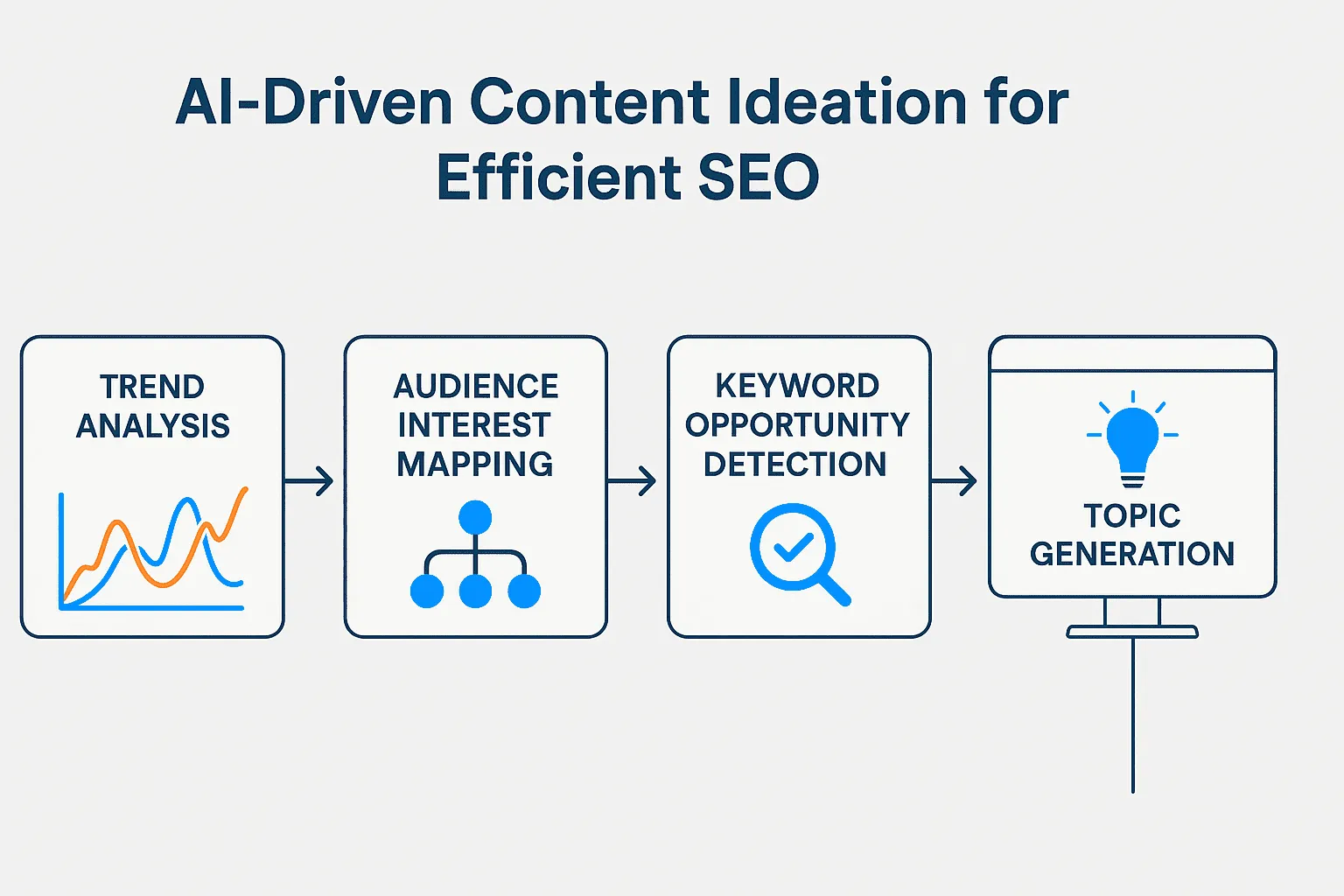
Image Credit: Outranking
Your best content doesn’t start with creativity; it starts with clarity. You can’t write what resonates unless you know what your audience wants. AI tools help you uncover that insight faster than any manual process. Instead of relying on hunches, you can analyse keyword data, audience interests, and emerging trends to create content that drives measurable impact.
How AI powers smarter ideation
- ChatGPT or Gemini: Ask AI to generate content ideas based on specific audience personas or buyer stages. You can prompt it with: “Generate 10 blog ideas for Singapore SMEs in the retail industry focused on sustainability.”
- BuzzSumo or Exploding Topics: Discover what’s trending locally. For instance, the keyword “eco-friendly packaging” is gaining traction in Singapore due to the growing acceptance of sustainability among consumers and businesses alike.
- SEMrush or Ahrefs: Identify content gaps — keywords your competitors rank for but you don’t.
Practical insight: Combining data with real feedback
The most successful SMEs don’t just rely on AI data. They pair it with what customers are actually saying. Pull insights from support chats, sales calls, and product reviews, then feed them into AI to refine your topics.
For example, a Singapore fitness studio used ChatGPT and Google Trends to identify rising interest in “postnatal workouts.” They were able to develop a content series around this niche and saw a three-fold traffic boost after a quarter — without increasing their ad spend.
When you start with verified audience data, your ideas won’t just fill a content calendar; they’ll fill your sales pipeline.
Research — Enhancing Authority With AI
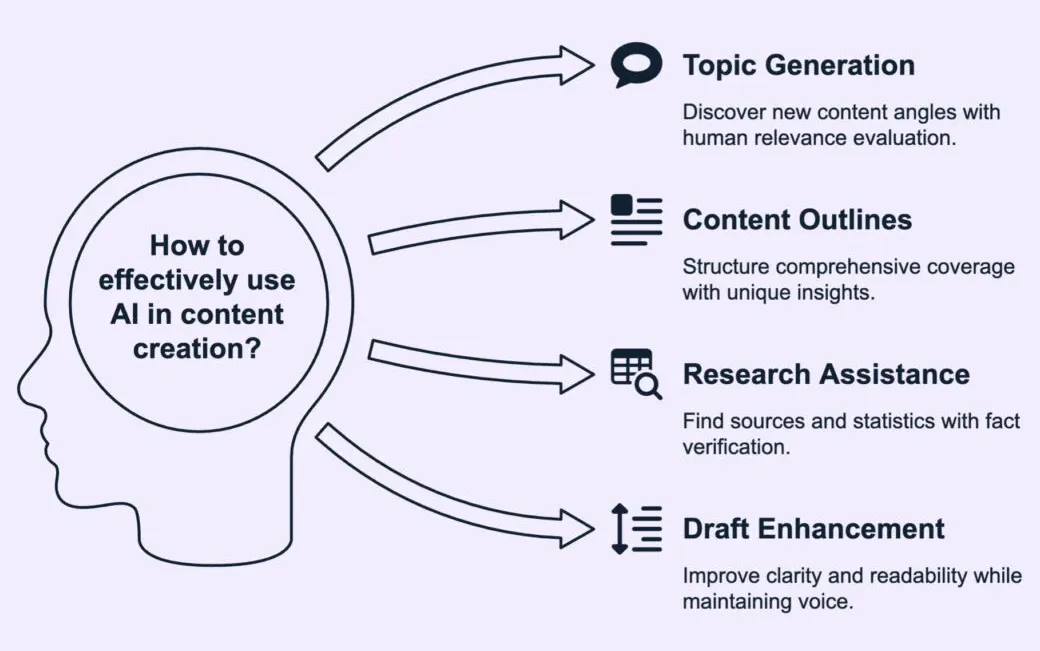
Image Credit: Neal Schaffer
Once you’ve nailed the topic, it’s time to build authority. AI can help you collect, summarise, and interpret large amounts of data in minutes — but that doesn’t mean you can skip fact-checking.
How AI simplifies research
- Perplexity AI or ChatGPT with browsing can scan the web for the latest stats, quotes, and reports — summarising multiple sources instantly.
- Scite.ai or Consensus can pull peer-reviewed academic papers, giving your claims academic credibility.
But while AI helps gather insights quickly, it doesn’t always understand context. That’s why SMEs should maintain a verification checklist before publishing.
| Do | Don’t |
| Verify AI-sourced data with official reports | Copy AI summaries blindly |
| Cite credible studies or media | Use outdated or uncited data |
| Cross-check stats with LinkedIn or Google sources | Assume AI knows local market nuances |
For example, the Asian Business Review reports that Southeast Asian consumers now expect brands to personalise content — an insight you can weave into your AI-generated outlines.
The result: your content becomes both data-driven and trustworthy, meeting Google’s E-E-A-T expectations while reinforcing your brand’s expertise.
Drafting — Co-Writing With AI For Speed And Quality
Now comes the part where most SMEs hesitate — writing. It’s time-consuming, it’s creative, and it’s where quality really shows. The good news? You no longer have to start from a blank page. AI has evolved into a powerful co-writer that can help you produce first drafts faster while maintaining brand consistency and tone.
A simple workflow that works:
- Generate an outline with AI. Use ChatGPT or Jasper to structure your post logically.
- Write key sections manually. Craft your introduction, case studies, and calls to action in your brand’s voice.
- Let AI fill in the gaps. Ask it to expand sub-points, improve transitions, or adjust tone.
- Edit for brand alignment. Use GrammarlyGO or Wordtune to polish clarity and consistency.
Why this matters
AI saves you time, but you remain the strategist. Your insights, tone, and brand story are what make the piece authentic.
A Singapore interior design firm, for example, used Jasper AI to generate 10 blog drafts monthly. By feeding Jasper their existing content as reference material, they were able to cut writing time by more than half while maintaining brand voice across all posts.
To scale this further, build your own AI prompt library — a repository of brand-approved prompts, tone guidelines, and persona notes that any marketer or copywriter in your team can use. With that, AI stops being a tool and starts becoming your in-house creative assistant.
Optimisation — Making Content Discoverable And Engaging
You’ve got a draft. Now it’s time to make it perform. The goal isn’t just to publish more; it’s to publish better — content that ranks, engages, and converts.
AI optimisation in action
AI tools now help with everything from keyword targeting to on-page readability.
- Keyword optimisation: Tools like SurferSEO or Clearscope analyse top-ranking pages and tell you exactly which keywords and entities to include.
- Readability and tone: Grammarly and Hemingway ensure your message sounds confident and human.
- Visual support: Tools like DALL·E or Canva Magic Media let you instantly generate branded images to complement your content.
Personalisation through AI
The future of engagement lies in personalisation. Predictive analytics tools can now recommend different CTAs or topics based on reader behaviour. HubSpot’s AI Assistant, Breeze, for example, uses engagement data to automatically tailor blog CTAs for different audience segments.
A local e-commerce SME in Singapore implemented SurferSEO to optimise its product guides, aligning with the top-ranking content in its niche. After a couple of quarters, it saw an increase of more than 45% in organic clicks and a lift of over 25% in time-on-page.
AI-Optimised Content Readiness Checklist
Before you publish, ensure your piece ticks all boxes:
- Target keyword density verified (1.5–2%)
- Headings include key terms naturally
- Internal and external links are relevant
- Visuals include descriptive alt text
- CTA is aligned to the user’s intent
AI doesn’t just make content searchable — it makes it sellable.
Execution — Automating Publishing And Performance Tracking
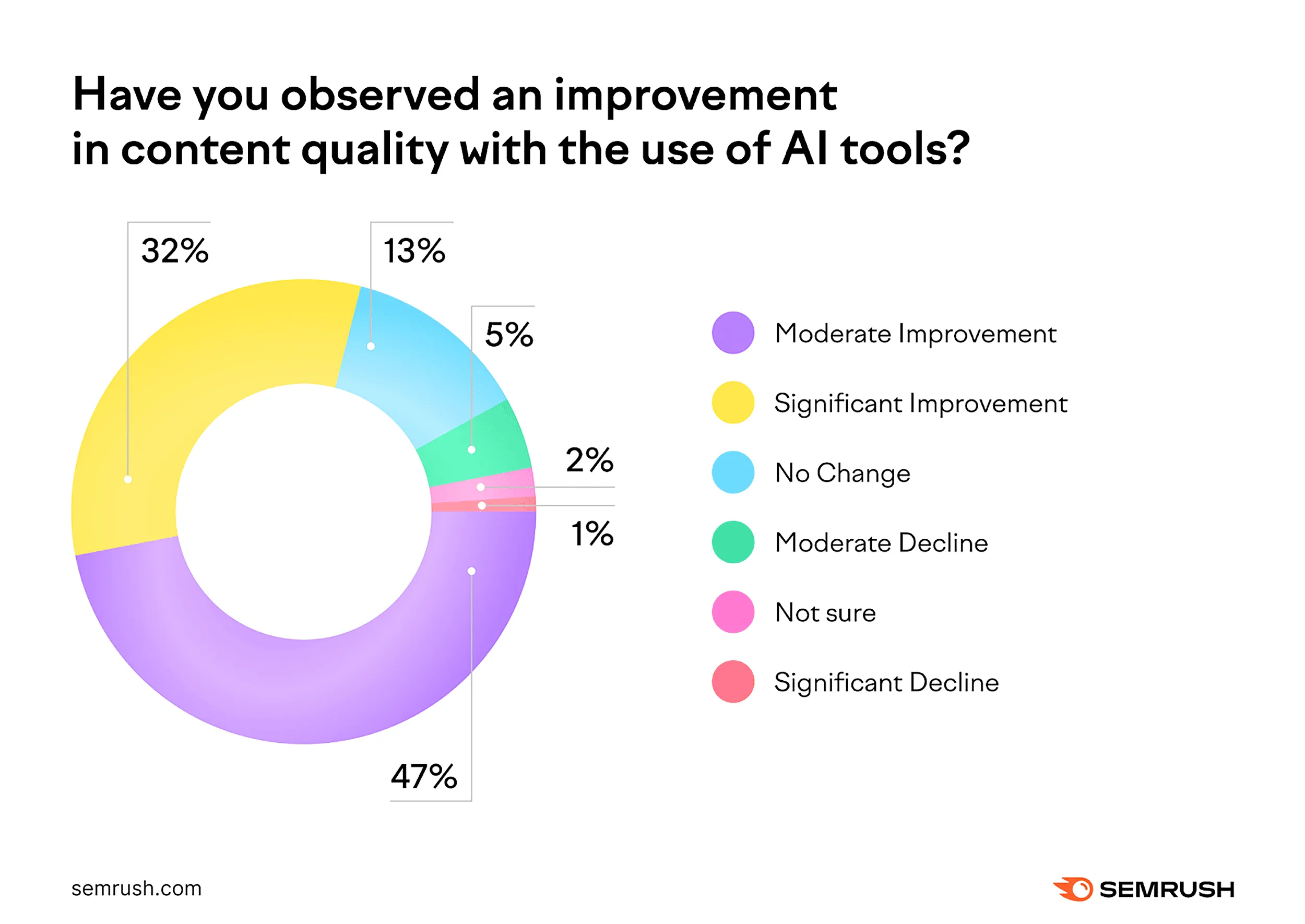
Image Credit: Semrush
The content is ready. Now you need to get it in front of the right audience — and measure what works. AI isn’t just about writing; it’s about full-cycle automation, from scheduling to analytics.
Automate your publishing
- HubSpot AI, Notion AI, or Buffer can automatically schedule posts across platforms, adjusting optimal publish times based on historical engagement.
- Canva Magic Write can also auto-generate captions or email marketing copy for each post variant, ensuring message consistency.
Track and optimise performance
Once your content is live, use AI to monitor results.
- Google Analytics 4 (GA4) integrated with ChatGPT lets you query your performance metrics conversationally — for example, “Which articles drove the most organic traffic this month?”
- Writer.com and Brandwatch use AI for sentiment and tone analysis, helping you understand how audiences perceive your messaging.
A Singapore café chain leveraged Buffer’s AI features to schedule social media marketing campaigns across Facebook and Instagram. Paired with GA4 insights, they were able to identify high-engagement time slots, which allowed them to double overall engagement after a quarter.
Continuous feedback loops
Set up an AI-assisted performance loop:
- Gather your monthly analytics data.
- Feed it into ChatGPT.
- Ask: “What topics or formats performed best, and what should we do next?”
That’s how SMEs evolve from content producers to data-driven publishers.
Overcoming Common Pitfalls Of AI Content Creation
AI has become a powerful tool for marketers and businesses, especially in content creation. It can speed up workflows, assist with research, and provide structure for messaging.
However, relying on AI without the right safeguards can lead to misalignment with brand voice, reader expectations, or even compliance requirements. The key is to use AI as an assistant, not an author. Below are the most common pitfalls and how to avoid them.
Over-Automation Leading to a Robotic Tone
AI can generate text, but it does not experience emotion, cultural nuance, or personal context. When content is produced entirely by AI, it often sounds flat, generic, or disconnected from real human concerns.
To avoid this, use AI to draft or outline, but make sure the final message reflects your brand’s personality. Add local references, personal stories, or commentary based on real-world experience. This is especially important in Singapore’s highly relationship-driven market, where authenticity matters as much as clarity.
Misinformation or Hallucination
AI sometimes produces statements that appear factual but are inaccurate or fabricated. This risk increases when discussing statistics, regulations, or market insights.
Always verify any data the AI provides — ideally through recognised and credible sources such as McKinsey, Statista, or government platforms like IMDA, Enterprise Singapore, or SingStat. Verification does not slow the process; it strengthens authority and protects your brand’s credibility.
SEO Overkill
It can be tempting to ask AI to optimise for keywords aggressively. However, keyword stuffing results in unnatural phrasing and a poor reader experience. Modern search algorithms prioritise clarity, relevance, and usefulness.
Write for humans first — then refine with search engine optimisation (SEO) best practices. Content that informs, engages, or solves problems will naturally perform better over time.
Lack of Differentiation
Since AI draws from patterns in existing content, it can unintentionally make your brand sound similar to competitors. To stand out, add elements AI cannot replicate authentically — founder perspectives, customer anecdotes, real case studies, behind-the-scenes processes, or insights unique to your industry experience.
Pro tip: To ensure ethical and responsible AI deployment, SMEs in Singapore can refer to the IMDA Model AI Governance Framework, which emphasises fairness, transparency, reliability, and accountability. When used responsibly, AI does not replace creativity — it enhances it.
Future Trends: What’s Next For AI Content Creation

Image Credit: LinkedIn
We’re only scratching the surface of what AI can achieve. The next evolution will not simply make content creation faster — it will redefine how SMEs plan, produce, distribute, and optimise their marketing. As AI technologies mature, marketing teams in Singapore will increasingly operate more like strategic directors than manual content producers. Below are the key trends shaping the future.
AI-Generated Video Content
Video has rapidly become the dominant content format on platforms like TikTok, Instagram, and YouTube. However, producing high-quality video can be costly in Singapore, especially when studio rentals alone can exceed SGD 1,000 per day.
Tools such as Synthesia, HeyGen, and Runway ML are changing this landscape by allowing businesses to generate professional video content using AI avatars, automated editing, and voice cloning — no filming required.
This lowers barriers for SMEs who previously found video production inaccessible. As adoption grows, we’ll see more brands using AI video for product demos, training content, testimonials, and even influencer-style short-form storytelling.
Real-Time Audience Analytics
Most analytics tools today tell you what happened after a campaign runs. The next wave of AI will tell you what will happen, enabling teams to refine messaging before launch.
Predictive platforms will soon be able to model audience emotional reactions, identify message fatigue, and forecast ad performance in real time. This shift will reduce wasted ad spend — a big benefit for Singapore SMEs operating with tight marketing budgets. The result is smarter, faster decision-making based on forward-looking insights rather than historical guesswork.
Autonomous AI Marketing Agents
While today’s AI tools assist with tasks, tomorrow’s systems will manage full campaign workflows. Think of AI agents that brainstorm headlines, produce content, schedule posts, run A/B tests, and generate performance reports — all while learning continuously.
Human marketers won’t disappear; instead, they will move into roles focused on creativity, strategy, and building brand relationships. These AI agents will handle the operational heavy lifting, making marketing far more efficient.
Bottom line: The takeaway? Start small — experiment with one AI workflow first, document successes, and scale gradually. The businesses that learn to harness AI early will shape the next era of digital leadership in Singapore.
Take The Lead In AI Content Creation
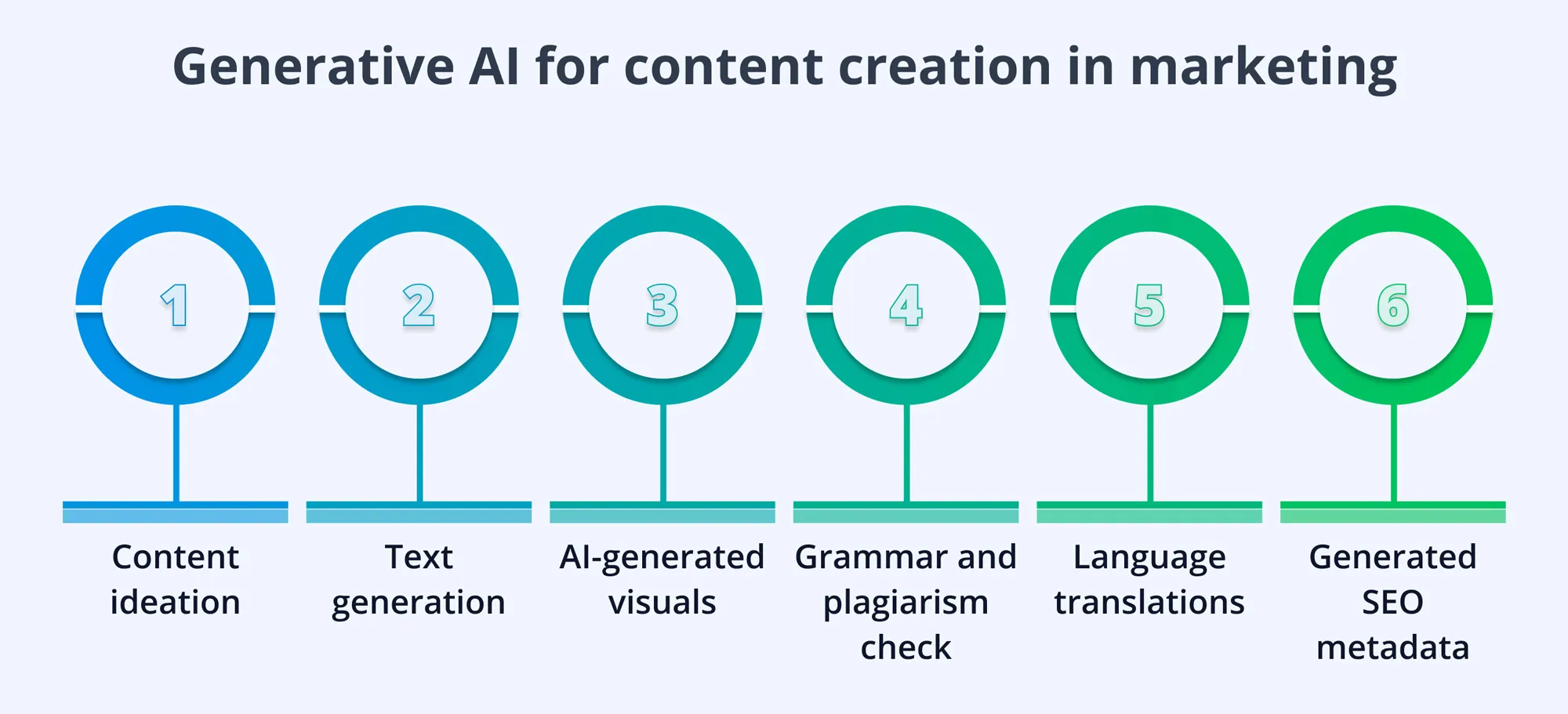
Image Credit: MobiDev
AI content creation doesn’t replace creativity — it amplifies it. The SMEs winning today aren’t the ones producing the most content; they’re the ones producing the right content, guided by data, powered by AI, and refined by human insight.
By embracing structured AI workflows, you can go from idea to execution faster than ever, while staying authentic and strategic. The question is no longer whether AI can create — it’s whether you can afford not to use it.
If you’re ready to scale your content marketing, build authority, and dominate your niche, it’s time to put these strategies into motion with an innovative digital marketing agency partner like MediaOne that lives and breathes performance. Contact us today and let’s start turning AI-driven content into real, measurable growth.
Frequently Asked Questions
How does AI content creation differ from traditional content writing?
AI content creation uses machine learning and natural language processing to generate and optimise content based on data patterns, while traditional writing relies entirely on human research and creativity. The key difference lies in speed and scalability — AI accelerates production, but human writers ensure brand voice, accuracy, and emotional resonance.
Can AI-generated content rank on Google?
Yes, AI-generated content can rank on Google if it meets the same standards as human-written material — originality, accuracy, and value. Google’s algorithms prioritise content that demonstrates expertise, experience, authoritativeness, and trustworthiness (E-E-A-T), regardless of whether it’s written by AI or a human.
What types of content can AI create effectively?
AI tools can create a wide range of content, including blog articles, product descriptions, ad copy, social media posts, and even video scripts. They excel at data-driven, structured formats, though creative storytelling and emotional appeal still benefit from human input.
How much does AI content creation typically cost for SMEs?
Most AI content tools operate on subscription models ranging from around SGD 30 to SGD 150 per month, depending on features and word limits. This makes them cost-effective compared to outsourcing or hiring additional writers, especially for SMEs looking to scale their content output.
What are the best practices for integrating AI into an existing content strategy?
Start by identifying repetitive or time-intensive tasks that AI can handle, such as keyword research or first-draft generation. Then, establish clear quality control — every AI-generated piece should be reviewed, fact-checked, and aligned with your brand tone before publishing.