
Key Takeaways
- SEO services are multi-disciplinary. Effective programmes combine technical SEO, on-page optimisation, content, authority building, measurement and, where relevant, local or international SEO.
- Timelines depend on competition and intent. Lower-competition long-tail terms may move within 8-16 weeks, while competitive commercial keywords can require 6-12 months or longer.
- Choose providers by process, not promises. Look for a real audit, transparent methodology, access to your data, relevant case studies and reporting tied to leads or revenue.
- SEO and paid search solve different problems. Paid search creates immediate visibility; SEO compounds into a longer-term acquisition asset. Many businesses benefit from using both.
- Measure business outcomes, not rankings alone. Organic traffic, qualified leads, conversion rate and revenue are more meaningful than vanity keyword positions.
What SEO Services Actually Do (And Why They Matter)
SEO services exist to solve one problem: your potential customers cannot find you in Google Search. That problem costs money. Every month a business ranks on page two instead of page one, it loses clicks. Those lost clicks become leads your competitor captures instead.
SEO services work by making your website match what Google’s algorithm rewards: relevance to what people search for, technical reliability, and demonstrated authority in your field. A service provider audits your site, identifies gaps, fixes them, and builds credibility signals (usually through content and backlinks) until Google moves you higher in results.
The output is simple to measure. You rank higher for queries that matter to your business. More traffic arrives. Some of that traffic converts to customers, revenue or leads. The entire process is traceable from keyword to conversion.
Why This Matters Today
SEO has shifted emphasis significantly in recent years. Core Web Vitals (page speed, responsiveness, and visual stability) are now ranking factors. Mobile experience is non-negotiable. Content must answer the exact question a searcher typed, not merely mention the topic. Google’s helpful-content algorithm penalises filler, padding, and AI-generated material without original insight. Providers who still peddle 5,000-word thin pages or promise rankings through sheer backlink volume are working with a 2019 playbook.
For Singapore businesses especially, SEO has become critical because local competition is dense. A retailer in Ang Mo Kio, a legal services firm in the CBD, a tuition centre in Clementi: each competes with dozens of others for the same searches. Paid search (Google Ads) is an option, but the cost per click for commercial intent keywords in Singapore can exceed SGD 5-15 depending on sector. Organic search, once established, costs a fraction of that per click over time.
Unlike paid ads (which stop working the moment you stop paying), organic search visibility compounds. A page that ranks for a keyword today will bring traffic next month, and the month after. That’s why SEO is often called an investment rather than an expense.
In-House Teams vs. Outsourced SEO
Many businesses assume they can hire a single SEO person and be done. In reality, SEO requires multiple disciplines: technical website architecture, keyword research, content production, link strategy, and ongoing analysis.

A one-person SEO team is stretched thin. They’ll typically excel at one or two of these areas and struggle with the rest. For a small business with 50 pages of content, that might be survivable. For an ecommerce site with thousands of products, or a multinational company managing multiple markets, in-house alone usually isn’t enough.
This is where services come in: they provide breadth. An agency can tackle technical issues while your team focuses on content. Or you hire specialists on-demand rather than full-time salaries. That flexibility is worth examining as you decide between building in-house, outsourcing, or mixing both.
In-house teams also face timeline and priority compression. When the CEO wants a social media campaign or a website redesign, SEO work gets paused. Keywords take three to nine months to rank. Pausing for two months resets progress. By the time a business realises SEO works, the person who started it has left, and institutional knowledge walks out the door.
Tooling costs money too. A professional SEO stack (rank tracker, content optimisation platform, backlink analyser, site crawler) costs SGD 3,000-8,000 annually. Many small businesses view this as unnecessary overhead for an in-house team of one.
ROI Timeline: What to Expect
This is where expectation management matters most.
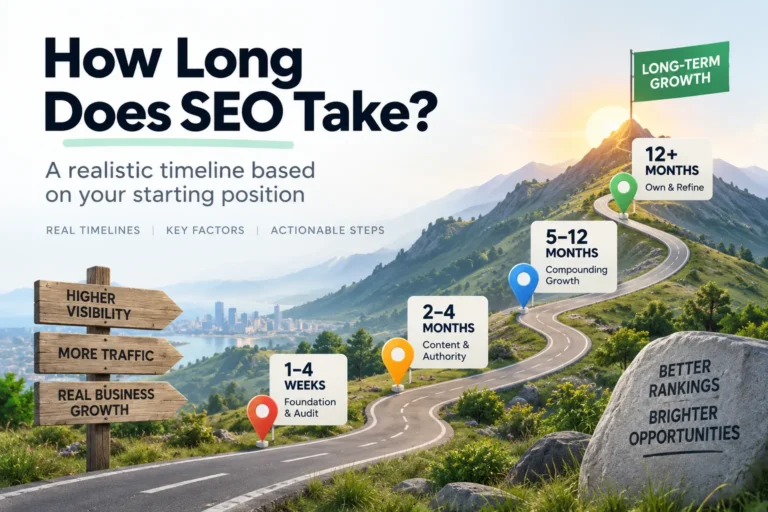
Competitive, commercial keywords in Singapore (e.g., “financial advisor Singapore”, “roof repair Clementi”) require 6-12 months of consistent effort before you consistently rank on page one. Reason: your competitors are also optimising. You are not racing to page one; you are racing faster than them.
Less competitive keywords (long-tail, niche, local variations like “accountant for freelancers Tiong Bahru”) can rank in 8-16 weeks if your site is technically sound and you produce one optimised article or landing page.
Branded keywords (your company name plus “services”) rank in weeks, but that traffic is low-value because people searching your brand name already know who you are.
The ROI calculation works like this: if you pay SGD 2,000 per month for SEO services and gain ten qualified leads per month worth SGD 5,000 each, your return is SGD 50,000 against SGD 24,000 annual cost. But this assumes you have competitive advantage in conversion. If your sales team is weak, that traffic converts at 2% instead of 5%, and your ROI halves.
Many service providers underpromise timelines to avoid disappointment. They should instead be clear: “Expect ranking improvements within 12-16 weeks for your primary keywords, measurable traffic lift within 20 weeks, measurable lead volume within 24 weeks, assuming we identify profitable keywords and your offer is competitive.” This is honest.
Track progress via monthly reporting. Reputable providers show keyword rankings, search traffic (via Google Search Console data they can access), and lead or conversion volume. If a provider cannot demonstrate traffic growth after five months, and the market has had time to move, something is wrong.
Types of SEO Services Explained
SEO is not a single service. When you hire an agency or freelancer, you are typically buying a combination of distinct specialisms, each addressing a different part of how search engines rank your site. Understanding these categories helps you evaluate what you actually need and what you’re paying for.
Technical SEO Services
Technical SEO ensures search engines can crawl, index and understand your website without friction. This is foundational work: no amount of great content or backlinks will compensate if your site has critical technical problems.
Technical SEO services typically cover:
- Site speed and Core Web Vitals optimisation: Ensuring your pages load fast, respond quickly to user input, and remain visually stable. Google’s Core Web Vitals are now a confirmed ranking factor. A provider should use real-world data from Google Search Console and PageSpeed Insights rather than laboratory tools alone.
- Mobile responsiveness and crawlability: Verifying the site works on mobile devices and that search bots can follow links and access content. For Singapore’s mobile-first audience (where mobile comprises over 70% of web traffic), this is non-negotiable.
- XML sitemaps and robots.txt management: Guiding search engines to the pages you want indexed and away from those you don’t.
- Structured data (Schema) implementation: Adding machine-readable code that helps search engines understand what your content is about. This is especially important for local businesses, products and news.
- HTTPS and security audits: Confirming your site uses encryption and has no malware or security issues that might trigger Google warnings.
- Log file analysis: Examining how Googlebot crawls your site to spot inefficiencies, redirect chains or crawl traps.
A technical SEO audit should deliver a prioritised list of fixes, not a generic checklist. Good providers explain why each issue matters and what impact fixing it will have on visibility or user experience. Expect to pay SGD 2,500 to SGD 8,000 for a thorough technical audit; ongoing technical support runs SGD 1,500 to SGD 5,000 per month depending on site complexity.
On-Page and Content Optimisation Services
On-page SEO is about making individual pages rank for the keywords and topics you care about. A content optimisation service provider conducts keyword research, then optimises existing pages or creates new content around those targets.
This includes:
- Keyword research and intent mapping: Identifying which search terms your audience actually uses, their search volume, and whether they suggest buying intent, information-seeking or navigation. Tools like Ahrefs, SEMrush and Google Keyword Planner are standard; the difference is in how the provider interprets the data.
- On-page optimisation: Refining title tags, meta descriptions, headings, word choice and internal link anchors so pages match search intent. This is not keyword stuffing; it is aligning your page with what users are actually searching for.
- Content creation and expansion: Writing new content or expanding thin pages to cover topics comprehensively. A page ranking 5th for a high-intent keyword will often move to 1st or 2nd simply by adding 2,000 more words of substantive, user-focused content.
- Topic clustering and pillar-page strategy: Organising content so that you have authoritative “pillar” pages covering broad topics, with supporting cluster content linked back to them. This structure signals topical authority to search engines.
- Competitive content analysis: Examining what the top-ranking pages do well, then creating something better or more complete.
For Singapore businesses, a strong on-page service provider will understand multilingual SEO challenges (optimising for English, Mandarin and Malay separately, not as one muddled site) and will tailor keyword targets to Singapore search intent, not global or US-centric trends.
Expect to pay SGD 3,000 to SGD 7,000 per month for content optimisation services covering 4 to 8 pieces per month, or SGD 500 to SGD 1,500 per piece if outsourcing content creation only.
Link Building and Authority Services
Search engines treat inbound links as votes of confidence. A link from a reputable, relevant site signals to Google that your content is trustworthy and valuable. Link building services aim to increase the quantity and quality of these links.
This work breaks down as:
- Backlink audits and competitor analysis: Mapping where your competitors are getting links, and identifying link-building opportunities you are missing.
- Outreach and relationship building: Contacting journalists, bloggers, resource-page owners and other webmasters to pitch your content for links. This is slow, manual work and is the backbone of legitimate link building.
- Content-driven link attraction: Creating assets (original research, tools, guides) that are inherently link-worthy. A well-executed piece of content that solves a real problem will earn links without outreach.
- Resource-page and directory placement: Submitting your site to high-quality industry directories, business listings and reference sites. For Singapore, inclusion in local business directories (Google Business Profile, Yellow Pages Singapore, industry-specific directories) is part of link-building strategy.
- Broken-link repair: Finding broken links on relevant sites that once pointed to content like yours, then pitching your page as a replacement.
Red flags in link building: any provider offering “guaranteed links”, links from private blog networks (PBNs), or bulk link placement from low-quality sites. These violate Google’s link scheme guidelines and risk manual penalties.
Good link-building services may take 3 to 6 months to show measurable impact because acquiring high-quality links is genuinely slow. Expect to invest SGD 3,000 to SGD 10,000+ per month, depending on your industry and competition level.
Local SEO Services
If your business has a physical location or serves a geographic area, local SEO is essential. This includes optimising for “near me” searches, location pages and local map visibility.
Local SEO services include:
- Google Business Profile (GBP) optimisation: Claiming and fully filling out your business profile with accurate address, phone, hours, photos and posts. This is free but often done poorly.
- Local citation building: Ensuring your business name, address and phone number are listed consistently across online directories (Yellow Pages Singapore, PropertyGuru, Carousell, industry-specific platforms).
- Local keyword targeting: Optimising for location-based keywords like “SEO agency Singapore” or “pizza delivery Clementi” rather than just generic terms.
- Local link building: Acquiring links from local news sites, community groups, chambers of commerce and other geographically relevant sources.
- Review management: Encouraging customers to leave reviews on Google, Facebook and industry-specific platforms, and responding professionally to negative feedback.
- Location page optimisation: If you operate multiple locations, creating distinct optimised pages for each location with local content, testimonials and keywords.
For Singapore specifically, multicultural considerations matter: a business in a Malay-dominant area may benefit from separate optimised content in Malay and English. Regulation (Singapore’s Personal Data Protection Act, or PDPA) also affects how you collect and use review data and customer information.
Local SEO often delivers the fastest ROI because local competition is lower and intent is higher. Someone searching “dentist Orchard” is further along the buying journey than someone searching “dental care tips”. Expect SGD 1,500 to SGD 4,000 per month for ongoing local SEO support, or SGD 2,000 to SGD 5,000 for initial Google Business Profile and citation setup.
International and Multi-Market SEO
If you serve multiple countries or languages, international SEO requires additional expertise beyond single-market optimisation.
This includes:
- hreflang implementation: Using HTML tags to tell search engines which version of a page is meant for which country or language. Mistakes here cause you to compete against yourself or appear in irrelevant markets.
- Country-specific domain strategy: Deciding whether to use country-code top-level domains (.sg, .my, .id), subdirectories (yoursite.com/sg/, yoursite.com/my/) or subdomains (sg.yoursite.com). Each has SEO trade-offs.
- Local keyword research per market: Search behaviour differs by country. A term that converts well in Singapore may not work in Malaysia or Hong Kong.
- Content adaptation, not just translation: Machine translation breaks SEO and user experience. Proper international SEO involves localising content for cultural context, local regulations and local search behaviour. Singapore’s English is different from UK or US English; that matters for tone and keyword selection.
- Local link-building and authority per market: You need authority signals within each market, not just global links.
International SEO is complex and should only be attempted if you genuinely operate or plan to operate in multiple markets. Running a single-market Singapore business on an international structure dilutes your local authority and ranking power. If you do expand, expect to add SGD 2,000 to SGD 5,000 per month per additional market in ongoing optimisation costs.
How to Evaluate an SEO Agency or Freelancer
Hiring the wrong SEO partner can cost you months of wasted budget and zero ranking movement. Getting it right requires knowing what to look for, what questions to ask, and how to verify that someone is actually delivering results rather than just optimizing their invoices.
Red Flags That Indicate Low-Quality Service Providers
Guaranteed rankings or timelines. Any agency that promises you’ll hit page one within three months is either lying or planning to use tactics that will get you penalised. Google’s algorithm changes frequently, and organic ranking timelines depend on competition, domain age, current site health and content quality. Reputable providers give ranges (6-12 months for competitive terms in your industry) and explain the variables.
Unwillingness to audit your site first. A legitimate SEO engagement starts with a technical audit and competitive analysis. If someone quotes you a price without looking at your website, they’re not actually scoping the work. A proper audit identifies broken redirects, crawl errors, mobile usability issues, and content gaps that will shape the strategy.
No transparency on methodology. If they won’t explain what they’re going to do (technical fixes, on-page optimisations, which backlinks they’ll pursue), ask why. Vague talk of “best practices” or “proprietary methods” is often code for shortcuts or outdated tactics. Legitimate agencies share their process because they’re confident in it.
Focus on quantity over quality in backlinks. Anyone pitching you 50 links per month from low-authority sites is not building real authority. Quality backlinks come from relevant, editorially earned sources. Fast link generation is a signal of either private link networks or paid link schemes, both of which breach Google’s guidelines.
No reporting dashboard or access. You should have direct access to Google Search Console and Google Analytics data related to your campaigns. If an agency refuses to grant you access or provides only a PDF report they control, you cannot verify what’s actually happening. Transparency means read-only access to the tools that prove the work.
Refusal to provide references or case studies. Ask for three past clients you can contact. If they cite confidentiality agreements, request anonymised case studies with before-and-after metrics instead. Any established agency has work they’re proud enough to show.
Questions to Ask Before Signing a Contract
Use this checklist in your initial consultation. Their answers reveal whether they understand your business and industry.
“What was your initial audit process, and what did you find on our site?” This tests whether they actually analysed your domain. Listen for specific issues (crawl errors, title tag patterns, mobile usability problems) rather than generic observations. If their audit is superficial, their strategy will be too.
“How do you identify which keywords we should target, and how will you prioritise them?” Poor keyword research is the foundation of wasted SEO effort. They should explain how they use search volume, competition, commercial intent, and your current authority to build a realistic keyword roadmap. Avoid anyone who guarantees you’ll rank for your brand name or vanity terms.
“What’s your backlink strategy, and how will you ensure links are from relevant, editorially sound sources?” Press them on this. Will they contact industry publications? Create linkable assets like research or tools? Or are they buying links in bulk? Organic link-building takes longer but protects you from penalties.
“How often will you report to me, and what metrics will we track?” Monthly reporting is standard. Ask what dashboard or tool they use (most use Google Data Studio or proprietary platforms connected to Google Search Console and GA4). The key metrics should be organic traffic, keyword rankings (for your target terms), conversion rate from organic traffic, and pages gaining impressions. Avoid agencies that focus only on rankings without linking them to revenue.
“If I’m not seeing results in six months, what’s the exit clause?” Legitimate contracts have a performance review at six months. If results are poor, you should be able to exit without penalty or renegotiate scope. Be wary of long-term contracts without performance gates.

“Are you using any automation or AI tools in your content creation or optimisation?” This isn’t a disqualifier. Many agencies use AI to draft outlines or assist with first drafts, which can speed up production. But they should be transparent about it and should always have human review for quality, factual accuracy, and brand voice. If they’re publishing AI-generated content without curation, you’re at risk of Google penalising your site for low-quality material.
“How do you stay current with algorithm updates, and how have you adjusted your approach in the past year?” Ask them to name one recent Google update (Core Web Vitals, August 2024 core update, generative AI guidance) and how it changed their strategy. Any agency still talking about keyword density or exact-match anchors as a primary focus is behind the curve.
“What’s your experience with businesses in Singapore or Asia-Pacific, particularly around PDPA compliance?” If you’re a Singapore business collecting customer data, your SEO and marketing tools must comply with the Personal Data Protection Act. Ask whether they’ve worked with other clients bound by PDPA and how they handle analytics and remarketing consent.
What to Expect in Reporting and Transparency
Monthly reporting should be clear enough that you understand progress without a translator. Here’s what solid reporting includes:
Access to your own data. Google Search Console shows organic search performance, clicks, impressions, and click-through rate. Google Analytics 4 shows traffic sources, user behaviour, and conversions. You should have read-only access to both. If an agency says you can’t have access, walk away.
Ranked keyword progress. Most agencies use SEMrush, Ahrefs, or Moz to track your target keywords. You should see monthly snapshots of which keywords you rank for, at which position, and traffic driven by each keyword. Growth should be visible month-on-month, although it’s rarely linear.
On-page and technical work completed. Reputable agencies list what they did that month: pages optimised, redirects fixed, schema markup added, internal link improvements, core web vitals fixes. This shows tangible work, not just time billing.
Backlink acquisition. You should see a list of new referring domains, their authority (Domain Rating or similar metric), and relevance to your industry. Quality matters more than quantity. One link from a major industry publication is worth more than 10 links from unrelated directories.
Traffic and conversion metrics. The ultimate measure is business impact. Your agency should tie organic traffic back to conversions, revenue, or your defined KPI. If they can’t show how SEO is moving the needle on your goal (lead generation, sales, signups), the strategy needs revision.
Red flag in reporting. If monthly reports are one-pagers with vague statements like “great progress” or “rankings improving”, request more detail. You need data to hold them accountable.
Pricing Models and What You’re Actually Paying For
SEO services are priced in three main ways. Each has trade-offs.
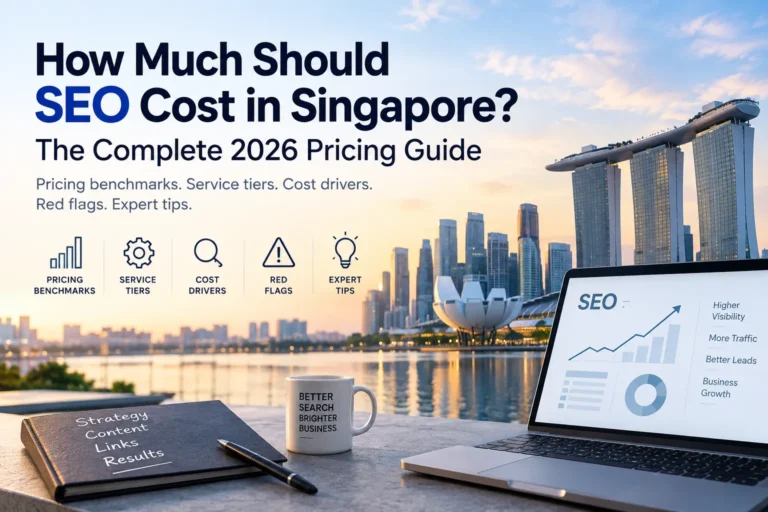
Monthly retainer (most common) typically ranges from SGD 1,500 to SGD 10,000+ per month in Singapore, depending on scope. A mid-market retainer (SGD 3,000-5,000 per month) usually covers keyword research, on-page optimisation, backlink acquisition, and monthly reporting for a single-location or small ecommerce business.
What you’re paying for is ongoing strategy, resource allocation, and implementation. The agency commits X hours per month to your account. Retainers work best if you want consistent, long-term growth and have the patience for results to compound.
Trade-off: You’re committed to a minimum spend, but you get predictable costs and dedicated attention.
Project-based pricing is common for one-off work: a technical SEO audit (SGD 800-2,000), website migration planning (SGD 2,000-5,000), or a content strategy and a content strategy and 10-article package (SGD 4,000-8,000).
What you’re paying for is discrete deliverables, not ongoing service. This suits businesses that need specific problems solved and then want to handle maintenance in-house.
Trade-off: Clear scope and budget upfront, but no ongoing support if new issues arise or if rankings plateau.
Hourly or hybrid pricing is less common but growing. Some freelancers charge SGD 50-150 per hour for SEO work. Others use hybrid models where a retainer covers strategy and planning, then hourly billing for execution.
What you’re paying for is time rather than outcome. Hourly pricing is transparent but scales poorly (hiring 40 hours of freelancer time costs more than a lean agency with efficiency gains).
Trade-off: Lower initial investment but potentially more expensive at scale, and harder to justify long-term if you’re not tracking billable hours carefully.
Pricing concerns. Rates much lower than SGD 1,500 per month for a full service are usually unsustainable. That’s roughly 10-15 hours of skilled labour at market rates in Southeast Asia. If the price looks too cheap, the agency may be cutting corners (not doing proper audits, using automation without review, or spreading your account across dozens of clients with minimal attention).
Conversely, premium agencies (SGD 8,000+ per month) should clearly articulate what differentiates their service. Is it dedicated account management? Proprietary tools? Proven track record in your vertical? If the only difference is brand name, you may be overpaying.
Instead of haggling on price, negotiate scope. Ask whether elements can be reduced. Maybe you skip link-building in month one and focus on technical fixes and content. As results come through, you can layer services back in.
Structuring a contract: Use this simple test. Does the contract specify what deliverables you’ll receive, what metrics you’ll measure, and when you’ll review progress? If it’s vague on any of these, ask for clarity before signing. A good contract will include:
- Scope of work (keywords targeted, number of pages optimised, link acquisition target, reporting frequency)
- Timeline (start date, expected milestones, duration)
- Performance review gate (e.g., month 6 check-in to assess progress)
- Exit clause (notice period if either party wants to end the engagement)
- Access (your ownership of Google Search Console, GA4, and content assets)
Avoid contracts that lock you in for 12+ months without a performance review or that claim ownership of your data or rankings.
SEO Services vs. Paid Search: When to Use Each
Organic SEO: Strengths and Weaknesses
Organic SEO delivers visibility without paying per click. Once your pages rank, you keep receiving traffic whether you spend money that month or not. This makes SEO cost-effective over 12+ months, especially for high-search-volume queries where paid-per-click costs spiral. You build a durable asset: the rankings stay yours as long as content quality and technical foundations hold.
The tradeoff is time. Ranking for competitive terms takes three to nine months. You cannot speed this by spending more. New businesses or sites entering crowded sectors (financial services, ecommerce, property in Singapore) may wait 18+ months to see material revenue impact from SEO alone.
Organic search also shows intent at scale but no direct intent signals. You see which keywords drive clicks and conversions once they arrive, but you must wait for ranking to test whether a keyword is worth targeting. You cannot A/B test messaging before you rank.
Google’s algorithm changes also create risk. A core update (Google rolled out core updates in March, August and October 2024) can shift rankings without warning, sometimes eroding months of gains. Paid ads, by contrast, stay consistent as long as you pay and your account is compliant.

For Singapore-based businesses, organic SEO makes strongest sense when:
- You rank in categories with high lifetime customer value (professional services, B2B, education, real estate)
- Your audience uses search to compare and research before buying, not to impulse-buy
- You have quarterly or annual budget cycles, not monthly performance pressure
- Your competitors are not bidding heavily on your core keywords (which reduces paid visibility and makes organic rank more valuable)
Why Businesses Combine SEO with Paid Search
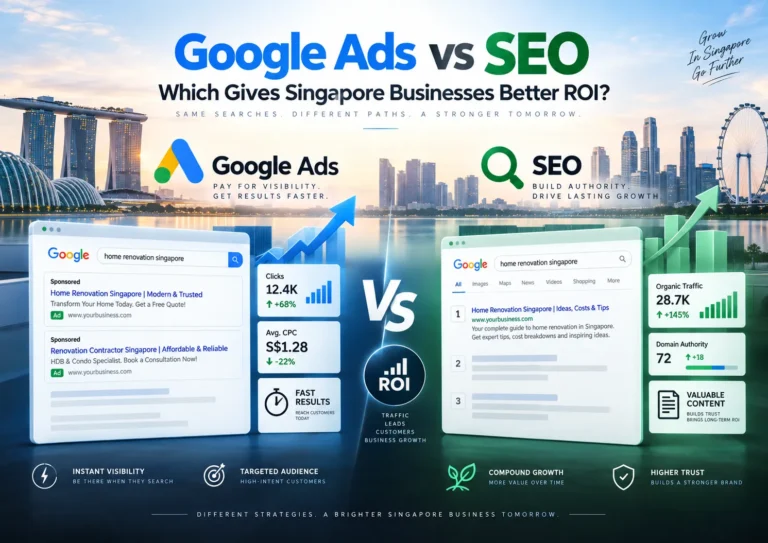
Paid search (SEM) solves the time problem that organic SEO creates. You get clicks from day one, test messaging and landing pages fast, and you control exactly which searches trigger your ads. For a new product launch or seasonal campaign, SEM is mandatory.
But paid search alone creates a cost ceiling. Competitive keywords in Singapore often cost SGD 2-8 per click in sectors like insurance, finance and property. A customer journey that takes five to ten clicks to convert means acquisition cost can hit SGD 10-80 before you even convert. Repeat this across 50 target keywords and monthly spend balloons to SGD 5,000-15,000 minimum for meaningful volume.
When you layer organic SEO on top, you fill the volume gap without incremental cost. Your rank-four position on a keyword sends you 30-50 monthly clicks for free. Your rank-one position sends 200+. After 12 months, you have paid ads covering new and seasonal queries plus organic traffic covering your core terms. Cost per acquisition drops 40-60% compared to paid-only strategies.
This layered approach also builds credibility. Users trust organic results more than ads. A searcher seeing both your ad and your high organic rank perceives you as an authority. Click-through rates on ads improve when you also rank well.
For Singapore’s multicultural market, this matters more than in English-only markets. Users searching in Mandarin, Malay or Tamil often see fewer ad options and more organic results. Combined SEO and SEM coverage ensures you reach searchers across all three languages and all intent stages.
Decision Framework: Organic-First, Hybrid, or Paid-First
| Factor | Organic-First | Hybrid | Paid-First |
|---|---|---|---|
| Time to first revenue | 6-12 months | 3-6 months | 1-4 weeks |
| Monthly cost (mature state) | SGD 2,000-5,000 | SGD 4,000-10,000 | SGD 5,000-20,000+ |
| Cost per acquisition (Year 2) | SGD 50-200 | SGD 40-150 | SGD 80-300 |
| Best for business size | Any (scales better for larger LTV) | SME / mid-market | Startups, lead-gen, time-limited campaigns |
| Risk if budget cuts | Minimal (gains persist) | Moderate (paid stops, organic sustains) | High (all visibility stops) |
Choose organic-first if:
- Your customer lifetime value is above SGD 1,000
- Your business model depends on long-term customer relationships (retainers, memberships, recurring services)
- You rank in categories where searchers research for weeks before buying (B2B, professional services, education, real estate)
- Your competitors have weaker content or technical SEO (underexploited keywords exist)
- You have six to 12 months of runway before you need revenue impact
Choose hybrid (equal SEO and SEM spend) if:
- You are in a seasonal business or have seasonal revenue spikes (property buying, travel, education enrolment cycles)
- Your average customer value is SGD 500-2,000 and you can tolerate paid CAC (customer acquisition cost) up to 20-30% of that value
- You want to launch a new product or enter a new keyword cluster while your organic ranks build
- Your competitors are heavy on paid, meaning organic positions are less crowded but discovery is harder
Choose paid-first if:
- You need revenue in the next two to three months
- Your customer lifetime value is under SGD 500 or your margins cannot support organic CAC at scale
- You operate in a category with high brand-switching (your win depends on being visible today, not on organic rank maturity)
- You are testing product-market fit and cannot commit to 12+ months of organic investment before validating
An honest audit of your actual cash runway, customer margins and competitive landscape will point you to the right starting mode. Most businesses that move to hybrid do so because they underestimated organic timelines, not because hybrid is optimal from the start.
Common SEO Service Mistakes (And How to Avoid Them)
Most SEO projects fail not because the strategy is wrong, but because the wrong foundations were laid before the work began. These four mistakes account for roughly 70% of underperforming SEO engagements. Each is avoidable if caught early.
Picking the Wrong Keywords from the Start
Keyword research done without commercial intent or audience grounding silently kills SEO ROI. A business might rank position one for a term nobody actually searches for, or worse: for a term that attracts the wrong kind of visitor entirely.
The mistake happens in two ways. First, teams pick keywords based on search volume alone, targeting high-volume terms without checking conversion intent or business fit. A Singapore property developer might chase 50,000 monthly searches for “apartment buying tips” when the real buyers are searching “3-bedroom condo Tanjong Pagar under SGD 1.2M” with far lower volume but immediate purchase intent.
Second, they skip competitor analysis. If the top ten ranking pages are all high-authority brands or news outlets, a small business cannot realistically displace them, no matter how long the SEO campaign runs. The keyword may be real, but the playing field may be unwinnable.
How to avoid it:
- Start with intent mapping, not volume. For every keyword, ask: would someone searching this term become our customer?
- Run a SERP difficulty check. Open the top three results. Are they your direct competitors or impossible-to-beat incumbents? If yes, deprioritise.
- Use tools like Semrush, Ahrefs or even Google’s free Keyword Planner to cross-reference search volume, cost-per-click (which indicates commercial intent) and keyword difficulty. Prioritise keywords where difficulty is low but volume and intent are real.
- For Singapore businesses, check if keywords have local modifiers (“Singapore”, “near me”, postcodes). Unmodified keywords often pull in irrelevant international traffic.
- Test keyword assumptions against your sales team. Ask them which search terms actually lead to inquiries and conversions. That ground truth beats any tool.
Over-Reliance on Backlinks Without Content Quality
Backlinks are still a ranking factor, but they are not a shortcut. An SEO agency that promises “500 backlinks in 90 days” without mentioning on-page content quality is optimising for the wrong metric.
The classic pattern: a business pays for link building, sees backlinks increase, but rankings stall or even drop. Google’s algorithm, especially after the Helpful Content Update (September 2023, March 2024), heavily weights whether the linked-to page actually deserves to rank. A link pointing to thin, generic or outdated content signals manipulation to Google, not authority.
Worse, low-quality links (from private blog networks, link directories, or irrelevant sources) can trigger manual action or algorithmic penalties. Businesses in Singapore and across Asia-Pacific increasingly face scrutiny on link practices, particularly around paid links that violate Google’s webmaster guidelines.
How to avoid it:
- Insist on a content audit before any link-building campaign starts. Ask which pages you’re even linking to. Are they comprehensive, up-to-date and actually useful?
- Prioritise link quality over quantity. Three links from industry-relevant, high-authority websites outrank 300 from spam networks.
- Require your SEO provider to show you a sample of prospective link sources before they pitch outreach. If they cannot name them, walk away.
- Use tools like Moz Domain Authority or Ahrefs Domain Rating to spot-check the quality of links you’re acquiring. Links from sites with authority above 20+ are reasonable; below 10 is questionable.
- Request a monthly backlink report showing referring domain quality, not just count. If 90% of links come from the same network of sites, that’s a red flag.
Failing to Update Content After Ranking
Many businesses hire an SEO provider, invest for six months, see rankings improve, then stop the engagement thinking the work is done. In reality, SEO is not a one-time project. Once you rank, you must maintain and improve the content to stay ahead of competitors and to adapt to changing search intent.
A page that ranks fifth today can slip to tenth within two months if competitors add fresher, more comprehensive content. Searchers’ questions evolve. New product categories emerge. Statistics age. A page ranking for “best laptop under SGD 2,000” needs updating every three to six months as pricing, models and specs shift.
The mistake is especially costly in fast-moving verticals: technology, finance, health, property. A medical article that ranks but cites 2020 research will eventually lose trust and rank. A property listing page that doesn’t reflect current market prices becomes a leaking funnel.
How to avoid it:
- Budget for ongoing content maintenance, not just initial creation. Set aside 10-20% of your SEO budget for quarterly content audits and updates.
- Use Google Search Console data to spot pages losing impressions or click-through rate. Those are early signals of rank decline or content decay.
- Establish a content review calendar. Flag pages that depend on statistics, pricing or time-sensitive information for quarterly review.
- When competitors move, move faster. If you see a competitor’s article on a shared topic grow in authority or acquire backlinks, your article needs a response: fresher data, deeper insight, or both.
- Monitor user behaviour on your pages. If bounce rate rises on a previously strong page, content quality may have degraded relative to searcher expectations. Update it.
Poor Measurement and Attribution
The hardest SEO mistake to spot is poor measurement. An agency delivers a report showing “organic traffic up 40%”, but you cannot connect that traffic to actual revenue. Meanwhile, you’re paying SGD 4,000 per month for six months (SGD 24,000) and seeing no clear return. Without proper setup, you cannot tell whether SEO is working or whether your sales process is the bottleneck.
This happens when businesses don’t set up conversion tracking before the SEO work starts. Google Analytics tracks sessions and page views, but without goals or e-commerce tracking, you have no idea which visitors converted or to what value. You also cannot see which keywords or landing pages drove the highest-value customers.
For service businesses (consulting, legal, recruitment, real estate), the problem is worse. A lead form submission is easy to track. But if your sales cycle takes three months and your CRM doesn’t link back to the original organic search keyword, you’re flying blind. You think your lead volume improved, but you don’t know which keywords actually delivered paying customers.
How to avoid it:
- Before you hire an SEO provider, set up conversion tracking in Google Analytics 4. Define what a conversion is for your business: a purchase, a lead form, a demo booking, a newsletter signup. Track all of them.
- If you use an e-commerce platform (Shopify, WooCommerce), connect it to GA4 so revenue is automatically attributed to the traffic source and keyword.
- For service businesses, ask your CRM (Hubspot, Pipedrive, Salesforce) whether it integrates with Google Analytics. If not, at minimum export your lead data monthly and manually check which keywords drove your highest-value deals.
- Require your SEO provider to set up monthly reporting that includes not just rankings and traffic, but conversion rate from organic traffic and estimated customer acquisition cost. This ties their work directly to your business goal.
- Give the organic channel at least six months before you judge ROI. If you’re seeing 200 organic visitors per month and they convert at 5%, that’s 10 conversions per month. At SGD 4,000 monthly retainer, your CAC is SGD 400 per customer. Is that acceptable for your industry? If not, the problem may be conversion quality, not SEO.
Frequently Asked Questions About SEO Services
What’s the difference between SEO and SEM, and do I need both?
SEO (search engine optimisation) is organic ranking. You don’t pay per click; you pay for the work (agency retainer or in-house salary) to make your pages rank higher. SEM (search engine marketing) typically refers to paid search ads, where you bid on keywords and pay per click. Many businesses use both: paid ads for immediate visibility and short-term campaigns, organic SEO for long-term sustainable traffic. In Singapore, many professionals use “SEM” to mean paid search specifically, so if you hear “SEM services”, they usually mean Google Ads management. Ask for clarity on definitions when consulting with agencies.
How much will I spend before I see revenue?
Most businesses need 3-6 months of consistent SEO work before they see measurable organic traffic growth, and 6-12 months before that traffic drives meaningful revenue. If you hire an agency at SGD 3,000 per month, you’re looking at SGD 9,000-18,000 upfront before you see return. Some of that cost may be recovered if you measure carefully: if organic revenue reaches SGD 2,000 per month in month six, your annual ROI improves. But you must be prepared to invest and wait. If your runway is only two months, organic SEO alone is not the right channel. Layer in paid search instead.
Is it a scam if an agency guarantees me first-page rankings?
Yes, treat that as a major red flag. No legitimate SEO provider can guarantee rankings because Google’s algorithm is proprietary and changes frequently. If an agency claims “we guarantee you’ll rank on page one for [keyword] within 90 days”, they either don’t understand SEO or they’re about to use tactics (private blog networks, link schemes, hidden text) that violate Google’s guidelines and will get you penalised. Rankings depend on competition, your site’s current authority, content quality and technical health. A good provider gives timelines as ranges and conditions them on what you’ll do (e.g., “assuming you publish the content we recommend and you don’t have major site issues”). Guarantees are marketing noise.
Can I do SEO myself, or do I need an agency?
You can do basic SEO yourself if you’re willing to learn: fix mobile usability issues, optimise title tags and meta descriptions, audit your technical site health using free tools like Google Search Console. But scaling SEO without expertise or tools is slow. A single person optimising ten pages per month takes two years to optimise a 240-page site. An agency might do the same work in three months by running processes in parallel. For competitive keywords or complex technical issues (international SEO, large ecommerce sites, migration planning), professional help often saves money in the long run by avoiding costly mistakes. Consider hybrid: hire an agency for strategy and technical work, then handle ongoing content optimisation in-house.
How long before I can stop paying for SEO services?
Once a page ranks well, you don’t need active, month-to-month optimisation for that specific page indefinitely. But you do need maintenance: refreshing outdated information, responding to algorithm updates, and updating content when competitor pages improve. Most businesses keep a small ongoing SEO budget even after reaching their ranking targets. If you’ve spent SGD 30,000 getting to page one on ten keywords, spending SGD 1,000 per month to keep those rankings and add new keywords is defensive and cost-effective. The moment you stop maintaining content and monitoring rankings, competitors will outpace you. Think of SEO like maintaining a building: the major renovation costs money upfront, but ongoing maintenance is always needed.
What if my SEO agency isn’t delivering results in six months?
Ask for a detailed breakdown. Are they optimising for the right keywords? Has organic traffic grown at all, even slightly? Are rankings stable or moving downward? Sometimes slow progress is a sign of realistic timelines in a competitive market, not failure. But if you see zero ranking improvement or traffic decline after six months, something is wrong. Either the strategy was flawed from the start (wrong keywords, ignored technical issues) or the implementation is weak. Request a strategy review meeting. Ask them to show you their work: audits, competitor analysis, pages optimised, backlinks acquired. If they cannot point to specific actions taken, or if their answers are vague, exit the contract. A contract should have a performance review gate at month six for exactly this reason. Some agencies will pivot to a new strategy at this point; others will let you out of the contract if progress is genuinely stalled.
Is SEO a common misconception that rankings equal sales?
Yes, and it’s expensive. Ranking number one for a high-volume keyword means nothing if the people searching that keyword don’t need what you sell or your page doesn’t convert. A dentist might rank first for “teeth cleaning Singapore”, but if the searcher is just researching prices and won’t book for months, the ranking has limited value. Conversely, ranking fifth for “emergency dentist open now near me” might drive three bookings per week because the intent is urgent and the searcher is ready to act. Work with your SEO provider and your sales team to define which keywords actually matter: not just traffic potential, but conversion potential. Measure success by leads or revenue, not rankings.
What happens if Google penalises my site for bad SEO practices?
Google’s penalties come in two types. An algorithmic penalty (triggered by an automated update like the Helpful Content Update) means your pages lose ranking across the board if they’re thin, low-quality, or over-optimised. A manual action (triggered by human review at Google) is rarer but more severe: Google detects unnatural links, cloaking, or spam and removes your entire site from search results until you fix it and request review. To recover from either, you must identify the problem, fix it (remove bad links, rewrite thin content, stop the bad practice), and wait or request review. Recovery takes two to six months. To avoid penalties: never buy links in bulk, never use hidden text or cloaking, never plagiarise content, never use private blog networks. Work with reputable providers who follow Google’s Webmaster Guidelines.
Should I use AI tools to write my SEO content?
AI tools like ChatGPT can help draft outlines or first drafts, which speeds up production. But publishing AI-generated content without human curation is risky. Google’s helpful-content algorithm specifically targets content that sounds generic, lacks original insight, or reads like it was written by a template. A page written entirely by AI that lacks fact-checking, original data, or real expertise will rank poorly. Use AI as a production assistant, not as a replacement for human writers. Have a human review every piece for accuracy, tone, and original value before publishing. If your SEO provider is publishing bulk AI content without review, you’re at risk of penalties.
How do I find an SEO provider in Singapore if I’ve never hired one?
Ask for referrals from other business owners in your network. Check local business directories (LinkedIn, Google Business Profile reviews, industry associations). Research agencies’ own SEO rankings: an agency claiming expertise in SEO should rank well for “SEO agency Singapore” or similar terms. Check client case studies and ask for references you can contact. Interview at least three providers before deciding. Red flags: they promise guarantees, they won’t audit your site before quoting, they focus only on rankings without mentioning conversion, they offer cheap service (SGD 800/month for full service is unsustainable), or they’re evasive about their methodology. Green flags: they ask detailed questions about your business, they show you previous work, they explain their process in plain language, they have PDPA-aware practices, and they’re willing to sign a contract with clear deliverables and an exit clause.
What is the typical contract length for SEO services?
Most agencies ask for a three to six month minimum. Six months is standard because results take time and it’s hard to judge success earlier. Contracts longer than 12 months are common but should include a performance review at six months with an exit option if results are poor. Avoid open-ended contracts without an exit date. Even if you plan to continue with an agency long-term, a signed contract should have specific terms: renewal dates, price adjustments, and conditions for termination. The best contracts have a clause saying if you don’t see defined progress by month six (e.g., “organic traffic up 20%, three target keywords on page one”), either party can exit with 30 days notice. This protects you if the agency isn’t delivering and protects the agency by ensuring they’re not blamed for factors outside their control (poor conversion rate, weak sales follow-up).