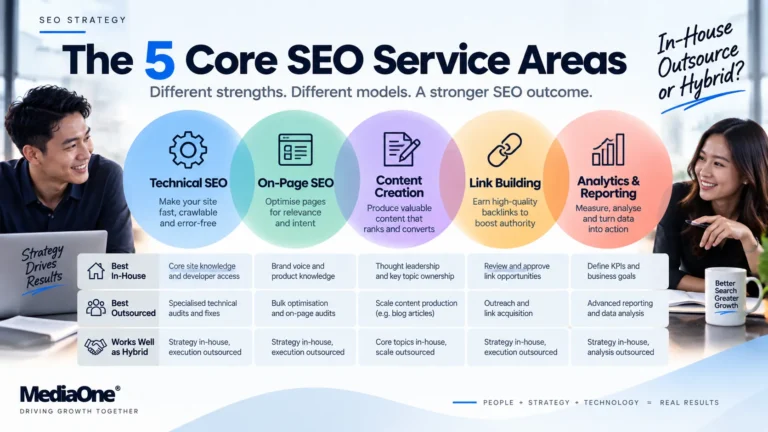
The decision to outsource SEO depends less on outsourcing logistics than on organisational readiness and strategic intent. It is about whether your business is ready to scale search visibility, and if so, whether your in-house capacity can support that growth. Most companies approach this incorrectly by treating outsourcing as a binary choice instead of a stage-dependent decision tied to revenue, team maturity and strategic control.

If you are looking to outsource your SEO when your annual revenue can support the cost of a specialist (typically SGD 60,000 to 90,000 per year depending on market and service depth), your site has enough existing traffic or content volume to warrant optimisation, and you can retain oversight of strategy and brand voice. Outsource too early, and you allocate budget to optimisation work prematurely, before the site is ready. Outsourcing without strategic control risks penalties, knowledge loss, and vendor lock-in, leaving you helpless if the relationship ends.
This article gives you a diagnostic framework to decide whether outsourcing makes sense for your business right now, how to choose a partner without being exploited, and how to set up the arrangement so it actually delivers results instead of generating expense without demonstrable ranking improvement.
Key Takeaways
Outsourcing SEO is not a binary choice. It is a scaling decision tied to specific thresholds: revenue level, content volume, team maturity and available budget. Most failures stem from outsourcing too early (before the business is ready) or too late (after penalties have set in), not from outsourcing itself.
Outsourcing makes financial sense when the cost of an in-house hire plus overhead exceeds an agency retainer. In Singapore, a mid-level SEO specialist costs SGD 60,000 to 90,000 annually plus 17% employer CPF contribution (roughly SGD 72,000 to 106,000 total). If an agency retainer is SGD 3,000 to 5,000 monthly (SGD 36,000 to 60,000 annually), outsourcing is cheaper for businesses with annual revenue under about SGD 1.5 million or fewer than three dedicated marketing hires.
You cannot outsource strategy, brand voice or performance oversight. These must stay in-house. Outsourcing execution (technical audits, link building, content optimisation) without strategic control invites low-quality tactics and brand misalignment. The ideal model pairs an in-house strategist with outsourced execution.
Real risks are specific and manageable. Algorithmic penalties, knowledge silos, timezone communication delays and vendor lock-in are not inevitable. They require deliberate mitigation: clear service-level agreements, monthly reporting, documented workflows, and a contract exit clause. Without these, outsourcing is more likely to underperform.
Your readiness to outsource depends on three factors: site maturity (you have at least six months of baseline organic data), content depth (you can supply four or more pieces monthly or have a documented content calendar), and business clarity (you can define success in KPIs, not vanity metrics). If all three factors are present, outsourcing may be viable for many businesses. Assess fit against your specific context.

The vendor relationship is not a purchase transaction. It is a partnership with asymmetric information (they know more about SEO than you do; you know your business better). Your job is to ask hard questions before signing, set measurable KPIs upfront and audit monthly. Agencies that resist service-level agreements, pricing transparency, or performance guarantees are red flags.
Hybrid models (in-house strategist plus outsourced execution) reduce risk more than full outsourcing. You retain control of direction, brand and data analysis while letting the agency handle technical work and link acquisition. This costs more upfront but prevents knowledge loss and vendor lock-in.
Is Your Business Ready?
Before you contact an agency, ask yourself: Do you have the traffic or content volume to optimise? Do you understand what SEO should deliver to your business (leads, sales, sign-ups), and can you measure it? Can you commit to a partner for at least six to twelve months without expecting overnight results?
If your site gets fewer than 5,000 organic visits per month or if you have fewer than 50 pages of indexable content, outsourcing is premature. You risk paying agency fees without proportional ranking improvements. Instead, invest in a fractional SEO consultant (ten to fifteen hours per week) to audit your site, set up proper tracking and create a roadmap. Once you have momentum, then shift to an outsourced execution model.
If your revenue doesn’t yet justify a full-time hire, outsourcing also doesn’t make financial sense unless you use a retainer model with a smaller agency or freelancer. A SGD 36,000 to 60,000 annual budget buys you a junior in-house hire or a part-time external resource, not a full-service agency doing technical, content and link work across multiple projects.
If you cannot answer “What does a 20% increase in organic traffic mean for our bottom line?” outsourcing will feel like an expense rather than an investment. Before you hire anyone, define your revenue threshold (for example, “a new lead from organic search is worth SGD 500 to us”) and work backwards to decide how much you can afford to spend on SEO.
What Outsourcing SEO Actually Means
SEO spans technical fixes, content creation, link building, analytics and strategic planning. Outsourcing does not mean handing off your entire marketing function. It means selecting which parts of that work go to a third party and which stay internal.
Core differences: control structure, accountability ownership and integration depth
The core difference is not just who does the work. It is where control and accountability sit. Now let us look at what actually happens in each model.
In-house SEO means hiring an SEO specialist or team as permanent or long-term employees. They sit within your organisation, report directly to your marketing leader and operate under your brand and processes. They know your business deeply. They make daily decisions without waiting for approval. They own the results and feel the consequences.
Outsourced SEO means delegating search optimisation tasks to an external agency, freelancer or consultant. They work remotely, usually on a contract basis, and typically serve multiple clients. They bring external expertise and flexibility but operate at arm’s length from your daily operations. You pay for hours or outcomes, not a salary.
The practical gap matters more than the label. An in-house specialist gives you continuity, immediate feedback loops and institutional knowledge that compounds over months. They understand why you made a decision in 2022 and why it failed in 2023. They sit in strategy meetings. They catch brand-voice issues before they go live.
Outsourced partners bring fresh perspective, no office overhead and the ability to scale up or down quickly. If you need a link-building sprint for three months, you hire. If you need a full technical audit, you engage an agency for eight weeks. When the project ends, the cost ends.
The trade-off: outsourced work is typically less integrated into your day-to-day and less accountable to your specific long-term vision. You do not retain the institutional relationships or contextual knowledge the vendor has developed. If they leave, you start with a new vendor and knowledge from briefings, not from years of embedded context.
The scope of outsourced SEO services
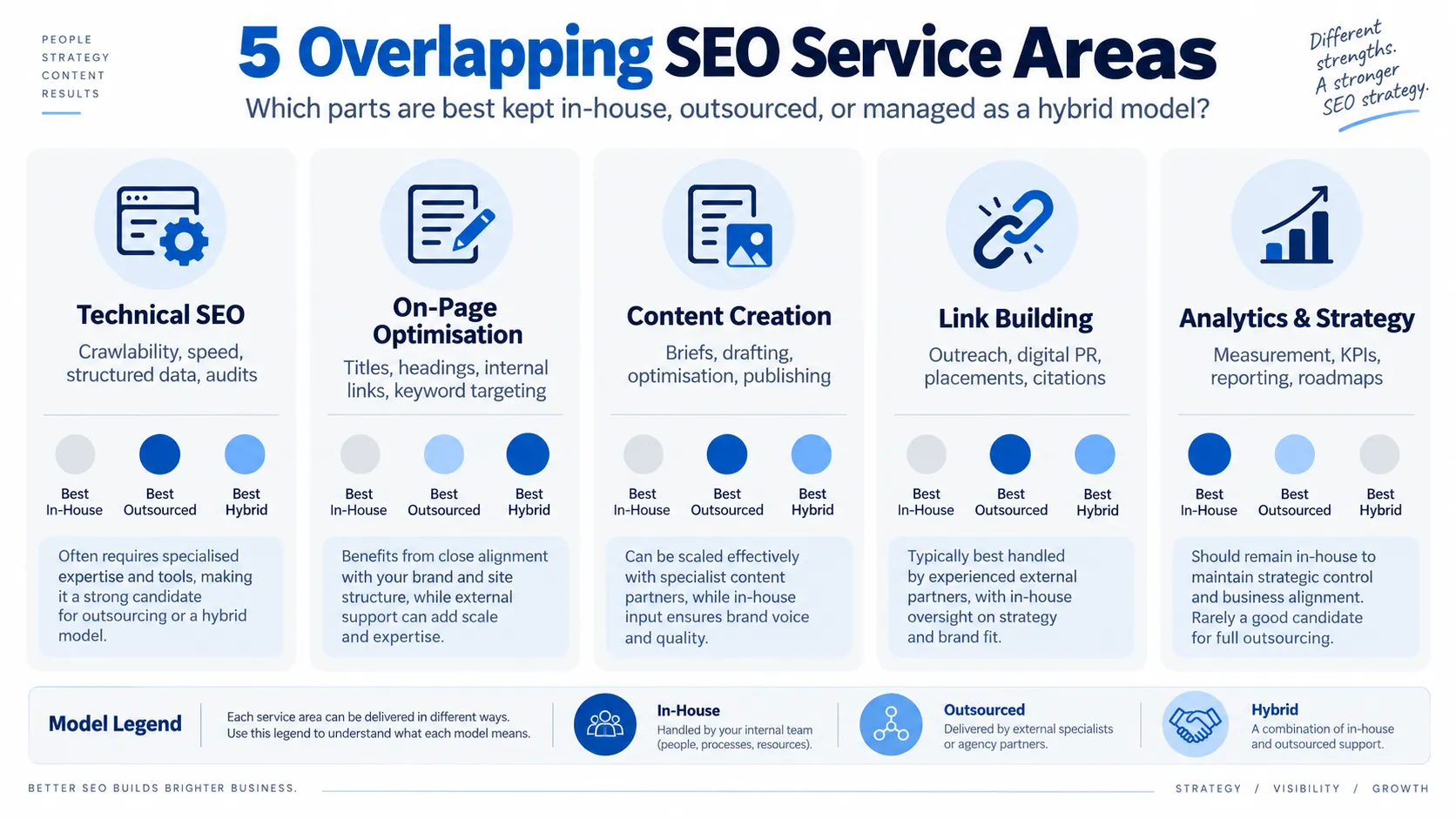
Outsourced SEO is not monolithic. The work falls into five overlapping areas, and you can outsource all, some or none of each.
Technical SEO
Crawlability, site speed, structured data, mobile optimisation, and log analysis are all key areas of technical SEO. This area is often a good first outsourcing target because it is bounded, measurable, and doesn’t require deep brand knowledge. An agency can audit your site, identify issues and recommend fixes. Execution can stay in-house (your developers) or go to the agency.
On-page optimisation
Title tags, meta descriptions, heading structure, internal linking strategy and keyword targeting. This sits between technical and strategic. It requires knowing your audience and business positioning, so many teams keep this partially in-house. A vendor might recommend targets; your internal team retains copy approval authority.
Content creation and optimisation
From keyword research to drafting, editing and publishing. This is labour-intensive and often entirely outsourced, especially if your team is small. Risk: a freelance writer may not match your tone. Benefit: you can scale from two posts a month to eight.
Link building and off-page signals
Outreach, guest posting, citation building and PR support. This is frequently outsourced because it is time-consuming, requires external relationships and does not require your company’s operational knowledge. Many teams use hybrid models: an agency identifies opportunities and builds relationships; your team approves placements.
Analytics, reporting and strategy
SEO measurement, traffic analysis, conversion attribution and quarterly planning. This should almost never be fully outsourced. An external partner can provide monthly reports and tactical recommendations, but the strategic calls (which channels to double down on and how SEO feeds the sales funnel) must stay with you. Outsourcing this creates a knowledge gap that will hurt you when you change vendors.
Most outsourced engagements combine two or three of these. A typical setup: an agency handles technical audits, content planning and link building. Your team writes copy, approves placements and owns analytics.
Who typically outsources and why?
Outsourcing SEO is not for a specific size or type of business. It comes down to straightforward economics: when external resources are cheaper than hiring, or when you need specialist skills that would sit idle after a project ends, outsourcing wins.
Early-stage startups (pre-product-market fit) often outsource because they cannot afford a full-time hire and their content needs fluctuate wildly. They may engage a freelancer for keyword research and a content creator for six months, then pause. Cost: SGD 1,500 to 3,500 per month. Hiring in-house would cost at least SGD 4,500 per month, full-time, with no pause button.
SMEs with stable revenue typically outsource if they have a marketing person but no dedicated SEO expert. A local e-commerce business with SGD 500,000 annual revenue might outsource link building and technical fixes (SGD 800 per month) rather than hire. The alternative (hiring a part-time SEO specialist for SGD 2,500 or more) isn’t reliably available in their market.
Growth-stage SaaS and e-commerce companies often use hybrid models. They hire one internal SEO strategist (SGD 60,000 to 90,000 annually in Singapore, plus 17% employer CPF contribution, totalling roughly SGD 72,000 to 106,000) but outsource content production, link building, and technical execution to specialists. This costs an additional SGD 3,000 to 8,000 per month but allows faster scaling. The internal person focuses on what drives the biggest revenue: conversion optimisation, channel prioritisation and competitive positioning.
Agencies and consultancies white-label SEO by outsourcing execution to specialist vendors while reselling under their own brand. They keep client relationships and strategy; a partner handles the technical work and reporting. The margin benefit is substantial at high volumes.
Bootstrapped and part-time marketers outsource because they lack time. A founder managing marketing and sales alongside their main job might outsource all tactical work (content, links, technical fixes) and spend three to four hours weekly reviewing strategy and results.
The common thread: outsourcing wins when the external cost is lower than the internal salary (including overhead), when you need temporary capacity or when the skill set would otherwise sit underutilised. Outsourcing loses when you need deep brand knowledge, continuous strategic refinement or tight integration with product and sales decisions. Those functions are almost always cheaper and more effective in-house.
When Outsourcing SEO Makes Financial Sense
Outsourcing decisions should be driven by numbers, not gut feel. The key calculation is straightforward: What does it cost to hire someone in-house versus paying an agency?
Calculating the cost of in-house SEO versus agencies
In Singapore, a mid-level SEO specialist with three to five years of experience costs SGD 60,000 to 90,000 annually in base salary. That is not the total cost.
Add employer CPF contribution at 17%: SGD 10,200 to 15,300 per year.
Add benefits (health insurance, equipment, workspace): SGD 3,000 to 5,000 per year.
Add hiring and onboarding costs (recruitment, training, lost productivity during ramp-up): SGD 5,000 to 8,000 one-time.
Add slack time and context-switching overhead (they will spend 20 to 30% of their time in meetings, responding to urgent requests or learning your business): effectively 25 to 30% of their productive time is lost.
Total true cost of an in-house SEO specialist in Singapore: SGD 77,000 to 115,000 per year for productive SEO time.
An agency retainer for equivalent full-service SEO (technical audits, content planning, and some link building) costs SGD 3,000 to 5,000 per month (SGD 36,000 to 60,000 annually) for SMEs, or SGD 5,000 to 10,000 per month (SGD 60,000 to 120,000 annually) for larger campaigns or more senior expertise.
The break-even point: If you can keep an in-house specialist busy and productive on SEO alone, hiring in-house costs the same as, or slightly more than, a retainer but gives you continuity. If SEO is one of five responsibilities for a marketing hire or if your needs fluctuate, outsourcing wins.
For a business with SGD 1 million to 3 million annual revenue and one existing marketing person wearing many hats, outsourcing at SGD 3,000 to 5,000 per month is almost always cheaper than hiring.
Revenue thresholds that justify outsourcing
Revenue is a reasonable proxy for whether you can afford SEO investment at all.
Below SGD 500,000 annual revenue: SEO is premature unless it is your primary channel and growth driver. Spend on product, sales and paid advertising first. When you reach SGD 500,000, you have proven demand and can invest in organic growth. At this stage, outsource small tactical projects (a technical audit, three months of content, a link-building sprint) rather than retainers.
SGD 500,000 to 1.5 million revenue: Outsourcing makes sense. You have enough revenue to justify agency fees (SGD 3,000 to 5,000 monthly) but not enough to hire someone full-time whose time you can guarantee. Use a retainer model and expect six to twelve months before results compound.
SGD 1.5 million to 5 million revenue: You can support either a junior in-house hire or a strong outsourced team. A hybrid model works well here: hire a fractional SEO strategist (0.5 to 1.0 FTE, SGD 30,000 to 50,000 annually) and outsource execution (SGD 3,000 to 8,000 monthly). This balances cost, continuity and specialist depth.
SGD 5 million or more revenue: You can afford a full-time in-house SEO lead (SGD 80,000 to 120,000 annually, plus team) plus outsourced specialist vendors for technical audits, link building and content scaling. The in-house person drives strategy and vendor management. Agencies handle execution and bring expertise you wouldn’t justify hiring internally.
These thresholds are rough, not rules. A SaaS company with 70% of revenue tied to organic sign-ups might justify outsourcing at SGD 300,000 in revenue. A B2B service business where SEO is a 5% channel might not justify it until SGD 2 million.
The question to ask: If organic traffic grew 30% in the next year, how much additional revenue would that generate? If the answer is SGD 100,000 or more, outsourcing SEO makes financial sense. If it is SGD 10,000, it does not.

Cost figures are illustrative as of publication and subject to market variation and regulatory changes.
Hidden costs of building an in-house team
Hiring one SEO specialist is rarely the end of the build. Once you have one person, you typically need:
A second person within twelve to eighteen months if organic traffic becomes a growth driver. One person cannot sustain technical work, content production and strategic planning alone. A second hire (SGD 50,000 to 80,000) brings specialisation: one on technical SEO, one on content.
A project manager or content operations hire if you scale to eight or more pieces of content monthly. Someone needs to coordinate calendars, brief writers, track revisions, and manage publication workflows. Cost: SGD 40,000 to 60,000 annually.
Tools and software: SEO management platforms (Digimetrics.ai, Moz, Ahrefs, SEMrush), analytics tools, content management systems and monitoring tools. Budget SGD 2,000 to 5,000 per month for a team of three to four people across multiple tools.
Recruiting and onboarding costs for each hire: SGD 5,000 to 10,000 per person, plus two to three months of reduced productivity as they ramp.
Knowledge redundancy: If your only SEO expert leaves, you lose continuity. Hiring a replacement takes two to three months and costs another SGD 5,000 to 8,000 in recruitment.
A team of three to four in-house SEO people (director, strategist, content lead, analyst) costs SGD 250,000 to 350,000 annually in salary and benefits. Add tools at SGD 40,000 to 60,000 per year, and you are at SGD 290,000 to 410,000 per year, plus hiring costs.
An equivalent outsourced team (a full-service agency handling technical work, content production, and link building, plus a fractional in-house strategist) costs SGD 80,000 to 150,000 annually in-house (strategist) plus SGD 60,000 to 120,000 annually (agency), for SGD 140,000 to 270,000 per year.
The in-house team model costs more upfront, builds institutional knowledge and gives you direct control. The outsourced model is more flexible and cheaper for businesses without a dedicated search channel. Choose based on your growth ambitions and whether SEO is core to your business, not on which sounds cheaper in the first year.
The Real Risks of Outsourcing SEO (And How to Mitigate Them)
Outsourcing fails when you don’t manage risk. The right structure makes specific risks known and preventable.
Algorithmic penalties and low-quality tactics
The worst case: your SEO partner employs high-risk tactics (keyword stuffing, artificial link building, content farms, private blog networks, cloaking) to accelerate results. Google’s algorithms catch this and penalise your site, dropping rankings and traffic by 30 to 70%. Recovery takes months and requires auditing and removing all low-quality work.
Why it happens: pressured agencies promise quick results, cut corners, or work with subcontractors whose practices they don’t vet. You don’t see the low-quality links or artificially inflated metrics until the penalty hits.
How to prevent it:
- Ask specifically about link acquisition tactics before signing. A safe answer sounds like: “We do outreach to relevant, topically related sites, focus on sites with strong domain authority and conduct a manual review of every link before placement.” A red flag: “We can get you 50 links a month” or “Our network includes thousands of sites ready to link to clients.”
- Request monthly reports showing every link placed and every piece of content published. Review them yourself using Digimetrics.ai, Ahrefs or SEMrush. If you see links from unrelated or low-quality domains or content that does not match your brand, ask why and document the conversation.
- Add a contractual clause stating that the agency assumes responsibility for penalties caused by its actions. If a Google penalty results from their tactics, they must remediate it at no cost. Most reputable agencies accept this responsibility. Those that resist are signalling they may be willing to take shortcuts.
- Require the agency to reference at least two existing clients (not just a case study). Call those clients and ask specifically: “Has this agency ever caused you a penalty? What tactics do they use? Would you re-hire them?” Ask about concrete results, not just traffic increases. Metrics can be gamed; client retention and longevity cannot.
- Audit quarterly. Use Google Search Console, Google Analytics and a third-party crawler (Screaming Frog or Sitebulk) to check: Are pages still indexed? Has organic traffic dropped in unexpected ways? Are internal links pointing to spammy sites? You should be doing this anyway, but it is an early warning system for vendor problems.
Loss of control and brand voice
An agency writing all your content may produce SEO-optimised pieces that read like they were written for search engines, not people. Or they may miss your brand positioning, tone and the specific value propositions your product actually delivers.
Why it happens: agencies are incentivised to hit keyword targets and produce volume, not to nail your unique positioning. A freelancer hired to write “ten posts about project management” has no context for what makes your tool different from rivals.
How to prevent it:
- Write a one-page brand and tone guide and require the agency to follow it. Include examples of your voice (publish a strong existing article and say “this is the tone we want”), key positioning messages (for example, “we are for remote teams, not enterprise”) and a list of terms and topics that are off-limits. Update it annually.
- Require a content outline review before writing begins. The agency should submit a detailed outline (headings, argument structure, key claims) for your approval before the first draft. This catches positioning misalignment early and saves revision rounds.
- Review the first three to five pieces as drafts, not final proofs. Give hard feedback. If the tone is wrong, rewrite a paragraph and show them what you want. After five pieces, you should see them adapting to your voice. If you don’t, the relationship isn’t working.
- Retain final approval on all published content. This is non-negotiable. Your blog is your voice, not theirs. A clause in the contract should say you have final sign-off. If an agency resists, they are telling you they do not respect your input.
- Define off-limits topics and claims upfront. If you use “AI-powered” as a key message, do not let the agency write “our AI technology” on every page (keyword stuffing in disguise). If you make regulatory or compliance claims, require your legal team to review before publication.
Communication gaps across time zones
Outsourcing across time zones (for example, a Singapore-based team working with a US or European agency) introduces delays. You ask a question Monday morning; they reply Wednesday. A decision you make Friday isn’t executed until Tuesday. This slack can add weeks to projects and make the relationship feel frustrating.
Why it happens: Working hours don’t overlap, and agencies typically serve multiple clients across different time zones. Your urgent question is not their urgent question.
How to prevent it:
- Choose an agency with a coordinator or account manager in your time zone or within plus or minus four hours. This person becomes the single point of contact. Even if the execution team is elsewhere, the coordinator can answer routine questions without delay. This is worth paying 10 to 20% more.
- Establish a communication rhythm with fixed timing. Example: “Weekly sync call every Tuesday at 9 am Singapore time. Async updates via Slack Wednesday evening. Monthly business review first Friday of the month.” Predictability reduces surprise delays.
- Use asynchronous communication for most work. Jira tickets, shared documents, Slack updates. Reserve calls for decisions that need live discussion. This removes the need for overlap and keeps information documented.
- Set a 48-hour response time SLA for urgent questions. In the contract, specify that both parties will respond to marked-urgent items within two business days. This gives enough buffer for time zones but prevents indefinite delays.
- Have a backup point of contact. One person on the agency side (the founder, a senior team member) who can unblock urgent decisions if your account manager is unavailable. Exchange direct contact details. You should rarely need this, but it removes a single point of failure.
Vendor lock-in and knowledge silos
Lock-in happens when your agency is the only person who understands why you made certain decisions, how your site is structured or which tactics have worked. If they leave, you are helpless. You cannot switch to a new agency without losing months of institutional knowledge. You pay high renewal rates because you are trapped.
Why it happens: Agencies aren’t incentivised to document their work or train you. They benefit from staying indispensable. Lazy teams do not hand over access to tools or accounts. Knowledge stays in their heads.
How to prevent it:
- Own all accounts and access from day one. Your company owns your Google Analytics account, Google Search Console, Digimetrics.ai, domain registrar and hosting. The agency should be a user with edit access, not the account owner. Non-negotiable. A contract clause should say “Client retains ownership of all accounts, tools and data.”
- Require monthly documentation of all work done. This includes technical changes made, content published (with keyword targets and linking strategy), links acquired (with domain metrics), audit findings and recommendations. Store it in a shared drive or wiki. This is not optional. Make it a contract requirement.
- Demand access to all reports and raw data. You should be able to log into Google Analytics, SEMrush and the agency’s reporting tool and see real numbers yourself, not just a polished PDF. Agencies should push back only on internal processes you do not need to know about.
- Schedule quarterly knowledge-transfer sessions. The agency leads a one-hour meeting every three months, walking you through key decisions, strategy rationale and any upcoming changes. Record it. This is partly insurance and partly training. It is also a chance to catch misalignment.
- Build exit optionality into your contract. Require thirty to ninety days’ notice for termination (reasonable); require the agency to hand over all documentation, accounts and raw data within fourteen days of termination (non-negotiable). If they resist, assume they will fight you if the relationship sours.
- Hire a fractional SEO strategist to audit the outsourced partner quarterly. This person isn’t doing the work; they are auditing the vendor and translating their outputs into your business. Cost: SGD 1,500 to 3,000 per month. This is cheap insurance against vendor lock-in and low-quality work.
Common Issues in Outsourced SEO Partnerships
| Common Issue | Why It Happens | How To Prevent or Fix |
|---|---|---|
| Traffic increases, but revenue does not grow | Agency optimised for wrong keywords or user intent mismatched to your sales funnel | Define the revenue impact KPI upfront (e.g., “leads per month from organic”). Have agency target keywords by conversion intent, not just volume. Audit landing page conversion rates monthly. |
| Frequent communication delays or missed deadlines | Time zone misalignment, agency overbooking or unclear expectations | Set fixed meeting times in your zone. Use async communication. Assign a dedicated account manager. Specify a 48-hour response SLA in contract. |
| Content does not match brand voice | Agency lacking context or not given clear tone guidelines | Provide a detailed brand guide with examples. Review the first five pieces as drafts. Give feedback. Re-brief if tone does not improve by month two. |
| Ranking improvements plateau after three months | Quick wins are exhausted; competitive keywords require 6-12 months of work | Set realistic expectations upfront (quick wins = 0-3 months, competitive keywords = 6-12 months). Track leading indicators (top 50, top 100 rankings) monthly, not just top 10. |
| The agency resists transparency on methods or metrics | The vendor has something to hide or does not trust you to understand their work | Demand monthly reporting with method explanations. Request references from current clients. Ask pointed questions in the first call about their process. If resistance continues, switch vendors. |
| You discover low-quality backlinks pointing to your site | The agency used risky tactics or subcontracted to a lower-quality team | Stop work immediately. Audit all links acquired. Use the Google Disavow Tool for low-quality links. Request a written remediation plan from the agency. If not credible, terminate contract. |
How to Evaluate and Select an SEO Outsourcing Partner
Choosing a vendor is where most outsourcing relationships fail. Businesses trust credentials, case studies and sales pitches instead of asking hard questions.
Red flags in agency proposals and pricing
Red flag: “Guaranteed results” or “First-page guaranteed”. No legitimate SEO vendor can guarantee top rankings. Search rankings depend on hundreds of algorithm factors outside anyone’s control. Agencies that promise results are either lying or using high-risk tactics. Avoid them.
Red flag: Vague scope and timeline. If a proposal says “SEO services, six months, results TBD,” walk away. You need specifics: Which keywords will be targeted? What technical work is in scope? What counts as success? If they cannot articulate this clearly, they haven’t thought it through or don’t care about your specific situation.
Red flag: Pricing that sounds too cheap. If an agency quotes SGD 800 per month for full-service SEO, they are either not doing real work or staffing it with inexperienced people. SEO costs what it costs. A reasonable floor for any meaningful work is SGD 2,000 per month. Below that, you are likely getting junior staff or automation, not strategy.
Red flag: Pricing that sounds too expensive without justification. If they quote SGD 50,000 per month and cannot explain what the team will do and why it costs that much, push back. Get a breakdown: X hours of strategy, Y content pieces, and Z link outreach. Does it add up?
Red flag: No clear contact person or account management. If you cannot identify one person as your point of contact and owner of your success, the relationship will be frustrating. Larger agencies should assign you a dedicated account manager. If they say, “You will work with the whole team,” they are spreading responsibility too thin.
Red flag: No SLA or contract terms about what happens if they do not deliver. If they refuse to specify response times, performance benchmarks or exit terms in writing, they are signalling they do not stand behind their work. Insist on a written agreement with specific terms.
Red flag: Unwillingness to share client references. A reputable agency should happily give you two or three current clients (not just case studies) who will vouch for their work. If they cite confidentiality, ask for anonymised reference calls. If they refuse, that is suspicious.
Credentials that actually matter
Awards and certifications: Many agencies display “SEO Expert” badges or awards from industry bodies. Most are marketing noise. The exception: if they are a Google-certified partner (through Google Ads or Google Analytics certification programmes) or listed on Google’s official partner network for your region, that is a real credential.
Case studies with numbers: A good case study shows before-and-after metrics: “Traffic increased from 5,000 to 20,000 monthly in twelve months, and revenue from organic grew from SGD 0 to SGD 200,000.” Vague case studies (“client saw great results”) are useless.
Team credentials: Ask about the team. Do they have people with 5+ years of SEO experience? Who will be doing your work? Can they explain why a tactic works, not just what to do? Interview the person who will be your main point of contact. If they cannot articulate SEO strategy in your domain, they are not qualified.
Industry experience in your space: An agency with ten years of SaaS SEO experience is more valuable if you are a SaaS company than one with broad generalist experience. They understand your sales cycle, your keywords and your typical customer journey. But don’t be fooled: some of the best generalist agencies can ramp up quickly in any industry.
Transparency about methods: A good agency will explain their approach in plain language. They should tell you what they will do (technical audits, content planning, link outreach), how long it will take (this keyword will take six to twelve months to rank) and what you need to do (approve content, provide product knowledge, provide internal linking strategy). If they are vague or defensive, distrust them.
Vendor types and evaluation framework
| Vendor Type | Typical Cost Range | Best For | Key Strengths | Key Risks |
|---|---|---|---|---|
| Full-service agency | SGD 5,000 to 10,000+ monthly | Businesses with SGD 2m+ revenue needing integrated strategy, content and link building | Specialised team, project management, consistent methodology, built-in account management | Expensive for small budgets; may be less flexible; results depend on account manager quality |
| Specialist agency (technical only, content only, link-building only) | SGD 2,000 to 5,000 monthly | Businesses with in-house capability in some areas but gaps in others | Deep expertise in a narrow area; low overhead; scalable; good for tactical projects | Siloed work; less integrated strategy; you manage multiple vendors |
| Freelancer (individual contractor) | SGD 1,500 to 4,000 monthly | Startups, part-time businesses, tactical projects (audits, content, link building) | Low cost; flexibility; direct relationship; easy to pause or scale | Limited capacity; knowledge risk if they leave; less formal SLAs; potential quality variance |
| Fractional consultant (0.5–1.0 FTE) | SGD 2,500 to 4,000 monthly | Businesses that need strategy and oversight but outsource execution | Deep strategic input; knowledge transfer; vendor management; can audit other vendors | Limited execution; you still need to hire agencies for tactical work; harder to find qualified people |
Questions to ask before signing a contract
- “Can you walk me through how you would approach our specific situation?” Do not accept a generic pitch. They should ask you about your current site, your revenue, your competitive landscape and your business goals before recommending anything. If they start talking about their playbook before understanding your context, they are templating you.
- “What is the typical timeline before we see results?” Honest answer: three to six months for traffic growth on high-volume keywords, six to twelve months for competitive keywords. If they promise results in thirty days, they are overselling. If they say “six months minimum with no exceptions”, they are being overly cautious but at least honest.
- “How do you build links? Can you walk