Most Singapore SMEs treat their blog like a printing press. They publish, move on, publish again. Three years later, the site has 400 articles, roughly 60 percent of which receive fewer than 10 organic visits per month, and the founder is still commissioning new content instead of fixing what already exists.

The economics are inverted. New content is expensive to produce and slow to rank. Existing content already has indexation history, backlinks, and topical authority that new content must build from scratch. Refreshing what you have is faster, cheaper, and mathematically favoured. Yet most content strategies treat refresh work as an afterthought.
Why is my old blog content losing traffic is now one of the most common questions our sales team hears in discovery calls, particularly after Google’s May 2026 core update. The update explicitly demoted content with declining freshness signals. Pages that have not been meaningfully updated in 18+ months are being systematically pushed down regardless of historical authority.

Standard content refresh advice treats every underperforming page as worth updating. It isn’t. Some pages should be refreshed, some should be consolidated, some should be redirected, and some should just be deleted. Getting this triage right is where a working content refresh strategy diverges from the generic advice most articles publish.
This piece walks through the four-tier triage MediaOne applies on every content audit, the prioritisation logic that determines what gets refreshed first, and the AI citation angle nobody else covers.
Key Takeaways
- A content refresh strategy in 2026 is not about touching every underperforming page. It is about triaging content into four decisions: refresh, consolidate, redirect, or delete.
- Roughly one in five underperforming pages genuinely deserves a refresh. The rest deserve consolidation, redirection, or deletion.
- Google’s May 2026 core update explicitly demoted stale content, making freshness a stronger ranking signal than at any point in the past five years.
- The strongest refresh candidates rank positions 5–20 with declining trend lines. They typically respond within 4–8 weeks. Pages ranking below position 30 rarely justify the effort.
- AI citation refresh is now a separate discipline from Google ranking refresh, and most Singapore SMEs are optimising for neither properly.
The Content Triage Framework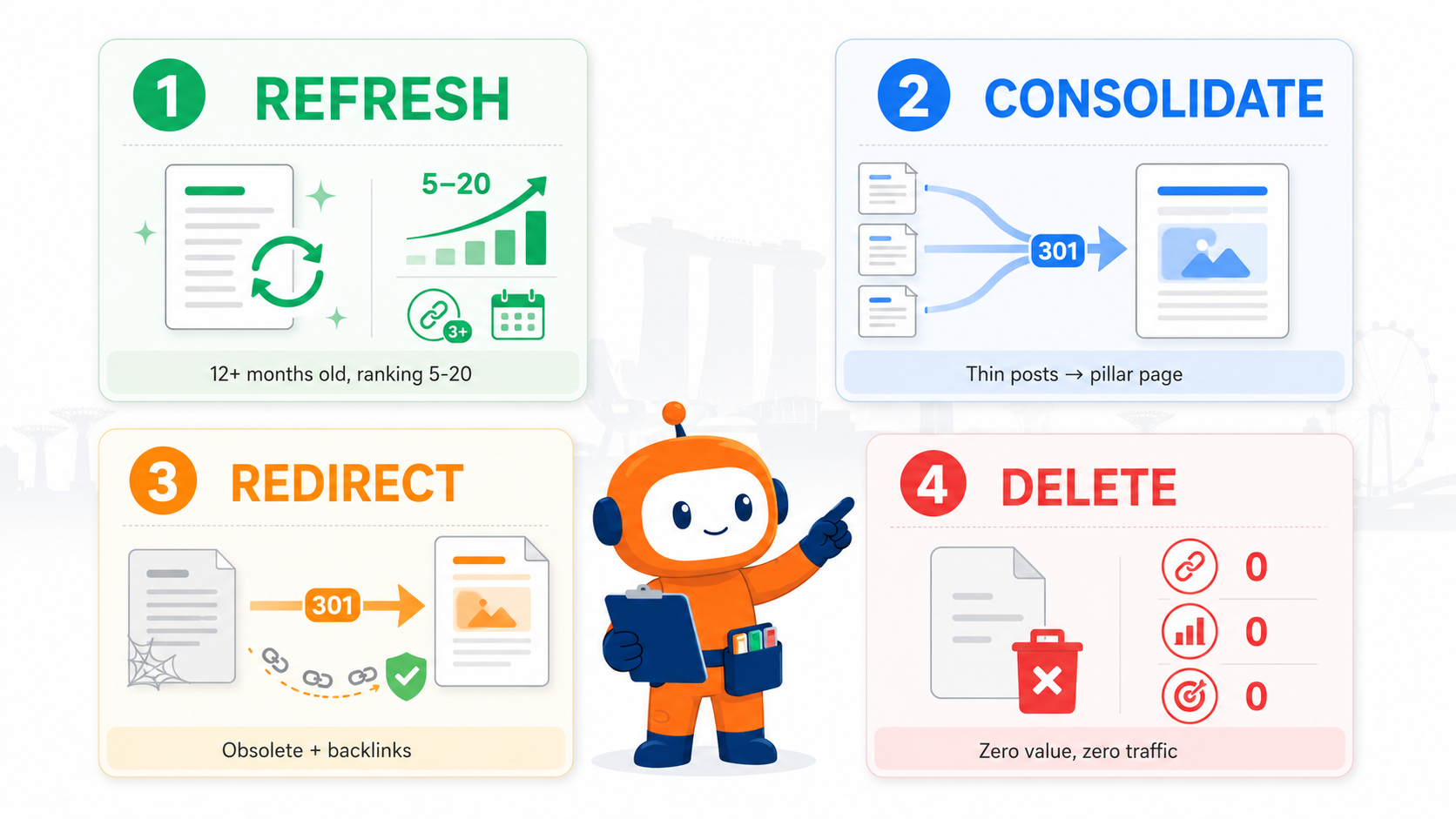
Standard content refresh articles assume every underperforming page is worth updating. In practice, roughly 40 percent of the “underperforming” content on typical Singapore SME blogs is actively hurting the site by diluting topical authority, cannibalising better pages, or signaling neglect to Google’s Helpful Content system.
The framework below sorts every page into one of four decisions. Skip this triage step and you spend refresh budget on pages that were never going to recover.
Tier 1: Refresh (The Highest-ROI Candidates)
Pages that meet all three criteria simultaneously:
- Currently ranking positions 5–20 for a commercially relevant keyword
- Have at least a small backlink profile (typically 3+ referring domains)
- Have not been meaningfully updated in 12+ months
These are the pages worth investing refresh effort in. Existing authority accelerates recovery, and the ranking distance to page one is close enough to close within 4–8 weeks of a proper refresh.
What does a content refresh actually involve is where most articles get vague. A meaningful refresh means rewriting 40–60 percent of the sentences by hand (not synonym swaps by an AI tool), adding a direct 40–60 word answer paragraph within the first 100 words of the page, updating at least three statistics with sources dated within the past 18 months, adding two new sections covering angles the original missed, and updating FAQ schema markup if present.
Superficial refreshes (date change, one new paragraph, refreshed hero image) rarely move rankings. Google’s systems are increasingly good at detecting cosmetic updates without substantive content changes.
Tier 2: Consolidate (When Multiple Thin Posts Should Become One Strong Guide)
Pages that individually cover thin slices of a topic your site could rank better for as a single comprehensive resource. The pattern is common: an SME has four blog posts on “email marketing tips,” each averaging 800 words and getting 20 monthly visits. Consolidated into one 3,000-word pillar page, they consistently outperform the sum of their parts.
The consolidation protocol requires 301 redirects from the merged URLs to the new destination. Skip this step and you lose the backlink equity accumulated on the original pages.
Should I delete or merge my old blog posts depends on the backlink profile. Pages with any referring domains should always be redirected, never deleted. Consolidation preserves link equity while cleaning up thin content.
Tier 3: Redirect (Preserve Backlinks Without Refreshing the Content)
Pages that are structurally obsolete but have earned backlinks worth preserving. Example: a 2019 blog post about a discontinued product feature. The content is dead, the topic is no longer relevant, but the backlinks still carry authority value.
Do not refresh. Redirect the URL with a 301 to the closest thematically relevant page on your site. This preserves link equity, removes dead content from Google’s index of your site, and consolidates authority on pages you actually want ranking.
After 30 days, verify the receiving page has absorbed the redirected authority. If it hasn’t, the target was a poor fit and you need to pick a different destination.
Tier 4: Delete (The Right Call for Content That Cannot Be Salvaged)
Pages with zero backlinks, zero organic traffic in the past 12 months, and no strategic purpose. Just delete them. Google’s Helpful Content system now treats site-wide thin content as a ranking signal against the entire domain, not just the individual pages.
Does deleting old blog posts hurt SEO is a common founder concern. The evidence points the other way. Content pruning at scale (removing 30 percent or more of thin content) typically produces measurable site-wide organic traffic lift within 60–90 days as Google’s quality signals recalibrate across the remaining stronger pages.
The AI content flood of 2024–2026 amplified this. Google is aggressively filtering low-value pages, and the safer position is to be on the right side of that filter before your next core update.
For SMEs unsure how to run this triage themselves, MediaOne’s SEO audit services include a full content-tier assessment identifying pruning candidates alongside refresh opportunities.
The Refresh Prioritisation Logic
Once the triage identifies Tier 1 refresh candidates, the next question is sequencing. You cannot refresh 200 pages at once. Which 20 first?
Five factors matter, weighted by their actual impact on refresh ROI:
| Factor | Weight | Why It Matters |
| Current ranking position (5–10 higher priority than 11–20) | 30% | Closer wins compound faster and require less lift |
| Referring domain count | 20% | Existing authority accelerates recovery meaningfully |
| Commercial intent of target keyword | 25% | Traffic that converts beats traffic that doesn’t |
| Search volume of primary keyword | 15% | Volume floor to justify the editorial investment |
| Time since last meaningful update | 10% | Stale pages respond fastest to substantive refreshes |
Score each candidate 1–10 on each factor, multiply by the weights, and rank. Refresh the top 20 first. Repeat quarterly.
Which pages should I refresh first for the biggest SEO wins is answered by this scoring, not intuition. Teams using intuition typically refresh the wrong pages: the ones the founder personally cares about, or the ones the marketing coordinator remembers writing. The scored approach removes personal bias and consistently produces stronger results.
The AI Citation Refresh Decision Nobody Covers
Every content refresh article in 2026 talks about Google rankings. Almost none address AI citation refresh, which is now the leading indicator of pipeline for B2B brands whose buyers research through ChatGPT, Perplexity, or Gemini before ever touching Google.
The two goals sometimes align, but not always. A page that ranks position 3 on Google might never be cited by an AI model because the content lacks attributable statistics or original data. A page that ranks position 15 might be cited weekly because it contains the specific data point the AI model needs. Refreshing for one is materially different from refreshing for the other.
For traditional Google refresh:
- Update statistics, expand thin sections, improve on-page SEO elements
- Optimise for click-through rate and dwell time
- Target featured snippet capture
For AI citation refresh:
- Ensure every statistic has attribution links (AI models preferentially quote attributed data)
- Add original research, firsthand data, or perspectives competitors do not have
- Structure content with clear semantic completeness (definitions, mechanics, examples, exceptions)
- Update publication and last-modified timestamps (AI models filter for recency more aggressively than Google does)
- Increase third-party mentions of the brand across independent sources
How do I get my blog content cited by ChatGPT depends on refreshing for retrievability rather than rankings. The content patterns that Google rewards and the content patterns that AI models cite have started diverging. Optimising for one alone leaves the other on the table.
For teams operating in verticals where buyers now research through AI assistants, engaging a specialist GEO agency alongside traditional refresh work produces materially better pipeline outcomes than either discipline alone. Our companion analysis on how to still get mentioned in Google AI Overviews walks through the specific citation triggers.
The Content Types Worth Refreshing (Reordered by Actual ROI)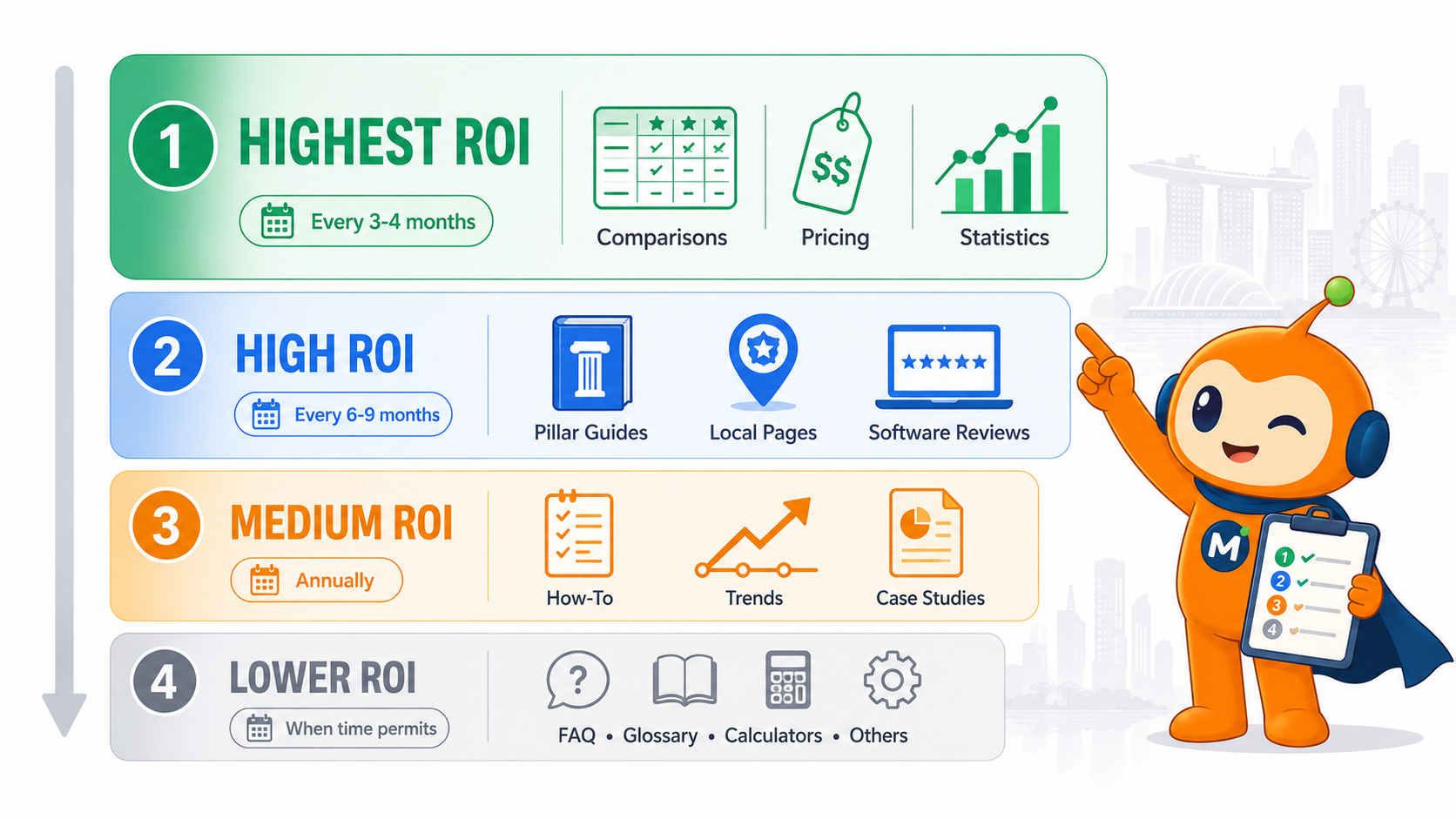
Most articles list content types alphabetically or by publication frequency. The more useful ordering is by ROI potential. Some content types respond dramatically to refresh work; others produce marginal returns even with heavy investment.
Highest ROI (Refresh First)
-
Product Comparison Posts and “Best of” Listicles
Refresh frequency: Every 3–4 months
These convert commercially and decay fastest. A “best CRM software Singapore 2024” post drops meaningfully in relevance by mid-2026 unless updated with current pricing, new competitors, and removed defunct options. Comparison content that ranks well now compounds well over time when refreshed consistently.
-
Pricing and Rate Guides
Refresh frequency: Every 3 months minimum
Pricing content ranks high on commercial intent and loses relevance faster than any other format. Pages with pricing data older than 6 months typically lose meaningful organic traffic as users detect the staleness before they even scroll.
-
Statistics-Heavy Content
Refresh frequency: Every 6 months
Pages built around statistics decay from the moment they publish. New data comes out constantly, and readers (plus AI models) filter out sources with data older than 18–24 months. Refresh statistics before anything else on these pages.
High ROI (Refresh Every 6–9 Months)
-
Pillar Content and Comprehensive Guides
These earn backlinks over years and anchor topical authority. Neglect is expensive. Add new sections, update statistics, refresh case studies, and expand thin subsections. Pillar refreshes typically produce the largest single traffic lifts because these pages already have accumulated authority to build on.
-
Local Service Pages
Business hours, service areas, team profiles, testimonials, and NAP consistency all change. Google’s local ranking system explicitly rewards freshness signals on service pages. Our companion guide on local SEO content strategy covers the specific freshness signals worth prioritising for Singapore-based businesses.
-
Software Reviews
Product interfaces, features, pricing tiers, and integrations shift constantly. Screenshots and pricing tables from 12+ months ago actively hurt credibility. If you are reviewing SaaS products, plan for twice-yearly refresh cycles minimum.

Medium ROI (Refresh Annually)
-
How-To Tutorials
Basics remain constant, but interfaces change. Update screenshots and software-specific instructions. Do not rewrite the fundamentals if they still hold.
-
Industry Trend Pieces
Convert stale trend predictions into “what actually happened” analysis. This retrospective approach uniquely provides value that new trend pieces cannot offer: accountability scoring for the predictions that came true versus the ones that missed.
-
Case Studies
Add “one year later” or “three years later” sections. Long-term outcome data is powerful proof of concept that new case studies cannot offer.
Lower ROI (Refresh When Higher Priorities Are Complete)
-
FAQ Pages, Calculator Tools, Glossary Pages, Recipe Content, Landing Pages, Resource Roundups
These matter but typically produce smaller lift-per-hour-invested than the categories above. Refresh them when the higher-ROI work is complete. Do not delay pillar or pricing refreshes to update a glossary page.
The Refresh Workflow Worth Following
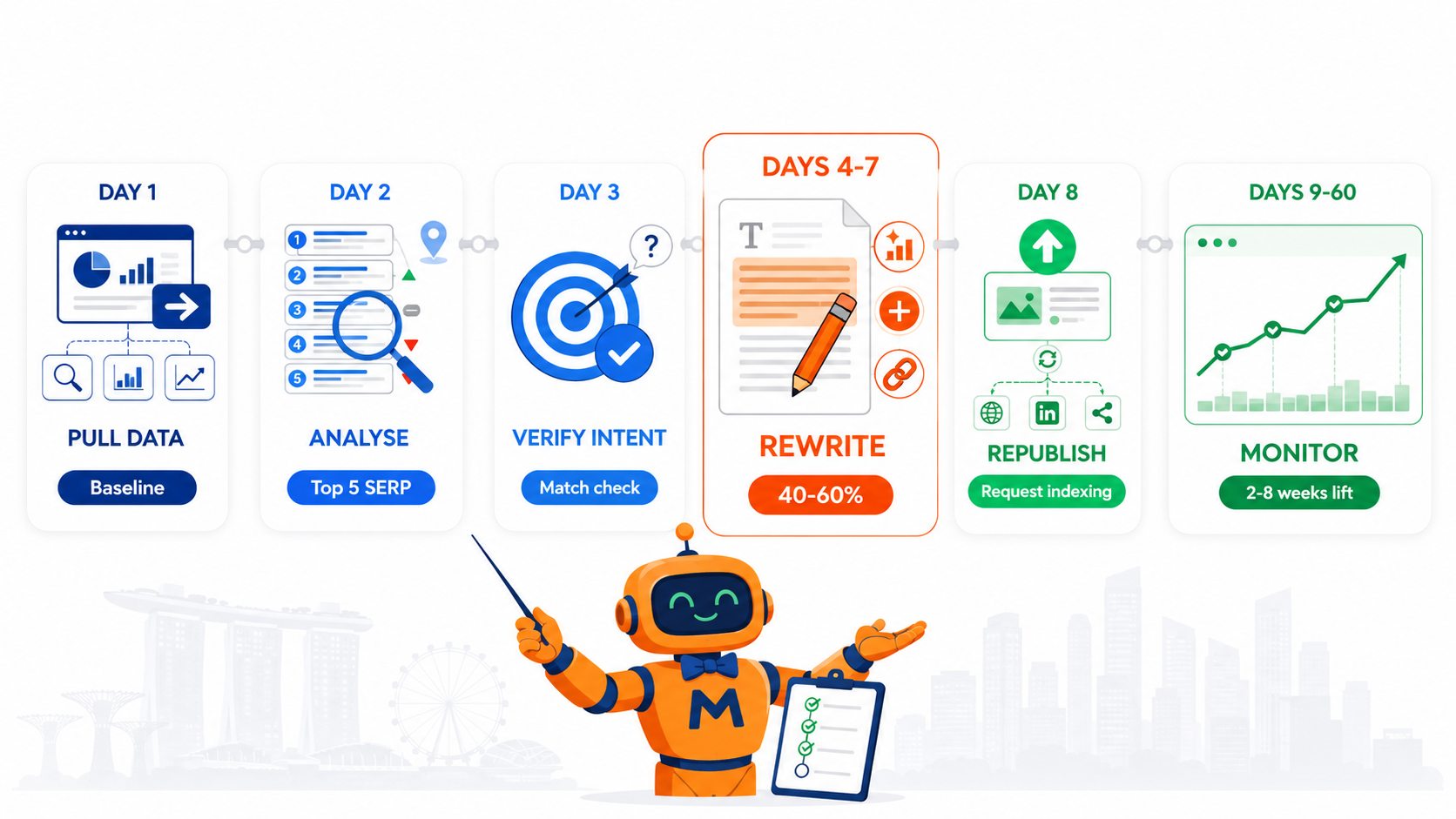
Prescriptive, sequenced, opinionated. The workflow below is what disciplined content teams follow. Skip steps and refresh outcomes get inconsistent.
Day 1: Pull the Data
Export the target page’s performance from Google Search Console (last 12 months), Ahrefs or Semrush (backlink profile, referring domains, keyword rankings), and Google Analytics 4 (traffic trend, bounce rate, average session duration). Note the current ranking position for the primary target keyword and top 3 secondary keywords. This is your baseline.
Day 2: Competitive Analysis
Search the target keyword in Google from a Singapore IP for local relevance. Analyse the top 5 currently-ranking results. What angles do they cover that yours does not? What word count are they at? What structural elements (tables, comparison grids, embedded calculators, videos) do they use? What questions do they answer that yours doesn’t?
Day 3: Search Intent Verification
Confirm the current search intent still matches your page. A “how to” page that used to rank for “best X” may need repositioning entirely. Pull the “People Also Ask” and “Related Searches” data for the keyword. If the intent has shifted, refresh alone may not be enough. You may need to reposition the page.
Day 4–7: The Rewrite
Apply the 40–60 percent rewrite standard. Add the direct 40–60 word answer paragraph in the first 100 words. Update all statistics with sources dated within the past 18 months. Add 2 new sections covering angles competitors miss. Update FAQ schema if present. Add internal links to 3–5 newer related pieces on your site. Update the “Last Updated” date visibly while keeping the original publication date.

Day 8: Republish and Request Indexing
Republish. Submit the URL for reindexing through Google Search Console. Share on 2–3 relevant channels to signal freshness through inbound traffic patterns.
Days 9–60: Monitor
Track ranking position weekly. Expect movement within 2–4 weeks, meaningful lift within 4–8 weeks. If no movement by week 6, investigate whether search intent shifted more than expected, whether competitors published stronger content in the interim, or whether the page has technical issues preventing recovery.
For SMEs wanting the full workflow executed at scale, MediaOne’s SEO agency services include monthly refresh cycles on top-priority pages with performance tracking built into the standard retainer.
The Metrics That Actually Prove Refresh Worked
Content refresh success is not measured by “we updated the page.” It is measured by outcomes. Track these five metrics for 90 days post-refresh:
| Metric | Target | What It Signals |
| Primary keyword ranking position | Move 3+ positions higher | Google recognises the update as improvement |
| Organic clicks (GSC) | 25%+ increase within 60 days | Users find the refreshed version more compelling |
| Impressions (GSC) | 15%+ increase within 60 days | Google is showing your page for more query variations |
| Time on page (GA4) | 20%+ increase | Content quality improvement is measurable in engagement |
| Featured snippet capture | Yes/no | The refresh structured content correctly for snippet eligibility |
If four of five metrics improve, the refresh worked. If two or fewer improve after 90 days, revisit the page. Something in the refresh missed the mark.
How do I measure whether a content refresh worked is answerable only against a baseline captured before the refresh started. Skip the baseline step and you cannot prove ROI.
Refresh Frequency by Content Type
Standard refresh frequency guidance is usually generic. The frequencies below reflect how quickly each content type decays in actual search performance:
| Content Type | Recommended Frequency | Primary Decay Driver |
| Pricing and rate guides | Every 3 months | Rate changes and competitor pricing shifts |
| Product comparisons | Every 3–4 months | New product releases and pricing changes |
| Statistics-heavy pieces | Every 6 months | Data recency drops citation credibility |
| Pillar and comprehensive guides | Every 6–9 months | Topic coverage gaps widen as fields evolve |
| Local service pages | Every 6–12 months | Business hours, team, and service area changes |
| Software reviews | Every 6–9 months | Interface changes make screenshots outdated |
| How-to tutorials | Every 12 months | Tool interfaces and best practices shift |
| Case studies and trend pieces | Every 12–18 months | Longevity data adds value; over-refreshing dilutes |
For time-poor SME teams, a rolling quarterly schedule is more sustainable than an all-at-once refresh sprint. Refresh 5–10 top-priority pages per quarter, prioritised by the scoring logic above.
For teams with limited internal capacity, working with a digital marketing agency that bundles content refresh into a monthly SEO retainer typically produces stronger results than sporadic internal refresh efforts. Consistency matters more than intensity.
The Compounding Advantage Most SMEs Miss
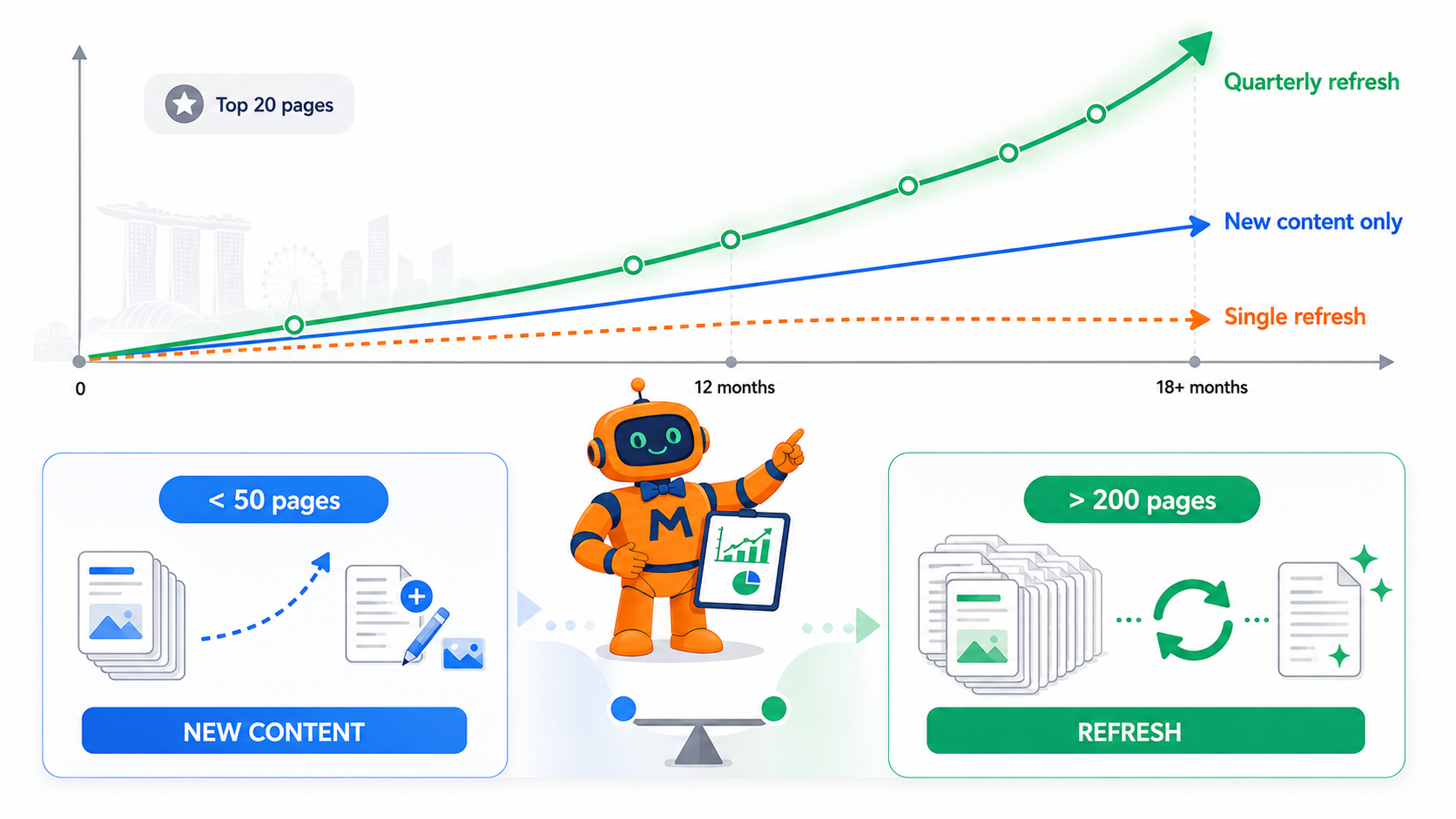
The strongest argument for treating content refresh as an ongoing discipline rather than an occasional project comes from the compounding effect over 12–24 months.
A single refresh produces a lift. Ongoing quarterly refreshes on the top 20 pages produce compounding lifts as each refresh cycle builds on authority accumulated in previous cycles. Sites running a disciplined refresh cadence for 18+ months consistently outperform sites publishing the same volume of new content without refreshing existing pages.
This is why the “should I create new content or refresh old content” debate misses the point. It is not either/or. Refresh the pages that have accumulated authority. Publish new content strategically in gaps that refresh cannot fill.
Which is better for SEO: refreshing old content or writing new content depends on your existing content library size. Sites under 50 published pages should prioritise new content. Sites over 200 published pages almost always benefit more from refresh work than new production.
For teams unsure where the balance sits for their specific situation, our breakdown of the technical SEO audit checklist covers the diagnostic steps to determine whether your content library is at the point where refresh should overtake new production in the editorial budget.
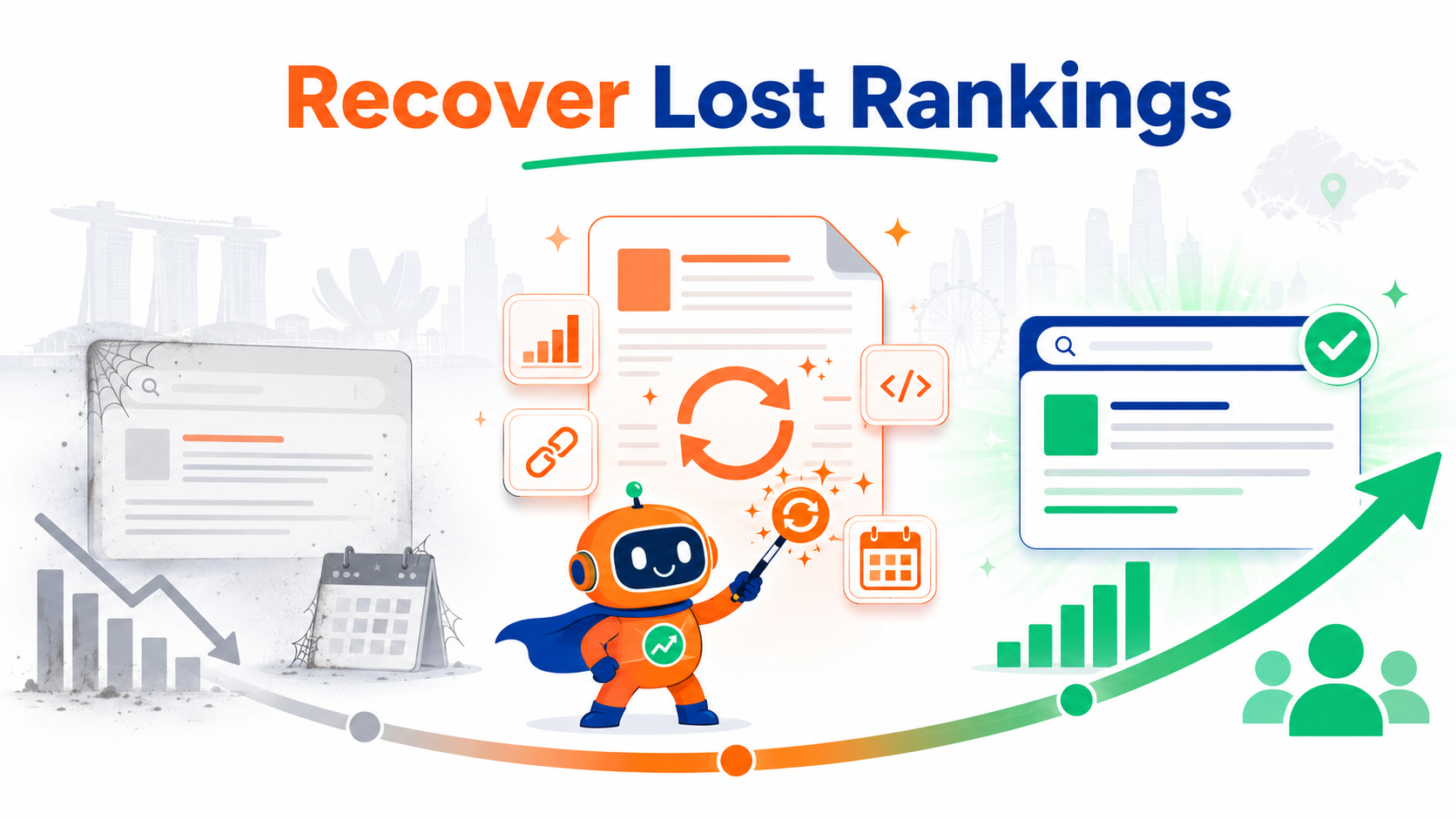
Ready to Recover Lost Rankings?
Refreshing content is not flashy work. While competitors focus on volume, disciplined refresh strategy compounds quietly over 12–24 months into a moat that new-content-only strategies cannot match.
The best time to start refreshing was 12 months ago. The next best time is now.
If your team needs help executing the triage, prioritisation, and refresh workflow at scale, MediaOne’s content audit identifies which pages to refresh, which to consolidate, which to redirect, and which to delete. Contact us for a scoped audit of your existing content library.
Frequently Asked Questions
Can refreshing content negatively affect my existing rankings?
Rarely, when done correctly. The main risk is making drastic changes to well-performing content, which can trigger temporary ranking fluctuations while Google re-evaluates. Refresh strategically: keep the URL, keep the primary topic focus, and update supporting information rather than rewriting from scratch.
Pages that lose rankings after a refresh usually did so because the refresh accidentally changed the search intent match. Match the current search intent carefully during the refresh.
Should I change the publication date when I refresh content?
Add a “Last Updated” date visibly while keeping the original publication date. Displaying both signals freshness without losing accumulated authority. Format: “Published: January 2023 | Updated: December 2026.”
Do not simply overwrite the publication date. Google reads this as manipulation if there are no meaningful content changes to justify the new timestamp.
How do I know which content to refresh first if I have hundreds of blog posts?
Prioritise pages ranking positions 5–20 for commercially relevant keywords, with at least 3 referring domains, that have not been updated in 12+ months. These are the highest-ROI refresh candidates in almost every audit.
Apply the five-factor scoring (ranking position, referring domain count, commercial intent, search volume, staleness) to sequence the top 20 first. Repeat quarterly.
Is it better to refresh old content or delete it and start fresh?
Refresh whenever the page has any backlinks or historical traffic. Delete only when the page has zero backlinks, zero traffic in the past 12 months, and no strategic purpose. Never delete a page with backlinks; redirect it with a 301 to the closest thematically relevant page.
Deleting content that has earned authority throws away SEO equity that took years to accumulate. Redirecting preserves that equity and applies it to a stronger destination.
How long after refreshing content should I expect to see results?
Initial results within 2–4 weeks as Google recrawls and re-evaluates. Meaningful ranking lift within 4–8 weeks. Full impact typically stabilises by month 3.
If no movement after 8–12 weeks, revisit the refresh. Common causes: search intent shifted more than the refresh captured, competitors published stronger content, or technical SEO issues prevented recovery.