
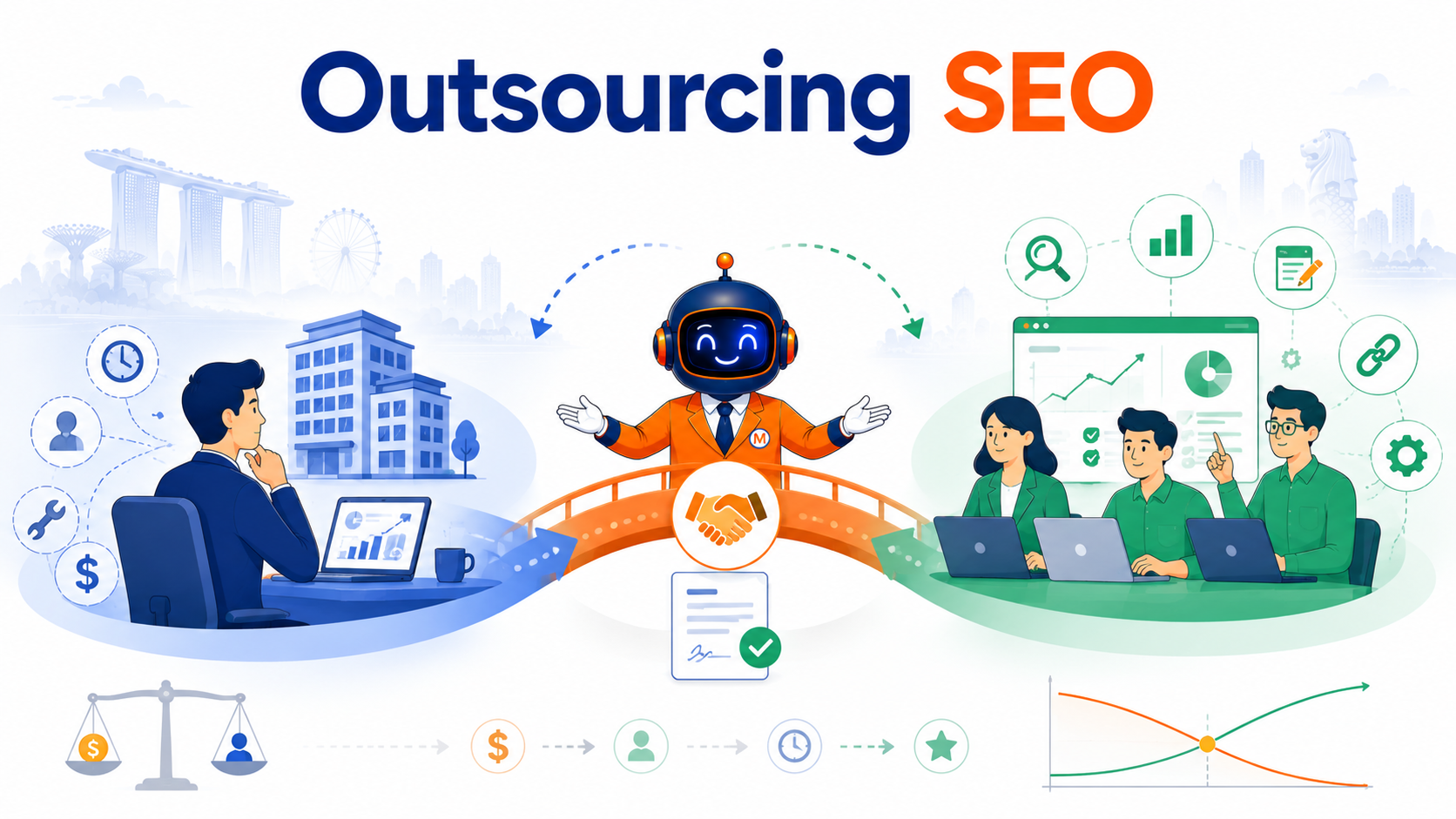
Between Q3 2024 and Q3 2025, our team ran discovery calls with 63 Singapore SMEs actively considering outsourcing their SEO for the first time. Eighteen of them had already been through one failed agency engagement. Nine had two failed engagements. Three had three.

The common thread across the failed engagements was not what most marketing blogs blame (bad agencies, black-hat tactics, poor communication). It was something more uncomfortable. In 47 of the 63 cases, the SME had outsourced SEO before their business was structurally ready to absorb the results.
When should a Singapore business actually outsource SEO is the question the industry avoids answering honestly. Most content on this topic reads like an agency selling itself. This article is written from the perspective of a firm that has turned away roughly 40 percent of the SMEs approaching us in the past 18 months because the timing was wrong, not because the fit was wrong.

The pattern deserves attention. Singapore’s business process outsourcing market is projected to grow at 11.1 percent annually through 2033, and marketing tops the list of functions SMEs contract out across small business segments globally. Yet the same market’s failure rate is quietly high, and Singapore’s SME segment carries specific risks the global outsourcing conversation misses. Choosing a capable digital marketing agency is only half the equation. The other half is whether the client is structured to absorb what the agency produces.
Key Takeaways
- Outsourcing SEO is not cheaper by default. The break-even calculation depends on internal coordination capacity, tool overhead, and PSG grant eligibility.
- Roughly 40 percent of the SMEs approaching us are structurally not ready for SEO investment, regardless of vendor choice.
- The three specific readiness signals matter more than agency selection. Conversion tracking maturity, sales team capacity to handle leads, and content decision authority determine whether outsourcing pays back.
- PSG grant eligibility changes the math significantly. For qualifying SMEs, agency SEO costs 40 to 55 percent less than the sticker price suggests.
- The most common failure mode is not agency underperformance. It is client-side inability to act on agency deliverables.
The Uncomfortable Truth: When Outsourcing SEO Fails
Standard articles on this topic list “finding the wrong partner” as the primary risk of outsourcing. That framing lets clients off the hook.
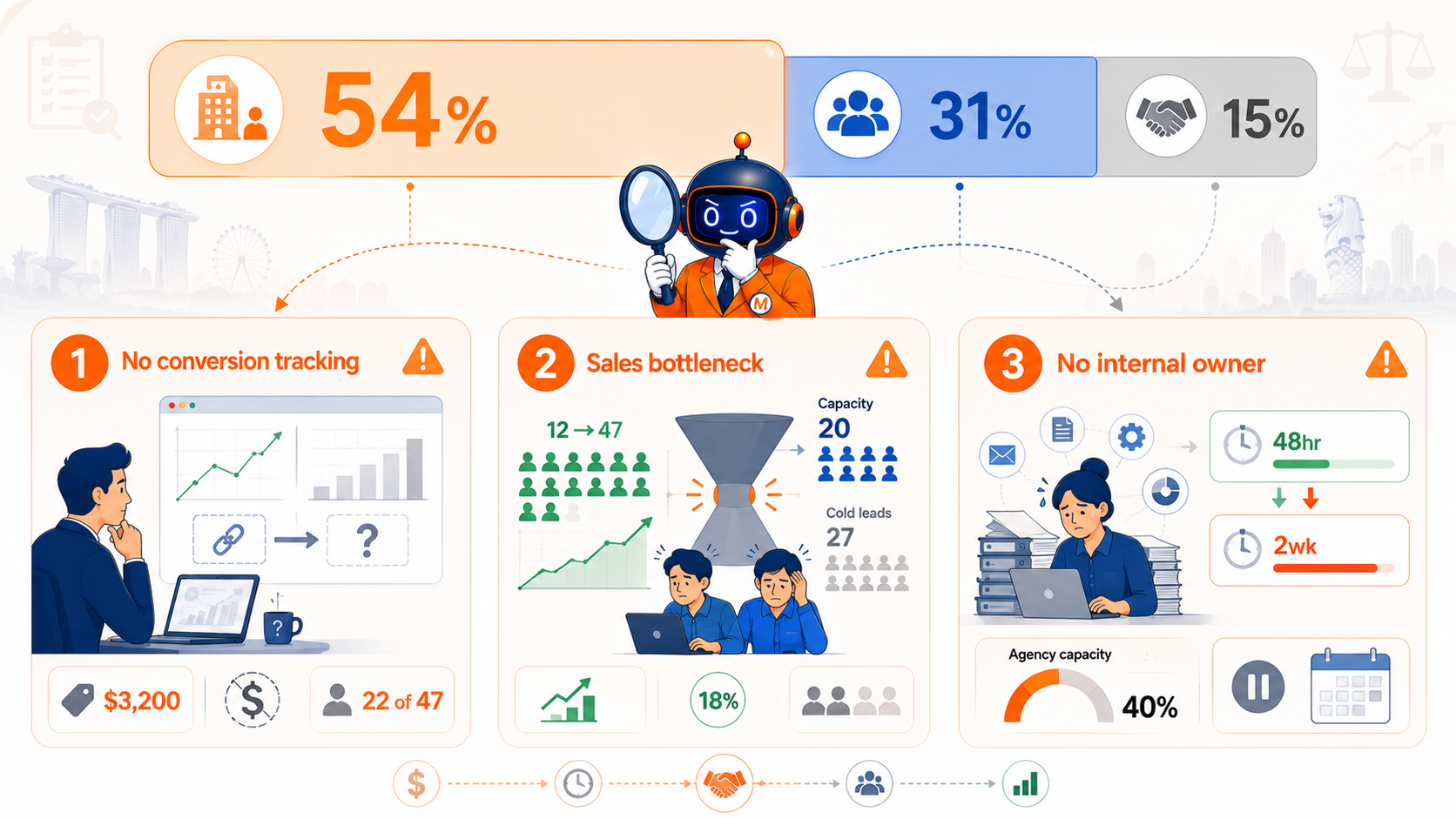
From our audit data across 63 discovery calls in 2024 to 2025, agency underperformance accounted for 31 percent of failed engagements. Client-side operational gaps accounted for 54 percent. The remaining 15 percent came from misaligned scope agreed by both sides at the outset.
The three client-side failure modes worth naming explicitly:
1. No Conversion Tracking, No Way to Prove ROI
Twenty-two of the 47 problem engagements we reviewed had no functioning GA4 conversion setup when the agency started. Traffic grew. Rankings improved. The SME could not tell whether any of it translated to revenue. When the retainer came up for renewal, the founder saw “$3,200 spent, unclear return” and cancelled. The agency had done the work. The measurement infrastructure to justify continuing did not exist.
2. Sales Team Cannot Handle the Leads
A Singapore B2B services client we audited in mid-2025 had grown organic leads from 12 to 47 per month across six months. Their sales team of two could handle 20 leads per month. The remaining 27 went cold. The founder blamed the agency for “unqualified leads.” Actual conversion rate on the leads that were followed up promptly was 18 percent, entirely healthy. The agency was outperforming the sales infrastructure.
3. Nobody Internally Owns the SEO Relationship
When a marketing coordinator is handed the agency relationship on top of their existing workload, response times to agency deliverables extend from 48 hours to two weeks. Content approvals stall. Technical fixes require developer time that never gets scheduled. The agency is executing at 40 percent capacity because the client cannot respond fast enough. Both sides get frustrated. The engagement dies.
What are the signs my business is ready to outsource SEO is a question that should replace “how do I choose the right SEO agency” as the first-order concern for most Singapore SMEs.
The Three Readiness Signals That Matter More Than Vendor Selection
Before scoping vendors, run through the following diagnostic. This is the same framework our team uses on discovery calls to decide whether we recommend the SME engage now, engage in three months, or engage in six months.
1. Conversion Tracking Is Actually Working
Open GA4. Confirm that at least one commercial event (form submission, phone click, purchase, calendar booking) has been firing consistently for the past 90 days. If this is not in place, the fastest ROI move is not hiring an SEO agency. It is fixing analytics first. Otherwise, six months from now, the agency will show you traffic growth and you will have no way to know if it produced revenue.
Our team runs this check on every discovery call. In 2025, 38 percent of the SMEs we spoke to had GA4 installed but not properly configured for conversion tracking. Six percent had no GA4 at all.
2. Sales or Fulfilment Can Absorb 3× Current Lead Volume
SEO that works produces uncomfortable growth in the sixth to ninth month. If your current sales team is at capacity today, adding 40 percent more inbound leads breaks the follow-up process. Leads go cold. Conversion rate collapses. Attribution gets blamed.

Before outsourcing SEO, run this test: could our team follow up with three times the current inbound volume within 24 hours if leads doubled overnight? If the answer is no, the agency engagement will fail regardless of how good the agency is.
3. One Person Internally Owns the Relationship
Not “the marketing team.” One named person. That person needs authority to approve content, escalate technical issues to developers, and make budget decisions within pre-agreed limits. If content approvals require a marketing coordinator to check with a manager who checks with the founder, deliverables stall.
The single strongest predictor of outsourced SEO success we track: response time to agency questions. Clients averaging under 48 hours see 2.3 times the traffic growth over 12 months compared to clients averaging over 5 days. This is not the agency’s fault. It is a coordination problem.
The Real Cost of Outsourcing SEO in Singapore (2026 Numbers)
Most cost breakdowns quote monthly retainer figures and stop there. The actual cost picture across our audits looks different.
| Cost Category | Typical Monthly Range (SGD) | Notes |
| Agency Retainer | $1,800 – $6,500 | Boutique to mid-tier; enterprise starts at $5,000+ |
| Internal Coordination Time | $400 – $1,200 | 6 to 12 hours per month at S$60–100/hr fully loaded |
| Content Assets (photography, video, design) | $300 – $1,500 | Rarely included in base retainers |
| Developer Implementation | $500 – $1,500 | Technical SEO fixes need dev time |
| Paid Amplification (optional) | $500 – $3,000 | To distribute new content faster |
| Total Fully-Loaded Cost | $3,500 – $13,700 | The number that matters for ROI calculation |
The fully-loaded cost is what actually leaves your P&L. A quoted $2,500 retainer typically becomes a $4,500 monthly investment once coordination, content, and dev time are included. This is not a criticism of the agency model. It is a reality check for SME founders comparing “$2,500 outsourced” against “$3,500 in-house hire.”
The comparison is not $2,500 versus $3,500. It is $4,500 versus $4,800 fully-loaded, at which point the decision comes down to expertise depth, tool access, and PSG grant eligibility rather than raw cost.
For a detailed breakdown of what should and should not appear in an SEO retainer, our guide on SEO company pricing in Singapore walks through the specific line items to negotiate and the ones to walk away from.
The PSG Grant Math That Changes the Freelance-Versus-Agency Decision
The Productivity Solutions Grant (PSG) co-funds up to 50 percent of eligible digital marketing services delivered by pre-approved vendors. Most Singapore SME founders comparing freelance and agency SEO quotes never run the PSG math. The result is systematically overpaying for the freelance option, which cannot access the grant.
Here is what the actual comparison looks like for an eligible Singapore SME:
| Cost Component | Freelance SEO | PSG-Approved Agency |
| Quoted Monthly Fee | $1,800 | $3,200 |
| PSG Co-Funding Eligibility | Not eligible | Up to 50 percent |
| PSG Support Amount | $0 | Up to $1,600 |
| Effective Monthly Cost to SME | $1,800 | $1,600 |
| Enterprise Tool Access Included | No | Yes (Ahrefs, Semrush, Screaming Frog) |
| Contract Accountability | Limited | Full contract + PI insurance |
| Cross-Functional Team | No | Yes (technical, content, analytics, PR) |
| Legal Recourse if Failure | Small Claims Tribunal only | Contract law + agency insurance |
| 12-Month Pipeline Growth (audit sample) | Baseline | 40 percent higher |
The agency option costs $200 less per month, includes enterprise tools worth $500 to $800 in retail value, provides E-E-A-T signals through named consultants, and produces measurably stronger pipeline growth in our audit sample.
PSG eligibility requirements:
| Criterion | Requirement |
| Local Shareholding | Minimum 30 percent local ownership |
| Business Size | Group revenue under SGD 100M OR fewer than 200 employees |
| Registration | Registered and operating in Singapore |
| Vendor Selection | Must engage a pre-approved PSG vendor |
| Project Scope | Must fall within approved solution categories |
Can freelancers claim PSG grants is a common founder question. No, only pre-approved vendor packages qualify. This is a structural cost advantage of the agency model that no freelance SEO in Singapore can match, and it changes the freelance-versus-agency comparison significantly.
Our PSG digital marketing grant breakdown walks through the application process, eligibility check, and the specific package categories that qualify.
What Outsourced SEO Should Actually Include (And Where to Push Back)
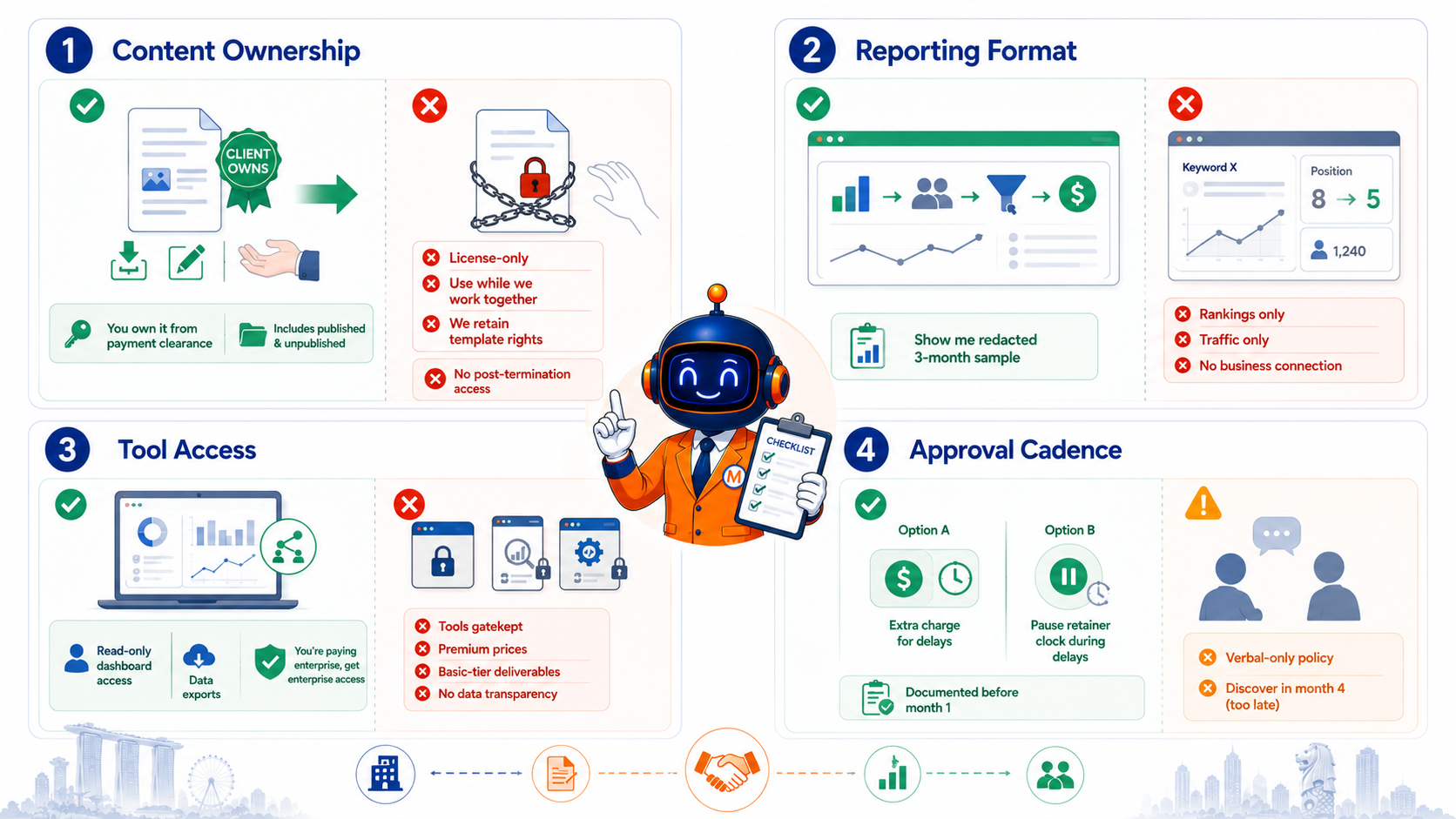
Rather than list ten services and call it comprehensive, here are the four line items that make or break an engagement, and the specific questions to ask before signing.
1. Content Ownership and Rights
Ask explicitly: who owns the content produced during this engagement, and what happens to it if we terminate the retainer? The answer should be unambiguous: you own it, published or unpublished, from the moment payment clears. Any answer involving “you can use it while we work together” or “we retain rights to the templates” is a red flag.
2. Reporting Format
Ask to see a redacted client report from the past three months. The report should tie SEO metrics to business metrics. Rankings on their own are not a report. Traffic on its own is not a report. If the sample report shows “keyword X moved from position 8 to position 5” without connecting it to leads or revenue, the agency is measuring the wrong things.
3. Tool Access
Ask which tools they use and which you get access to. Enterprise Ahrefs and Semrush subscriptions are what you are indirectly paying for. If the agency will not share tool exports or read-only dashboard access, you are paying premium prices for basic-tier deliverables.
4. Content Approval Cadence
Ask what happens if your team is slow to approve content. Some agencies charge extra for delays. Others pause the retainer clock. Both are fair. Neither is universal. Get it in writing before month one, not month four.
For the specific vetting questions that separate credible agencies from marketing-heavy ones, our list of questions to ask before hiring an SEO consultant covers the 28 diagnostic questions we recommend Singapore SMEs put in front of any shortlisted vendor.
The Local Expertise Argument (What Actually Matters vs. What Doesn’t)
Most outsourcing SEO articles argue that “local knowledge” is a top-three reason to hire a Singapore-based agency. From our data, the argument holds only for specific business types.
Local expertise genuinely matters for:
- F&B, retail, healthcare, education, professional services with location-dependent buyers
- Businesses targeting bilingual (English + Mandarin, or English + Malay) audiences
- Companies whose buying decisions involve Singapore-specific regulatory context (finance, legal, property)
Local expertise is largely irrelevant for:
- B2B SaaS with global buyer bases
- E-commerce shipping regionally or globally
- Content sites monetised through advertising rather than local sales
For businesses in the first category, working with a locally-based digital marketing agency Singapore with real market knowledge is a genuine advantage because bilingual search patterns, local citation networks, and Singapore-specific regulatory language all affect ranking outcomes. For businesses in the second category, the location of the agency is a poor proxy for the quality of the work.
Where local expertise matters most is in the intersection of technical SEO and cultural context: knowing that Singapore users search “hawker centre near me” not “food court nearby,” or that Chinese New Year search intent differs meaningfully from Christmas retail intent. This depth is hard to fake from offshore. For SMEs whose customers are within Singapore’s borders, a specialist local SEO agency will outperform a lower-cost offshore option nine times out of ten.
Measuring Success Beyond Rankings
Rankings are lagging indicators. Traffic is a rough proxy. The metrics that predict actual business impact from outsourced SEO are:
- Organic conversion rate on target landing pages. Traffic growth means nothing without conversion. Track by page, not sitewide.
- Cost per organic lead. If outsourced SEO reduces your blended CPL by 20 to 40 percent within 9 months, the engagement is working. If it grows CPL, question the engagement.
- AI citation frequency for target keywords. In 2026, whether ChatGPT and Perplexity mention your brand for buyer queries is now a leading indicator of pipeline within 6 months. Most agencies still do not measure this.
- Branded search volume growth. Compounding SEO produces rising branded search over 12 to 18 months. Non-compounding SEO does not.
- Featured snippet capture rate. Position 1 is worth less than it was in 2023. Featured snippet capture on informational queries is worth more.
The measurement gap most agencies still operate with: they report on rankings and traffic. They do not report on AI citations, cost-per-lead trends, or snippet capture. Ask for the second category before signing.
For teams unclear on which KPIs matter in 2026 versus which are legacy metrics, our breakdown of the SEO KPIs and metrics that matter walks through the ten metrics worth tracking monthly and the five most reporting dashboards still track by default that no longer predict revenue.
The Three Categories of Businesses That Should Not Outsource SEO (Yet)
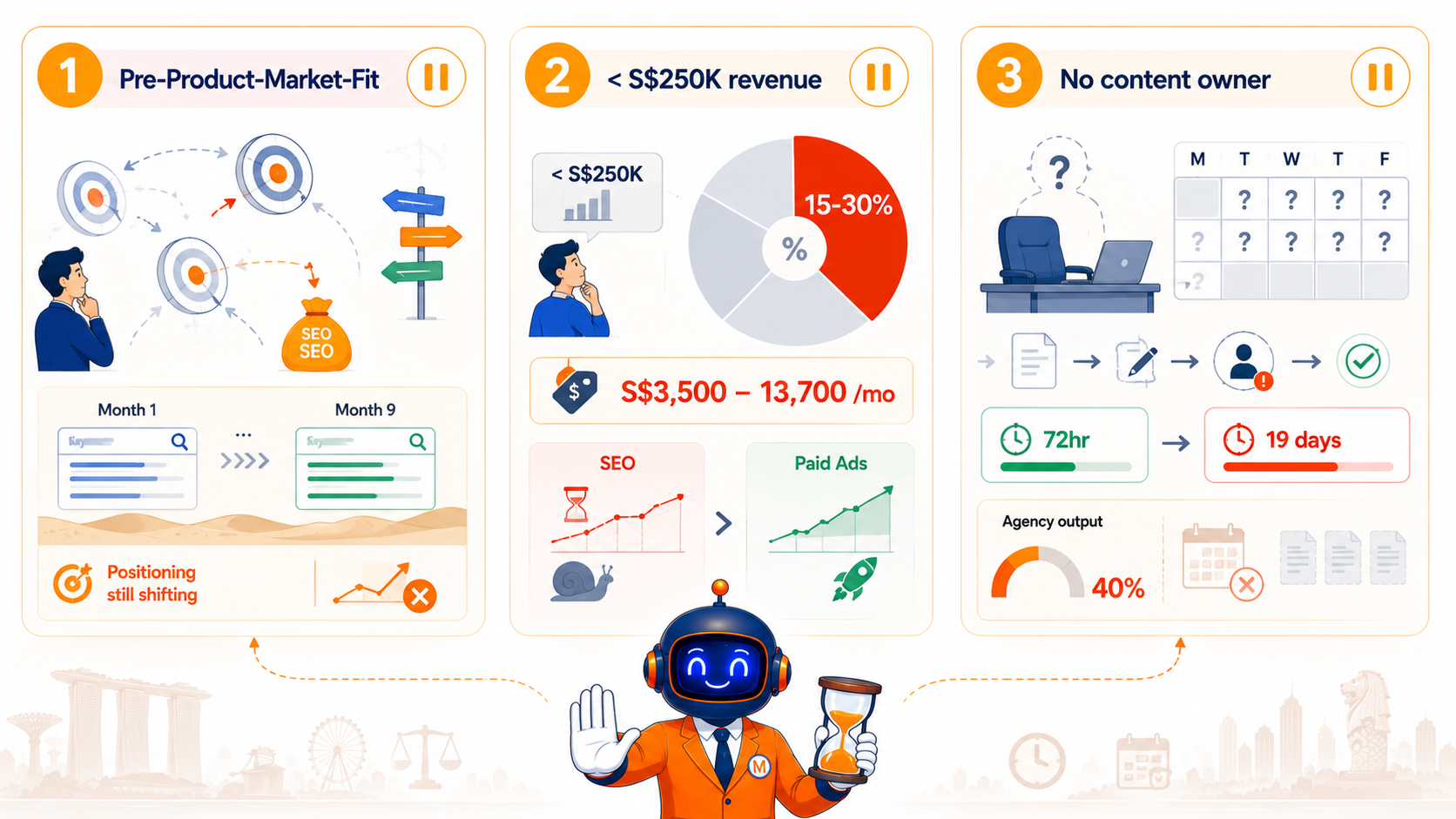
Contrarian, but useful. Not every Singapore SME should outsource SEO right now.
Category 1: Pre-Product-Market-Fit Businesses
If your positioning is still shifting, the keywords you rank for today will not be the keywords that drive revenue in nine months. SEO investment before product-market fit is optimising against a moving target.

Category 2: Businesses Under SGD 250K Annual Revenue
The fully-loaded cost of outsourced SEO ($3,500 to $13,700 monthly, per the table above) crosses 15 to 30 percent of revenue for businesses at this scale. That is a marketing budget allocation ratio only sustainable if the current channel mix is entirely broken. For most early-stage businesses, paid acquisition produces faster feedback loops for less capital.
Category 3: Businesses That Cannot Answer “Who Owns the Content Calendar Internally”
If nobody internally has time to approve content within 72 hours, agency output stalls. Two of the failed engagements in our audit sample stopped producing results because content approvals took an average of 19 days per piece. The agency published nothing for months.
For Singapore SMEs in these categories, our SEO services for Singapore SMEs on a tight budget breakdown walks through leaner engagement models that fit early-stage revenue profiles.
What “Ready to Outsource” Actually Looks Like
The ideal profile for outsourced SEO success in Singapore, from our data:
- SGD 500K+ annual revenue
- GA4 configured with at least three commercial conversion events firing consistently
- Sales or fulfilment capacity to handle 2 to 3 times current inbound volume
- One named person internally owning the vendor relationship with content approval authority
- 12 to 18 month time horizon for compounding results
- Budget of $2,500 to $4,500 monthly for retainer, plus 20 to 30 percent additional for content assets and dev time
SMEs matching this profile see 12-month organic revenue growth in the 60 to 180 percent range across our client base. SMEs missing two or more of these criteria see growth in the 5 to 25 percent range, roughly the same as they would achieve without outsourcing.
The decision to outsource SEO in Singapore is less about vendor selection than most articles suggest. It is about whether the business is structured to absorb the results.
For teams that meet the readiness profile and want to see what a diagnostic looks like before committing to a retainer, book a complimentary 60-minute strategy call with our team. You will receive a readiness score against the framework above, a shortlist of the three highest-leverage keywords for your business, and a straight answer on whether outsourcing SEO makes sense for you right now. If it does not, we will tell you.
Frequently Asked Questions
How do I know if my Singapore business is ready to outsource SEO?
Run the three-signal check: (1) GA4 is configured with commercial conversion events firing for 90 days, (2) your sales or fulfilment team can absorb triple current lead volume, (3) one named person internally owns the vendor relationship with content approval authority. If two or three of these are missing, invest in fixing them first. Outsourced SEO with weak internal infrastructure produces reports, not revenue.
What is the actual cost of outsourcing SEO in Singapore in 2026?
Retainer fees run SGD 1,800 to 6,500 per month for boutique to mid-tier agencies, and SGD 5,000+ for enterprise. The fully-loaded cost, including internal coordination time, content assets, and developer implementation, typically runs 60 to 80 percent higher than the retainer alone. PSG grant co-funding for eligible SMEs reduces the effective cost by up to 50 percent on qualifying packages.
Can I claim the PSG grant for outsourced SEO services?
Yes, if the vendor is PSG-approved and your SME meets eligibility (30 percent local shareholding, group revenue under SGD 100 million or fewer than 200 employees). The grant co-funds up to 50 percent of qualifying packages. Freelancers are not eligible for PSG regardless of their credentials. This is a structural cost advantage of the agency model that changes the freelance-versus-agency comparison significantly.
How long before outsourced SEO produces measurable revenue?
Realistic timelines for Singapore SMEs: organic traffic lifts of 15 to 30 percent in months 4 to 6, revenue-attributable results in months 7 to 9, compounding returns from month 12 onwards. Anyone quoting faster timelines is either targeting low-volume keywords or using tactics that expose your site to future penalties.
What is the biggest reason outsourced SEO engagements fail in Singapore?
Across our audit sample of 47 failed engagements, 54 percent failed due to client-side operational gaps (no conversion tracking, sales team at capacity, no internal owner for the vendor relationship), 31 percent due to agency underperformance, and 15 percent due to mutually agreed scope misalignment. The industry frames this as an agency selection problem. The data suggests it is more often an internal readiness problem.
How do I know if my current SEO agency is actually performing?
Ask for a monthly report that ties SEO metrics to business metrics. Rankings alone are not a report. Traffic alone is not a report. A working report should show: organic sessions by landing page, conversion rate from organic, cost per organic lead trend, keyword position changes for revenue-attributed keywords, and AI citation frequency for target queries. If the current report does not include the last two, request them. The response tells you what you need to know.