If you are looking for a smarter way to apply STP marketing strategies in Singapore, you are not alone. Many business owners understand the theory of segmentation, targeting and positioning, but very few know how to turn it into revenue.
On paper, STP sounds simple. Segment your audience. Pick the best group. Position your brand clearly. In practice, most Singapore businesses still end up with broad messaging, generic campaigns, weak offers, and ad spend that goes nowhere.
At MediaOne, we have spent 15+ years as a digital marketing agency in Singapore, served 3,000+ clients, and built campaigns across SEO services, paid ads, social media, branding, and web design. After running thousands of live tests across HDB heartland brands, CBD B2B firms, and regional D2C launches, we keep arriving at the same hard truth: classic STP is still useful, but the textbook version is too slow, too broad, and too detached from how Singaporeans actually buy in 2026.
In this guide, we will show you how we think about STP today, what most brands still get wrong, and how MediaOne approaches segmentation, targeting and positioning with stronger local context, better data, and clearer commercial intent.
Key Takeaways:
- STP marketing still matters, but in 2026 it works best as a fast, test-and-refine system rather than a slow annual planning exercise.
- In Singapore, stronger segmentation comes from local intent, buyer context, and real behaviour, not just basic demographics.
- Better targeting improves lead quality, budget efficiency, and message relevance across SEO, paid ads, and content.
- Positioning only works when it is specific, credible, and clearly different from what competitors are saying.
- MediaOne’s STP 2.0 framework connects strategy to execution, so brands turn audience insight into measurable growth.
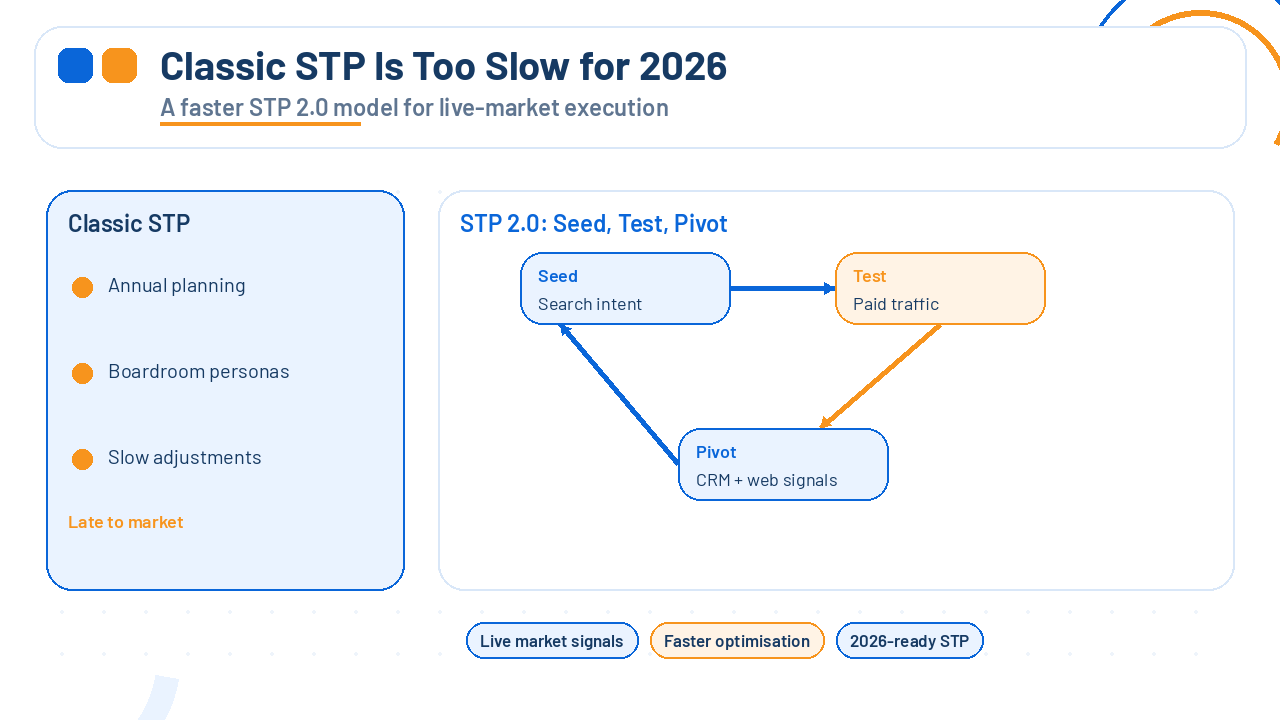
We Will Say What Other Agencies Will Not: Classic STP Is Too Slow for 2026
Most articles about STP marketing are safe. They define the framework. They explain the three steps. They tell you to “understand your audience better.” Then they end with a generic call to action.
That is not good enough for a Singapore business trying to grow in a more expensive, more competitive, and more algorithm-driven market.
Classic STP is still valuable as a strategic lens, but not as a once-a-year boardroom ritual. Platforms have changed. Meta, Google, TikTok, LinkedIn, CRM systems, and AI-led bidding tools now react faster than most internal marketing teams. Search intent shifts within weeks. Ad fatigue kicks in sooner. Attention spans are shorter. Competitors copy your positioning before your designer has finished the new homepage.
If you are still spending months debating personas in a workshop, you are already late.
At MediaOne, we use a faster and more accountable version of STP. We call it STP 2.0: Seed, Test, Pivot. Instead of pretending we already know the perfect segment, we start with strong hypotheses, test them quickly using real signals from search, paid traffic, CRM behaviour and on-site engagement, then sharpen the segment and positioning based on what the market actually rewards.
It is the opposite of the slow, deck-driven STP most agencies still sell.
A Quick Refresher: What STP Marketing Actually Means
Before we get practical, let us align on terms.
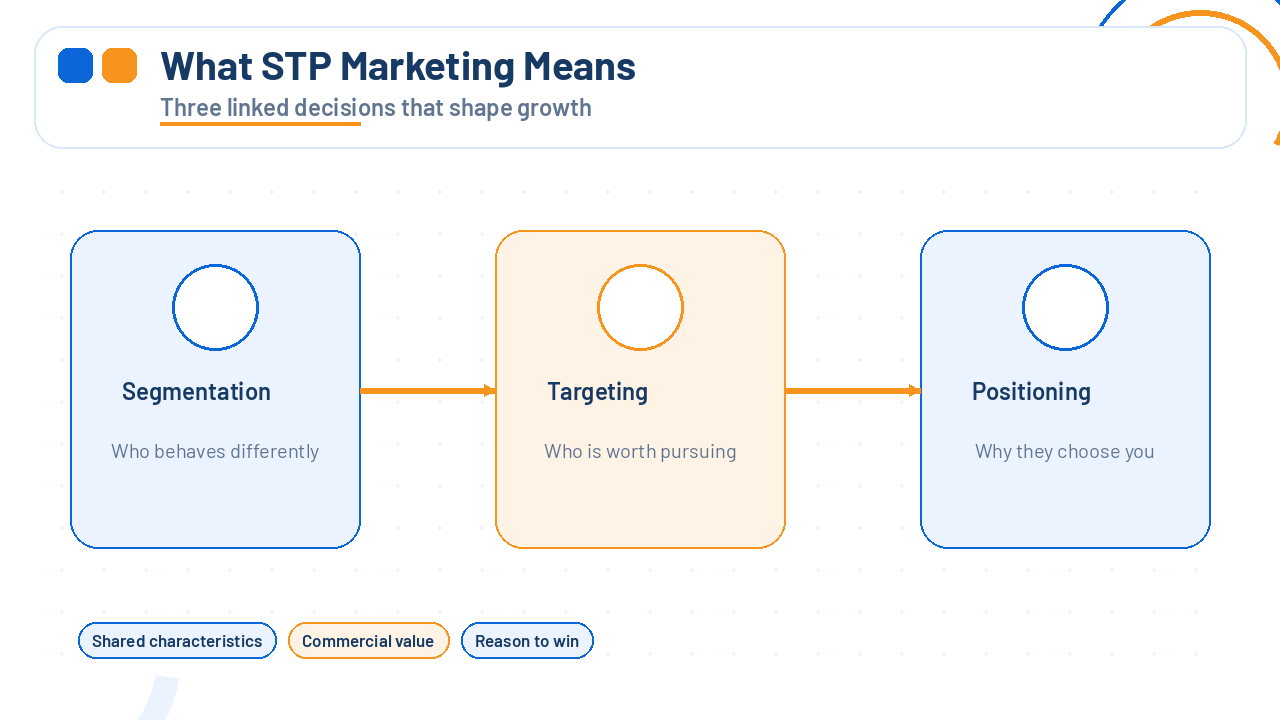
The textbook definition of STP stands for:
- Segmentation: dividing a broad market into smaller groups with shared characteristics
- Targeting: choosing which segments are worth pursuing
- Positioning: shaping how your brand should be perceived by that chosen audience
But for us, the business definition is sharper:
- Segmentation tells us who behaves differently
- Targeting tells us who is commercially worth pursuing
- Positioning tells us why they should choose us over anyone else
That last part is where most businesses quietly lose. They understand audiences at a surface level, but they never build a clear enough reason to win. If you want a deeper dive on the upstream work that feeds good positioning, our guide on the basics of marketing research in Singapore walks through it step by step.
Why Most Singapore SMEs Still Misuse STP
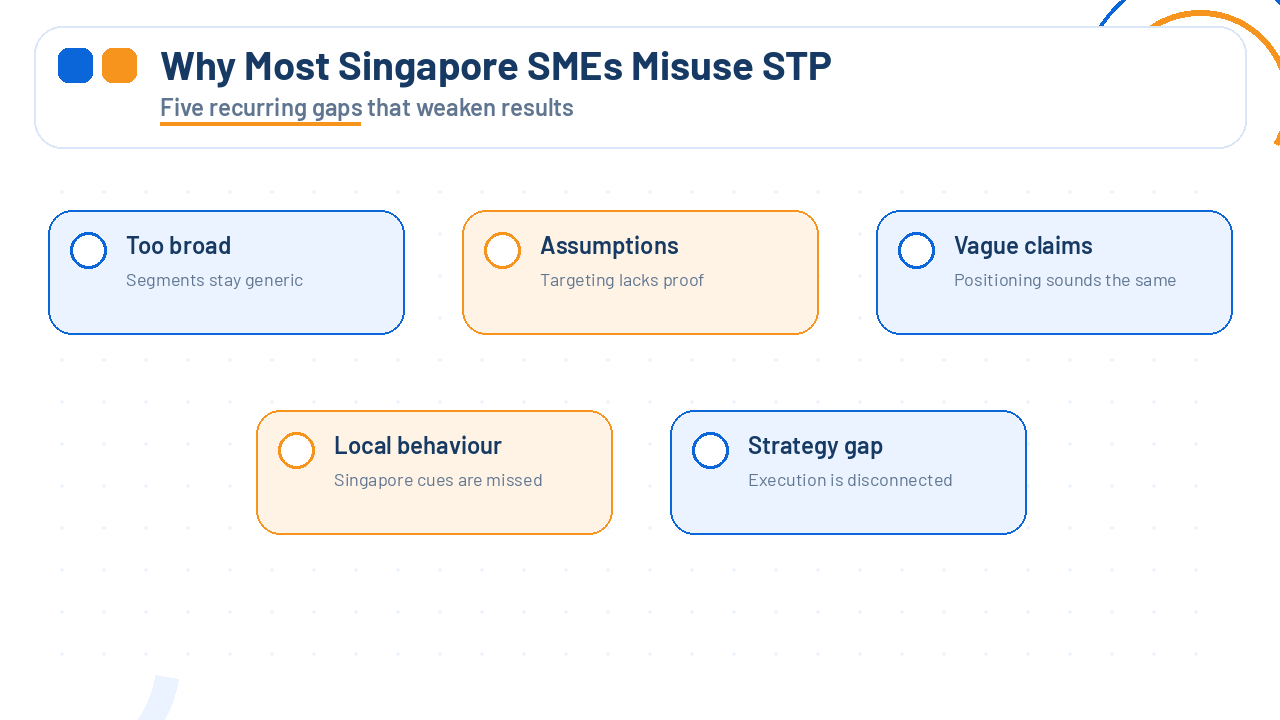
We see the same mistakes again and again:
1. They Segment Too Broadly
“SMEs”, “working professionals”, “parents”, and “Gen Z” are not usable segments. They are labels, not buying patterns.
2. They Target Based on Assumptions
The founder thinks they know the customer. The sales team thinks otherwise. The agency runs with a guess. Nobody validates it properly.
3. They Position With Vague Claims
“Trusted”, “award-winning”, “innovative”, and “customer-centric” are not positioning statements. They are filler words.
4. They Ignore Singapore-specific Buying Behaviour
A strategy imported from the US or UK often misses what matters here: estate-level context, language nuance, price sensitivity, trust barriers, and regulatory expectations like PDPA. This is why we always pair STP with proven marketing strategies for the Singapore market, using frameworks built for local buying behaviour.
5. They Separate Strategy from Execution
A nice STP slide deck means nothing if it does not change the headline, the landing page, the offer, the channel mix, and the sales script.
That is why we always connect STP directly to performance.
The Singapore Segmentation Dimensions Your Marketing Textbook Missed
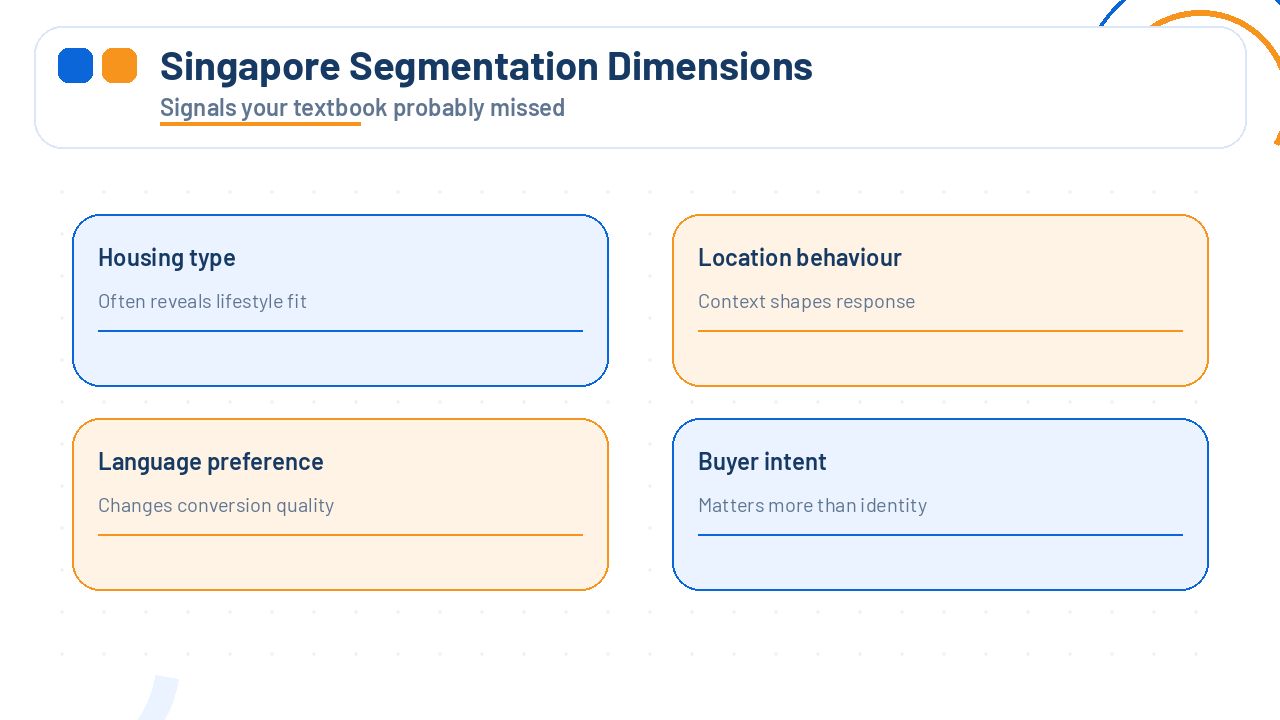
Most STP articles talk about demographics, psychographics, geography, and behaviour. Useful, but not enough on their own in Singapore. You need a sharper lens. Here are four dimensions we have built into our work that you will not find in a standard Kotler textbook.
1. Housing Type Is Often More Revealing Than Income Alone
A customer in a landed property, a city-fringe condo, or an HDB estate does not just differ by wealth. They differ by daily routines, aspirations, convenience expectations, family priorities, and price response.
That affects everything from messaging to offer framing:
- A value-led household responds to savings, reliability, and practical ROI
- An affluent urban buyer responds to time saved, status, convenience, or exclusivity
- A family-led segment cares more about safety, consistency, and trust signals
The point is not to stereotype. It is to respect context that purely income-based segmentation misses.
2. Location in Singapore Is Not Just Geography. It Is Behaviour.
In larger countries, geographic segmentation is blunt. In Singapore, it can be surgical. CBD professionals search differently from heartland homeowners. East-side family segments do not convert like city-centre singles. A Jurong industrial audience does not behave like a Bukit Timah lifestyle audience.
For local SEO, paid search, social targeting, and creative strategy, this matters more than most marketers admit. We treat postal-sector behaviour as a live signal, not a static demographic field.
3. Language Preference Changes Response Quality
In Singapore, language is about comfort, trust, and cultural fit, not just literal comprehension. An audience may read English fluently but still respond better to a particular tone, phrasing style, or cultural reference.
We do not recommend forcing Singlish into every campaign. That is lazy and often condescending. We do recommend respecting how each segment actually processes tone. Our work on crafting an effective messaging strategy goes deeper into how tone and word choice shift conversion rates.
4. Buyer Intent Matters More Than Buyer Identity
This is the biggest shift in 2026.
A business owner searching “best payroll software Singapore” is not just a demographic. They are showing high-intent behaviour at a specific decision stage. That signal beats almost any persona slide.
At MediaOne, we segment by:
- Search intent
- Funnel stage
- Urgency
- Content consumption pattern
- Conversion resistance
- Repeat engagement behaviour
We call this intent-first segmentation, and it is far more actionable than relying on age, job title, or gender alone.
STP 2.0: Our Seed, Test, Pivot Framework
Here is the framework we use when we need a strategy that actually performs.
| Stage | What We Do | Why It Matters |
| Seed | Build 3 to 5 strong audience hypotheses | Avoid overcommitting to one untested assumption |
| Test | Validate segments through search, ads, CRM, and site behaviour | Let data expose what actually converts |
| Pivot | Reallocate budget, refine copy, sharpen offers | Scale what works and stop funding weak assumptions |
This framework is practical, fast, and far more suitable for Singapore’s current media landscape.
Step 1: Seed
We start with hypotheses, not fixed beliefs.
For example, a Singapore B2B service brand might begin with these possible segments:
- Founders of SMEs who need faster lead generation
- In-house marketers struggling with poor SEO visibility
- Enterprises unhappy with agency accountability
- Businesses looking for PSG-supported digital services
Each of these groups sounds related. But their motivations, objections, and buying triggers are completely different.
Step 2: Test
We test the angle through:
- Keyword intent
- Paid traffic response
- Landing page behaviour
- CRM engagement
- Sales call feedback
- Organic search performance
- Ad copy resonance
This is where many weak assumptions die. That is good. Better to lose a weak idea early than scale it expensively.
Step 3: Pivot
Once we see which segment responds best, we tighten the rest of the campaign around it.
That means updating:
- Headlines
- CTAs
- Landing pages
- Remarketing logic
- SEO content clusters
- Social proof
- Offer framing
- Follow-up sequence
That is the difference between “doing STP” and making it commercially useful.
The PDPA Layer: Segmentation in Singapore Cannot Ignore Compliance
This is another angle most generic STP articles skip.
In Singapore, good targeting is not just about better data. It is also about lawful data use.
If you are collecting, storing, and using personal data for marketing, the Personal Data Protection Act (PDPA) matters. That includes how you gather leads, what consent language you use, and how you manage ongoing communication preferences. Source
This changes how we think about segmentation. We do not just ask, “What data would be useful?”
We ask:
- What data do we actually need?
- What did the user consent to?
- How should the brand store and action that data?
- Can this be turned into a better first-party data asset?
This is especially important now that reliance on third-party tracking is becoming less reliable.
Our Practical Recommendation
If you are a Singapore SME, build your segmentation around data you can ethically and legally own.
That includes:
- Website behaviour
- Content engagement
- Form responses
- Consultation topics
- Purchase history
- Enquiry source
- CRM stage progression
- Email interaction data
This is not just safer. It is more durable.
When your brand owns stronger first-party data, your SEO, paid ads, email, remarketing, and conversion strategy all improve.
The Positioning Mistake 9 Out of 10 Businesses Make
Let us be honest. Most brands are not poorly positioned because they lack effort. They are poorly positioned because they sound exactly like everyone else.
If your homepage says things like:
- “We are a trusted partner”
- “We deliver innovative solutions”
- “We are customer-centric”
- “We offer end-to-end services”
…you do not have positioning. You have placeholders.
Real positioning makes a prospect think, “This is for me, and this is clearly different.” which requires specificity. Positioning also lives or dies on the page it lands on, which is why we operate as both a strategy team and a web design agency, because the sharpest message will still sink on a slow, cluttered, or off-brand landing page.
The MediaOne Positioning Audit
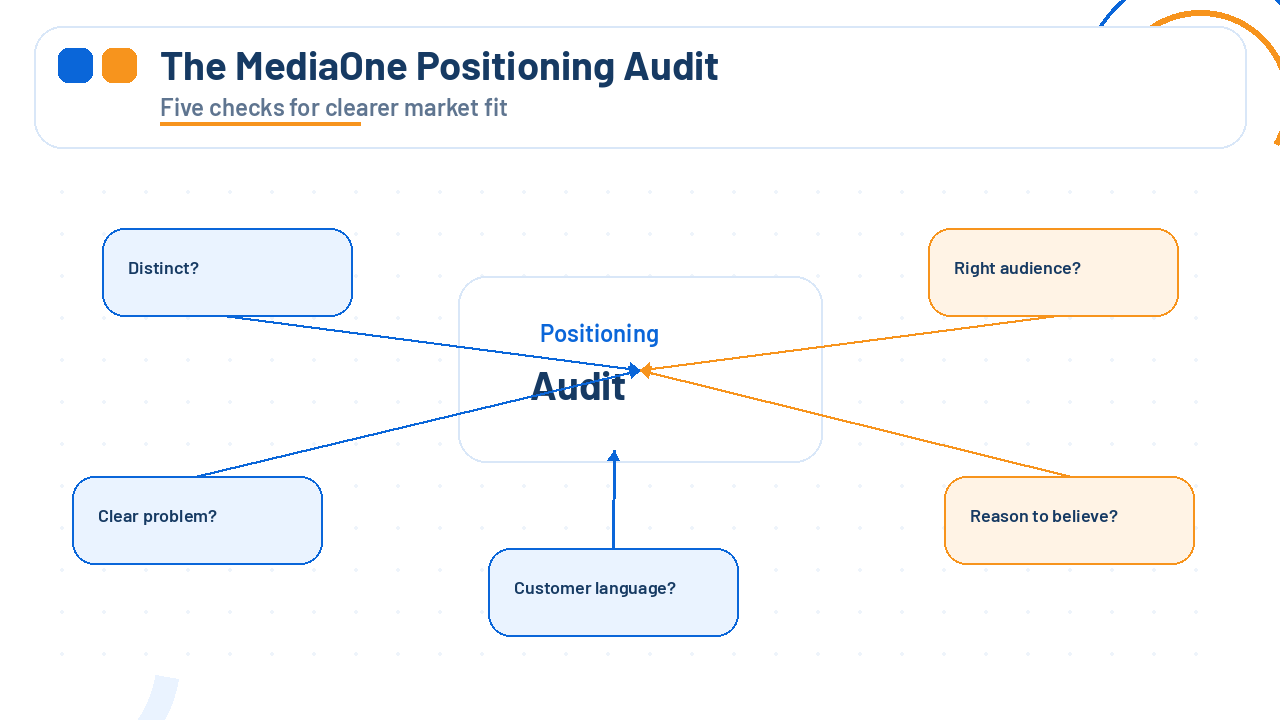
When we review a brand, we ask five simple questions:
1. Could Your Competitor Say the Same Thing?
If yes, it is not a differentiator.
2. Does Your Message Name the Right Audience Clearly?
“Helping businesses grow” is weak.
“Helping Singapore SMEs generate qualified leads through SEO and paid media” is sharper.
3. Does It Show the Problem You Solve?
Not just what you do, but the business pain you remove.
4. Does It Create a Reason to Believe?
This is where proof matters: results, process, technology, experience, awards, reviews, dashboards, guarantees.
5. Does It Fit How Customers Actually Describe You?
If your best customers never use the words on your site, your message is disconnected from reality.
At MediaOne, our own positioning is not built around empty adjectives. It is built around commercial accountability.
We emphasise:
- 15+ years in Singapore
- 3,000+ clients served
- 83.9% campaign success rate
- 32+ AI tools powering Digimetrics.ai
- a results-driven, transparent, full-funnel approach
- a stronger connection between visibility, conversion, and commercial growth
That is a stronger market position than vague claims about being “passionate” or “dedicated”.
When You Should Not Use Narrow STP
This is another point we believe more marketers should say openly.
STP is not always about narrowing quickly.
In some cases, over-segmentation hurts performance.
You may not want a narrow STP approach if:
- Your brand has very low awareness
If nobody knows you yet, your first job may be reach and visibility, not aggressive narrowing.
- Your budget is too small for proper testing
If you cannot generate enough traffic or conversion volume, over-segmentation creates false confidence from weak data.
- Your product is low involvement and broad appeal
Some everyday purchases do not need overly refined personas. They need strong distribution, clear offers, and memorable brand cues.
- Your team confuses complexity with strategy
A detailed segmentation document does not automatically create sales.
Sometimes broad targeting plus strong positioning works better, especially in paid media where the algorithm can learn faster from larger data pools. That is why we do not force narrow segmentation for the sake of it. We apply the level of precision the business can actually support.
The 14-Day STP Sprint We Use at MediaOne
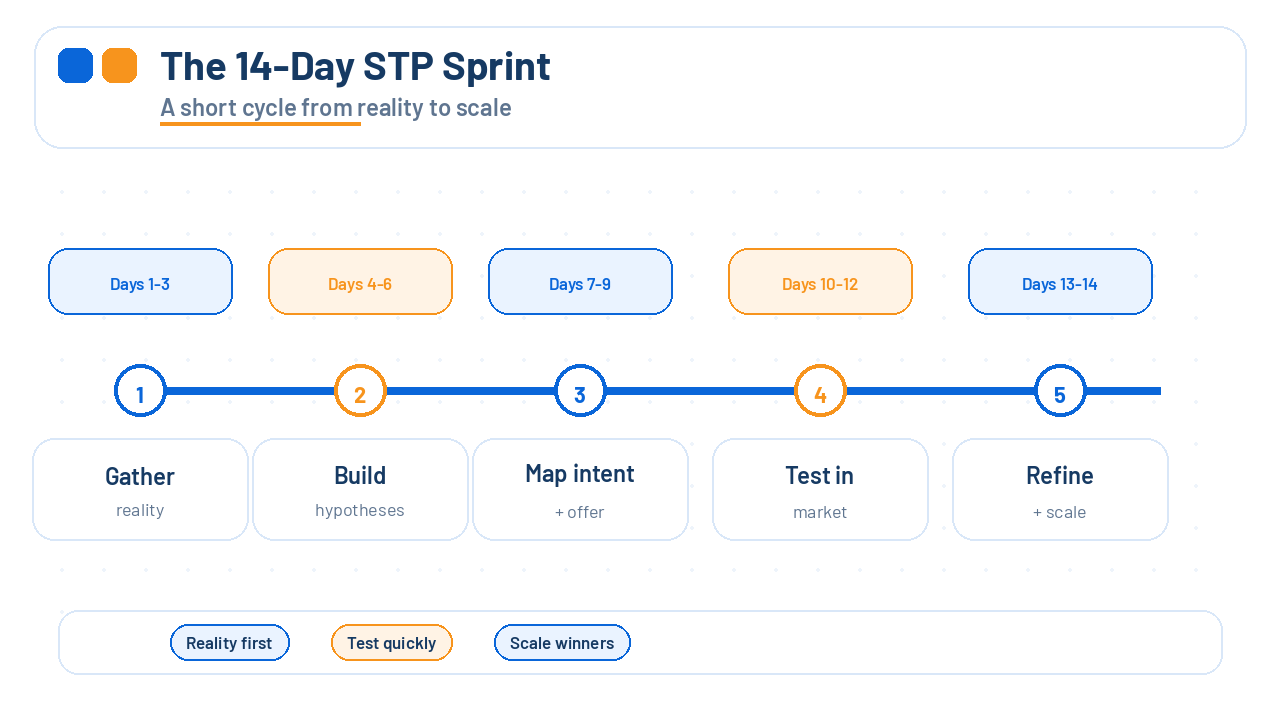
If we had to build or refine an STP strategy quickly for a Singapore business, this is how we would do it.
Days 1 to 3: Gather Reality
We review:
- Business goals
- Best customers
- Existing traffic sources
- Search visibility
- Current offers
- Sales objections
- Content performance
- Channel mix
If possible, we also pull real input from sales calls, customer enquiries, and CRM notes. This matters. Real-world objections often reveal better segments than polished survey language.
Days 4 to 6: Build Segment Hypotheses
We identify 3 to 5 viable audience groups based on:
- Search intent
- Buyer readiness
- Commercial value
- Fit with MediaOne service lines
- Likely message resonance
- Landing page opportunity
Days 7 to 9: Map Each Segment to Intent and Offer
Now we build matching assets:
- SEO content angles
- Ad copy directions
- Lead magnet ideas
- Landing page promises
- Objection-handling points
- Proof elements
Days 10 to 12: Test in Market
We validate using available channels such as:
- Google Ads
- Meta ads
- SEO topic mapping
- Remarketing behaviour
- Organic search trend signals
Days 13 to 14: Refine and Scale
We cut weak angles. We sharpen the winners. Then we align SEO, paid media, CRO, and content around the segments that actually show commercial promise.
This is what modern STP should look like. Not static. Not abstract. Not bloated.
Just focused, tested, and commercially useful.
What Better STP Looks Like for Different Singapore Businesses
Here is a simplified example.
| Business Type | Weak STP Approach | Better MediaOne Approach |
| B2B service firm | “Target SMEs in Singapore” | Segment by urgency, service maturity, and acquisition pain |
| F&B brand | “Target millennials” | Segment by location, meal occasion, family behaviour, and convenience need |
| Tuition centre | “Target parents” | Segment by exam year, subject anxiety, location, and desired outcome |
| Ecommerce brand | “Target women 25 to 40” | Segment by purchase trigger, repeat behaviour, and product use case |
| Agency or consultancy | “Target businesses needing marketing” | Segment by in-house capability gap, trust barrier, and expected ROI timeline |
That is how you move from a shallow segment to a useful one.
STP Now Shapes GEO, Not Just SEO
Here is something most Singapore agencies are not telling you yet. Generative Engine Optimisation (GEO) is now a parallel discipline to SEO, and STP is what makes it work.
Generative engines do not rank ten blue links. They synthesise an answer, then decide which brands to name. If your segmentation is fuzzy, the AI has no reason to pick you over a competitor when a Singapore buyer asks, “Who is the best payroll provider for an SME with 15 staff in the CBD?” The brands that get named are the ones with sharp positioning, specific audience signals, and content written around real buyer intent.
This is why our GEO services are built on top of STP, not bolted on after. We map each segment to the prompts they are actually typing into AI tools, then engineer the entity signals, citations, and structured content that make generative engines confident enough to recommend our clients by name.
If you are still optimising only for Google’s ten blue links in 2026, you are losing visibility in the answer engines your buyers have already migrated to.
Why This Matters for SEO Too
A lot of businesses still think STP belongs only to brand strategy or paid advertising.
- It does not.
- It directly shapes SEO performance.
- If your segmentation is weak, your SEO content will be vague.
- If your targeting is weak, your keyword strategy will be too broad.
- If your positioning is weak, your meta titles, page headings, and landing pages will not convert even if they rank.
This is why on-page SEO and STP should work together.
At MediaOne, we use STP to shape:
- Content clusters
- Keyword mapping
- Search intent matching
- Page hierarchy
- CTA logic
- Internal linking
- Local SEO pages
- Conversion journeys
A page that ranks but speaks to the wrong audience is not a winning page.
A page that ranks, attracts the right segment, and moves them towards enquiry is.
That is the difference.
Why Businesses in Singapore Work With MediaOne
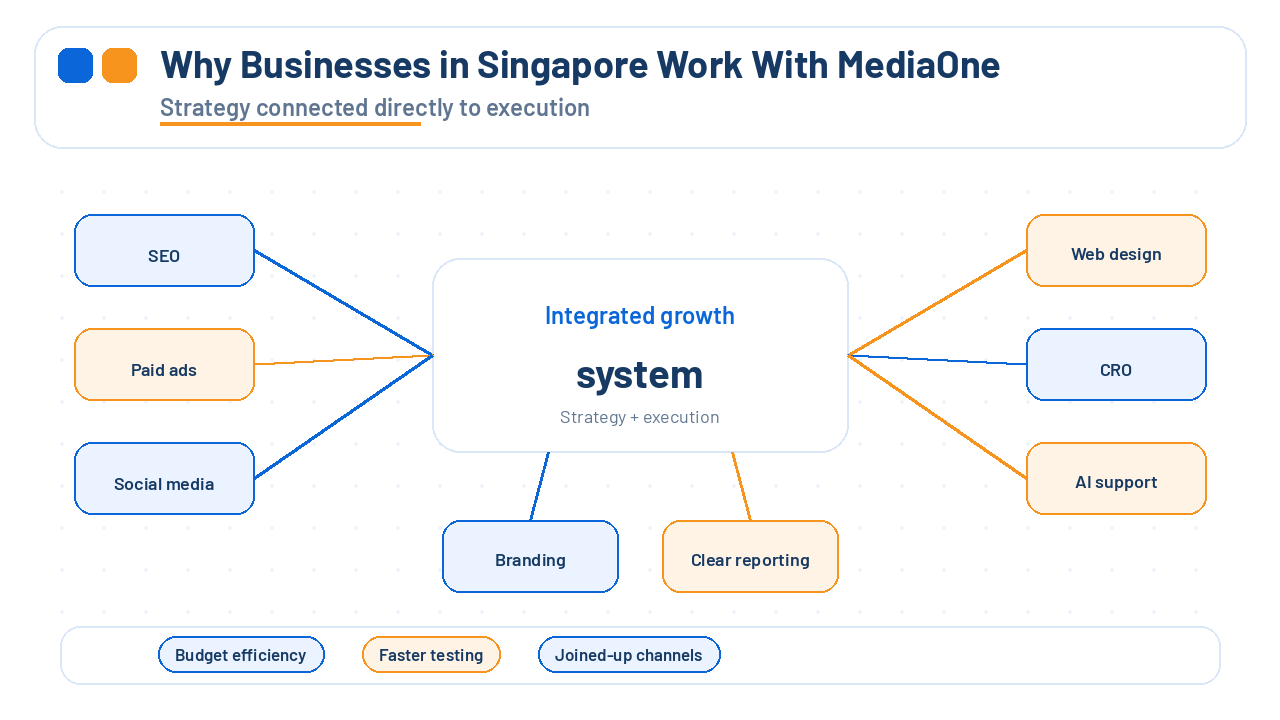
We are not interested in generic marketing theory. We are interested in what produces measurable growth.
That is why businesses come to us when they need:
- Better segmentation that reflects real buyer intent
- Clearer targeting linked to budget efficiency
- Stronger positioning that improves conversion
- SEO and paid campaigns that support each other
- Better reporting and accountability
- An agency that understands Singapore, not just marketing jargon
Our edge is not just experience. It is integration.
We connect strategy with execution.
We bring together:
- SEO
- Paid ads
- Social media
- Branding
- Website design
- Conversion thinking
- Proprietary AI support through Digimetrics.ai
That helps us move faster, test more intelligently, and optimise continuously rather than waiting for slow reporting cycles.
If your current STP strategy still lives in a slide deck instead of your campaigns, pages, offers, and sales pipeline, it is time to fix that. If your messaging feels too broad or your conversion rate is stuck, book a strategy call with our team and we will pressure-test your segmentation, targeting, and positioning against real Singapore data.
Frequently Asked Questions
What are STP Marketing Strategies?
STP marketing strategies refer to segmentation, targeting and positioning. It is a framework used to identify audience groups, choose the most valuable ones, and position a brand clearly for them.
Why is STP Important for Singapore Businesses?
Singapore is a compact but highly competitive market. Buyer expectations are high, ad costs are rising, and broad messaging wastes budget. STP helps businesses focus on the right customer groups and communicate more clearly.
Is Classic STP Still Relevant in 2026?
Yes, but not in its old static form. We believe businesses should use STP as a live system that is tested and refined using real search, paid media, CRM, and website behaviour.
How Does STP Help SEO?
STP improves SEO by aligning content with the right audience and the right intent. It helps brands create more relevant pages, target better keywords, and improve conversions from organic traffic.
What is the Biggest Mistake Businesses Make With Positioning?
They use vague claims that competitors can say too. Real positioning should be specific, credible, audience-focused, and tied to a clear business problem.
How Can MediaOne Help With STP Marketing?
As a Singapore SEO agency with 15+ years of local experience, we help businesses build sharper segmentation, stronger targeting, and clearer positioning. Then we apply that strategy across SEO, paid ads, branding, social media, and conversion-focused web experiences — so STP stops being a slide deck and starts driving measurable leads.