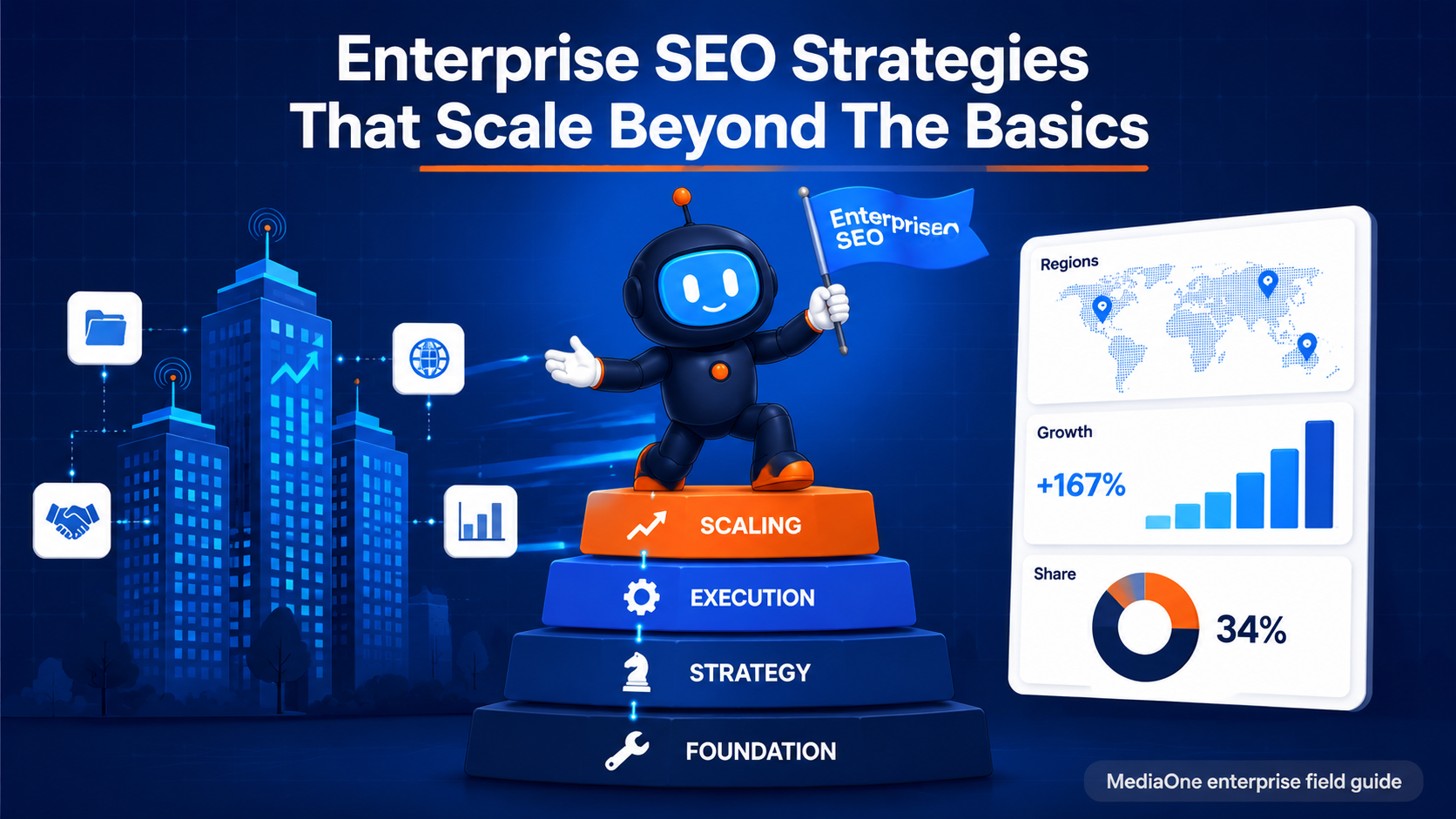
Mastering enterprise SEO is what separates the brands that dominate search from the ones that simply exist on it. This guide walks through the enterprise SEO strategies that genuinely scale, drawn from years of working with enterprise clients across Singapore and the wider APAC region. You will find the foundational principles every enterprise SEO team needs, alongside the niche, practitioner-grade tactics that move the needle when generic advice falls short.

Key Takeaways
- Enterprise SEO works at a scale where a single template change affects thousands of URLs, so the strategies that work for SMEs simply do not apply.
- The biggest wins come from high-leverage moves such as programmatic page templates, crawl budget recovery, entity optimisation, internal link equity, content refresh cycles, governance frameworks, and AI search visibility.
- Real results come from pairing technology with judgement. AI and advanced SEO tools accelerate the work, while the strategic decisions stay with experienced practitioners who understand the business context.
Importance of Enterprise SEO In 2026
Enterprise SEO has become a higher-stakes discipline than ever. Google AI Overviews now appear on roughly 60% of US search results as of late 2025, and AI Mode has crossed 1 billion monthly users following Google’s I/O 2026 announcements. The global SEO services market reached US$108.28 billion in 2026, according to The Business Research Company, with enterprise budgets driving much of that growth.
Closer to home, Singapore’s digital economy hit S$128.1 billion in 2024, accounting for 18.6% of GDP according to the IMDA Singapore Digital Economy Report, with growth continuing through 2026. The prize for getting enterprise SEO right keeps climbing, while the cost of getting it wrong compounds faster than ever.
The journey ahead covers foundational concepts, the niche strategies our team applies for enterprise clients, and the data-driven insights that confirm whether the work is paying back.
Defining Enterprise SEO
Enterprise SEO is a form of search engine optimisation designed for the expansive and intricate needs of large-scale businesses. Its core objective revolves around improving online presence, increasing organic traffic, and amplifying brand authority for major organisations.
Where traditional SEO services suit smaller websites, enterprise SEO services address the distinct challenges of substantial content volumes spread across numerous digital channels.
SEO initiatives within an enterprise context are geared toward attracting visitors and transforming them into dedicated customers. This calls for well-crafted strategies coupled with specialised expertise, focused on achieving high domain authority and implementing finely-tuned schema markup to boost visibility in search results.
Key Challenges In Enterprise SEO
Enterprise SEO operates inside a thicket of moving parts. Understanding each challenge in plain terms helps you prioritise the work that actually shifts rankings.
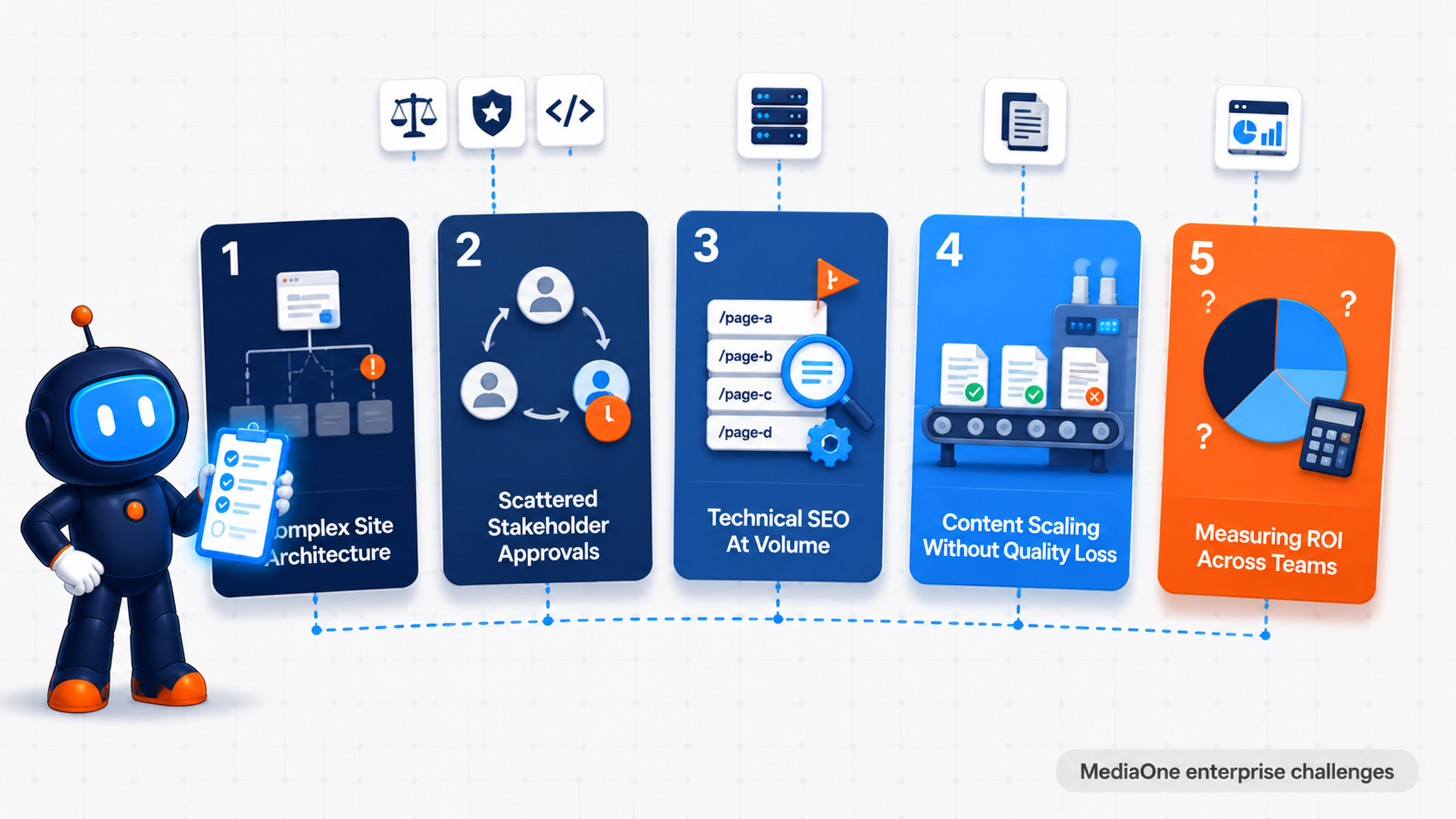
The Five Challenges Every Enterprise SEO Team Faces
1. Complex site architectures
Large websites accumulate thousands of legacy pages, duplicate URLs, and outdated sections over time. Search engines struggle to identify which version of a page deserves to rank, which dilutes authority and slows indexing.
2. Scattered stakeholder approvals
Every SEO change touches legal, brand, product, or engineering. Without a clear governance model, even a metadata update can sit in a queue for weeks while rankings drift.
3. Technical SEO at volume
Crawl budget, mobile performance, Core Web Vitals, and schema implementation all need to work across millions of URLs simultaneously. A single misconfigured rule can deindex an entire section.
4. Content scaling without quality loss
Producing hundreds of pages per month is straightforward. Producing hundreds of pages that each deserve to rank is where most enterprises break down.
5. Measuring ROI across distributed teams
When SEO contributes to multiple business units, attributing revenue back to specific optimisations becomes a reporting headache that often masks the real impact.
How Each Challenge Plays Out In Practice
| Challenge | What It Looks Like Day-To-Day | Where It Hurts Most |
| Complex site architecture | Filter parameters generating thousands of duplicate URLs; orphan pages from legacy campaigns | Crawl budget waste, diluted ranking signals |
| Stakeholder approvals | A meta description update waiting three weeks for legal sign-off | Missed seasonal opportunities, slow recovery from algorithm updates |
| Technical SEO at volume | Mobile performance regressions appearing only on specific page types | Lost mobile traffic, especially across eCommerce |
| Content scaling | Thin programmatic pages triggering Google’s spam policies | Site-wide quality penalties |
| ROI measurement | Multiple analytics platforms reporting different traffic figures | Lost executive buy-in for further investment |
Mobile devices account for more than half of all eCommerce traffic according to Singapore e-commerce statistics from Statista, which means weak mobile execution at the enterprise level shows up directly in revenue. A regular enterprise technical SEO audit checklist keeps these foundations intact.
Programmatic SEO: Build Thousands Of Pages From One Template
Programmatic SEO is the single strategy that separates enterprises from smaller competitors in the search results. Most large organisations already own a structured dataset such as products, locations, integrations, or categories. By pairing that dataset with one well-designed page template, you can capture long-tail searches at a scale manual content production could never match.
We have spent years studying programmatic SEO examples for our enterprise clients, and the patterns repeat across industries.
Real brands using this successfully:
| Brand | Page Type | Search Pattern Captured | What Makes It Work |
| Zapier | App integration pages | Connect [App A] to [App B] | A dedicated page for every possible pairing, drawn from their integration database |
| Wise | Currency conversion pages | Convert [Currency A] to [Currency B] | Live exchange-rate data on every page, refreshed automatically |
| Tripadvisor | Location pages | Best restaurants in [Neighbourhood] | City and neighbourhood pages generated from their venue database |
| Canva | Template gallery pages | [Use case] templates | A landing page for nearly every design intent, from CVs to wedding invitations |
| G2 | Software comparison pages | [Software A] vs [Software B] | Owns bottom-funnel SaaS comparison searches built from review data |
Where most enterprises stumble is treating programmatic SEO as a content shortcut. The pages that get rewarded are the ones that pair the template with something genuinely useful per URL, whether that is live data, comparison points, customer reviews, or proprietary insight. Pages that simply swap a keyword and call it a day get filtered out under Google’s policies on scaled content abuse.
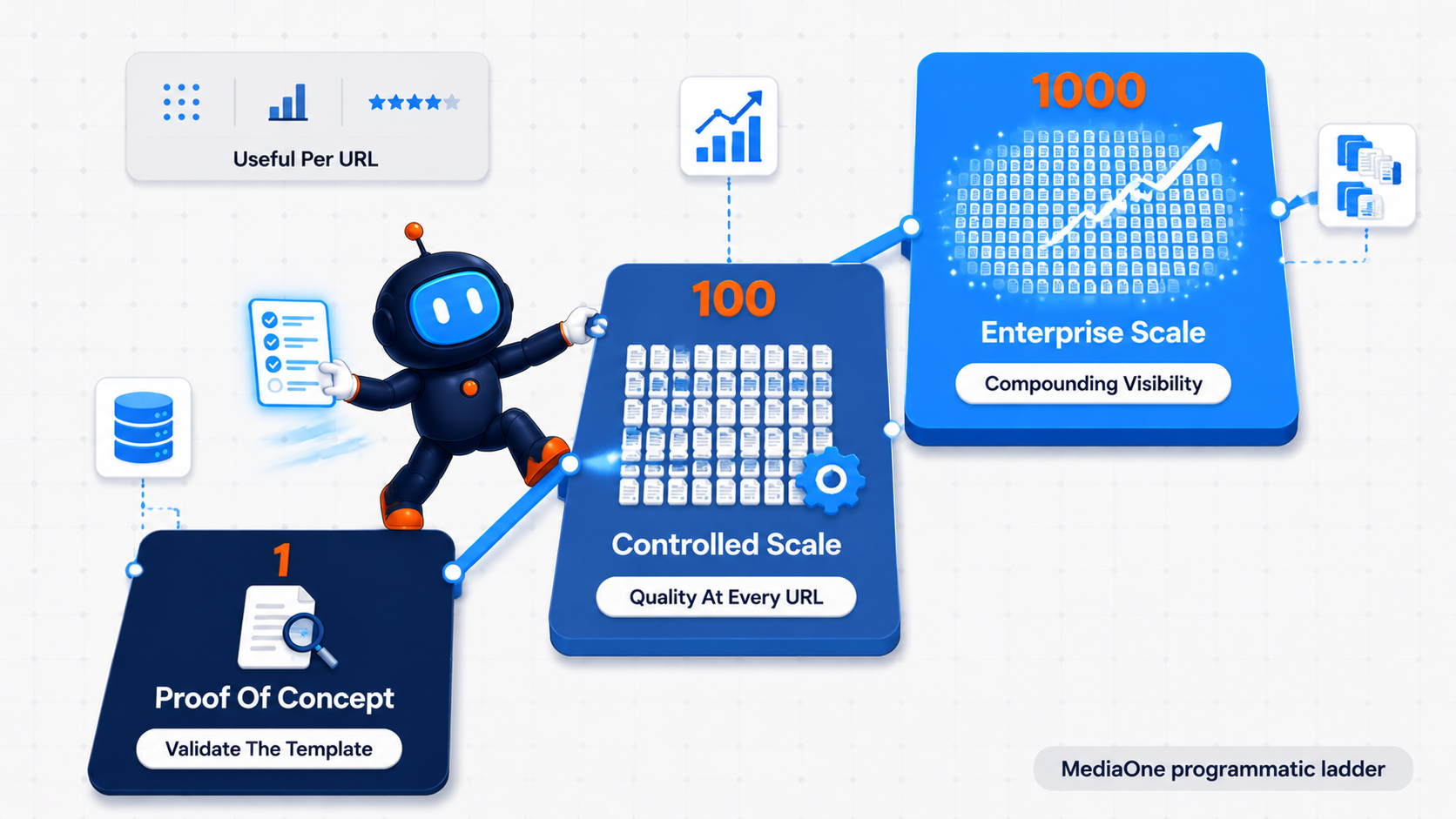
The framework that has worked consistently for our enterprise SEO clients is what we internally call the MediaOne 1-100-1000 Programmatic Ladder. The first stage is launching a single proof-of-concept page and measuring its performance. The second stage scales to 100 pages built from the same template, with quality control on every one. Only once those pages have demonstrated indexation, ranking signals, and organic traffic does the build move to 1,000 or more.
How to apply this in your business:
- Find a dataset you already own that maps onto how people search, such as product attributes, service areas, store locations, integrations, or categories.
- Confirm there is real search demand for the pattern by checking 20 to 30 sample variations in your keyword tool.
- Build a template that adds something useful to every page.
- Release pages in batches of a few hundred at a time, so template issues can be caught before they spread.
| Strategic Suggestion | Rationale |
| Add unique data or insight to every generated page | Pages that only swap keywords look thin to search engines and can trigger spam filters; pages with proprietary data feel genuinely useful |
| Release pages in staged batches | A sudden flood of 50,000 new pages can overwhelm search engines and your own quality control; staged releases keep both manageable |
| Quality-check a sample of 1% of pages before scaling | Catches template bugs such as empty fields and broken layouts before they affect the full set |
Crawl Budget Recovery: Stop Wasting Google’s Time
The pattern we see in almost every enterprise SEO audit is the same. Between 30% and 70% of the site’s crawl budget gets spent on pages that bring zero organic value, while pages that actually generate revenue get visited far less often than they should. The fix involves reviewing what search engines spend time on, then removing the noise so they focus on what matters.
This is the area where forensic SEO earns its keep. The findings are rarely glamorous, yet they consistently produce some of the largest organic gains we deliver for enterprise clients.
Common sources of crawl waste on enterprise sites:
| Source Of Waste | Typical Example | Why It Hurts |
| Filter and sort parameters | /shoes?colour=red&sort=price creating thousands of near-duplicates | Search engines crawl the same content many times under different URLs |
| Expired product or campaign pages | Out-of-stock SKUs and old promotions still linked from menus | Crawl budget spent on pages that cannot convert |
| Internal site search results | /search?q=… URLs accidentally left indexable | Endless URL combinations that add no value |
| Old paginated archives | /blog/page/47/ from years of publishing | Deep, low-value pages competing for attention with priority content |
| Tracking parameters | URLs with UTM tags treated as separate pages | Splits ranking signals across duplicate versions |
A useful internal metric we apply for enterprise clients is the Crawl-to-Revenue Ratio, which compares the share of crawl activity each page type receives against the share of revenue it generates. Any page type whose crawl share dramatically exceeds its revenue share becomes a candidate for clean-up. Page types whose revenue share dwarfs their crawl share signal a different problem where search engines don’t pay them enough attention.
A practical approach your enterprise team can run:
- Ask your developer or hosting team for a sample of server logs, or use an SEO platform that ingests them automatically.
- Group URLs by page type, such as product pages, category pages, blog, account, and search results.
- Identify which page types consume crawl time without delivering organic traffic.
- Work with engineering to block, consolidate, or redirect those URLs through robots rules, canonical tags, or sitemap clean-up.
- Re-check after 30 days and confirm crawl activity has shifted toward priority pages.
| Strategic Suggestion | Rationale |
| Treat crawl budget as a recurring quarterly review | Enterprise sites grow constantly, so waste accumulates without ongoing attention |
| Prioritise revenue-generating page types in the clean-up | Recovered crawl budget is most valuable when redirected to commercial pages |
| Document the changes in a shared log | Approval chains in large organisations need a clear audit trail, especially when robots rules or redirects affect multiple teams |
Entity Optimisation: Get Cited By AI Search
Google AI Overviews now appear on around 60% of US search results, and tools such as ChatGPT, Perplexity, and Gemini answer many queries directly while pulling from sources they recognise as authoritative. Traditional keyword optimisation has become one piece of a larger puzzle. Enterprises need search engines and AI tools to recognise their brand as a defined entity, beyond strings of words on a page. Google’s own AI features documentation confirms that recognised entities and structured data sit at the centre of how AI Overviews select sources.
This is one of the areas where the shift toward generative engine optimisation becomes most visible. The brands already cited in AI Overviews share a pattern of having clear entity signals, consistent descriptions across the web, and structured data that ties everything together.
What entity optimisation looks like in practice:
| Action | Example For An Enterprise Brand |
| Define your brand clearly on its own pages | An “About” page that opens with “[Company] is a [category] that [differentiator]”, written so AI can lift the sentence directly |
| Connect your brand to authoritative profiles | Use Organization schema markup that links your site to your Wikipedia entry, LinkedIn company page, Crunchbase profile, and verified social accounts through the sameAs property |
| Earn third-party mentions | Coverage in publications such as Reuters, Bloomberg, or trade press helps search engines verify who you are |
| Claim and manage your Google Knowledge Panel | Ensures the brand information shown in search results comes from you |
| Build content clusters around named concepts | A pillar page on a key topic supported by spoke pages on related sub-topics, all referencing each other |
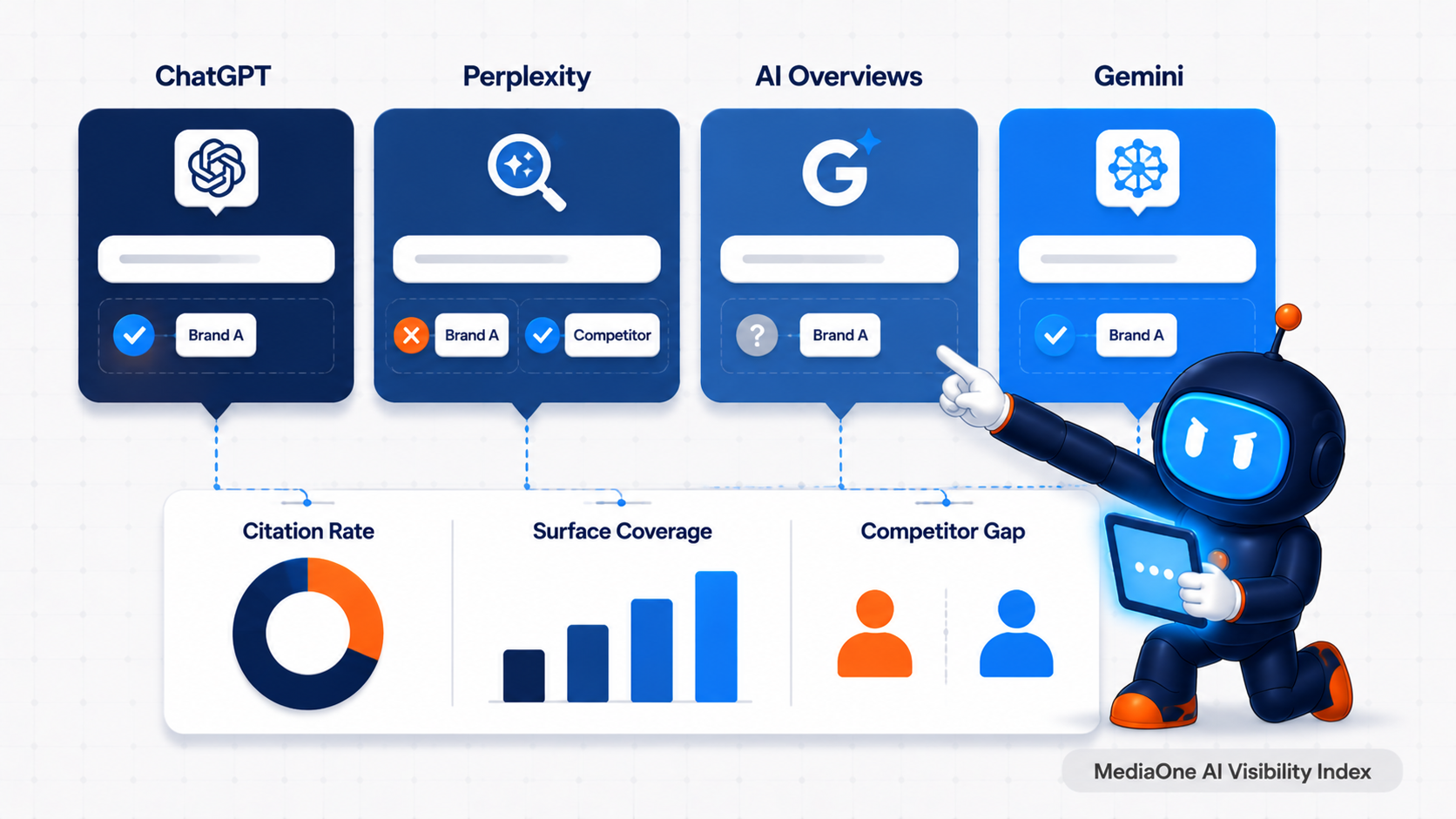
A useful self-check involves typing your brand name and a few of your priority topics into ChatGPT, Perplexity, and Google AI Overviews. If your brand goes uncited, or worse, a competitor gets cited, that gap becomes your roadmap. We run this exercise monthly for enterprise clients under what we call the MediaOne AI Visibility Index, a scoring framework that tracks brand citation rates across the four leading AI surfaces and benchmarks them against the top competitors in each category.
Any enterprise that treats AI search visibility as a future trend is going to find itself rebuilding visibility from scratch within 18 months. The question to ask internally is whether your brand sits among the sources AI tools cite, or among the sources they overlook.
| Strategic Suggestion | Rationale |
| Invest in a Wikipedia entry where the brand genuinely qualifies | Wikipedia is one of the strongest signals AI search engines use to confirm an entity exists and is legitimate |
| Standardise how your brand name and description appear across the web | Inconsistent descriptions across LinkedIn, Crunchbase, press releases, and your own site weaken entity recognition |
| Build content around named industry concepts rather than single keywords | AI systems retrieve information by topic and relationship, so being known as the authority on a defined concept beats ranking for one keyword |
Strategic Content Creation For Enterprise SEO
Successful enterprise SEO depends on content that resolves real audience queries and delivers genuinely useful insight. Enterprise content programmes need to cover diverse formats including articles, videos, podcasts, and interactive tools to match how different audiences prefer to consume information.
Scaling content production while keeping quality high is the unique challenge of enterprise sites. The fix involves having a robust strategy tailored specifically for the business and its creators.
Building A Content Ecosystem That Scales
A cohesive content ecosystem hinges on five practical habits:
-
Unified brand voice across departments
Marketing, product, support, and PR all create content. When they speak in different voices, search engines and audiences both lose trust.
-
Subject matter expert involvement
Where experts cannot write, interview them or have them review drafts. Their fingerprints on the content are what make it linkable.
-
Employee perspectives in the mix
Frontline insights that competitors cannot replicate become genuine ranking assets.
Republishing strong pieces on industry hubs extends reach without cannibalising your own rankings.
-
Strategic partnerships for testimonials and case studies
These produce high-quality inbound links naturally as part of the relationship.
Optimising Existing Pages Through Content Refresh Cycles
Most enterprises pour resources into producing new content while letting older articles slowly decay. The brands that win at scale do the opposite. Zapier has refreshed its guide on the best time-tracking software every year since 2018, and the page consistently holds the top spot in search results.
Existing pages already have backlinks, ranking history, and indexed authority. Refreshing them moves faster, costs less, and produces more reliable results than starting from scratch.
A refresh framework that scales across an enterprise content library:
| Refresh Trigger | What To Look For | Typical Action |
| Steady traffic decline | Pages losing 20% or more of their traffic month-on-month | Update statistics, add new sections, refresh examples |
| Ranking drop from page one to page two | Pages that once ranked top five but now sit on page two | Strengthen the introduction, expand thin sections, improve internal linking |
| Outdated facts or product references | Pages citing old data, defunct tools, or superseded regulations | Replace with current sources, add a “last updated” note |
| Strong backlinks on a weak page | Pages with quality external links but limited depth | Expand into a definitive guide that justifies the existing authority |
| Annual category content | Listicles, “best of” guides, year-in-review pieces | Schedule a fixed annual refresh window for the whole set |
The internal rhythm we follow for enterprise clients is what we call the 60/40 Content Reinvestment Rule, which allocates 60% of editorial effort to refreshing existing high-value pages and 40% to producing genuinely new content. The split sounds counter-intuitive to teams used to a “new content only” approach, while the compounding effect over 12 to 18 months consistently outperforms equivalent investment in new pages.
| Strategic Suggestion | Rationale |
| Aim for a 60/40 split between refreshing existing content and producing new content | Refreshes typically deliver faster results because the page already has search history; new content takes months to mature |
| Assign refresh ownership to senior writers, not juniors | Updating a high-traffic page badly can erase years of ranking equity, so the work needs experienced judgement |
| Keep a versioned record of every refresh | Important for regulated industries and useful for understanding which types of updates drive the biggest gains |
International SEO For Multinational Enterprises
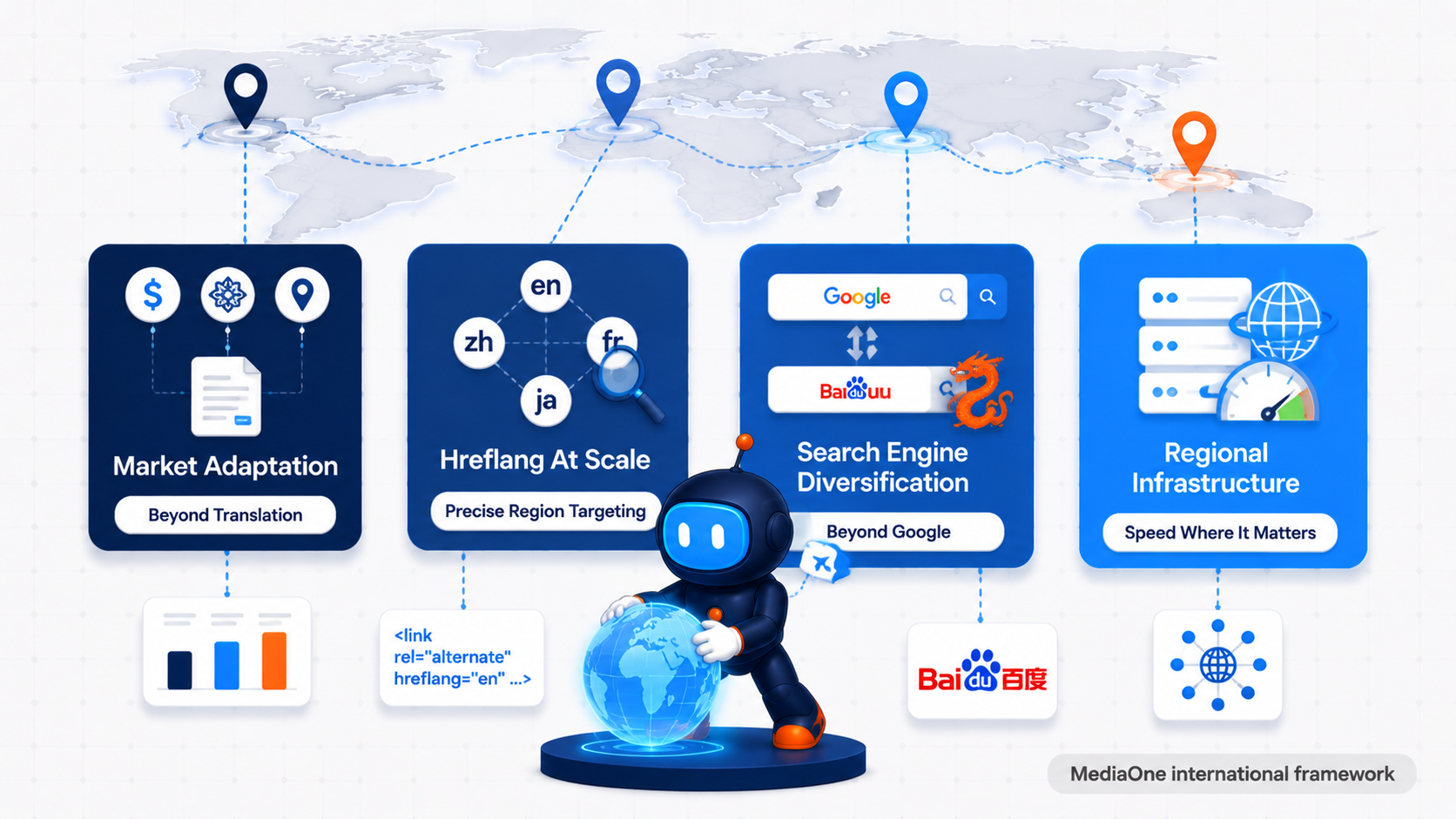
International SEO matters enormously for enterprises with multi-market footprints. The execution comes down to four practical pillars:
-
Market-specific content adaptation
Translation alone falls short. Localised examples, currency, and cultural references signal genuine market commitment.
-
Hreflang implementation at scale
Cluster visualisation tools help identify Hreflang complications quickly, ensuring precise language and region targeting.
-
Search engine diversification
Enterprises expanding into China need dedicated Baidu SEO services since the algorithms and ranking factors differ substantially from Google.
-
Regional technical infrastructure
CDN configuration, server response times, and local hosting decisions all affect rankings differently across regions.
Effective Link Building Tactics For Enterprise SEO
Link building remains a foundational pillar of enterprise SEO, while the tactics that work at this scale differ sharply from what serves smaller businesses.
Building Linkable Assets That Earn Attention
Linkable assets are the content pieces designed specifically to attract backlinks. At enterprise scale, the format options expand considerably:
-
Original research and industry surveys
Proprietary data gets cited by journalists, analysts, and bloggers for years.
-
Free interactive tools
Calculators, configurators, and assessment tools earn passive links from anyone explaining the topic.
-
Comprehensive guides on named industry concepts
When a guide becomes the definitive reference, it attracts citations as a default source.
-
Data visualisation and infographics
Complex topics rendered visually get embedded across the web with attribution links.
-
Expert quotes and contributions
Industry authorities lending their voice creates citable elements that lift credibility.
Pages that secure top positions in search results attract additional links progressively. This creates a self-reinforcing cycle where strong content earns elevated rankings, which then attracts more backlinks.
Internal Link Equity: The Lever Most Enterprises Underuse
On large sites, the way pages link to each other shapes which ones search engines treat as important. Roughly a quarter of pages on most enterprise sites receive zero internal links, which signals to search engines that the business itself does not consider them valuable.
For enterprises, this represents a high-leverage opportunity because the fix costs nothing and the changes happen without writing new content. Most of the internal link wins we deliver for enterprise clients come from this exact diagnosis. The full methodology lives in our internal linking strategy guide.
How enterprise teams identify and fix internal link gaps:
| Issue | How To Spot It | How To Fix It |
| Priority pages with few internal links | A revenue page receiving fewer than five internal links from across the site | Add contextual links from related blog posts, category pages, and resource hubs |
| Important pages buried deep in the site | Pages requiring four or more clicks from the homepage | Surface them through navigation, hub pages, or featured sections |
| Pages with strong backlinks but few outbound internal links | A blog post with high external authority that links nowhere | Use it to pass authority to commercial pages through contextual links |
| Repetitive anchor text | Hundreds of internal links using the same generic phrase such as “click here” | Diversify anchor text to describe what the linked page is about |
| Orphan pages | Pages indexed by search engines but linked from nowhere on the site | Either link them properly or remove them if no longer needed |
| Strategic Suggestion | Rationale |
| Build a monthly internal linking sprint into your editorial workflow | Each new article should add at least three internal links to existing priority pages, compounding authority over time |
| Treat your top 50 commercial pages as protected assets | These should receive a deliberate stream of internal links from every relevant new piece of content |
| Use a 3-column tracking table (Original Paragraph, Add Link, Revised Paragraph) for every link added | Keeps the work auditable across distributed content teams and prevents accidental over-linking |
Recovering Lost Links
Reclaiming lost links is a high-yield activity that often gets overlooked. Three practical methods deliver most of the recovery:
-
Unlinked brand mentions
Where journalists or bloggers mention your brand without a link, a polite outreach request often converts those mentions into active links.
-
Broken link reclamation
Specialised tools locate broken inbound links so you can request fixes or redirect the affected URLs.
-
Outdated URL redirects
Mapping retired pages back to relevant current pages recaptures lost link equity. Google advises maintaining such redirects for at least one year per their Search Central documentation.
SEO Governance: Stop Approval Chains From Killing Momentum
In an enterprise, the best SEO strategy stalls if every change needs to navigate legal, brand, product, and engineering approvals. The organisations that win at scale build governance frameworks that allow speed without sacrificing oversight. This layer almost never gets discussed in generic SEO articles, while it remains the most common reason enterprise SEO programmes underperform their potential.
After years of working with enterprise clients across regulated industries such as finance, healthcare, and education, we have realised a consistent pattern. Brands that ship SEO changes weekly outperform brands that ship monthly, and monthly shippers outperform quarterly ones. Velocity itself functions as a ranking factor, indirectly.
A governance model that actually works:
| Decision Type | Approval Required | Typical Turnaround |
| Metadata updates (titles, descriptions) | SEO team only | Same day |
| Refreshing existing copy on a published page | SEO and content lead | Within 48 hours |
| New page or new template launch | SEO, content, legal, brand | Within two weeks |
| Technical changes affecting site architecture | SEO, engineering, product | Scheduled into engineering sprint |
| Changes affecting regulated content (finance, health, legal claims) | SEO, content, legal, compliance | Within two to three weeks |
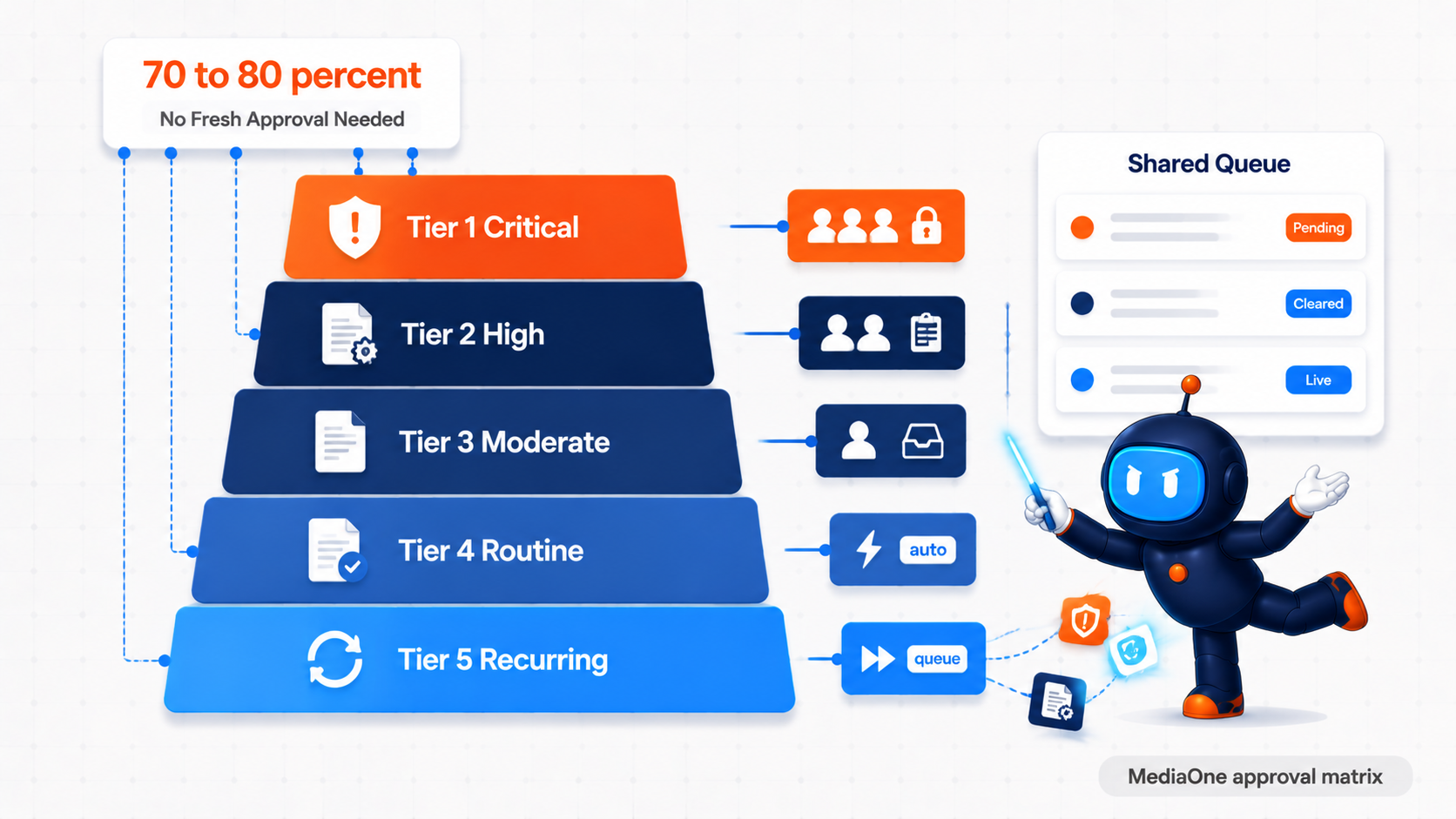
The framework we deploy for enterprise clients is the MediaOne Tiered Approval Matrix, which classifies every SEO change into one of five risk tiers and assigns pre-approved sign-off paths to each. The result is that 70% to 80% of routine SEO work no longer requires fresh stakeholder approval, freeing up bandwidth for the changes that genuinely warrant it.
Practical steps to set this up:
- Map every type of SEO change you make and assign it to one of the categories above.
- Document who must approve each category, then publish the framework internally.
- Pre-approve recurring change types so they no longer require fresh sign-off each time.
- Use a shared queue or ticketing system so requests stay visible across teams.
| Strategic Suggestion | Rationale |
| Pre-approve low-risk change categories at the start of each quarter | Removes the biggest source of delay, which is repeating the same approval conversations |
| Build SEO requirements into existing engineering and content processes | When SEO checks form part of the standard checklist, they stop being a separate bottleneck |
| Quantify the cost of approval delay in lost revenue | Helps senior stakeholders prioritise governance reform when they can see the commercial impact |
Leveraging Technology And Tools
Technology plays a central role in enterprise SEO success in 2026. AI and machine learning streamline workflows, refine content, and uncover patterns in datasets too large for manual analysis. The full landscape gets covered in our analysis of AI for SEO.
The Enterprise SEO Tech Stack At A Glance
| Category | What It Does | Examples |
| Marketing automation | Automates keyword research, outreach, and routine optimisation tasks | Semrush, Ahrefs |
| Advanced analytics | Provides dashboards, reporting, and pattern detection across large datasets | Looker, Tableau, Google Looker Studio |
| Enterprise SEO platforms | Manages crawls, rankings, and technical audits at scale | Conductor, BrightEdge, Botify |
| Content optimisation | Guides writers toward better topical coverage and entity inclusion | Clearscope, MarketMuse, Surfer |
| AI search monitoring | Tracks brand citations across ChatGPT, Perplexity, and AI Overviews | Profound, Otterly, AthenaHQ |
The reliance on Ahrefs by 44% of S&P 500 companies signals how central these tools have become. That said, tools alone deliver nothing. The strategic decisions about what to optimise, what to ignore, and what to prioritise still belong to experienced practitioners who understand the business context.
Measuring Success In Enterprise SEO
Evaluating SEO success is essential for refining strategies and proving impact to executive stakeholders.

The KPIs That Earn Executive Attention
- Revenue from organic search. The number that gets boardroom attention. Attribution models vary, while the principle stays the same.
- Organic share of total digital revenue. Shows SEO’s contribution relative to paid channels.
- Branded versus non-branded traffic split. Reveals whether your SEO is acquiring new audiences or just serving existing ones.
- Core Web Vitals and page experience scores. Direct ranking signals tied to user experience.
- AI citation rate. New for 2026 and rising fast in importance.
- Indexation coverage of priority pages. Confirms that the pages you care about actually appear in search results.
Where Enterprise SEO Is Heading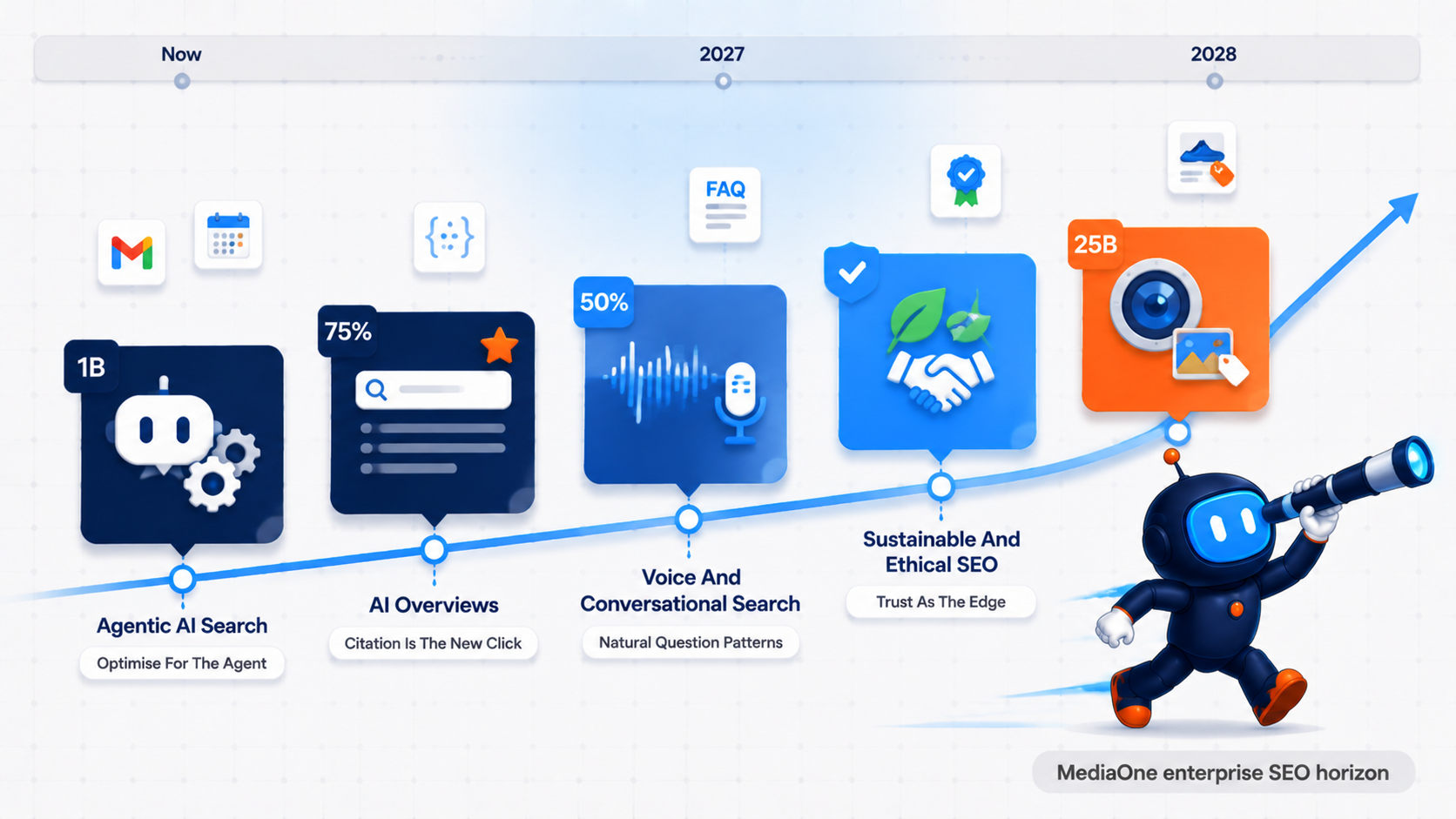
The next 24 months bring sharper shifts than the past five years combined. The trends below are the ones reshaping enterprise SEO right now in 2026.
-
Agentic AI Search And The End Of Ten Blue Links
Google AI Mode crossed 1 billion monthly users in 2026, with Gemini 3.5 Flash as the default model. AI Mode now connects to Gmail, Google Photos, and Calendar, executing tasks on behalf of users rather than simply returning results. For enterprises, this means search increasingly happens inside an AI conversation where your brand either gets recommended or stays invisible.
Businesses must now optimise for the agent, not just the searcher. Pages that clearly answer specific intent, surface verifiable data, and connect to authoritative entity signals are the ones AI agents pull from.
-
AI Overviews As The Default Search Experience
AI Overviews now dominate the search landscape. McKinsey’s analysis of winning in the age of AI search reports that around half of Google searches already trigger AI summaries, with that share projected to climb above 75% by 2028.
Click-through rates on traditional organic listings have taken a substantial hit. Pew Research analysis of how AI summaries reduce clicks on Google search results found that users encountering an AI summary clicked through to source websites far less often than users on standard search results. Ars Technica’s coverage of research showing AI Overviews reduce website clicks by nearly half confirms the same pattern across multiple independent studies. Brands cited inside AI Overviews see noticeably more engagement, which makes citation the new visibility metric worth chasing.
Winning here demands clear, definitional opening sentences, original data that AI tools cannot find elsewhere, and structured data that ties everything to a recognised entity.
-
Voice And Conversational Search
Roughly 50% of US consumers use voice search every day according to a YouGov survey on daily voice search usage among US consumers, with adoption among 25 to 34 year olds reaching 58%. Given that the United States typically sets the pace for consumer technology adoption, Singapore and the wider region are following the same trajectory. The Asia-Pacific voice assistant market is on course to reach US$11.12 billion by 2030 at a 31.3% CAGR according to Fortune Business Insights research on the Asia-Pacific speech and voice recognition market, which reflects how quickly voice habits are taking root across markets like Singapore.
Voice queries skew longer and more conversational, which rewards content written in natural question-and-answer patterns. Enterprise content programmes that build FAQ-style sections, conversational headings, and direct answer paragraphs capture this traffic almost automatically.
-
Sustainable And Ethical SEO As A Trust Signal
Consumer preferences continue shifting toward brands that emphasise sustainability and ethical practice. White hat SEO strategies remain the only sustainable path for enterprises, since black-hat shortcuts get exposed faster than ever by Google’s increasingly sophisticated quality systems.
-
The Multimodal Search Era
Google Lens processes over 25 billion visual searches every month according to Think with Google data on top search trends and visual search behaviour, with one in five Lens queries carrying commercial intent. Google’s own announcement on Google Lens and AI Overviews for marketers confirms that visual search has become a primary shopping entry point. Enterprises that optimise image alt text, file naming, product imagery, and visual schema markup capture searches that competitors miss entirely.
What This Means For Your 2026 Roadmap
The brands that will dominate enterprise SEO in 2026 and beyond share five traits:
- They have already started tracking AI citations alongside traditional rankings.
- They invest in original research that gives AI tools a reason to cite them.
- They publish content in multiple formats so it ranks in text, voice, and visual search.
- They have governance frameworks that let them move fast on emerging opportunities.
- They treat entity optimisation as foundational, not as an afterthought.
Bringing It All Together
Excelling at enterprise SEO calls for harnessing technology while adopting potent enterprise SEO strategies across content creation, link building, governance, and technical foundations. When enterprise businesses tailor these strategies effectively, they significantly improve their search rankings, attract more organic traffic, and foster enduring sustainable growth.
Key performance indicators measure the journey, while data-driven insights refine the direction. The brands that stay synchronised with overarching business objectives are the ones that compound advantage year after year.
Keeping pace with agentic AI search, voice optimisation, multimodal queries, and sustainable SEO practices is essential for securing an advantageous position within the digital market landscape of 2026 and beyond.
If your organisation is ready to apply these enterprise SEO strategies in practice, our team at MediaOne provides specialist international SEO services built around the frameworks described throughout this guide. Request a quote to see how the approach maps to your business.
Frequently Asked Questions
What is enterprise SEO?
Enterprise SEO is tailored to improve search engine rankings for large businesses facing complex challenges. It aims to enhance visibility, drive organic traffic, and boost brand authority across thousands or millions of pages.
What enterprise SEO strategies actually work for large businesses?
The strategies that move the needle for enterprises include programmatic SEO using existing structured datasets, crawl budget recovery through log analysis, entity optimisation for AI search visibility, content refresh cycles using a 60/40 split, internal link equity sprints, tiered governance frameworks, and AI citation tracking.
How is enterprise SEO different from regular SEO?
Enterprise SEO operates at a scale where a single template change affects thousands of URLs, governance involves multiple stakeholders across legal, brand, product, and engineering, and the highest-leverage wins come from technical and structural changes rather than individual page optimisation.
Why is programmatic SEO important for enterprises?
Programmatic SEO lets large organisations capture long-tail search demand at a scale manual content production cannot match, using datasets they already own. Brands like Zapier, Wise, and Tripadvisor have built their organic visibility on this approach.
How can internal linking benefit enterprise websites?
Internal linking substantially improves search engine rankings and refines the user experience through clear content structure and effective indexing of important pages. Around a quarter of pages on most enterprise sites receive zero internal links, which represents one of the largest untapped opportunities available.
How do enterprises optimise for AI search and Google AI Overviews?
Optimising for AI search calls for clear definitional opening sentences, consistent entity signals across the web, structured data using Organization schema with sameAs properties linking to authoritative profiles, original research, and monthly citation tracking across ChatGPT, Perplexity, and Google AI Overviews.
What role does technology play in enterprise SEO?
Technology enhances efficiency through automation, supports advanced analytics, and enables data-driven approaches. The strategic decisions still belong to experienced practitioners who understand the business context.
What are the future trends in enterprise SEO?

Agentic AI search through Google AI Mode, AI Overviews as the default search experience, voice and conversational search, multimodal search through Google Lens and Circle to Search, and sustainable SEO practices are the trends reshaping enterprise SEO through 2026 and beyond.