
For years, one number could tell how people viewed a website: Alexa Rank. Marketers, publishers, website owners, and SEO professionals used it to compare a site with millions of others online.

The idea was simple. A lower number meant higher estimated popularity. A website ranked #1 was considered more popular than one ranked #100,000. This made Alexa ranking a useful way to compare websites when public traffic data was harder to access.
But how did Alexa Rank work, why did it become so popular, and what ultimately led Amazon to shut it down?
Key Takeaways
- Alexa.com shut down on May 1, 2022. No single tool replaced it; marketers now use platforms such as Google Analytics, Search Console, Similarweb, Semrush, and Ahrefs.
- Alexa Rank measured estimated website popularity, not Google rankings. A lower rank meant higher estimated popularity.
- Alexa’s methodology evolved over time. Its early rankings relied heavily on data from Alexa Toolbar users, while later versions incorporated data from multiple sources and expanded measurement capabilities.
- Alexa became a popular SEO benchmark because it gave marketers a simple way to compare websites, competitors, and overall web popularity.
- Alexa Rank was never a perfect measure of traffic or SEO performance. It was based on estimates rather than a direct count of every visitor.
What Is Alexa Ranking and How Does It Work?
Alexa Traffic Rank or simply Alexa Rank, was a website popularity ranking system developed by Alexa Internet, a company founded in 1996 and acquired by Amazon in 1999. Alexa Internet collected data about websites and used it to estimate their popularity and traffic compared with other sites.
However, you should not confuse Alexa Rank with a Google ranking.
Google ranks individual pages in response to search queries. Alexa ranking, on the other hand, estimated a website’s overall popularity. It did not tell you whether your page would appear first for a particular keyword.
That difference matters when looking at Alexa from an SEO perspective.
The Early Years: How Alexa Ranking Began (2000-2009)
During the early 2000s, website owners had fewer tools for comparing their sites with competitors. Google Analytics did not become widely available until later in the decade, and many website owners had limited access to detailed traffic data.
Alexa filled part of that gap by providing a standardized way to compare website popularity.
In 2006, Alexa launched its Top Sites service, allowing applications to retrieve websites ordered by Alexa Traffic Rank. The service could provide rankings globally or by country.
Alexa also expanded its data services during this period. Its Web Information Service gave developers access to historical traffic and information about sites linking to a website.
This helped establish Alexa ranking as more than a curiosity. It became a reference point for people who wanted to understand website popularity.
At the time, this was especially useful because the internet was growing rapidly. New websites were appearing every day, and businesses were moving more of their marketing activities online.
Having a public ranking made it easier to answer questions such as:
- How popular is this website?
- Is this competitor larger than my website?
- Has this website become more popular over time?
- Which websites are among the most visited?
- How does my site compare with websites in another country?
The data was not perfect, but it was accessible. That accessibility played a major role in the growth of Alexa ranking.
How Alexa’s Data Methodology Changed Over Time

One important detail that is sometimes missed when discussing Alexa Rank is that Alexa did not use exactly the same data methodology throughout its entire history.
In its earlier years, Alexa’s rankings were heavily associated with its browser toolbar. In 2006, Amazon described Alexa Traffic Rankings as being based on the anonymous usage patterns of millions of Alexa Toolbar users worldwide, with rankings calculated using a combination of reach and page views over a rolling three-month period.
The system was therefore based on a sample of web users rather than a direct measurement of every person visiting every website.
Alexa made a major methodological change in April 2008. The company announced that it would move away from exclusive reliance on the Alexa Toolbar and begin aggregating data from multiple sources. The change was significant enough that many websites experienced noticeable changes in their rankings at the time.
This change also reflected a problem with relying heavily on toolbar users. People who installed a browser toolbar were not necessarily representative of the entire internet population. Contemporary reporting noted that toolbar-based measurements could skew toward more technically oriented users.
Later descriptions of Alexa’s methodology continued to emphasize that its ranking was based on a combination of user and page-view measurements. In 2014, Alexa stated that its global rankings generally used a panel of toolbar users, with global rankings based on unique visitors and page views from the previous three months. For sites using Alexa’s Certified Site Metrics, rankings could instead incorporate certified website data.
This means Alexa’s history is better understood as an evolving measurement system, rather than a single unchanging formula.
A simplified timeline looks like this:
| Period | How Alexa’s Data Approach Evolved |
| Early 2000s | Strongly associated with usage data from Alexa Toolbar users. |
| 2006 | Alexa described rankings as using millions of Toolbar users and a combination of reach and page views over a rolling three-month period. |
| 2008 | Alexa moved beyond exclusive reliance on the Toolbar and began aggregating data from multiple sources. |
| 2010s | Alexa expanded its analytics capabilities, including traffic, engagement, demographics, keyword, and competitive information. |
| Later years | Alexa continued combining external measurement with options such as Certified Site Metrics, allowing participating website owners to provide more direct traffic information. |
This evolution is important because comparing an Alexa Rank from the early 2000s with one from the late 2010s should not be treated as a perfectly consistent apples-to-apples comparison. Changes in data sources and methodology could influence the number itself.
In other words, Alexa Rank was not simply a permanent ruler that measured the web in exactly the same way for 20 years. It was a measurement system that evolved as the web, available data, and analytics technology changed.
The Rise: Alexa Ranking Becomes an SEO Benchmark (2010-2020)
During the 2010s, Alexa ranking became a familiar name in SEO and digital marketing.
By this point, website owners were no longer simply asking whether they had a website. They wanted to know how their website performed compared with competitors.
Alexa offered a convenient way to make that comparison.
Marketers could look at competing websites, review their estimated traffic, examine linking sites, research keywords, and monitor changes in their rankings. The platform also offered tools that supported competitive research and content planning.
The appeal was obvious: instead of looking at a website in isolation, you could place it within a much larger competitive landscape.
Why Do Businesses and SEO Professionals Use Alexa Rank?
Alexa Rank was useful as a source of competitive intelligence, giving users a way to evaluate websites and compare their relative position within an industry.
They could use Alexa to:
- Compare your website with competitors.
- Identify potentially popular websites in your industry.
- Research websites before pursuing partnerships.
- Examine traffic trends.
- Find websites that are linked to competitors.
- Support broader content and SEO research.
However, improving your Alexa rank did not directly tell Google to rank your website higher. Likewise, a strong Alexa Rank did not automatically mean that a website had strong SEO.
A website could have a good Alexa ranking because it received substantial traffic from sources such as direct visits, referrals, social media, or other channels without necessarily dominating Google search results.
For that reason, you should treat Alexa Rank as a historical competitive metric rather than a direct measure of SEO success.
Expert Perspective: How SEOs Actually Viewed Alexa Rank
Alexa Rank was not merely a metric discussed by website owners; it became part of the broader SEO conversation.
Barry Schwartz, a long-time search marketing journalist and founder of Search Engine Roundtable, documented how SEOs used Alexa alongside other third-party metrics. In his 2021 retrospective on Alexa’s shutdown, Schwartz wrote that SEOs in the early 2000s used Alexa in a similar way to PageRank and, later, metrics such as Domain Authority.
In a 2010 interview, SEOmoz co-founder Rand Fishkin noted that many SEOs wanted to understand metrics such as PageRank, Compete Rank, Alexa Rank, and link data. SEOmoz aimed to examine how useful these metrics were for predicting search rankings and how they compared with its own metrics, including Domain Authority and Page Authority.
These historical accounts show why Alexa became part of the SEO toolkit: not because Google used Alexa Rank, but because marketers wanted independent ways to compare websites when first-party competitor data was unavailable.

How Alexa Rank Determines Website Rankings
The exact methodology evolved over Alexa’s history, but the central concept was to estimate website popularity using web traffic and engagement data.
Alexa’s ranking system considered measures such as estimated visitors and page views. Historical descriptions of Alexa’s Global Rank state that it was calculated from a combination of daily visitors and page views over a three-month period.
In simple terms, Alexa tried to answer:
How much traffic and engagement does this website appear to receive compared with other websites?
The process was statistical rather than a simple headcount.
Think of it like estimating the size of a crowd by studying a large sample rather than counting every person individually. The estimate could be useful, but it could never guarantee a perfectly accurate number for every website.
That limitation was one of the most common criticisms of Alexa.

The Fall: What Led to the End of Alexa Ranking?
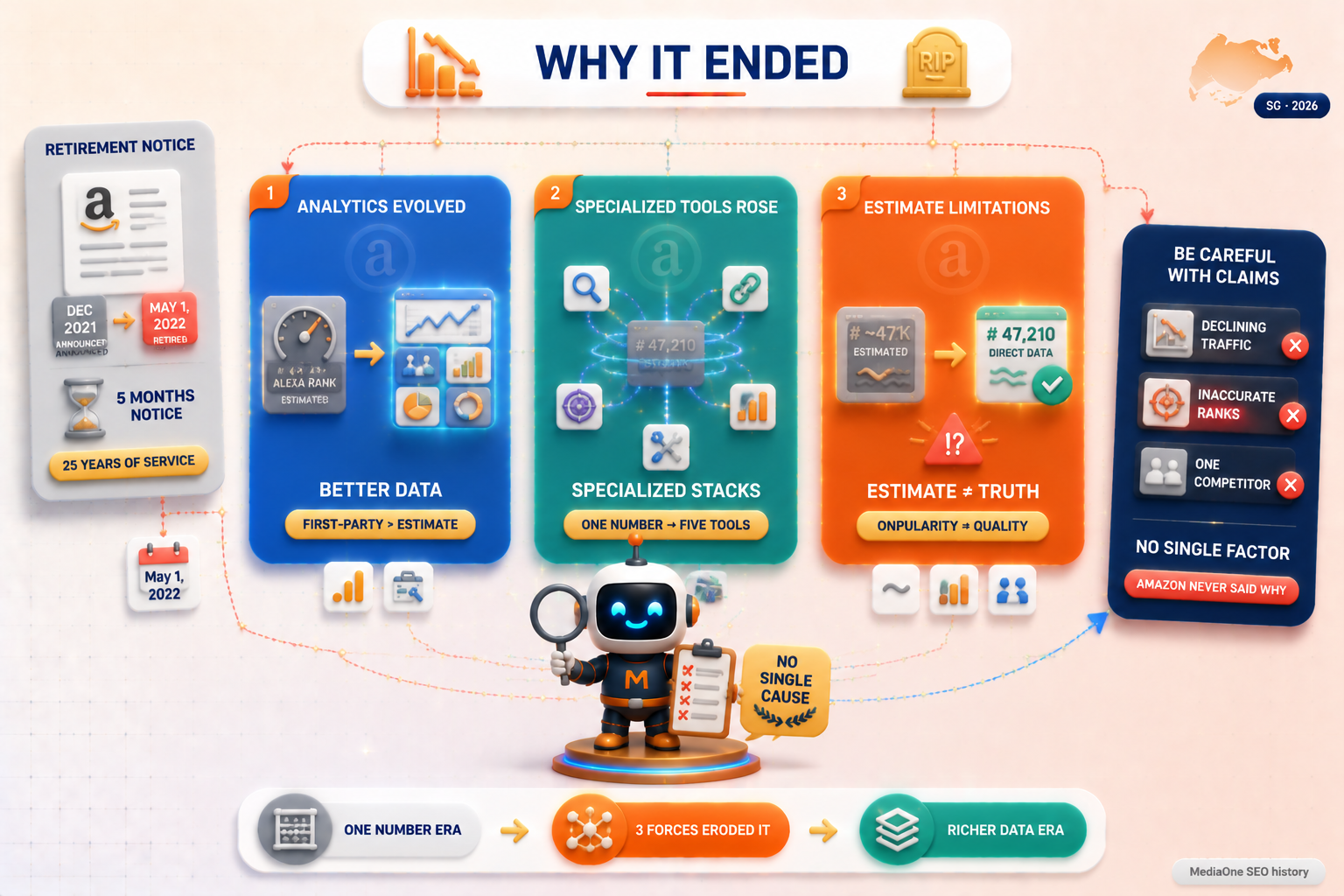
Alexa Internet’s story ended on May 1, 2022.
Amazon announced in December 2021 that it would retire Alexa.com after more than two decades of operation. Existing customers could continue using the service until the retirement date, after which the website and its services were shut down.
The important point is that Amazon did not provide a detailed public explanation saying that one specific factor caused the shutdown.
That means you should be careful with claims that Alexa was discontinued solely because of declining traffic, inaccurate rankings, or competition from another tool.
Several factors, however, help explain why the service had become less essential:
1. Website analytics have changed dramatically.
When Alexa began, having a broad estimate of website popularity was valuable. By the 2010s, businesses could access far more detailed first-party data. Website owners could see their own traffic, search performance, conversions, engagement, and audience information through modern analytics platforms.
2. SEO professionals had developed more specialized tools.
Instead of relying on one general website popularity number, marketers could use separate platforms for keyword research, backlinks, technical SEO, competitor research, search visibility, and traffic analysis.
3. Alexa Rank’s limitations became more noticeable over time.
Because Alexa ranking was an estimate, it could not provide the same level of accuracy as data collected directly from your website. A ranking could also create the impression that one website was definitively “better” than another when the number only represented estimated popularity.
The shutdown was therefore the end of a tool that had played an important role during an earlier stage of internet marketing.
What Replaced Alexa Rankings?
There was no single replacement for Alexa ranking. Instead, marketers now use different tools depending on what they want to measure. The best approach is to match the old Alexa use case with a more specialized modern metric or platform.
| If you previously used Alexa for… | You can use… |
| Your own website traffic | Google Analytics (GA4) |
| Google search visibility | Google Search Console |
| Competitor traffic estimates | Similarweb |
| SEO competitor research | Semrush or Ahrefs |
| Backlink analysis | Ahrefs or Semrush |
| Local search visibility | Google Business Profile + local rank tracking |
| Simple domain-authority proxy | Moz and other third-party metrics, used cautiously |
The bottom line: Alexa showed how popular a website appeared to be. Modern tools help you understand how and why it performs.
What Singapore Businesses Should Use Instead
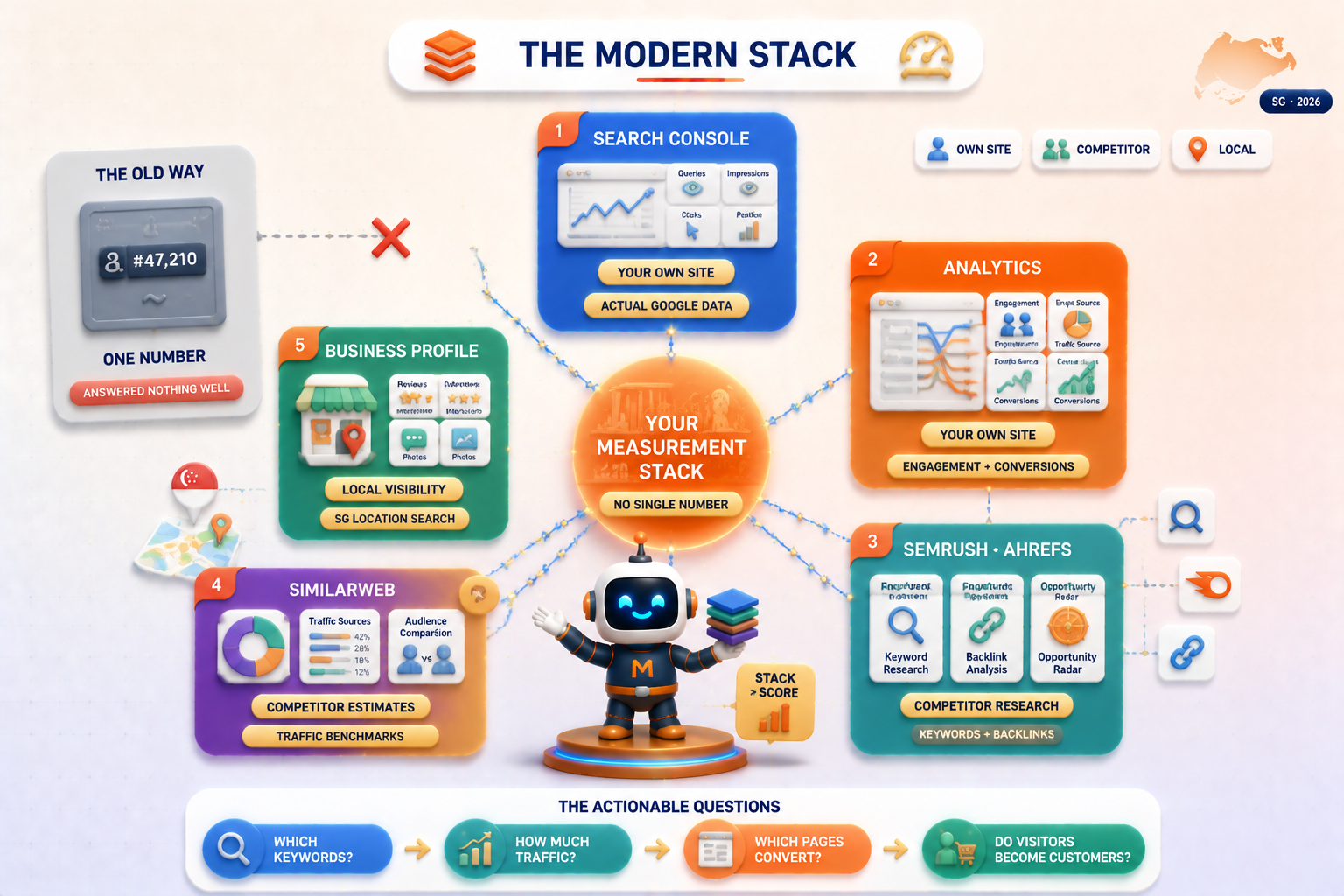
For Singapore businesses, your choice of tools should depend on whether you are measuring your own website, researching competitors, or tracking local search performance.
A practical Singapore SEO measurement stack could therefore look like this:
- Google Search Console: Measure actual Google Search impressions, clicks, queries, and rankings for your website.
- Google Analytics: Measure website engagement, traffic sources, conversions, and user behavior.
- Semrush or Ahrefs: Research competitors, keywords, backlinks, and search opportunities.
- Similarweb: Benchmark estimated traffic sources and competitor audiences.
- Google Business Profile: Monitor local visibility and customer interactions for businesses serving specific locations.
The key difference from Alexa is that you should not expect one number to answer every SEO question.
For a Singapore SME, for example, knowing that a competitor has a strong estimated traffic profile can be useful. But knowing which keywords generate that visibility, how much organic traffic your own site receives, which pages generate leads, and whether those visitors become customers is much more actionable.
Final Thoughts: What Can We Learn from Its Rise and Fall?
The story of Alexa rankings shows how quickly digital marketing can change.
Alexa succeeded because it made website popularity easy to understand. One number gave businesses a simple way to compare websites and competitors.
But simplicity also had limits. As analytics tools became more advanced, marketers needed more than an estimated popularity score. They needed accurate, actionable data.
The biggest lesson is to avoid relying on a single metric. Your website’s success should be measured through meaningful results, such as organic traffic, search visibility, leads, conversions, and revenue.
Most importantly, it reminds you that the best SEO strategy is one that adapts as technology, search behavior, and user needs change.
Build a Stronger SEO Strategy with Media One Marketing
Alexa may be gone, but the questions it helped marketers ask are still important.
How does your website compare with competitors? Are you attracting the right visitors? Are your pages ranking for valuable searches? Is your content bringing potential customers to your website?
You no longer need an Alexa ranking to start answering those questions.
What you need is a clear SEO strategy backed by useful data, strong content, technical optimisation, and ongoing measurement.
That is where Media One Marketing can help.
Instead of focusing on one outdated popularity score, you can take a broader approach to search visibility and digital growth. From SEO and content marketing to digital strategy, the goal should be to turn search traffic into meaningful business results.
Your website does not need an Alexa Rank to prove that it is performing well. It needs the right audience, the right strategy, and measurable results.
Ready to strengthen your online presence? Explore Media One Marketing’s digital marketing services and take a more data-driven approach to growing your website.
Frequently Asked Questions
1. Can Alexa Rank still be checked today?
No. Alexa Internet retired Alexa.com and its ranking services on May 1, 2022. Alexa Rank is no longer updated or available through the original service.
2. Could Alexa Rank Be Manipulated?
To some extent, yes. Since Alexa ranking relied on estimated data rather than direct website traffic, attempts to influence traffic or Alexa-related data could affect a site’s ranking. However, artificially improving the rank did not necessarily mean the website had genuine, high-quality traffic.
3. What Happened to Websites That Displayed Their Alexa Rank Publicly?
The Alexa Rank displayed on those websites became outdated after the service shut down. Website owners had to remove the badges or replace them with other metrics, such as organic traffic, search rankings, or domain authority.