A few months ago, a founder came to me frustrated. She had been paying a social media marketing agency S$2,800 a month for six months. Regular posts, branded graphics, the occasional reel. When I asked what it had done for her business, she paused. “We got more followers,” she said slowly. “But I’m not sure anyone actually bought anything.”

That conversation is more common than it should be, and it tells you everything you need to know about why social media marketing agency pricing is such a high-stakes decision for Singapore businesses.
Most guides will hand you a range of numbers. Few explain what the range actually means, what drives it, what separates a fee that produces returns from one that produces activity, or how to evaluate three very different options: agency, in-house, or freelancer.
This article goes further than that. It covers pricing models, platform-level ad costs, real Singapore salary benchmarks for building an in-house team, total monthly budget scenarios, how industry changes affect the calculation, and government grant options that many Singapore SMEs are still not using.
If you are approaching this decision for the first time or reconsidering an arrangement that doesn’t feel like it is working, this is for you. And if you want a team that thinks about these things commercially rather than just tactically, MediaOne is one of the agencies in Singapore worth speaking with before you commit.
Key Takeaways
- Social media management fees in Singapore range from S$500 to S$20,000+ per month, depending on scope, provider type, and strategy depth. Most growing SMEs operate in the S$1,500-S$5,000 range.
- Ad spend is a separate budget line. Many businesses budget only for management fees and are surprised by what a properly paid campaign actually requires on top of that.
- A lean in-house marketing team costs S$7,500 to S$18,000+ per month in salaries alone, before CPF contributions, tools, and recruitment. For most SMEs, an agency delivers more capability at a lower total cost.
- Platform choice materially affects cost and return. LinkedIn CPMs are significantly higher than Facebook or TikTok, but the lead quality justifies it for B2B. Platform selection should align with your audience and commercial goals, not trends.
- Nearly half of Singapore businesses say their digital marketing strategy has not contributed to organisational goals, according to a HubSpot and LinkedIn survey. The problem is almost always strategy and measurement, not spending level.
- PSG and EDG grants are still accessible now, and a new consolidated EDGE grant launches in H2 2026, supporting up to S$100,000 per year. Apply before signing any agency contract.
- The right agency relationship is built on commercial clarity, not deliverable volume. More posts are not a better strategy.
What a Social Media Marketing Agency Actually Does
A social media marketing agency manages the strategy, content, advertising, and reporting for a brand’s presence across platforms, including Instagram, Facebook, TikTok, LinkedIn, and YouTube.
Core deliverables typically include:
- Strategy development and content calendar planning
- Content creation, including copywriting, graphic design, and video editing
- Post scheduling and community management
- Paid advertising campaign management
- Analytics reporting and strategic recommendations
What it does not cover: SEO, website development, Google Ads, email marketing, or PR. These are related but distinct disciplines.
Some agencies offer them as combined packages. When they do, make sure you understand what is genuinely integrated versus what is bolted on.
The business problems a well-run social media programme addresses are brand visibility, audience engagement, and demand generation. The keyword is well-run. A social media agency that fills your calendar with content without tying it to commercial outcomes is not solving a business problem. It creates the appearance of being solved.
The Singapore Reality: What the Data Actually Shows
Before we get into pricing, I want to share something that most pricing guides skip entirely, because it is the most important commercial context for this decision.

A HubSpot and LinkedIn survey, conducted by Milieu Insight across Asia, produced findings about Singapore specifically that every business owner considering social media marketing should understand:
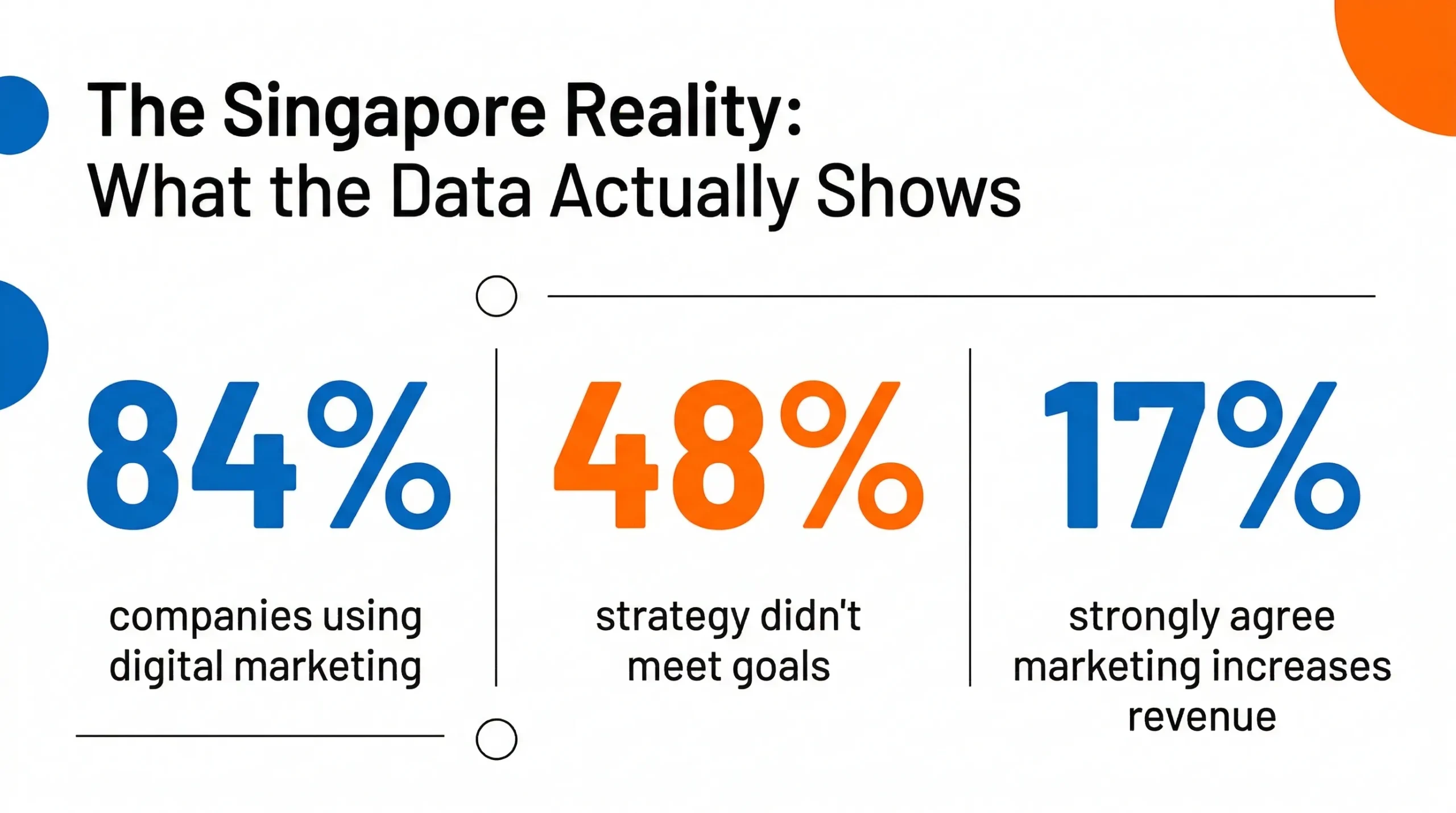
- 84% of Singaporean companies use digital marketing. Most of them are spending. And yet nearly half of the Singapore respondents reported that their digital marketing strategy had not contributed to their organisational goals in the previous year. That figure is the highest among all countries in the survey.
- Only 17% of Singapore businesses strongly agreed that a good digital marketing strategy increases revenue. The regional average was 41%. Only 41% of Singapore companies use CRM tools to track outcomes, again the lowest of all countries surveyed.
- Social media receives 23% of all digital marketing budgets in Singapore. And yet 52% of Singapore businesses measure marketing success through brand awareness rather than sales or revenue, the inverse of what most of their regional counterparts prioritise.
I do not share this to be discouraging. I share it because it tells you exactly where the failure point is. It is not that social media does not work in Singapore. It is that most businesses are buying activity and measuring output while hoping it produces revenue. The gap between activity and outcome is the gap between a good spend and a wasted one.
The right agency relationship closes that gap. The wrong one widens it while delivering pretty reports.
Factors That Influence Social Media Marketing Agency Pricing
Understanding what shapes the price you are quoted helps you evaluate proposals more critically.
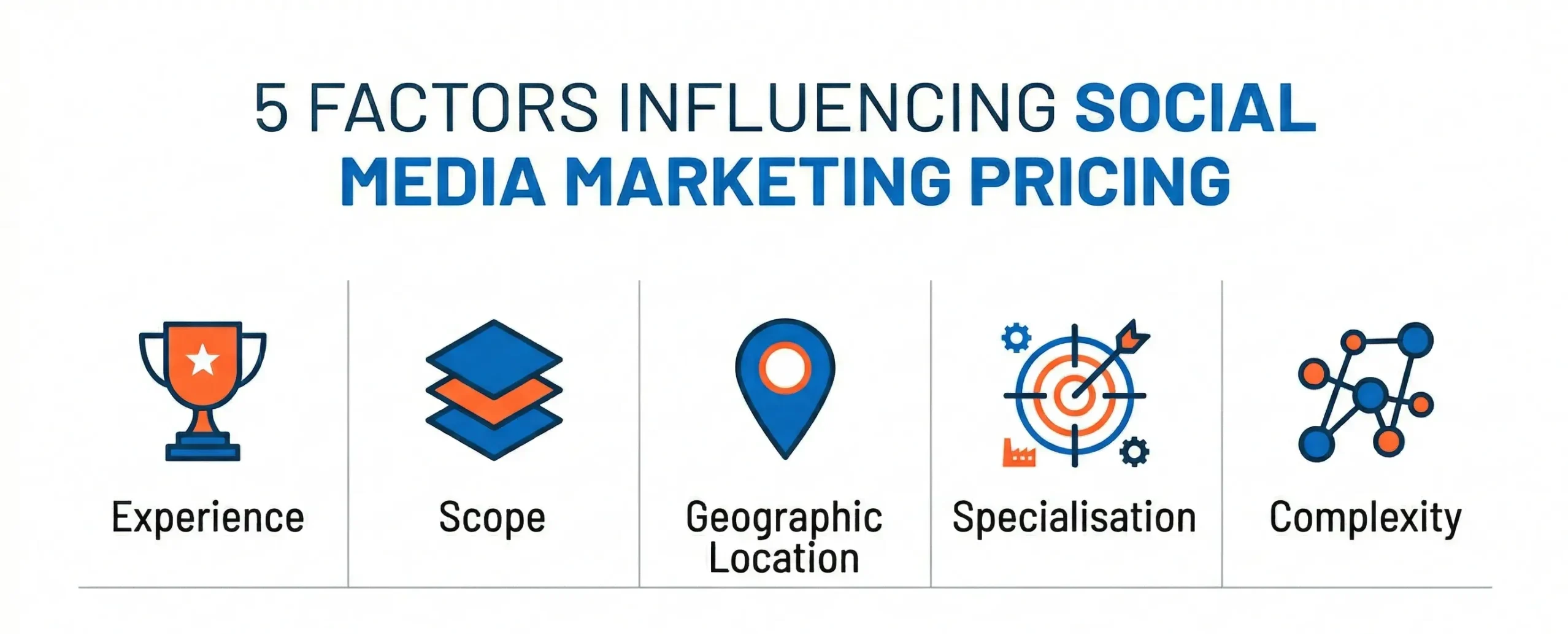
- Agency experience and reputation: A team with five to eight years of proven sector-specific results will charge more than a newer one. That premium is usually earned.
- Scope of deliverables: Number of platforms managed, content volume, whether video production is included, depth of strategy, and whether paid advertising management is in scope all drive the fee materially.
- Geographic location of the agency: A Singapore-registered agency with a local team and dedicated account management will cost more than an offshore arrangement. That differential reflects accountability, cultural understanding, and commercial proximity to your market.
- Industry specialisation: Agencies working in regulated sectors like healthcare, finance, or legal services charge more because the compliance knowledge has real value. Getting it wrong in those sectors is not a marketing problem. It is a regulatory one.
- Client size and complexity: A local renovation company running one Instagram account has different requirements from a B2B SaaS firm managing LinkedIn, YouTube, and a multi-market paid programme. Complexity drives cost. If an agency quotes the same fee for both, I would ask why.
Types of Pricing Models for Social Media Marketing Services
How an agency charges you is just as important as how much they charge you. The pricing model shapes the relationship, the incentives, and the risk exposure on both sides. I see businesses compare quotes without comparing the underlying structures, and that leads to mismatched expectations before the first piece of content is even approved.
There are four main models you will encounter in Singapore. Each suits a different type of business situation. Understanding the logic behind each one (along with the typical costs involved) helps you choose an arrangement that fits how your business actually operates, not just the one that looks cheapest on paper.
Pricing Model Comparison Table
| Pricing Model | Starting Price | Average Cost | Best For |
| Retainer-Based | S$500/month | S$1,500 – S$4,000/month | Businesses with consistent, ongoing needs |
| Project-Based | S$3,000/project | S$5,000 – S$15,000/project | One-off campaigns, launches, or specific initiatives |
| Performance-Based | 10% of ad spend + base fee | Variable (base + commission) | Brands with clean conversion tracking and short sales cycles |
| Hourly Rate | S$20/hour (freelancer) | S$80 – S$200/hour (experienced strategist) | Strategy audits, consulting, or short execution bursts |
Retainer-Based Pricing
The most common arrangement. You pay a fixed monthly fee for an agreed scope of work. The agency commits to a defined number of content pieces, platforms managed, campaigns run, and reports delivered each month.
Typical costs in Singapore:
- Entry-level packages (freelancer or micro-agency): S$500 – S$1,500/month
- Standard packages (boutique agency): S$1,500 – S$3,500/month
- Growth packages (mid-market agency): S$3,000 – S$6,000/month
- Full-service packages (established agency): S$6,000 – S$15,000/month
- Enterprise-level: S$15,000+/month
This model works well when you have consistent, ongoing needs and want predictable monthly costs. It also encourages a genuine long-term partnership, which matters because social media results compound over time.
The limitation: if your business is highly seasonal, a retainer can feel like poor value in quiet months. Ask prospective agencies how they handle this before signing.
Project-Based Pricing
A fixed fee for a defined scope. A product launch campaign. A six-week brand awareness push. A content series for a specific event. This suits businesses that do not need ongoing management but have a specific commercial goal to reach.
Typical costs in Singapore:
- Social media strategy and audit: S$3,000 – S$15,000
- Short-form video production (per video): S$1,000 – S$5,000
- Brand content shoot (photo and video): S$3,000 – S$15,000
- One-off campaign launch (product or event): S$5,000 – S$30,000
- Landing page design and build: S$2,000 – S$8,000
Make sure every deliverable, revision, and deadline is in writing before work begins. Scope creep is the most common source of cost overruns in project-based arrangements.
Performance-Based Pricing
The agency is paid based on outcomes, typically leads generated, conversions, or revenue influenced. In principle, this aligns incentives perfectly. In practice, attribution in Singapore’s multi-touch buyer journeys is messy enough that “who gets credit for this lead?” becomes a recurring conversation.
Typical structure in Singapore:
- Base retainer: S$2,000 – S$5,000/month (covering ongoing management)
- Performance fee: 10% – 20% of ad spend, or cost-per-lead/cost-per-acquisition agreements
- Some agencies offer hybrid models combining a reduced retainer with performance bonuses tied to specific KPIs
This model works best when conversion tracking is clean, the sales cycle is short, and both parties have agreed exactly what counts as a result. For most Singapore SMEs, it adds complexity before clarity.
Hourly Rate Pricing
More common with freelancers and independent consultants than with full-service agencies. Useful for strategy reviews, audits, or short execution bursts. Not ideal for ongoing management where unpredictable hours make budgeting difficult.
Typical hourly rates in Singapore:
- Freelancer (entry to mid-level): S$20 – S$100/hour
- Experienced social media strategist: S$80 – S$200/hour
- Senior consultant or specialist: S$150 – S$300/hour
The challenge with hourly billing is that it creates misaligned incentives—the agency benefits from inefficiency, and you lack predictability in monthly costs. It works best for defined, short-term engagements where you need specific expertise rather than ongoing execution.
Total Investment by Business Stage
To give you a clearer picture of what social media marketing actually costs in practice, here’s a breakdown combining retainer and ad spend:
| Business Stage | Agency Retainer | Monthly Ad Spend | Total Monthly Investment |
| Startup / Early SME | S$1,500 – S$3,000 | S$1,000 – S$2,000 | S$2,500 – S$5,000 |
| Growing SME | S$3,000 – S$6,000 | S$2,000 – S$5,000 | S$5,000 – S$11,000 |
| Established Brand | S$6,000 – S$12,000 | S$5,000 – S$15,000 | S$11,000 – S$27,000 |
| Enterprise / Multi-market | S$15,000+ | S$20,000+ | S$35,000+ |
Note: All prices are in Singapore Dollars (SGD) and reflect 2024–2025 market rates. Actual costs vary based on scope, agency reputation, and specific service requirements.
Average Costs of Social Media Marketing Agencies in Singapore (2026)
Here are the current Singapore market rates, including what each tier typically delivers and who it is most suited to.
| Tier | Monthly Cost (SGD) | Typical Scope | Who It Suits |
| Basic | S$500 – S$1,500 | 2–4 platforms, 8–12 posts/month, basic community management, monthly report | Solopreneurs, early-stage brands, single-platform presence |
| Mid | S$1,500 – S$3,500 | Strategy, content planning, graphic design, light paid management on 2–3 platforms | Growing SMEs are building a consistent presence and initial lead generation |
| Premium | S$3,000 – S$6,000+ | Full strategy, video production, paid ad management on 3–5 platforms, detailed analytics | Established SMEs scaling towards growth with multi-platform presence |
| Enterprise | S$8,000 – S$20,000+ | Multi-market campaigns, dedicated account teams, advanced attribution, executive reporting | Regional brands, MNCs, high-revenue businesses with complex cross-platform needs |
Note: These figures cover management fees only. Paid advertising budgets are entirely separate and sit on top of every tier above.
The True Cost of Your Options: Agency vs. In-House vs. Freelancer

This is the comparison most pricing articles avoid because the numbers make the case for agencies too obviously. I will share them anyway, because your decision should be based on reality, not omission.
What In-House Actually Costs
Running social media to a professional standard requires at least three distinct skill sets: strategic planning, creative production (design and video), and paid social management.
No one person can credibly cover all three. I have seen businesses try, and the result is almost always a compromise that serves none of the three areas well.
A lean two-person in-house team, a social media manager and a content creator costs roughly S$7,500 to S$12,000 per month in salaries alone. Add CPF contributions at 17% (the employer’s portion), software subscriptions, equipment, and training, and the actual monthly cost is materially higher.
A more complete team that also covers paid social reaches S$12,000 to S$18,000 per month in staff costs before any additional overhead, recruitment fees, or the management time required to supervise a growing marketing headcount.
Current Singapore salary benchmarks for these roles, sourced from Glassdoor Singapore and Jobstreet, are as follows:
| Role | Monthly Salary Range (SGD) | Median |
| Social Media Executive | S$2,500 – S$5,000 | S$3,500 |
| Social Media Manager | S$3,500 – S$6,000 | S$4,333 |
| Content Creator | S$2,800 – S$4,600 | S$3,663 |
| Paid Social Specialist | S$4,000 – S$7,000 | S$5,000 |
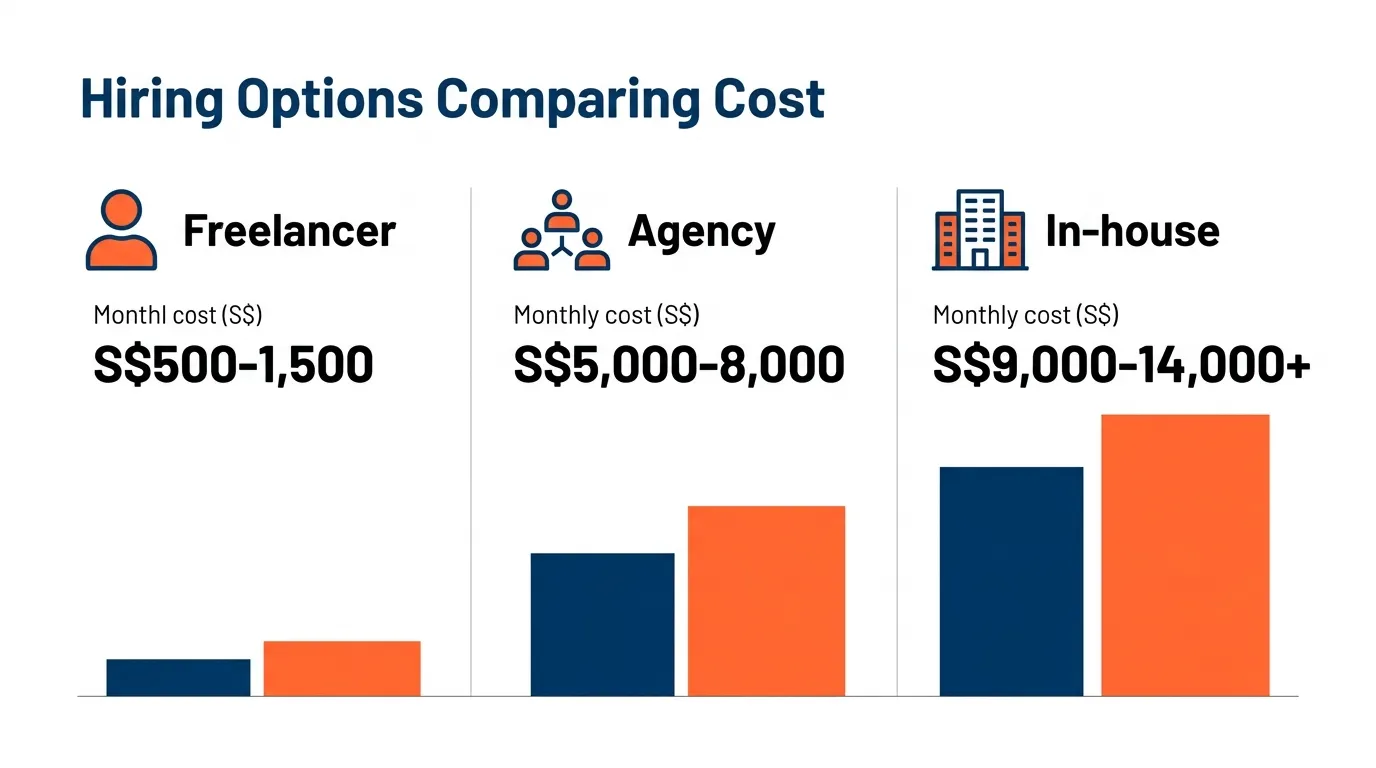
A quality agency retainer covering equivalent capability costs S$5,000 to S$8,000 per month, with no CPF obligation, no recruitment cost, no annual leave cover, and no risk of losing the institutional knowledge when someone resigns.
In-house makes sense when you are large enough to justify dedicated headcount, when your brand requires deep internal knowledge, or when social is so central to your revenue model that speed of response matters more than cost efficiency. For most Singaporean SMEs, those conditions do not yet apply.
What a Freelancer Costs
Freelancers are a legitimate option for early-stage businesses and brands with simple, low-frequency content needs. Typical freelancer rates in Singapore run from S$500 to S$1,500 per month on retainer for basic management. Hourly rates range from S$80 to S$200, depending on experience.
The limitation is structural. A single freelancer rarely brings together strategy, creative production, paid social, and video capability. When something needs to change quickly or the algorithm shifts, and the approach needs rethinking, a freelancer operating alone has a narrower toolkit to draw from. They are also a single point of failure, unlike a team arrangement.
How the Options Compare
| Option | Monthly Cost (SGD) | Skill Coverage | Scalability | Risk |
| Freelancer | S$500 – S$1,500 | Limited (usually 1–2 areas) | Low | Single point of failure |
| Boutique Agency | S$1,500 – S$6,000 | Broad (strategy, creative, paid) | Medium | Managed |
| Established Agency | S$5,000 – S$12,000+ | Comprehensive | High | Low |
| In-House (lean team) | S$9,000 – S$14,000+ (incl. CPF + tools) | Moderate | Medium | Staff turnover, recruitment |
| In-House (full team) | S$14,000 – S$21,000+ (incl. CPF + tools) | Comprehensive | High | High overhead, headcount cost |
Platform Advertising Costs in Singapore: What to Budget Per Channel
Your management fee pays for strategy and execution. Your ad spend is what reaches people. These are separate budgets.
Here is what each major platform typically costs in Singapore, alongside realistic return benchmarks.
| Platform | Avg CPM (SGD) | Avg CPC (SGD) | Avg ROAS | Best For |
| S$7 – S$10 | ~S$1.10 | 4.2x (Meta combined) | Broad awareness, retargeting, and local campaigns | |
| S$5 – S$8 | S$0.70 – S$1.41 | 4.2x (Meta combined) | Visual brands, lifestyle, eCommerce, product discovery | |
| TikTok | S$7 – S$11 | ~S$1.35 | 2.8x | Gen Z and millennial audiences, product-led content |
| S$30 – S$60+ | S$2.00+ | 3.1x (B2B) | Professional services, B2B lead generation, recruitment | |
| YouTube | S$5 – S$14 | CPV S$0.04 – S$0.40 | 3.4x | Brand video, awareness, longer-form storytelling |
A few things worth understanding before you read that table as a simple cost comparison:
- LinkedIn’s high CPM is not inefficiency. It reflects the precision of professional targeting. If you are a legal firm, a wealth manager, or a B2B SaaS business targeting decision-makers, paying S$15–S$20 CPM to reach CFOs is often a far better use of budget than paying S$8 CPM to reach a general audience on Facebook.
- TikTok’s lower ROAS needs context. Despite a lower average ROAS, some benchmarks show that TikTok posts an average conversion rate of 2.8% in Singapore, compared to Instagram’s 2.3% — though figures vary across sources. It performs especially well for product discovery and impulse-driven categories. The ROAS gap narrows significantly when creative quality is high.
- Meta (Facebook and Instagram combined) remains the most reliable all-round platform for Singapore SMEs, with the best balance of reach, cost efficiency, and conversion tracking. Most growing businesses start here before expanding to other channels.
What Does a Realistic Monthly Budget Look Like in Singapore?
This is the section most pricing articles skip. They show you management fees and ad spend separately, and leave you to do the maths. Here are three realistic total monthly investment profiles for Singapore businesses:
| Business Profile | Management Fee | Ad Spend | Total Monthly Investment | Realistic Outcome |
| Small business (single platform, brand building) | S$800 – S$1,200 | S$500 – S$800 | ~S$1,300 – S$2,000 | Consistent organic presence, initial paid reach, and brand awareness |
| Growing SME (2–3 platforms, lead generation focus) | S$2,000 – S$3,500 | S$1,000 – S$2,000 | ~S$3,000 – S$5,500 | Qualified leads, community growth, measurable engagement |
| Scaling brand (multi-platform, paid + organic integrated) | S$4,500 – S$6,000+ | S$3,000 – S$5,000+ | ~S$7,500 – S$11,000+ | Consistent lead pipeline, retargeting, paid funnels, reporting |
What matters here is that the “total” column is your actual budget, not the management fee in isolation. I see this mistake constantly. A founder budgets S$2,000 for social media, assigns S$1,800 to the management fee, and expects paid campaigns to work on S$200 a month of ad spend. They do not work. And the agency gets blamed for it.
Additional Costs to Consider
Even with a clear total budget picture, there are costs that fall outside the typical scope that are worth flagging before you sign anything.
- Video production: Short-form video is now a standard expectation, not a premium add-on. But the cost of video production varies significantly. Some agencies include basic reels and TikTok-style video in their fees. Others charge separately for professional shoots, motion graphics, or studio time.
- Photography: Branded product photography, lifestyle shoots, and headshots are almost never included in a social media retainer. Budget for these separately if your content requires original visual assets.
- Influencer partnerships: Micro-influencer fees in Singapore range from S$200 to S$2,000+ per post, depending on following size and engagement rate. Macro-influencer campaigns run considerably higher. This is a separate budget category entirely.
- Tool subscriptions: Scheduling platforms, social listening tools, and analytics dashboards have real costs. Most agencies absorb these into their fees, but not all do. Confirm upfront.
- Rush fees: If you need campaign assets turned around faster than the standard turnaround agreed in your scope, expect a premium. Build adequate lead times into your planning, or confirm whether rush work is covered in the retainer.
Always ask for an all-in cost estimate before comparing proposals. Two agencies quoting identical management fees may have very different answers when you ask what is and is not included.
Can Singapore SMEs Offset Costs Through Government Grants?
Most Singapore business owners I speak with either do not know this funding exists, or they find out about it the wrong way: after they have already signed a contract with an agency and spent the first month’s retainer. At that point, the grant window has closed.
If you are a Singapore-registered business and have not checked your grant eligibility before approaching an agency, this section is worth careful reading. The funding is real, the savings are meaningful, and the only thing standing between most eligible SMEs and a 50% cost offset is the order in which they do things.
PSG and EDG: Still Available Now
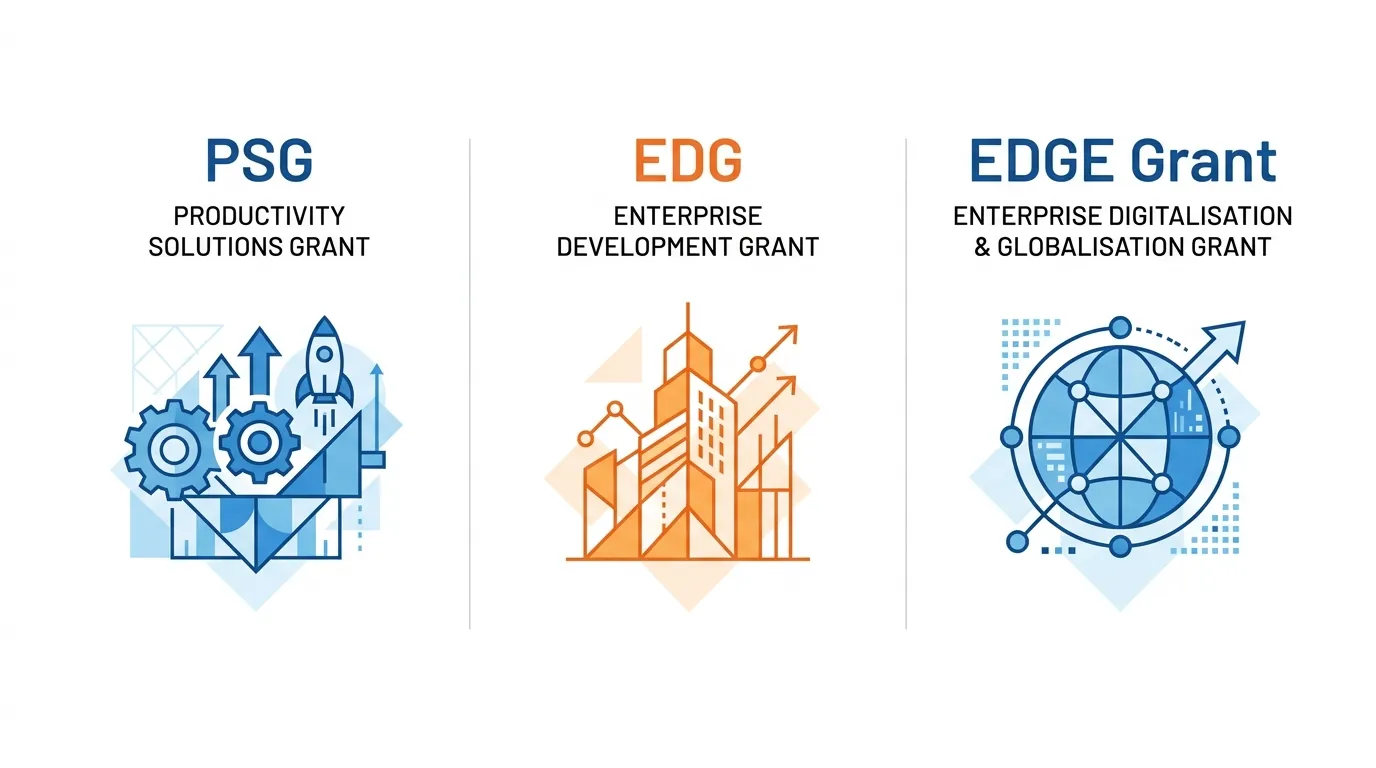
The Productivity Solutions Grant (PSG) supports Singapore businesses in adopting pre-approved IT solutions and services, including digital marketing. Funding support is up to 50% of qualifying costs, capped at S$30,000 per year. Services must be delivered by pre-approved vendors listed on the GoBusiness portal.
The Enterprise Development Grant (EDG) supports capability development more broadly, including marketing strategy and digital capability building, at up to 50% of qualifying project costs for SMEs.
Both grants are currently accessible via the Business Grants Portal.
The EDGE Grant: Launching H2 2026
Senior Minister of State for Trade and Industry Low Yen Ling announced the consolidation of PSG, EDG, and the Market Readiness Assistance (MRA) into EDGE during the Ministry of Trade and Industry’s Committee of Supply debate on 2 March 2026.
Key features of EDGE:
- Single application covering capability development, digitalisation, and internationalisation
- Open to all Singapore-registered businesses, not just SMEs
- Up to S$100,000 per year in support
- Continued emphasis on AI and digital solutions
- Increased internationalisation support: up to 70% for SMEs venturing overseas
Until EDGE launches, PSG, EDG, and MRA remain fully accessible. Approved applications under existing grants will be honoured through the transition.
One rule that does not change under any of these schemes: You must apply and receive approval before signing contracts or making payments to a vendor. This is the most common grant-related mistake I see. A business decides on an agency, signs a contract, and then discovers they were eligible for a grant they can no longer claim because they committed the funds first.
If you are evaluating a social media agency and grant funding may apply, check GoBusiness for pre-approved vendors and apply through the Business Grants Portal before finalising any agreement.
How to Choose the Right Social Media Marketing Agency
Choosing a social media marketing agency is one of those decisions that looks straightforward until you are sitting across the table from five agencies with polished decks, similar pricing, and equally confident claims about what they can deliver.
The difference between a good choice and a costly one rarely comes down to budget. It comes down to how clearly you have defined what you need, how well you can read the signals in front of you, and whether you are asking the right questions before anything is signed.
I have seen the best social media marketing agencies in Singapore choose the most expensive agency and get very little. I have seen others work with a lean boutique team and build their most productive lead-generation channel in 2 years. The variable was never the fee. It was the fit between commercial objective, agency capability, and the quality of the working relationship from day one.
What follows is the framework I use when advising businesses on this decision:
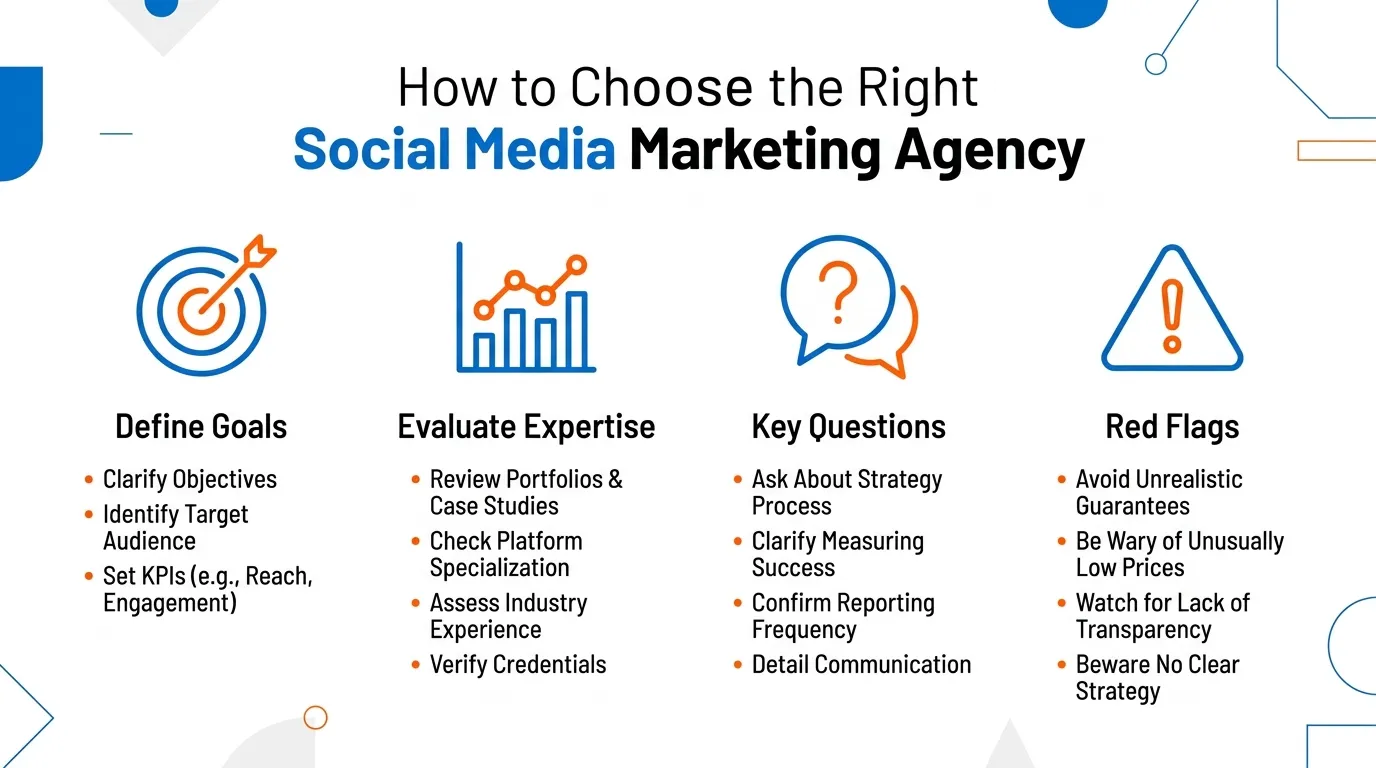
Define Your Business Goals First
Before approaching any agency, get specific about what you actually need. Brand awareness, qualified leads through LinkedIn, Instagram conversion for an eCommerce line, and TikTok growth ahead of a product launch all require different platforms, content formats, and success metrics.
An agency that cannot engage you specifically on commercial objectives and instead defaults to packages and platform mentions is not ready to advise strategically. Strategy begins before the proposal, not after.
Evaluate Expertise and Case Studies Properly
Ask for case studies with measurable outcomes, ideally in your sector. Ask about the thinking behind the work. Anyone can cherry-pick a good month. What you want to understand is whether they have a coherent strategic framework or are producing content and hoping something connects.
Look for case studies that reference cost per lead, conversion rate, ROAS, and revenue influenced. Reach and impressions matter when they support a commercial outcome. They are not a substitute for one.
Questions to Ask Before You Sign
Use these before committing to any agency:
- How do you define a successful campaign for a business like mine?
- Which platforms do you specialise in, and can you show platform-specific results?
- Are paid and organic social managed by different team members?
- Who will be my day-to-day account contact? Is this the same person who pitched me?
- What is your reporting cadence, and what does the report actually show?
- Do I own my ad accounts, or do they sit on your agency accounts?
- How do you handle underperformance mid-retainer?
- Can you show me raw data, not just a formatted dashboard?
- What does your onboarding process look like, and how long before we go live?
The answers to these questions reveal more about an agency’s operational quality than any case study presentation.
Red Flags to Watch for When Evaluating a Social Media Agency
I have seen these patterns often enough that I keep a list. Each one is a signal worth taking seriously.
- They lead with follower count as the primary KPI. Followers are a metric. Business outcomes are the goal. These are not the same thing.
- They cannot showcase studies with real numbers. If the agency avoids sharing actual performance data, it is usually because there is none worth sharing.
- They promise guaranteed results or viral content. Experienced agencies know that performance is influenced by too many variables for anyone to guarantee specific outcomes. Guarantees are a sales technique, not a strategy.
- Their proposal is identical to the one they pitch every other client. Social media strategy should be built around your audience, your market, and your commercial goal. If it reads like a template, it probably is one.
- They resist giving you ownership of your own ad accounts. Your data and your account access should be yours at all times. Any agency that insists on housing your campaigns inside their own account is creating dependency, not value.
- Reports show only vanity metrics with no interpretation. Reach, impressions, and follower growth with no commentary on what it means for your business is data entry, not strategy.
- They are slow to respond before you are even a client. The speed and quality of communication before you sign are reliable indicators of what comes after.
- They cannot clearly tell you who does the actual work. Some agencies sell senior expertise and deliver through junior staff or subcontractors. Ask directly who will be doing the day-to-day work on your account.
Assessing Communication and Support
A good agency does not wait for you to chase them. They communicate proactively. They flag problems before they become crises. They bring strategy to monthly reviews rather than just recapping the previous month’s numbers.
Ask about the reporting cadence, account ownership structure, and what happens if your main contact leaves the agency. These operational questions matter as much as the creative portfolio.
How Long Before Social Media Marketing Produces Results?
This is one of the most searched questions in this space, and one of the least honestly answered. Here are realistic timelines based on what I’ve actually observed:
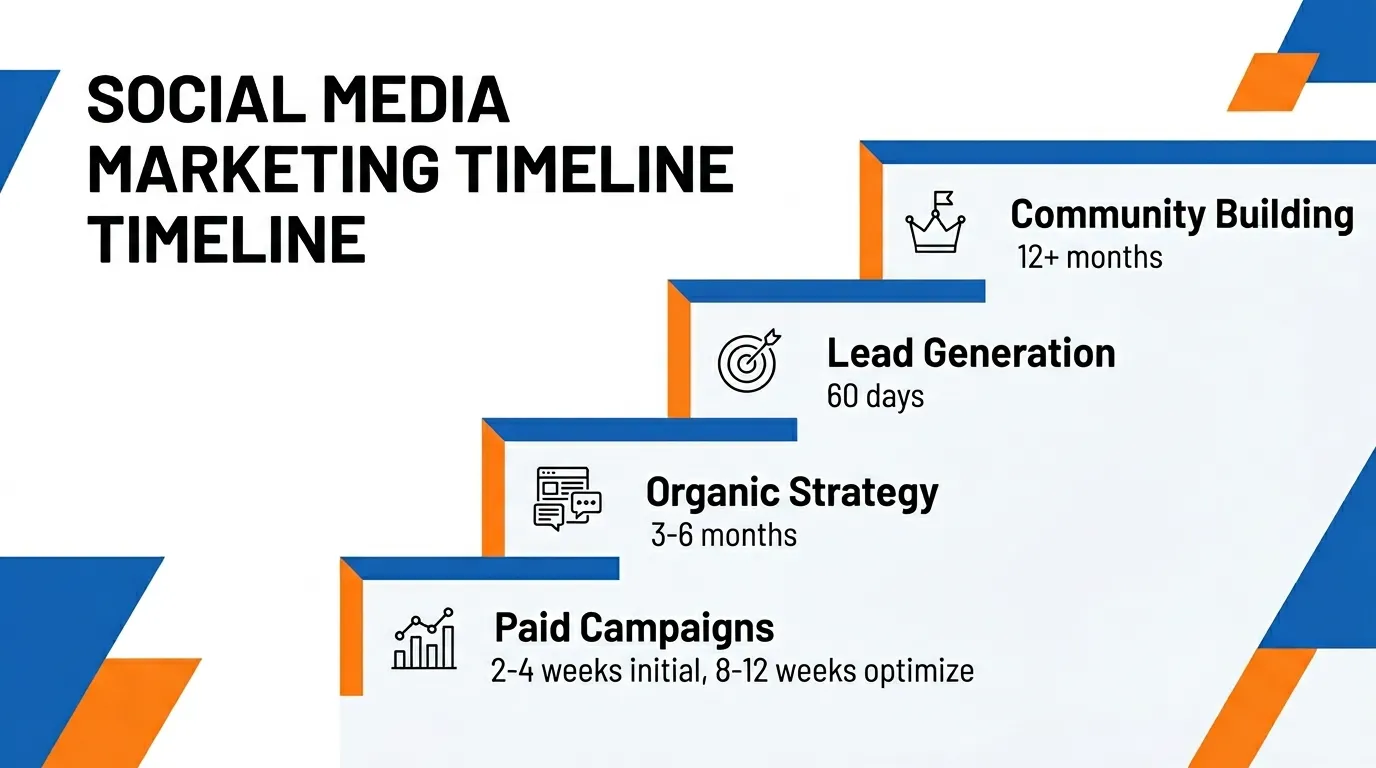
- Paid campaigns: Initial data emerges within two to four weeks of launch, but meaningful optimisation requires eight to twelve weeks of campaign data. A month is rarely enough time to draw conclusions about paid performance.
- Organic content strategy: Three to six months before you see meaningful traction in reach, engagement, and organic follower growth. Six to twelve months for compounding effects, where content starts working together as a body of work rather than individual posts.
- Lead generation through social: Highly dependent on your offer, your funnel depth, and your audience targeting. Most campaigns need at least sixty days of data before performance conclusions should be drawn. Anyone promising significant lead volume in the first thirty days is overselling.
- Community building and brand equity: This is a twelve-month-plus investment. Social media’s most durable returns come from sustained, consistent presence, not campaign bursts.
The businesses that get the best results from social media are almost always the ones that treat it as a medium- to long-term investment with clear quarterly KPIs, rather than a short-term campaign channel. Expectations set properly at the start of an agency relationship are the most effective tool for measuring whether it is working.
Practical Guide to Onboarding a Social Media Marketing Agency
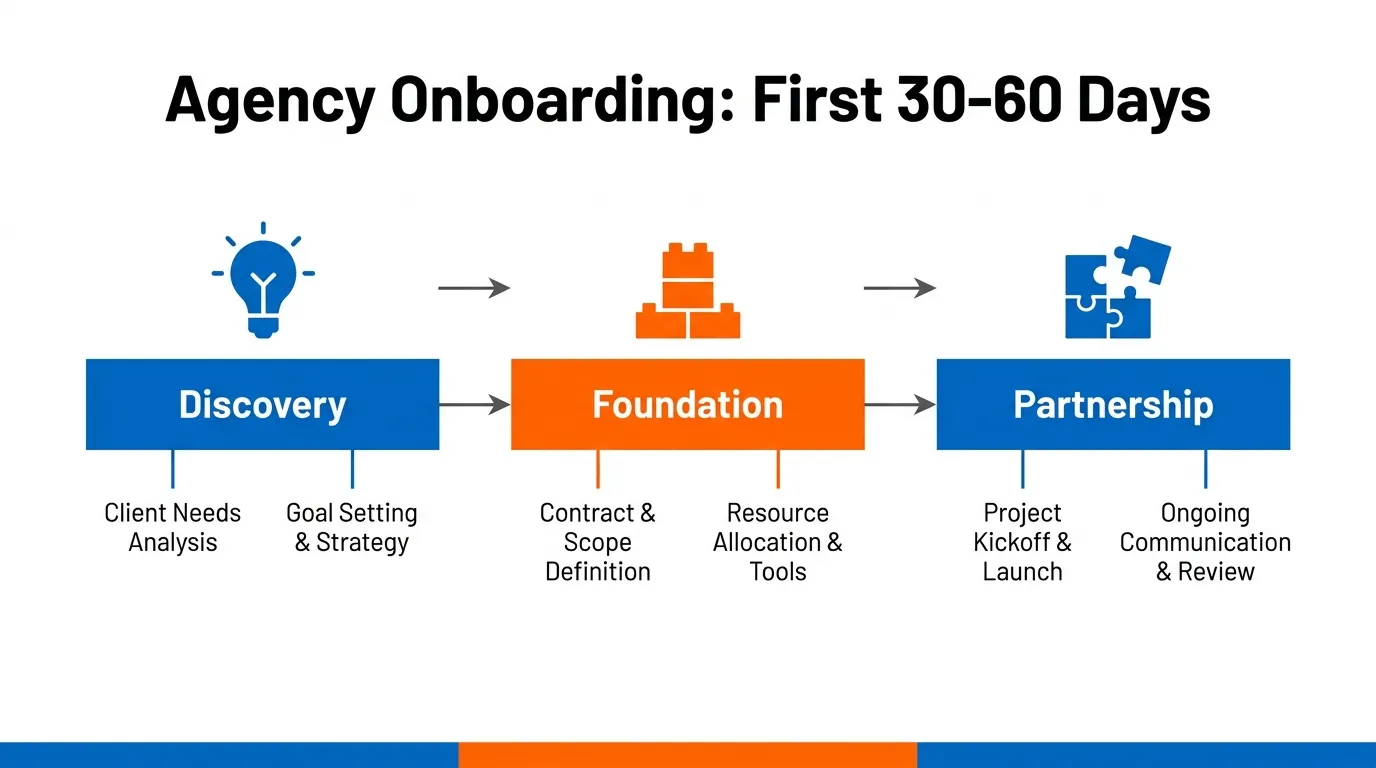
Signing the contract is the easy part. What happens in the first 30 to 60 days of an agency relationship usually determines whether the next 12 months produce real results or quiet frustration.
Most engagements that go wrong do not fail because the agency lacks talent. They fail because the onboarding phase was rushed, expectations were left vague, and neither side took the time to build the operational foundation the relationship needed.
I have seen businesses skip the setup work entirely in their eagerness to get content live, and spend the following six months managing a misalignment that was entirely avoidable.
A well-structured onboarding sets the brief, aligns on commercial objectives, establishes the reporting framework, and clarifies the working relationship before a single post goes out. Done properly, it is not an administrative overhead. It is the single highest-leverage investment you make in the entire engagement. Here is what that process should look like.
Initial Consultation Process
A well-run initial meeting should feel like a diagnostic, not a presentation. The agency should ask about your business model, current customers, competitive landscape, existing content performance, and what has already been tried.
Come prepared with:
- Analytics access for existing platforms
- Your commercial objectives for the next twelve months
- A clear budget range (be specific, not vague)
- Examples of content or campaigns you admire, and ones you want to avoid
Setting Clear Expectations
Before anything goes live, agree in writing on:
- Monthly deliverables and content volumes
- Platform focus and posting frequency
- KPIs and measurement framework
- Reporting format, content, and cadence
- Approval workflows and turnaround times
- What happens if performance targets are not met
This is not bureaucracy. It is the foundation of a professional relationship. The engagements I see perform best are almost always those in which both sides invested seriously in the setup phase.
Maintaining Effective Collaboration
The best agency relationships function as partnerships, not supplier arrangements. The client shares the business context. The agency shares data and insight. Both sides contribute to strategic decisions.
Keep approval chains short. Give feedback promptly. Share the commercial context proactively. Agencies perform better when they understand what is happening in your business, not just on your platforms.
Does Your Industry Affect What You Pay?
The short answer is yes, meaningfully.
- F&B and retail: Instagram and TikTok are the primary channels. Content is visual and production-intensive. Expect higher content-creation costs than strategy fees. Paid spend is often lower per campaign but higher in frequency.
- Professional services (legal, financial, healthcare): Compliance-aware content is not optional in these sectors. Advertising guidelines from MAS, MOH, and CPE place real constraints on what can be said and how. Agencies with sector experience charge more, but the cost of non-compliance is significantly higher than the premium.
- B2B and SaaS: LinkedIn is the primary platform for driving revenue. Higher CPMs are the norm. Content strategy is more thought-leadership oriented and has a longer sales cycle. Expect to invest more per lead but see higher-quality leads.
- eCommerce: Meta and TikTok are the core platforms, with retargeting via Facebook Pixel central to conversion performance. Attribution and tracking setup require proper technical attention from day one.
- Renovation and home services: Local targeting on Facebook and Instagram, combined with Google My Business optimisation, tends to produce the strongest results. Agencies that understand both social and local search dynamics are worth the premium in this sector.
Trends Shaping Social Media Marketing Costs in 2026
The social media landscape has shifted considerably in the past two years, and some of those shifts have a direct bearing on what agencies charge and what your budget needs to cover.
A few of these changes work in your favour. Others add complexity and cost if you are not paying attention. Either way, understanding them helps you ask better questions when evaluating agencies and make smarter decisions about where your budget goes.
- AI content tools have changed the economics of content production. Agencies that integrate AI into their workflows can produce more output at a lower unit cost. That efficiency does not always reduce client fees, but it should translate to faster turnarounds, higher content volume, or better testing capacity.
- Short-form video is now standard, not premium. If your agency is not producing reels, TikToks, or YouTube Shorts as a core deliverable, ask why. In 2026, a social media strategy without short-form video is incomplete.
- Social commerce is accelerating in Singapore. Consumers discover on TikTok, validate on Instagram, and convert on brand websites or via WhatsApp. Agencies that understand this journey and build content to support each stage, rather than treating platforms in isolation, deliver materially better returns.
- GEO and AEO (Generative Engine Optimisation and Answer Engine Optimisation) are beginning to intersect with social strategy as AI-driven search surfaces social content more directly. The boundary between social media and SEO is blurring for well-structured, commercially relevant content. Forward-thinking agencies are starting to factor this into content planning.
- Privacy and tracking changes continue to affect paid social measurement. Server-side tracking and modelled conversions have become the industry standard following the deprecation of cookies. If your agency is still relying solely on pixel-based tracking without a server-side setup, your reporting is likely underattributing conversions.
What You Need to Know About Social Media Marketing Agency Pricing
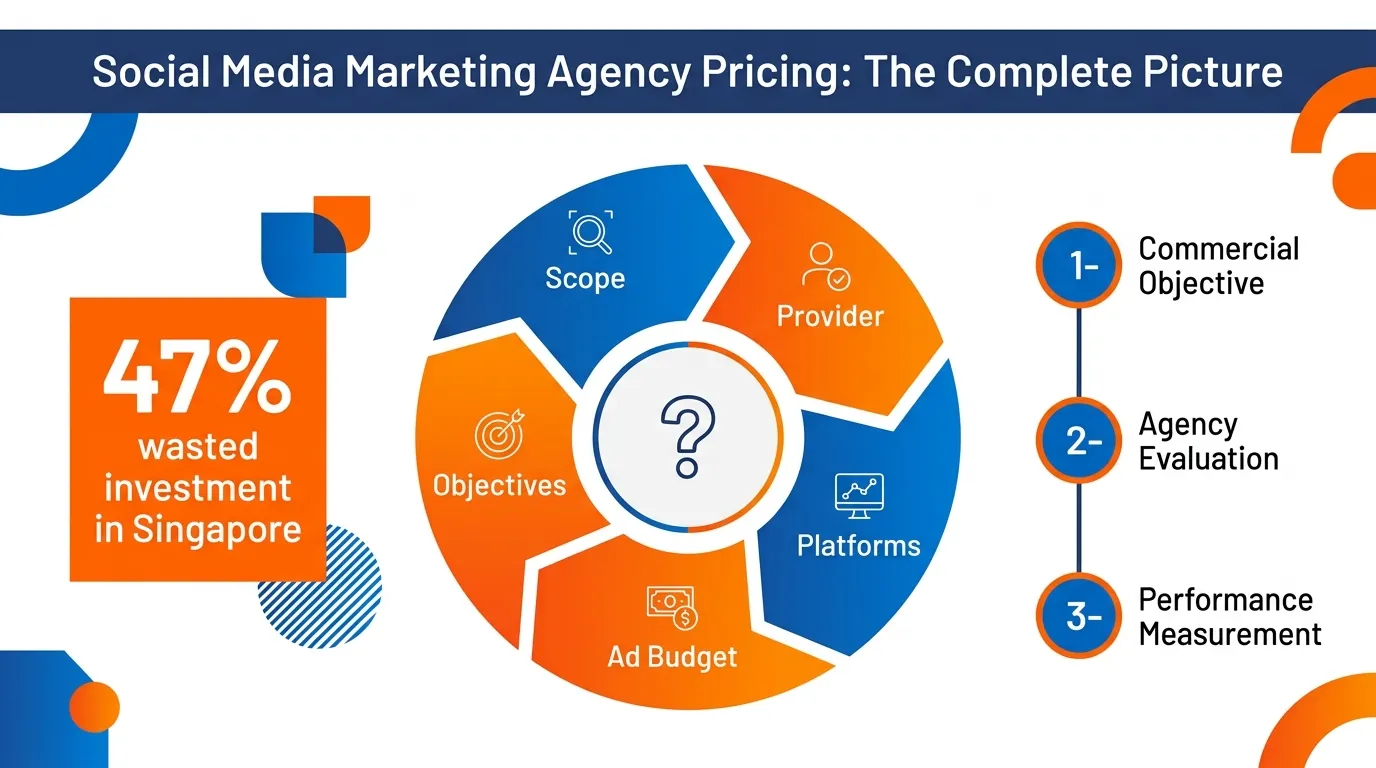
Social media marketing agency pricing in Singapore is not a single number. It is the sum of your scope, your provider type, your platform choices, your ad spend, and most critically, the clarity of your commercial objectives before any of it begins.
The businesses I have seen get lasting value from social media are not the ones that found the cheapest option. They are the ones who understood what they were buying, held their agencies to commercial outcomes, and gave the investment enough time and resource to compound.
Nearly half of Singapore’s businesses have paid for social media marketing that did not contribute to their business goals. That is not a coincidence. It is the result of buying activity that is not anchored to strategy, measurement, or accountability.
If you are making this decision for the first time or reconsidering how your current social media investment is performing, start with your commercial objective. Build the brief around it. Evaluate agencies against it. Measure performance by it.
For a more strategic conversation about how social media marketing fits into a broader digital growth approach, MediaOne is one of the teams in Singapore with the experience to help you think it through properly.
Frequently Asked Questions
It depends on what you are trying to achieve. At S$1,500 per month in management fees, you are in the mid-tier range, which typically covers strategy, content planning, basic design, and scheduling across two or three platforms. What it does not include is a meaningful ad spend budget, which needs to sit on top of that figure. For brand awareness on a single platform with a modest organic focus, S$1,500 can be enough. For lead generation, plan for a combined total of S$3,000-S$5,000 per month, including ad spend.
Most Singapore SMEs pay between S$1,500 and S$5,000 per month for full social media management, including strategy, content, and reporting. Small businesses with basic needs can start from S$500 per month. Enterprise brands with multi-market requirements may invest S$10,000 to S$20,000 or more monthly. These figures do not include paid advertising budgets, which are separate.
Ask the agency to link their work to commercial outcomes. Can they show cost per lead, conversion rate, or revenue influenced by their campaigns? If their reporting covers only reach, impressions, and follower growth with no connection to business results, the value is difficult to justify. Before signing, ask for case studies with specific numbers from clients in comparable sectors.
Do I need to pay for ad spend in addition to the agency fee?
Yes, always. Management fees cover the agency’s time, strategy, and execution. Ad spend is a separate budget paid directly to the platform (Meta, TikTok, LinkedIn, Google). For most Singapore SMEs running paid campaigns, budget at least S$1,000 to S$2,000 per month in ad spend, in addition to your management fee. Running paid campaigns on less than S$500 per month rarely produces enough data to optimise meaningfully.
Paid campaigns produce initial data within two to four weeks, but require eight to twelve weeks for meaningful optimisation. Organic content strategy takes three to six months to gain traction and six to twelve months for compounding results. Lead generation through social media depends heavily on the offer, funnel depth, and targeting, but 60 days is a reasonable minimum before drawing performance conclusions. Anyone promising significant results within the first month is overstating what the early phase of any social media programme can reliably deliver.