If you run an eCommerce business, your payment gateway quietly decides whether your operation feels smooth or stressful. You can have traffic, demand, and a solid product, yet still choke cash flow if payouts lag, disputes pile up, or fees creep into margins unnoticed. That is why Shopline Payments deserves more scrutiny than most merchants give it.

Shopline has carved out a strong position across Singapore and wider Asia by offering an all-in-one commerce stack. Payments are a critical part of that promise. Shopline Payments is positioned as the default, native option that removes friction at checkout and simplifies backend operations.
This guide is written for you if you are launching a new Shopline store, scaling a DTC brand, or actively comparing platforms and payment setups. We will focus on how Shopline Payments works in practice, how fees and payouts affect your cash position, how chargebacks are handled, and where merchants are often caught off guard.
This is not a feature list. It is a decision guide. By the end, you should know exactly what to verify before relying on Shopline Payments for revenue collection.
Key Takeaways:
- Shopline Payments offers native integration that simplifies checkout, reporting, and operations, but it requires merchants to clearly understand fees, payout timing, and risk exposure before relying on it fully.
- Fees, settlement cycles, and chargeback handling directly affect cash flow and margins, making payment setup a strategic business decision rather than a technical detail.
- Payout timing and account reviews can vary based on risk profile, transaction volume, and compliance status, which means merchants must plan liquidity carefully.
- Chargebacks are a normal part of eCommerce, and merchants need defined internal processes to manage disputes efficiently and protect revenue.
What Is Shopline Payments?

Shopline Payments is the platform’s native payment solution, designed to sit directly inside the Shopline merchant backend rather than operate as a standalone third-party gateway. Conceptually, this matters because native payments reduce handoffs between systems. Fewer handoffs usually mean fewer reconciliation issues and faster operational decisions.
Unlike external gateways such as Stripe or PayPal, Shopline Payments is built to work tightly with Shopline’s order management, refunds, and reporting interfaces. Your payment data, order status, and settlement tracking live in one place.
Typical use cases include:
- Direct-to-consumer brands selling primarily in Singapore and nearby markets
- Merchants prioritising speed to launch over deep payment customisation
- Operators who want fewer vendor relationships to manage
The appeal is obvious. Native payments often reduce setup complexity, speed up checkout, and simplify support workflows. According to Baymard Institute’s checkout usability research, reducing friction at payment selection directly improves conversion rates, especially on mobile devices.
What Shopline Payments offers in return for that simplicity is control. That trade-off is where most strategic decisions sit.
How Shopline Payments Works: From Checkout to Settlement
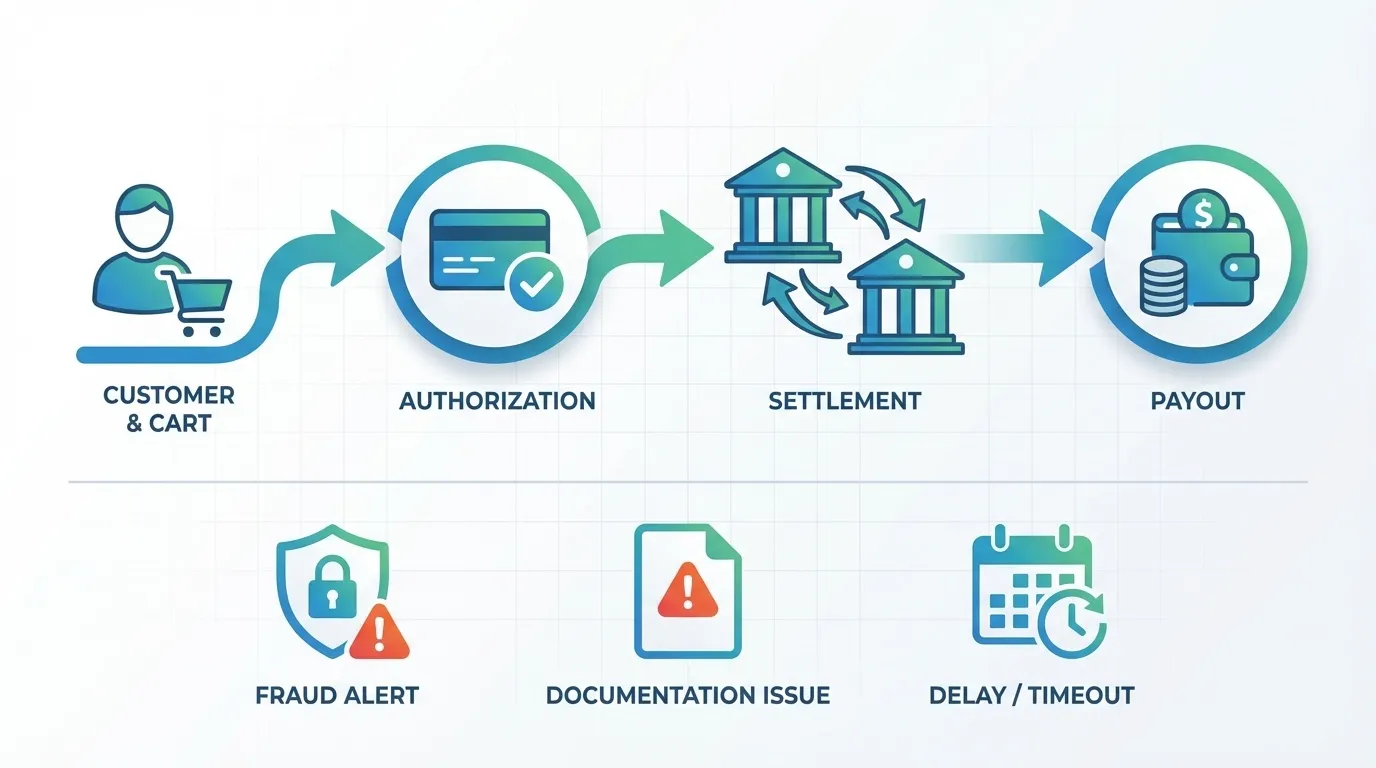
To manage cash flow confidently, you need to understand how funds flow through Shopline Payments. Not in theory, but in sequence. Payments are not a single action. They are a multi-step process with dependencies at each stage, and those dependencies determine when funds become usable in your business.
Below is the complete flow, from the moment a customer clicks “Pay” to the point where funds arrive in your bank account.
Step 1: Checkout and Payment Authorisation
The payment journey begins at checkout. Your customer selects a supported payment method and authorises the transaction.
At this stage, several parties are involved behind the scenes:
- The card network, such as Visa or Mastercard
- The issuing bank that holds the customer’s funds
- The payment processor operating behind Shopline Payments
The key outcome of this step is authorisation, not settlement. The issuing bank confirms that the customer has sufficient funds and that the transaction meets basic risk criteria. No money has moved yet. The amount is simply reserved.
Why this matters: Authorisation reduces the risk of payment failures later, but it does not guarantee that you will be paid.
Step 2: Order Capture and Payment Confirmation
Once authorisation is successful, the order is captured in your Shopline admin.
At this point:
- The order status updates to reflect a successful payment authorisation
- Inventory is adjusted according to your store configuration
- The transaction enters the settlement queue
This step is where many merchants assume payment is complete. It is not. Funds are still with the customer’s bank.
Why this matters: An authorised and captured order can still be delayed or reversed before settlement if risk checks fail or verification issues arise.
Step 3: Risk and Fraud Checks
Before settlement proceeds, transactions pass through automated risk and fraud screening.
These checks may be triggered by:
- Unusual transaction amounts
- Sudden spikes in order volume
- Mismatches between billing, shipping, or device data
Most transactions pass through without issue. However, flagged transactions may be delayed or reviewed.
Why this matters: Risk checks protect your business from chargebacks, but they can temporarily hold funds, especially during sales campaigns or sudden traffic surges.
Step 4: Settlement Processing
After risk checks are cleared, settlement begins. Funds move through the following path:
- From the customer’s issuing bank
- To the acquiring bank
- Through the payment processor
- Into your Shopline merchant balance
This process is not instant. It operates on banking schedules and batch processing cycles.
Why this matters: Settlement timing determines when funds become available for payout. It is influenced by banking cut-off times and processing windows.
Step 5: Payout to Your Bank Account
The final step is payout. Funds are transferred from your merchant balance to your linked bank account. Payout timing depends on:
- Your Shopline Payments payout schedule
- Bank processing times
- Weekends and public holidays in Singapore
Once the payout is completed, funds are fully available for use.
Why this matters: Cash that has not reached your bank account is still cash in transit. You cannot deploy it for marketing, inventory reorders, or payroll.
Where Delays Commonly Occur
Understanding the flow makes it easier to anticipate delays. The most common causes include:
- Fraud or risk checks triggered by transaction patterns
- Incomplete or pending business verification
- Banking cut-off times, especially around weekends and Singapore public holidays
These are structural delays, not system failures.
Why This Payment Flow Matters Operationally
Predictable settlement underpins operational planning. When you understand where funds sit in the process, you can plan marketing spend, inventory purchases, and staffing with greater confidence.
Shopline Payments does not remove the complexity of payment processing. It makes that complexity visible and manageable. The businesses that benefit most are those that understand the flow, plan for timing dependencies, and build financial buffers accordingly.
Shopline Payments Fees Explained: What Merchants Pay and Why
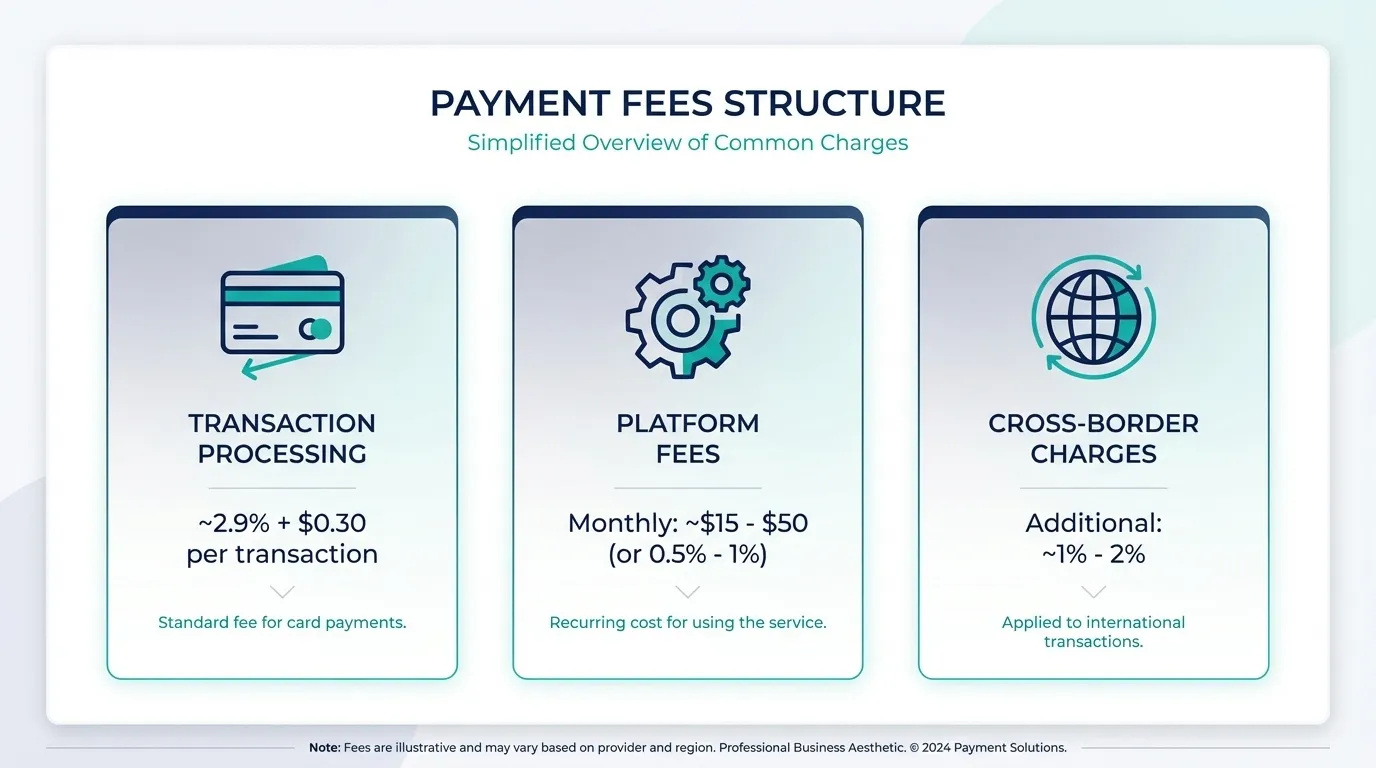
Payment fees are rarely a single line item. They represent a bundle of costs associated with infrastructure, risk management, and regulatory compliance. Understanding these fees is critical for merchants, as they directly impact profit margins, pricing strategies, and campaign performance.
Components of Shopline Payments Fees
Most payment gateways, including Shopline Payments, group fees into several categories:
- Transaction processing costs: Fees charged by card networks and banks for authorising and settling payments. These cover the technical infrastructure that enables funds to move securely from the customer to the merchant.
- Platform or service fees: Costs tied to the commerce provider, covering maintenance, support, and integration of the payment system.
- Cross-border and currency conversion charges: Applied when payments are made in a foreign currency or processed outside the merchant’s home country. These include foreign exchange spreads and additional fees from international card networks.
Domestic vs Cross-Border Payments
- Domestic Singapore transactions (SGD): Costs are typically lower due to fewer intermediaries.
- Cross-border transactions: Additional costs include currency conversion fees, international network fees, and compliance-related charges.
Why Understanding Fees Matters
Fee structures have a direct impact on pricing and profitability:
- Even a 1 per cent variance in payment costs can erase margins, especially on promotions or discounted campaigns.
- High fees may require adjustments to product pricing, shipping charges, or marketing budgets.
- Merchants should account for cross-border and high-volume transactions when forecasting revenue.
By understanding the breakdown of Shopline Payments fees, merchants can make informed decisions about pricing, promotions, and payment options, ensuring they maintain healthy margins while offering a seamless checkout experience.
Payout Times and Settlement Cycles: When Do Merchants Get Paid?
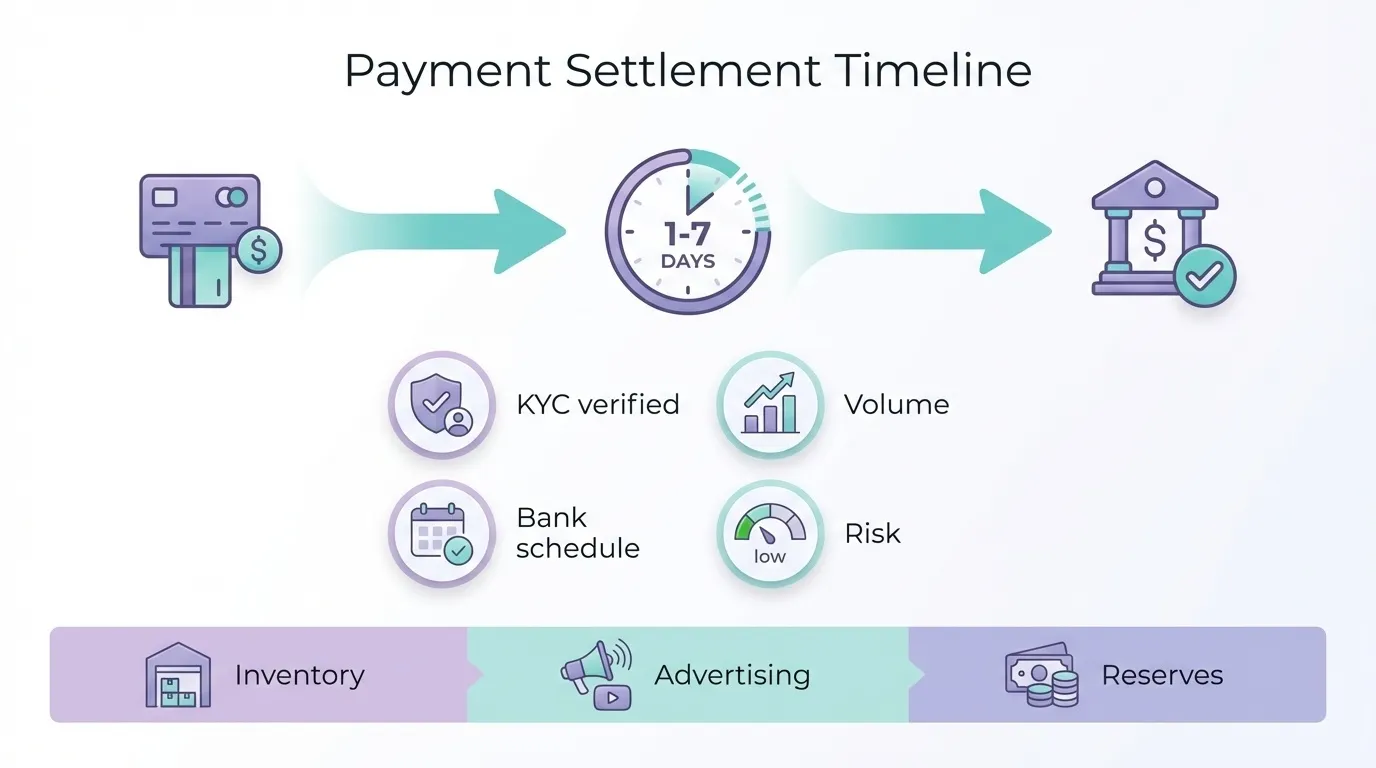
Payout timing is a crucial aspect of running any business. The delay between a successful transaction and funds reaching your bank account determines how much working capital you actually have available to operate efficiently. Understanding the factors that influence payout speed helps merchants plan cash flow, inventory, and marketing spend effectively.
Factors That Influence Payout Speed
Several variables affect how quickly payouts are processed across payment processors:
- Rolling settlement cycles: Most processors use cycles ranging from one to seven business days, depending on the merchant’s risk profile and location.
- Business verification and KYC checks: Initial verification can delay early settlements, particularly for new merchants.
- Transaction volume and volatility: Sudden spikes in transaction volume may trigger additional risk reviews, delaying payouts.
- Local banking schedules: Cut-off times, weekends, and public holidays regulated by the Monetary Authority of Singapore (MAS) affect when payouts are processed.
Being aware of these factors helps merchants set realistic expectations for cash inflows and prevents surprises that can disrupt operations.
First Payouts and Risk Baselines
- Initial payouts are typically slower as payment processors establish a risk baseline for new merchants.
- Once a stable transaction history is built, settlement cycles become more consistent and predictable.
Understanding that first payouts may take longer allows merchants to plan initial cash flow carefully and avoid early liquidity issues.
Operational Implications of Payout Timing
Delayed access to funds has several practical impacts on daily business operations:
- Inventory management: Slower cash inflows can delay restocking or inventory replenishment decisions.
- Marketing campaigns: Spending on platforms like Meta and Google depends on predictable cash availability.
- Cash buffers: Maintaining sufficient reserves helps absorb refunds, chargebacks, or dispute-related holds without disrupting daily operations.
By factoring in payout times and settlement cycles, merchants can forecast cash flow more accurately, plan expenditures with confidence, and prevent liquidity gaps that could quietly hinder growth.
Chargebacks and Disputes: How Shopline Payments Handles Them
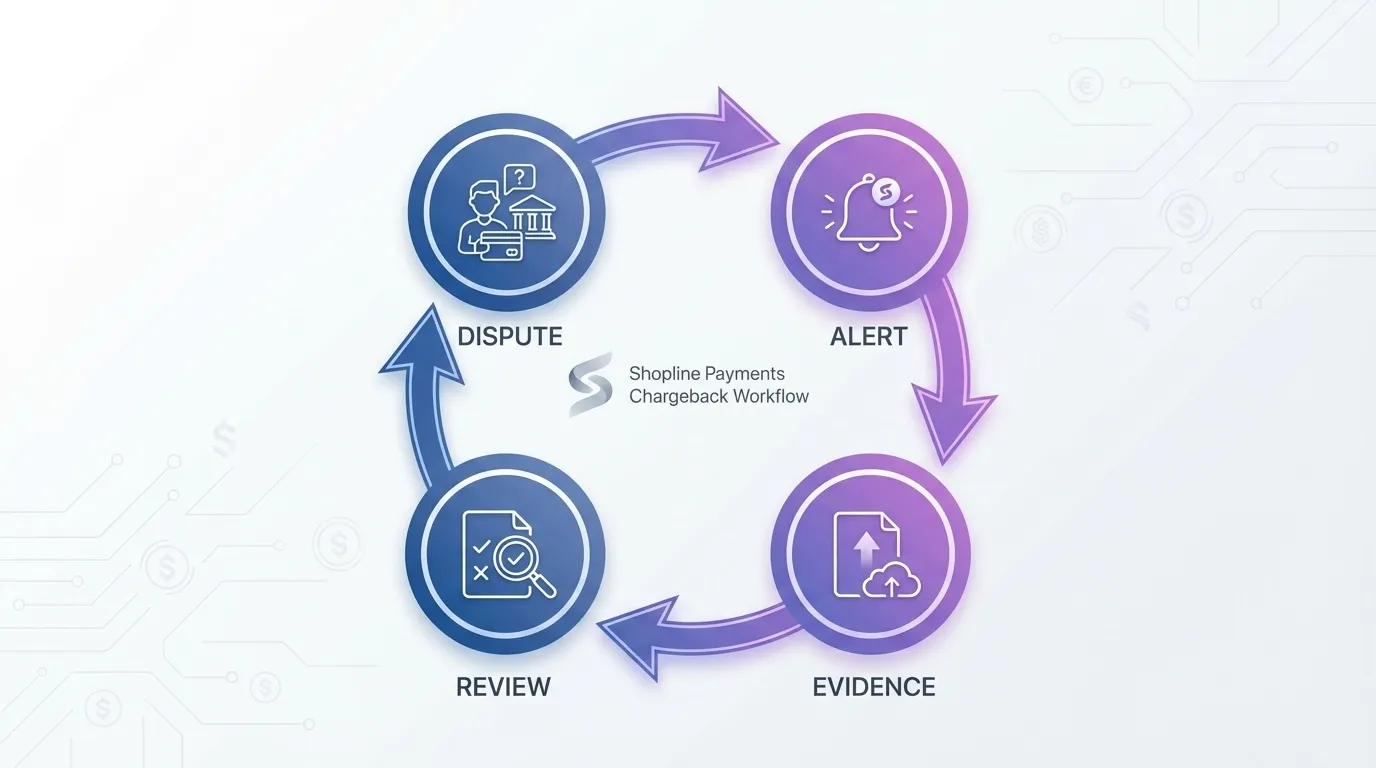
Chargebacks affect more than a single transaction. They influence cash flow stability, operational workload, and long-term account risk. For merchants using Shopline Payments, understanding how disputes work is essential for protecting revenue and reducing unnecessary disruption.
How a Chargeback Happens
A chargeback follows a defined process that usually starts with the customer’s bank, not the merchant.
- A customer disputes a transaction with their issuing bank for reasons such as fraud, unrecognised charges, or dissatisfaction with fulfilment.
- Once the dispute is raised, the merchant is notified and must submit supporting evidence within a specified timeframe. This usually includes:
- Proof of delivery
- Transaction records
- Customer communications
- The issuing bank reviews the case and makes a final decision.
- If the dispute is lost, the transaction amount is reversed, and a dispute fee is typically applied.
This process makes every dispute a time-sensitive case that requires proper documentation and prompt action by the merchant.

The Broader Risk of Chargebacks
The impact of chargebacks goes beyond the value of a single order.
- Card networks monitor chargeback ratios closely.
- Merchants that exceed accepted thresholds may be:
- Placed under monitoring programmes
- Subject to additional scrutiny
- Faced with account restrictions or limitations
- A consistently high dispute rate can signal a higher risk to payment providers and card networks.
Even if individual disputes seem small, their cumulative effect can threaten account stability and payment processing privileges.
The Hidden Operational Costs
The real cost of chargebacks is not only financial. It is also operational.
- Each dispute consumes staff time to gather documents and prepare responses.
- Funds can be tied up or delayed, creating cash flow uncertainty.
- Repeated disputes increase administrative overhead and reduce team efficiency.
Over time, disputes quietly drain resources and introduce uncertainty into day-to-day operations, even when the amounts involved are not large.

Why Understanding Shopline Payments Dispute Handling Matters
Knowing how Shopline Payments handles disputes helps merchants prepare and reduce risk.
- You can organise documentation in advance to respond faster and more effectively.
- You can identify weak points in fulfilment, communication, or policies that trigger disputes.
- You can build internal processes that reduce both financial losses and operational disruption.
By understanding the dispute process and preparing for it, merchants can protect cash flow, reduce risk exposure, and keep operations running more smoothly.
What to Watch Out For: Risks, Limitations, and Operational Considerations
Native payment systems streamline checkout and reduce integration overhead, but they also concentrate responsibility within a single ecosystem. Understanding where risks sit, what limitations exist, and how operations are affected helps you avoid surprises as transaction volume grows.
Risks: Where Payment Friction Can Appear
Centralised payment systems apply automated risk controls to protect merchants and customers. These controls are necessary, but they can introduce temporary friction.
Common risk-related issues to monitor include:
- Temporary fund holds triggered by automated risk or fraud reviews
- Transaction delays during sudden spikes in order volume, such as flash sales or promotional campaigns
- Increased scrutiny for high-value or cross-border transactions
High-volume merchants are more likely to be subject to these checks. Rapid growth or unusual purchasing patterns often trigger automated reviews across most payment processors, not just Shopline Payments.
These reviews are standard, but they can delay access to funds at critical moments.
Limitations: Where Flexibility May Be Constrained
Native payment systems are designed for simplicity, not maximum configurability. That trade-off is important to understand.
Potential limitations include:
- Reliance on a single payment gateway without advanced routing or fallback options
- Limited flexibility in handling edge cases, such as partial settlements or complex payout structures
- Dependence on platform-supported payment methods rather than bespoke integrations
For businesses operating in multiple markets, this can be restrictive. International selling introduces additional variables, including local payment method preferences, currency settlement rules, and regulatory compliance requirements.
A single gateway may not support every market equally.
Operational Considerations: Planning for Scale and Stability
Operational impact is often felt before strategic impact. Payment behaviour influences day-to-day decision-making. Key operational factors to plan for include:
- Refund processing times, especially during peak sales periods
- Ongoing verification updates as your business scales or changes structure
- Cash flow buffers to absorb payout delays, refunds, or disputes
As your business grows, payment operations require more deliberate oversight. What works at low volume can strain under scale if processes are not revisited regularly.
Questions to Ask Before Committing
Before relying on a native payment system long-term, assess your tolerance for risk and constraints:
- Can your business tolerate delayed payouts during peak sales periods?
- Do you require advanced routing or fallback gateways for resilience?
- How exposed is your revenue model to chargeback volatility or refund spikes?
Clear answers to these questions help you decide whether a native payment system aligns with your growth trajectory or whether supplementary payment strategies are needed.
Shopline Payments vs External Payment Gateways: Strategic Trade-Offs
When merchants compare payment options, the conversation usually starts with features like supported cards, local payment methods, and setup time. That is the wrong starting point.
The real decision is about control. Specifically, how much operational, financial, and risk control you want as your business grows.
Using Shopline Payments means committing to a tightly integrated payment layer that works seamlessly within the Shopline ecosystem. External payment gateways sit outside that ecosystem and trade convenience for flexibility.
Before looking at scenarios, it helps to frame the trade-offs clearly.
A side-by-side view of the strategic differences
The table below simplifies the comparison, but each row has deeper implications for how you run your business.
| Factor | Shopline Pay | External Payment Gateway |
| Setup speed | Faster | Slower |
| Operational simplicity | Higher | Lower |
| Customisation | Limited | Extensive |
| Risk diversification | Lower | Higher |
This is not about which option is “better.” It is about which option fits your current operating model and which you will need tomorrow.
Where Shopline Payments Has the Advantage
If your priority is speed and focus, native payments are hard to beat. Shopline Payments is already wired into your checkout, order management, refunds, and reporting. That tight integration reduces friction at launch and lowers the chance of human error in day-to-day operations.
For many Singapore-based merchants, especially those running lean teams, this simplicity matters more than advanced controls. You spend less time reconciling payouts across systems, training staff on multiple dashboards, or chasing support across vendors. When something breaks, there is one place to look.
Shopline Pay also tends to work well when:
- Your sales are primarily domestic or regional
- Your transaction patterns are predictable
- You value speed to market over payment experimentation
At early and mid-growth stages, this setup keeps operational overhead low and decision-making fast.
Where External Gateways Start to Matter
External payment gateways introduce complexity, but that complexity buys you optionality. With providers such as Stripe or PayPal, you gain greater control over payment routing, risk rules, and international expansion strategies.
This becomes relevant when your business expands beyond a single market or sales channel. Cross-border selling, marketplace models, subscription billing, or high-ticket transactions often benefit from advanced configuration options that native gateways do not prioritise.
External gateways also reduce single-point-of-failure risk. If one provider experiences delays, reviews, or outages, your entire revenue stream is not locked behind a single system.
External gateways are often the better fit when:
- You sell across multiple currencies and regions
- Your transaction volume fluctuates significantly during campaigns
- You need granular fraud or risk controls
- You want negotiation leverage on fees and payout terms
The trade-off is operational overhead. More tools mean more processes, more reconciliation, and more internal discipline.
Why a Hybrid Setup is Often the Most Resilient Choice
Once revenue stabilises, many experienced operators move away from all-or-nothing decisions. A hybrid setup allows you to keep Shopline Payments as the primary gateway while adding an external provider as a fallback or specialist option.
This approach spreads operational risk without overwhelming your team. If one gateway is under review, experiencing payout delays, or struggling with a specific payment method, you have an alternative path to keep revenue flowing.
A hybrid setup also gives you leverage. You are no longer locked into a single provider’s terms, timelines, or risk decisions. That leverage becomes increasingly valuable as transaction volume grows.
Practical Checklist Before You Enable Shopline Payments
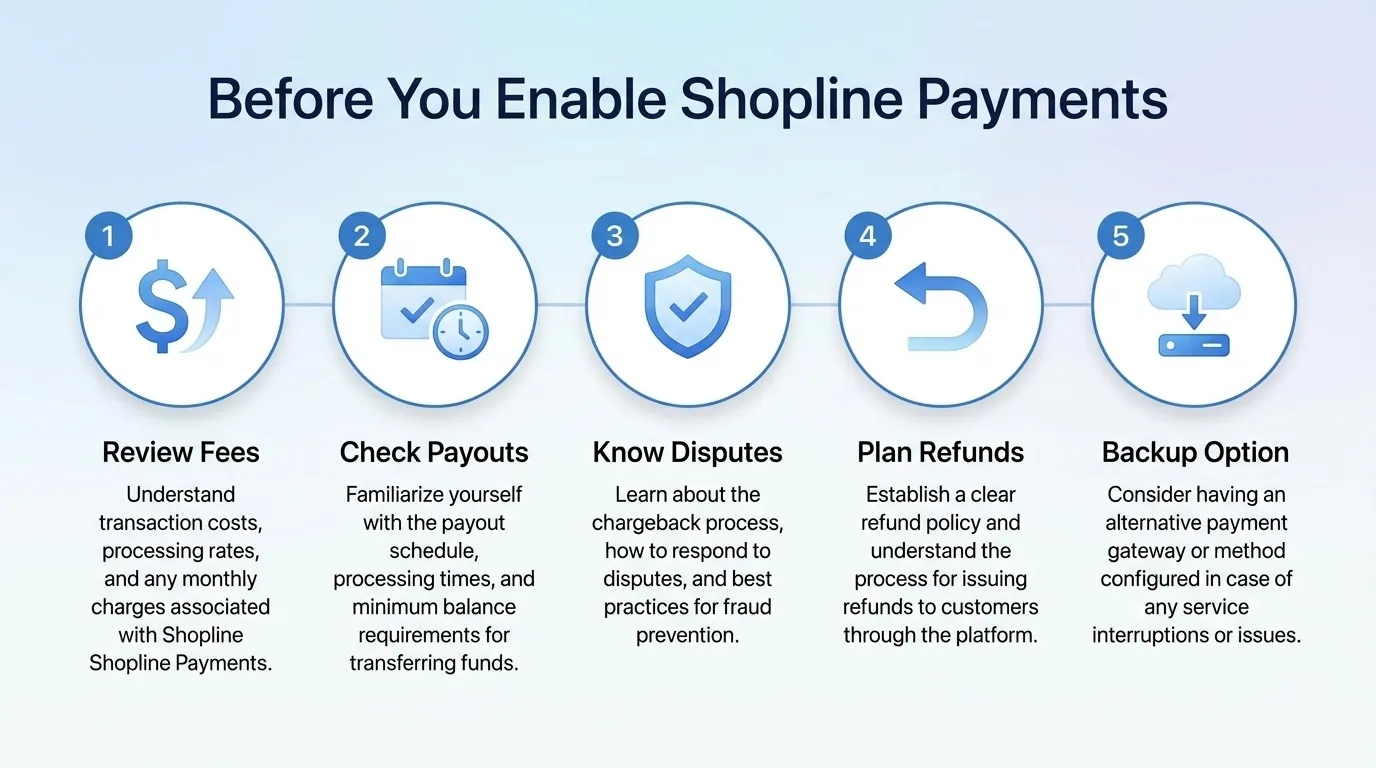
Before you enable Shopline Payments and start routing revenue through it, pause and treat this as a commercial decision, not a technical toggle. Payment setups affect cash flow, risk exposure, and the level of operational control you retain as you scale.
The checklist below is designed to help you validate the fundamentals before money starts moving:
Step 1: Review Your Fee Structure Inside the Merchant Dashboard
Start with fees, because small percentages compound quickly once volume increases. Shopline does not publish a single universal pricing table publicly, so your merchant dashboard is the source of truth.
You should confirm:
- Transaction fees by payment method
- Whether rates differ for local SGD transactions versus cross-border payments
- Any additional charges tied to refunds or disputes
- Currency conversion handling and FX margins, if you sell outside Singapore
Do not assume your fees will match another merchant’s experience. Payment pricing is often influenced by region, risk profile, and business category. If anything is unclear, document it and raise it with Shopline support before going live.
Step 2: Confirm Payout Timing and Bank Requirements
Payout speed directly affects working capital. Even a short delay can matter if you are running paid media campaigns or managing tight inventory cycles. Check the following:
- Expected payout cycle once transactions are settled
- Whether weekends and Singapore public holidays affect transfers
- Bank account requirements, including supported banks and account name matching
Also, pay attention to howthe first payouts are handled. Initial settlements are often slower across the payments industry due to risk checks. Planning for this avoids unnecessary cash pressure in your first few weeks.
Step 3: Understand Dispute and Chargeback Response Rules
Chargebacks are not optional work. They are part of operating online, especially at scale. Before enabling payments, make sure you understand:
- How are we notified when a dispute is opened
- The evidence submission window and required documentation
- Who on your team is responsible for responding
Set up internal processes early. Keep order confirmations, delivery proofs, and customer communication logs organised from day one. This discipline saves time and reduces losses when disputes inevitably arise.
Step 4: Map Out Refund and Customer Support Workflows
Refunds are not just a financial issue. They are a customer experience issue. Clarify:
- How refunds are initiated within the Shopline backend
- How long do refunded funds typically take to reach customers
- How does refund timing align with your stated policies on your website
Your support team should be aligned with finance, so customers receive consistent answers. Mismatched expectations around refunds are a common trigger for disputes.
Step 5: Decide If You Need a Backup Payment Option
Relying on a single payment provider concentrates risk. Reviews, temporary holds, or technical issues can affect any processor, including native solutions.
Ask yourself:
- Can your business tolerate delayed payouts during peak sales periods
- Do you sell across multiple regions with different payment preferences
- Would a secondary gateway improve resilience without adding too much complexity
Many growing merchants on Shopline start with native payments, then add an external gateway as volume and complexity increase. That progression is normal and often sensible.
Treat this checklist as a control mechanism, not red tape. A well-planned payment setup gives you predictability, leverage, and confidence as revenue grows. Skipping these steps usually feels fine at launch and painful later.
Is Shopline Payments the Right Choice for Your Store?
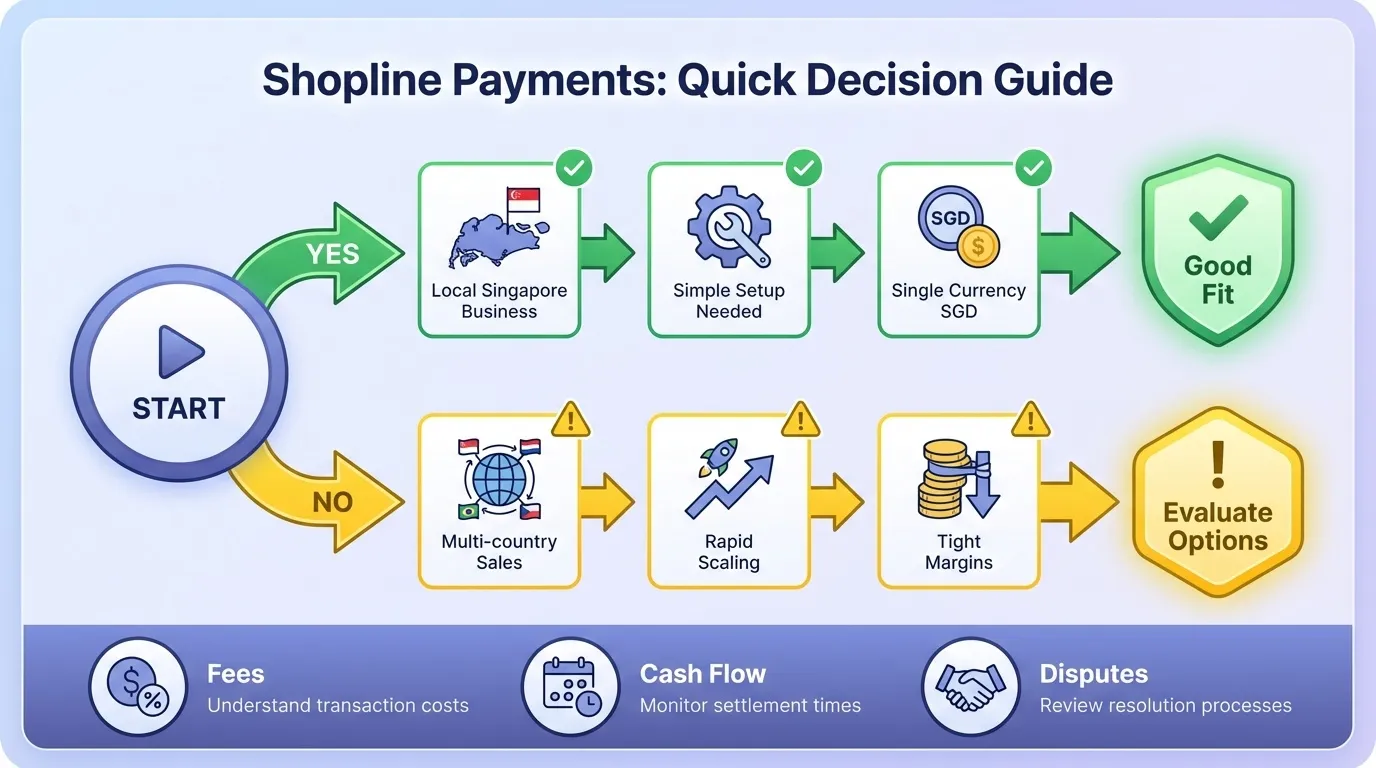
Shopline Payments can be a strong fit if your priority is speed, simplicity, and tight integration with the Shopline ecosystem. For many Singapore-based merchants, especially those in early growth or operating primarily in SGD, a native payment solution reduces setup friction and keeps daily operations manageable.
That said, the right choice depends on how you run your business, not just the tools available. If you are scaling quickly, selling across borders, or operating with thin margins, payment decisions become strategic. Fees affect pricing power. Payout timing affects cash flow. Dispute handling affects both revenue and team bandwidth.

These are not details to figure out after launch. They should align with your growth model and risk tolerance. This is where working with an experienced digital partner matters. MediaOne helps merchants evaluate not just whether Shopline Payments works, but whether it works for you.
From payment setup to conversion optimisation and growth strategy, the goal is to build an eCommerce operation that scales cleanly and sustainably. If you want clarity and confidence before committing fully to Shopline Payments, MediaOne can help you get there. All you need to do is call us today.
Frequently Asked Questions
Is Shopline Payments mandatory for Shopline merchants?
No. Shopline merchants can usually integrate external payment gateways, depending on their region, business category, and subscription plan. Shopline Payments is positioned as a native option, not a compulsory one. You should always confirm which gateways are supported inside your merchant dashboard before finalising your payment setup.
How long do Shopline Payments payouts take in Singapore?
Payout timing varies based on factors such as your verification status, transaction volume, and local banking schedules. In the wider payments industry, settlement typically takes several business days after a transaction is captured. Your first payouts may take longer than later ones due to initial risk checks. Always verify your specific payout cycle directly in your Shopline account.
Does Shopline Payments support cross-border payments?
Yes, Shopline Payments supports cross-border transactions, allowing you to sell beyond Singapore. However, international payments often come with different fees, currency conversion costs, and settlement timelines. These differences can affect margins and cash flow as you scale. Reviewing FX rates and cross-border charges before expanding is essential.
What happens if my Shopline Payments account is reviewed?
If your account is flagged for review, funds may be temporarily held while risk assessments are completed. This process is standard across payment processors and is often triggered by sudden volume changes or unusual transaction patterns. Reviews can affect payout timing, so merchants should plan for a short-term cash-flow disruption. Clear documentation and responsive communication can help speed up resolution.
Should I use more than one payment gateway?
Many growing merchants choose to use multiple payment gateways to reduce operational risk. A secondary provider can act as a fallback during reviews, technical issues, or payout delays. This approach also provides flexibility when expanding into new markets with different payment preferences. The trade-off is additional setup and reconciliation work, which should be weighed carefully.