

For large Singapore ecommerce stores, category pages are where organic revenue is won or lost. Most retailers focus on product page optimisation or keyword targeting, but in scalable catalogues, the real growth lever sits one level higher.

SEO ecommerce category pages capture mid to high commercial intent, accumulate the strongest internal link equity, and determine how efficiently search engines crawl and index your store.
As inventories expand, complexity increases. Filters generate thousands of parameter combinations. Pagination deepens crawl paths. Variants create duplicate URLs. Seasonal stock changes introduce ranking volatility.
Without structural control, search engines waste crawl budget on low-value URLs while high-revenue categories compete against their own duplicates. The SEO strategy for ecommerce category pages is therefore not just about content optimisation. It is about indexation governance.
This blueprint outlines the architectural framework required to scale large catalogues predictably. From crawl budget control and canonical patterns to pagination strategy, lifecycle rules, and sitemap governance, this guide focuses on a single objective: ensuring that only commercially valuable category URLs accrue authority and rank.
If your store has plateaued despite publishing more products and expanding inventory, the issue is likely structural rather than competitive. This master guide explains how to fix it. For more information, check out our ecommerce SEO guide.
Key Takeaways
- SEO ecommerce category pages strategy is fundamentally about indexation control, not just on-page optimisation. Ranking stability depends on governing which URLs are allowed to exist in the index.
- Crawl budget efficiency directly impacts ranking velocity for large Singapore catalogues. When bots waste time on low-value parameter URLs, important category and product pages are crawled less frequently, slowing growth.
- Canonical patterns must control parameter traps, faceted filters, and duplicate paths. Clear consolidation ensures that authority flows to a single primary category URL rather than fragmenting across variations.
What Are Ecommerce Category Pages?

In the architecture of an online store, ecommerce category pages (often called “Listing Pages” or “Collections”) act as the high-traffic intersections between your homepage and individual products.
Think of them as the digital equivalent of an aisle in a physical Singaporean department store like Takashimaya or Mustafa Centre.
Instead of focusing on a single SKU, a category page groups related products together, such as “Ergonomic Office Chairs,” “OLED TVs,” or “Skincare Serums”, allowing users to browse, compare, and filter their options.
The Anatomy of a Category Page
From a technical SEO perspective, a well-optimised category page is not just a grid of images; it is a sophisticated data aggregator that includes:
- H1 Headers: Defining the broad topic (e.g., Men’s Running Shoes).
- Product Grids: A dynamic list of product snippets, prices, and ratings.
- Faceted Navigation: Filters (size, colour, brand, price) that help users narrow their search.
- Introductory/Footer Content: Strategic text that provides context to search engines and value to shoppers.
Why They Differ from Product Pages
While a Product Detail Page (PDP) targets specific, “long-tail” queries (e.g., Sony WH-1000XM5 Black), a category page targets “middle-of-funnel” keywords. These are users who know what they want to buy but haven’t decided on the specific model yet.
For large-scale retailers, SEO ecommerce category pages are often the most powerful asset because they inherit the most internal link authority and have the highest potential to rank for high-volume search terms that drive massive organic sessions.
- H1 Structure: Defines the broad commercial topic clearly and aligns with the target search intent.
- Product Grid: Dynamic listing of SKUs, often paginated and filtered via parameters.
- Faceted Navigation: Filters such as brand, price, size, colour, and rating. These generate parameterised URLs and are one of the biggest technical risks in the SEO ecommerce category pages.
- Strategic Intro or Footer Content: Provides semantic context to search engines while supporting commercial relevance. This must remain concise and avoid diluting transactional intent.
Why Category Pages Differ from Product Pages
Product detail pages target highly specific long-tail queries. Category pages target commercial comparison intent. Users know what they want, but they have not chosen the exact model.
For example:
- Product page: Sony WH-1000XM5 Black
- Category page: Wireless Noise Cancelling Headphones
From an authority perspective, category pages:
- Accumulate more internal links
- Pass equity to products
- Capture broader search demand
- Stabilise rankings for competitive head terms
This is why SEO for ecommerce category pages determines the scalability ceiling for large Singapore stores.
The SEO Ecommerce Category Pages Store Indexation Control Framework

Scaling SEO ecommerce category pages for large Singapore stores requires more than keyword optimisation or content tweaks. It requires architectural discipline.
As catalogues expand, complexity increases. Filters multiply. Variants generate duplicate paths. Pagination deepens crawl depth. Seasonal inventory changes introduce lifecycle volatility. Without a structured indexation system, search engines inefficiently crawl, index, and rank.
The Store Indexation Control Framework is a governance model designed to:
- Decide which URLs deserve to rank
- Protect crawl budget from parameter waste
- Consolidate duplicate signals
- Preserve authority through pagination
- Maintain ranking stability across stock cycles
Diagram 1: The 5-Layer Indexation Control Pyramid
┌────────────────────────────┐
│ 5. Lifecycle Governance │

│ Redirects / Stock Rules │
└────────────────────────────┘
▲
┌────────────────────────────┐
│ 4. Pagination & Discovery │
│ Crawl Depth / Equity Flow │
└────────────────────────────┘
▲
┌────────────────────────────┐
│ 3. Canonical Consolidation │
│ Duplicate Signal Control │
└────────────────────────────┘
▲
┌────────────────────────────┐
│ 2. Crawl Budget Allocation │
│ Parameter & Bot Control │
└────────────────────────────┘
▲
┌────────────────────────────┐
│1. URL Qualification │
│ Index vs Suppress Decision │
└────────────────────────────┘
How to interpret this pyramid
The framework works from the bottom up.
- If URL qualification fails, the crawl budget is wasted.
- If the crawl budget is wasted, the effectiveness of canonical consolidation weakens.
- If canonical signals conflict, pagination equity fragments.
- If lifecycle rules are inconsistent, authority erodes over time.
SEO ecommerce category pages become predictable only when all five layers operate together.
Diagram 2: Store Indexation Control Flow Map
Homepage
|
▼
Primary Category Pages (Indexable, Self-Canonical)
|
├── Paginated URLs (Crawlable, Controlled)
| |
| └── Product Detail Pages
|
├── Faceted URLs (Canonicalised or Suppressed)
|
└── Internal Search (Blocked / Noindex)
What this demonstrates
- Authority flows from the homepage into primary categories.
- Pagination supports discovery without inflating index bloat.
- Faceted URLs are controlled rather than freely indexed.
- Internal search is prevented from diluting crawl focus.
In large Singapore stores, uncontrolled filter indexing is one of the biggest causes of ranking stagnation.
Diagram 3: Parameter Risk Matrix
| URL Type | Crawlable | Indexable | Canonical Target |
| Base Category | Yes | Yes | Self |
| Pagination | Yes | Yes | Self |
| Sort Parameter | Yes | No | Base Category |
| Faceted Filter | Conditional | Conditional | Base Category |
| Internal Search | No | No | N/A |
This matrix clarifies a crucial principle of SEO ecommerce category pages:
- Not every crawlable URL should be indexable.
- Not every indexable URL should exist.
SEO Ecommerce Category Pages and Crawl Budget Control

In large Singapore catalogues, the SEO ecommerce category page strategy is primarily a crawl-efficiency issue.
Search engines allocate a finite number of crawl resources per domain. If bots spend time crawling sorting parameters, filter combinations, tracking URLs, and internal search results, they crawl high-value category and product pages less frequently. This slows index updates, delays ranking improvements, and fragments authority.
Category pages sit at the centre of internal link equity flow. When the crawl budget is wasted, their ranking potential weakens.
Where Crawl Waste Typically Happens
Most crawl inefficiency comes from:
- Faceted filter combinations
- Sorting parameters
- Tracking parameters and session IDs
- Internal search result pages
- Deep or duplicated taxonomy paths
Faceted navigation is the biggest risk. A small set of filters can generate thousands of URL variations. If left uncontrolled, these combinations consume crawl resources without adding ranking value.
Core Crawl Budget Controls
Effective crawl governance for SEO ecommerce category pages includes:
- Canonicalising parameterised URLs to the primary category
- Blocking low-value parameters where appropriate
- Applying noindex to internal search pages
- Maintaining shallow click depth for key categories
- Keeping XML sitemaps limited to indexable URLs
The principle is straightforward: Not every crawlable URL should be indexable. Not every generated URL should be crawled.
Strategic Outcome
When the crawl budget is controlled:
- Primary category pages are refreshed more frequently
- New products are indexed faster
- Duplicate signals consolidate
- Ranking volatility reduces
For large-scale Singapore stores, crawl budget control is not an optional optimisation. It is the structural foundation that allows SEO ecommerce category pages to scale predictably.
Canonical Patterns in SEO Ecommerce Category Pages
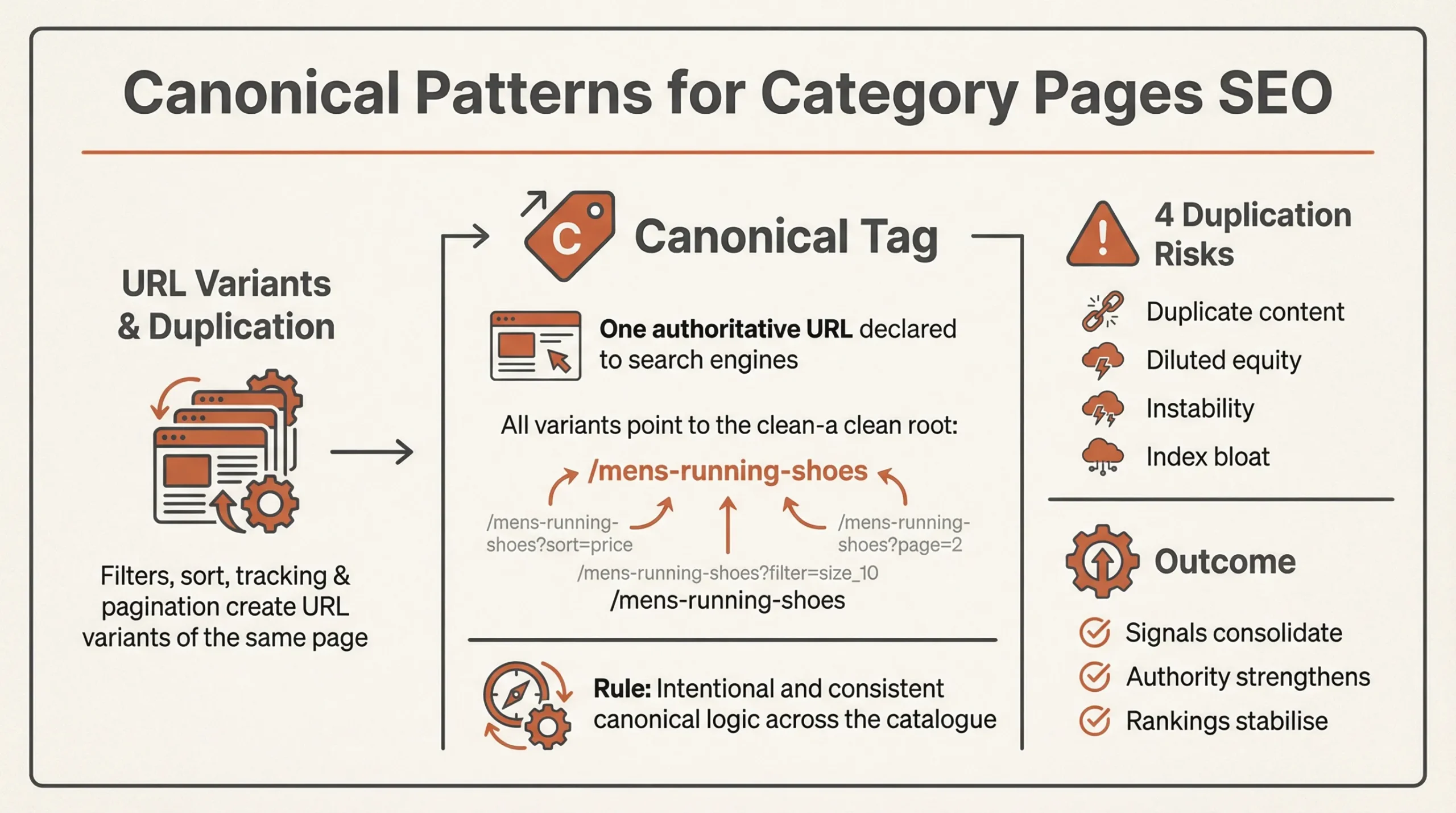
Canonicalisation is the control system that prevents ranking signals from fragmenting across duplicate URLs.
In large catalogues, category pages often exist in multiple variations due to filters, sorting, tracking parameters, pagination, and platform-generated paths. Without disciplined canonical patterns, search engines may treat these variations as separate pages, splitting authority and weakening ranking potential.
For scalable SEO ecommerce category pages, canonical logic must be intentional and consistent.
Why Canonicalisation Matters at Scale
A single category may generate URLs such as:
/mens-running-shoes
/mens-running-shoes?colour=black
/mens-running-shoes?sort=price-asc
/collections/mens-running-shoes
/mens-running-shoes?page=2
If these URLs compete with each other, you create:
- Duplicate content signals
- Diluted link equity
- Ranking instability
- Index bloat
Canonical tags tell search engines which version of the URL is authoritative.
Core Canonical Rules for SEO Ecommerce Category Pages


Canonicalisation determines whether ranking signals consolidate or fragment across duplicate category URLs. The rules below ensure authority flows into a single primary category URL to strengthen SEO performance for ecommerce category pages.
1. Self-Referencing Canonicals for Primary Categories
Every main category page should:
- Be indexable
- Contain a self-referencing canonical tag
- Serve as the consolidation target for non-strategic variations
This anchors authority to one clean URL.
2. Sorting Parameters Must Canonicalise to the Default View
Sorting does not change search intent. Examples:
/mens-running-shoes?sort=price
/mens-running-shoes?sort=popular
These should canonicalise back to:
/mens-running-shoes
Allowing sorted versions to index splits signals an unnecessary condition.
3. Faceted Filters Require Strategic Evaluation
Not all filter combinations are equal. If a filter reflects genuine standalone search demand, such as:
/mens-running-shoes/black
And there is measurable keyword volume for “black men’s running shoes”, this may justify indexation.
However, most multi-filter combinations, such as:
/mens-running-shoes?colour=black&size=9&price=100-200
should canonicalise back to the primary category.
SEO performance of ecommerce category pages fails when every filter variation is allowed to self-canonicalise.
4. Pagination Requires Independent Canonical Logic
Paginated URLs should typically:
- Be crawlable
- Use self-referencing canonicals
- Not canonicalise to page 1
Page 2 contains unique product listings and supports crawl discovery. Canonicalising all pagination to page 1 weakens product discovery and internal equity flow.
5. Tracking and UTM Parameters Must Be Neutralised
URLs containing tracking parameters should always canonicalise to the clean version.
Example:
/mens-running-shoes?utm_source=facebook
Canonical target:
/mens-running-shoes
This ensures marketing campaigns do not create duplicate indexable paths.
The Strategic Objective
The goal of canonical patterns in the SEO ecommerce category pages is consolidation.
When canonical logic is correct:
- Authority flows into one primary category URL
- Duplicate signals are unified
- Crawl efficiency improves
- Ranking stability increases
Canonical tags are not minor technical elements. In large catalogues, they determine whether your category pages build or dilute authority.
Pagination Strategy in SEO Ecommerce Category Pages

Pagination is not a duplication problem. It is a discovery mechanism.
In large Singapore ecommerce catalogues, category pages often contain hundreds or thousands of products. Loading everything on one URL is neither performance-friendly nor user-friendly. Pagination allows scalable product display while preserving crawl structure.
However, incorrect pagination handling is one of the most common architectural errors that undermine the performance of ecommerce category pages.
Why Pagination Matters
Paginated category URLs typically look like:
/mens-running-shoes
/mens-running-shoes?page=2
/mens-running-shoes?page=3
Poor pagination implementation can result in:
- Shallow product indexation
- Orphaned SKUs
- Fragmented internal link equity
- Ranking stagnation
1. Use Crawlable Static URLs
Pagination must generate clean, static URLs that search engines can follow. Avoid JavaScript-only infinite scroll without crawlable fallback URLs.
2. Maintain Self-Referencing Canonicals
Each paginated page should:
- Contain a self-referencing canonical
- Remain indexable
- Not canonicalise to page 1
Pagination is not duplicate content. It represents unique inventory segments.
3. Avoid Blanket Noindex on Page 2 and Beyond
A common misconception is that only page 1 should be indexed. While page 1 usually captures ranking intent, page 2 and onwards:
- Support crawl continuity
- Distribute link equity
- Help surface long-tail SKUs
Blanket noindex can reduce crawl efficiency and limit product discovery.
4. Control Pagination Depth
Very deep pagination creates crawl dilution. Mitigation strategies include:
- Logical product sorting
- Featuring best-selling or high-margin products earlier
- Linking strategically to deeper SKUs
- Limiting unnecessary pagination layers
5. Preserve Internal Link Equity Flow
Category pages act as authority hubs. Pagination ensures that:
- Equity flows sequentially through product listings
- No product becomes orphaned
- Deep inventory remains accessible
Broken pagination chains disrupt authority distribution and harm the performance of SEO and ecommerce category pages.
Out-of-Stock and Lifecycle Rules in SEO Ecommerce Category Pages
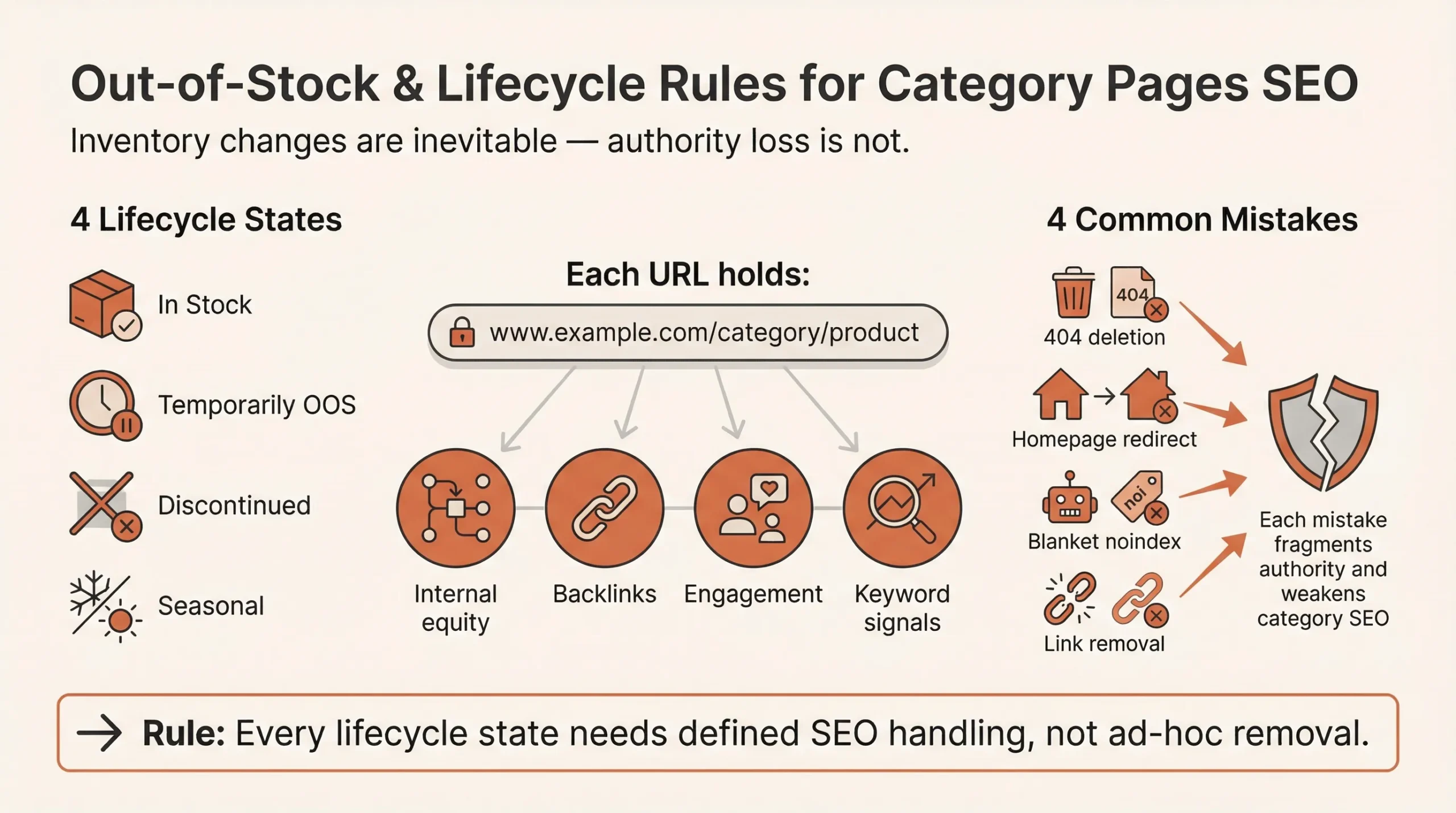
Inventory changes are inevitable. Authority loss is not.
In large Singapore ecommerce catalogues, products constantly move between in stock, temporarily unavailable, discontinued, and seasonal states. Without defined lifecycle rules, ranking equity disappears each time inventory changes.
SEO ecommerce category pages strategy must incorporate lifecycle governance to preserve authority while maintaining a strong user experience.
Why Lifecycle Control Matters
Every indexed product URL accumulates:
- Internal link equity
- External backlinks
- Engagement signals
- Keyword relevance
Common mistakes include:
- Deleting URLs and returning 404
- Redirecting all discontinued products to the homepage
- Applying blanket noindex to out-of-stock pages
- Removing internal links without consolidation
Lifecycle Scenarios and Recommended Actions
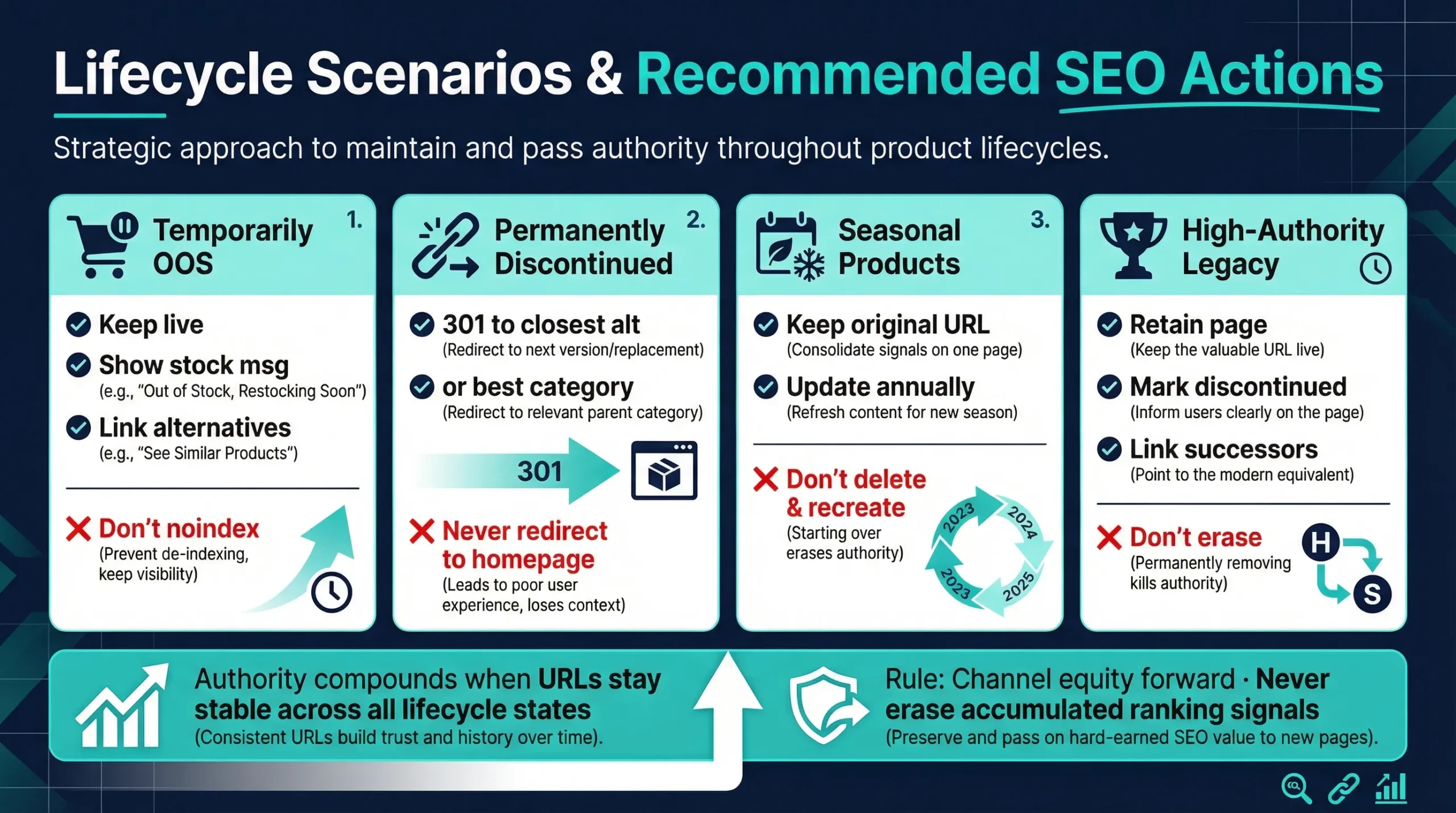
Product inventory constantly shifts between in stock, temporarily unavailable, discontinued, and seasonal states. Without defined lifecycle rules, ranking equity can be lost whenever a product changes status. The scenarios below outline how to preserve authority while maintaining strong e-commerce category pages’ SEO performance:
1. Temporarily Out of Stock
If the product will return:
- Keep the URL live and indexable
- Display clear stock messaging
- Offer back-in-stock notifications
- Link to related or alternative products
Removing or noindexing short-term stockouts disrupts ranking continuity unnecessarily.
2. Permanently Discontinued Products
If the product will not return:
- 301 redirect to the closest relevant alternative
- If no direct replacement exists, redirect to the most relevant category
- Preserve contextual similarity in redirects
Avoid redirecting all discontinued products to the homepage. This weakens topical relevance signals.
3. Seasonal Products
For recurring seasonal items such as festive bundles or annual releases:
- Retain the original URL
- Update content annually
- Refresh structured data
- Maintain internal linking
Do not delete and recreate seasonal URLs each year. Authority compounds when URLs remain stable.
4. High-Authority Legacy Products
Some discontinued products continue attracting backlinks or traffic. In these cases:

- Retain the page
- Mark as discontinued
- Provide structured alternative recommendations
- Preserve internal linking pathways
Authority should be channelled forward, not erased.
Common Mistakes That Undermine SEO Ecommerce Category Pages in Singapore
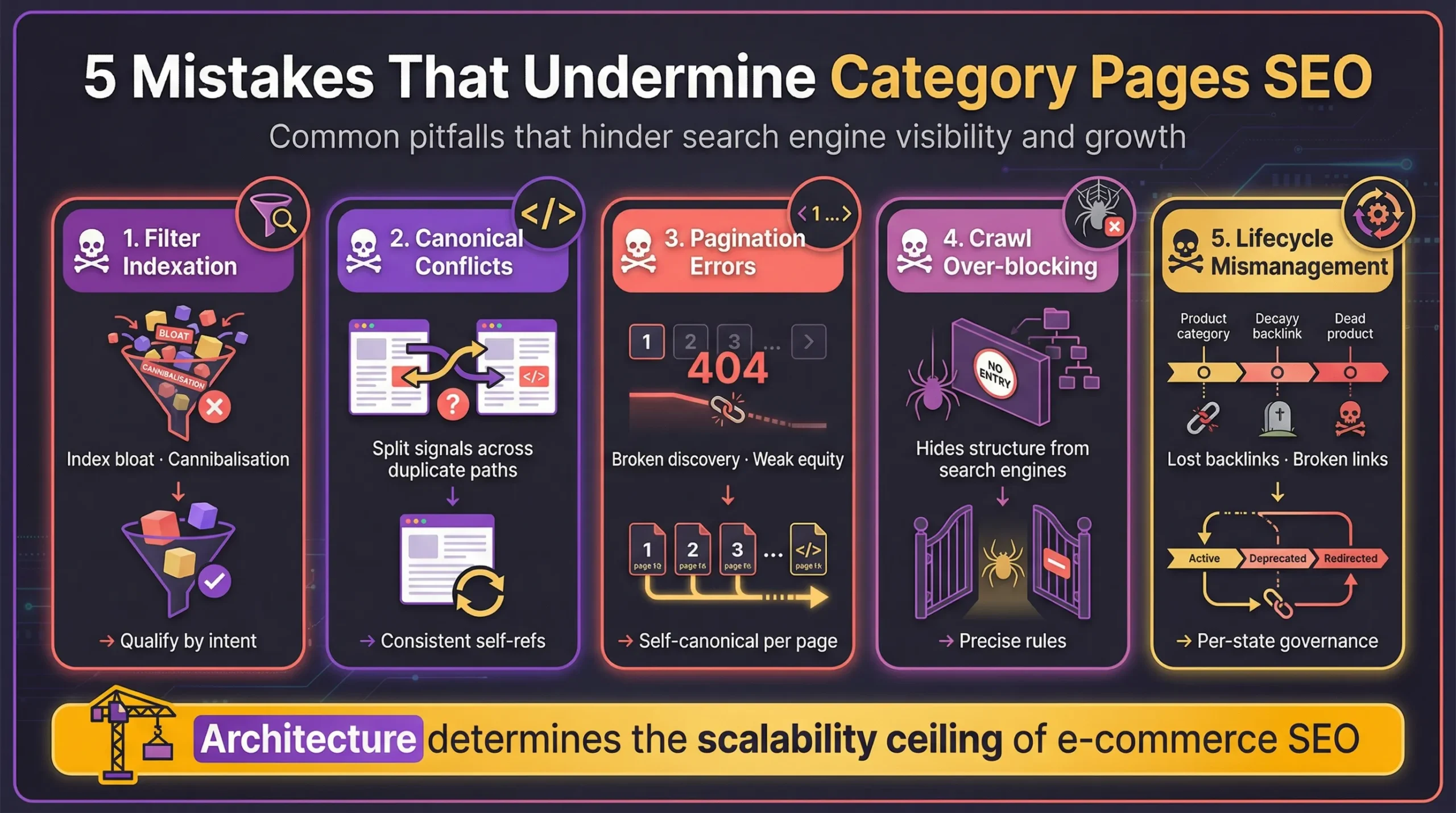
In large Singapore ecommerce catalogues, ranking plateaus are rarely caused by weak keywords. They are usually caused by architectural mistakes.
SEO performance of ecommerce category pages depends on structural discipline. When governance breaks down, authority fragments, crawl efficiency declines, and index bloat increases.
1. Indexing Every Filter Combination
Faceted navigation can generate thousands of URL variations. Allowing every combination to index leads to:
- Duplicate content signals
- Crawl waste
- Authority dilution
- Keyword cannibalisation
2. Canonical Conflicts Across Category Paths
Duplicate category URLs such as:
/mens-shoes
/collections/mens-shoes
/mens-shoes?sort=popular
If canonicals are inconsistent or self-referencing incorrectly, ranking signals are split across variations.
3. Mismanaging Pagination
Common pagination errors include:
- Canonicalising all pages to page 1
- Applying blanket noindex to page 2 onwards
- Breaking internal pagination chains
- Using JavaScript-only infinite scroll without crawlable URLs
4. Blocking Crawling Without Understanding Indexation
Over-aggressive robots.txt rules can block:
- Valuable subcategories
- Paginated pages
- Important product clusters
5. Poor Product Lifecycle Handling
Deleting out-of-stock products without redirects or consolidation results in:
- Lost backlinks
- Authority decay
- Broken internal links
Scaling Predictable Growth with SEO Ecommerce Category Pages
SEO ecommerce category pages are not a surface-level optimisation exercise. It is an architectural discipline.
For large Singapore stores, category pages determine how authority flows, how efficiently search engines crawl, and how consistently revenue-driving keywords rank. When filters generate uncontrolled URL combinations, when canonical signals conflict, or when lifecycle rules erase accumulated equity, growth stalls regardless of how strong your products or content may be.
The stores that scale predictably treat category pages as hubs for indexation control. They qualify which URLs deserve to exist, consolidate duplicate signals, structure pagination correctly, and protect authority through inventory cycles. They align crawl budget with commercial value.
If your organic growth has plateaued despite catalogue expansion, the constraint is likely structural. Fixing crawl governance, canonical patterns, and lifecycle rules often unlocks more ranking stability than adding new keywords ever could.
In enterprise-level ecommerce, the competitive advantage is not who publishes more pages. It is who controls their index more precisely.
If you want a technical audit of your category architecture and crawl structure, explore MediaOne’s ecommerce SEO services and speak with our team about building a scalable, index-controlled SEO framework for your store. Contact us today!
Frequently Asked Questions
Should subcategories rank separately from primary category pages?
Yes, if they represent distinct search intent and meaningful keyword demand. Subcategories such as gaming laptops and business laptops may warrant independent optimisation, while overly granular taxonomies without search volume should be consolidated under the primary category.
Does page speed directly affect SEO ecommerce category pages performance?
Yes. Category pages often contain heavy product grids, filters, and scripts. Poor Core Web Vitals, especially Largest Contentful Paint and Interaction to Next Paint, can reduce crawl efficiency and suppress rankings in competitive Singapore markets.
How should structured data be implemented on category pages?
Category pages should use the ItemList schema to help search engines understand product groupings. Product schema should remain on product detail pages to avoid structured data conflicts or duplication.
Is it beneficial to add user-generated content, such as reviews, to category pages?
Aggregated review summaries can strengthen semantic signals and improve engagement. However, they should not replace transactional clarity. The primary goal of a category page remains product discovery and conversion.
How often should category page content and structure be reviewed?
For large catalogues, technical audits should occur quarterly. Inventory turnover, filter changes, platform updates, and URL restructuring can introduce indexation risks over time. Regular governance prevents silent authority erosion.