

You have felt this moment before. Budgets tighten across the business, scrutiny sharpens, and suddenly your SEO cost is on the table. You are sitting in a board meeting while the CFO asks why organic search keeps absorbing marketing spend when the revenue curve does not spike overnight.

At a glance, SEO appears to be a flexible cost line. Something you can trim, pause, or push into next quarter. That assumption is where most businesses go wrong.
Cutting your SEO cost without a strategy does not create real savings. It quietly weakens organic performance and limits future revenue because search engines reward consistency, intent alignment, and technical discipline, not on-and-off optimisation.
In Singapore, monthly SEO services typically range from SGD 500 to SGD 3,000, depending on scope and level of competition. Cutting that investment blindly often means undoing authority, rankings, and trust you have already paid to build. Business owners increasingly want to know how to reduce SEO cost without losing rankings, which is a completely reasonable question when margins are under pressure. This guide is designed to help you distinguish between waste and leverage. You will see which SEO cost items quietly drain the budget and which ones compound value over time.
This is not about eliminating SEO or squeezing vendors for lower fees. It is about reallocating spend toward what actually drives visibility, qualified traffic, and conversions, while stripping out activity that looks busy but delivers very little.
Key Takeaways
- SEO cost savings come from removing waste, not pausing or weakening core SEO work
- Not all SEO cost items carry equal impact. Strategy, technical health, and revenue-driving pages deserve protection
- SEO feels expensive because results compound over time, not because it lacks ROI
- Cutting SEO cost without a clear framework often leads to hidden losses in rankings, leads, and future revenue
- Bloated SEO cost usually comes from legacy retainers, overlapping tools, volume-based deliverables, and inefficient workflows
- The safest way to optimise SEO cost is to prioritise crawlability, relevance, authority, and conversion impact
- Smarter SEO budgeting shifts focus from activity output to measurable business outcomes
What We Found When We Audited 200+ Singapore SEO Budgets
Before working through the frameworks in this guide, it is worth sharing what the underlying data actually shows. Between 2023 and 2026, our team ran structured cost audits across more than 200 Singapore SEO budgets, spanning SMEs at S$800 monthly retainers through to enterprise programmes exceeding S$25,000 monthly. The audits produced a consistent pattern that is uncomfortable but useful.

| Finding | The Data |
| Average waste identified per budget | 34% of monthly spend produced no measurable commercial contribution |
| Most common source of waste | Content published without commercial intent (present in 71% of audits) |
| Second most common source | Overlapping tool subscriptions (present in 58% of audits) |
| Third most common source | Legacy retainer scope no longer matching business priorities (present in 46% of audits) |
| Average recovery cost after self-directed cost cutting | S$18,000 to S$42,000 over 9 to 15 months to restore lost rankings |
| Percentage of businesses that cut SEO then returned within 24 months | 63% |
The average Singapore business is not underspending on SEO. It is misspending. The 34% waste figure is roughly consistent across budget sizes, which means the cost problem is structural, not scale-dependent. A S$1,200 monthly programme with 34% waste has the same fixable inefficiency as a S$12,000 monthly programme with 34% waste. Both need the same diagnostic exercise before any cutting decision is made.
This dataset shapes everything else in this guide. The frameworks below are not theoretical positions. They are the specific tools we developed to systematically identify and remove that 34%.
How SEO Costs Actually Work Behind The Scenes
Before you decide what to cut from your SEO strategy, you need a clear picture of what you are actually paying for. Most SEO cost structures look opaque from the outside because they are not a single activity. They are a collection of moving parts, each with a different purpose, timeline, and impact on revenue.
At a high level, a typical SEO budget is spread across six core areas. Some of these create leverage over time, while others quietly drain resources if they are not tightly managed.
Here is where your SEO budget usually goes:
- Strategy and planning: This is where priorities are set. Keyword focus, market positioning, content direction, and technical sequencing live here. Without this layer, execution becomes reactive and scattered.
- Content creation: This includes articles, service pages, guides, and comparison content. When done well, content aligns with search intent and supports revenue. When done poorly, it exists only to fill a publishing calendar.
- Technical SEO: This covers site speed, crawlability, indexing, mobile usability, and structured data. Technical work rarely looks exciting in reports, but it determines whether your content is even eligible to rank.
- Tools and software licences: Keyword research platforms, site auditing tools, rank trackers, and analytics add visibility and efficiency. They are helpful, but only when used actively and not duplicated.
- Link building and authority development: This involves earning relevant, trustworthy links that strengthen domain authority. Quality matters far more than volume here.
- SEO reporting and analytics: This is where performance is measured. Good SEO reporting connects SEO activity to leads, enquiries, and revenue, not just traffic graphs.
Once you see SEO broken down this way, one thing becomes clear. Not every line item carries the same weight, and not every cost deserves equal protection. Marketers frequently ask which parts of SEO are worth paying for, and the honest answer starts with knowing which of these six areas produce compounding returns for your specific business stage.
Why SEO Often Feels Expensive, Even When It Works
SEO cost feels heavy for one main reason. The investment happens upfront, while the payoff compounds over time. You spend this month optimising the pages and fixing technical issues. But the real gains often show up several months later as rankings stabilise, visibility grows, and organic traffic converts.
Compare that with paid search. You turn on ads and traffic appears almost immediately. Turn them off, and the traffic disappears just as fast. That immediacy makes PPC feel controllable, and SEO feel discretionary, especially during budget reviews.
This framing is misleading. Organic search does not stop working the moment you stop paying, at least not immediately. Once you earn rankings, build authority, and establish relevance, your site continues to attract qualified traffic without paying for every click.
That is why, when managed properly, SEO often delivers one of the lowest long-term customer acquisition costs in digital marketing. The mechanics of quantifying that return properly are covered in more depth in our work on the ROI on SEO investment, which introduces a Revenue Intelligence Framework built specifically for finance teams that want to defend SEO spend against paid channel comparisons. Research from Harvard Business Review on customer retention economics documents that increasing retention rates by just 5% can lift profits by 25 to 95%, which mirrors exactly how sustained organic visibility compounds commercial return over time. The problem is not that SEO cost is high. The problem is that many teams spend money on SEO activities that do not compound.
The Principle That Should Guide Every SEO Budget Decision
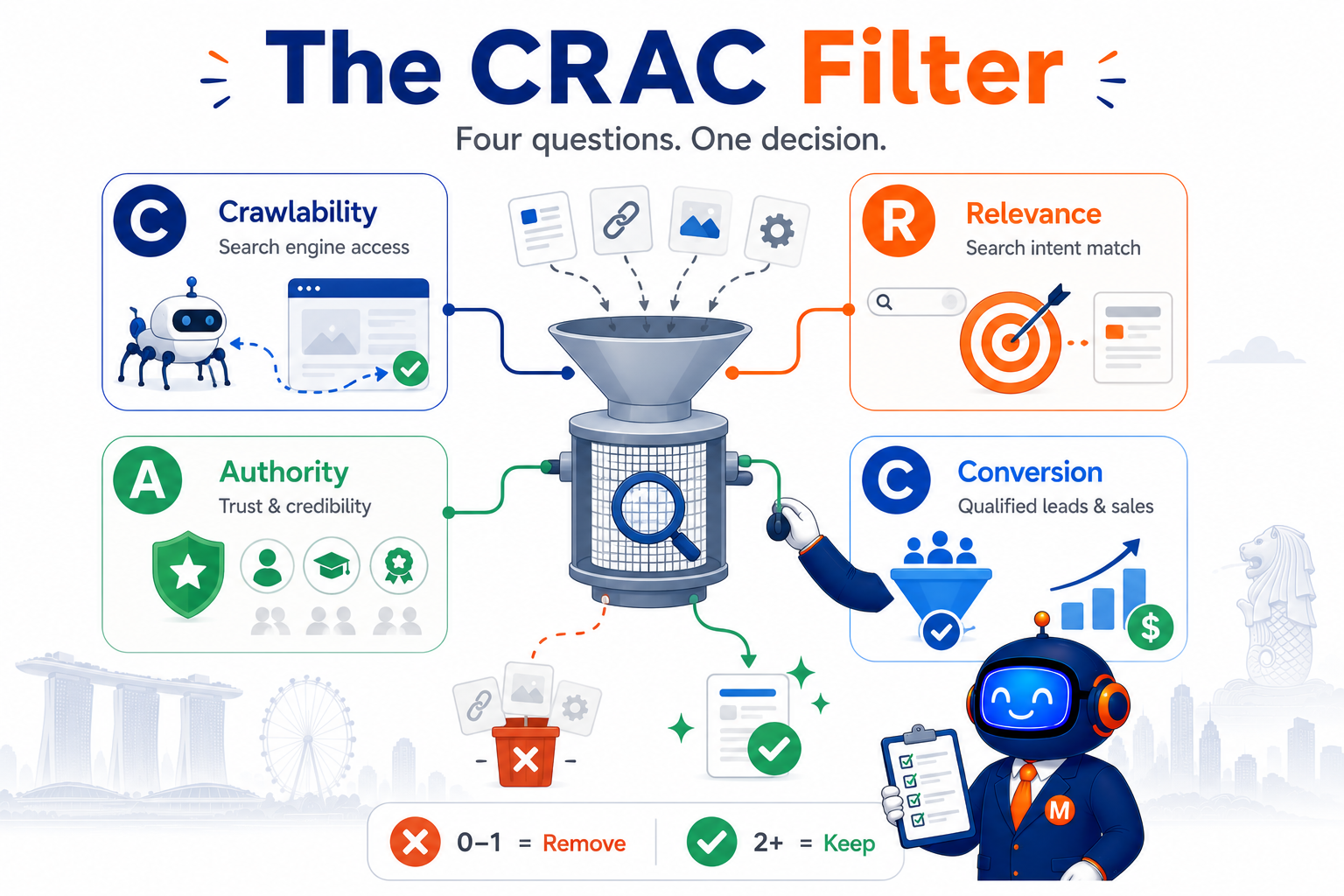
When budgets tighten, emotions tend to drive decisions. The safer approach is to use a simple filter. If an SEO activity does not clearly improve at least one of the following, it deserves scrutiny:
- Crawlability: Can search engines access and understand your site more easily?
- Relevance: Does this help your pages match real search intent?
- Authority: Does this strengthen trust and credibility in your niche?
- Conversion: Does this increase qualified leads, enquiries, or sales?
If the answer is no across all four areas, that activity is likely noise. It may look productive and may even generate reports or deliverables. But it is not pulling its weight.
This principle enables you to reduce SEO cost without sacrificing performance. You are not asking “what can I remove”. You are asking what actually drives outcomes in my SEO programme. Once you answer that honestly, budget optimisation stops being painful and starts being strategic.
We call this the CRAC Filter in client audits. Crawlability, Relevance, Authority, Conversion. Every activity in your programme should improve at least one, and preferably two or more. Activities that improve none of the four are candidates for removal regardless of how convincing the reporting looks.
The MediaOne SEO Waste Index
The CRAC Filter tells you whether individual activities pass a value test. The MediaOne SEO Waste Index goes one step further and produces a single number that quantifies how much of your current SEO budget is likely producing no return. It is the scored diagnostic we run at the start of every client audit, and it consistently identifies waste that internal teams and incumbent agencies have missed for years.
The Waste Index scores your programme on a 0 to 100 scale across six variables. Higher scores indicate more waste. Below 20 indicates a lean programme. 20 to 40 indicates typical inefficiency worth addressing. 40 to 60 indicates significant waste requiring structural change. Above 60 indicates a programme in need of complete restructuring.
| Variable | Weight | What To Check | Score Contribution |
| Retainer Age Without Rescope | 20% | Has the current scope been formally reviewed against business priorities in the last 12 months? | If no, add 15 to 20 points |
| Content-To-Conversion Ratio | 20% | What percentage of content published in the last 12 months produced measurable enquiries or ranking movement? | If under 30%, add 12 to 20 points |
| Tool Utilisation Depth | 15% | For each SEO tool paid for, is it used weekly by a named owner? | For each unused or lightly-used tool, add 3 to 5 points |
| Reporting Business Alignment | 15% | Do monthly reports connect SEO activity to leads, revenue, or CRM outcomes? | If reports focus on rankings and traffic only, add 10 to 15 points |
| Link Building Quality Filter | 15% | Are new links acquired from publications you would actually read in your industry? | If not, add 8 to 15 points |
| Strategic Recalibration Frequency | 15% | How often does the SEO strategy get formally reviewed against changing business priorities? | If less than quarterly, add 8 to 15 points |
Example score for a mid-market Singapore business:
- Retainer last rescoped 26 months ago: 18 points
- Content producing measurable results at 22%: 15 points
- Two tools out of five used weekly: 9 points
- Reports show rankings and traffic but no CRM integration: 12 points
- Recent links from generic guest post networks: 10 points
- Strategy last reviewed 8 months ago: 6 points
- Total Waste Index: 70 points
A Waste Index score of 70 means roughly 70% of the current SEO budget carries measurable risk of producing no return. In practice, we typically find that the actual waste sits close to this figure once we finish the deeper audit, though the exact composition varies by business.
The Waste Index does not replace the CRAC Filter. It complements it. CRAC evaluates individual activities. The Waste Index evaluates the entire programme. Both are needed to make defensible cost decisions.
The Most Common Reasons Your SEO Cost Gets Bloated
If your SEO budget feels heavier than it should, there is a good chance the issue is not poor performance but structural inefficiency.
Many SEO programmes quietly accumulate cost over time, not because results demand it, but because no one stops to reassess how the work is being done. This is especially common for growing businesses in Singapore, where marketing teams move quickly, and vendors are rarely challenged once a retainer is approved. Owners often want to know why their SEO cost keeps rising without a matching lift in results, and the honest answer usually sits somewhere in the five patterns below.
1. Legacy Retainers That No Longer Match Business Reality
SEO retainers are often set during a specific growth phase, usually during early expansion, aggressive market entry, or a rebrand. The problem is that retainers often remain fixed even when the business changes. Your priorities shift, but the scope does not.
You might still be paying for deliverables that made sense two years ago, but are now misaligned with how customers search or convert today. Without regular strategic recalibration, retainers become default spending rather than intentional investment. The specific components that belong inside a well-scoped retainer and the ones that quietly pad the invoice are broken down in detail in our analysis of SEO company pricing in Singapore, which walks through what a fair retainer includes at each price point and which line items to challenge in your next vendor review.
2. Tool Stacking That Creates Overlap, Not Advantage
SEO teams love tools. Keyword research platforms, rank trackers, technical crawlers, competitor dashboards. Individually, each tool looks justified. Collectively, they often do the same job.
Many businesses pay for multiple platforms with overlapping features because different team members prefer different interfaces or because subscriptions were added incrementally without review. The result is a monthly software bill that grows quietly while usage remains shallow.
A lean SEO stack is not about having fewer tools. It is about having the right tools, fully utilised, with clear ownership and purpose.
3. Output-Based Pricing That Rewards Activity Over Impact
Another common source of budget bloat is pricing models built around volume. A fixed number of blog posts per month, a set count of backlinks, or a predictable stream of deliverables that looks productive on paper. The issue is that search performance does not scale linearly with output. Publishing more content does not guarantee more traffic. Building more links does not automatically increase authority.
When volume becomes the goal, relevance and intent alignment often suffer, and spending increases without meaningful gains. This is why our approach to negative keywords in SEO matters just as much as target keyword selection. Cutting out queries that produce traffic without conversions is often where the biggest cost efficiencies are hiding.
4. Agency Workflows Built For Scale, Not Your Business
Many agencies operate on systems designed to efficiently handle dozens or hundreds of clients. That efficiency benefits the agency, not always the client.
This can show up as templated audits, generic content frameworks, or fixed monthly tasks that run regardless of performance signals. While these workflows keep operations running smoothly, they can also introduce unnecessary work that adds cost without addressing your specific market, competitive position, or growth stage.
5. Manual Internal Tasks That Should Be Streamlined
SEO budget bloat does not always sit with agencies. Internal teams often absorb hidden costs through manual processes. Repetitive reporting, spreadsheet-based tracking, or content workflows that rely heavily on human coordination instead of automation.
These tasks consume time, inflate labour costs, and slow decision-making. Over time, they become accepted as “how things are done” even when simpler, more efficient alternatives exist. When these issues stack up, your SEO budget starts to look busy rather than effective. Activity increases, reports grow thicker, tools multiply, yet strategic clarity declines.
The solution is not to cut SEO spend across the board. It is to identify where costs have drifted from impact, then bring the budget back in line with outcomes that actually matter.
What Are The Most Crucial SEO Tasks You Should Never Cut
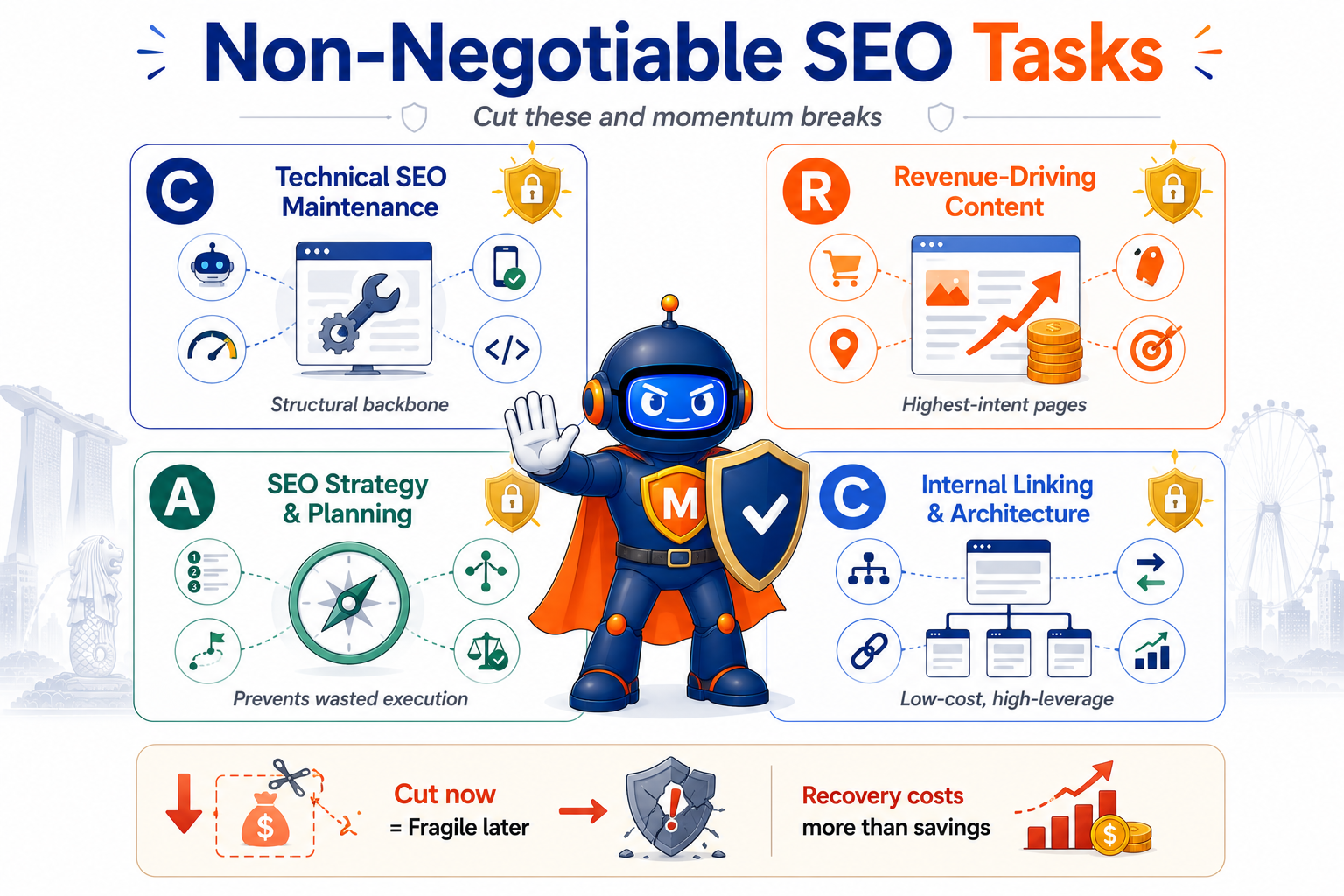 When businesses talk about reducing SEO cost, they often focus on line items rather than impact. That is how essential work gets lumped together with optional activity. The result is short-term savings followed by long-term damage that is far more expensive to fix.
The areas below are not “nice to have”. They form the structural backbone of sustainable SEO performance. Cutting here does not slow growth gently. It usually breaks momentum outright.
Technical SEO Maintenance
Technical SEO is easy to deprioritise because it rarely delivers a visible win on its own. There is no celebratory spike in traffic when crawl errors are fixed or when indexation issues are resolved. What happens instead is quieter and more dangerous since problems can continue to compound in the background.
Search engines rely on technical signals to understand, crawl, and rank your site. When those signals degrade, performance follows. Often with a delay that makes the root cause harder to diagnose. According to Google’s official documentation on Core Web Vitals, page experience metrics including loading performance, interactivity, and visual stability are directly factored into ranking decisions, which means technical maintenance is not optional infrastructure work but active performance investment.
Core technical areas you should continue to maintain include:
- Crawlability and indexation control
- Page speed and Core Web Vitals
- Mobile usability and responsiveness
- Broken links, redirect chains, and server errors
- Structured data where relevant
Ignoring these does not save money. It shifts costs into the future, when recovery work is more complex and rankings are already lost. A proper SEO audit in Singapore catches these issues before they compound, which is why running an audit annually usually costs less than the traffic recovery work required when problems accumulate for two or three years unnoticed.
Content That Targets Revenue-Driving Keywords
Not all content carries equal weight. Informational blog posts and awareness pieces have their place, but they should never be prioritised over pages that directly influence revenue.
Your highest-risk mistake is cutting investment in:
- Core service pages
- Product and category pages
- Location-based landing pages
- Comparison and “best for” pages with commercial intent
These pages capture users who are already close to making a decision. When rankings slip here, the impact shows up immediately in leads and sales, not just traffic reports.
Before you cut content spend, audit which pages already convert and which keywords bring high-intent users. Protect those pages first. Optimise them further if possible. Removing budget from proven revenue drivers rarely ends well. The disciplined approach to protecting high-intent pages sits at the centre of performance SEO strategies that print revenue, where the focus is deliberately narrow rather than spread across every page in the site.
SEO Strategy And Planning Time
SEO strategy is often the first thing trimmed because it looks intangible. There is no deliverable to point at, no word count, no link total. That makes it an easy target when budgets tighten.
In practice, strategy is what prevents waste everywhere else. SEO strategy defines priorities, sequencing, and trade-offs. It determines which keywords matter now, which content needs updating rather than rewriting, and which technical issues are worth fixing first.
Without it, execution becomes reactive and fragmented. Cutting strategy time usually leads to:
- More tasks completed with less impact
- Conflicting initiatives across teams
- Slower results despite higher effort
If you must reduce spending, reduce volume, not direction. Fewer actions guided by a clear strategy outperform more actions driven by habit. An experienced SEO consultant working two days a week often produces better commercial outcomes than a full-service retainer running six activities monthly without clear prioritisation.
Internal Linking And Site Architecture Work
Internal linking rarely receives the attention it deserves because it does not feel like new work. Yet it plays a critical role in how search engines interpret authority and topical relevance across your site.
Well-planned internal links help search engines:
- Discover and prioritise important pages
- Understand topic relationships
- Distribute authority from strong pages to weaker ones
Poor internal linking, on the other hand, wastes equity you have already earned through content and backlinks. Pages remain isolated. Crawl depth increases. Rankings stagnate for reasons that are not immediately apparent.
The upside is that this work is relatively low-cost. It leverages existing assets rather than requiring constant new production. Cutting it saves little and costs a lot.

Measurement That Ties SEO To Business Outcomes
Traffic numbers alone do not protect your SEO budget. Revenue alignment does. When analytics, attribution, or conversion tracking are reduced or removed, SEO becomes harder to defend internally.
You lose the ability to answer simple yet critical questions, such as which pages drive leads, which keywords drive conversions, and where organic search fits within the broader customer journey. Effective SEO measurement should connect:
- Organic traffic to conversions or enquiries
- Landing pages to revenue or lead quality
- SEO activity to business objectives, not just rankings
Once those connections are gone, every optimisation looks optional. You cannot protect what you cannot measure, and you cannot optimise what you do not understand. Business owners asking how to justify SEO cost to their finance team almost always find the answer sits inside the measurement layer, because a well-instrumented programme produces a defensible commercial case that finance directors can validate against their own numbers.
SEO Costs You Can Usually Cut Or Reduce Safely
Instead of the SEO tasks mentioned above, here is where you can trim fat without damaging organic performance:
-
Excessive SEO tool subscriptions
Many teams subscribe to three separate tools for keyword research, auditing, and competitor analysis. Yet most features overlap. You may never use the full suite of reports you are billed for each month. Conduct a tool audit quarterly, cancel redundancy, and invest in platforms that integrate multiple functions.
-
Overly frequent rank tracking
Daily rank tracking usually does not change decisions. Rankings fluctuate. Weekly or biweekly tracking aligned with your reporting cadence prevents chasing noise and saves subscription costs.
-
Low-value link building packages
Bulk link packages and cheap directories appear to offer savings but deliver little value and can increase the risk of penalties. Prioritise fewer, high-quality links over dozens of low-quality ones.
-
Content written without search intent
Content written without search intent: Many teams produce content simply to keep publishing. If posts do not align with search intent or contribute to conversions, they are wasted hours and budget. Audit content. Pause or prune where there is no clear traffic or conversion goal. For Singapore SMEs operating with tighter budgets, prioritisation matters even more, which is why we developed a specific approach for SEO services for Singapore SMEs on a tight budget that focuses spend on the small set of activities that produce measurable returns even at monthly budgets between S$800 and S$1,500.
-
Vanity SEO reports
Be wary of pages of charts that answer nobody’s questions. Invest in reports that tie metrics directly to business outcomes (leads, bookings, demo requests, or sales) rather than page views alone.
The Hidden Cost Of Cutting The Wrong SEO Activities

Here is the danger in false savings. Removing the wrong investments does not just save money. It costs opportunity. Rankings you worked months for take many more months to recover once lost. Fewer indexed pages mean fewer future opportunities for visibility.
Teams lose trust in SEO when cuts backfire, and leadership blames SEO instead of flawed budgeting. This is one of the most common patterns we see when businesses come back to us after 12 to 18 months of self-directed cost cutting. The recovery work almost always exceeds the savings that were achieved during the cutting phase.
How A Singapore Financial Services Business Rebuilt Its SEO Cost Structure
The following is drawn from an actual client engagement, with identifying details anonymised.
A mid-market Singapore financial services provider came to us after 14 months of self-directed cost cutting. The internal marketing team had reduced the SEO budget from S$8,400 monthly to S$3,200 monthly to demonstrate cost discipline during a challenging quarter. The cuts felt decisive at the time. Twelve months later, the picture looked different.
| Metric | Before Cuts (Month 0) | After Cuts (Month 14) |
| Monthly SEO investment | S$8,400 | S$3,200 |
| Monthly organic sessions | 24,200 | 11,600 |
| Monthly enquiries from organic | 87 | 34 |
| Estimated monthly organic-attributed revenue | S$52,000 | S$21,000 |
| Cost per organic enquiry | S$97 | S$94 |
On the surface, the cost per organic enquiry stayed roughly constant. This is what the marketing director presented to the board as evidence the cuts were working. The board approved further reductions.
What the analysis missed: they had lost 53 enquiries per month. At their historical close rate of 18% and average client value of S$18,000, this represented approximately S$172,000 per month in lost pipeline. The S$5,200 monthly saving on SEO was producing over S$170,000 monthly in lost commercial opportunity, a ratio nobody had modelled honestly.
When we ran the Waste Index, the original S$8,400 programme scored 47. In practice, this meant roughly S$3,950 of the original budget was producing measurable results, and roughly S$4,450 was waste. The cuts had removed most of the S$3,950 productive spend and left most of the S$4,450 waste in place, because the reductions targeted line items with visible deliverables rather than line items with commercial impact.
The restructure:
We rebuilt the programme at S$5,800 monthly, keeping it below the original spend while restoring commercial outcomes.
| Line Item | Old Programme | New Programme |
| Blog content volume | 8 posts monthly | 3 posts monthly on high-intent commercial queries |
| Technical SEO maintenance | Ad hoc | Monthly with quarterly deep audits |
| Link building | Bulk directories and generic guest posts | 2 to 3 genuinely earned placements per quarter |
| Tool stack | 5 subscriptions | 2 subscriptions |
| Strategic review cadence | Annual | Monthly |
| Conversion tracking and attribution | Basic Google Analytics only | Full CRM integration with revenue attribution |
Results 9 months after restructure:
| Metric | After Restructure (Month 9) |
| Monthly SEO investment | S$5,800 |
| Monthly organic sessions | 27,100 |
| Monthly enquiries from organic | 96 |
| Monthly organic-attributed revenue | S$58,000 |
| Cost per organic enquiry | S$60 |
The programme now produced better commercial outcomes than the original S$8,400 budget at S$2,600 less monthly cost, because the restructure removed waste rather than removing spend. This is the honest difference between cost cutting and cost optimisation, and it is the outcome most Singapore businesses can achieve if they resist the impulse to cut before they diagnose.
What To Cut Vs What Not To Cut In Your SEO Budget
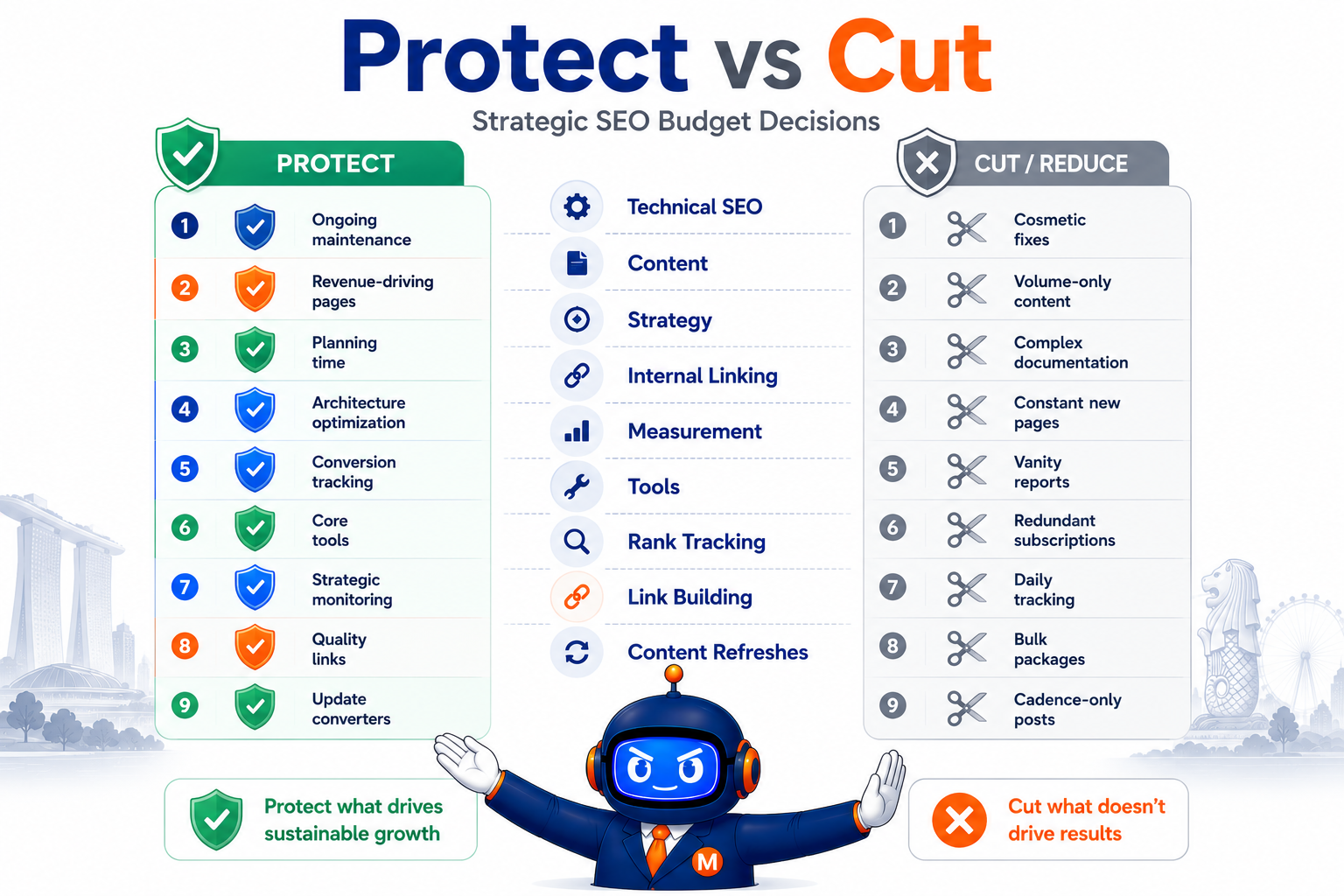
| SEO Area | Do Not Cut This | Why It Must Be Protected | Can Be Cut Or Reduced | Why It Is Safer To Cut |
| Technical SEO | Ongoing technical SEO maintenance | Supports crawlability, indexation, site speed, and stability. Ranking losses often appear later and are harder to reverse | One-off cosmetic technical fixes | Visual or low-impact tweaks that do not affect crawl, speed, or indexing rarely move performance |
| Content Investment | Revenue-driving pages like services, products, categories, and high-intent comparisons | These pages capture users closest to conversion. Ranking drops here affect leads and sales directly | Content created without search intent | Publishing for volume alone wastes budget and does not support traffic or conversions |
| SEO Strategy | Strategy and planning time | Prevents wasted effort, defines priorities, ensures execution supports business goals | Overly complex documentation | Long strategy decks that do not influence action add little value once direction is clear |
| Internal Linking | Internal linking and site architecture optimisation | Distributes authority, improves crawl efficiency, strengthens topical relevance using existing assets | Constant new page creation | Adding pages without strengthening internal links increases crawl depth and dilutes authority |
| Measurement | Conversion tracking and revenue-aligned reporting | Protects SEO budget by tying performance to business outcomes like leads and sales | Vanity SEO reports | Reports focused only on traffic, impressions, or rankings do not support decision-making |
| SEO Tools | Core tools that support decisions | Reliable data for keywords, audits, and performance tracking is essential | Redundant tool subscriptions | Overlapping features across multiple tools increase cost without adding insight |
| Rank Tracking | Strategic rank monitoring aligned with reporting cycles | Helps track trend direction and diagnose issues over time | Daily rank tracking | Day-to-day fluctuations create noise and rarely change strategy |
| Link Building | High-quality, relevant link acquisition | Supports authority and competitive rankings when done selectively | Bulk or low-quality link packages | Cheap links add little value and can introduce risk |
| Content Refreshes | Updating proven, converting pages | Improves performance faster than starting from scratch | Publishing just to maintain cadence | Content without a clear goal consumes budget without return |
The Uncomfortable Truth About Most SEO Retainers
Across the 200+ audits we have run, a consistent pattern emerges in what agencies bill for versus what actually produces commercial return. The most common line items that appear on invoices but produce no measurable business outcome:
-
Monthly “SEO health check” reports at S$400 to S$1,200
In 78% of the audits we reviewed, these reports contained the same 12 to 15 checks month after month, none of which changed strategy or produced action. A single quarterly deep audit at higher rigor produces better commercial outcomes at lower total cost.
-
“Keyword expansion” deliverables adding 20 to 50 new tracked keywords monthly
In 82% of cases, the added keywords either had no meaningful search volume or no realistic ranking potential given the site’s authority level. The tracked keyword list grew, reporting looked more comprehensive, and nothing changed commercially.
-
Content published without a documented conversion path
In 71% of cases, blog content was produced against a monthly quota with no defined next step for the reader. Rankings for the content improved slightly. Conversions from the content approached zero.
-
“Link outreach” activities without published placements
In 43% of cases, agencies billed for outreach hours without producing evidence of secured placements. The activity was real. The output was invisible.
-
“Technical SEO monitoring” without documented issue resolution
In 61% of cases, monitoring was billed monthly but issues identified were flagged rather than fixed. The client paid for the identification and paid again for the fix when it eventually happened.
None of these are described as waste on the invoice. They appear as legitimate line items with professional-sounding names. The honest test is not whether the activity happened. It is whether the activity produced a commercial signal in the following 90 days. If it did not, and the same activity is billed the following month, the pattern is bloat regardless of the language on the deliverables list.
Many Singapore SMEs are paying for SEO activity that would not survive a rigorous quarterly review, because no rigorous quarterly review is ever conducted. The review is the highest-leverage single change most businesses can make to their SEO cost structure, and it costs nothing to implement.
A Smarter Budget For SEO Cost Means Shifting Your Focus
If there is one idea to take away from this guide, it is this: smarter SEO budgeting is not about spending less across the board. It is about spending with intent. When you understand which activities compound value and which ones quietly drain resources, budget decisions become far less emotional and far more effective.
Blind cutting often feels decisive, but it usually causes hidden damage that surfaces months later as lost rankings, weaker leads, and stalled growth. Shifting your focus instead toward strategy, technical health, high-intent content, and meaningful measurement gives you leverage. You are no longer paying for the activity. You are investing in outcomes.
This is where many business owners and marketers in Singapore benefit from an external perspective. Singapore SMEs have particular support options available through government programmes, and Enterprise Singapore’s Budget 2026 announcements confirmed enhanced grant support for SMEs of up to 70% until March 2029, which can meaningfully offset the strategic SEO work that produces long-term compounding returns. A seasoned partner can help you audit spend, identify waste, and redirect investment to what actually drives visibility and revenue in competitive local and regional markets.
MediaOne works with businesses at exactly this intersection, helping you make confident decisions about your SEO cost without compromising long-term performance.
If you want clarity on where your SEO budget is working, where it is leaking value, and how to refocus it for sustainable growth, our team at MediaOne is the SEO agency Singapore businesses trust to audit spend, identify structural waste, and rebuild programmes around activities that actually compound.
Start with an SEO Cost Audit that maps your current investment against the CRAC Filter and shows which line items are producing returns, which are neutral, and which are quietly draining budget without moving rankings.
Frequently Asked Questions
What factors affect SEO cost for a small business?
SEO cost for a small business is influenced by several factors, including your website size, industry competitiveness, required services, and the pricing model you choose. Businesses in competitive markets or with complex sites typically face higher SEO cost due to the level of strategy, content, and technical work involved.
Ongoing SEO cost for small businesses often falls within a monthly range rather than a one-time fee, reflecting the need for consistent optimisation and measurement.
How much does a comprehensive SEO audit cost?
The cost of a comprehensive SEO audit depends on its depth and scope. A high-quality SEO audit that covers technical performance, content gaps, and backlink profile analysis typically ranges from SGD 650 to SGD 9,500. Lower audit cost often indicates automated reports with limited insight, while higher audit cost usually includes prioritised recommendations tied to business goals and revenue impact.
Is paying an SEO audit cost upfront worth it before ongoing optimisation?
Yes. Paying an upfront SEO audit cost helps prevent wasted spend later. A proper audit identifies which SEO issues are limiting performance, which opportunities matter most, and how future SEO cost should be allocated. Without this clarity, businesses often overspend on low-impact activities or misdirect ongoing SEO investment.
What SEO cost pricing models do agencies typically use?
SEO cost structures vary by agency, but most fall into three models: monthly retainers, project-based SEO cost, or hourly consulting rates. The monthly SEO cost covers ongoing optimisation and monitoring. Project-based SEO cost applies to defined work, such as audits or migrations. Hourly SEO cost is common for strategic advisory or specialised technical tasks. Each model suits different business needs and budget controls.
Does a higher SEO cost guarantee better results?
A higher SEO cost does not guarantee stronger results. SEO performance depends on strategic alignment, execution quality, and measurement, not price alone. In many cases, a focused SEO strategy with controlled SEO cost outperforms a larger but poorly directed budget. The goal is not to minimise SEO cost blindly, but to ensure every dollar supports visibility, authority, and revenue growth.
How do I know if my current SEO cost is producing real returns?
Look at three signals. First, is the organic traffic to your commercial pages growing or plateauing over the last 6 to 12 months. Second, is that traffic converting into enquiries, leads, or sales at rates consistent with your paid channels. Third, is your reporting connecting SEO activity to business outcomes or just to rankings and impressions. If any of the three signals is weak, the SEO cost is producing effort rather than results, and the budget structure needs review.
Can I reduce my SEO cost by moving work in-house?
Sometimes, but not always. In-house SEO teams work well for businesses with consistent, high-volume content needs and enough scale to justify permanent hires. Smaller businesses often underestimate the true cost of in-house SEO once fully-loaded salaries, tool subscriptions, training, and management time are counted. The honest comparison is not agency retainer versus one hire, but agency retainer versus one senior hire plus tools plus junior support plus management overhead.