
Programmatic advertising has transformed digital media buying by replacing many manual negotiations with automated, data-driven transactions. Ad opportunities can be evaluated, bid on and filled in milliseconds, allowing marketers to reach defined audiences while publishers manage their inventory and pricing more dynamically.

The value is not simply speed. Programmatic gives marketers greater control over audience selection, bidding and optimisation, while publishers gain more efficient ways to monetise available inventory. The trade-off is greater technical complexity, particularly around data quality, brand safety, measurement and privacy.
Programmatic also covers several different buying models, from open auctions to private marketplaces and guaranteed deals. Choosing the right model depends on campaign objectives, budget, inventory quality, brand-safety requirements and Singapore’s privacy obligations.
Key Takeaways
- Programmatic automates ad inventory buying and selling in real time through algorithmic bidding. Auctions complete in milliseconds, not days.
- Four core buying models exist: open auctions for scale, private marketplaces for premium curated inventory, programmatic-guaranteed for predictable volume, and preferred deals for early access.
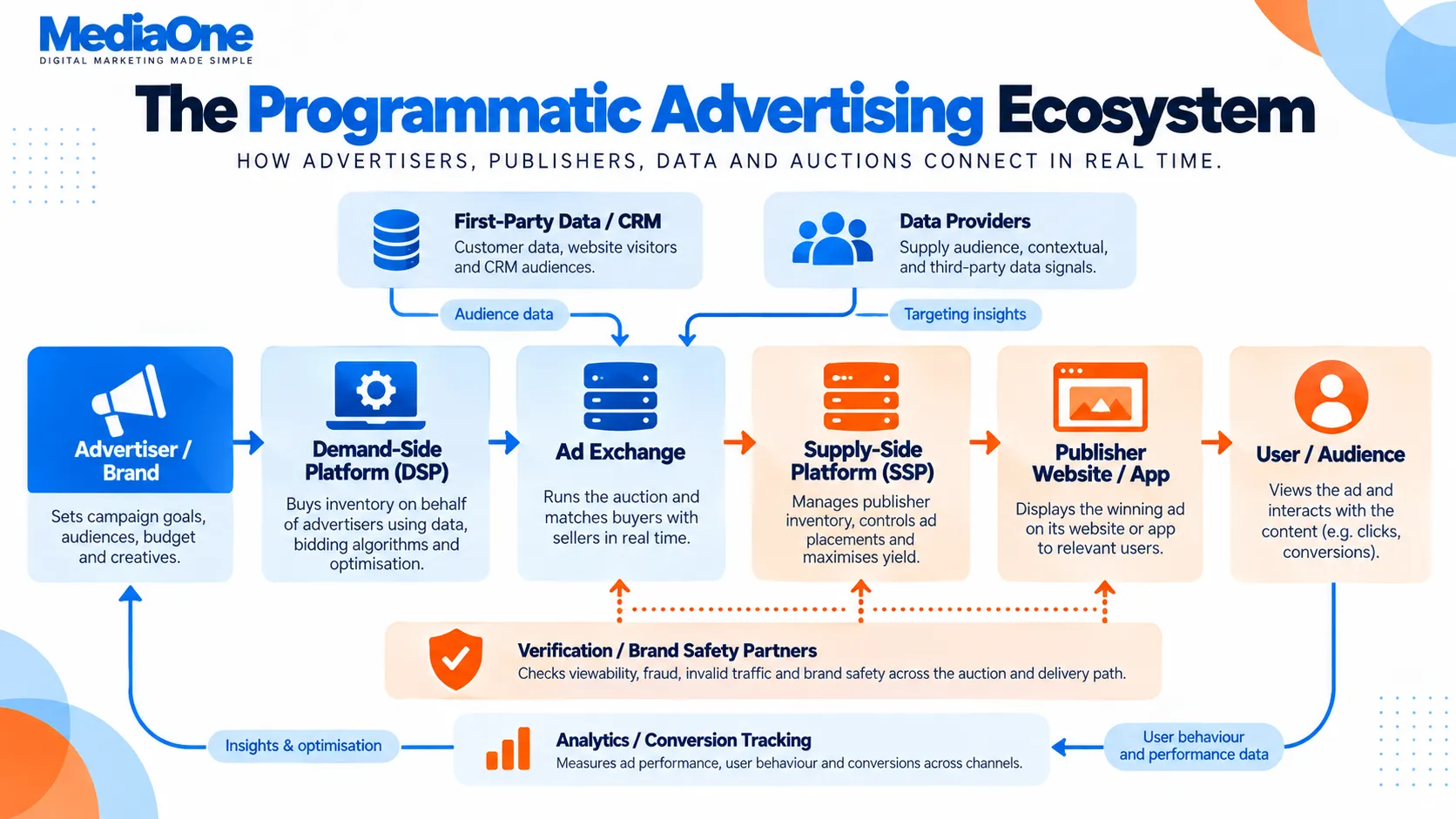
- Demand-side platforms (DSPs), supply-side platforms (SSPs) and ad exchanges form the core ecosystem. Data providers and verification partners complete the infrastructure.
- First-party data strategies reduce legal risk and improve targeting accuracy as third-party cookies are phased out.
- Programmatic delivers lower costs through real-time bid optimisation, faster scaling, and cross-channel consistency from a single command centre.
- Brand safety, ad fraud and attribution remain operational risks. Mitigation requires verification partners, contextual exclusions and disciplined audience segmentation.
- Implementation success hinges on clear KPIs, audience cohort strategy, disciplined testing and the right vendor. Small businesses can start with monthly budgets of S$5,000; enterprises typically allocate 20 to 40 per cent of their digital media spend to programmatic (budget figures are indicative and vary by market, objective and platform).
What Is Programmatic Advertising?
Programmatic advertising is the automated purchase and sale of digital ad inventory in real time through software algorithms and bidding systems. Instead of manually negotiating with publishers, marketers use technology to evaluate millions of ad slots per second and automatically buy or skip them based on predefined criteria.
The core difference from manual buying lies in speed and scale.
Manual buying involves human negotiation: a marketer contacts a publisher, agrees on price, placement and audience, and receives a guaranteed spot. This takes days or weeks.
Programmatic buying completes the entire transaction in milliseconds, evaluating user, page context, available inventory and bidding rules simultaneously.
Manual buying favours predictability and long-term relationships. Programmatic buying favours efficiency and data-driven precision. Most campaigns blend both: premium placements are bought direct, while performance-focused volume is bought programmatically.
Programmatic now represents a large majority of digital display ad spending in mature markets. APAC markets, including Singapore, are following the same trajectory, with industry forecasts suggesting significant growth in programmatic adoption over the coming years. This concentration reflects the genuine value of scale and automation, making programmatic understanding essential for all marketers.
How Real-Time Bidding Works
Real-time bidding (RTB) is the auction mechanism behind much of programmatic advertising. When an ad impression becomes available, eligible advertisers automatically compete for it, and the system selects and delivers the winning ad in milliseconds.
The decision is based on signals such as audience characteristics, page context, device, location and campaign rules. Instead of buying large blocks of broad inventory in advance, advertisers can evaluate individual impressions and bid based on relevance and expected value.
For publishers, RTB creates competition for each impression. For advertisers, it creates a more flexible way to control whom they reach, how much they bid and which campaign outcomes they optimise for. The next section breaks down the technical sequence in detail.
Where Direct and Programmatic Overlap
Direct sales and programmatic are often presented as opposites, but the boundary is increasingly blurred. Direct sales remain standard for premium placements.
When a marketer wants a takeover on a publisher’s homepage or guaranteed impressions with specific audience guarantees, they buy direct. The publisher controls placement quality, and the marketer gains certainty. Direct deals typically run for weeks or months and are negotiated in advance.
Programmatic’s strength is scale and flexibility. A fashion brand wanting 1,000 sales per week can buy ads across 500 sites to reach enough shoppers. Marketers reach millions of users across hundreds of websites simultaneously, adjusting bids and budget allocation in real time based on performance.
The overlap has grown with private marketplaces (PMPs) and programmatic guaranteed deals. A PMP is a curated auction where a publisher invites selected advertisers to bid on premium inventory. A programmatic guaranteed deal is automated direct buying: the marketer and publisher agree upfront on volume, placement and price, but programmatic systems execute delivery. Most sophisticated marketers run a portfolio approach: direct deals for flagship brands, PMPs for premium scalable inventory, and open programmatic auctions for volume and testing.
The choice depends on campaign objective, budget and acceptable risk.
How Programmatic Advertising Works: The Technical Flow
Programmatic advertising depends on a coordinated sequence of events.
The Bid Request and Response Cycle
When a user loads a webpage or app, the publisher’s ad server generates an ad request containing signals about the user and context:
- User signals: cookies or IDs, browsing history, inferred interests, location
- Context signals: page category, page URL, device type, time of day
- Inventory signals: ad slot size, position on page, viewability potential
The ad request travels to an ad exchange or SSP, which forwards it to multiple DSPs. Each DSP evaluates it against the advertiser’s campaign criteria and calculates a bid. The highest bid wins, and the ad returns to the publisher and renders on screen.
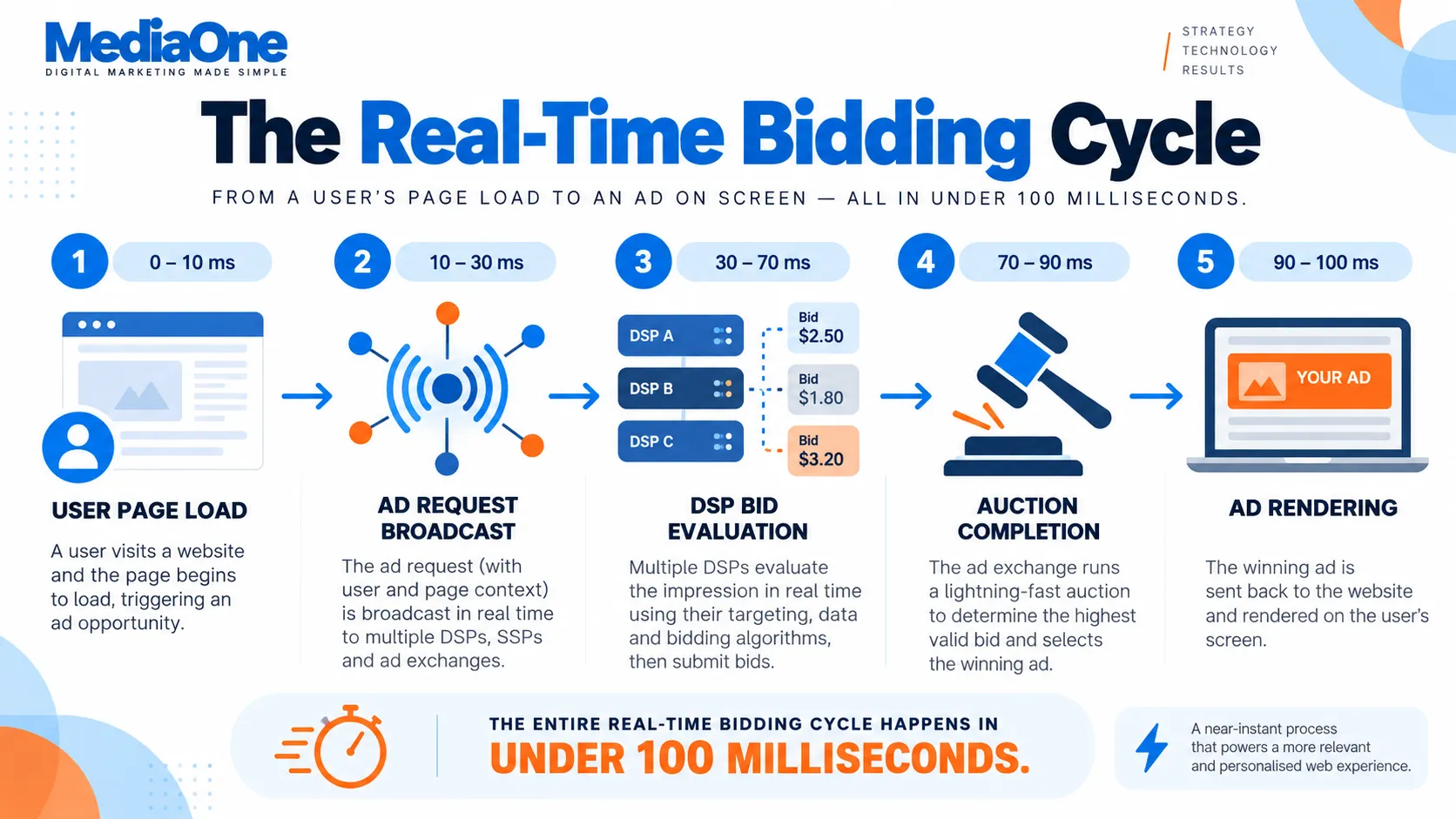
Throughout this cycle, data flows in multiple directions. The DSP sends bid data to the exchange. The exchange reports winning bids to the SSP. The publisher records the impression. The advertiser’s tracking pixels fire to log the event. This data underpins future optimisation.
The Role of Data in Real-Time Decisions
Data signals fuel programmatic advertising. Data quality directly influences bid accuracy and campaign performance.
First-party data comes from a company’s own customers: email lists, website visitors, app users, CRM records. This data is the most accurate and privacy-compliant because customers have explicitly engaged with the brand.
Second-party data is first-party data shared directly from another company. A retailer might share its customer list with a CPG brand. This data is premium and privacy-safe because the original collector obtained consent. Data brokers collect third-party data and aggregate it from multiple sources without direct user consent. This category is being phased out globally as third-party cookies are deprecated. What remains is aggregated, contextual and legally compliant data.
Successful programmatic campaigns now rely on a mix: first-party audience segments, contextual targeting based on page content, and privacy-preserving identity solutions. The shift away from third-party cookies has actually improved data quality by forcing marketers to build direct relationships with audiences.
Bid Optimisation and Machine Learning
Once a campaign is live, DSPs use machine learning to continuously refine bidding decisions. The algorithm tracks which bids resulted in conversions, which placements drove engagement, and which audience segments performed best. Bid optimisation operates at multiple levels:
- Impression level: Should I bid on this specific impression right now?
- Audience level: Which user segments convert most efficiently?
- Placement level: Which sites and apps deliver the best ROI?
- Time level: Which hours of the day drive highest-intent conversions?
Marketers set the objective (cost per action, return on ad spend, or conversion volume), and the algorithm handles granular bidding. This removes human bias and emotion from media buying.
Types of Programmatic Buying: Choosing the Right Model
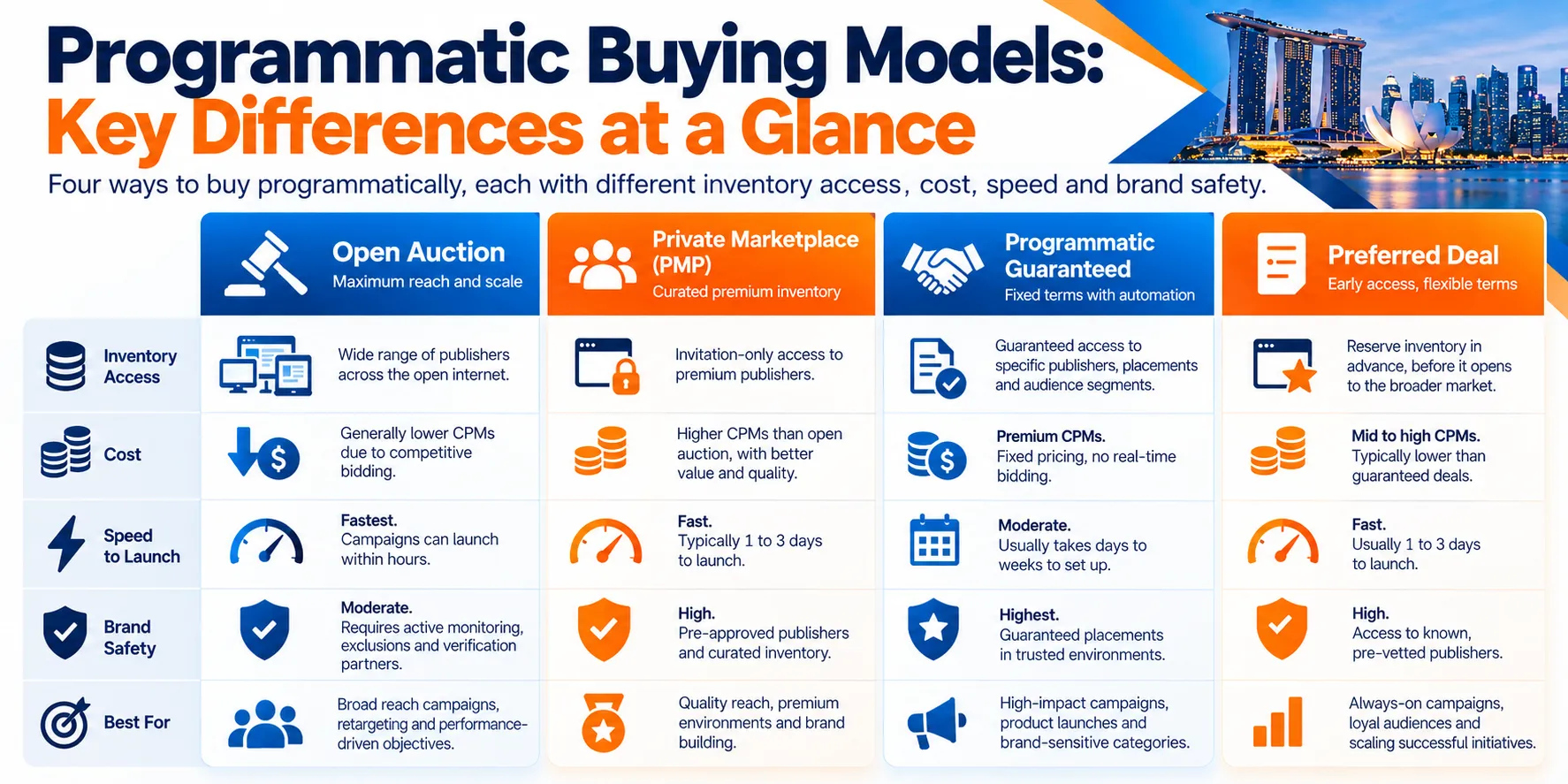
Programmatic buying is not a single approach. The four main models differ in inventory access, pricing, speed, control and brand-safety trade-offs. Start with the decision factors below, then use the detailed model descriptions to understand when each approach fits.
- What is your primary campaign objective? Volume-driven campaigns suit open auctions. Brand safety and predictability favour programmatic guaranteed deals or PMPs.
- What is your brand safety tolerance? Premium brands should start with PMPs or guaranteed deals. Performance-driven brands can use open auctions with strong contextual exclusions.
- How quickly do you need to launch? Open auctions launch in hours. PMPs take days. Programmatic guarantees take weeks of negotiation.
- What is your budget and CPM tolerance? Open auctions and preferred deals are cost-efficient. Programmatic guarantees and PMPs carry higher CPMs but offer certainty.
- Do you have existing publisher relationships? If yes, preferred deals and guaranteed models leverage those relationships. Without existing relationships, open auctions and PMPs become more accessible.
| Decision Factor | Open Auction | PMP | Programmatic Guaranteed | Preferred Deal |
|---|---|---|---|---|
| Launch speed (days) | 0-1 | 2-7 | 10-21 | 2-5 |
| Cost per impression | Low | Medium | Higher | Medium-low |
| Audience volume (weekly scale) | 10-100M+ | 1-10M | 100K-1M | 500K-5M |
| Brand safety effort | High (manual) | Medium | Low | Low-medium |
Open Auctions (Real-Time Bidding)
Open auctions form the public marketplace of programmatic advertising. Any advertiser can bid on any available impression. Publishers set a minimum floor price, and the highest bid wins the placement.
Best for:
Scale, experimentation, and performance-driven campaigns focused on volume and cost efficiency.
How it works:
When a user visits a publisher’s site, an ad request enters the exchange. DSPs submit bids within milliseconds. The winning bid secures the impression, and the ad displays immediately. The entire cycle typically completes in under one second.
Pros:
- Unlimited inventory access across thousands of publishers
- Prices fluctuate based on real demand, often below direct-sales rates
- Campaigns launch within hours with minimal setup friction
- Automatic optimisation drives cost efficiency
Cons:
- No guarantee of placement on premium publisher sites
- Higher fraud risk due to inventory opacity
- Volume and quality vary day to day; less predictability
- Brand safety requires active monitoring and custom blocklists
Budget requirement:
Minimum S$3,000 to S$5,000 per month; programmes scale efficiently from this baseline (budget figures are indicative and vary by market, objectives and platform).
Private Marketplaces (PMPs)
A PMP is a curated auction where a publisher invites select advertisers to bid on premium inventory. The publisher controls participation and often reserves the best placements for these invited buyers.
Best for:
Accessing premium inventory without the negotiation overhead of direct sales.
Pros:
- Curated inventory from known, trusted publishers
- Lower fraud risk than open auctions
- Higher viewability and engagement rates compared to open auctions
- Direct publisher relationships without direct-sales complexity
Cons:
- Smaller inventory pool than open auctions
- Requires setup and vetting agreements with each publisher
- Moderate cost premium compared to open auctions
Budget requirement:
S$5,000 to S$15,000 per month depending on publisher relationships (budget figures are indicative and vary by market, objective and platform).
Programmatic Guaranteed (PG)
Programmatic Guaranteed is a direct deal executed through programmatic systems. The advertiser and publisher agree upfront on volume, placement, audience and price. The DSP and SSP automate delivery, but contract terms are fixed.
Best for: Predictable volume commitments, brand-safe premium inventory, and inventory roadblocks such as full-page takeovers.
Pros:
- Guaranteed volume and placement certainty
- Fixed pricing eliminates surprise costs
- Highest brand safety and quality control
- Specific contextual or audience match requirements enforceable
Cons:
- No real-time bid flexibility; price is negotiated upfront
- Requires direct negotiation with the publisher, similar to traditional direct buying
- Limited opportunity for cost optimisation once terms are set
- Failure to meet volume commitments incurs financial penalties
Budget requirement: S$10,000 to S$50,000 per month; typically reserved for larger campaigns (budget figures are indicative and vary by market, objective and platform).
Preferred Deals (Programmatic Direct)
Preferred deals grant selected advertisers first access to premium inventory before it enters open auction. The advertiser has the option to buy at a pre-agreed price but is not obligated to do so.
Best for:
Testing premium placements or securing premium inventory at reasonable prices without full commitment.
Pros:
- Early access to premium, curated inventory
- Option to buy without obligation
- Pricing discount compared to traditional direct sales
- Lower friction than full direct negotiation
Cons:
- Quick decision required; offers typically expire within seconds
- Misses inventory if declined; another buyer may purchase it
- Smaller inventory pool than open auctions
- Requires DSP technical capability to handle real-time deal acceptance
Budget requirement:
S$5,000 to S$20,000 per month (budget figures are indicative and vary by market, objective and platform).
Choosing the Right Model: A Decision Framework
Choosing the right buying model depends on three factors: budget size, brand safety risk tolerance, and campaign objective. The table below outlines recommendations based on these criteria.
| Campaign Goal | Budget Range | Brand Safety Priority | Recommended Model |
|---|---|---|---|
| Awareness and reach | S$5,000–S$15,000 | Low to moderate | Open auction |
| Performance/conversions | S$3,000–S$10,000 | Moderate | Open auction with custom blocklists |
| Premium brand campaigns | S$15,000–S$50,000 | High | PMP or programmatic guaranteed |
| Predictable volume | S$20,000+ | Moderate | Programmatic guaranteed |
| Premium testing | S$10,000–S$25,000 | High | Preferred deals |
| Audience reach on premium sites | S$15,000+ | High | Direct publisher relationships |
Most mature campaigns operate multiple models simultaneously in a portfolio approach. Most volume flows to open auctions for cost efficiency. A portion goes to PMPs for improved quality and brand safety. Programmatic guaranteed deals secure strategic volume for predictable reach.
Key Players in the Programmatic Ecosystem
Programmatic advertising operates as an ecosystem of specialised players, each managing a specific part of the transaction. Understanding these roles helps marketers choose vendors and diagnose campaign performance issues.
Demand-Side Platforms (DSPs)
A Demand-Side Platform (DSP) is the advertiser’s buying interface to the programmatic marketplace. It lets marketers set campaign goals, define target audiences, manage budgets, and track performance across multiple ad exchanges and publishers.
What DSPs do:
- Connect advertisers to multiple ad exchanges and supply-side platforms simultaneously
- Accept data signals, including first-party audiences, contextual information, and intent data
- Execute bidding algorithms based on marketer-defined KPIs and objectives
- Provide reporting dashboards and campaign optimisation tools
- Handle payment processing and reconciliation
Leading DSP providers:
Google Display and Video 360 (DV360), Amazon DSP, Criteo, The Trade Desk, Xandr, and Magnite each offer different strengths. DV360 integrates deeply with Google Analytics and YouTube. Amazon DSP leverages first-party retail data. The Trade Desk excels at cross-device targeting. Magnite specialises in video and connected TV inventory. For small to medium businesses, Google DV360 and The Trade Desk offer the most accessible entry points. Larger enterprises typically use multiple DSPs to avoid vendor lock-in and compare pricing across platforms.
Supply-Side Platforms (SSPs)
A Supply-Side Platform (SSP) serves publishers in the same capacity DSPs serve advertisers. It enables publishers to connect their inventory to multiple ad exchanges and buyers, set floor prices, and control buyer access.
What SSPs do:
- Manage publisher ad inventory and establish floor pricing thresholds
- Route ad requests to multiple ad exchanges and DSPs simultaneously
- Enforce brand-safety rules and content policies
- Optimise yield and provide performance reporting
- Handle payment collection and settlement
Leading SSP providers:
Google Ad Manager (formerly DoubleClick for Publishers), Rubicon Project, OpenX, PubMatic, Magnite and Index Exchange. Google Ad Manager holds the largest market share because it integrates with YouTube and Google Search. Independent SSPs like PubMatic and Rubicon focus on premium publishers seeking alternatives to Google’s ecosystem.
Ad Exchanges
An ad exchange is a neutral marketplace where DSPs and SSPs transact. It receives bid requests from SSPs, distributes them to DSPs, collects bids, and determines winners based on price and other signals.
What ad exchanges do:
- Receive ad requests from publishers via SSPs or direct connections
- Distribute requests to multiple buyer platforms (DSPs)
- Collect and rank incoming bids
- Declare winning and losing bids
- Report transaction results to both publishers and advertisers
Major ad exchanges include Google Ad Exchange (AdX), OpenX, Rubicon Project, Index Exchange and Magnite. Some operate as independent platforms; others are owned by SSP or DSP operators. In practice, large publishers use multiple exchanges at the same time to increase competition and maximise revenue.
Data Providers and Audience Platforms
Data providers collect, organise and package audience information that DSPs use to make bidding decisions. This layer has changed significantly as third-party cookies are being phased out globally and privacy regulations are tightening.
Traditional data providers (declining): Sold third-party behavioural data such as “users who searched for mortgage rates in the last 30 days”. These providers are phasing out their models due to cookie deprecation and privacy regulations, including Singapore’s Personal Data Protection Act (PDPA).
First-party data activation platforms: Providers such as Salesforce, Segment and mParticle help marketers collect and activate their own customer data within DSPs. This segment is growing as third-party data becomes unavailable.

Contextual intelligence providers: Companies such as Seedtag, Semrush and GumGum analyse page content in real time to identify high-intent environments without relying on user behavioural data. These solutions are becoming more important as privacy regulation increases.
ID solution providers: Companies such as Unified ID, ID5 and LiveRamp provide privacy-preserving identity solutions that enable cross-device and cross-site targeting without relying on third-party cookies. [IMAGE: Diagram showing the flow of data from publishers through SSPs and exchanges to DSPs and ultimately to advertisers]
Verification and Brand-Safety Partners
Verification and brand-safety vendors operate between the programmatic infrastructure and advertisers, monitoring and filtering campaigns to protect against fraud and unsafe content associations.
Major providers:
Integral Ad Science (IAS), Moat (part of Oracle), DoubleVerify, Trustmetrics, Pixalate and Smaato.
What they do:
- Monitor ads in real time for placement quality and fraud signals
- Block placements on suspicious, unsafe or non-brand-aligned sites
- Provide viewability verification (confirming ads were actually seen)
- Detect and report invalid traffic (bot-generated or non-human impressions)
- Deliver brand-safety scorecards and compliance reporting
These partners integrate with DSPs and SSPs to filter inventory before bids are submitted. Many advertiser programmes now require third-party verification as a condition of participation, particularly for regulated industries or premium brand campaigns in Singapore. [VIDEO: Explanation of how verification partners detect fraud and brand-safety issues within the bid request and response cycle]
Standards, Accreditations and Compliance in Singapore
The technology and buying model are only part of the decision. In Singapore, campaign design must also account for privacy, advertising standards and any sector-specific regulatory requirements.
| Framework / Body | Jurisdiction | What It Means for Marketers |
|---|---|---|
| PDPA (Personal Data Protection Act) | Singapore | Marketers must obtain explicit consent before collecting personal data. Consent for audience targeting and retargeting is mandatory. Penalties for non-compliance can exceed S$1 million. |
| PDPC (Personal Data Protection Commission) | Singapore | The PDPC enforces PDPA. Marketers should refer to PDPC guidance on consent and direct marketing when building audience segments. |
| IMDA (Infocomm Media Development Authority) | Singapore | IMDA oversees digital advertising standards in Singapore. Marketers using local exchanges should verify IMDA compliance requirements for the channels they use. |
| IAB Standards (Tech Lab, OpenRTB) | Global / Singapore adoption | IAB publishes technical standards for programmatic (OpenRTB protocol). Compliance ensures compatibility across DSPs, SSPs and exchanges. |
| MAS Guidelines | Singapore | The Monetary Authority of Singapore (MAS) may require additional transparency and controls for financial services advertising. Verify requirements if advertising regulated products. |
Singapore-based companies advertising to consumers must ensure they collect and use audience data in compliance with the PDPA. Consent is not optional; the law requires it. Marketers should work with data partners and DSP providers that can demonstrate PDPA-compliant data-handling practices.
Troubleshooting Common Programmatic Issues
Once a campaign is live, most performance problems can be traced to data quality, targeting, bidding, inventory controls or measurement. The table below summarises common symptoms and practical checks.
| Common Concern | Why It Happens | How To Avoid or Fix |
|---|---|---|
| High cost per acquisition despite optimisation | DSP algorithm lacks sufficient conversion data to optimise. The campaign is young, or conversion tracking is misconfigured. | Ensure at least 50-100 conversions per week before expecting optimisation. Please verify that the conversion tracking pixel is firing correctly. Allow 1-2 weeks of learning. |
| Ads appearing on brand-unsafe pages | Publisher inventory is not curated; open auctions include all inventory. Verification partner not configured. | Add contextual exclusions (block competitor sites, adult content, low-quality domains). Deploy a verification partner like IAS or Moat. Use PMPs instead of open auction. |
| Low impression volume despite high budget | The audience segment is too narrow. Budget allocation is concentrated on expensive placements. The CPM floor is too high. | Broaden the audience segment or lower targeting specificity. Review bid prices; lower bids to win cheaper inventory. Reduce audience exclusions. Test on open auction alongside PMP. |
| Campaign frequency capping is not working | DSP frequency rules may conflict with real-time data limits. Third-party cookie data is incomplete. | Verify that frequency cap rules in the DSP are active. Use first-party data for more reliable frequency control. Adjust frequency caps conservatively (e.g. 2-3 per user per day). |
| Discrepancy between DSP reports and publisher reports | Impression counts differ because of viewability thresholds or time zone discrepancies. Click-through reconciliation delays. | Request a publisher reconciliation report. Check if DSP counts only viewable impressions while the publisher counts all served. Please allow 24 hours for the pixel-fire and click data to fully reconcile. |
| ROI declining despite stable spend | Market saturation or audience fatigue. Bid prices are rising as competition increases. The conversion rate is declining. | Expand the audience segment or add lookalike audiences. Test creative refresh to combat fatigue. A/B test landing page changes. Shift budget to underperforming but cheaper placements. |
Trading Desks and Agency Partners
Running programmatic in-house requires platform expertise, campaign governance and continuous optimisation. Organisations without that capability can use managed DSP services, trading desks or agency partners. For marketers without in-house programmatic expertise, trading desks (managed services) and agency partners provide strategy, execution and optimisation.
What They Provide
- Campaign strategy and audience definition
- DSP setup, management and optimisation
- Day-to-day bid monitoring and adjustments
- Performance reporting and insights
- Vendor negotiation and relationship management
Types of Partners
Full-service agencies: MediaOne, Publicis, GroupM, WPP, Havas and others offer programmatic as part of full-service media planning. Independent trading desks: Standalone shops like Quotient, Havas Media Group and others specialise in programmatic execution. Tech-enabled consultancies: Boutique firms focused on specific channels or regions. For small businesses starting programmatic, a DSP with managed services (Google DV360, Amazon DSP partnership) often provides sufficient support. For mid-market and enterprise, a dedicated trading desk or agency partner brings strategy and optimisation that internal teams cannot replicate without significant headcount.


Frequently Asked Questions
What is the difference between a DSP and an ad exchange?
A DSP is the advertiser’s tool; it bids on impressions on behalf of marketers. An ad exchange is the marketplace where that bidding happens. A DSP connects to one or multiple ad exchanges to access inventory. Think of it like a travel agency (DSP) booking flights through multiple airlines’ booking systems (ad exchanges).
How much does programmatic advertising cost to get started?
Setup costs vary. A small business can test programmatic with an S$5,000 per month budget through a DSP like Google Display & Video 360 or The Trade Desk (budget figures are indicative and vary by market, objective and platform). Enterprise campaigns typically allocate 20 to 40 per cent of digital media spend to programmatic, which can be millions monthly. The cost per impression varies: open auctions range from S$0.30 to S$2.00 CPM depending on audience quality; PMPs and guaranteed deals range from S$ 2.00 to S$ 10.00 CPM.
Why is first-party data more important now than third-party data?
Third-party cookies are being phased out globally as part of privacy regulation changes. Third-party data is less reliable as it becomes scarcer. First-party data (your own customer data) improves campaign performance because it reflects real, consented customer behaviour rather than inferred behaviour from aggregated tracking. It also reduces legal risk under PDPA and similar privacy laws.
Is programmatic advertising compliant with Singapore’s PDPA?
Programmatic can be PDPA-compliant, but it requires explicit consent. Marketers must obtain clear consent before collecting personal data for audience targeting or retargeting. Cookie consent banners on websites must allow users to opt out. Work with DSP and data partners who document their PDPA compliance practices. Non-compliance can result in penalties exceeding S$1 million.
What is a private marketplace (PMP), and how is it different from an open auction?
An open auction is a public marketplace where any advertiser can bid on any inventory; prices are competitive, and audience quality varies. A PMP is a private auction where the publisher invites selected advertisers, sets minimum prices, and controls quality. PMPs cost more but offer higher-quality inventory and better brand safety.
How do I prevent my ads from appearing on inappropriate websites?
Use contextual exclusion lists in your DSP to block competitor sites, adult content and low-quality domains. Deploy a verification partner like Integral Ad Science or Moat to validate placements in real time. Switch from open auctions to PMPs or programmatic guaranteed deals, where the publisher curates inventory.
Can I reach specific people (targeted by name or email) in programmatic?
Yes, through audience matching or hashed email lists. Upload a list of email addresses to your DSP; the platform matches those emails to user IDs across publishers and serves ads to those specific people. This requires those individuals’ consent under PDPA.
How long does it take to set up a programmatic campaign?
Open auction campaigns can launch in hours. PMPs take 2-7 days (publisher invitation and setup). Programmatic guaranteed deals take 10-21 days (negotiation, insertion order, and trafficking). Once live, campaigns can be paused, adjusted or scaled within minutes.
What should I measure to know if programmatic is working?
Track cost per acquisition (CPA), return on ad spend (ROAS), viewability rate (what percentage of ads were seen by users) and brand lift (if available). For volume goals, track cost per mille (CPM) and daily impression volume. Compare programmatic results to baseline direct or other digital channels to isolate programmatic performance.

What happens if my campaign underperforms?
First, confirm your conversion tracking is accurate. Give the DSP algorithm at least 1-2 weeks of learning on 50+ conversions per week. Then test incrementally: expand audience, lower CPM bids, add new placements, refresh creative, or switch to a cheaper buying model (open auction instead of PMP). Slow, disciplined testing beats dramatic budget cuts.
Why should I work with a programmatic agency or consultant instead of doing it myself?
Programmatic expertise is specialised. Agencies bring experience across multiple DSPs, vendor relationships, negotiation leverage for PMPs and guaranteed deals, and performance benchmarking. For small- to mid-sized businesses, an agency can accelerate ROI. In-house teams, along with agency guidance, often yield the best results for large enterprises.