| AI Summary
A marketing-qualified lead (MQL) is a prospect whose profile and behaviour suggest they are more likely to buy. This guide explains four essential steps to define MQL criteria, build a lead scoring system, set qualification thresholds, and manage leads effectively. It also covers the MQL-to-SQL handoff, lead nurturing, performance tracking and ways to improve lead quality. |
A marketing-qualified lead, or MQL, is a contact that marketing has judged more likely to buy than an average visitor. Yet a surprising share of these leads never reach a sales conversation. According to EngageBay’s guide to marketing-qualified leads, around 1–5% of leads become paying customers, which highlights why businesses need to distinguish genuine buying interest from general engagement.
An MQL only has value when marketing and sales agree on its definition. If marketing celebrates a lead that sales never accepts, that lead is a cost to the business, not an asset. This guide explains four essential steps to define, score, manage and improve MQLs so that the qualification process supports actual sales outcomes.
Key Takeaways
- Define MQLs jointly: Marketing and sales should agree on the criteria that qualify a lead.
- Use a points-based scorecard: Combine company fit and engagement instead of relying on a single action.
- Test your scoring threshold: Compare lead scores with actual sales acceptance before putting the system into practice.
- Track lead quality: Monitor MQL-to-SQL conversion, sales acceptance and follow-up times.
- Review regularly: Adjust scoring criteria as campaigns, products and customer behaviour change.
What Is a Marketing-Qualified Lead?
Marketing-qualified lead definition and criteria
An MQL is a prospect whose behaviour and profile suggest they are more likely to buy than an average visitor, but who is not yet ready for a sales conversation. The criteria are set by the business, not by a universal standard, which is why they need to be written down.
In practice, most teams combine two types of information:
- Fit: Company size, job role, industry, location and other characteristics that indicate whether the prospect matches the target customer.
- Engagement: Pages viewed, content downloaded, webinars attended and explicit requests to be contacted.
The definition should also cover the handoff process, including the information sales receives and when the team is expected to follow up. Marketo’s guide to lead qualification and lead handoff explains why both teams need agreed definitions for MQLs and SQLs.
This process is part of a broader lead qualification framework, which helps businesses assess whether a prospect is a suitable potential customer before committing sales resources.
Why MQLs matter to the business
Lead volume is an easy number to report, which is why it often becomes the target. However, generating more leads does not necessarily mean generating more revenue.
EngageBay reports that around 1–5% of leads become paying customers and that 84% of marketers prefer high-quality leads over a larger quantity of leads.
Every unqualified handoff uses sales time that could be spent on prospects who are ready to talk. A well-defined MQL protects that time and gives marketing a measure tied to revenue rather than activity.
Marketing funnel stages and where MQLs sit
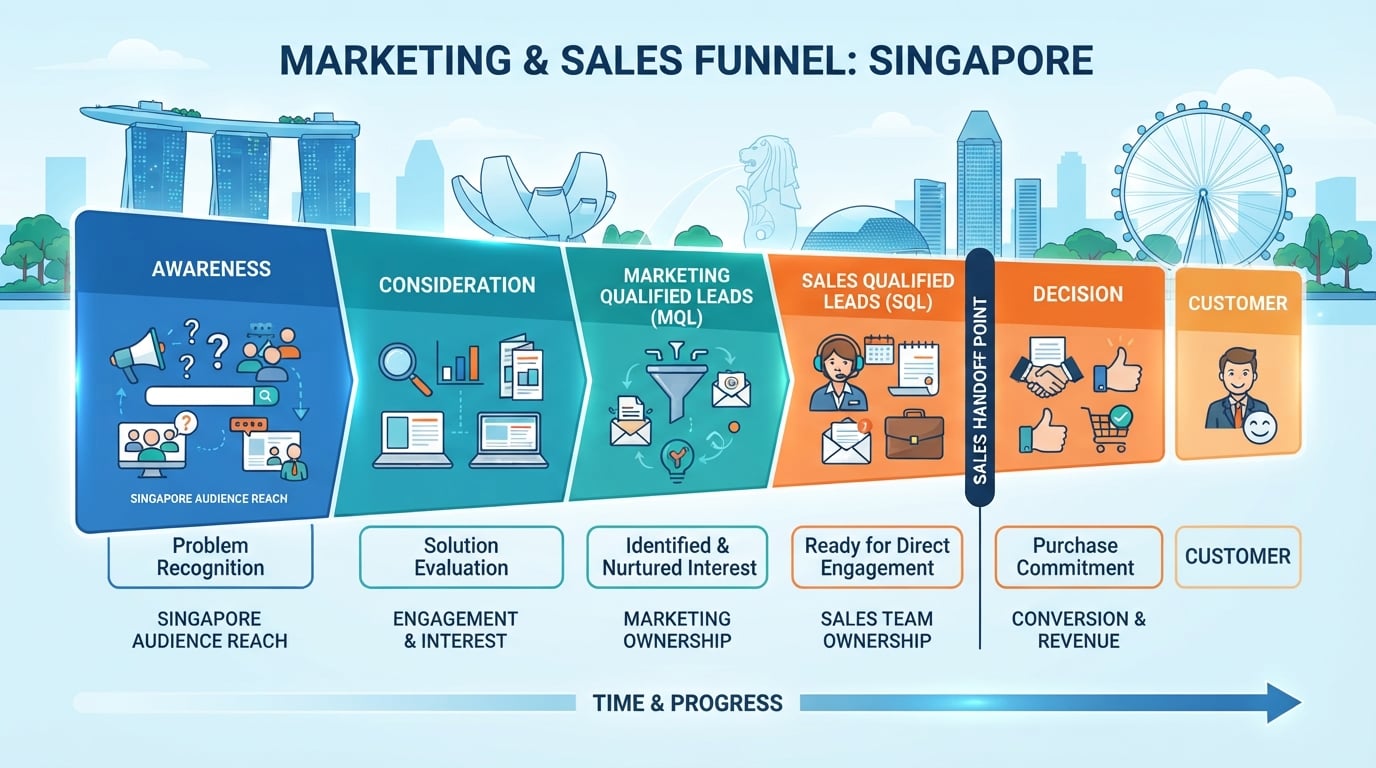
The marketing funnel moves a stranger through awareness, consideration and decision. MQLs generally sit between consideration and decision: the prospect has shown meaningful interest but has not yet been accepted by sales as a qualified opportunity.
A sales-qualified lead (SQL) comes next, once sales has reviewed the prospect and decided it is worth pursuing. The MQL is initially marketing’s responsibility; the SQL marks sales’ acceptance of the lead.
Step 1: Define Your MQL Criteria
Before assigning points or setting a threshold, decide what makes a prospect worth passing to sales. Marketing and sales should agree on a short list of criteria based on the characteristics and behaviours of customers who have previously converted.
Identify fit and engagement criteria
Start by separating your criteria into two groups.
1. Fit criteria
These indicate whether the prospect matches your ideal customer profile. Examples include:
- Company size
- Industry
- Job title and seniority
- Geographic location
- Available budget or purchasing authority
2. Engagement criteria
These indicate whether the prospect is actively considering your product or service. Examples include:
- Repeated visits to pricing or product pages
- Downloading relevant guides or resources
- Attending webinars or product demonstrations
- Clicking and responding to marketing emails
- Requesting a consultation or demo
Not all engagement signals carry the same weight. Someone who requests a product demo usually shows stronger buying intent than someone who reads a general blog article.
Consider common MQL examples
Three common examples of potential MQLs include:
- Highly engaged visitors who return to pricing or product pages several times within a short period.
- Active email responders who click links, reply to messages or request additional information.
- Event attendees who participate in a product demonstration or request a follow-up conversation.
Each prospect must also meet your fit criteria. For example, a competitor researching your pricing page may show strong engagement but is unlikely to be a suitable sales lead.
Consider product-qualified leads (PQLs)
A marketing-qualified lead is qualified through marketing activity, while a product-qualified lead (PQL) is qualified through behaviour inside a product.
For example, a software user who activates a free trial, repeatedly uses key features or reaches a usage milestone may qualify as a PQL. For businesses with free trials or freemium products, PQLs can provide an additional buying-intent signal.
A prospect can be both an MQL and a PQL. Your qualification process should specify which signals trigger a sales handoff and which team is responsible for following up.
Step 2: Build Your MQL Scoring System
Once marketing and sales agree on the criteria, turn them into a points-based scorecard. This makes lead qualification more consistent and reduces the risk of passing prospects to sales based on instinct alone.
Assign points to each criterion
Give each criterion a points value based on how strongly it indicates a potential sale. A request for a demo should receive more points than a general blog visit. Similarly, a decision-maker at a company that matches your ideal customer profile should score more highly than a contact with an unrelated job role.
A simple starting scale is 0 to 20 points per criterion. Adjust the weights based on your customer data and sales team’s experience.
Lead scoring systems can combine engagement signals, such as page views and email interactions, with fit information, such as job title and company size. HubSpot’s lead scoring documentation explains how businesses can assign points to these different criteria and configure scoring rules.
Worked MQL scoring example
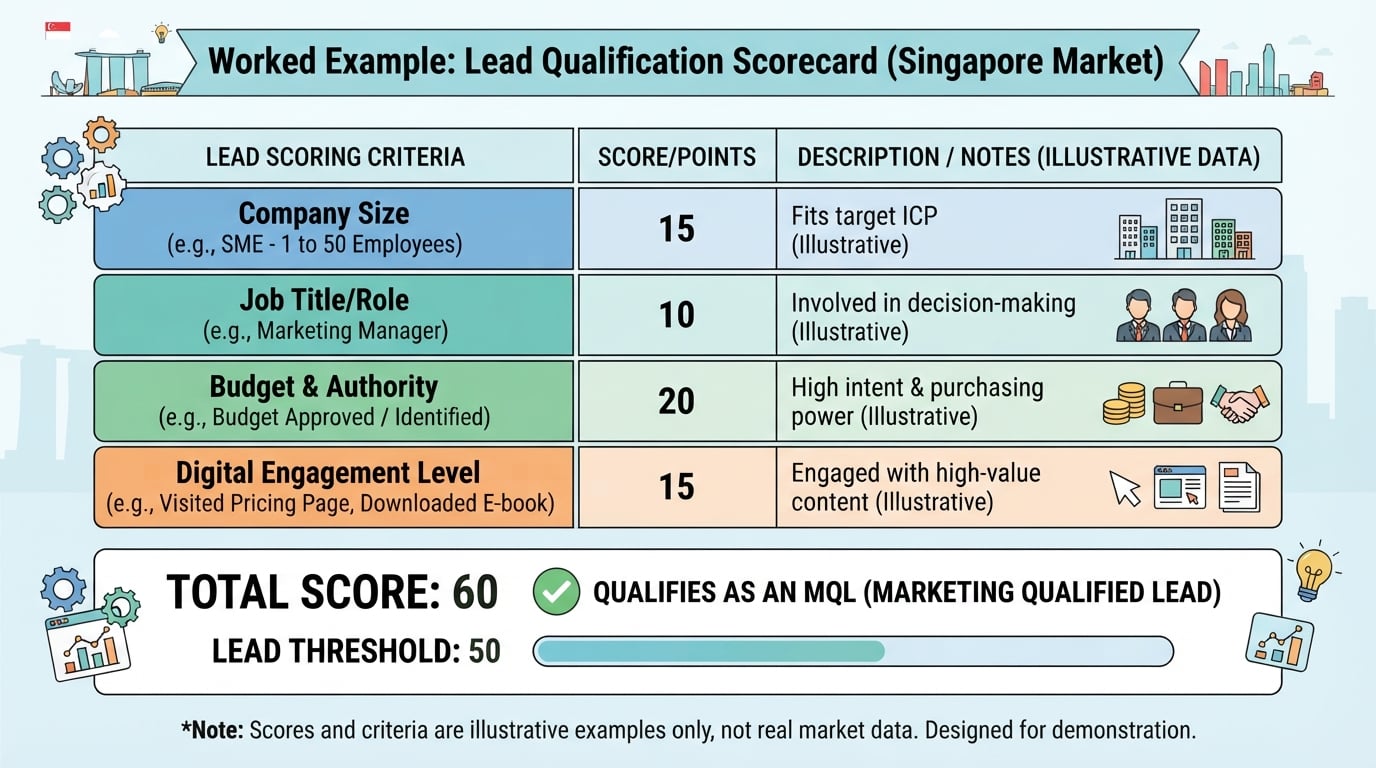
Suppose a software company uses the following scorecard:
| Criterion | Lead’s value | Points |
|---|---|---|
| Company size of 200 to 1,000 employees | Yes | 20 |
| Role of head of marketing | Yes | 15 |
| Viewed pricing page | Yes | 15 |
| Downloaded two or more guides | Yes | 10 |
| Requested a demo | No | 0 |
| Total | 60 points | 60 |
If the agreed threshold is 50 points, this prospect qualifies as an MQL.
By comparison, a student from a small company who has only visited a blog article may receive very few points and remain in the nurturing process.
The scorecard should reflect the likelihood of a prospect becoming a customer, rather than simply rewarding every interaction. Marketing automation can help apply these rules consistently, update lead records and notify sales when a prospect reaches the agreed score.
Step 3: Set and Test Your MQL Threshold
The threshold is the minimum score a prospect must reach before becoming an MQL. Setting it too low can overwhelm sales with unqualified leads, while setting it too high may prevent good prospects from receiving timely attention.
Choose a threshold based on historical data
Avoid choosing a threshold based on guesswork. If possible, review the previous 12 months of leads and compare their scores with actual sales outcomes.
Look for patterns such as:
- Which scores are common among leads accepted by sales?
- Which scores are common among leads rejected by sales?
- Which fit and engagement criteria appear most often among converted customers?
- At what score do leads begin progressing more consistently towards sales opportunities?
Use these patterns to select an initial threshold. The goal is to identify a score that separates promising prospects from those who need more nurturing.
Test the scorecard with past leads
Before launching the scoring system, select 30 to 50 past leads and score them manually.
Ask a sales representative to review each lead and decide whether they would have accepted it for follow-up. Compare the sales team’s decisions with the scores.
If the scorecard classifies leads that sales consistently rejects as MQLs, revisit the criteria and point values. If it excludes prospects that later became customers, consider whether the threshold is too strict or important buying signals are missing.
Review the threshold after one quarter
Once the scoring system is active, review its performance with sales after the first quarter.
Compare the number of MQLs generated with the number accepted by sales and the number that progress to SQLs or opportunities. If sales acceptance is low, investigate whether the criteria are too broad. If the number of qualified leads is too small, check whether the threshold is unnecessarily restrictive.
Make changes based on the reasons behind the results, not simply to increase or decrease MQL volume.
Step 4: Manage, Track and Improve MQLs
An effective MQL strategy does not end when a prospect reaches the scoring threshold. Businesses need a reliable process for passing leads to sales, tracking their progress and improving qualification criteria over time.
Track MQL performance
Monitor a few key metrics to understand whether your scoring system is producing useful leads.
| Metric | What it tells you |
|---|---|
| MQL volume | How many leads meet your qualification criteria |
| Sales acceptance rate | How many MQLs sales accepts for follow-up |
| MQL-to-SQL conversion rate | How many MQLs progress to sales-qualified leads |
| Opportunity conversion rate | How many qualified leads become sales opportunities |
| Follow-up time | How quickly sales contacts an accepted MQL |
| Customer conversion rate | How many leads eventually become paying customers |
According to EngageBay’s analysis of marketing-qualified leads, 73% of marketing-generated leads are never contacted by sales. This highlights why businesses should monitor follow-up activity alongside lead quality.
Establish clear lead management responsibilities
Marketing and sales should agree on who owns each stage of the process. Marketing is responsible for identifying and nurturing prospects until they meet the agreed MQL criteria. Sales then reviews accepted leads and determines whether they are ready to progress.
A documented service-level agreement (SLA) should specify:
- Who receives each MQL
- How quickly sales must follow up
- What information marketing must provide
- How sales records accepted or rejected leads
- How rejected leads return to marketing for further nurturing
For example, a business might require sales to contact an accepted MQL within one business day. This is a practical target that teams can agree on, rather than a universal industry standard.
Review and improve your scorecard
Review your MQL criteria at least quarterly, or sooner when your product, pricing or target audience changes.
Look for patterns in rejected leads, conversion rates and sales feedback. If prospects with high engagement but poor company fit are regularly rejected, increase the weight of fit criteria. If promising prospects are being overlooked, review whether the scoring system gives enough points to their buying signals.
Keep the scorecard documented and update it whenever the evidence suggests that the existing rules no longer reflect the customers your business wants to attract.
MQL vs. SQL: Understanding the Sales Handoff
A marketing-qualified lead (MQL) is a prospect that marketing considers ready for sales follow-up. A sales-qualified lead (SQL) is one that a sales representative has reviewed and judged worth pursuing as a potential customer.
The distinction is important because an MQL may match the target audience and show interest but still need more nurturing. An SQL has been assessed by sales and is considered ready for a direct sales conversation.
Salesforce explains this distinction in its guide to lead qualification.
MQL vs. SQL differences
| MQL | SQL |
|---|---|
| Identified by marketing | Reviewed and accepted by sales |
| Based on fit and marketing engagement | Based on sales assessment and buying readiness |
| May still need nurturing | Ready for direct sales follow-up |
| Marketing initially manages the lead | Sales takes responsibility for the opportunity |
Not every MQL becomes an SQL. EngageBay reports that many marketing leads fail to progress into sales, highlighting why both teams need to agree on qualification criteria.
What to include in the MQL-to-SQL handoff
A clean handoff gives the sales representative enough context to follow up without repeating the entire qualification process.
Pass across:
- The lead’s company, role and contact details.
- The pages viewed and content downloaded.
- The lead’s score and the threshold it met.
- Any explicit request for contact, such as a demo or pricing enquiry.
- A recommended next action and response-time expectation.
Sales should also record whether it accepts or rejects each MQL. When a lead is rejected, the reason should be documented so marketing can identify recurring problems and improve its scoring rules.
Generating and Nurturing MQLs
A strong scoring system helps identify qualified prospects, but businesses also need a strategy to attract and nurture the right audience.
Strategies to generate more MQLs
The goal should not be to generate as many leads as possible. Instead, focus on attracting prospects who match your ideal customer profile and are more likely to become customers.
Three approaches can help:
- Target the right audience. Build campaigns around the company sizes, job roles and industries that match your best existing customers.
- Create high-intent content. Develop pricing information, comparison guides, case studies and demo offers that help prospects evaluate your solution.
- Use scoring data to direct marketing spend. If a channel consistently produces leads that sales rejects, review its targeting and consider reallocating the budget.
The quality of MQLs also depends on how businesses attract prospects in the first place. A well-planned lead generation strategy helps reach audiences with a genuine interest in the offer.
The role of content in nurturing MQLs
A prospect who meets the MQL threshold may still need more information before making a purchasing decision. Relevant content can help answer questions, address objections and build confidence in your product or service.
For example:
- Share industry-specific case studies with prospects who are comparing solutions.
- Send pricing and return-on-investment information to contacts who have visited pricing pages.
- Provide product guides to prospects who have downloaded introductory resources.
- Use targeted email sequences to follow up based on previous interactions.
For ongoing communication, email marketing allows businesses to segment contacts and deliver messages based on their interests and previous interactions.
Keep nurturing content relevant to the prospect’s behaviour. If a lead stops engaging or no longer meets the agreed criteria, move it into a lower-priority nurturing stream instead of leaving it in the active MQL pool.
Diagnosing Why Sales Rejects MQLs
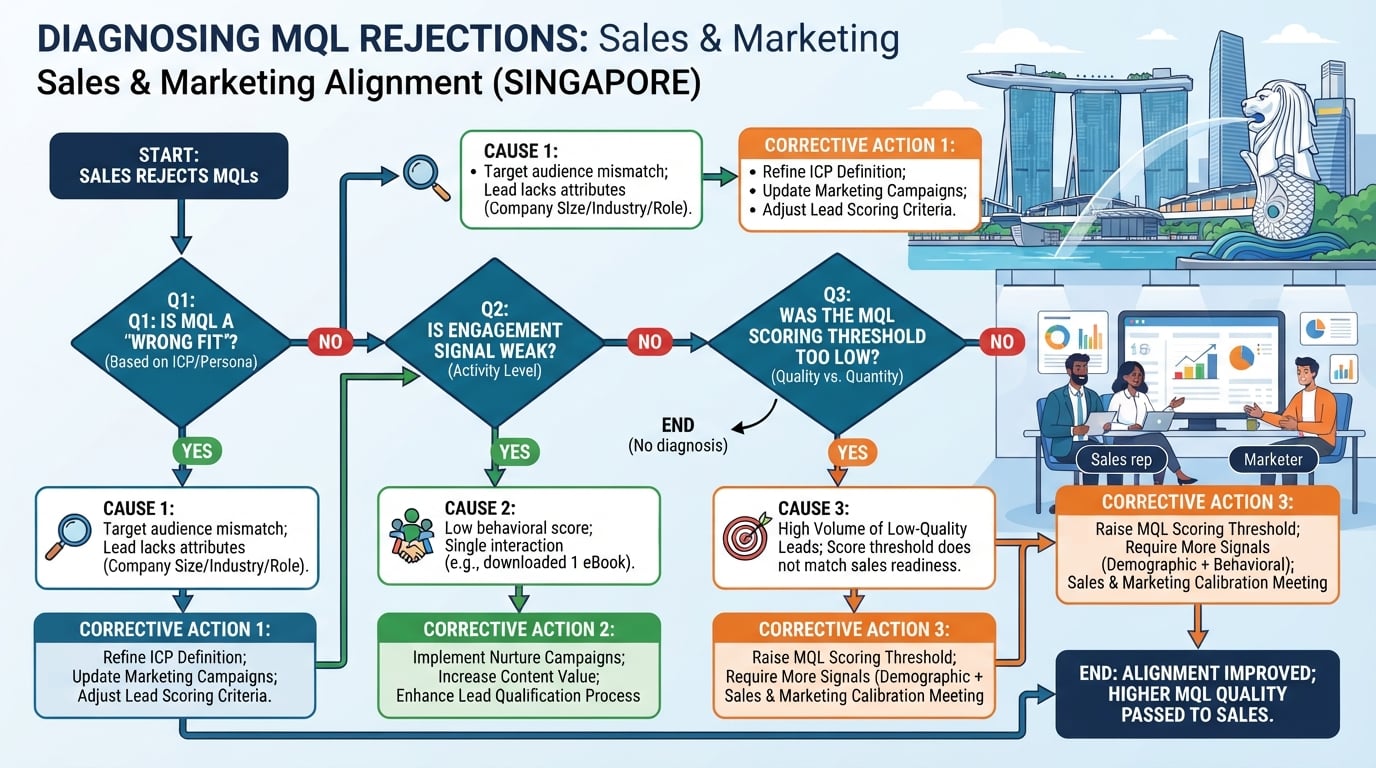
When sales rejects a large share of MQLs, the instinct may be to blame the leads or the sales team. However, rejection provides useful information about where the qualification process may be failing.
Start by reviewing a sample of 50 to 100 rejected leads from the previous quarter. Include the reason given by the sales representative, the criteria the lead scored against and the actions it took before reaching sales.
Then group each rejection by its main cause.
| Cause | What it looks like in the record | Typical fix |
|---|---|---|
| Poor fit | Wrong company size, industry or job role | Reweight firmographic criteria or tighten the fit threshold |
| Weak intent | High score built from blog reads and newsletter sign-ups | Give more points to pricing-page visits and direct contact requests |
| Slow follow-up | Lead was contacted days after being accepted | Set a response-time SLA |
| Stale data | Wrong contact, job change or closed company | Add data-hygiene checks and recency rules |
Where possible, have two people categorise the rejected leads independently and compare their findings. Disagreements may indicate that the rejection categories or qualification criteria are unclear.
Once the causes are identified, prioritise the most common problem. If poor fit dominates, increase the weight of company and role criteria. If weak intent is the main issue, adjust the engagement points or raise the threshold. If slow follow-up is responsible, improve the sales process rather than changing the scoring system.
After making adjustments, test the revised scorecard against a fresh sample of leads. Compare the sales acceptance rate and progression to SQLs to determine whether the changes have improved lead quality.
Frequently Asked Questions
What is the difference between an MQL and an SQL?
An MQL, or marketing-qualified lead, is a prospect that marketing has judged likely to buy based on fit and engagement. A sales-qualified lead (SQL) is one that a sales representative has reviewed and accepted as worth pursuing directly. The MQL is marketing’s judgement; the SQL is sales’ agreement.
How do you score a marketing-qualified lead?
Agree on a short list of criteria with sales, such as company size, job role, pricing-page visits, content downloads and requests for contact. Give each criterion a points value, add up the points for each lead and set a minimum threshold. Test that threshold against actual sales acceptance results before relying on it.
What is a good MQL-to-SQL conversion rate?
There is no universal benchmark because conversion rates depend on the business, its products, pricing and qualification criteria. A more useful measure is whether your rate is improving over time and whether sales accepts most of the leads marketing passes over.
Can a lead be an MQL and a PQL at the same time?
Yes. A product-qualified lead (PQL) is a user whose behaviour inside a product signals purchase intent, such as repeatedly using a key feature during a free trial. A trial user can meet both marketing criteria and product usage signals, making them both an MQL and a PQL.
How often should MQL criteria be reviewed?
Review the criteria at least quarterly, and sooner after a major campaign, product change or pricing update. Compare sales acceptance rates and lead outcomes with the existing threshold. If sales regularly rejects leads that meet the criteria, revisit the scorecard.