

When patients seek a clinic, specialist, or hospital, they typically begin with Google. They compare local options, review feedback, verify operating hours, and evaluate if a provider appears sufficiently credible to contact. That is precisely why local SEO for healthcare matters.

In Singapore, this behaviour occurs in a highly digital market. According to the Infocomm Media Development Authority, Singapore’s digital economy comprised 18.6% of GDP in 2024, up from 14.9% in 2019.
That data does not directly demonstrate patient search habits, but it reinforces a broader reality: digital discovery is now central to how people find and compare services, including healthcare.
At the same time, healthcare differs from retail, F&B, or home services. Visibility is essential, but so are trust, accuracy, and compliance.
In Singapore, healthcare advertisements are regulated by the Healthcare Services (Advertisement) Regulations 2021, which took effect on 3 January 2022. Any local SEO approach for healthcare must boost discoverability without making unsubstantiated claims or using excessively promotional language.
If you want the broader framework first, our guide to choosing a local seo agency in Singapore explains how local visibility across Google Search and Google Maps is built. Having covered the regulatory landscape, let’s now explore what local SEO for healthcare means in practical terms.
Key Takeaways
- Local SEO for healthcare in Singapore helps clinics and hospitals appear more clearly in Google Search and Google Maps when patients are looking for nearby care. It works best when profiles, pages, reviews, and local trust signals are aligned.
- Google’s local rankings are shaped by relevance, distance, and prominence, so visibility is not only about adding keywords. Accurate clinic information, strong location pages, and a well-managed Google Business Profile all play an important role.
- In healthcare, local SEO must be handled with compliance in mind. Service descriptions, review handling, and promotional wording should stay accurate, careful, and aligned with Singapore’s healthcare advertising rules.
- Strong local SEO for healthcare goes beyond listings and directories. Clinics and hospitals also need useful location pages, clear appointment pathways, and content that matches what patients are actually searching for.
- Success should be measured by meaningful outcomes, not traffic alone. Calls, appointment clicks, direction requests, and qualified enquiries give a clearer picture of whether local SEO is supporting patient acquisition.
What Is Local SEO for Healthcare in Singapore?
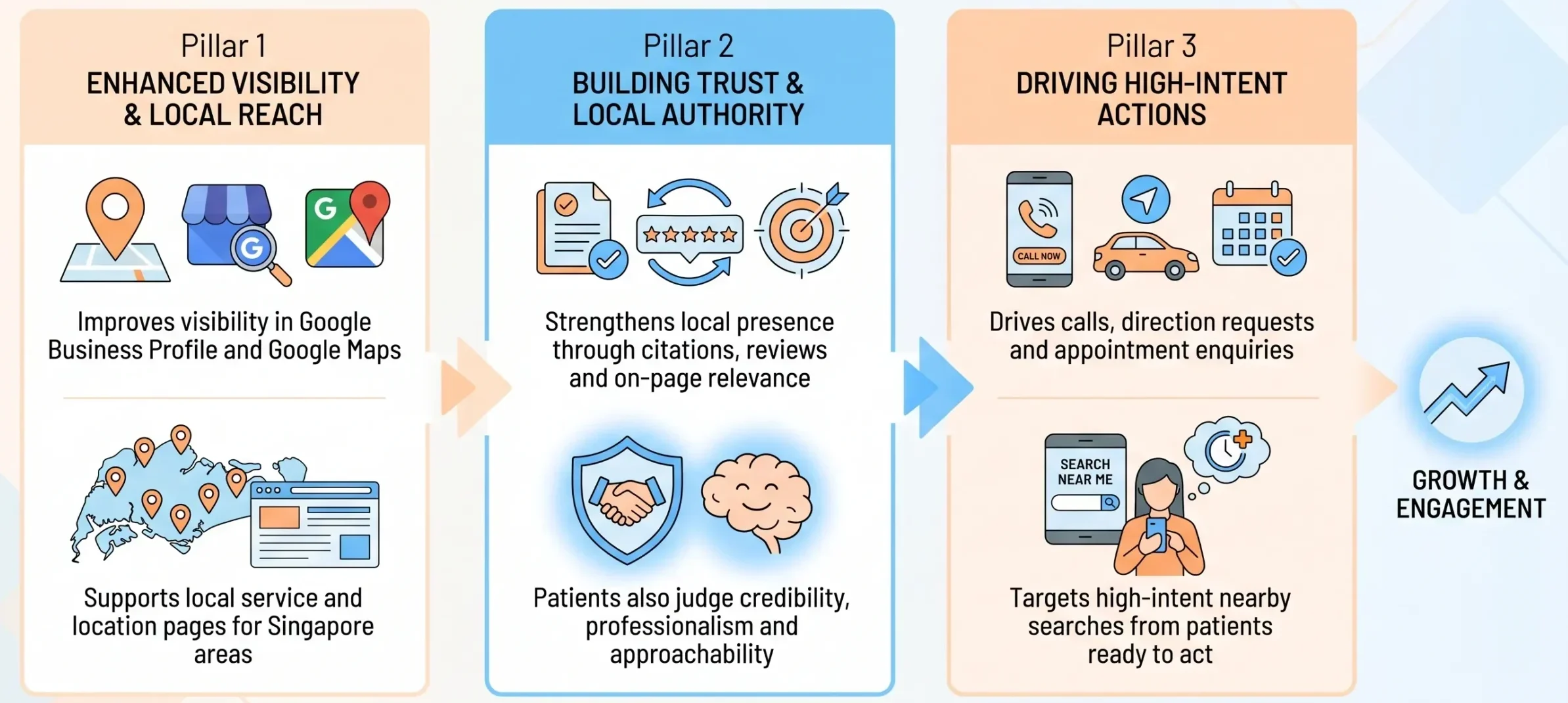
Local SEO for healthcare is the process of improving how a clinic, specialist practice, or hospital appears in location-based search results. In practical terms, it covers:
- Google Business Profile
- Google Maps visibility
- location and service pages
- local citations
- online reviews
- on-page local relevance signals
Unlike general SEO, which targets broader informational or national queries, local SEO for healthcare focuses on nearby patient needs, such as those searching for a GP, dental clinic, physiotherapist, or specialist in a specific area of Singapore.
| Area | General SEO | Local SEO for Healthcare |
| Main goal | Broader organic visibility | Nearby patient discovery |
| Typical queries | treatment guide, condition symptoms | GP clinic near me, ENT specialist Novena |
| Core assets | content, technical SEO, backlinks | Google Business Profile, reviews, local pages, citations |
| Main conversions | content engagement, form fills | calls, direction requests, appointment enquiries |
| Compliance sensitivity | varies by industry | high |
Healthcare also requires greater trust. Patients evaluate more than convenience. They assess credibility, professionalism, and whether the provider feels safe approaching the provider.
How Local SEO for Healthcare Works on Google
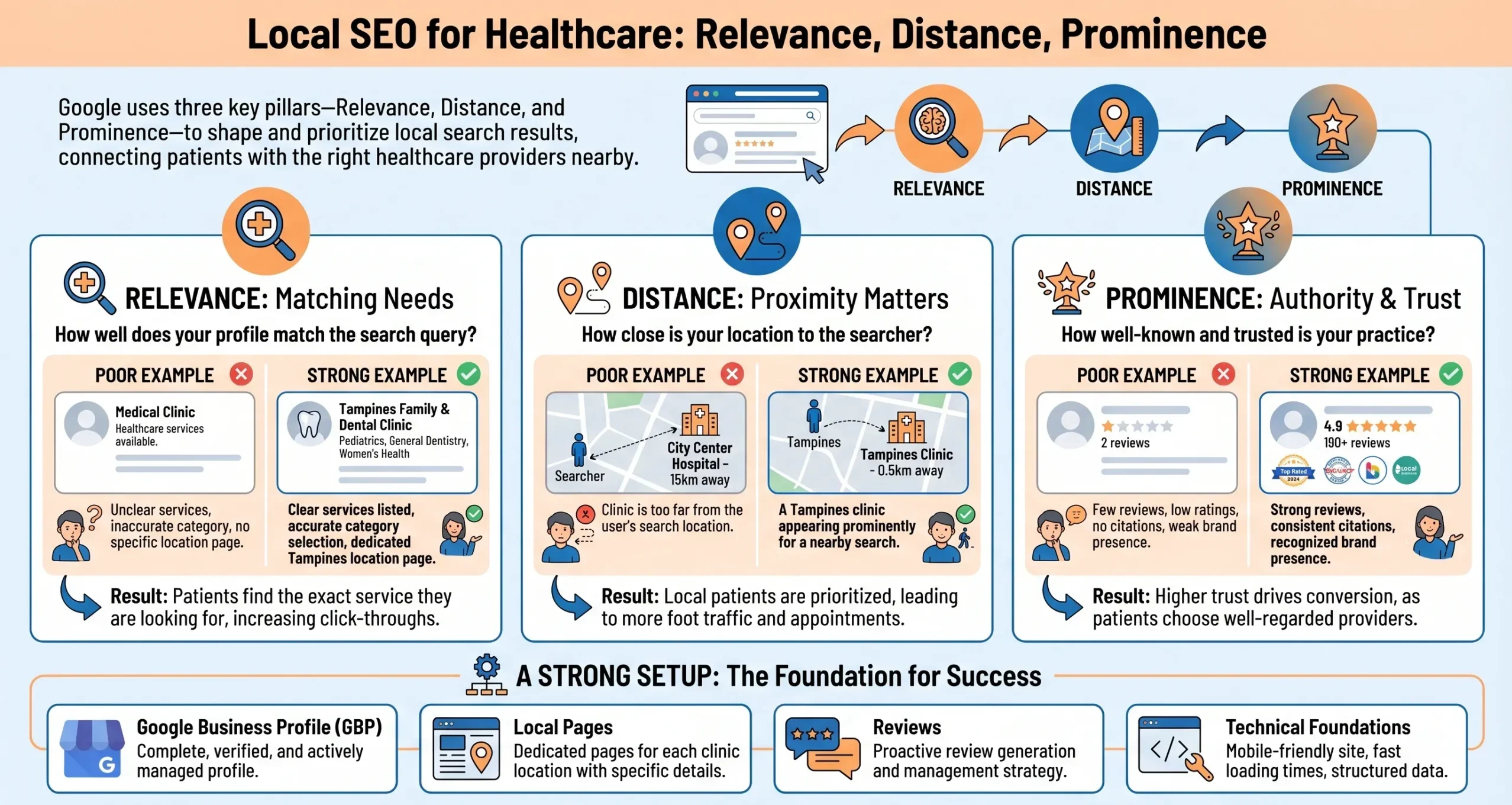
Google’s own guidance states that local results are mainly influenced by relevance, distance, and prominence. That framework should anchor any discussion of local SEO for healthcare, because it explains what Google is actually trying to do in local search.
See Google’s guide on tips to improve your local ranking on Google. Here is what that means in healthcare terms:
| Google factor | What it means | Healthcare example |
| Relevance | How closely the listing matches the search | Accurate category, clear services, relevant location page |
| Distance | How near the provider is to the searcher or searched area | A clinic branch in Tampines is appearing for a local search |
| Prominence | How established and trusted the provider appears online | Reviews, citations, strong website, recognised brand presence |
When managing local SEO for healthcare, our goal is not to manipulate Google. Instead, we aim to make the provider more understandable, trustworthy, and appealing for selection.
That is why a strong healthcare local SEO setup usually includes:
- a complete and accurate Google Business Profile
- high-quality location and service pages
- consistent clinic details across the web
- genuine patient reviews
- strong internal linking and technical foundations
Google also indicates that keeping profile information accurate and up to date helps customers understand what you offer, where you are, and when to visit.
For healthcare providers, that clarity directly supports patient decision-making. See Google’s documentation on editing your Business Profile.
Why Local SEO for Healthcare Matters in Singapore
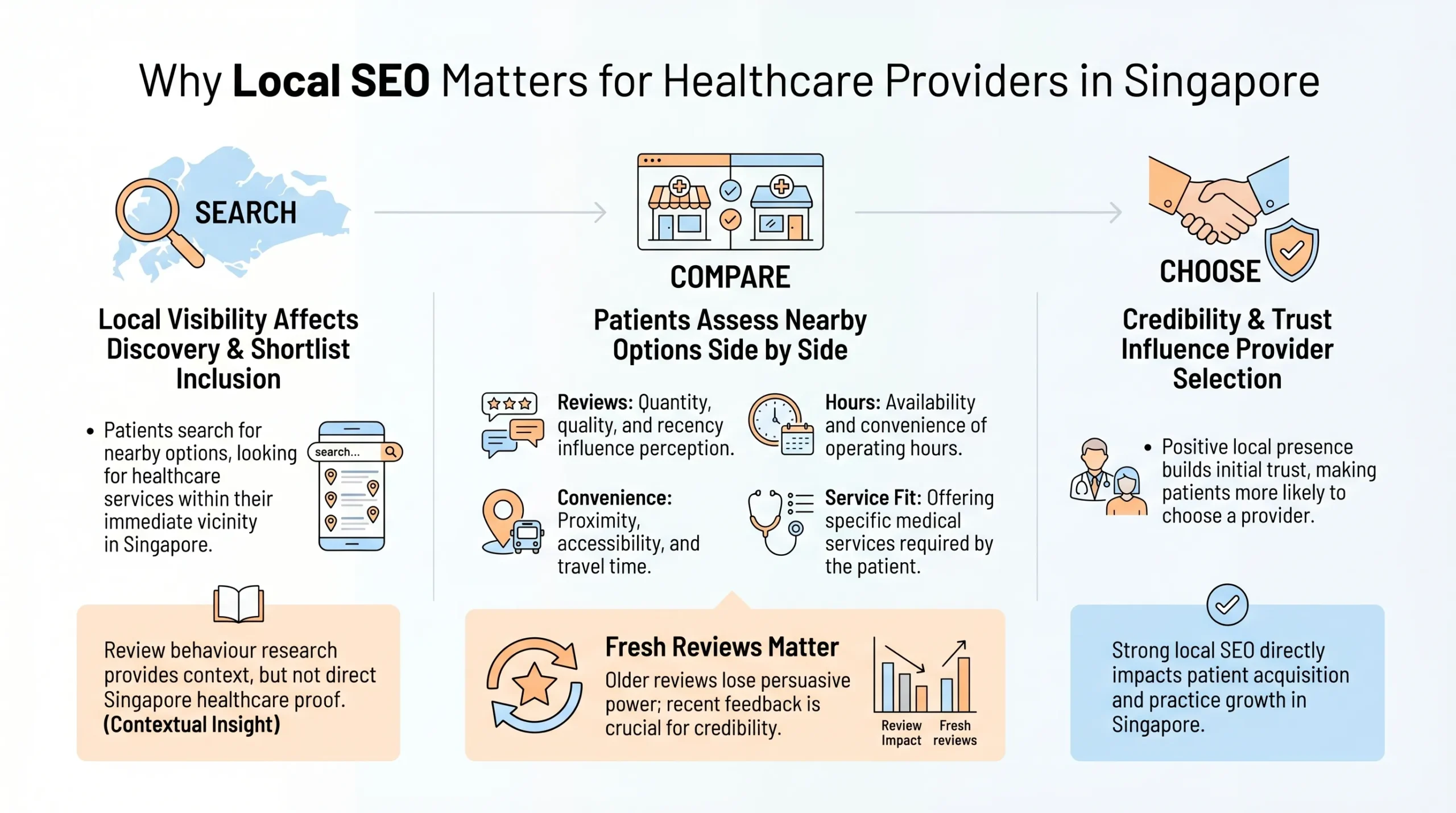
A patient searching for care is often comparing several providers at once. They may look at:
- proximity
- reviews
- clinic hours
- appointment convenience
- service coverage
- overall credibility
As a result, strong local visibility not only increases search visibility but also influences which providers patients consider.

Reviews are part of that decision process. According to the BrightLocal Local Consumer Review Survey 2026, review expectations remain high, and older reviews lose persuasive value more quickly than many businesses assume.
BrightLocal’s supporting data also notes that 97% of consumers read reviews for local businesses and 71% use Google to read local business reviews.
Although this is US-based research, not Singapore-specific patient data, I would treat it as directional rather than one-to-one proof for healthcare in Singapore. It is still relevant to local search behaviour.
Local SEO for Healthcare and Singapore Compliance Rules
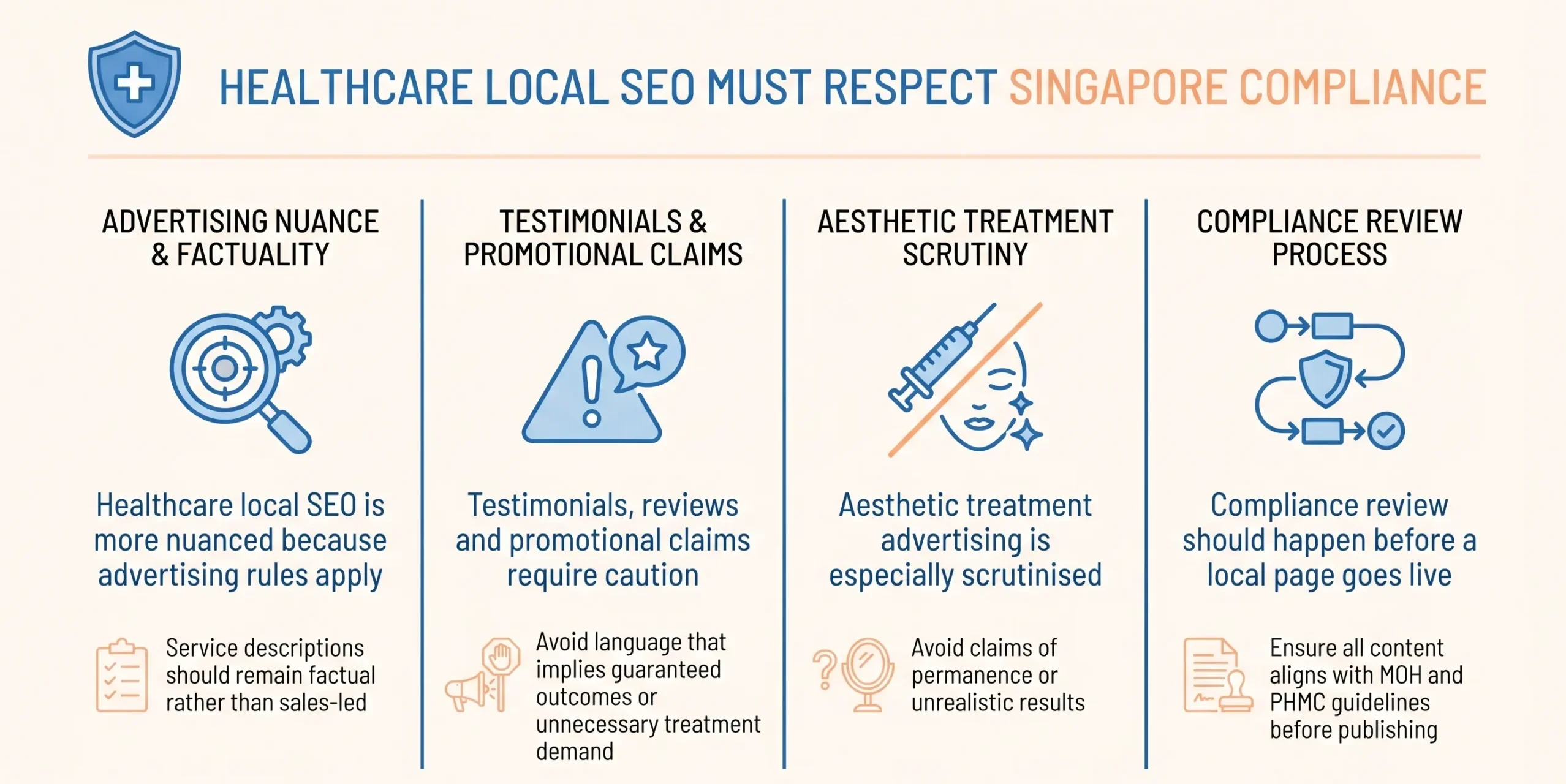
This is where healthcare local SEO becomes more nuanced.
Healthcare advertising in Singapore is regulated by the Healthcare Services (Advertisement) Regulations 2021, which took effect in January 2022. Providers must ensure all advertisements meet these requirements.
Providers offering aesthetic services must ensure ads are accurate, truthful, and do not encourage unnecessary healthcare use, as stated by the Ministry of Health.
See MOH’s statement on the regulation of advertisements for aesthetic treatments. To ensure compliance in local SEO content for healthcare, carefully review and implement specific guidelines in areas such as:
- treatment benefit claims
- profile copy
- testimonials and reviews
- before and after style messaging
- promotional wording for aesthetic treatments
| Area | Why does it need care |
| Profile descriptions | Can slip into marketing claims too easily |
| Service pages | Must stay factual and accurate |
| Reviews and testimonials | Sensitive in healthcare advertising contexts |
| Promotional wording | Should not overstate outcomes or induce unnecessary demand |
| Aesthetic treatment content | Specifically scrutinised by MOH |
Compliance checklist before publishing a local healthcare page
- Is the wording factual rather than sales-led?
- Are services described accurately?
- Are there any claims that imply guaranteed outcomes?
- Are reviews handled as genuine feedback rather than marketing assets?
- Has a healthcare decision-maker reviewed sensitive wording where needed?
A healthcare SEO guide that overlooks compliance is less authoritative and less practical.
How to Optimise Your Google Business Profile for Local SEO for Healthcare
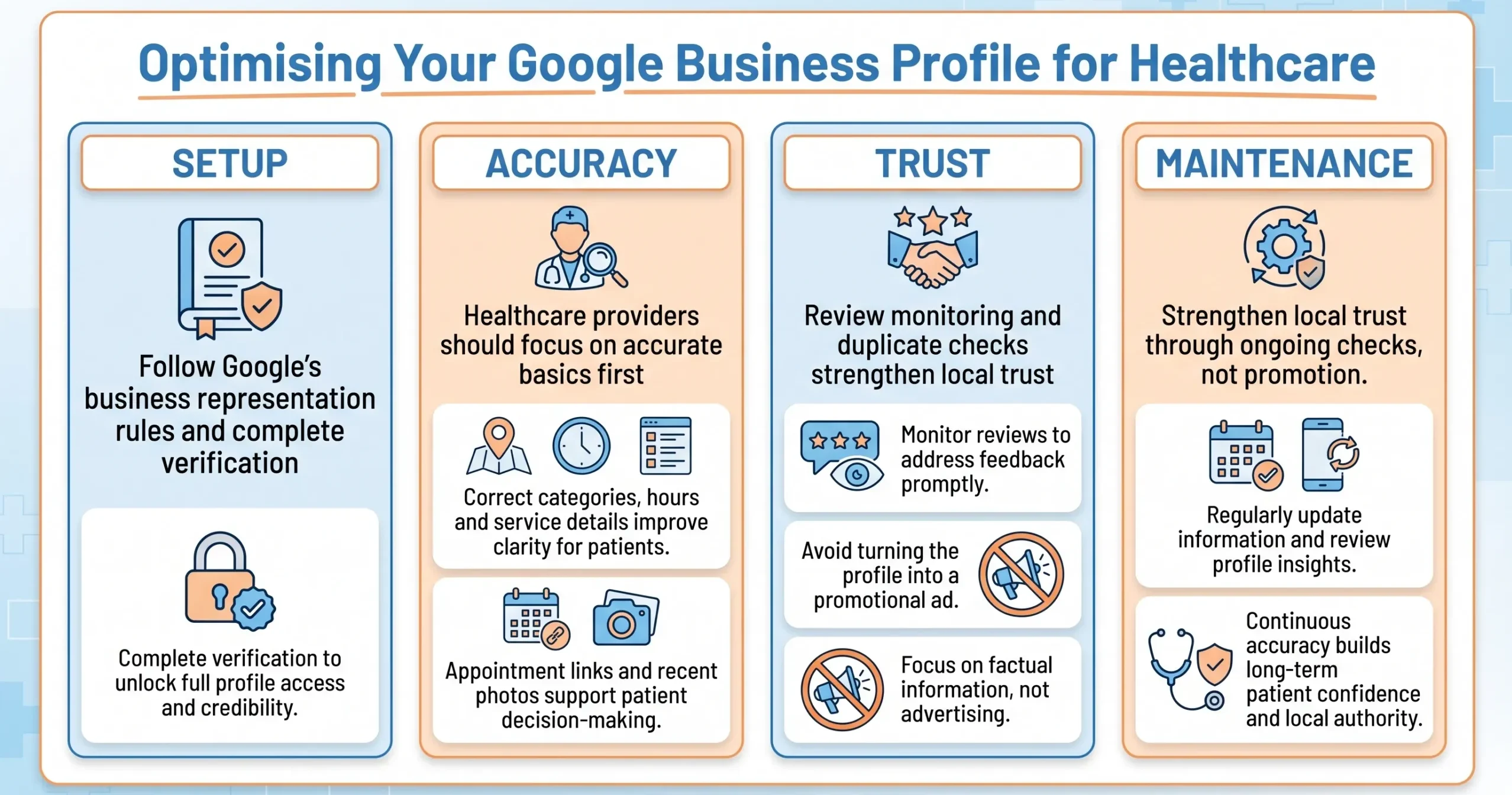
Google Business Profile is one of the most important assets in local healthcare SEO. Google’s official guidance also makes clear that businesses should follow the guidelines for representing their business on Google, and that businesses generally need to make in-person contact with customers during stated hours to qualify for a profile.
Verification is also part of the process, as explained in Google’s guide on verifying your business on Google.
For healthcare providers, focus on the basics first:
- accurate clinic name
- correct address and phone number
- current opening hours
- right primary and secondary categories
- service details that are clear and factual
- appointment links where relevant
- recent photos
- review monitoring
Google Business Profile checklist for healthcare
- claimed and verified profile
- consistent NAP details
- correct categories
- updated hours
- service list reviewed
- appointment link added
- recent photos uploaded
- duplicate profiles checked
- review response workflow in place
Equally important, avoid treating the profile as a promotional brochure. In healthcare, prioritise clarity and trust over marketing hype.
Local SEO for Healthcare Starts with Strong Location and Service Pages
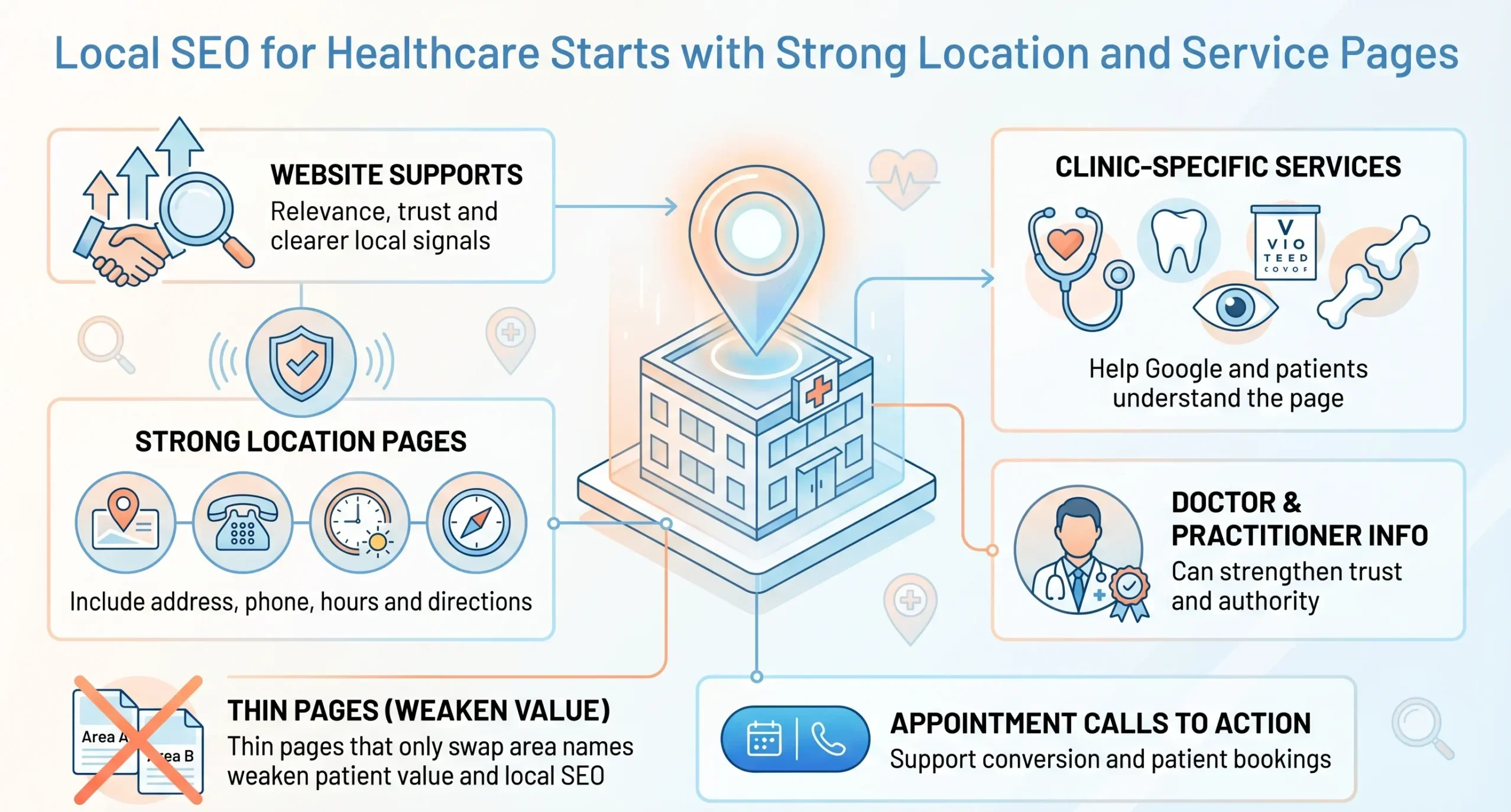
Even if your Business Profile is strong, your website still matters. It supports relevance, reinforces trust, and gives Google clearer signals about what each clinic or department actually offers.
A strong healthcare location page should include:
- address and phone number
- opening hours
- map or directions
- clinic-specific services
- doctor or practitioner information, where appropriate
- appointment CTA
- transport, parking, or accessibility details if useful
| Element | Why it matters |
| Address and phone | Supports local trust and consistency |
| Opening hours | Helps patients decide quickly |
| Directions or map | Improves usability |
| Service summary | Reinforces relevance |
| Doctor information | Builds trust |
| Appointment CTA | Supports conversion |
Weak location pages are common. Many clinic pages simply change the area name without updating the rest of the content. This approach is unhelpful for patients and fails to signal local SEO strength.
Local SEO for Healthcare for Multi-Location Clinics and Hospitals
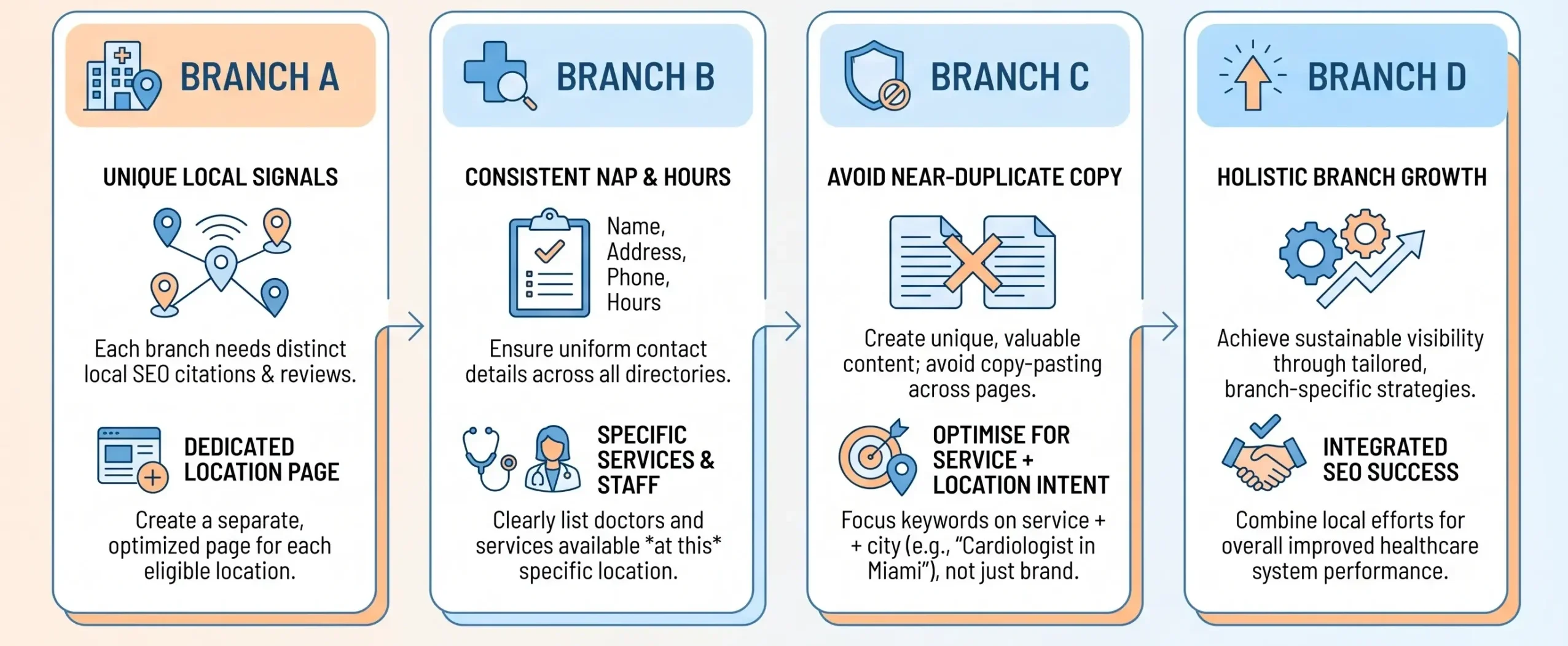
For multi-location providers, local SEO for healthcare becomes more complex because each branch may serve a different catchment area, offer different services, or have different doctors on site.
If we want each location to compete effectively in local search, we need to treat each branch as its own local visibility asset rather than relying on a single generic website page or a broad brand presence.
This matters because Google’s local results are shaped by relevance, distance, and prominence.
A provider with several branches in Singapore should make it easy for Google to understand which location is relevant to which search, what services are available there, and how that branch differs from the rest of the network.
In practice, that usually means:
- giving each eligible branch its own clear location page
- keeping each branch’s business details accurate and consistent
- aligning services with the correct location
- avoiding near-duplicate copy across every branch page
- strengthening internal linking between doctor, service, and location pages
| Multi-location issue | What to do |
| Same copy across all branches | Add location-specific details for each page, including services, access information, and branch-level context |
| One generic service page only | Link services to the relevant clinic locations and make branch availability clear |
| Inconsistent branch details | Standardise name, address, phone number, hours, and website information across listings |
| Weak non-branded rankings | Optimise each branch for service plus location intent instead of relying only on brand searches |
A hospital group or clinic chain does not automatically rank well in every local area just because the brand is known.
In many cases, stronger branch-level clarity is what helps a provider appear more consistently for non-branded searches such as specialist plus location or clinic plus neighbourhood.
How to Do Local Keyword Research for Healthcare in Singapore
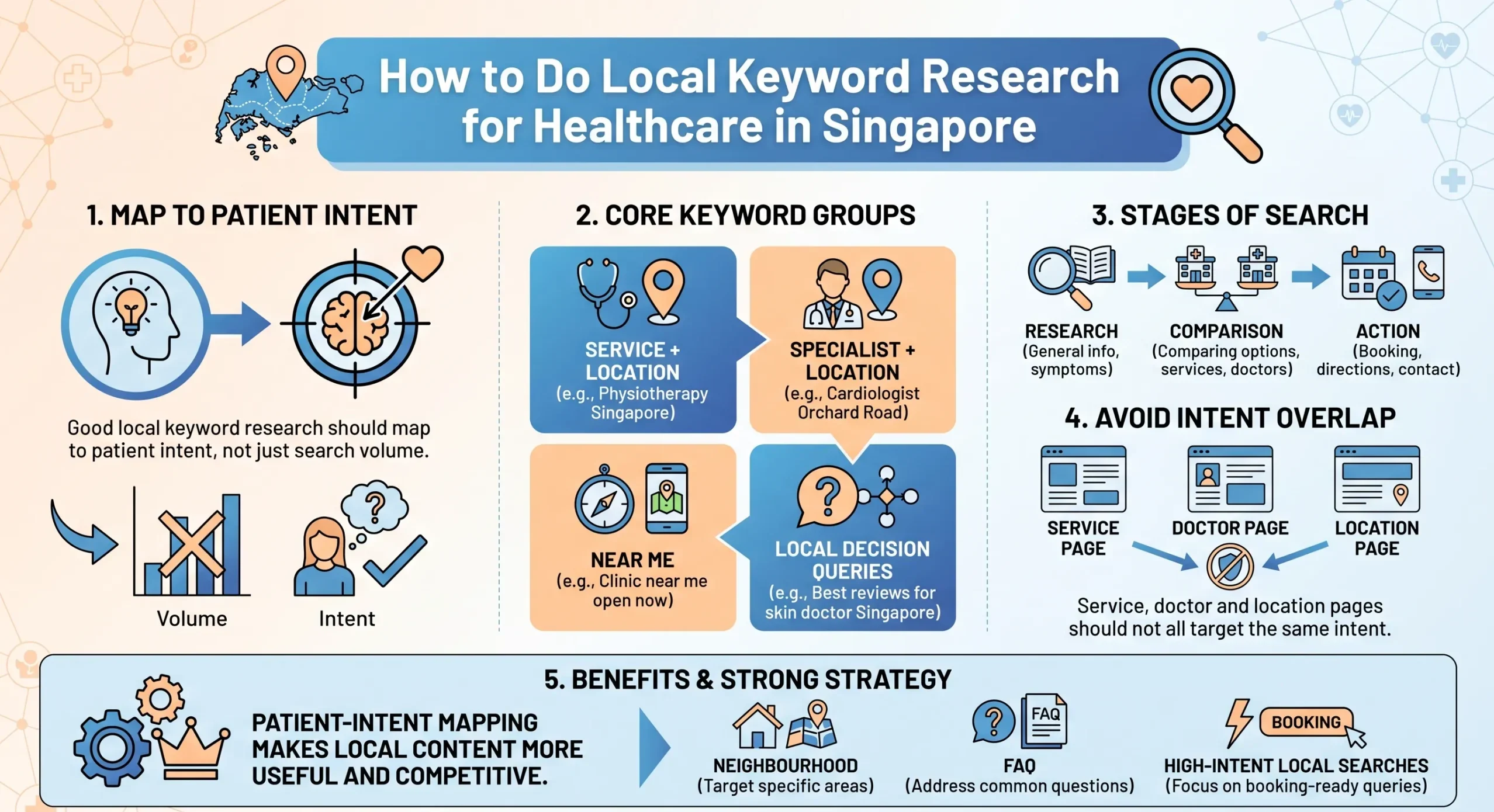
Good healthcare local keyword research should map to patient intent, not just search volume.
I would group keywords like this:
| Keyword type | Example | Likely intent |
| Service + location | Paediatric Clinic Orchard | High local intent |
| Specialist + location | dermatologist Novena | Comparison intent |
| Near me | GP clinic near me | Immediate local intent |
| Information about the local bridge | Where to get health screening in Singapore | Research moving towards action |
This helps us avoid a shallow approach. Patients do not only search in one way. Some already know the service they want. Others are still narrowing down providers.
A good keyword strategy for local SEO for healthcare should look at:
- service plus location terms
- specialist plus location terms
- neighbourhood searches
- near me intent
- FAQ-style decision queries
Mapping Local SEO for Healthcare Keywords to Patient Intent
Not every local healthcare keyword should be treated the same way. Some searches come from people who are still learning, while others come from people who are ready to compare providers or make contact.
When we map the keyword to the patient journey properly, the page can do a much better job of matching intent.
| Patient stage | Keyword example | What the page should do |
| Research | Where to get health screening in Singapore | Explain options and guide next steps |
| Comparison | Dermatologist Orchard reviews | Build trust and reduce uncertainty |
| Action | GP clinic near me | Make contacting or visiting easy |
In local healthcare SEO, this matters because a service page, a doctor page, and a location page do not all serve the same purpose. A broad keyword strategy may drive impressions, but a patient-intent strategy is what makes local content more useful and competitive.
Reviews, Reputation, and Local SEO for Healthcare
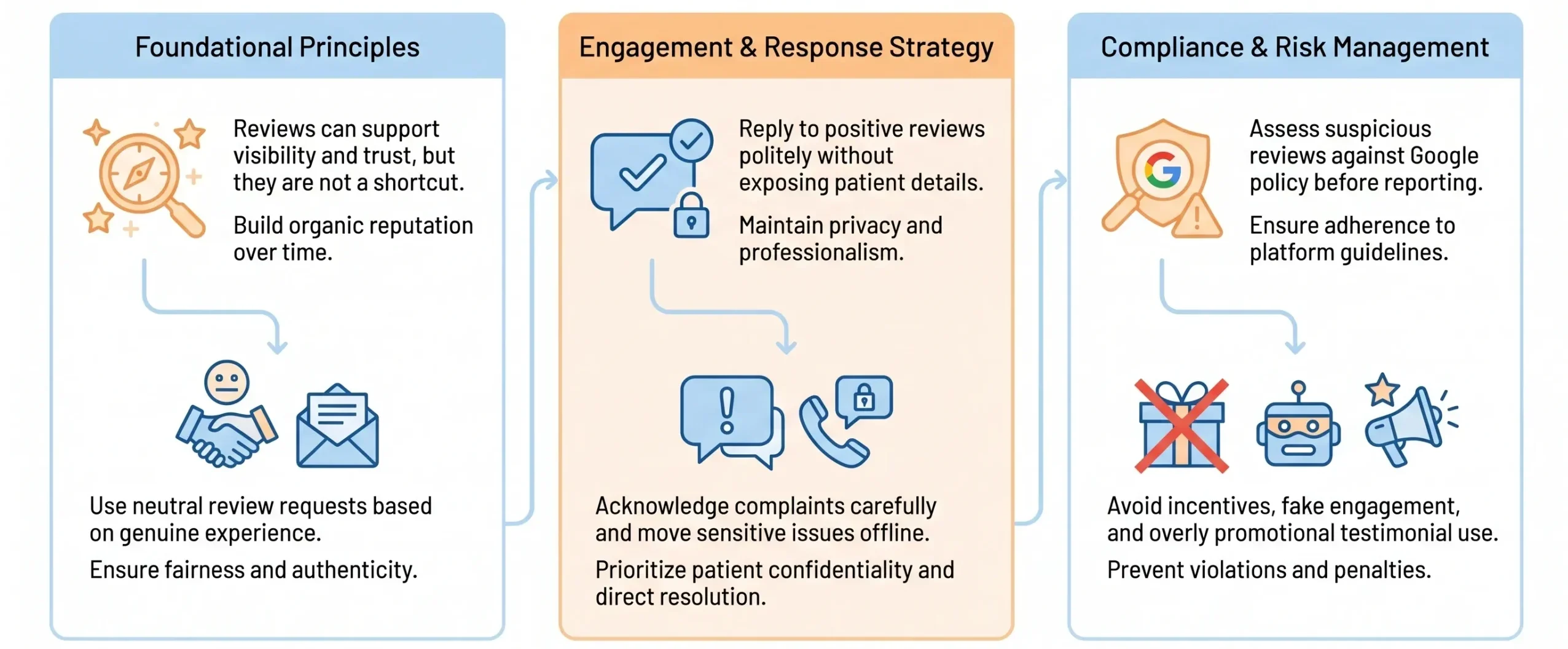
Reviews shape both prominence and patient confidence. But in healthcare, they need to be handled carefully.
If you need a structured approach to monitoring, protecting, and improving brand trust, our online reputation management service explains how to manage reputation more systematically.
Google’s prohibited and restricted content policy states that fake engagement is not allowed. That includes content not based on a real experience, paid reviews, or content posted from multiple accounts by or at the request of one person.
Google also says businesses that violate the fake engagement policy may face restrictions on their Business Profiles.
That means the right approach is not to manufacture reputation. It is to build a review process around genuine patient experience.
Review management checklist
- monitor new reviews regularly
- assign clear response ownership
- use privacy-safe response wording
- escalate sensitive cases internally
- report fake reviews where justified
| Situation | Best approach |
| Positive review | Thank politely without revealing patient details |
| Negative review | Acknowledge concern and avoid discussing clinical specifics publicly |
| Suspicious review | Assess against Google policy and report if needed |
| Repeated complaint theme | Feed the insight back into operations and content |
Review Governance Matters in Local SEO for Healthcare
Reviews can enhance visibility and patient confidence, but in healthcare, they should never be treated as a shortcut.
We need a clear review governance process that outlines how feedback is requested, who monitors it, how responses are handled, and when a concern should be escalated offline rather than debated publicly.
This is important for two reasons. First, Google prohibits fake engagement, including paid-for reviews, reviews based on non-real experiences, or reviews posted misleadingly. Businesses that breach these policies can face profile restrictions.
Second, Singapore healthcare advertising rules mean providers should also be careful not to drift into risky testimonial-style promotion or overly promotional patient-facing messaging.
A strong healthcare review process should include:
- clear ownership for monitoring and replies
- privacy-safe response language
- escalation steps for sensitive complaints
- a policy against incentives or manufactured reviews
- regular review of recurring themes that may affect service quality
| Review activity | Good practice |
| Asking for reviews | Keep it neutral and based on genuine experience |
| Replying to positive reviews | Thank the reviewer politely without exposing patient details |
| Replying to complaints | Acknowledge the concern carefully and move sensitive issues offline |
| Suspicious reviews | Assess against Google policy before reporting |
In practice, this also improves the quality of local SEO work itself. When recurring complaints or questions appear in reviews, they often highlight content gaps, service issues, or trust barriers that can be addressed more effectively on the website and in profile management.
Local Citations and Directory Listings for Healthcare SEO
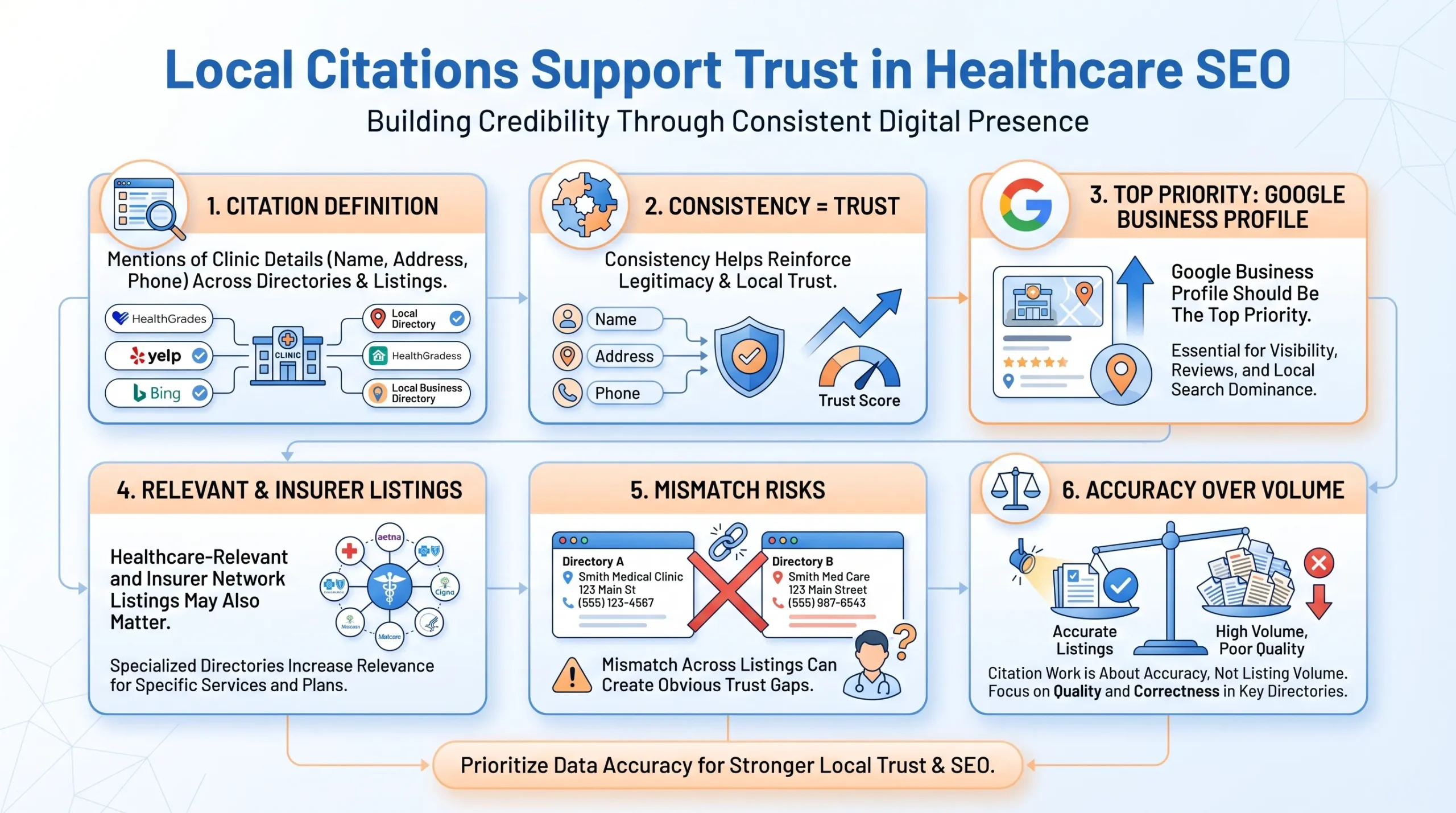
Citations are mentions of your clinic’s name, address, phone number, and website across directories and listing platforms. They are not the most glamorous part of local SEO for healthcare, but they help reinforce consistency and legitimacy.

The key principle is simple: your core clinic details should match across the web.
| Field | Should stay consistent |
| Clinic name | Yes |
| Address | Yes |
| Phone number | Yes |
| Website URL | Yes |
| Opening hours | Ideally yes |
I would prioritise:
- Google Business Profile
- core Singapore business directories
- healthcare-relevant directories where appropriate
- insurer or network listings, if applicable
This is less about chasing every listing site and more about avoiding obvious trust gaps.
Creating Content That Supports Local SEO for Healthcare
Local SEO is not just about profiles and directories. It is also about content that helps patients move from search to action.
Useful local healthcare content may include:
- location-specific service pages
- doctor profile pages
- patient FAQs
- appointment and referral guidance
- transport and parking guidance
- practical treatment explainers where relevant
This is where content can support both usability and local intent. A page that explains where the clinic is, who it serves, and how to book can often be more helpful than a generic, keyword-stuffed page.
Mini Case Study: Specialist Clinic with One Main Location
A useful reference here comes from MediaOne’s published SingHealth SEO case study. MediaOne says the campaign included a full technical SEO overhaul, clinical content topical authority mapping, and local SEO optimisation for 8 specialist clinic locations across Singapore, with monthly organic visits increasing from 3,200 to 18,400 over 14 months.
This is a good example of how specialist clinics often need more than just brand visibility. If service pages are too broad, them Google Business Profile is only partially optimised, or the location page does not clearly support local intent, the clinic may still struggle to rank beyond branded searches.

Google’s local ranking guidance also shows why this matters, as local visibility depends on relevance, distance, and prominence.
The key takeaway is that stronger local SEO for healthcare usually comes from improving multiple layers at once. We need clearer service relevance, stronger clinic-level location signals, and profile details that help both Google and patients understand the provider with less friction.
Mini Case Study: Multi-Branch Healthcare Group
The same SingHealth case study done by MediaOne also works well as a multi-branch example. MediaOne states that part of the campaign involved local SEO optimisation for 8 specialist clinic locations across Singapore, underscoring why branch-level visibility should not be treated as a single, broad brand task.
In practice, a multi-branch healthcare group may already be well known, but some locations can still underperform if they have thin pages, incomplete profile details, inconsistent directory information, or weak review management.
Google’s Business Profile guidelines and verification guidance reinforce the importance of accurately representing each eligible location.
The broader lesson is that each branch should be treated as its own local asset. That means stronger branch pages, cleaner listing consistency, and clearer alignment with service locations so each location is easier to find, understand, and trust.
Technical Local SEO for Healthcare Websites
Technical foundations still matter. Even strong content can underperform if the site structure is weak.
Technical checklist for local SEO for healthcare
- mobile-friendly location pages
- clear internal linking
- indexable service and location pages
- duplicate content reviewed
- canonicals checked
- structured data reviewed where relevant
- page speed and usability are monitored
For healthcare websites, technical local SEO is not only about crawlability. It is also about ensuring the clinic, branch, doctor, and service information are consistent enough for search engines and users to trust what they see.
That means we should review:
- whether location pages reflect the correct branch entity
- whether the doctor and service information align with the correct clinic
- whether structured data supports clarity around organisation and location, where relevant
- whether profile details and website details match cleanly
This is not always the first thing people think about when discussing local SEO for healthcare, but it can make a meaningful difference when a provider has multiple branches, multiple services, or a more complex site structure.
How to Measure Local SEO for Healthcare
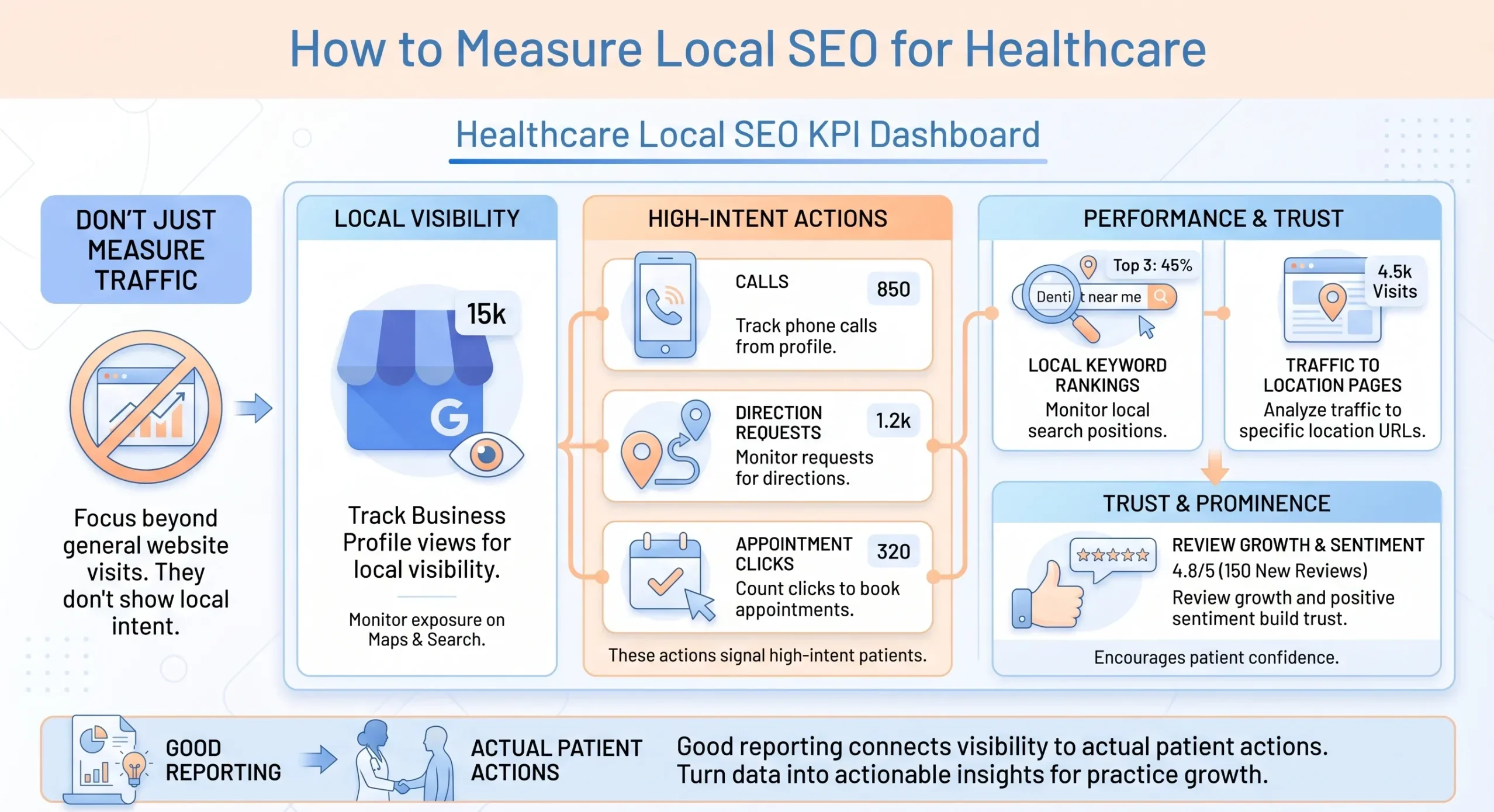
The biggest mistake I see is measuring only traffic. For local SEO for healthcare, the more meaningful KPIs usually include:
| KPI | Why it matters |
| Business Profile views | Indicates local visibility |
| Calls | High-intent action |
| Direction requests | Strong local intent |
| Appointment clicks | Conversion signal |
| Local keyword rankings | Visibility indicator |
| Traffic to location pages | Site-side local demand |
| Review growth and sentiment | Trust and prominence support |
If a clinic’s traffic rises but appointment intent does not, that is not a win yet. The right reporting should connect local visibility to actual patient actions.
A Practical Checklist for Local SEO for Healthcare in Singapore
Foundation
- claim and verify Google Business Profile
- align clinic details across the website and listings
- review categories and services
- check compliance-sensitive wording
Website
- improve location pages
- strengthen service pages
- add clear appointment routes
- improve internal linking
Reputation and optimisation
- monitor reviews
- respond consistently and carefully
- refresh photos and profile details
- track local KPIs
- review content for compliance before publishing
Common Local SEO for Healthcare Mistakes We Still See in Singapore
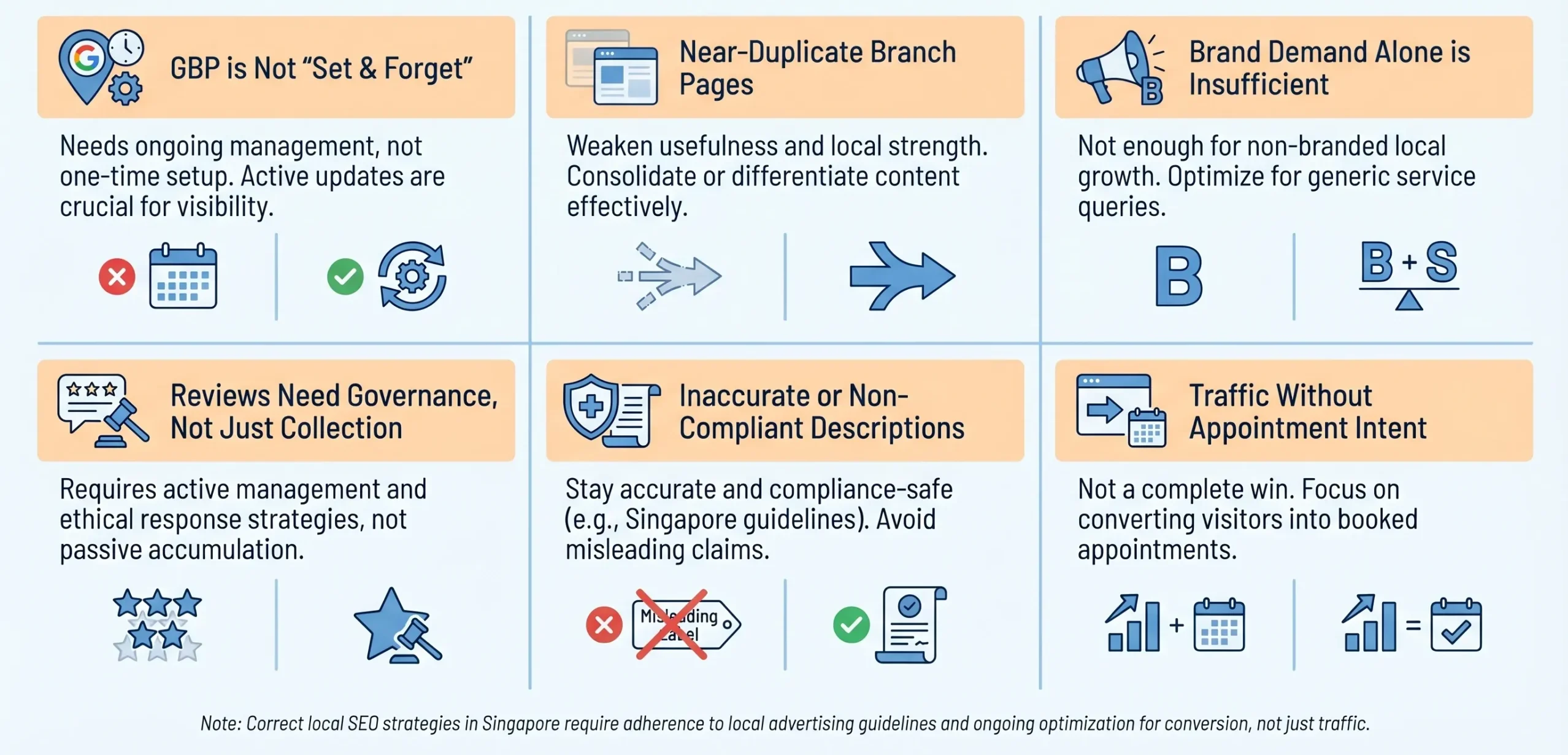
One of the biggest weaknesses I still see in healthcare local SEO is that people explain tactics without explaining the risks.
In Singapore, that is not enough. A clinic may improve visibility temporarily, but if the setup is inconsistent, too generic, or too promotional, trust and sustainability suffer.
Some of the most common mistakes include:
- treating Google Business Profile like a one-time setup
- publishing near-duplicate branch pages
- focusing only on branded search demand
- asking for reviews without governance
- ignoring compliance risks in service descriptions
- measuring traffic but not appointment intent
- using outdated Google My Business terminology instead of Google Business Profile
This matters because Google’s local guidance is based on relevance, distance, and prominence, not just keyword placement. Healthcare providers need their local setup to be accurate, trusted, and useful over time, not just visible for a short period.
Local SEO for Healthcare That Supports Patient Decisions

Local SEO for healthcare is not simply about appearing on Google. It is about making it easier for the right patients to find, understand, and trust a provider enough to take the next step.
In Singapore, that requires more than basic visibility work. We need to bring together a well-managed Google Business Profile, strong local and service pages, genuine review management, consistent business details, sound technical foundations, and messaging that stays accurate and compliant.
When these elements work together, local SEO becomes more than a rankings exercise. It becomes part of how a healthcare provider improves discoverability, reduces patient friction, and builds trust long before the first appointment.
If you want to strengthen your clinic or hospital’s local visibility with a strategy that is built for both performance and compliance, MediaOne can help.
As a trusted local SEO agency in Singapore, we work with brands to improve search visibility, sharpen local presence, and build stronger digital foundations for long-term growth. Get in touch with us today!
Frequently Asked Questions
How long does local SEO for healthcare take to show results?
It depends on the starting point, competition, and how complete the current setup is. In most cases, we should expect gradual improvement rather than immediate change, especially in a regulated, trust-sensitive category like healthcare.
Does every clinic branch need its own Google Business Profile in Singapore?
If a branch is an eligible physical location where the provider interacts in person with patients during stated hours, it may qualify for its own profile under Google’s business representation and eligibility guidance. The key is to make sure each profile reflects a real, properly managed location rather than duplicating listings unnecessarily.
Can local SEO for healthcare help specialist clinics rank for non-branded searches?
Yes, that is often one of the main goals. Strong service pages, clear local relevance, accurate Business Profile details, and better branch-level content can all help specialist clinics improve visibility for searches beyond their own brand name.
How should hospitals approach local SEO differently from clinics?
Hospitals often need a more layered structure because they may have multiple departments, services, or access points. In practice, that means local SEO should be organised more carefully across core hospital pages, service pages, and any relevant location or department pages so that patients can find the right entry point more easily.
Can healthcare providers in Singapore ask patients for reviews?
They should approach this carefully. Any review strategy should focus on genuine feedback, avoid incentives, and stay mindful of both Google’s fake engagement policy and Singapore healthcare advertising sensitivities.
What are the main compliance risks in healthcare local SEO in Singapore?
The main risks usually involve overly promotional wording, treatment claims, review handling, and advertising-style messaging that may not sit comfortably within the Healthcare Services (Advertisement) Regulations framework. In healthcare, stronger visibility should never come at the expense of accuracy or compliance.
How do I measure ROI from local healthcare SEO?
I would look beyond rankings alone. Calls, direction requests, appointment clicks, and enquiry quality usually provide a clearer picture of whether local SEO is translating into meaningful patient actions.