
If you are trying to grow search visibility, one of the first questions I would ask is this: Are you trying to win customers in a specific location, or are you trying to reach audiences across multiple countries or language markets?

That distinction matters more than many businesses realise. I often see businesses invest in SEO without first clarifying whether the real opportunity lies in local demand, broader national reach, or international expansion.
When that happens, the strategy becomes harder to execute, the content becomes less relevant, and the traffic often looks better on paper than it does in revenue.
International SEO and local SEO solve different visibility problems. One helps you reach users across borders. The other helps you appear to people nearby who are ready to act. If we choose the wrong one, we risk investing in traffic that does not convert or overlooking the markets that matter most.
If you are reviewing your growth options with an SEO agency in Singapore, it is important to understand which strategy aligns with your business model, target market, and commercial goals.
In this guide, I will break down the difference between international SEO and local SEO, when each one makes sense, and when both strategies should work together.
Key Takeaways
- International SEO helps businesses reach customers across multiple countries or language markets through market-specific content, technical targeting, and regional authority building.
- Local SEO helps businesses win visibility in a defined service area through local landing pages, Google Business Profile signals, reviews, and geographic relevance.
- The right choice depends on where your customers are, how your business earns revenue, and whether growth is tied to physical locations or cross-border demand.
- Some businesses need both strategies, especially if they operate in multiple countries while still competing locally inside each market.
- Strong SEO performance comes from matching the strategy to search intent, not from choosing the broader-sounding option.
What Is International SEO?
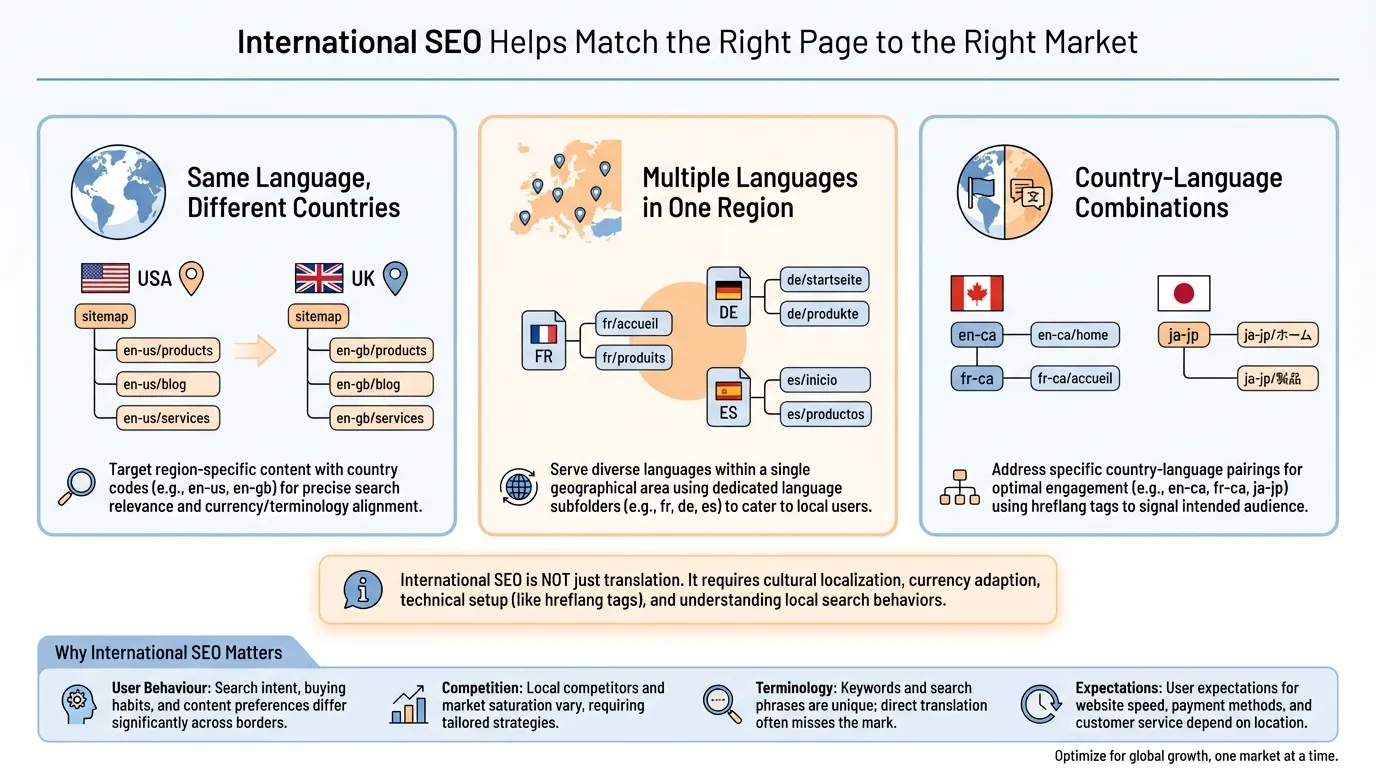
International SEO is the process of optimising a website so search engines can understand which countries, regions, or languages each page is meant to serve.
In practice, this means we are not simply trying to rank more pages. We are helping search engines match the right version of our content to the right audience. That may involve:
- targeting different countries that use the same language
- targeting different languages within the same region
- targeting both country and language combinations
If a business is trying to generate leads, sales, or brand visibility across multiple markets, international SEO becomes important because user behaviour, competition, terminology, and expectations can vary significantly from one country to another.
Even when two markets use English, they may still search, compare providers, and respond differently to messaging. That is why international SEO is not just translation. It also involves:
- localisation
- market research
- technical structure
- regional authority building
Google’s documentation on managing multi-regional and multilingual sites and localised versions of your pages makes this distinction clear.
What Is Local SEO?
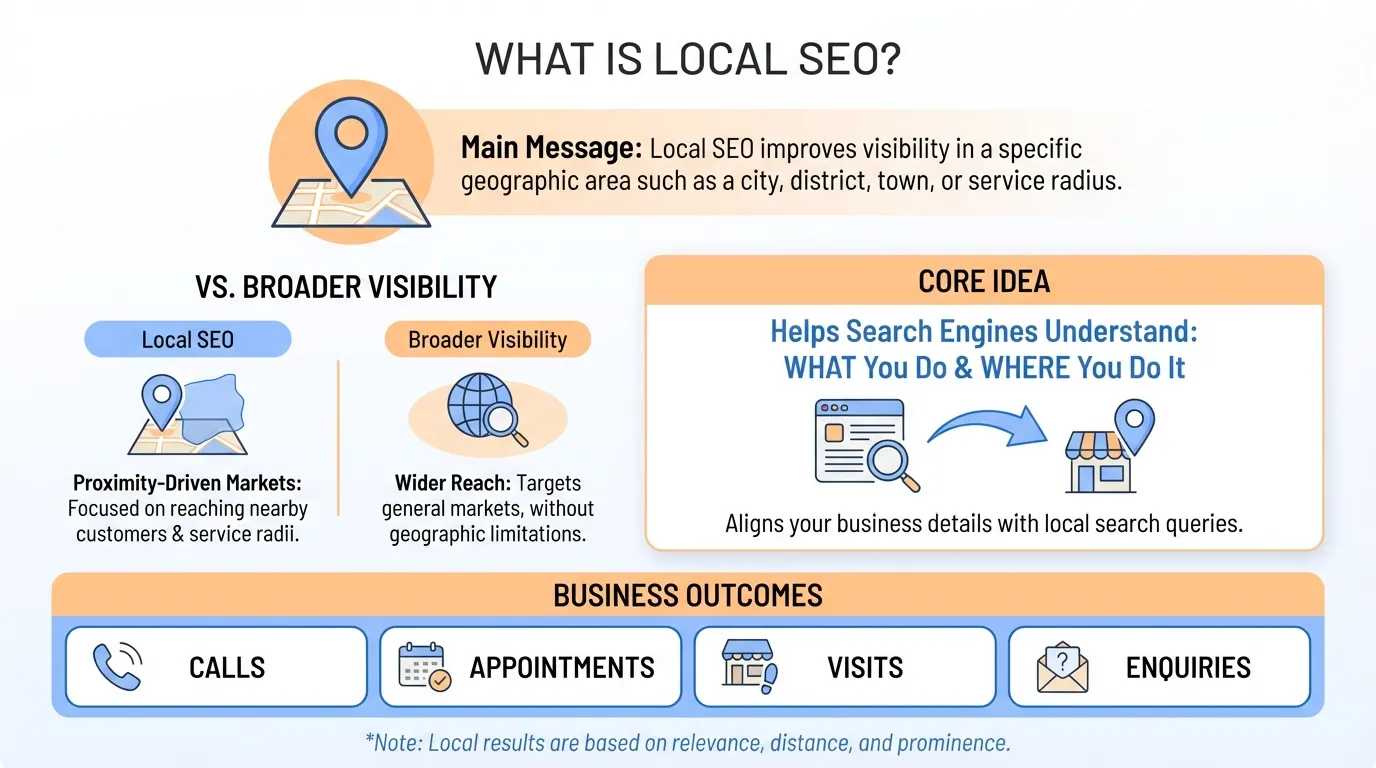
Local SEO is the process of improving visibility in a specific geographic area, such as a city, district, town, or service radius.
Where international SEO is designed to expand visibility across markets, local SEO is designed to strengthen visibility in proximity-driven markets. If your business depends on nearby customers, local trust signals, or physical service areas, local SEO is often the more commercially important strategy.
I usually think of local SEO as helping search engines understand two things clearly:
- what you do
- where you do it
That sounds simple, but it shapes everything from your landing pages and reviews to your location details and how you appear in map-based results.
For many businesses, local SEO is not just about driving traffic. It is about driving:
- calls
- appointments
- visits
- enquiries
These actions often come from users who are already close to making a decision. Google explains that local results are based primarily on relevance, distance, and prominence, which is why local SEO needs to be built around geographic precision rather than broad visibility alone.
International SEO vs Local SEO: The Core Difference
The core difference between international SEO and local SEO lies in the markets each targets.
International SEO is built for country-level or multi-country visibility. It helps businesses compete across broader markets where language, search behaviour, competition, pricing expectations, and market context may differ.
Local SEO is built for geographic precision. It helps businesses show up for users in a defined service area, often where trust, convenience, and immediate action matter more than broad reach.
In simple terms:
- International SEO helps us expand across markets
- Local SEO helps us win within one area
That is why I would never treat them as interchangeable. Even though both sit under the wider SEO umbrella, they solve different business problems and require different execution.
How Local SEO Actually Works
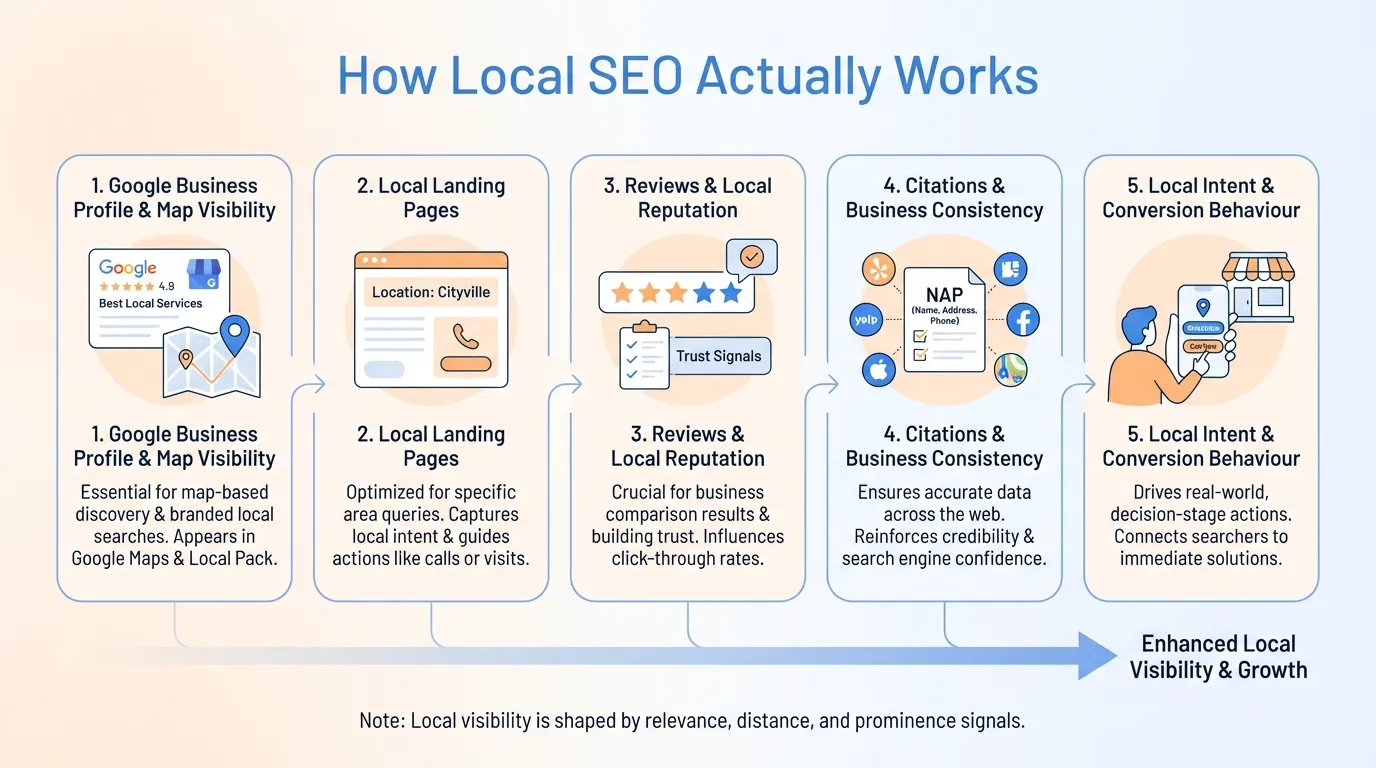
One of the biggest mistakes I see in this topic is that local SEO is often explained too vaguely. People define it, but they do not really unpack how it works. To properly understand the difference between international SEO and local SEO, you need to grasp the moving parts behind local visibility.
Google Business Profile and map visibility
For local SEO, your website is not the only asset that matters. In many local searches, Google Business Profile plays a major role in how your business appears, what information users see first, and whether they decide to click, call, or request directions.
That means local SEO is not only about webpage rankings. It is also about how well your business shows up in:
- map-based discovery
- branded local searches
- business comparison results
This matters because Google’s own guidance on improving local ranking centres on local relevance, distance, and prominence.
Local landing pages
If your business serves more than one city, district, or area, one generic page is often not enough. We usually need dedicated local landing pages that clearly explain the services available in each area, reinforce geographic relevance, and help users confirm that we serve their location.
A good local page should not feel like a copied template with the place name swapped out. It should reflect:
- How do people in that area search
- What matters to them
- What practical information helps them act
Reviews and local reputation
Reviews are a major part of local decision-making. When users compare nearby providers, they are often looking for quick reassurance. They want to know whether the business is trusted, responsive, and worth contacting.
That is why reviews matter beyond reputation alone. They help support:
- trust
- click behaviour
- conversion intent
- local credibility
Citations and business consistency
Local SEO also depends on consistency across the web. Search engines look for reliable signals that confirm your business details, such as:
- business name
- address
- phone number
- supporting references on trusted platforms
If those signals are inconsistent, it becomes harder to reinforce local trust. If they are clear and aligned, they strengthen your local footprint.
Local intent and conversion behaviour
Perhaps the biggest difference is intent. Local SEO often targets users who are close to taking action. Someone searching for a nearby clinic, law firm, tuition centre, or restaurant is often much closer to conversion than someone doing broad market research across countries.
That is why local SEO can be such a strong commercial lever. It captures users when geography is part of the buying decision.
International SEO vs Local SEO in Search Intent
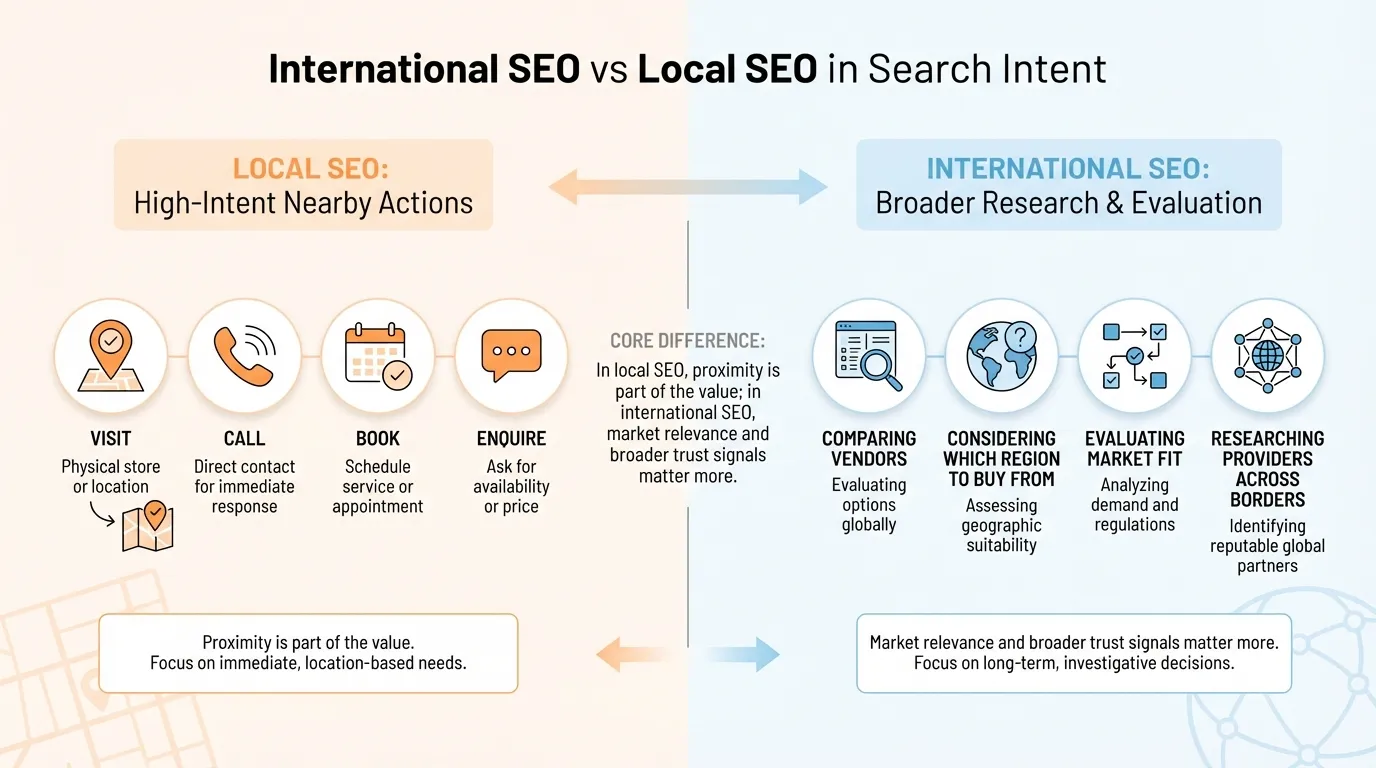
If I had to choose the most important strategic difference between international SEO and local SEO, it would be search intent.
Local SEO usually captures high-intent searches from users looking for something nearby and actionable. These searches often carry a strong sense of urgency. The user may want to:
- book
- visit
- call
- enquire
International SEO usually captures broader commercial research, comparison, and market evaluation intent. The user may still be:
- comparing vendors
- considering which region to buy from
- evaluating market fit
- researching providers across borders
That difference affects which content should rank and which page is most likely to convert. For example, if someone searches for a tuition centre in Tampines or a dentist nearby, they are usually well down the decision path.
If someone searches for an enterprise software provider across the Asia Pacific markets, they may still be evaluating options. In one case, proximity is part of the value. In the other, market relevance and broader trust signals matter more.
International SEO vs Local SEO: Side-by-Side Comparison
| Decision Factor | International SEO | Local SEO |
| Primary Goal | Expand visibility across multiple countries or regions | Dominate visibility in a specific city, district, or service area |
| Best Fit | E-commerce brands, SaaS companies, exporters, regional B2B firms, multi-market brands | Clinics, law firms, tuition centres, retailers, restaurants, home services |
| Target Audience | Country-level or multi-country audiences | Users within a defined geographic radius |
| Search Intent | Commercial research, comparison, cross-border buying, and regional evaluation | High intent, nearby, ready to act searches |
| Primary Asset | Country or language-specific site sections | Website plus Google Business Profile |
| Keyword Strategy | Country-specific keyword research and localisation | Service plus location keywords and nearby intent queries |
| Content Strategy | Market-specific pages, localised messaging, regional proof points | Local landing pages, local FAQs, reviews, area specific trust signals |
| Technical Setup | Broader architecture, market targeting, hreflang where needed | Strong local pages, clear service area signals, local profile alignment |
| Link Building | Build relevance and authority in each target market | Build local prominence through local references and citations |
| Typical Conversion Action | Lead form, demo request, ecommerce purchase, distributor enquiry | Call, booking, direction request, store visit, local enquiry |
| Time to Impact | Usually longer due to broader competition | Often faster in a defined local market |
| Best When | Revenue depends on multiple markets | Revenue depends on nearby enquiries or local demand |
When International SEO Is the Right Strategy
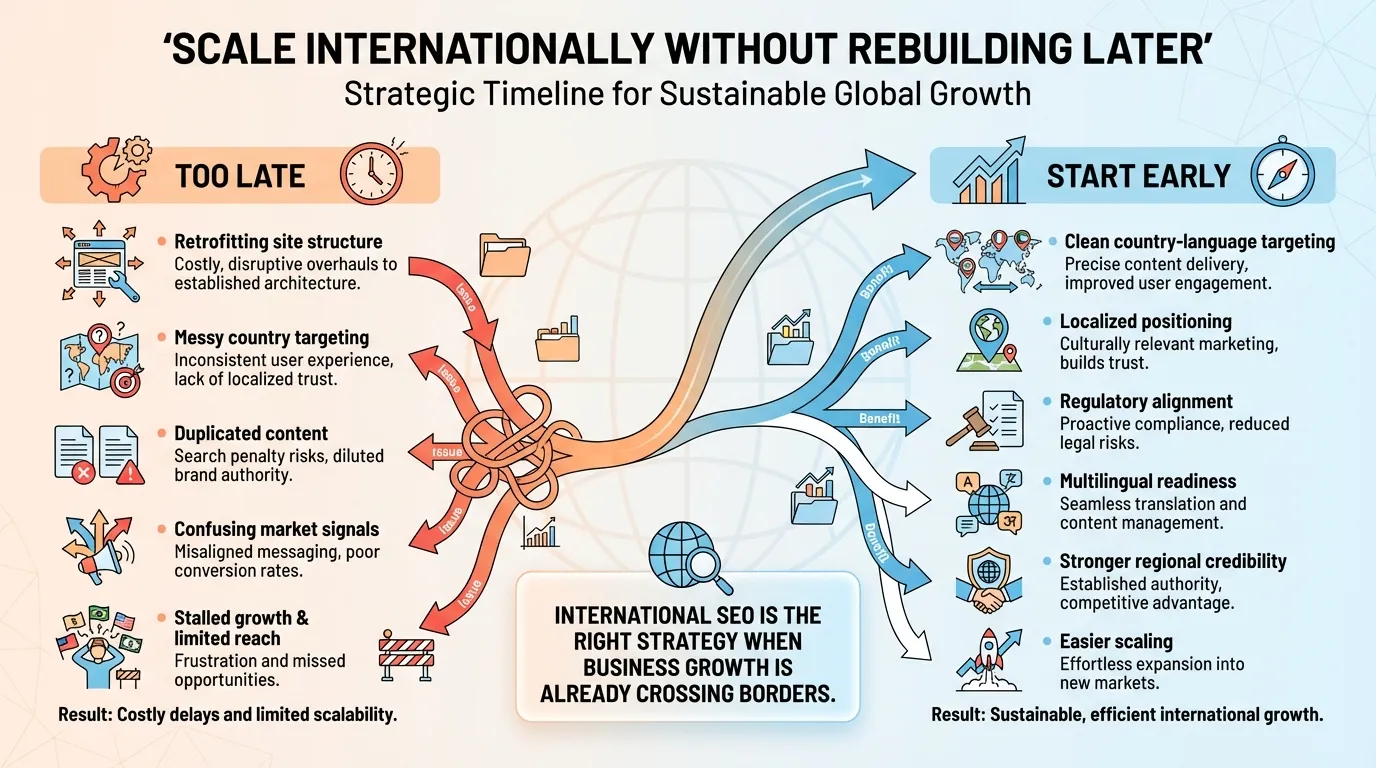
International SEO is the right strategy when your business is no longer commercially limited to a single country or market.
If overseas demand already contributes meaningfully to revenue, we are not dealing with a future possibility. We are already competing across markets, whether or not the site is structured properly for that.
International SEO is usually the right fit when:
- Overseas demand already contributes to revenue
- Pricing or positioning differs by country
- Regulations differ across markets
- Multilingual targeting is required
- International expansion is part of the growth plan
- Broader regional visibility supports credibility and lead generation
The earlier we structure this properly, the easier it is to scale without having to rebuild everything later.
When Local SEO Is the Right Strategy
Local SEO should lead when the business depends on customers within a defined area.
That includes businesses where nearby searches are closely tied to revenue, such as:
- clinics
- tuition centres
- legal services
- restaurants
- retailers
- home service providers
In these cases, visibility in front of the right nearby audience often matters more than broader reach.
If a person searching today in your service area is more valuable than someone overseas researching for later, local SEO is usually the better investment.
I often frame it this way: if geography is part of the buying decision, local SEO matters. If users want someone nearby, trust a local presence more, or are likely to take action quickly after searching, local visibility usually deserves priority.
Should You Choose International SEO, Local SEO, or Both?
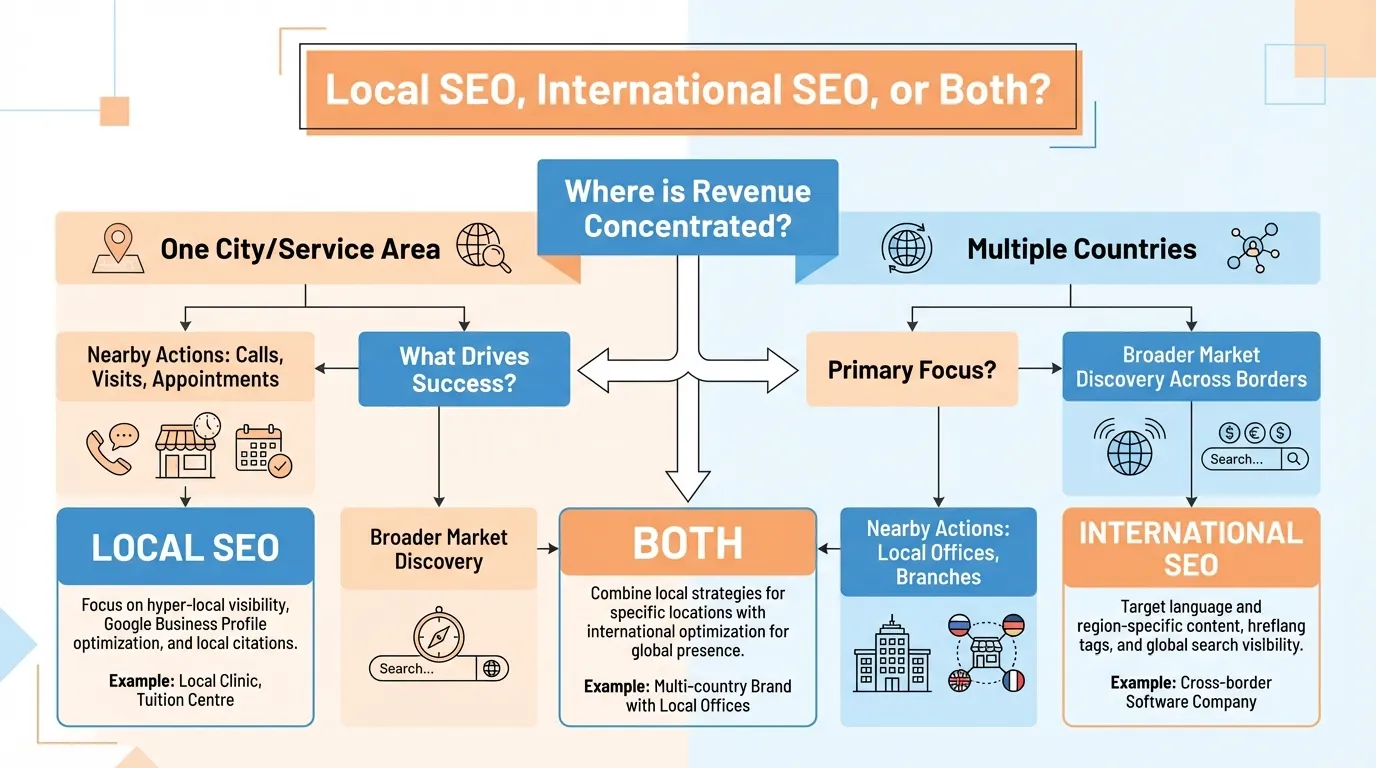
This is the practical question most marketers actually want answered.
Choose local SEO if
- Most of your revenue comes from one city or service area
- Users need to find you nearby
- Calls, visits, appointments, or local enquiries are the main goals
Choose international SEO if
- You target customers in multiple countries
- Demand differs by region
- Your growth depends on broader market visibility across borders
Use both if
- You operate in multiple countries and still need local visibility inside each market
- You have offices, branches, or franchises across regions
- You need both broad discovery and local conversion points
The right strategy is not the one with the wider scope. It is the one that reflects how the business actually wins customers.
When International SEO and Local SEO Work Best Together

In some businesses, international SEO and local SEO are not competing approaches. They work at different layers of the same growth model.
International SEO helps the business reach users across markets, countries, or language audiences. Local SEO helps each office, branch, clinic, campus, store, or location compete within its own geographic area.
This is common in:
- hotel groups
- franchise businesses
- healthcare networks
- education brands
- B2B firms with regional offices
A business like this may need country-specific pages to rank broadly across markets, while also needing strong local pages and trust signals for each branch or location.
In these cases, the goal is not to choose one over the other. The goal is to structure both correctly so they support different stages of discovery and conversion.
Keyword Strategy Differences
Keyword strategy is where the differences between international SEO and local SEO become very apparent.
In local SEO, keyword targeting often centres on service-plus-location combinations and other nearby intent signals. We are trying to capture how users search for something in a specific area.
With international SEO, keyword research needs to be done market by market. That is because terminology, competition, and search behaviour can vary from one country to another, even when the language appears similar.
One of the most costly mistakes I see is when businesses assume the same keyword list can simply be reused across every market. That approach looks efficient, but it often misses how people actually search in each country.
Strong international SEO starts with:
- separate research for each target market
- localised terminology analysis
- market-specific intent mapping
- competition review by country
Strong local SEO starts with:
- area-specific search behaviour
- service plus location intent
- local modifiers
- nearby conversion-focused keywords
Technical Setup Differences
Technical setup is usually where international SEO becomes more demanding.
International SEO may involve:
- country-specific domains
- subdirectories
- subdomains
- hreflang implementation
- more complex content management across markets
There is more room for structural mistakes, and those mistakes can affect indexation, relevance, and which version of a page search engines choose to show.
Local SEO is usually less complex technically, but it still requires precision. We need:
- clear and crawlable local landing pages
- strong internal links to those pages
- accurate alignment between the website and Google Business Profile
- enough clarity around service areas or location coverage
So while both require technical discipline, the difference is in where that discipline sits. International SEO usually requires a broader architecture. Local SEO usually requires greater geographic precision within a single market.
Google also warns that locale-adaptive pages can create crawling and indexing issues if content changes based on user location or language without proper handling.
Content Strategy Differences
Content strategy is another area where these two approaches differ significantly.
International SEO content needs to be market-specific. That can include:
- country pages
- localised messaging
- market-appropriate proof points
- different currencies
- regulatory references where relevant
- content adapted to the expectations of each region
Local SEO content is more geographically focused. It often includes:
- city pages
- local service pages
- local FAQs
- local testimonials
- area-specific trust signals
- practical details that help nearby users act
Both strategies need useful, relevant, high-quality content. The difference is that international SEO scales across markets, while local SEO sharpens relevance inside one.

I would also stress that neither strategy should rely on superficial duplication. Country pages should not be clones with only the currency changed. Local pages should not be generic templates with the place name swapped out.
Link Building Differences
Backlinks matter in both international and local SEO, but their role is slightly different.
In international SEO, link building is about establishing relevance and authority within each target market. We want search engines to see that our site is trusted not only generally, but also in the countries we are trying to rank in.
That often means earning:
- links from country-relevant publications
- regional PR coverage
- mentions from market-specific organisations
- partnerships that support local credibility
In local SEO, link building is more about local prominence. That can include:
- local directories
- business associations
- community references
- sponsorship mentions
- local citations
Put simply, international SEO links help establish country-level relevance. Local SEO links help strengthen local trust and visibility.
Common Mistakes Businesses Make When Choosing Between International and Local SEO
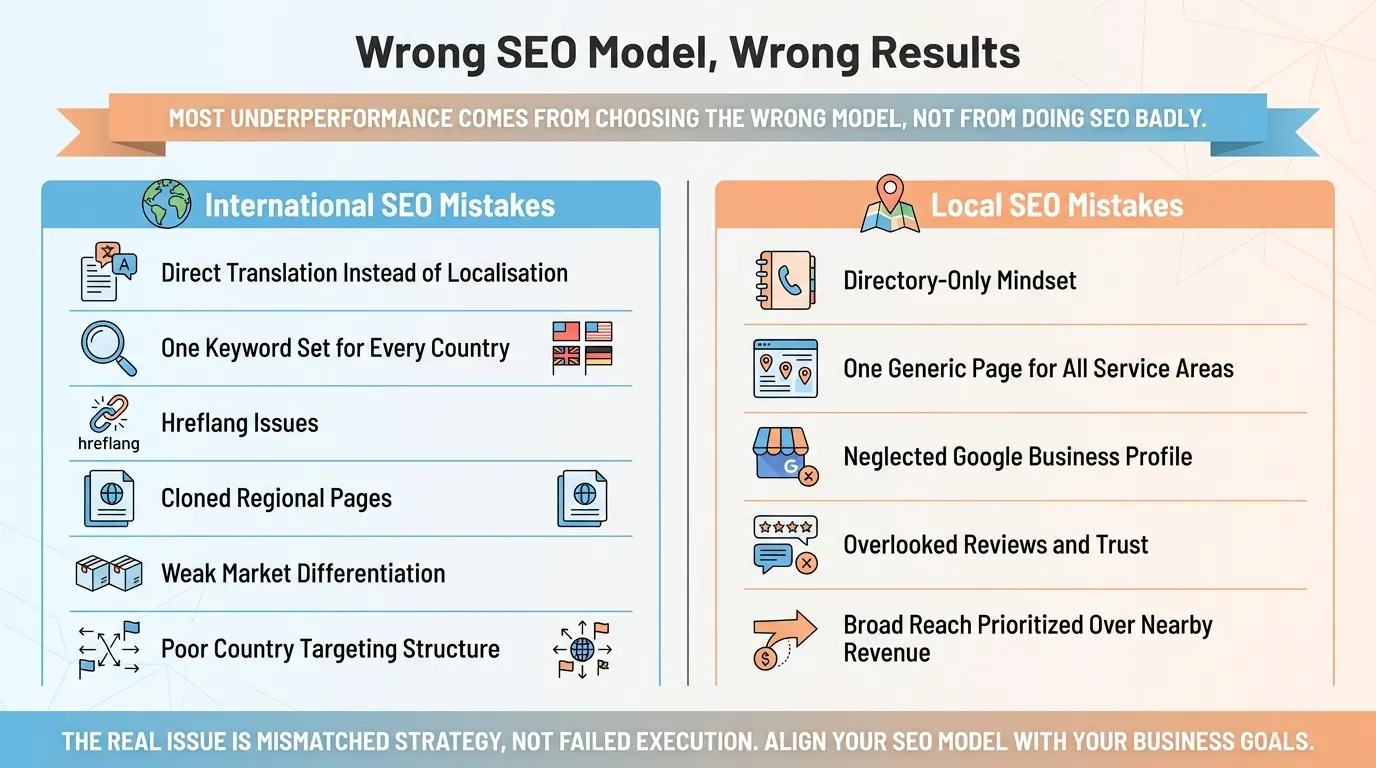
Most underperformance here does not come from doing SEO badly. It stems from choosing the wrong model for how the business actually operates.
One common mistake is directly translating content without proper localisation. Translation changes the language. It does not automatically align the messaging, search behaviour, proof points, or user expectations of a new market.
Another mistake is using one global keyword list for every country. That may save time early on, but it usually weakens relevance and misses country-specific opportunities.
On the international side, I often see issues such as:
- hreflang errors
- cloned regional pages
- weak market differentiation
- poor site structure for country targeting
On the local side, I often see businesses:
- treat local SEO as only directory submission
- create one generic page for all service areas
- neglect Google Business Profile
- overlook reviews as a trust and conversion factor
I also see businesses assume that broader reach must always be the smarter ambition. In reality, wider visibility is not automatically better if the business still wins most of its revenue from nearby, high-intent users.
The real problem is usually misalignment. We pick a strategy based on what sounds bigger or more exciting, rather than on what aligns with how the business earns money.

International SEO vs Local SEO vs National SEO
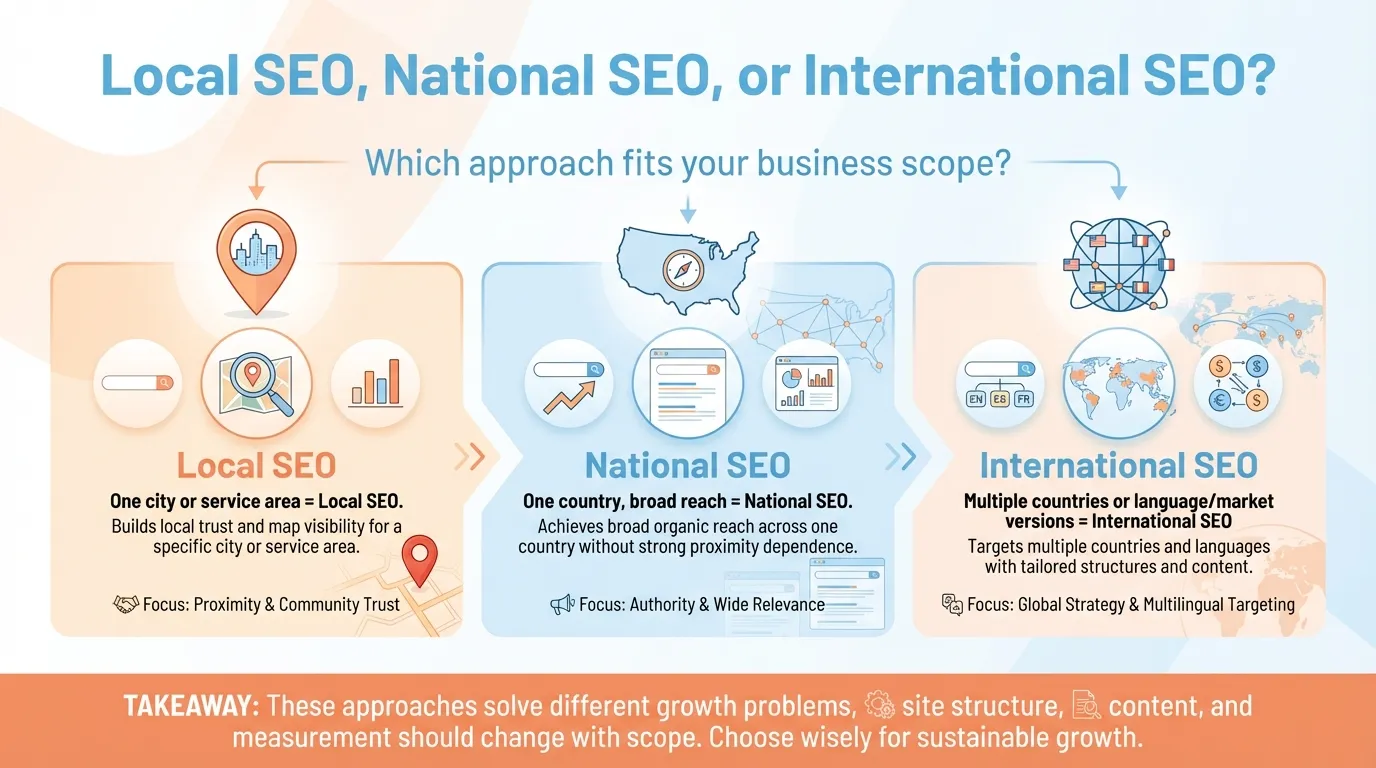
It is also worth clarifying where national SEO fits into this.
These three approaches are related, but they solve different problems:
- Local SEO focuses on visibility in a specific geographic area, usually where proximity and immediate intent matter.
- National SEO focuses on broader visibility within a single country, with less reliance on being physically close to users.
- International SEO extends beyond one country and may involve multiple languages or market versions.
That distinction matters because businesses targeting one city, one country, and multiple countries do not need the same site structure, content strategy, or success metrics.
If we confuse national SEO with international SEO, we may overcomplicate the strategy. If we confuse local SEO with national SEO, we may miss the importance of geographic trust and map-based visibility.
How to Build the Right SEO Strategy for Your Business
If I were building this from scratch, I would follow a sequence like this.
- Review where qualified leads and revenue already come from.
- Define whether the growth priority is local, national, or international.
- Study how users search in each target area or market.
- Choose the right site and page structure.
- Map keywords by city, country, or language.
- Create unique content for each target audience.
- Implement the right technical signals.
- Build local or regional authority where needed.
- Measure performance separately by market or location.
The right strategy is never chosen well in theory alone. It is built on how the business grows, how users search, and what type of visibility is most likely to convert.
How to Measure International SEO vs Local SEO Success
Measurement is another area where marketers often blur the line between these two strategies.
For international SEO, I would usually look at metrics such as:
- organic traffic by country
- conversions by country
- keyword rankings by market
- indexed regional pages
- backlinks from target markets
- engagement by market
For local SEO, I would focus more on:
- local keyword visibility
- map pack performance
- Google Business Profile actions
- calls
- bookings
- direction requests
- review growth
- conversions from local landing pages
The reason this matters is simple. International SEO is usually about how well we build demand and visibility across markets. Local SEO is often about how efficiently that visibility turns into nearby actions and local conversions.
International SEO vs Local SEO: Choosing the Right Strategy for Growth
International SEO vs local SEO is not a question of which one is better in general. It is a question of which one aligns with how your business actually grows. If your revenue depends on nearby customers, local trust, and location-based intent, local SEO should take the lead.
If your business is expanding across countries or language markets, international SEO becomes essential to help search engines and users understand which audience each part of your site is meant to serve.
In some cases, the strongest approach is not choosing one over the other, but building both properly so they support different stages of visibility and conversion.
What matters most is not chasing the broader-sounding strategy. What matters is building an SEO approach around search intent, geography, and commercial reality. When we align the strategy to how customers actually search and buy, SEO becomes far more than a traffic channel. It becomes a growth engine.
If you are evaluating whether your business needs local SEO, international SEO, or a combination of both, MediaOne’s SEO agency in Singapore can help you assess the right path based on your market, business model, and growth goals. If you want a strategy built around real commercial outcomes rather than guesswork, speak with our SEO consultants.
Frequently Asked Questions
Is local SEO easier than international SEO?
Local SEO is usually less technically complex than international SEO, but that does not make it easy. It still requires strong local pages, profile management, review signals, and geographic relevance. In many competitive industries, local SEO is highly in demand because commercial intent is so strong.
Can a business use both international SEO and local SEO?

Yes. Many businesses need both. If a brand operates in multiple countries while also relying on local offices, branches, or service areas, international SEO helps with broader market visibility, and local SEO supports branch-level conversion.
What is the difference between local SEO, national SEO, and international SEO?
Local SEO targets a specific area. National SEO targets one country more broadly. International SEO targets multiple countries or language markets. Each one requires a different structure, content approach, and measurement model.
When should a Singapore business move from local SEO to international SEO?
That usually happens when demand, revenue, or growth plans extend beyond Singapore and require market-specific targeting, content, and visibility. If overseas markets are becoming commercially meaningful, the SEO strategy should evolve to reflect that.
Do English-speaking countries still need separate SEO pages?
Often, yes. Even when the language is shared, search behaviour, competition, terminology, and user expectations can still differ significantly between markets. That is why localisation often matters even in the same language for international targeting. Google’s guidance on localised versions and x-default hreflang is useful here if you are building neutral or fallback pages for broader audiences.