When we talk about SEO, I often find that businesses assume local SEO and traditional SEO are basically the same thing, with a location keyword added on top. They are not.

Both aim to improve visibility in Google. However, they address different search behaviours, ranking environments, and business goals.
If your customers choose you based on area, branch location, or proximity, focus more on local SEO. If your audience searches broadly and does not choose by location, traditional SEO usually matters more.
This matters because Google’s approach to local search differs. For local rankings, Google says relevance, distance, and prominence are the main influencers.
That is a different framework from broader organic SEO, where content quality, technical health, internal linking, and authority usually do more of the heavy lifting. If we choose the wrong SEO model, we may still generate visibility, but not the kind that actually converts.
If your business serves a specific area and wants stronger map visibility, local relevance, and more qualified enquiries, working with a local SEO agency in Singapore can help you focus on the ranking signals that matter most.
Key Takeaways
- Local SEO and traditional SEO are related, but they are not interchangeable. Local SEO is built for geographic intent, while traditional SEO is built for broader organic discovery.
- Local SEO is fundamentally different from standard organic SEO because Google says local rankings are shaped by relevance, distance, and prominence.
- Reviews and category selection matter more for local SEO than traditional SEO; categories influence ranking.
- Most consumers read online reviews before choosing a business, underscoring the importance of a review strategy.
- In Singapore, handling customer reviews raises compliance considerations. In October 2025, the PDPC published an undertaking regarding the Cold Press Index following an incident in which personal data was included in public Google Review replies.
Why Local SEO Is Not Just Traditional SEO With a City Name Added

This is one of the biggest misconceptions I see.
Adding Singapore, Orchard, Tampines, or Jurong to a page does not automatically make it strong local SEO. If we want local visibility, we need signals that genuinely support local relevance, such as:
- a properly managed Google Business Profile
- accurate categories
- consistent business details
- reviews
- useful location pages
- local trust signals
- real operational relevance to the area
Without those signals, we often end up creating a weaker version of a generic service page.
What is Local SEO?

When I explain local SEO to clients, I usually define it as the work we do to help a business appear in location-based searches on Google Search and Google Maps.
These are searches where the user is looking for something nearby, in a specific district, or within a service area. Think of searches such as ‘dentist in Orchard’, ‘tuition centre near me’, or ‘aircon servicing in Singapore’.
What makes local SEO different is the search context. Google prioritises relevance, distance, and prominence. For businesses reliant on nearby customers, local SEO is a key driver of qualified traffic and direct enquiries.
Local SEO is particularly important for:
- clinics
- law firms
- tuition centres
- restaurants and cafés
- salons and wellness businesses
- home service providers
- multi-location retailers
- service-area businesses
Google also has rules for Business Profiles. Generally, businesses must make in-person contact with customers during stated hours to qualify. That is one reason why not every brand should assume local SEO is the right fit.
What is Traditional SEO?

Traditional SEO is broader than local SEO. It is the work we do to help a website rank in Google’s organic search results for searches that are not primarily driven by geography.
In other words, the goal is not just to appear for nearby users or map-based intent, but to build visibility across a wider set of searches where people are comparing options based on relevance, expertise, product fit, price, or content value.
In most cases, this means focusing on areas such as:
- service or category pages
- informational blog content
- technical SEO
- internal linking
- topical depth
- backlinks and authority signals
Traditional SEO is often the better fit when customers are not choosing the nearest provider, but the one that best answers their needs.
That usually means the website needs to do more than simply exist. It needs to demonstrate subject relevance, cover the right topics in enough depth, and make it easy for both users and search engines to understand how the content, services, and pages connect.
If your customers are comparing expertise, products, solutions, or content rather than the nearest option, traditional SEO is usually more effective.
SaaS companies, ecommerce brands, publishers, and regional B2B firms often need broader organic visibility, not just local pack rankings.
In these cases, success tends to come from building a stronger overall website presence through useful content, clearer site structure, and pages that target the full range of search intent across the buying journey.
Local SEO vs Traditional SEO: The Main Differences

Here is the clearest way I would explain it to a client.
| Area | Local SEO | Traditional SEO |
| Main goal | Win visibility in a defined area | Win broader organic visibility |
| Main search environments | Google Maps, local pack, localised results | Standard organic search listings |
| Key ranking influences | Relevance, distance, prominence, profile quality, reviews, categories | Content quality, topical authority, technical SEO, internal linking, and links |
| Best for | Clinics, law firms, tuition centres, restaurants, home services, multi-location brands | SaaS, ecommerce, publishers, national and regional B2B brands |
| Typical conversions | Calls, bookings, direction requests, visits, local enquiries | Leads, sign-ups, online sales, demo requests, broader content conversions |
| Core assets | Google Business Profile, location pages, citations, reviews | Service pages, content hubs, category pages, and technical foundations |
Google’s local ranking documentation and Business Profile guidelines support this distinction, especially around relevance, distance, prominence, and the importance of accurate business representation.
1. Target audience
With local SEO, we target people in a specific location. These are usually high-intent searchers who want to call, visit, compare nearby options, or book quickly. With traditional SEO, we often target a broader audience throughout the research and buying journey. They may still convert, but they are not always choosing based on proximity.
2. Search intent
Local SEO captures place-based intent. Traditional SEO captures broader informational, commercial, and transactional intent. This distinction matters. A business can rank for broad keywords yet miss searches that generate the best local leads. The reverse is also true. A business can appear in Maps but miss wider searches that build long-term demand.
3. Search results
With local SEO, we are often competing in:
- Google Maps
- the local 3-pack
- localised organic listings
With traditional SEO, we compete mainly for standard organic results. That change affects optimisation. A great service page alone will not guarantee strong local pack visibility. Likewise, a polished Business Profile alone will not replace broad content and site authority.
4. Ranking factors
This is where I think businesses usually underestimate the difference.
For local SEO, Google says local results are mainly influenced by these local SEO ranking factors:
- relevance
- distance
- prominence
Prominence reflects how established a business appears online. Relevance is about how well your profile and website match the search. Distance is how close the business is to the user or the area searched. Google also states that business categories affect local ranking.
For traditional SEO, the stronger levers are usually:
- helpful content
- technical SEO
- internal linking
- topical authority
- page quality
- link equity
5. Conversion path
In local SEO, the path to conversion is often short. Someone finds your profile, reads reviews, clicks call, requests directions, or visits your website to enquire. In traditional SEO, the journey is often longer. The user may read multiple pages, compare providers, or consume educational content before converting.
When Should You Focus on Local SEO?

Prioritise local SEO when location affects customer choice. If people seek a provider near them, in a district, or in a defined area, local SEO should come first. Proximity can increase both visibility and conversion.
Local SEO should usually take priority when:
- Your business depends on nearby customers: This is common when convenience, travel distance, or familiarity with the area affects decision-making.
- You serve specific districts, towns, or service areas: If your reach is geographically defined, your SEO strategy should reflect that.
- Calls, bookings, and branch enquiries matter: Local SEO is especially useful when users are likely to take direct action after searching.
- You have one or more physical locations: Branch-level visibility can make a real difference, especially when each location serves a different catchment area.
- Proximity influences conversion: If being closer makes a customer more likely to choose you, local SEO is not secondary. It is a core acquisition channel.
Quick checklist: Do you need local SEO, traditional SEO, or both?
Use this as a simple way to decide where your main focus should sit.
You probably need local SEO if:
- customers search for your service with a location attached
- your branches need separate visibility
- your conversions come from calls, visits, or bookings
- you qualify for a Google Business Profile
- your competitors appear in Maps for important searches
You probably need traditional SEO if:
- your audience is not choosing by proximity
- you sell nationally or regionally
- your buyers begin with research content
- your service pages target broader non-local keywords
- most conversions happen online
You probably need both if:
- you have physical locations and broader informational demand
- you want map visibility and wider content visibility
- you serve multiple areas and multiple service intents
- you want to capture both immediate demand and earlier-stage research demand
In practice, many businesses fit the third group. The key decision is often not whether to choose local SEO or traditional SEO, but which one should lead and which should support.
Local SEO helps capture ready-to-convert demand in a defined area, while traditional SEO builds broader visibility, trust, and long-term growth.
When is Traditional SEO More Important?
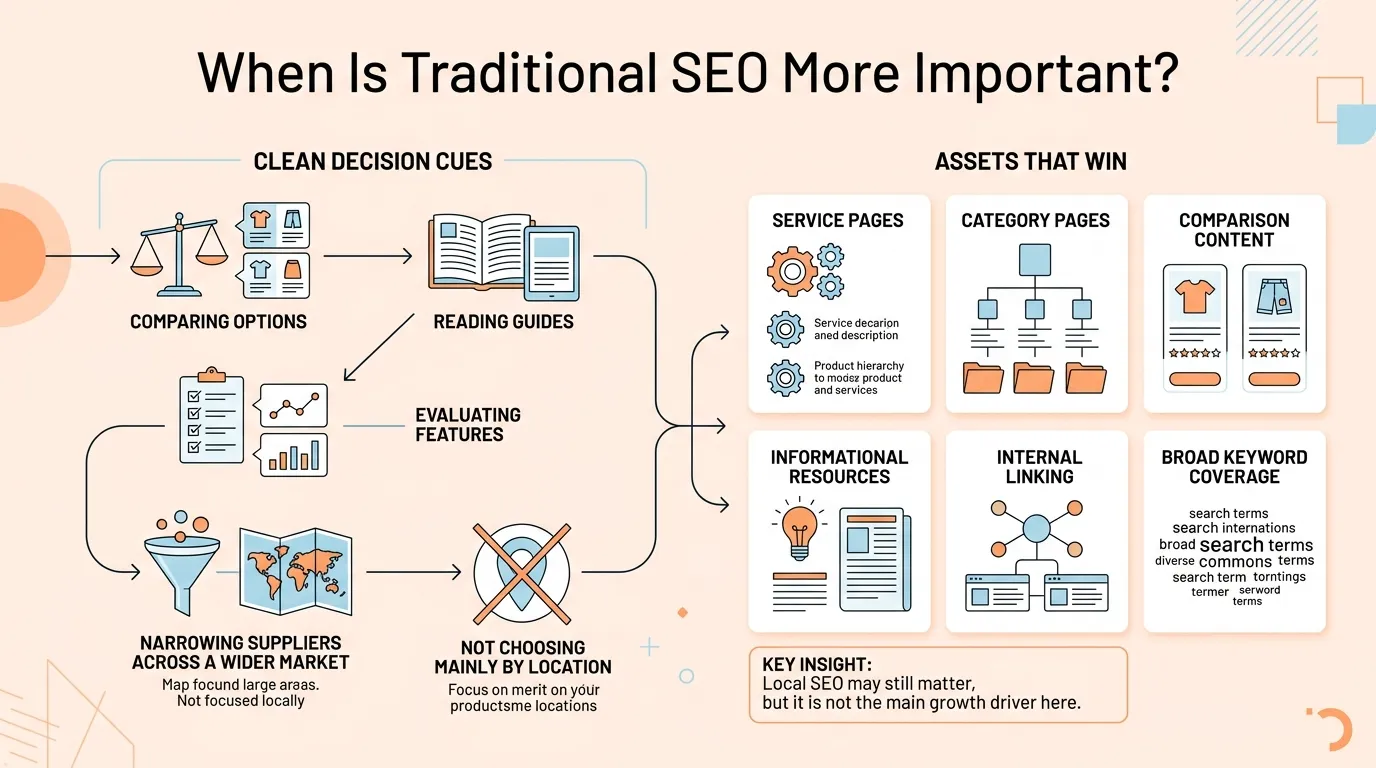
Traditional SEO is usually the better primary focus when customers are not choosing a business based mainly on location.
If they care more about expertise, price, product fit, service depth, or solution quality than proximity, broader organic visibility often matters more than local pack presence.
This is usually the case when the search journey starts with research rather than immediate local action. Instead of looking for the nearest provider, the user may be comparing options, reading guides, evaluating features, or narrowing down suppliers across a wider market.
In these situations, traditional SEO helps the business capture demand through service pages, category pages, comparison content, and informational resources that support the full buying journey.
This often applies to:
- SaaS companies: Buyers usually compare features, integrations, pricing, and use cases rather than choosing the nearest vendor.
- E-commerce brands: Customers often search by product, category, or intent, especially when fulfilment is not limited to a single area.
- Regional B2B firms: Decision-makers may be comparing experience, capability, and commercial fit across a wider territory.
- Media publishers: Visibility depends more on content relevance, authority, and search demand than on physical presence.
- Non-location-led service businesses: If the service can be delivered remotely or the buyer is not strongly influenced by proximity, broader SEO is often the stronger growth lever.
That does not mean local SEO is irrelevant. It simply means it may not be the main driver of growth.
In these cases, I would usually prioritise stronger content, clearer service pages, better internal linking, and broader keyword coverage before treating local visibility as a leading SEO objective.
When do you Need Both Local SEO and Traditional SEO?

In practice, many businesses need both.
A law firm may need local branch visibility for high-intent searches while also building broader authority through guides and service explainers.
A tuition centre may need strong location pages for each branch, along with educational content that attracts parents earlier in the decision journey.
A clinic may need a compliant, accurate Business Profile, along with content that helps prospective patients evaluate treatment options.
This is usually where we get the best results. Local SEO captures ready-to-convert nearby demand. Traditional SEO builds broader discoverability and trust over time.
When I look at why some businesses perform well in local search, and others do not, it usually comes down to how clearly they send the right local signals.
Strong local SEO is not built on a single asset. It comes from having accurate business information, a credible local presence, and enough trust signals to make both Google and potential customers confident in choosing you.
The most important local SEO elements are usually the following.
1. Google Business Profile
Google Business Profile is one of the most important assets in local SEO because it helps Google connect your business to local intent.
It supports visibility in Maps, the local pack, and other location-based search experiences, which makes it especially important for businesses that depend on calls, visits, or branch enquiries.
At a practical level, we should keep the profile complete, accurate, and actively maintained. That includes your:
- business name
- address
- phone number
- opening hours
- website URL
- categories
- services
- photos
If these details are incomplete, outdated, or inconsistent, maintaining local visibility can become harder, and customer trust can drop quickly.
2. Business categories
Categories are often underestimated, but they play a meaningful role in local relevance. They help Google understand what the business actually does and which searches it should appear for.
That is why the goal should not be to choose as many categories as possible. It should be to choose the most accurate primary category, supported by relevant secondary categories where appropriate. A precise category setup usually sends a much stronger signal than a broad but unfocused one.
3. Reviews and reputation
Reviews matter because they influence both trust and conversion. They also shape how users compare nearby businesses. When someone is deciding between two or three local providers, they are often not just looking at whether reviews exist. They are comparing signals such as:
- star rating
- review recency
- response quality
- review volume
- consistency of customer experience
In practice, a business with a strong review profile often looks more credible before the user even visits the website.
That is why review generation and response management should be treated as an ongoing part of local SEO rather than something handled only when a problem appears.
Compliance note: handle review replies carefully
This is also where local SEO can overlap with compliance. When replying to reviews, especially negative ones, businesses should be careful not to disclose personal data publicly in an attempt to defend themselves.
That means we should avoid revealing:
- a customer’s full name if it is not already public in that form
- contact details
- identifiable order or transaction details
- any personal data used to prove a point in public
The safer approach is to acknowledge the issue professionally, keep the reply general, and move any sensitive discussion into a private channel.
4. NAP consistency and local citations
NAP stands for name, address, and phone number. These core business details should remain consistent across all online appearances, including your website, directories, listings, and other citation sources.
Citations still matter, but quality matters more than volume. I would focus on trusted, relevant platforms rather than spend time building low-value listings that add little credibility.
Consistency helps reinforce trust, while conflicting information can create confusion for both users and search engines.
5. Local landing pages
If your business has multiple branches or serves multiple areas, local landing pages can play an important role in supporting local relevance. The key is to make each page genuinely useful rather than treating it as a copy-and-paste version of the same service page.
A strong local page should usually include:
- unique local service details
- branch-specific contact information
- local proof points
- area-specific FAQs
- embedded maps or directions where relevant
What I would avoid is publishing multiple pages with near-identical content, except for the place name. That approach tends to weaken usefulness rather than strengthen local relevance.
6. Local schema, links, and mentions
Local schema markups help search engines better interpret your business information, especially when it supports location-specific pages and business details. It is not a shortcut to rankings, but it can improve clarity and reinforce the signals already present on the page.
Local links and mentions can also strengthen local credibility. These are often more valuable when they come from relevant sources such as chambers, associations, local publications, sponsorships, or genuine community partnerships.
The goal is not just to collect links, but to build signals that reflect real local relevance and trust.
Mini case-style examples
To clarify the difference between local SEO and traditional SEO, consider how they work in practice.
The biggest pattern I see is this: local SEO performs best when the business has genuine local relevance, while broader SEO becomes more important when the customer is comparing solutions beyond location alone.
Google’s own local guidance supports that distinction, with local rankings shaped mainly by relevance, distance, and prominence.
Public brand example: NTUC FairPrice
A useful Singapore example is NTUC FairPrice. In MediaOne’s roundup of local SEO case studies, FairPrice is highlighted as a brand that benefits from real local relevance at scale through its outlet network, store-led campaigns, and locally relevant promotional content.
MediaOne points to FairPrice campaigns such as Worth the Trip and seasonal pushes tied to local shopping behaviour, and describes outcomes such as stronger Google Maps visibility, higher foot traffic and engagement during campaigns, and increased branded search interest from supporting digital content.
What makes this example useful for the article is that it shows local SEO is not just about adding a place name to a page.
FairPrice already has the ingredients that local search responds well to: real physical presence, strong brand prominence, and content that matches how customers search in specific local contexts.
In other words, the local advantage comes from operational relevance and supporting search signals working together, not from keyword insertion alone.
MediaOne example: English tuition centre
A more direct performance example from MediaOne is its English tuition centre project. According to the case study, MediaOne improved the centre’s local performance through Google Business Profile optimisation, stronger local citations, NAP consistency, and location-specific landing pages.
The case study says noticeable ranking improvements began within the first three months, stronger growth followed within six months, and by month nine, the centre had achieved first-page rankings for multiple high-intent keywords.
MediaOne also reports a 45% increase in new student enrolments per term, a 150% increase in organic visitors, and a lead conversion rate improvement from 2.5% to 6.8%
This is a strong local SEO example because the customer journey is clearly location-sensitive. Parents are not only seeking English tuition; they are also looking for tuition in other subjects. They are often searching for a credible option that is accessible from a specific area and easy to contact.
That is why the results here did not come from location keywords alone. They came from combining branch-level relevance, local business signals, and supporting website assets in a way that matched how people actually search and choose.
What these examples show
Taken together, these two examples reinforce the same point. When a business has real local relevance, local SEO is much more than on-page keyword targeting.
It becomes a broader system built around operational presence, accurate business signals, reputation, and content that supports how nearby customers search. By contrast, if a business is not chosen primarily for its location, traditional SEO usually deserves more weight.
Common Local SEO Mistakes Businesses Should Avoid

The most common mistakes I see come from treating local SEO too narrowly or too superficially. Businesses often assume that ranking locally is just a matter of adding city names to pages or setting up a Google Business Profile, but this rarely creates strong, lasting visibility.
The biggest mistakes are:
- Forcing local relevance through keywords alone: Adding location terms to titles and copy does not make a page genuinely useful for local search if the content is otherwise generic.
- Relying on Google Business Profile without strengthening the website: A profile may help with Maps visibility, but it works best when supported by strong service pages, useful location pages, and a credible website.
- Choosing inaccurate categories: Categories help Google understand what the business does, so selecting irrelevant or overly broad categories can weaken local relevance.
- Creating duplicate location pages: Pages with near-identical content, with only the area name changed, add little value and often make the site look thin or repetitive.
- Ignoring reviews until there is a reputation issue: Review generation, monitoring, and replies should be ongoing, not something handled only when negative feedback appears.
- Focusing on broad traffic when the real opportunity is local intent: Higher traffic numbers do not always translate into better results if the visits are not from nearby users who are ready to call, book, or visit.
- Focusing only on local pack rankings when broader organic demand also matters: Local visibility is important, but many businesses also need wider organic content and service pages to capture earlier-stage demand and build trust.
In practice, the best results usually come from balancing both. Local SEO should help you capture nearby customers who are ready to act, while the wider website supports trust, discovery, and longer-term growth.
How We Should Measure The Success of Local SEO vs Traditional SEO
The KPI framework should reflect the strategy. Google says Business Profile performance data can be downloaded into spreadsheets, including multiple profiles at once, which is useful for comparing locations or tracking branch-level performance.
| KPI type | Local SEO | Traditional SEO |
| Visibility | Local pack visibility, Maps visibility, profile views | Organic impressions, keyword reach, and landing page visibility |
| Engagement | Calls, direction requests, website clicks, review activity | CTR, time on page, internal click depth |
| Conversion | Bookings, branch enquiries, local form fills | Leads, sales, demo requests, assisted conversions |
| Asset health | Profile completeness, category accuracy, review recency | Indexation, page speed, internal links, and content quality |
This is why I would avoid judging local SEO purely by traffic growth. A smaller number of high-intent calls or bookings may be more valuable than a larger volume of low-intent visits.
Local SEO Compliance and Platform Checklist
Before publishing or optimising any local SEO asset, we should check that we are not creating avoidable compliance or platform issues.
- Do not create listings for locations you do not genuinely operate from
- Do not stuff keywords into your business name.
- Do not use inaccurate categories.
- Do not copy and paste location pages with minimal changes.
- Do not disclose personal data in public review replies.
- Do not collect or reuse personal data without considering PDPA obligations.
- Do keep business information accurate and aligned across your site and profiles
Google’s Business Profile guidelines explicitly warn that failing to comply with representation rules can result in profile changes or removal.

Make The Right Choice Between Local SEO and Traditional SEO
Local SEO and traditional SEO are closely related, but they are not interchangeable. If location influences how your customers search and choose, local SEO should be central to your strategy.

If your audience is comparing solutions broadly rather than choosing based on proximity, traditional SEO will usually warrant more attention.

In many cases, the strongest approach is not choosing one over the other, but understanding which one should lead and how both can work together to support visibility, trust, and conversion.
The key is not to chase traffic for its own sake. It is to build the right kind of search presence for the way your customers actually behave.
That means understanding whether your biggest opportunity lies in map visibility, location-specific intent, broader organic discovery, or a combination of all three.
If you are unsure which direction makes the most sense for your business, MediaOne can help you assess your current search visibility, identify where local SEO and traditional SEO should each play a role, and build a strategy around real business outcomes rather than vanity metrics.
If you want to improve your rankings, attract more qualified traffic, and turn search demand into meaningful enquiries, speak to MediaOne’s team or explore our local SEO services to get started.
Frequently Asked Questions
Does local SEO work for service-area businesses without a shopfront?
Yes, local SEO can still work for service-area businesses if they genuinely serve customers in specific areas and meet Google’s eligibility requirements. The strategy usually relies more on service-area relevance, local landing pages, reviews, and a properly configured Business Profile than on a public-facing storefront.
Can I do local SEO without creating separate pages for every location?
Yes, but it depends on your business model. If you only serve one main area, a strong core service page and an optimised Business Profile may be enough. Separate location pages become more important when you have multiple branches, distinct service areas, or meaningful differences between locations.
What is the difference between ranking in Google Maps and ranking in normal organic results?
Google Maps visibility is more heavily influenced by local signals such as Business Profile setup, proximity, reviews, and business relevance. Normal organic rankings depend more on page quality, content usefulness, technical SEO, and broader authority. A business can perform well in one and still underperform in the other.
Can local SEO help if my business already ranks well organically?
Yes. Strong organic rankings do not automatically guarantee strong local visibility. If customers are searching with local intent, local SEO can improve how often your business appears in Maps, the local pack, and branch-specific searches, which may drive more qualified enquiries.
Should each business location have its own Google Business Profile?
Usually, yes, if each location is a real, eligible business presence with its own customer-facing operations. Separate profiles can help each location compete in its own area, but they should only be created when they reflect genuine operational differences and comply with Google’s guidelines.
How often should I update my Google Business Profile?
You should update it whenever key business information changes, such as opening hours, services, phone numbers, or location details. Beyond that, regular maintenance helps keep the profile accurate and active, especially when adding new photos, monitoring reviews, or refining services and categories.
Are local citations still worth building today?
Yes, but only when they are relevant and trustworthy. The goal is not to collect as many directory listings as possible. It is to maintain consistent business information across credible platforms that reinforce your local presence and reduce confusion.
Can local SEO support offline conversions even if online traffic stays flat?
Yes. Local SEO often influences calls, direction requests, bookings, and in-person visits, which means performance can improve even without a dramatic rise in website traffic. That is why local SEO should be measured by lead quality and local actions, not traffic alone.
Which businesses should not prioritise local SEO first?
Businesses that are not chosen based on location usually should not treat local SEO as the main priority. This often includes SaaS brands, nationwide ecommerce businesses, publishers, and remote-first services where customers care more about expertise, product fit, or pricing than proximity.
How do I know if my local SEO problem is really a website problem?
If your Business Profile is well set up but conversions remain weak, the website may be the issue. Thin service pages, unclear location pages, weak trust signals, a poor mobile experience, or a lack of local relevance on the site can all limit results, even when the profile itself is strong.