
If you’re running an SME in Singapore’s fierce marketplace, what places you ahead often isn’t just what you sell– it’s how you show up. In this endeavour, a branding checklist isn’t a nice-to-have; it’s essential.

In a city where over 300,000 SMEs vie for attention, your brand presence can be the difference between being invisible and being unforgettable.
Rebranding happens more often than most founders realise. Businesses refresh visuals to stay modern, or overhaul positioning when growth stalls. But without a structured branding checklist guiding that work, you risk confusion, wasted budget, and lost SEO value.
This guide, grounded in local context and delivered with the insight you expect from expert digital strategists, will help you decide when to refresh, when to rebuild, and what to avoid.
If you’re looking for a branding agency in Singapore to implement this playbook, we’re ready to guide you every step of the way. You’ll walk away knowing how to diagnose your needs, execute with clarity, and protect your brand equity through a strategic process that drives results.
Key Takeaways
- A structured branding checklist helps SMEs decide whether to refresh or fully rebrand based on strategy, market position, and growth goals.
- Reviewing positioning, messaging, visuals, and SEO safeguards protects brand equity and digital visibility.
- Regular audits triggered by milestones, market shifts, or revenue plateaus keep your brand aligned and competitive.
- Strategic execution and internal alignment turn a branding checklist into a long-term growth asset rather than a cosmetic update.
What Is a Branding Checklist and Why Does It Matter for Singapore SMEs?
At a practical level, a branding checklist is a structured set of actions you follow when adjusting your brand. Here’s why it matters: it aligns your strategy, visuals, messaging, and customer experience into a unified whole, ensuring consistency across every touchpoint.
Singapore’s SMEs face unique pressures. Markets here feel saturated: New digital-first consumers expect slick experiences, and regional expansion goals demand a brand that translates beyond local borders.
A checklist keeps all of that in focus, so you’re not allocating budget to design without a strategy. Skipping one risks inconsistent visual identity, muddled messaging, and disjointed customer perception. Worse, it can erode SEO presence and digital visibility at a time when you can least afford it.
4 Signs It’s Time to Use a Branding Checklist to Refresh Your Brand
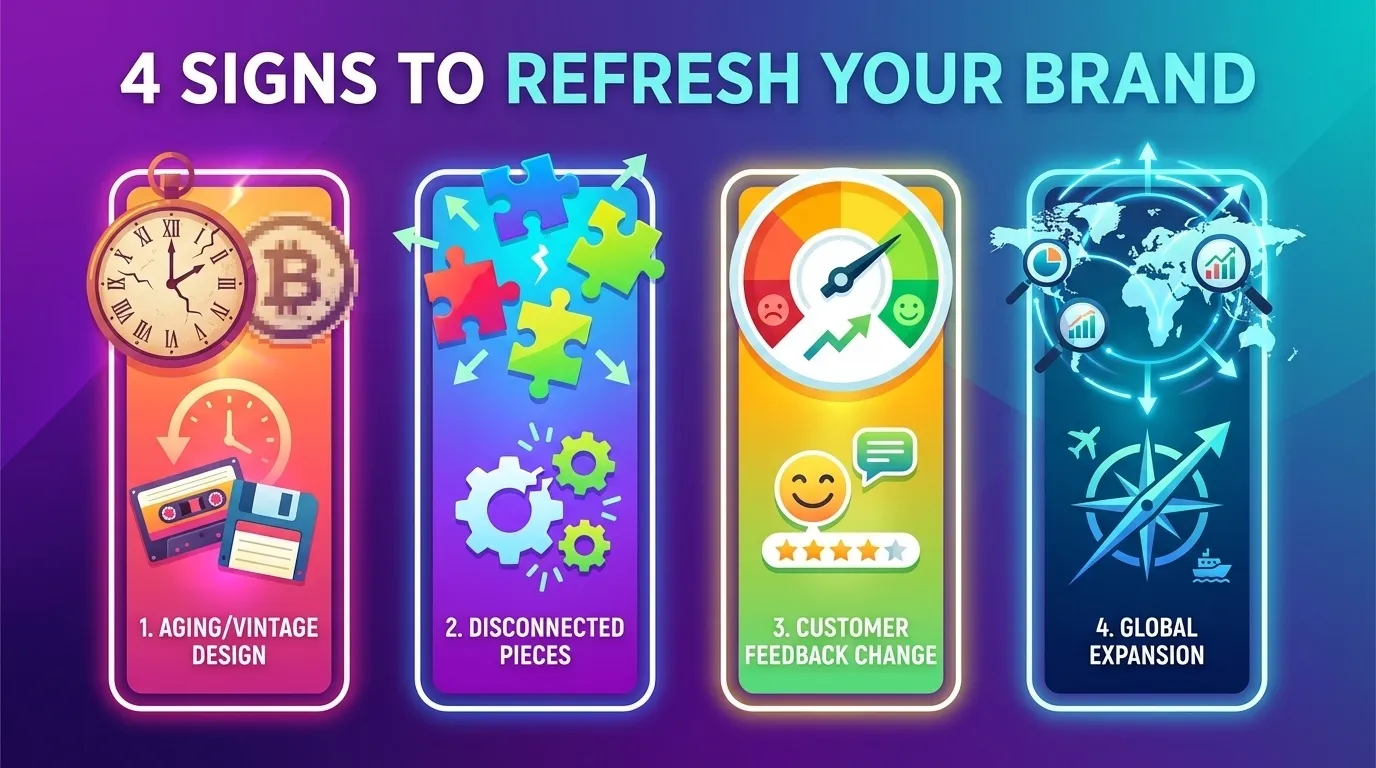
Recognising the right moment to act is what separates strategic brands from reactive ones. Many SME owners wait until revenue dips or competitors overtake them before reviewing their positioning. That delay is expensive.
A structured branding checklist allows you to diagnose problems early, long before they become visible in your P&L. Below are the clearest signals that your brand likely needs a refresh rather than a full rebuild, along with how a disciplined checklist helps you assess each situation properly.
Sign #1: Your Visual Identity Looks Outdated
Visual ageing rarely happens overnight. It creeps in quietly.
You might notice that your logo design feels busier than that of newer competitors. Your colour palette may appear muted compared with brands using cleaner, more confident systems. Your typography may reflect the era of your launch, not the business you are today.
An outdated design does not automatically mean poor design. It simply means misalignment with current market expectations. In Singapore’s highly visual, digital-first environment, first impressions are often formed on Instagram, Google search results, or a mobile landing page.
If your brand assets were built primarily for print or desktop viewing, they may not translate well across modern touchpoints.
A branding checklist helps you evaluate:
- Whether your logo scales well across digital platforms
- If your typography is legible on mobile devices
- Whether your colour system supports accessibility and contrast standards
- If your brand visuals feel cohesive across the website, social media, and offline materials
Without this structured review, businesses often change only the logo. They forget the website layout, iconography, tone of imagery, or user experience. The result is fragmentation rather than improvement.
A refresh works when every visual adjustment supports a unified strategic direction.
Sign #2: Your Messaging No Longer Reflects Your Services
Growth outpaces your website’s ability to keep up. You may have expanded into new services, entered higher-value contracts, or shifted towards a different client segment. Yet your homepage still speaks to the audience you had five years ago. Your value proposition might undersell what you now deliver.
This misalignment creates friction. Prospects feel the disconnect even if they cannot articulate it. They sense a lack of clarity. A proper branding checklist prompts you to review:
- Whether your headline clearly states who you serve today
- If your service descriptions match your actual revenue drivers
- Whether your case studies reflect your current positioning
- If your tone aligns with your ideal client profile
Messaging drift is common among SMEs that scale quickly. A refresh corrects that drift without requiring a full rebrand. It sharpens language, tightens positioning, and ensures that your communication matches your capabilities. When your words lag behind your business reality, clarity becomes your competitive edge.
Sign #3: Customer Perception Has Shifted
Sometimes the issue is not what you say, but how you are perceived.
You may notice lower engagement on social platforms despite maintaining quality content. Reviews might mention confusion about what you specialise in. Sales conversations may include repeated clarification questions that should have been answered on your website.
These signals suggest a perception gap. Your intended positioning and the market’s understanding no longer align.
A branding checklist formalises how you gather and interpret insight. It should include:
- Review of customer feedback and testimonials
- Analysis of frequently asked sales questions
- Monitoring of online reviews and sentiment trends
- Comparison between stated brand values and customer experience
By logging these touchpoints, patterns emerge. Perhaps clients see you as budget-focused when you want to position yourself as premium. Perhaps they perceive you as niche when you aim to broaden your appeal.
A refresh can recalibrate perception by refining messaging, visuals, and tone without dismantling brand equity that still holds value.
Sign #4: You’re Expanding to New Markets
Expansion introduces complexity. Moving beyond Singapore into regional markets such as Malaysia or Indonesia requires sensitivity to cultural nuance and competitive landscapes. Similarly, shifting from B2C to B2B changes how you communicate authority, pricing, and trust.
Expansion does not always demand a full rebrand. Often, it requires a structured refresh that adapts your positioning while preserving recognisable brand elements.
Your branding checklist should evaluate:
- Whether your current brand story resonates with the new audience
- If your pricing and messaging support the new market segment
- Whether your visual identity feels credible at a different scale
- How your digital presence needs to evolve for cross-border discoverability
Consistency builds trust, but relevance builds conversion. The checklist ensures you achieve both.
The Strategic Difference Between Reacting and Refreshing
Many SMEs make branding decisions emotionally. They redesign because a competitor looks better. They update colours because a new trend feels exciting. They change taglines because something sounds fresher.
A refresh guided by a branding checklist is different. It is diagnostic, evidence-based, and aligned with growth objectives.
Before committing budget, ask yourself:
- Is this change addressing a strategic gap or simply aesthetic fatigue?
- Will this improve clarity for my ideal customer?
- Does this support long-term positioning, or is it temporary?
When you approach brand evolution through structure rather than impulse, you protect equity while unlocking growth.
Refreshing your brand is not about chasing relevance. It is about maintaining alignment between who you are, who you serve, and how you communicate that value. A disciplined branding checklist ensures that alignment remains intact as your business scales, pivots, or enters new territory.
When to Refresh vs When to Rebuild: A Practical Branding Checklist Framework
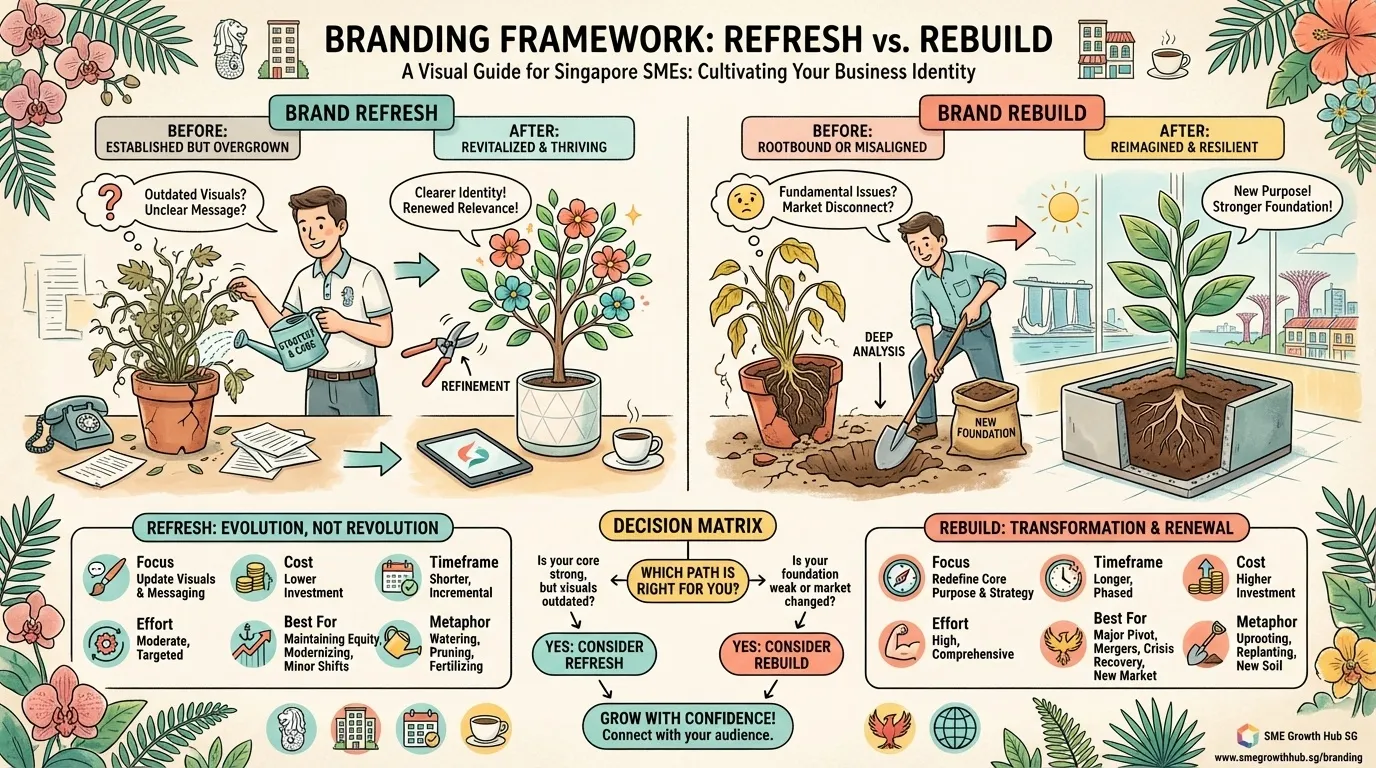
This decision should never be emotional. It should be diagnostic. Too many SMEs jump into a rebrand because a competitor looks sharper or because the founder feels bored with the logo. That is not a strategy– that is impulse. A proper branding checklist forces you to assess business fundamentals before you touch design. The real question is simple. Has your business evolved at its core, or has your presentation simply fallen behind?
Let’s break this down properly.
Branding Checklist for a Brand Refresh
A brand refresh keeps your foundation intact. Your positioning still works. Your audience still recognises you. Revenue is steady. However, the way you present yourself no longer reflects your current standards.
Think of it as renovation, not demolition. You pursue a refresh when:
- Your services are largely the same
- Your target audience has not dramatically changed
- Your brand equity still holds value
- Your digital presence feels dated rather than misaligned
A structured refresh checklist should include the following elements, and each one must connect back to strategy rather than aesthetics.
1. Update Your Logo Without Changing the Brand Essence
This is refinement, not reinvention. You might simplify shapes, modernise proportions, or improve scalability for digital platforms. Do not remove recognisable equity unless there is a strong strategic justification.
2. Refine Typography and Colour Palette
Design trends evolve, but clarity never goes out of style. You may adjust typefaces for better readability across mobile devices or shift colour tones to make the design feel more contemporary. The key is consistency across web, social media, print, and internal documents.
3. Improve Website UX and Visual Consistency
Often, the problem is not your logo. It is your execution.
You should assess:
- Navigation clarity
- Mobile responsiveness
- Page layout consistency
- Call-to-action visibility
- Alignment between visual hierarchy and business goals
A refresh here can significantly improve conversions without changing your brand’s strategic position.
4. Clarify Messaging and Value Proposition
Your brand voice may have matured. Your expertise may have deepened. If your website copy still speaks like a start-up when you are operating at an enterprise level, that gap needs closing.
This part of the branding checklist should include:
- Updated homepage positioning
- Clearer service descriptions
- Stronger differentiation statements
- Tighter headline structure
5. Update Brand Voice Guidelines
As your business grows, your tone (or brand voice) often needs refinement. Perhaps you want to sound more authoritative. Perhaps you want to feel more accessible. Either way, define it clearly so your marketing and sales teams, as well as external partners, speak the same language.
A refresh should feel evolutionary. Your audience recognises you instantly, but they experience a sharper, more confident version of your brand.
Branding Checklist for a Full Rebrand
A full rebrand is not cosmetic. It is strategic surgery. You consider this route when something fundamental has shifted:
- You are targeting a new market segment
- Your services have significantly changed
- Your previous positioning no longer differentiates you
- Your reputation needs rebuilding
- Your business model has evolved
In these cases, refreshing surface elements will not solve the problem. The structure underneath needs rebuilding. Here is what a proper full rebrand checklist must include:
1. Redefine Brand Positioning
Before any design begins, you must clarify:
- Who do you serve now
- What problem do you solve better than your competitors
- Why customers should trust you
- Where you sit in the pricing spectrum
This step requires research, not guesswork.
2. Conduct Competitor and Market Research
Study:
- Direct competitors in Singapore
- Emerging regional players
- Pricing models
- Messaging frameworks
- Visual positioning
You are looking for gaps, saturation points, and opportunities to claim space that others ignore.
3. Identify New Target Audience Segments
A rebrand often accompanies growth. You may be moving from SME clients to an enterprise. Or from B2C to B2B. Or from local to regional.
Your brand must speak fluently to the new audience. That requires updated personas, revised pain points, and new communication priorities.
4. Rename the Business if Necessary
Renaming is not common, but sometimes it is essential. If your current name restricts expansion, misrepresents your services, or carries negative associations, this must be addressed early in the process.
This step demands legal checks, domain availability, and trademark considerations.
5. Redesign the Full Visual Identity
Once the strategy is locked, you rebuild visuals from the ground up:
- New logo system
- Typography architecture
- Colour framework
- Iconography
- Brand imagery direction
- Comprehensive brand guidelines
This ensures alignment between positioning and perception.
6. Rebuild Website Structure and SEO Foundation
Many SMEs overlook this step and pay for it later. A rebrand often requires:
- New site architecture
- Revised keyword strategy
- Updated URL structures
- Redirect mapping
- Content consolidation
Without technical planning, you risk losing organic visibility built over the years.
7. Relaunch Communication Strategy
A rebrand must be communicated deliberately. You should prepare:
- Internal rollout briefings
- Public announcements
- Email campaigns
- Social media launch plans
- Press outreach where appropriate
Done correctly, a relaunch can generate momentum and renewed attention. But when executed poorly, it confuses loyal customers.
Refresh vs Rebrand: A Clear Comparison
To simplify your decision-making, here is a practical comparison.
| Factor | Brand Refresh | Full Rebrand |
| Core positioning | Stays the same | Changes significantly |
| Target audience | Mostly unchanged | New or expanded |
| Visual identity | Refined | Rebuilt |
| Website | Optimised | Restructured |
| Investment level | Moderate | High |
| Timeframe | Weeks | Months |
| Risk level | Lower | Higher but potentially transformational |
If your revenue is steady but your brand feels dated, refresh. If your business direction has shifted and your brand no longer represents reality, rebuild.
The right choice depends entirely on where your business stands today and where you intend to go next. When guided by a structured branding checklist, this decision becomes far less emotional and far more strategic. You move from reacting to leading. And that is exactly where serious growth begins.
Step-by-Step Branding Checklist for Singapore SMEs
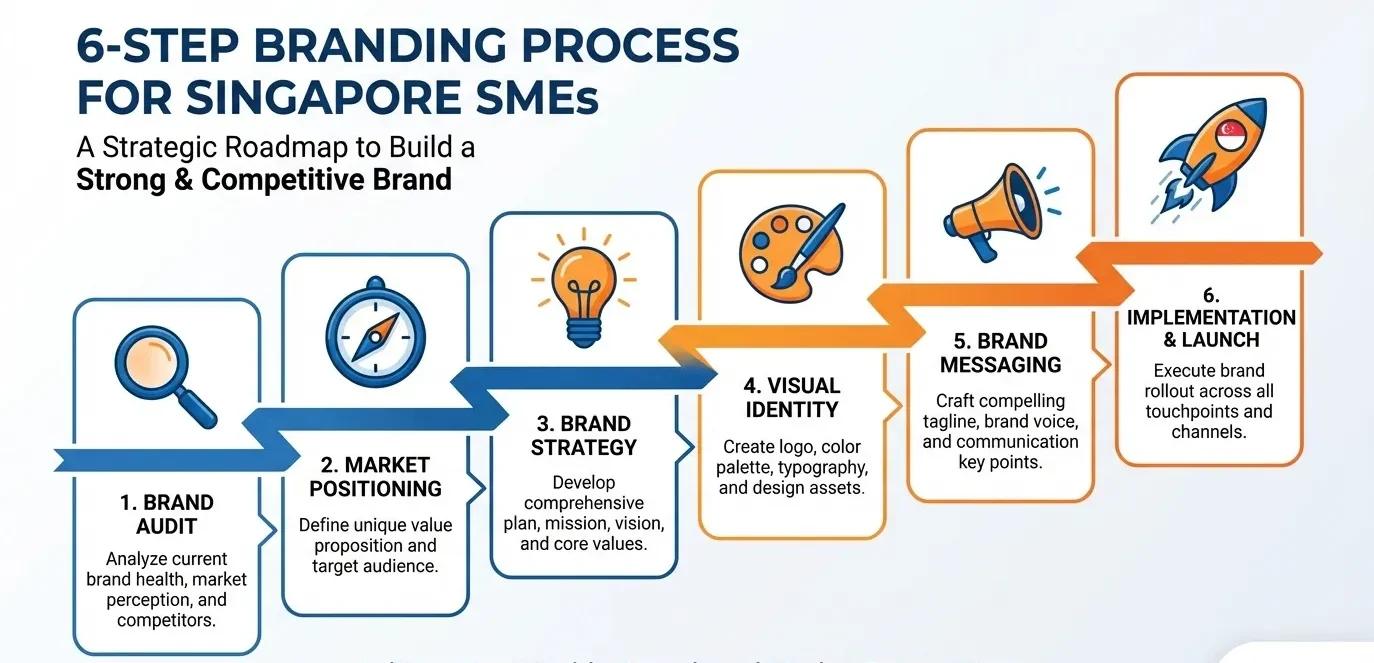
Here is how you turn strategy into execution, not theory or a mood board. A disciplined process that protects your revenue, your SEO equity, and your positioning in a competitive Singapore market.
Step 1: Audit Your Current Brand Assets
Before you redesign anything, you need clarity. Most SMEs skip this and jump straight into visuals. That is where money gets wasted.
Start by cataloguing everything that carries your brand:
- Logo variations across platforms
- Website and landing pages
- Social media presence
- Offline materials such as signage, brochures, and packaging
- Brand guidelines, if they exist
Do not just check for aesthetics. Assess performance. Is your website converting? Are your social channels aligned in tone? Does your LinkedIn banner look like it belongs to the same company as your homepage?
You’re looking for inconsistencies, duplicated messages, outdated positioning, and broken user journeys. A strong branding checklist forces you to confront fragmentation before you decide what to rebuild.
Step 2: Review Your Market Position Using a Branding Checklist
Your brand does not exist in isolation. It lives inside a market. In Singapore, the market is often crowded, fast-moving, and digitally sophisticated. Use your checklist to analyse:
- Direct competitors in Singapore
- Pricing positioning
- Differentiation gaps
- Customer sentiment analysis from reviews and social feedback
This is not a design exercise. It is a positioning exercise. You need to assess the following:
- Are you competing on price without meaning to?
- Are competitors clearer about their value than you are?
- Are customers describing you differently from how you describe yourself?
A structured review prevents ego-driven decisions. It replaces guesswork with evidence.
Step 3: Define a Clear Brand Strategy Before Design
If you skip this step, everything else becomes cosmetic. Before any redesign begins, your branding checklist must lock in strategic foundations:
- Mission and vision
- Core values
- Unique value proposition
- Brand personality
- Tone of voice
Your mission clarifies why you exist beyond profit. Your unique value proposition explains why someone should choose you over competitors in Tanjong Pagar, Orchard, or Jurong. Your tone ensures your Instagram caption, proposal deck, and homepage headline read as coming from the same mind.
Design should reflect the brand strategy. It should not invent it.
Step 4: Align Visual Identity with Strategy
Now you move into creative territory. But this is controlled creativity, guided by decisions already made. Your branding checklist at this stage should cover:
- Logo redesign or refinement
- Typography system
- Colour psychology considerations
- Photography and design direction
- Brand style guide creation
If your strategy positions you as premium, your typography cannot look playful. If your brand personality is bold and disruptive, your colour palette should not whisper.
The goal here is alignment. Visual identity becomes a multiplier of clarity. When done correctly, it increases recall, reinforces trust, and creates consistency across digital ads, shopfront signage, packaging, and pitch decks.
Step 5: Update Messaging and Content Using a Branding Checklist
Even the strongest visual identity collapses without precise messaging. This is where many SMEs underinvest. Words are treated as filler rather than strategic levers.
Your checklist should guide updates across:
- Homepage messaging
- Service page clarity
- Taglines
- Social media bio and content tone
- Sales materials and proposal templates
Your homepage should immediately communicate who you serve and the transformation you provide. Your service pages should remove ambiguity, not add to it. Your taglines should support positioning, not confuse it.
Compelling messaging sharpens perception. Clear perception improves conversion.
Step 6: Implement and Roll Out the Branding Checklist Internally and Externally
A rebrand fails quietly when internal alignment is ignored. Before launch, your branding checklist must include operational execution:
- Staff briefing sessions
- Updating all digital touchpoints
- Email signatures
- Directory listings and Google Business Profile
- Launch announcement plan
Your team needs to understand the “why” behind the shift. Otherwise, they will default to old messaging patterns. Externally, consistency is critical. One outdated landing page or forgotten LinkedIn banner signals carelessness. That erodes credibility faster than you realise.
This stage is about control. Control of narrative. Control of perception. Control of experience.
When you follow this structured approach, your branding checklist becomes more than a document. It becomes a risk management tool and a growth framework. It ensures that every decision, from typography to tone, moves your business forward rather than sideways.
Common Mistakes to Avoid When Following a Branding Checklist
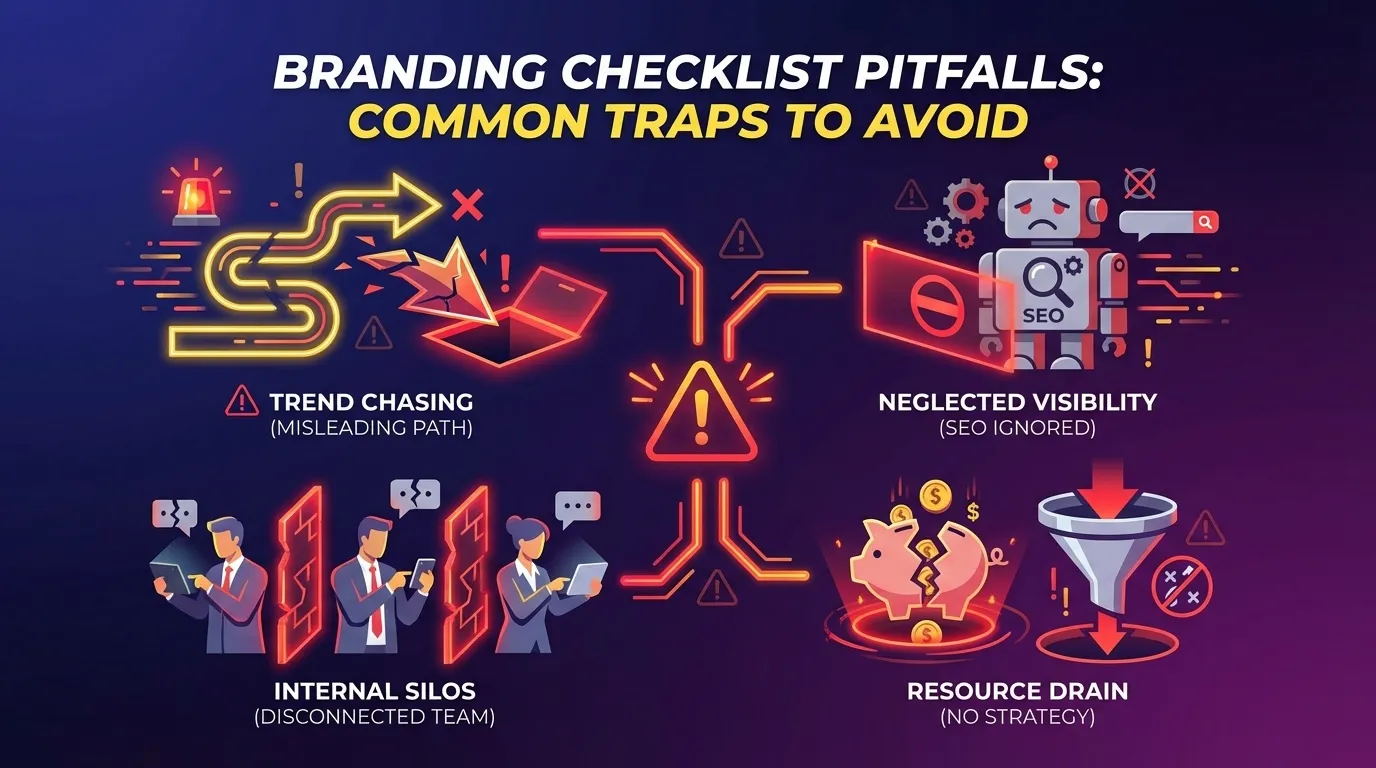

A branding checklist protects you from chaos. It brings structure to what can otherwise become an emotional, design-led exercise. But the checklist itself is not a magic bullet. If you use it poorly or ignore critical elements, you can still waste time, money, and brand equity.
Let’s talk about the mistakes that quietly undermine rebrands, especially for Singapore SMEs operating in competitive sectors like F&B, professional services, property, and eCommerce. These are not theoretical risks. They are patterns we see repeatedly:
Mistake 1: Rebranding Based on Trends Alone
Design trends move fast. Minimalist logos. Flat icons. Muted palettes. Serif typography revival. Every year brings a new aesthetic wave. The problem is not trends themselves. The problem is using trends as your strategy.
If your decision-making sounds like this, you are already in danger:
- “Our competitors look more modern.”
- “This style is popular right now.”
- “We want something that feels trendy.”
None of those statements connects to positioning, audience insight, or commercial goals.
A strong branding checklist forces you to justify every visual decision against strategy. Before approving a new logo or visual direction, you should be able to answer:
- Does this align with our target audience’s expectations?
- Does it reinforce our value proposition?
- Will it still feel relevant in three to five years?
- Does it improve clarity or just change aesthetics?
In Singapore’s dense market, familiarity builds trust. If you abandon recognisable elements without a strategic reason, you risk weakening brand recall. That is particularly dangerous for SMEs that rely on repeat business and referrals.
Trends can inspire– but they should never dictate.
Mistake 2: Ignoring SEO During a Rebrand
This is where many SMEs lose hard-earned visibility. A rebrand often includes a new website, revised service structure, and updated messaging. Done well, this can strengthen your digital presence. Done carelessly, it can wipe out years of organic authority.
Common technical errors include:
- Changing URLs without 301 redirects
- Deleting high-performing blog content
- Removing indexed pages without mapping them properly
- Launching without testing the site structure and internal linking
If you rank for high-intent keywords such as “corporate secretarial services Singapore” or “wedding photography Orchard”, those rankings represent real commercial value. Losing them is not cosmetic. It is financial.
Your branding checklist must include a technical SEO migration plan. That means:
- Conducting a full URL inventory before redesign
- Mapping old URLs to new URLs with permanent redirects
- Preserving high-performing content where possible
- Monitoring rankings and traffic before and after launch
A rebrand should elevate your visibility, not reset it. If SEO is not embedded into your checklist, your rebrand becomes a design project rather than a growth strategy.
Mistake 3: Not Involving Key Stakeholders
Brand decisions made in isolation almost always create friction later. When only the founder or a small internal team drives the rebrand, you miss critical insight from the people closest to your customers. That includes:
- Sales teams that hear objections daily
- Customer service staff who understand recurring concerns
- Long-term clients who chose you for specific reasons
Your branding checklist should require structured input before major decisions are finalised. This does not mean design by committee. It means informed leadership.
For example, before refining your value proposition, gather:
- Customer feedback from reviews and surveys
- Sales call transcripts
- Data on which services generate the most profit
This gives you language grounded in reality rather than assumptions. In Singapore’s relationship-driven business culture, misalignment between brand promise and frontline delivery is quickly exposed. A checklist that enforces stakeholder consultation prevents internal confusion and external inconsistency.
Mistake 4: Rebuilding Everything Without a Clear ROI
Rebranding can feel exciting, with the promise of new visuals, sharper messaging, and a genuine fresh start for the business. But if you cannot articulate what success looks like, you are operating on emotion.
A serious branding checklist links every major decision to measurable objectives. Before approving a full rebuild, define:
- What commercial problem are we solving?
- Are we trying to increase average order value?
- Are we repositioning to attract higher-margin clients?
- Are we entering a new market segment?
Then set metrics. For example:
- Increase qualified inbound leads by 30 percent within 12 months
- Improve website conversion rate from 1.8 percent to 3 percent
- Reduce sales cycle length by clarifying positioning
Without benchmarks, you will not know whether your rebrand worked. Overspending on aesthetics without performance tracking is one of the most expensive branding errors SMEs make. Design is important, but it must support commercial outcomes.
A disciplined branding checklist includes:
- Pre-rebrand baseline metrics
- Clear KPIs tied to business goals
- Post-launch review timelines
- Budget controls aligned with projected return
Rebranding should strengthen profitability, not just appearance. A branding checklist is not a decorative document. It is a strategic control system. It keeps you focused when emotions run high, when opinions clash, and when trends tempt you.
Used properly, it protects your equity, safeguards your SEO, aligns your team, and ensures your investment produces measurable growth. But when used carelessly, it becomes a formality that masks expensive mistakes.
If you are going to refresh or rebuild, do it with discipline. Structure your thinking. Challenge your assumptions. Tie every change to strategy. That is how serious brands are built.
How Often Should You Review Your Branding Checklist?

If you only revisit your brand when sales dip, you are already reacting too late. A strong brand requires a structured and intentional review because markets shift, customer expectations evolve, and competitors reposition themselves more often than most business owners realise.
When your brand does not keep pace with those changes, it gradually loses relevance, and that erosion usually happens quietly before it shows up in your revenue numbers.
For Singapore SMEs operating in dense sectors such as F&B in Tanjong Pagar, professional services in Raffles Place, or eCommerce brands competing regionally, the pace of change is not theoretical. It is visible every quarter.
You should treat your branding checklist as a living document. That means scheduling structured reviews rather than waiting for problems to surface.
Conduct a Formal Annual Brand Audit
At a minimum, complete a full review annually. An annual audit allows you to assess:
- Whether your positioning still reflects your current services
- Whether your visual identity feels contemporary in your category
- Whether your messaging aligns with customer pain points today
- Whether SEO visibility has improved, stagnated, or declined
- Whether competitors have shifted their positioning
This is not about redesigning every year. It is about strategic validation. Many brands discover that only minor refinements are needed. Others uncover deeper structural misalignment.
Block this review into your calendar as you would financial planning. Branding affects revenue. It deserves equal attention.

Trigger Reviews at Major Business Milestones
Certain moments demand immediate review of your branding checklist. Do not wait for the annual cycle. Common milestone triggers include:
- Launching a new flagship service
- Expanding beyond Singapore into Malaysia or Australia
- Moving from B2C to B2B
- Securing external funding
- Merging with another company
When your business model evolves, your brand must evolve with it. A checklist ensures that your positioning, visuals, and messaging scale intentionally rather than drift.
Monitor Market Shifts and Competitive Pressure
Singapore markets can change quickly. You may see a surge of new entrants entering your space within months, a regulatory adjustment that reshapes how you operate, or a noticeable shift in consumer preferences that alters buying behaviour almost overnight.
When competitors aggressively reposition or adopt a new dominant narrative in your industry, it is a strategic signal worth paying attention to. It does not mean you should imitate their direction or react impulsively. Instead, it is the right moment to review your branding checklist with discipline.
Evaluate how clearly your brand differentiates itself, whether your positioning still reflects a meaningful advantage, and whether your value proposition is articulated in a way that feels relevant and compelling.
The goal is not to follow the noise, but to ensure your brand remains distinct, credible, and strategically sharp within a changing competitive landscape. This is especially relevant in digital-heavy sectors such as fintech, SaaS, and direct-to-consumer retail.
Watch for Revenue Plateau Indicators
Sometimes the clearest signal is performance. If revenue flattens despite consistent marketing efforts or if customer acquisition costs rise without a clear explanation, your brand positioning may be underperforming.
Review:
- Is your value proposition distinct enough?
- Does your messaging communicate outcomes clearly?
- Is your visual identity reinforcing trust and credibility?
A structured review prevents emotional decisions because it forces you to examine evidence before acting. You begin by diagnosing what is actually underperforming, whether that is positioning, messaging, or visual consistency, and only then decide whether a redesign is truly necessary.
Build Reviews Into Your Operating Rhythm
Pairing quarterly light reviews with a more comprehensive annual audit creates a healthy rhythm for managing your brand.
During quarterly reviews, focus on practical alignment. Examine whether your messaging remains clear across campaigns, whether your current promotions reflect your positioning, and whether visual and tonal consistency is maintained across platforms.
These shorter reviews help you catch drift early, before small inconsistencies compound into larger strategic issues.
The annual audit should go deeper. This is where you reassess your market positioning, evaluate how customers perceive your brand, analyse competitors’ shifts, and determine whether your strategic direction continues to support your long-term business goals.
Instead of tweaking surface elements, you step back and question whether your brand narrative, authority, and differentiation remain strong in your sector. When you follow this structured cadence, your brand evolves with intention. Decisions become proactive rather than reactive, guided by data and strategic review rather than by urgency or pressure.
Branding Checklist Template Summary for Quick Reference
| Area | What to Review | Why It Matters |
| Strategy Alignment |
|
|
| Visual Consistency |
|
|
| Messaging Clarity |
|
|
| Market Positioning |
|
|
| SEO Safeguards |
|
|
| Internal Alignment |
|
|
| Launch Plan |
|
|
A branding checklist is not a one-time worksheet that you complete and forget. It functions as a governance tool that keeps your business aligned as you scale, pivot, introduce new services, or expand beyond Singapore into regional markets.
When you review it consistently and apply it with discipline, your brand evolves with intention rather than by accident. Over time, that consistency strengthens recognition, sharpens positioning, and builds trust.
Instead of becoming something you need to repair every few years, your brand becomes a strategic asset that compounds in value as your business grows.
From Audit to Action: Making Your Branding Checklist Work

A branding checklist only creates value when it moves beyond discussion and into disciplined execution. Auditing your positioning, visuals, messaging, and SEO safeguards is the diagnostic phase. Action is where growth happens.
Start by prioritising what will create the highest impact. If your positioning is unclear, fix that before redesigning your logo. If your website structure is costing you organic visibility, address technical foundations before launching a campaign. Sequence matters. A strategic rollout ensures that every adjustment strengthens authority rather than creating confusion.
You also need ownership. Assign clear responsibility across leadership, marketing, and sales teams. Set measurable objectives. Track changes in brand perception, conversion rates, and search visibility over time. Branding is not abstract. It directly influences how prospects evaluate you against competitors in Singapore’s crowded market.
When the process feels complex or resource-intensive, that is often a signal that expert guidance is required. MediaOne works with SMEs to translate branding audits into structured action plans that integrate positioning, digital strategy, and performance tracking.
If you are reviewing your branding checklist and need clarity on next steps, call us today to discuss how to execute strategically and protect your growth trajectory. In a market shaped by constant digital shifts and evolving social media statistics, businesses that treat branding as governance rather than decoration are the ones that scale sustainably.

Frequently Asked Questions
Is a branding checklist useful for eCommerce SMEs?
A branding checklist is particularly valuable for eCommerce SMEs because digital touchpoints drive most customer interactions. It ensures consistent product presentation, aligned messaging, optimised conversion paths, and integrated paid advertising. Without a structured checklist, updates to packaging, website design, and campaigns can become fragmented.
A disciplined approach strengthens trust and improves long-term customer acquisition efficiency.
What is the difference between a brand refresh and a rebrand?
A brand refresh updates selected elements such as visual identity, messaging, or website design while keeping the core positioning and brand essence intact. A rebrand is a deeper strategic shift that may involve redefining target audiences, repositioning in the market, renaming the business, and rebuilding the visual and digital foundation.
Refreshes are typically evolutionary, while rebrands are transformational. The right choice depends on whether your business fundamentals have changed or simply your presentation.
How much should Singapore SMEs budget for branding work?
Branding costs in Singapore vary based on scope, complexity, and agency expertise. A focused brand refresh typically ranges from SGD 8,000 to SGD 40,000, while a full strategic rebrand, including research, positioning, visual identity, and website redevelopment, can exceed SGD 60,000.
SMEs should budget according to business objectives rather than aesthetics alone. The investment should align with measurable growth targets such as market expansion or repositioning.
How long does a typical branding project take?
A brand refresh typically takes four to eight weeks, depending on decision-making speed and asset complexity. A full rebrand can take three to six months, especially when it includes market research, stakeholder alignment, and website restructuring. Larger organisations or multi-market rollouts may require a longer timeline. The duration depends more on strategic depth than on design execution.
Can a rebrand improve SEO?
A rebrand can improve SEO if it includes technical safeguards and content optimisation. Updating site architecture, refining keyword targeting, and improving user experience can strengthen search visibility over time. However, changing URLs without proper redirects or removing high-performing content can harm rankings. SEO should be integrated into the rebranding strategy from the outset.