As you probably know, Singapore’s marketplace is saturated. Every company claims to be innovative, customer-centric, and different. In Singapore alone, there are over 626,000 registered businesses competing for attention across digital platforms. When everyone sounds the same, your message disappears.

That is why a distinct brand story is no longer optional. It is strategic and shapes how customers perceive you before they compare prices or features. It determines whether they remember you or scroll past.
Many growing companies turn to a branding agency to sharpen their positioning and articulate that narrative clearly, especially when internal messaging starts to feel diluted or inconsistent. External expertise helps clarify what makes you genuinely different and translate it into a story your audience recognises as real.
In this guide, you will learn how to build a brand story that feels human, persuasive, and unmistakably yours, not something lifted from a competitor’s homepage.
Key Takeaways:
- A brand story defines who you are, what you believe, and how you connect emotionally with your audience, shaping perception, recall, and differentiation.
- A strong brand story centres on conflict, audience identity and lived experience to make narratives memorable and meaningful.
- Avoid generic messaging by being specific about who you serve, the problem you solve and the future you help create.
- The narrative should align internal culture and actions with external messaging to build credibility and trust.
What Is a Brand Story (And What It Is Not)
If you strip away the design, the ad spend, and the clever copywriting, what remains is the story people tell themselves about your business. That is your brand story.
It is not a slogan. It is not a timeline. It is not a polished paragraph on your About page that sounds impressive but says very little.
A brand story is the narrative framework that shapes how your audience interprets everything you do. It answers three critical questions in a way that feels coherent and human:
- Who you are
- Why you exist
- How do you solve a real, human problem
When someone encounters your business, whether through a Google search, a LinkedIn post, or a pitch deck, they are subconsciously trying to place you in a mental category. Your brand story guides that categorisation. It tells them what role you play in their world.
What a Brand Story Is
A brand story is the strategic narrative that connects your origin, beliefs, audience and solution into a single, consistent thread.
It is:
- The lens through which your services are understood
- The emotional context behind your offers
- The reason your positioning feels intentional rather than accidental
- The story your customers repeat when they refer you
Think of it as your business translated into meaning.
For example, two digital marketing agencies may both offer SEO and paid ads. One frames its work around aggressive growth and market dominance. The other frames it around sustainable, long-term visibility and trust.

The services overlap. The narrative does not. That narrative difference shapes who they attract, how they price, and how they compete.
A strong brand story aligns your commercial goals with your audience’s internal motivations. It makes your marketing feel less like persuasion and more like alignment.
What a Brand Story Is Not
Clarity often comes from contrast. So let’s draw the boundaries. A brand story is not:
- A mission statement: A mission statement is typically concise and aspirational. It may articulate purpose, but it rarely carries narrative tension or transformation.
- An About page: An About page can contain elements of your brand story, but it is a format. The story is the underlying logic that shapes the page.
- A tagline: A tagline is a distilled expression. Your brand story is the foundation that makes that expression meaningful.
- A founder biography: Your personal journey can be part of the story, but unless it connects directly to your audience’s problem, it remains autobiography, not strategy.
Most importantly, a brand story is not a chronological list of milestones. Revenue milestones, office expansions, awards, and media mentions may build credibility, but they do not create a narrative on their own. Without context and conflict, they are simply facts.
The Difference Between Information and Meaning
Here is the distinction that separates effective brands from forgettable ones.
- Information tells people what happened.
- A brand story tells them why it matters.
A mission statement might read, “We empower SMEs through data-driven marketing.” That is functional. It explains intent. But it does not create an emotional connection.
A brand story might explain that you saw local SMEs in Tanjong Pagar spending thousands of dollars a month on digital ads with no measurable return, and you built a performance-driven framework to stop the waste. Suddenly, there is tension. There is a problem. There is a reason to care.
That shift from abstract purpose to lived reality is where identity forms.
The Role of Emotion, Identity and Positioning
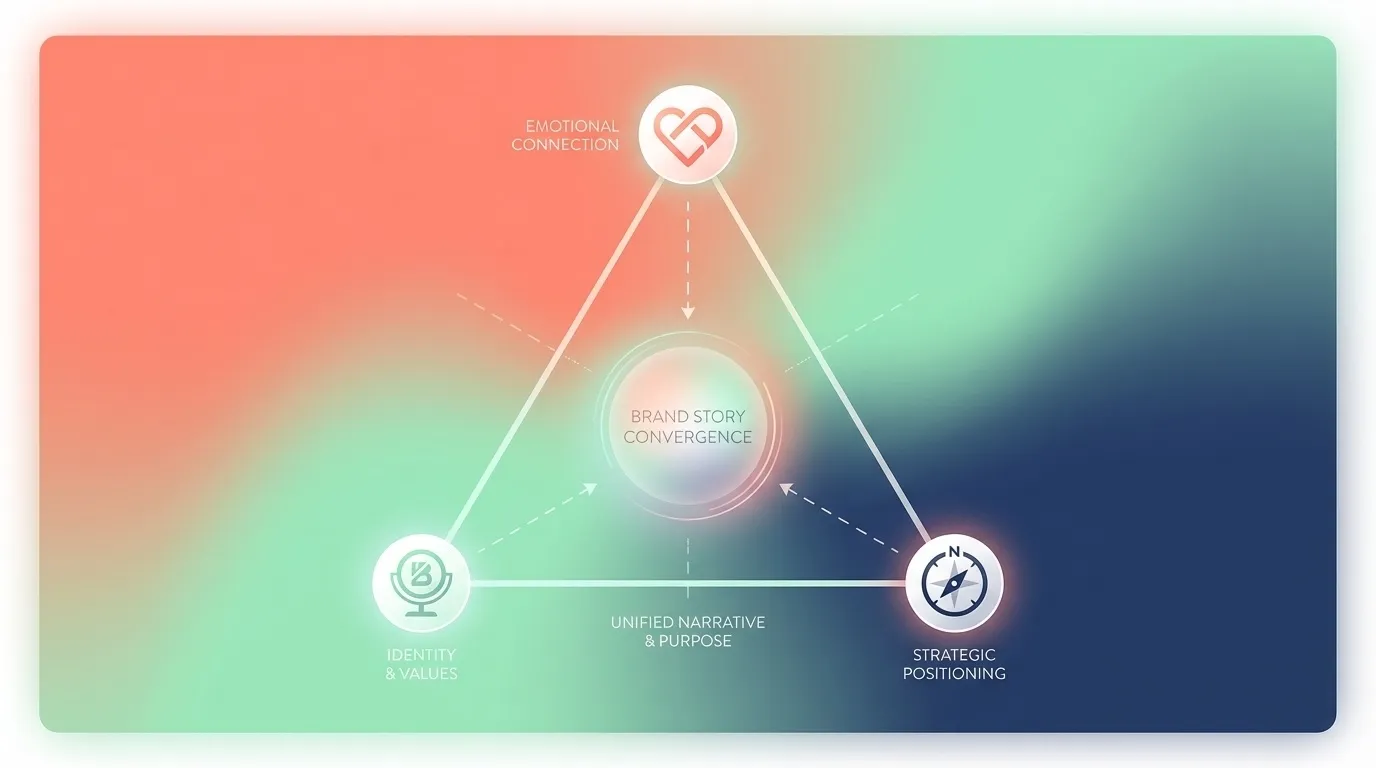
A compelling brand story sits at the intersection of three forces:
- Emotion: People make decisions emotionally and justify them rationally. Your story must reflect a feeling your audience already has, whether that is frustration, ambition, fear of stagnation or desire for growth.
- Identity: Customers choose brands that reflect who they believe they are. If your story signals discipline, boldness, innovation or reliability, you are inviting a specific type of person to align with you.
- Positioning: Your story clarifies how you are different, not just in features but in philosophy. It answers the unspoken question, “Why you instead of someone else?”
When these three elements align, your messaging feels cohesive. Your website copy, sales pitch, social content, and pricing strategy all start to make sense as parts of the same narrative.
Why This Matters More Than You Think
In crowded markets, features converge quickly. Pricing gets matched. Services look similar. What endures is perception.
Your brand story becomes the filter through which every future message is interpreted. It shapes trust. It shapes recall. It shapes whether someone sees you as a commodity or a category leader.
If you treat it as an afterthought, your marketing will feel fragmented. If you treat it as a strategic asset, it becomes the spine that supports everything else.
That is the difference between sounding like everyone else and building a narrative that people recognise, remember and choose.
Why Most Brand Stories Sound the Same

If you feel like every company in your industry sounds identical, you are not imagining it. The sameness is structural.

Walk through almost any website in your space. You will see the same promises recycled with minor tweaks:
- “Customer first.”
- “Driven by innovation.”
- “Committed to excellence.”
These phrases are not wrong, but they are empty without context. They could belong to a fintech start-up in Raffles Place, a logistics firm in Jurong, or a boutique agency in Tanjong Pagar. When language is interchangeable, your positioning is too.
This does not happen because your competitors lack effort. It happens because most businesses build their messaging from the outside in. They start by scanning what others are saying, then adjust slightly so they do not appear too different. The result feels safe, but safety rarely earns attention.
Let’s break down the real reasons brand stories collapse into background noise:
1. They Borrow Language Instead of Defining Difference
When you study competitors before clarifying your own point of view, you unconsciously absorb their vocabulary. Over time, your website reads like a remixed version of everyone else’s. You might tell yourself that you are “aligning with industry standards.” But in reality, you are erasing your edge.
A strong narrative starts with questions like:
- What do we believe about this industry that others do not openly say?
- What frustrates us about how things are currently done?
- Where do we disagree with the status quo?
If your messaging cannot answer those questions clearly, it will default to familiar, safe, but forgettable phrases.
2. They Focus on Features Instead of the Experience Those Features Create
Features are easy to describe. Experiences require empathy. It is far simpler to say, “We offer 24/7 support,” than to articulate what that support means to a stressed founder trying to fix a crisis at 11 pm. The first is a specification. The second is a lived moment.
When your story centres on:
- Faster processing times
- Advanced technology
- Proven frameworks
- End-to-end solutions
You may sound competent, but you do not yet sound meaningful.
A compelling narrative translates features into transformation. It answers, “What changes for the customer because we exist?” That shift from product to impact is where differentiation begins.
3. They Optimise for Internal Approval, Not Customer Resonance
Many brand stories are written in boardrooms. Language gets filtered through layers of management. Risky phrases are softened. Strong opinions are diluted. Anything that feels too bold is toned down in favour of something universally acceptable. What remains is polished, professional and entirely forgettable.
If your story is designed to avoid offending anyone, it will rarely excite anyone either. Your audience does not need a perfectly neutral brand. They need a brand that understands their tension and speaks to it clearly.
This is where customer research matters. Not generic surveys, but real conversations. When you use your customer’s own language, your message becomes sharper and more credible.
4. They Choose Safety Over Specificity
Specificity feels dangerous because it excludes people. Yet exclusion is what creates clarity.
When you say, “We help businesses grow,” you appeal to everyone and no one. But when you say, “We help Singapore-based service firms increase inbound leads through performance content marketing,” you narrow the field.
That narrowing is what makes your message recognisable. Specific stories include:
- Concrete situations
- Clear target audiences
- Real frustrations
- Tangible outcomes
Vague stories rely on abstract terms such as excellence, synergy, empowerment, and innovation. These words require interpretation. Specific examples do not.
The irony is that many brands fear being too specific because they think it will limit opportunity. In practice, specificity attracts the right clients and repels the wrong ones, which is far more efficient for growth.
When your narrative is built on borrowed language, feature lists, internal politics and risk avoidance, it will sound polished but hollow. Your audience will skim it, nod politely and move on.
If you want to stand out, you must be willing to sound like yourself. That means taking a position, grounding your message in real experiences, and choosing clarity over corporate comfort. That is where your differentiation lives.
The Psychology Behind a Memorable Brand Story

If you want your messaging to land, you need to understand what the brain actually responds to. A memorable brand story works because it aligns with how humans process, store and retrieve information. This is not poetic theory. It is backed by behavioural and cognitive research.
Multiple studies have shown that narrative information is retained more effectively than isolated facts. One controlled study published in The Quarterly Journal of Economics found that while statistics initially had a stronger influence on beliefs than stories, the effect of statistics decayed by 73% over one day compared to only 32% for stories, making stories have a stronger and longer-lasting influence on beliefs over time.
In other words, when people hear a story, they are not just processing information. They are internalising it.
Other research in cognitive neuroscience indicates that stories activate multiple brain regions, including those associated with sensory experience and emotion. That richer activation increases engagement and recall.
If you are a business owner or marketer, this has a direct implication. When you rely solely on statistics, credentials and product features, you are asking your audience to process information passively. When you frame your positioning as a narrative, you invite them to experience it.
Why Stories Stick: Four Psychological Drivers
A persuasive brand story usually activates at least one, and often several, of the following psychological triggers:
1. Belonging
Humans are wired for social connection. Research in social psychology consistently shows that the need to belong is a fundamental human motivation.
When your narrative signals “people like you choose this,” it does more than describe a product. It creates a sense of tribe. This is why strong brands often use language that subtly signals a sense of community. Not in a forced way. In a recognisable way.
For example, when you frame your service as built for “founders scaling beyond SGD 1 million in revenue,” you are not just stating a market segment. You are signalling status, stage and shared ambition. That sense of belonging makes your message feel relevant rather than generic.
2. Aspiration
Stories enable your audience to envision a better future. Research in consumer psychology suggests that aspirational messaging influences self-concept and decision-making, particularly when people see the outcome as attainable.
In practice, this means your brand story should not just describe where your audience is today. It should show where they could be. Not through vague promises, but through specific transformation.
Instead of saying “we help businesses grow,” describe what growth looks like. More inbound leads from Orchard Road retailers. Higher conversion rates for B2B firms in Raffles Place. Greater pricing power without constant discounting. Aspiration becomes credible when it is concrete.
3. Relief
A compelling narrative also offers emotional release. Studies on narrative persuasion show that when audiences see a problem introduced and resolved within a story structure, they experience stronger engagement and more positive evaluation of the message.
In commercial terms, relief comes from recognising a shared struggle. Your audience may be frustrated with inconsistent leads, rising ad costs in Singapore’s competitive digital landscape, or agencies that overpromise and underdeliver.
When your story acknowledges that tension and shows a clear resolution, you provide psychological relief. Relief is powerful because it lowers resistance. When people feel understood, they become open.
4. Identity
Perhaps the most powerful driver is identity. Research in behavioural science shows that people make decisions that reinforce their sense of who they are or who they want to become.
Your brand story should answer this silent question: “What does choosing this brand say about me?”
Are you for pragmatic operators who value ROI over hype? Are you for ambitious disruptors who want to lead their category? Are you for founders who prioritise long-term brand equity over short-term hacks?
When your narrative aligns with identity, you are no longer competing purely on features or price. You are reinforcing self-perception.
The Role of Conflict and Relatable Characters.
Conflict creates tension. Tension creates attention. Attention improves recall.
In a business context, the “character” is often your customer. The conflict might stem from stagnant revenue, brand confusion, or a crowded market in areas such as Tanjong Pagar or Jurong, where competition is fierce. The resolution is the transformation your service enables.
When you structure your brand story around a relatable protagonist facing a recognisable challenge, you are tapping into a cognitive shortcut. The brain follows the arc naturally. Beginning, struggle, resolution. That structure is easier to remember than a list of service features.
Why Specificity Creates Credibility
Specific details anchor memory. Cognitive psychology shows that concrete information is easier to encode and retrieve than abstract language.
If your narrative says “we help businesses succeed,” it evaporates. If it says “we helped a local F and B chain increase online bookings by 42 per cent within six months through structured SEO and paid search optimisation,” it sticks.
Specificity does not mean exaggeration. It means clarity. When you ground your brand story in tangible situations, real numbers in SGD, and recognisable contexts, you reduce scepticism and increase trust.
What This Means for You
If you want your brand story to cut through the noise in Singapore’s crowded digital market, you must do more than craft elegant copy. You must align with how the brain works.
A strong narrative:
- Activates belonging
- Paints a credible aspiration
- Offers emotional relief
- Reinforces identity
- Uses conflict to hold attention
- Anchors’ claims in concrete detail
When you understand the psychology behind storytelling, you stop treating your brand story as decoration. You start treating it as a strategy.
The Core Elements of a Powerful Brand Story
If you want your brand story to drive revenue rather than just fill an About page, you need structure. Not fluff or adjectives– structure.
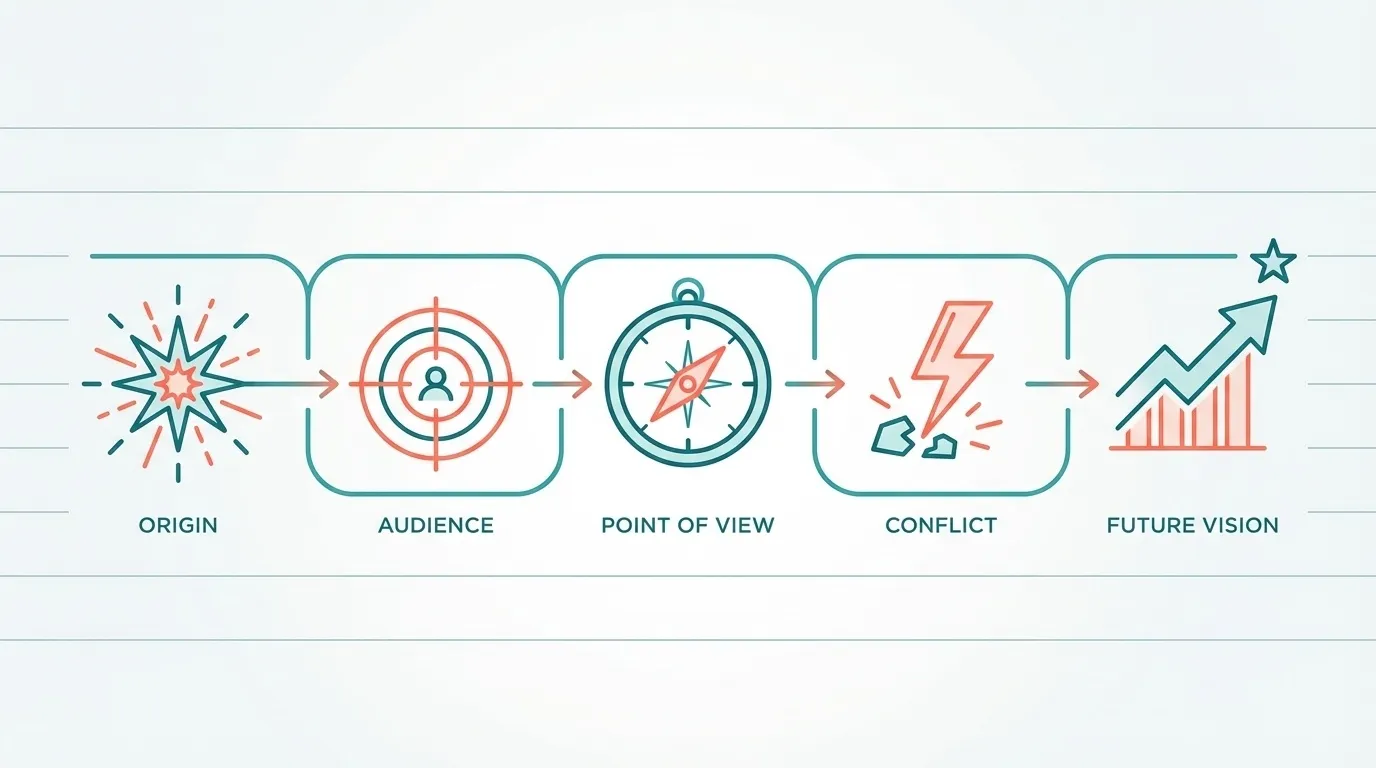
A powerful brand story rests on five pillars. Each one sharpens positioning. Each one makes your message easier for humans to understand and for AI search systems that reward clarity, consistency, and entity alignment.
Here’s what you need to build each element properly:
1. A Clear Origin
Your origin is not a corporate timeline. It is the moment something felt broken enough that you decided to fix it.
Most businesses sanitise this part. They remove friction. They smooth out doubt. They polish away the real struggle because it feels unprofessional. That instinct is exactly what makes most brand stories forgettable.
A strong origin answers three questions:
- What was wrong with the status quo?
- Why did that problem matter personally?
- What changed because you refused to ignore it?
The most compelling origin stories are grounded in lived experience. They connect to a real frustration, not a marketing angle invented later.
Take Hegen, the Singapore baby product company. Founder Yvon Bock created the brand after struggling with inefficient, complicated feeding systems. Her experience at her father’s plastics manufacturing company, Fitson, combined with her personal journey as a breastfeeding mother, led to the patented Press-to-Close, Twist-to-Open system, which simplified feeding and storage in a single container.
That origin is not abstract. It is practical, relatable, and tied directly to product innovation. What makes this effective is not drama, but clarity. The problem existed. It was frustrating. And after that, a solution emerged from that tension.
When crafting your own origin, resist the urge to sound impressive. Focus on sounding honest.
2. A Defined Audience
You do not have a brand story if you are speaking to everyone. Broad messaging creates vague storytelling. Vague storytelling creates weak positioning. Weak positioning creates price competition.
Instead, anchor your narrative to a specific person. Not a demographic spreadsheet. A real scenario. For example:
- A founder running a five-person SME in Tanjong Pagar who feels invisible online.
- A marketing manager in Jurong is tasked with generating leads on a limited SGD budget.
- A working parent juggling career growth and childcare responsibilities.
When you write with that individual in mind, your tone changes naturally. Your examples become concrete. Your language sharpens. Defined audience clarity does three important things:
- It shapes vocabulary and references.
- It determines which conflicts matter.
- It filters out irrelevant messaging.
You are not excluding customers. You are attracting the right ones.
3. A Distinct Point of View
Your point of view is your spine. Without it, your brand story collapses into generic promises. A distinct point of view answers this question clearly: What do you believe about your industry that others either ignore or dilute?
It might be:
- That performance marketing without brand building is short-term thinking.
- That aesthetics without usability is design theatre.
- That local brands can compete globally without copying Western positioning.
The key is conviction. If your belief could comfortably appear on a competitor’s website, it is not distinct enough.
To develop your point of view:
- Identify industry norms you disagree with.
- Clarify the cost of following those norms.
- Explain the alternative path you champion.
This is not about being controversial for attention. It is about having a stance rooted in expertise and experience.
A strong point of view signals authority. It also makes your content more indexable and recognisable in AI-driven search, because consistent perspectives strengthen semantic associations over time.
4. A Meaningful Conflict
No conflict, no story. Conflict is the tension between where your audience is now and where they want to be. It is the gap between effort and results. It is the frustration of spending on ads without seeing measurable growth. It is the exhaustion of trying multiple agencies without strategic alignment.
If your brand story does not articulate this tension clearly, your solution feels optional rather than essential. A meaningful conflict includes:
- A visible obstacle.
- Emotional stakes.
- Practical consequences.
For example, if a business owner invests SGD 5,000 per month in digital ads without understanding attribution, the conflict is not just wasted spend. It is a lost opportunity, stalled growth, and internal doubt about marketing decisions.
Your role in the story is not to artificially eliminate tension. It is to guide your audience through it. When you frame your solution as a bridge between struggle and clarity, you move from selling services to enabling transformation.
5. A Future Vision
A brand story without a future vision is incomplete. You are not only solving today’s problem. You are inviting your audience into a bigger trajectory. What changes long-term because your product or service exists?
The future vision should feel tangible. Not abstract ambition. Not motivational slogans. Consider these framing questions:
- After working with you, what becomes easier?
- What new opportunities open up?
- How does your customer’s identity shift?
For a growing Singapore SME, the future vision might include:
- Sustainable lead generation without constant promotional discounts.
- A recognisable market position beyond price competition.
- Confidence in scaling into regional markets.
The future vision aligns aspiration with action. It gives your audience something to step into.
How These Five Elements Work Together
When combined, these pillars create coherence:
- The origin establishes credibility.
- The defined audience sharpens relevance.
- The point of view signals authority.
- The conflict creates urgency.
- The future vision drives momentum.
Remove one, and the story weakens. Neglect two and it becomes generic. If you are serious about growth, treat your brand story as infrastructure. It should inform your homepage messaging, pitch decks, social content, and even sales conversations.
A powerful brand story is not decorative. It is a strategic positioning expressed through narrative. When built correctly, it becomes the thread that ties marketing, sales, and long-term brand equity together.
How to Develop Your Brand Story Step by Step
If you want a brand story that earns attention and trust, you need more than inspiration. You need a method. What follows is a practical workflow you can apply across your website, campaigns, and sales conversations. It forces clarity, exposes weak positioning, and turns vague messaging into a strategic narrative that drives revenue.
Here’s a step-by-step guide on developing your own brand story:
Step 1: Audit Your Current Brand Story
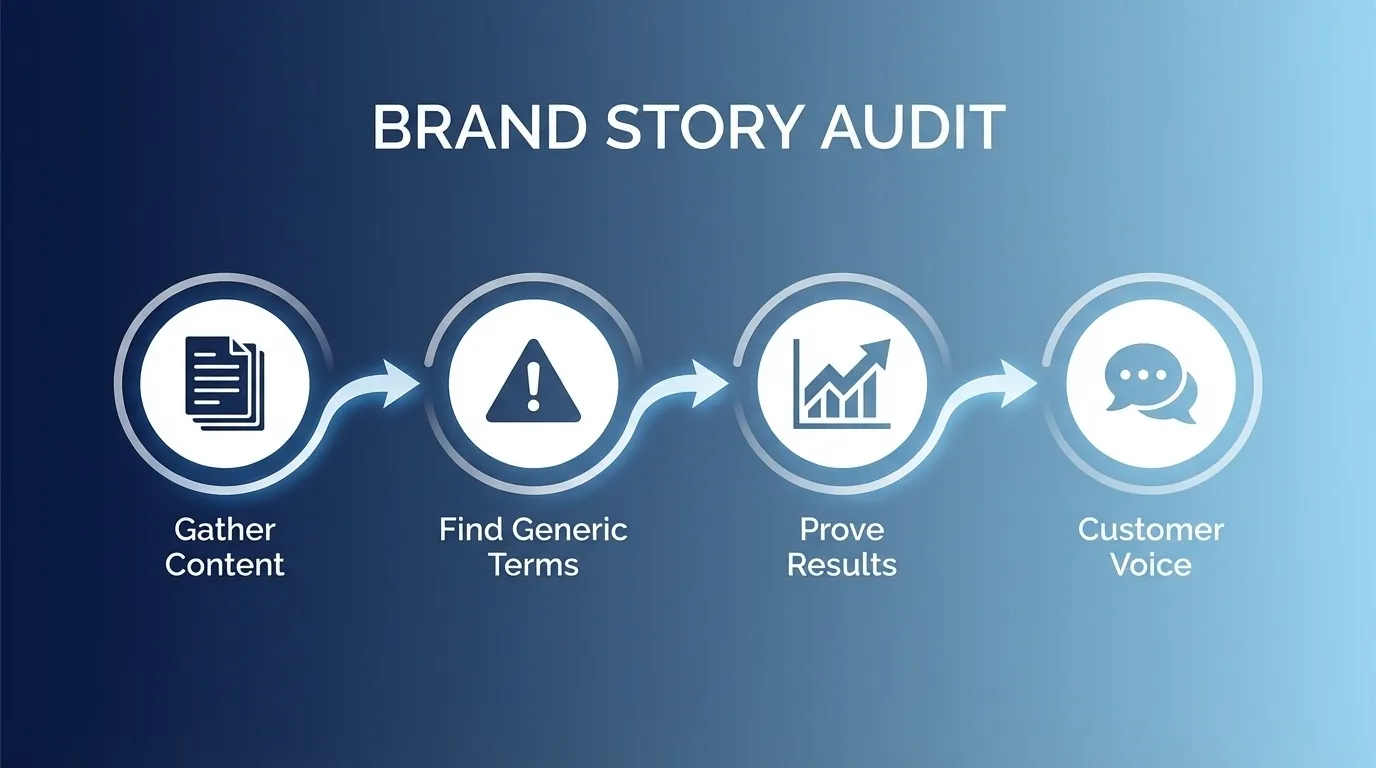
Before you rewrite anything, diagnose what you already have. Pull up your homepage, your “About” page, your LinkedIn company description, your paid ads, your pitch decks, and your email sequences. Lay them side by side. Read them as if you were a sceptical prospect who has never heard of you.
Now interrogate the language.
- Where is the wording vague or interchangeable with a competitor?
- Where do you claim to be “innovative”, “customer-focused”, or “leading” without evidence?
- Where are you describing features instead of outcomes?
- Where do you sound like you are talking about yourself instead of your customer?
This exercise is uncomfortable. Good. It should be.
Most businesses discover that their messaging leans heavily on internal achievements, certifications, and product specifications. Those have a place. But if your narrative does not reflect your customer’s reality, it will not move them to act.
As you audit, highlight phrases that could be used by anyone in your industry. Those are the first to go. Specificity is your competitive advantage.
Step 2: Clarify Your Brand Story Foundation
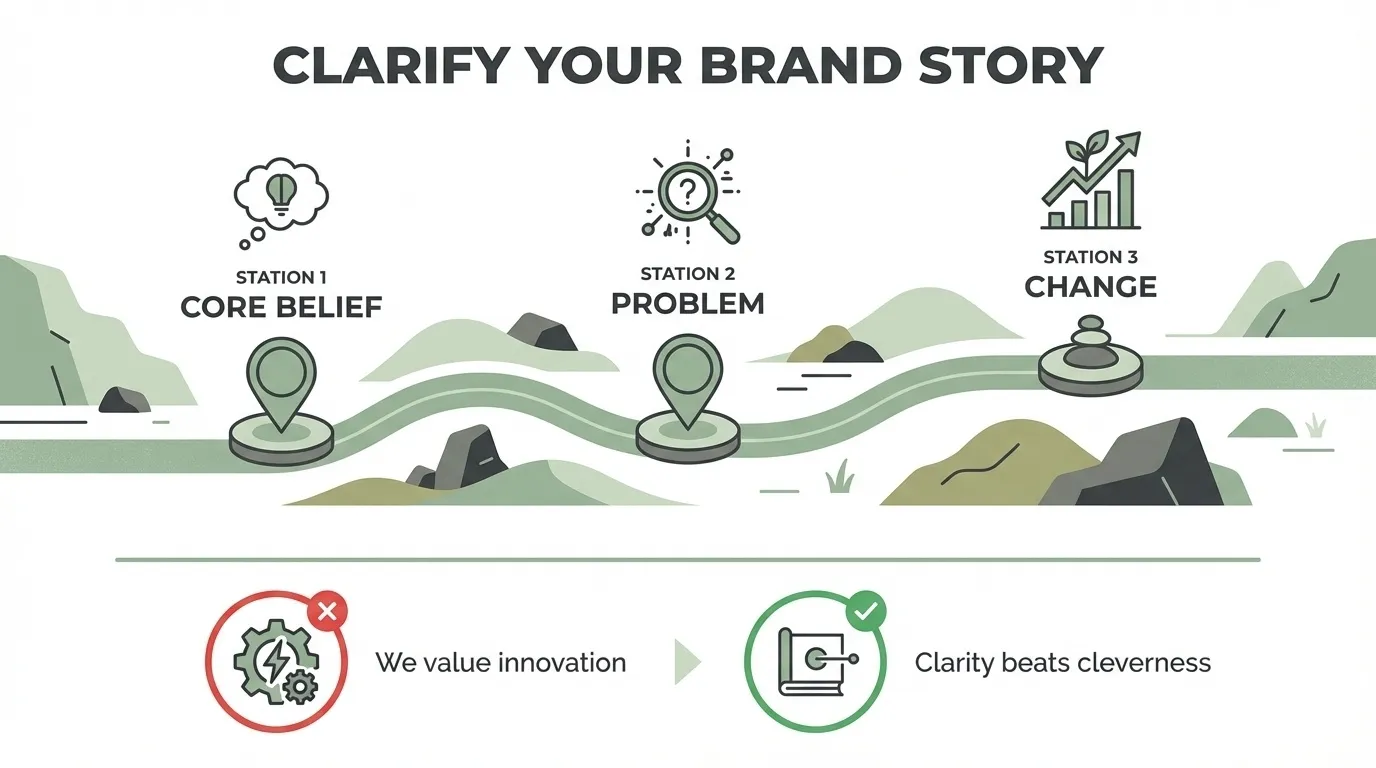
Once you identify the gaps, you can rebuild intentionally. Every strong brand story rests on three foundational elements. If these are unclear, everything else becomes noise.
- Your core belief: What do you believe about your industry, your customers, or the way things should be done? This belief must be strong enough that you would defend it publicly.
- The problem you solve: Be precise. Not “we provide digital marketing services”. Instead, define the tension your audience feels. Is it an unpredictable lead flow? Rising ad costs in Singapore? Difficulty standing out in saturated sectors like F and B, or property?
- The change you create: What is different in your customer’s life or business after working with you? More qualified enquiries. Shorter sales cycles. Greater confidence in their positioning. Describe the shift clearly.
Write these in plain English. Avoid marketing shorthand. If you would not say it in a conversation with a client in Raffles Place or Tanjong Pagar, do not put it on your website.
Here is a simple comparison to guide you:
| Weak Foundation | Strong Foundation |
| We are a full-service agency | We help B2B firms in Singapore turn complex services into clear, compelling offers that convert |
| We value innovation | We believe clarity beats cleverness in crowded markets |
| We deliver results | We focus on measurable pipeline growth, not vanity metrics |
Clarity sharpens everything that follows.
Step 3: Identify the Hero in Your Brand Story
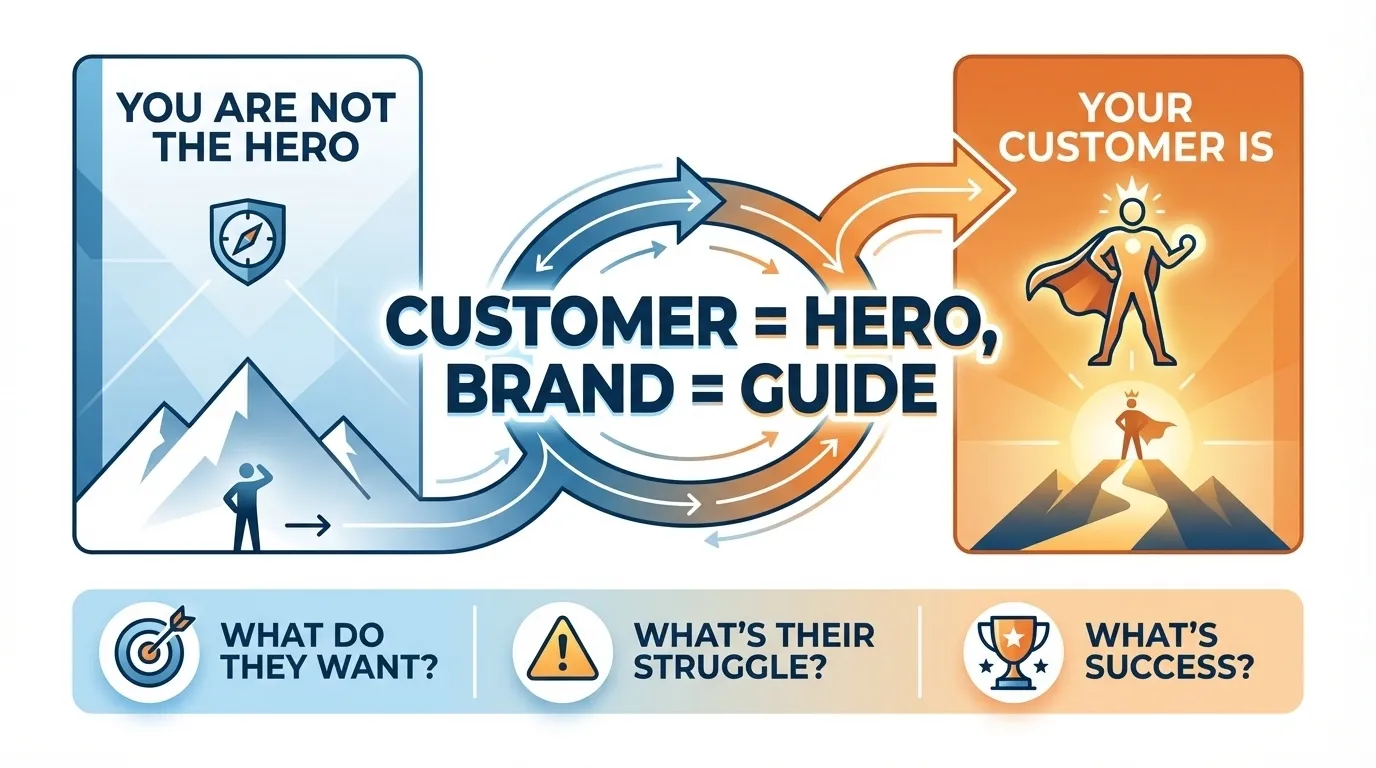
This is where many brands get it wrong. You are not the hero. Your customer is. Your brand is the guide. The strategist. The mentor. The expert who helps the hero overcome a challenge.
When you position yourself as the hero, your messaging becomes self-centred. When you position your customer as the hero, your story becomes relevant.
Ask yourself:
- What does your ideal client want but struggle to achieve?
- What fear or frustration are they experiencing right now?
- What does success look like from their perspective, not yours?
If you serve SME owners in Singapore who are overwhelmed by rising competition and marketing complexity, then your story should reflect that pressure. Speak to the late nights reviewing campaigns. The uncertainty around ROI. The hesitation before increasing ad spend.
When they see themselves in your narrative, they lean in.
Step 4: Shape the Narrative Arc
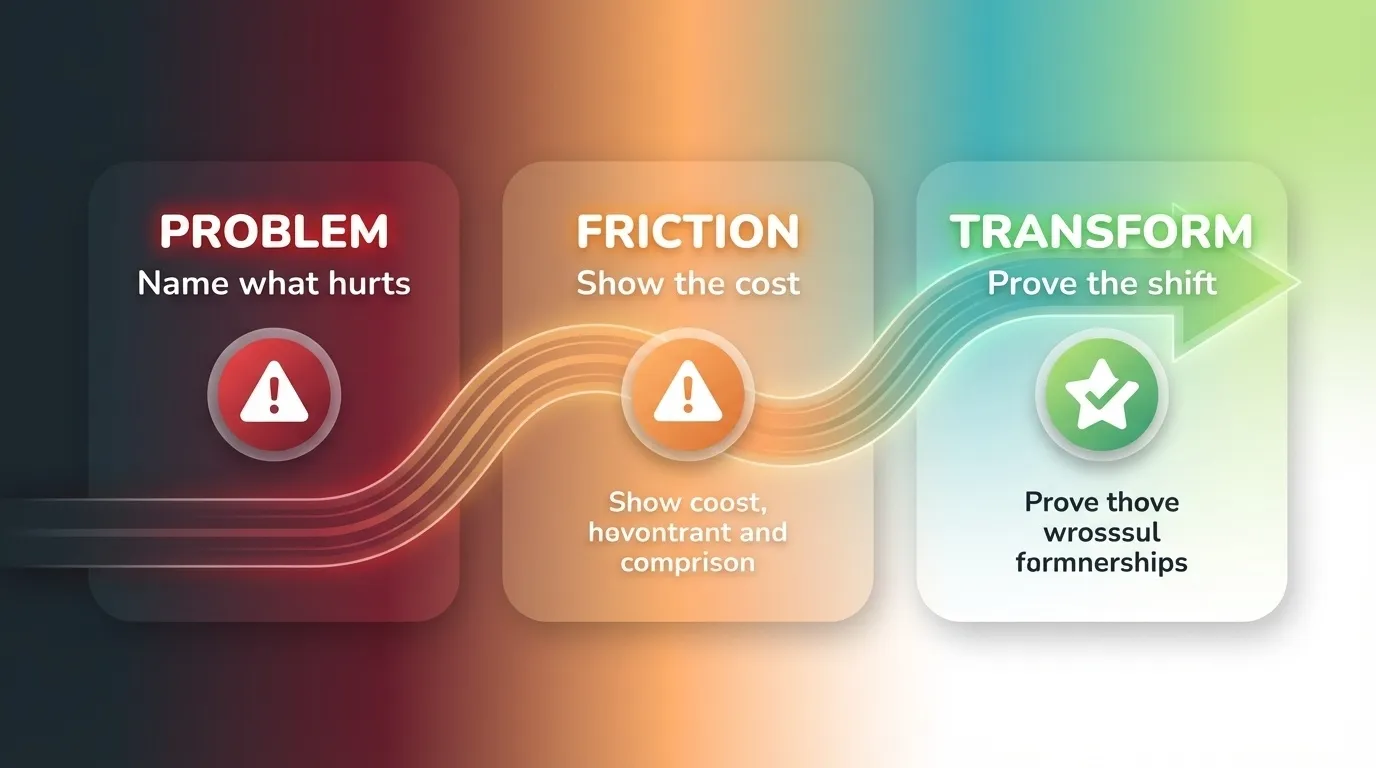
A compelling brand story has structure. Without structure, you ramble. With structure, you persuade. Think in three movements:
| Narrative Stage | What It Must Do |
| Beginning | Define the problem your audience feels |
| Middle | Show the struggle, tension, or cost of inaction |
| End | Show the transformation or resolution |
- Beginning: Name the problem clearly. Do not soften it. If your audience feels invisible in a crowded market, say so.
- Middle: Describe the friction. What happens when they try to solve this alone? Do they waste budget on scattered tactics? Do they feel stuck using the same messaging as everyone else? This is where you demonstrate both empathy and authority.
- End: Show the transformation. Not in abstract terms, but in tangible outcomes. More qualified leads. Clearer positioning. Higher perceived value. A brand that commands attention instead of chasing it.
Keep the arc tight. Avoid detours into unnecessary corporate history. Every sentence should serve the transformation.
Step 5: Refine the Voice of Your Brand Story
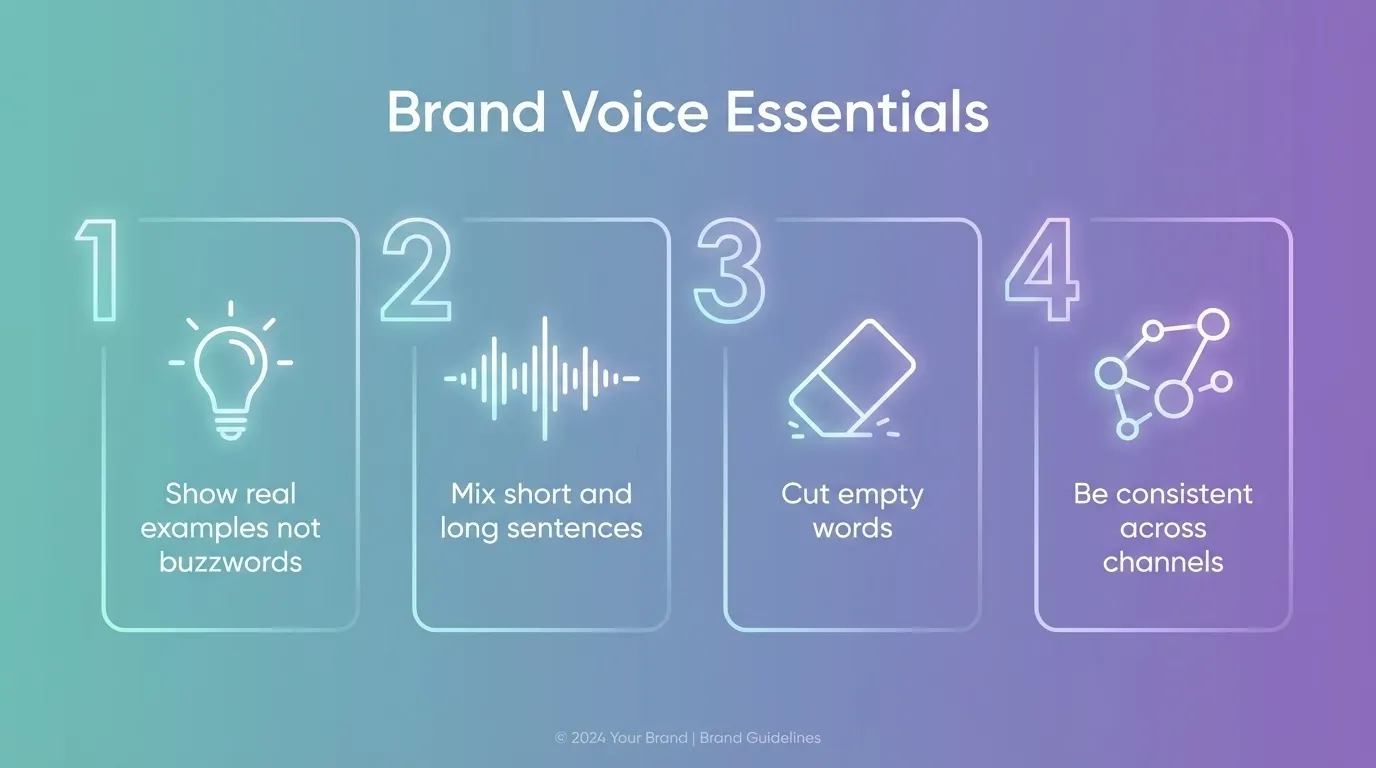
Once the structure is in place, focus on tone and language. Concrete language wins. Buzzwords dilute meaning.
Instead of saying, “We empower businesses through innovative solutions,” describe a real situation. For example, “We helped a professional services firm clarify its positioning so prospects understood its value within seconds of landing on the homepage.”
Your voice should reflect your audience and your market. If you serve corporate clients in Singapore, your tone may be direct and strategic. If you serve lifestyle brands, you may lean into aspiration and creativity. Either way, avoid generic phrasing.
To refine your voice:
- Replace abstract nouns with concrete examples.
- Use sentences of varying length to make the writing feel human.
- Remove filler words that add no meaning.
- Read your copy aloud. If it sounds rehearsed or hollow, revise it.
Most importantly, ensure consistency. Your website, LinkedIn posts, email campaigns, and sales presentations should feel like they come from the same mind. A fragmented voice weakens trust.
Developing your brand story is not a one-time creative exercise. It is a strategic discipline. When you audit honestly, clarify your foundation, position your customer as the hero, structure your narrative deliberately, and refine your voice with precision, you move from sounding like everyone else to standing apart.
That is where attention turns into trust. And trust turns into revenue.
How to Make Your Brand Story Feel Authentic
If you are serious about building trust, authenticity cannot be limited to the surface level of your messaging. It has to be structural. Customers today are exposed to more content than at any point in history. Your audience has seen polished campaigns before. They are currently scanning for consistency between what you say and what you do.
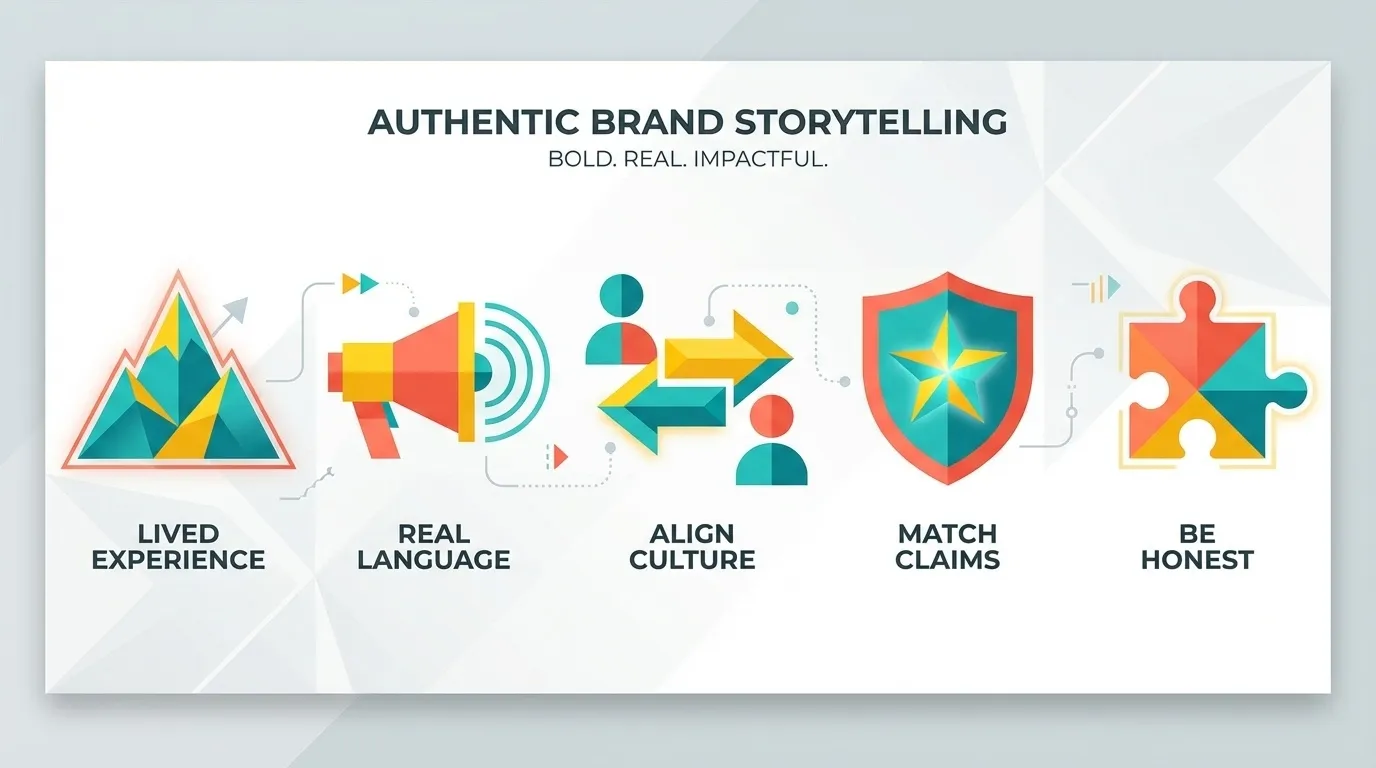
Authenticity is not about sounding casual. It is about being congruent. Here is how you build that into your brand story in a way that stands up to scrutiny:
Anchor Your Narrative in Lived Experience
An authentic brand story starts with something real. A frustration. A gap in the market. A personal moment that forced a decision. When your business’s origin reflects a real pain point, the story carries weight. It does not need embellishment. In fact, over-polishing weakens it.
Ask yourself:
- What specific problem made you start this business?
- Who was affected?
- What was at stake if nothing changed?
Notice the word specific. “We wanted to make marketing better” is vague. “We saw SMEs in Tanjong Pagar spending SGD 5,000 a month on ads with no attribution data and no measurable ROI” is concrete. Specificity signals truth. It is harder to fabricate and easier to believe.
When your origin is grounded in lived experience, you are not inventing emotion. You are recalling it. That difference shows in your language.
Use Real Customer Language, Not Internal Jargon
Your brand story should sound like your customer’s internal monologue, not your boardroom presentation. One practical way to achieve this is to mine real conversations:
- Sales call transcripts
- Customer support tickets
- Google reviews
- Social media comments
- Client interviews
Look for repeated phrases. Look for emotional cues. How do customers describe their frustration before working with you? How do they describe success after?
If your customer says, “I was overwhelmed and didn’t know where to start,” do not translate that into “The client experienced operational inefficiencies.” Keep the human language. It carries emotional accuracy.
From an AI search perspective, this also matters. Large language models surface content that mirrors how users phrase questions. When your wording reflects real search queries and conversational phrasing, you increase semantic alignment with what people are actually typing into Google and AI assistants.
Authenticity and discoverability are not opposing forces. They reinforce each other when you use real language.
Align Internal Culture With External Messaging
This is where many brands quietly fall apart. You cannot position yourself as customer-obsessed while your internal processes ignore feedback. You cannot claim transparency if your pricing structure is deliberately confusing. Eventually, the disconnect leaks.
Authenticity requires operational alignment. That means:
- Your team understands and believes the core narrative.
- Your hiring reflects the values you promote.
- Your customer experience supports the promises you make in marketing.
If your brand story says you champion local entrepreneurs in Singapore, show how. Do you feature client case studies from Bedok or Jurong? Do you collaborate with local suppliers? Do you reinvest in the community?
When internal culture and external messaging align, your story stops feeling like marketing and starts feeling like reality.
Make Sure Your Actions Match Your Claims
This is the simplest test of authenticity, and the hardest to fake. If you claim measurable growth, show data. If you position yourself as premium, your pricing and experience must reflect that. If you advocate a long-term strategy, your content should not push quick hacks.
Credibility increases when you provide evidence:
- Transparent pricing ranges in SGD.
- Case studies with real metrics.
- Testimonials with names and companies.
- Clear explanations of your methodology.
When your actions reinforce your narrative, trust compounds. When they contradict it, trust collapses.
Trust, once broken, is difficult to rebuild. Research consistently shows that consumers value transparency and consistency in brand behaviour. Edelman’s Trust Barometer reports that trust is a key driver of brand preference and loyalty, with 60% of respondents buying, choosing, or avoiding brands based on their politics and values.
When your story and your behaviour align, you create the conditions for that trust to grow.
Embrace Imperfection Where It Is Honest
Perfection reads as corporate, controlled, or sanitised. An authentic brand story can include lessons learned, pivots made, and mistakes corrected. That does not weaken authority. It strengthens relatability.
You are not positioning yourself as flawless. You are positioning yourself as experienced. There is a difference.
The Litmus Test for Authenticity
Before you publish your brand story, ask:
- Would my team recognise this as true?
- Would a long-term client agree with this description?
- Could I defend every claim publicly with proof?
If the answer to any of these is no, refine it. You cannot manufacture authenticity through clever copy. Your audience is perceptive. In a digitally mature market like Singapore, where consumers research extensively before making purchasing decisions, inconsistencies surface quickly.
An authentic brand story is not written once and left alone. It is lived daily. It is reflected in conversations, pricing, service delivery, and leadership decisions.
When you get this right, your story stops sounding like marketing. It becomes a mirror. Your audience sees themselves in it. They recognise their own frustrations, ambitions, and values. That is when your message stops blending in and starts building loyalty.
Final Checklist: Is Your Brand Story Strong Enough?
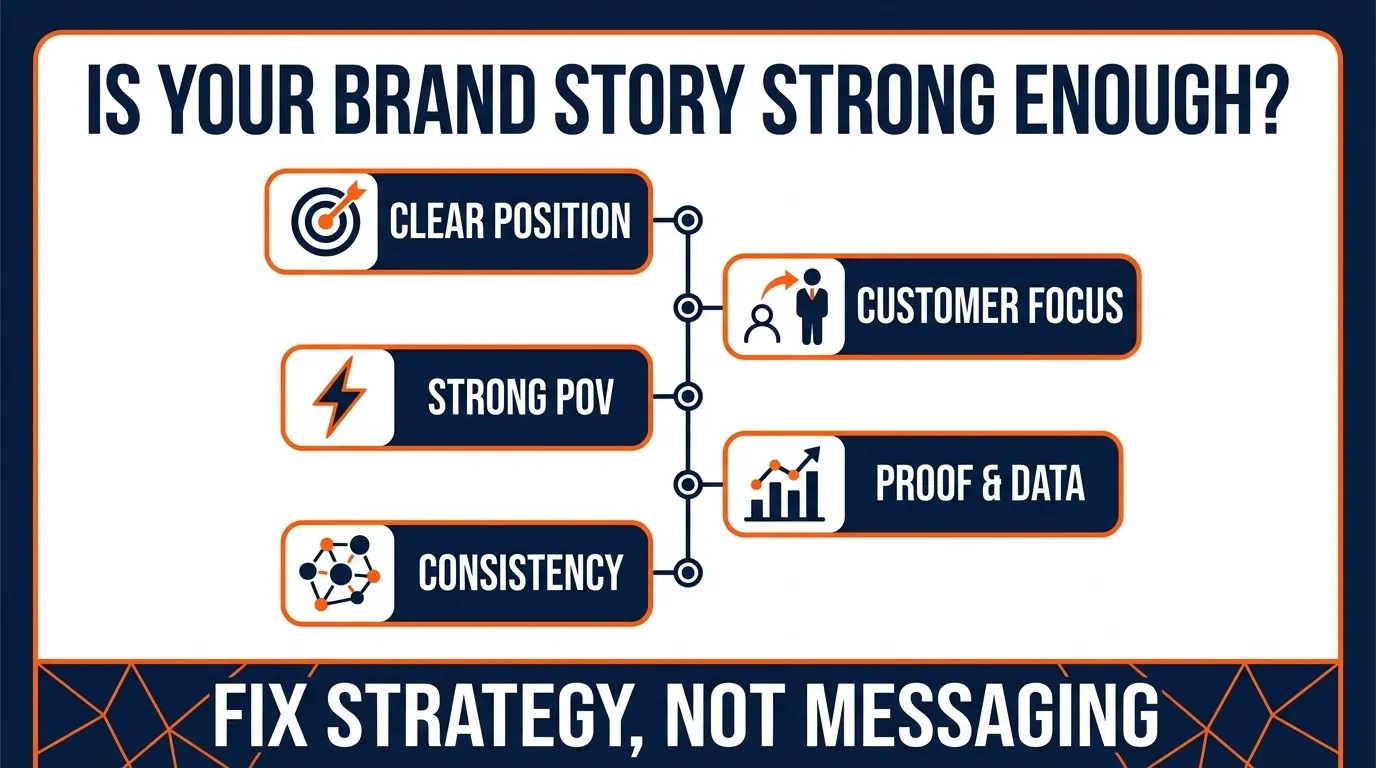
Before you invest another dollar in ads, SEO, or social campaigns, pause and pressure-test the foundation. If the narrative is weak, amplification only spreads confusion faster.
Run through this checklist with brutal honesty:
- Can you explain your positioning in one clear sentence that is distinct from your competitors?
- Does your story focus on the customer’s transformation rather than your company’s achievements?
- Is your point of view strong enough that some people might disagree with it?
- Can you support every major claim with proof, data, or lived experience?
- Is your messaging consistent across your website, sales deck, ads, and social channels?
If you hesitated on more than one, you do not have a messaging problem. You have a strategic one.
A powerful brand story is not merely decorative; it shapes perception, influences buying decisions, and strengthens every marketing channel you use. When done well, it reduces acquisition friction, builds trust, and improves conversion quality because prospects already understand why you matter before they speak with your team.
If you want clarity rather than guesswork, work with specialists who build narratives aligned with your search strategy, positioning, and revenue goals. MediaOne is a branding agency in Singapore that helps businesses refine and activate a distinct brand story across digital channels.
If you are ready to sharpen your positioning and turn your brand story into a measurable growth asset, call us today to discuss how your narrative can work harder for your business.
Frequently Asked Questions
What is the difference between a brand story and brand identity?
Brand identity is the collection of visual, verbal and experiential traits that represent a company to its audience, while a brand story is the narrative that explains why the brand exists and what it stands for.
Identity elements such as logo, colours, and tone of voice help make the story recognisable and consistent across touchpoints, but the story itself is about meaning and emotional connection. Brand identity is what people see and hear; the brand story is how they interpret and internalise what that means for them.
Why is a brand story important for customer loyalty?
A brand story provides context and meaning for a company’s purpose and actions, helping people see themselves in the narrative and feel understood. When customers perceive a brand as aligned with their values and aspirations, they are more likely to choose it repeatedly because it resonates emotionally beyond product features.
That deeper connection increases loyalty, advocacy and word of mouth over time.
Can a brand story change over time?
Yes, a brand story can evolve as the business grows, customer needs shift, or market conditions change. The core purpose and values often remain, but how a company tells its story can adapt to new realities while staying true to its foundation. Updating a story should strengthen relevance and resonance without undermining consistency that builds recognition.
How do you measure the impact of a brand story?
Impact can be assessed through customer engagement metrics, repeat-purchase behaviour, and brand recall in surveys, as well as through qualitative customer feedback on how they perceive the brand over time. Higher levels of emotional connection and messaging clarity typically correlate with stronger preference and lower churn. It can also be evaluated by how well the story drives desired actions, such as enquiries or conversions.
Should a brand story be included in digital marketing content?
Yes, including the brand story in digital content helps audiences immediately understand the brand’s purpose, values and differentiation across channels. When integrated into websites, social media, emails, and ads, the narrative provides coherence and builds familiarity, increasing engagement and perceived authenticity.
This alignment can also improve SEO and how AI-driven systems interpret the brand’s relevance for search queries.