AI search is no longer a side trend. It is reshaping how people discover, compare, trust, and buy — and that shift has real implications for brands.

Search behaviour is becoming less predictable. Queries are longer, intent is clearer, and decisions happen faster. AI search is compressing the path from question to shortlist, and from shortlist to purchase. If your brand is not visible in that moment, you are not just losing traffic. You are losing demand.
For Singapore brands, the stakes are especially high. According to Digital 2025: Singapore digital and social media trends, Singapore had 5.61 million internet users at the start of 2025, equal to 95.8% internet penetration. It also had 10.5 million active mobile connections and 5.16 million social media user identities. In a market this connected, changes in AI search behaviour can quickly affect revenue, lead quality, and brand visibility.
At the same time, AI search has not replaced traditional search. SparkToro research on AI tool vs. traditional search usage reported that traditional search still far outpaced AI tools in usage. But the same report also showed organic clicks declining and zero-click searches increasing. In other words, people still search — they just get more of the answer before they ever visit your site.
That is why brands can no longer rely on outdated SEO playbooks. Winning in AI search now requires stronger content structure, better local signals, clearer trust cues, and a better connection between visibility and conversion.
Hiring an SEO agency in Singapore that stays current with AI search, search intent, structured content, and evolving Google best practices is becoming less of a nice-to-have and more of a competitive necessity.
Key Takeaways:
- AI search is shortening the distance between discovery, comparison, and purchase.
- Search queries are becoming more conversational and intent-rich.
- Generic content is easier for AI systems to summarise and bypass.
- Singapore brands need stronger local relevance, cleaner data, and clearer proof points.
- Success in AI search now depends on visibility, credibility, and conversion readiness together.
How AI Search is Changing the Buying Journey
The 5E brand funnel framework has not vanished. But AI search has made it far less linear.
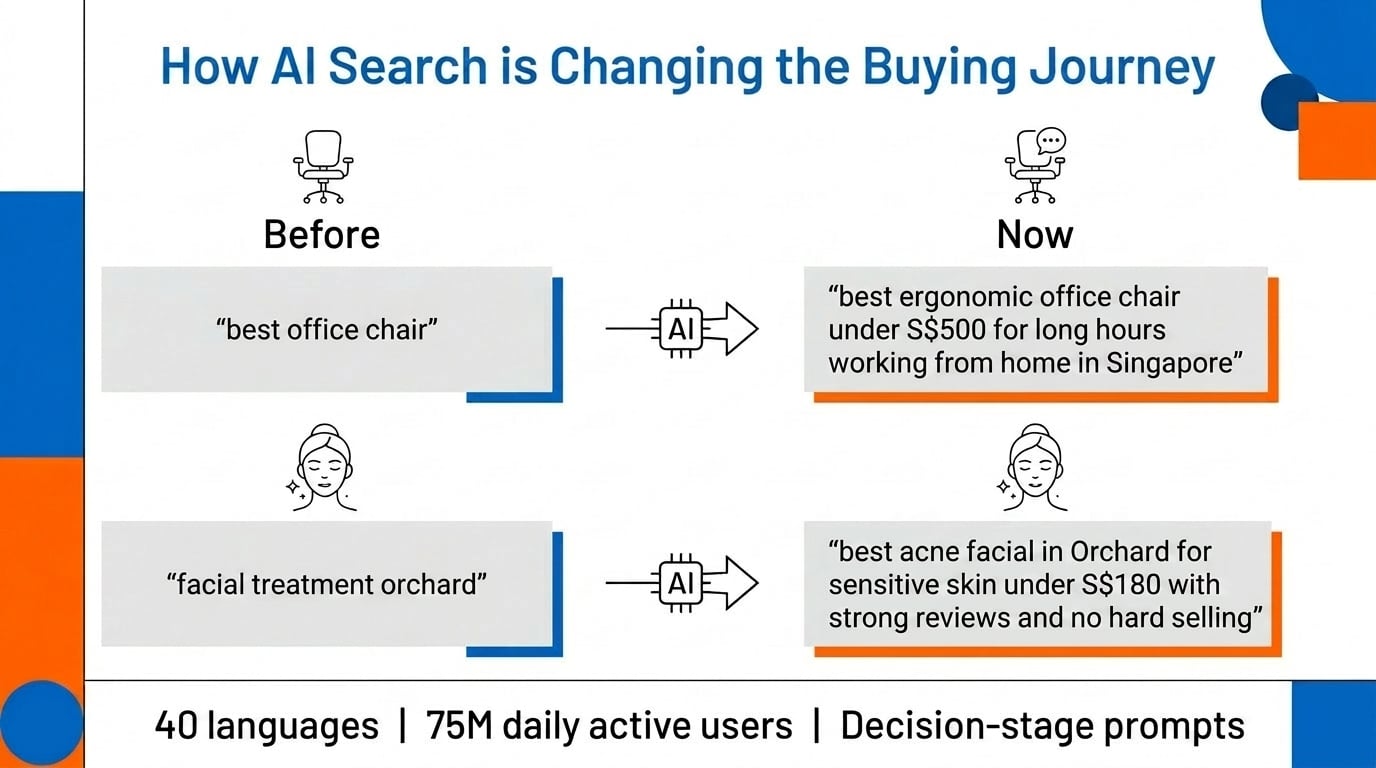
Google says queries in its AI experiences are becoming longer and more complex, and that AI is helping shorten the time between discovery and decision. By Q3 2025, Google’s AI Mode reached 40 languages and 75 million daily active users, reflecting how quickly AI-powered search is becoming part of everyday consumer behaviour.
That matters because people are using search less like a directory and more like an advisor.
Instead of typing “best office chair,” a user might ask: “best ergonomic office chair under S$500 for long hours working from home in Singapore.”
Instead of searching “facial treatment orchard,” they might ask: “best acne facial in Orchard for sensitive skin under S$180 with strong reviews and no hard selling.”
That is not just keyword variation. It is a decision-stage prompt. It combines needs, constraints, intent, and purchase context in a single search. Brands that still build pages around broad, shallow keywords risk becoming less useful in this environment.
What AI Search Has Changed — At a Glance
| Old search reality | New AI search reality | What brands must do |
| Short head terms | Longer conversational queries | Build pages around real questions and buyer intent |
| Awareness before evaluation | Discovery and evaluation happen together | Tighten page messaging and proof points |
| More clicks, lower clarity | Fewer but more qualified visits | Focus on lead quality and conversion value |
| SEO, paid and local handled separately | Search, video, maps and feeds influence one journey | Treat visibility as one connected system |
| Generic content could still compete | Generic content is easy for AI to summarise | Publish original, brand-specific, useful content |
This is why Google’s guidance for AI search is still rooted in fundamentals: unique content, strong page experience, crawlability, structured data, and useful multimedia.
It is also why Sitebulb’s take on informational content in the AI search era is important: the future of informational content is not about saying more, but about adding information gain. If your article says nothing AI could not infer from a dozen similar pages, it becomes commodity content.
AI Search is Changing Clicks, But Not the Need for Trust
One of the biggest mistakes marketers make is assuming AI search is only about reach. It is also about trust compression.
Google says people still turn to Search and YouTube to compare products, prices, and reviews before they buy. Google also says clicks from search results pages with AI Overviews can be higher quality because users arrive better informed and more ready to act.
So the real question is not just whether your brand can appear in AI search. It is whether your page gives people enough confidence to move forward once they arrive.
That means your pages need to do more than rank. They need to reassure.
What Trust Looks Like in an AI Search Environment
- Clear pricing in SGD
- Strong service descriptions
- Specific use cases
- Transparent comparisons
- Updated business details
- Helpful FAQs
- Reviews, proof and authority cues
- Local context such as neighbourhoods, delivery zones, store locations or Singapore-specific constraints
That last point matters. A page that vaguely promises “fast delivery” is weaker than one that states same-day delivery in selected parts of Singapore, or service coverage in Orchard, Jurong, Tampines, and Punggol.
AI search rewards clarity. Buyers do too. This is where working with a local SEO agency in Singapore matters too.
What Google Says Brands Should Do for AI Search
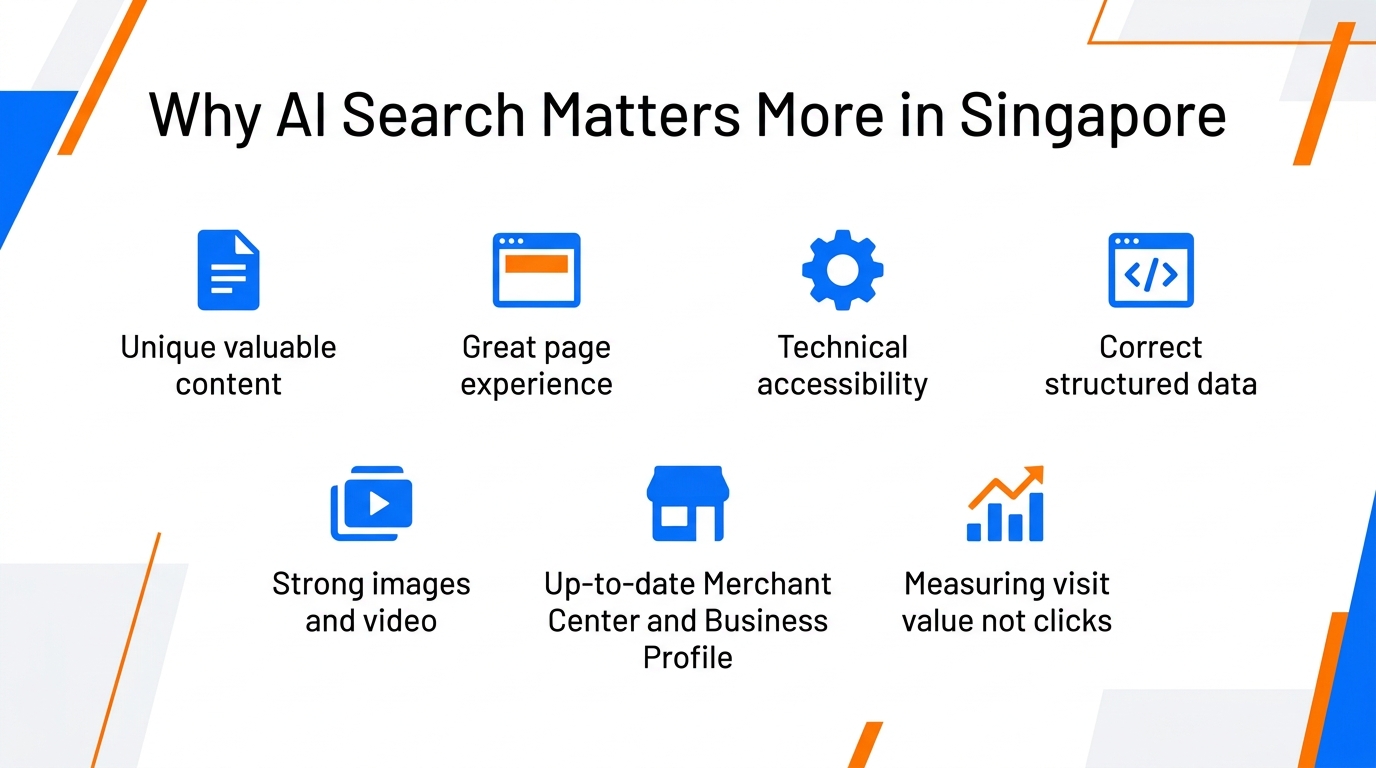
Google’s guidance on succeeding in AI search is refreshingly direct. Brands should focus on:
- Unique, valuable content
- Great page experience
- Technical accessibility
- Correct structured data
- Strong images and video
- Up-to-date Merchant Center and Business Profile information
- Measuring the value of visits, not just click counts
That sounds basic, but in an AI search environment, those basics often determine whether your brand is retrievable or ignored.
Three Practical Implications
- Build for extraction: Each section of a page should answer a clear question quickly. Strong subheads, short paragraphs, comparison blocks, and direct answers make content easier for both users and AI systems to interpret.
- Build for entity trust: Your brand, products, services, locations, and expertise should be easy to identify. That means stronger local SEO, better authorship signals, and cleaner supporting data.
- Build for decision support: A landing page should help someone compare, validate, and choose — not just “learn more.”
That is why strong AI search content is structured, specific, and commercially useful.
How Local Brands are Adapting to AI Search and AI-assisted Shopping
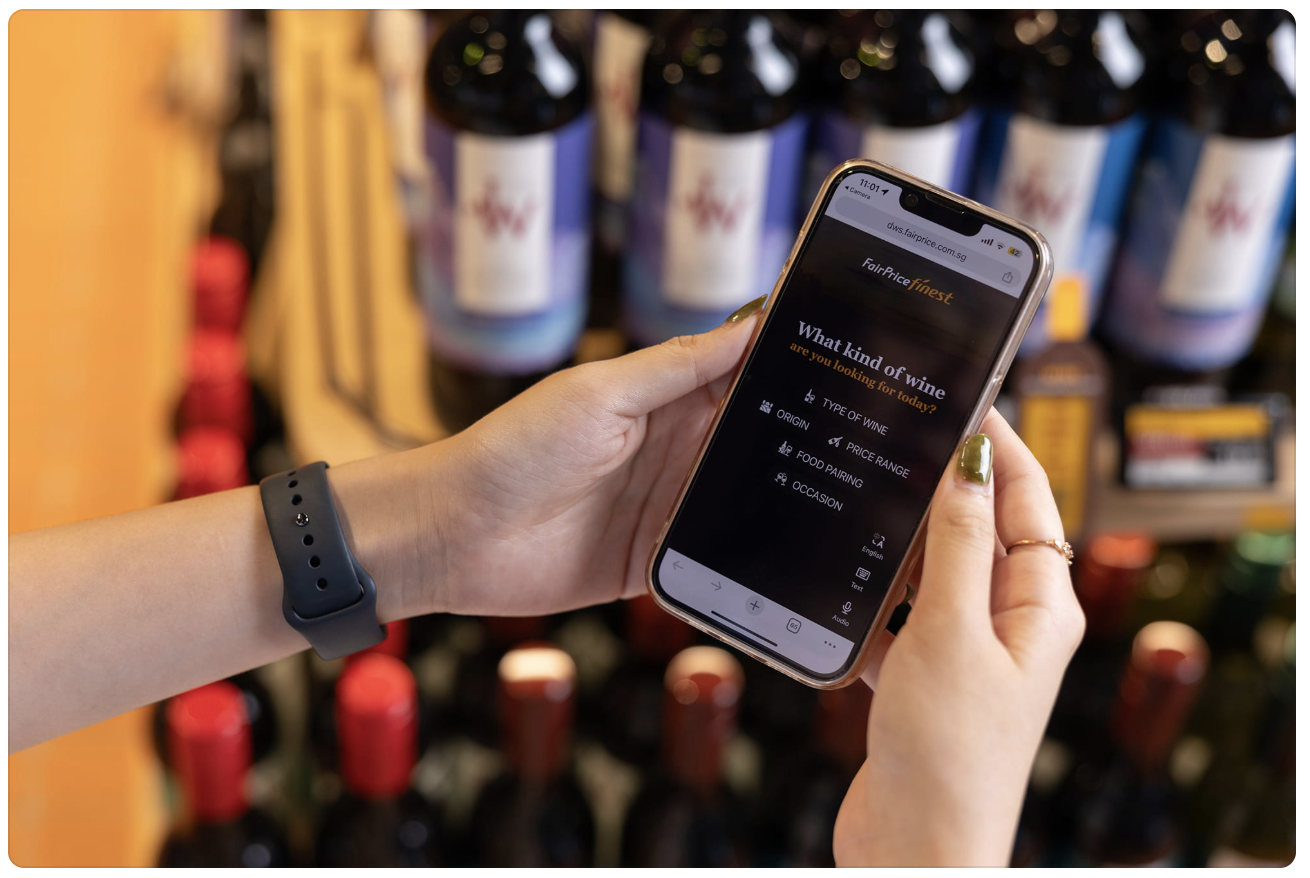
Image Credit: Google Cloud
The rise of AI search is not theoretical. Singapore brands are already adapting discovery and purchase experiences around AI-assisted behaviour.
FairPrice Group’s AI-powered retail transformation is one of the clearest examples. In Google Cloud’s case study, FairPrice Group says customers can use conversational in-cart assistants for personalised product recommendations, with up to 18% click rate, and search inventory using local context such as “Orh Nee” for yam paste.
That matters because it reflects what search is becoming: not just keyword matching, but contextual intent resolution.

In its official 2026 Store of Tomorrow expansion announcement, FairPrice Group also said its smart carts reduced customer checkout times to an average of 36 seconds at FairPrice Punggol Coast Mall and would be rolled out to 48 FairPrice Xtra and Finest outlets by end-2026.
Grab provides another useful signal. Its AI-powered Grab Shopping Agent, available in Singapore from April 2026, lets users type, speak, or upload a shopping list photo. Grab says the tool helps users avoid one-by-one searches, reduces decision fatigue, and ranks products using factors such as purchase history and contextual signals.
The bigger pattern is clear: search is shifting from product lookup to intent expression. Brands that still rely on vague category pages, thin product descriptions, and weak structured data will find it harder to compete.
Why This Matters When Choosing an AI Search Expert in Singapore
If you are looking for a partner to help your brand win in AI search in Singapore, you need more than a team that can write blog posts or chase rankings.
You need a team that understands how people now search, compare, and buy.
At MediaOne, we build content and campaigns for how search works today — not how it worked three years ago. That means stronger hooks, clearer structure, shorter paragraphs, sharper takeaways, and pages built to support both discovery and decision-making.
That matters because AI search rewards clarity, structure, authority, and usefulness. Generic, poorly organised content is easier to overlook. Precise, well-structured content backed by real expertise is far more valuable.
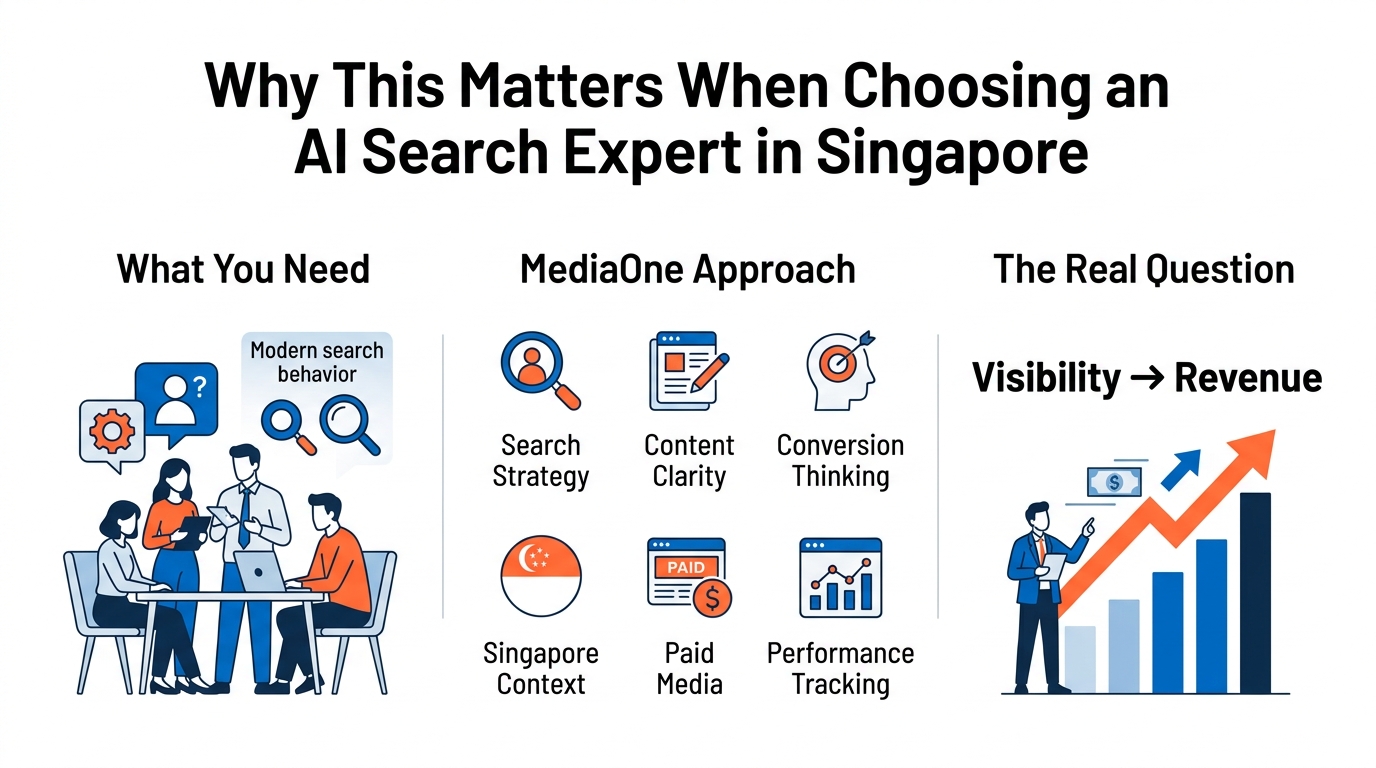
That is why our approach goes beyond content alone. Brands that want real growth in AI search need an agency that can connect:
- Search strategy,
- Content clarity,
- Conversion thinking,
- Singapore market context,
- Paid media alignment,
- and measurement and performance tracking.
At MediaOne, that is exactly how we work. We combine SEO, paid advertising, CRO, analytics, and journalist-grade copywriting because AI search visibility no longer comes from one discipline in isolation. It comes from building a brand presence that is easy to find, easy to trust, and easy to choose.
So if you are searching for an agency that leads in AI search in Singapore, the real question is not whether they understand keywords. It is whether they understand how visibility turns into revenue.
That is the standard AI search demands now. And that is the standard MediaOne is built to deliver.
Want to understand what AI search means for your brand in Southeast Asia right now?
Join the Google x MediaOne 2026 SEA Webinar: AI Has Changed How People Search & Buy — Are You Keeping Up? for a practical breakdown of search behaviour shifts, trust signals, first-party data, AI-powered campaigns and the actions brands should take next.
Frequently Asked Questions
How does AI search affect local SEO in Singapore?
AI search increases the importance of local relevance, structured data, and trust signals. Businesses with accurate Google Business Profiles, strong reviews, and location-specific content are more likely to appear in AI-generated answers. Singapore brands should also optimise for conversational search queries and neighbourhood-level intent.
Can small businesses compete in AI search results?
Yes. Small businesses can still compete in AI search if they focus on useful content, local authority, and clear expertise. A well-structured page that answers specific customer questions can outperform a larger competitor with generic content.
What type of content performs best in AI search?
Content that answers user questions clearly tends to perform best in AI search. Pages with strong headings, concise explanations, comparison sections, FAQs, examples, and original insight are easier for AI systems to interpret and surface.
Does AI search reduce website traffic?
AI search may reduce total clicks for some informational queries because users often get answers directly in search interfaces. But the visitors who do click through are often better informed and closer to making a decision, which makes conversion quality more important than raw traffic volume.
How should marketers measure success in AI search?
Marketers should look beyond rankings and traffic alone. Qualified leads, assisted conversions, engagement quality, branded searches, and conversion rates provide a better view of AI search performance.