
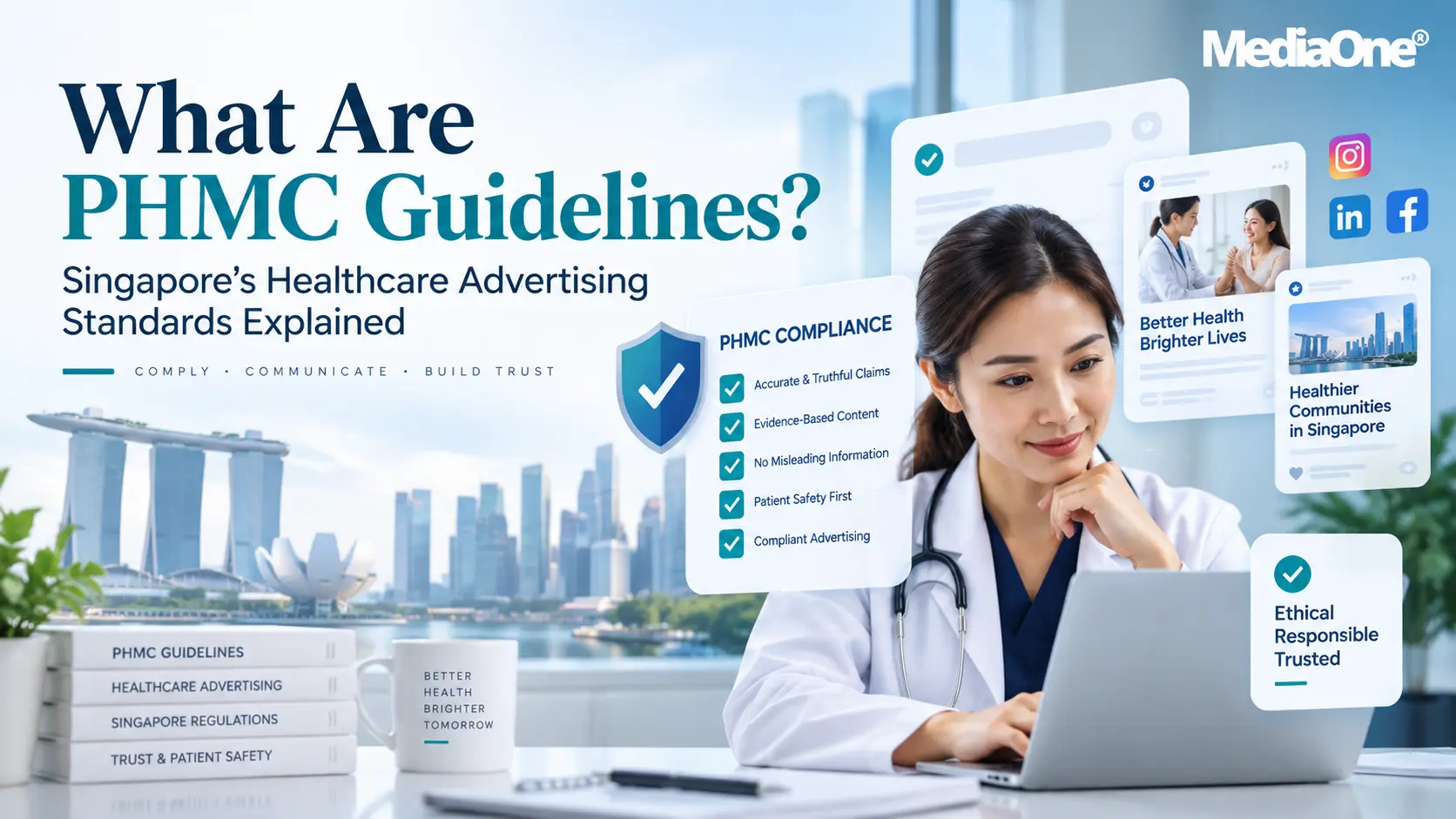
What Are PHMC Guidelines? Singapore’s Healthcare Advertising Standards Explained
What Are PHMC Guidelines, and Why Do They Matter?
PHMC stands for the Private Hospitals and Medical Clinics (Advertisement) Regulations. These binding advertising standards, enforced by the Ministry of Health (MOH), apply to private healthcare providers, clinics, hospitals, dental practices, health product manufacturers, and retailers when marketing health services or products in Singapore across all media. Because false or exaggerated health claims can directly harm public health, PHMC guidelines protect consumers from misleading health marketing with stricter scrutiny than general commercial advertising.
For working professionals in Singapore, compliance is not optional. Whether you operate a wellness clinic, sell health products online, collaborate with influencers, or market services on social media, these standards legally bind you. Understanding your obligations now prevents costly enforcement action, platform suspensions, and reputational damage. Non-compliance can result in regulatory investigation, mandatory content removal, fines, and civil liability under the Consumer Protection (Fair Trading) Act.
Current Enforcement Trends and Regulatory Priorities
MOH enforcement on influencer disclosure is accelerating. Violations carry swift legal consequences, including regulatory orders, mandatory content removal, fines, platform suspension, and reputational damage. Even micro-influencers and part-time content creators must properly disclose paid relationships. MOH now routinely investigates social media claims, cross-references marketing assertions against HSA-approved product information, and pursues enforcement against individuals and small businesses, not just large corporations.
Who Must Comply with PHMC Guidelines
PHMC guidelines bind private hospitals and medical clinics, dental surgeries, optometry centres, registered traditional medicine practitioners, manufacturers and retailers of health products and medical devices, wellness centres, pharmacies, skincare and cosmetics brands making health claims, fitness centres offering health advice, and e-commerce sellers. The obligation extends to sole proprietors, small businesses, and compensated influencers endorsing health products. If your business or marketing involves any claim about health, fitness, disease prevention, treatment, or benefit to human function, you fall within PHMC scope.
Core Compliance Obligations
PHMC guidelines require all healthcare advertising to be factually accurate and substantiated. Healthcare advertising must support claims about efficacy, success rates, or benefits with credible evidence. Testimonials cannot be presented as typical results unless statistical evidence supports the claim. Entities must not make exaggerated claims or suggest a product can cure, prevent, or treat disease without approved clinical evidence and Health Sciences Authority (HSA) approval. For example, a skincare brand cannot claim to “cure acne” without HSA-standard evidence; it may claim to “reduce the appearance of acne” if substantiated. MOH treats failure to retain substantiation as evidence that a claim is unsubstantiated. Healthcare advertisers must disclose paid partnerships clearly and prominently, not buried in captions or hashtags.
| Compliance Requirement | What It Means | Consequence of Breach |
| Factual accuracy | All claims must be true and verifiable | MOH enforcement order, content removal |
| Substantiation | Claims must be backed by credible evidence | Fines and platform suspension |
| No exaggerated claims | Cannot claim to cure or treat without HSA approval | Regulatory investigation and penalties |
| Genuine testimonials | Customer reviews must be authentic and disclosed | Breach of Consumer Protection Act |
| Clear disclaimers | Time frames, conditions, and outcomes must be stated | MOH warning letter or enforcement order |
| Influencer disclosure | Paid endorsements must be declared prominently | Social media platform action and fines |
Enforcement Trends and MOH Priorities in PHMC Guidelines
MOH enforcement focuses on influencer disclosure, since sponsored posts must clearly disclose commercial relationships. Influencers bear full responsibility for compliance of their sponsored posts. Substantiation and factual accuracy enforcement extends across all platforms. A product that claims to be “stronger” than competitors must support this claim with direct clinical comparison studies that name the competitor and detail the methodology. Terms like “clinically proven”, “scientifically formulated”, or “dermatologist tested” must be linked to specific, named studies that are current, credible, and transparent about methodology and funding.
Technical Compliance Requirements: Content Restrictions and Digital Standards
PHMC guidelines enforce strict boundaries on healthcare advertising claims. Advertisements must not attribute personality, character, or social advantages to health products. Weight-loss supplements may claim to “support healthy weight management” but not to “help you attract a partner.” Health products cannot be advertised as alternatives to necessary medical treatment. Comparative advertising is heavily restricted and must meet substantiation requirements, including HCSA guidelines for health claims.
Visual Content Standards
Before-and-after photos must be authentic and representative. Video testimonials cannot be edited to alter tone or context. Graphics claiming to show results must be labelled illustrations, not photographs. Content based on protected characteristics such as age, ethnicity, or disability is prohibited. Filters and editing that significantly alter appearance must be disclosed.
Pricing and Vulnerable Populations
Pricing claims must be transparent; hidden charges and misleading structures are prohibited. Advertising directed at children, pregnant women, and the elderly faces heightened scrutiny.
Digital Marketing and Social Media Compliance
PHMC guidelines extend to social media, paid search, influencer partnerships, and direct messaging. Sponsored posts must clearly disclose commercial relationships and cannot make unsubstantiated health claims. Testimonials must be genuine, with reviewers declaring commercial arrangements and claiming only personally experienced results.
Enforcement Trends and MOH Priorities for PHMC Guidelines
MOH enforcement on influencer disclosure is accelerating. Regulators are tightening enforcement on image authenticity and misleading health claims across digital channels. Maintain documentation of image authenticity, including original source files and consent forms. Treat disclosure as a structural requirement in influencer partnership agreements.
Paid Search and E-commerce Advertising
Paid search advertising must comply with both PHMC guidelines and platform-specific rules. Substantiation and accuracy standards apply across all distribution channels; landing pages and ad copy must be factually accurate. Email and SMS campaigns must identify the sender, include an opt-out mechanism, and cannot misrepresent identity or purpose or make exaggerated health claims, aligning with HCSA guidelines.
Influencer Partnerships and Disclosure
Influencer partnerships require explicit written disclosure of payment, gifts, or incentives. Hashtags like #ad or #sponsored in the first line satisfy PHMC guidelines; hashtags at the end may not be sufficient, as they are easily overlooked. Disclosure buried in comments does not meet prominence standards. Both PHMC and HCSA guidelines require disclosure to be immediately visible.
Before-and-After Imagery Rules
Before-and-after imagery is heavily regulated under PHMC advertising regulations. All images must be authentic photographs, not illustrations or digital renderings. Results must represent the advertised product alone, unless concurrent interventions such as diet or exercise are clearly disclosed. Time frames must be disclosed; results claimed in “two weeks” differ from “six months”. Images must represent typical results, not outliers, unless explicitly stated with statistical evidence. Before-and-after comparisons cannot suggest a cosmetic product is medically therapeutic without HSA-approved evidence. Video content follows the same rules; time-lapse videos must be authentic recordings, not edited footage.
| Rule | Requirement | What Is Not Permitted |
| Authenticity | Real photographs only | Digital composites, AI-generated images, renderings |
| Concurrent interventions | Disclose diet, exercise, other treatments | Hiding lifestyle changes |
| Manipulation prohibition | No filters, lighting tricks, digital editing | Beauty filters, skin smoothing, angle distortion |
| Time frame disclosure | State duration: “two weeks” vs. “six months” | Vague claims like “quick results” |
| Typical vs. exceptional | Represent typical results unless stated otherwise | Showing outlier results without statistical support |
| Medical vs. cosmetic | Cannot claim medical benefits without HSA approval | Claiming to treat conditions without evidence |
| Vulnerable audiences | Extra scrutiny for children, teenagers, elderly | Marketing unrealistic transformations to sensitive groups |
Common PHMC Violations and Regulatory Outcomes
| Violation Type | Example | Typical MOH Action |
| Unsubstantiated medical claims | “Cures type 2 diabetes” without HSA approval | Enforcement order, warning letter, possible fine |
| Misleading before-and-after images | Filtered or edited photos without disclosure | Mandatory removal, investigation, possible penalty |
| Fake testimonials | Paid reviews without disclosure or fabricated stories | Cease and desist order, platform suspension, possible fine |
| False scientific claims | “Clinically proven” without naming the study | Warning letter, 14-day deadline to comply |
| Undisclosed influencer partnerships | Paid endorsement without #ad or #sponsored | Platform action and MOH investigation |
| Comparative advertising without evidence | Claiming “stronger” than competitors without studies | Enforcement order, possible fine |
| Targeting vulnerable populations | Marketing unproven treatments to elderly or ill | Enforcement order, possible fine |
| Medical claims for cosmetic products | Moisturiser claiming to “treat dermatitis” without HSA approval | Cease and desist order, product seizure |
The Ministry of Health issues warning letters requesting substantiation or mandatory claim removal when it detects violations. Non-compliance triggers enforcement orders with specified deadlines; failure to meet them may result in fines, legal action, or criminal prosecution. Social media platforms and e-commerce sites often suspend ad accounts or ban violators. Recent MOH enforcement action on undisclosed influencer partnerships makes disclosure compliance non-negotiable in digital campaigns. PHMC guidelines often overlap with HCSA guidelines in substantiation standards and disclosure protocols.
Testimonials, Endorsements, and Influencer Obligations
Testimonials and endorsements drive purchasing decisions on social media. PHMC guidelines govern these strictly because they can create false impressions of typical results and lend false credibility to unsubstantiated claims. Recent MOH enforcement action on undisclosed influencer partnerships has reshaped compliance obligations for healthcare advertisers in Singapore.
What Constitutes a Valid Testimonial
A testimonial is a statement by a consumer, healthcare professional, or public figure about their personal experience with a product or service. Under PHMC rules, testimonials must be genuine, represent actual experience, and cannot mislead about typical results. Featuring only success stories when most users see no benefit violates the guidelines. Testimonials also cannot include unsubstantiated medical claims; a customer can say “I felt more energetic” but cannot claim a supplement “cured my diabetes” without clinical evidence and therapeutic approval.
Professional Endorsements
Healthcare professional endorsements must be genuine; the endorser must have used or prescribed the product and hold relevant qualifications verifiable with the Singapore Medical Council. Celebrity or influencer endorsements must not imply medical expertise. Skincare endorsed by an actor cannot suggest medical knowledge; it must be framed as personal preference, not professional recommendation. The Ministry of Health has intensified enforcement on influencer disclosure compliance, particularly where endorsements blur personal opinion and professional recommendation.
Selecting Testimonials Responsibly
Testimonials must represent typical experience or be clearly identified as exceptional. If 95% of users experience no benefit, advertisements cannot feature only the 5% as typical. Incentivised testimonials must disclose the incentive prominently from the first encounter, as non-disclosure undermines consumer trust. Fake testimonials, fabricated reviews, or reviews from non-users are serious violations. Recent MOH audits show disclosure gaps are the most common violation across influencer campaigns, and regulators treat absent or obscured disclosure as a breach of transparency requirements.
Ensuring PHMC Guidelines Compliance: A Practical Approach
Healthcare advertising regulations are tightening, particularly around transparency in social media partnerships. Understanding PHMC guidelines requirements protects your campaigns from enforcement action and reputational damage. The most effective way to implement compliance is to treat it as an integral part of campaign planning rather than a final review step. This section integrates substantiation, claim verification, platform rules, and sign-off procedures into a structured workflow executable within 48 hours of finalising ad copy.
Why a Structured Compliance Workflow Matters
Influencer disclosure failures are the highest-risk area of PHMC guidelines compliance. MOH routinely cross-references influencer posts against advertising agreements to verify disclosure placement and prominence. A systematic approach reduces the likelihood of missed disclosures, unsubstantiated claims, and platform-specific rule violations that regulators flag during audits.
Working with Influencers and Content Creators
Establish a written agreement specifying the product, permitted claims, prominent disclosure requirement, disclosure placement guidance, content retention rights, audit rights, and indemnification. Brief influencers on PHMC guidelines and provide them with approved messaging. Do not rely on influencers to determine compliance independently, as this shifts accountability while leaving violations in place. Document all disclosure communications and monitor posted content to confirm disclosure is present and prominent before releasing payment. HCSA guidelines complement these requirements by establishing standards for how health claims must be substantiated and presented.
Documentation and Record Retention
Maintain records of all studies and clinical trials cited as evidence, before-and-after image metadata, testimonials with consent, endorser credentials, internal approvals, legal reviews, and disclosure arrangement communications. Retain records for a minimum of three years or as long as promotional material remains in circulation. MOH may request substantiation at any time, and inability to produce documentation is treated as evidence that a claim is unsubstantiated.
Pre-Launch Compliance Checklist
Before launching any healthcare advertising campaign, conduct an internal compliance review:
- Document every health claim in the advertisement.
- Identify evidence sources for each claim (clinical studies, HSA approval, customer feedback).
- Verify each source is credible, current, and transparent about methodology, aligning with PHMC guidelines and HCSA guidelines.
- Confirm before-and-after images are authentic, unfiltered, and clearly labelled with time frame and conditions.
- Ensure testimonials are genuine, representative, disclose incentives, and reflect actual use.
- Confirm that professional endorsements come from qualified practitioners.
- Confirm scientific terminology is accurate and linked to named, verifiable studies.
- Review pricing and promotional claims for transparency and accuracy.
- Verify influencer and social media posts include clear disclosure of commercial arrangements.
- Confirm material does not exploit vulnerable populations or reinforce harmful stereotypes.
Digital Advertising Platforms
Platform enforcement aligns with MOH priorities. Use platform-approved health claim categories, match ad copy to landing page content, obtain platform verification if required, and monitor campaigns promptly. Please respond promptly to policy violation notices and keep screenshots or archives of approved ad copy and landing pages.
You must follow PHMC guidelines when advertising health products or services in Singapore. These rules apply across social media, email, search ads, and all digital channels, working alongside HCSA advertising standards.
Your Core Obligations Under PHMC Guidelines
You cannot make any health claim without proof. Under PHMC guidelines, you must substantiate all claims with credible evidence and cite specific studies, not vague terms like “clinically proven”. Educational content about health products must meet substantiation standards if it includes efficacy, safety, or health outcome claims. Maintain detailed documentation of all evidence sources before any claim appears in advertising. This applies to all healthcare providers, including dental clinics and allied health practitioners. You must disclose all material facts: side effects, dosage limits, and contraindications. You are liable for claims made by influencers, customers, or partners who endorse your product.
What You Cannot Do in Your Ads
You cannot use before-and-after images without clear disclosure showing real results, a timeline, and any diet or exercise changes. PHMC guidelines and HCSA guidelines require prominent, unambiguous disclosures, not fine print. You cannot claim to cure, treat, or prevent disease; words like “cure” or “heal” are prohibited. You can only say your product “supports” or “helps” with peer-reviewed evidence. You cannot use unverified testimonials, target minors with health claims, or make comparative claims without solid data.
Social Media Advertising Rules
Each platform has its own rules in addition to PHMC requirements. Paid advertising and educational content must both comply with PHMC guidelines, though disclosure placement may differ. Disclose every sponsored post clearly upfront. Do not delete negative comments about safety concerns; respond honestly or remove false claims. Do not autoplay videos with health claims; sound must be muted by default.
Substantiation: How to Back Up Your Claims
You need clinical data, lab reports, or published studies for any health claim. A single customer story is not enough. Maintain documentation that directly supports each claim in one place: emails, test reports, clinical trial results, and published research. If regulators ask, you must produce it within 30 days. Use precise language. Instead of “boosts immunity”, say “supports natural immune response in adults” and cite your source.
Common Pitfalls to Avoid
Do not use vague medical terms like “detox”, “cleanse”, or “balance”. Use exact, measurable claims backed by data. Do not assume old ads are compliant; review all ads every six months. Do not rely on influencers to know the rules; you are responsible for briefing them on what they can and cannot say.
Enforcement and Consequences
The PHMC can issue a warning, order you to stop the ad, or fine you up to SGD 10,000. Repeat offenders face larger fines or legal action within HCSA regulations that govern healthcare advertising across Singapore. Your hosting platform can remove your ad or suspend your account. You may face legal claims from consumers or competitors if your ad causes harm or misrepresents facts.
Quick Compliance Checklist
- All health claims have clinical proof attached.
- No words like “cure”, “treat”, or “prevent” unless it is a registered drug.
- All testimonials are verified and real.
- Before-and-after photos include full disclosure of the timeline and method.
- All sponsored content is labelled clearly.
- Side effects and contraindications are listed.
- No comparative claims without solid data.
- Your team knows platform-specific rules for TikTok, Instagram, Facebook, and YouTube.
How to Audit Your Ads in 48 Hours: A Practical PHMC Compliance Workflow
Running health product or healthcare service ads in Singapore? Ensure PHMC compliance in 48 hours. This workflow covers four steps: identify your claim type, check evidence requirements, verify disclosure placement, and sign off. Whether you audit internally or engage a digital marketing agency, the 48-hour timeframe applies.
Why This Matters: The Cost of Non-Compliance
PHMC advertising regulations govern all advertising for health products and healthcare services in Singapore. Violations can lead to enforcement action, brand damage, and costly corrections. A 48-hour audit catches common pitfalls before your ads go live.
Step 1: Identify Your Claim Type (4 Hours)
Categorise what you are claiming. This determines which PHMC rules apply and what substantiation you need.
Question: What type of claim does your ad make?
- Structure or function claim: “Supports bone health” or “helps maintain normal digestion”. Requires general scientific evidence, not therapeutic claims.
- Disease or therapeutic claim: “Treats osteoporosis” or “cures anxiety”. Strictly regulated and often prohibited for non-pharmaceutical products.
- Comparative or superiority claim: “Better than Brand X” or “clinically proven superior”. Requires direct comparative evidence.
- Testimonial or endorsement: “I lost 10kg in 2 weeks.” Must be verifiable, representative, and clearly distinguished from advertising copy.
- Before-and-after imagery: PHMC guidelines restrict presentation and require clear disclaimers.
- Pricing or promotional claim: “Save 50% now.” The claim must be accurate and not misleading about the regular price.
Action: List every distinct claim in your ad and assign it to a category above. Flag disease claims or unintended therapeutic language for rewriting now.
Step 2: Check Evidence Requirements (12 Hours)
Each claim type has specific evidence rules under PHMC guidelines. All claims must be factually accurate, substantiated by credible evidence, and not misleading, aligning with HCSA regulations for healthcare advertising compliance in Singapore.
Structure/Function Claims
- Must be supported by credible scientific evidence (peer-reviewed studies, systematic reviews, or expert consensus).
- Evidence must be current (preferably from the last 5-10 years) and relevant to the product formulation or its ingredients.
- Cannot extrapolate from ingredient studies to finished products without product-specific data.
Audit step: For each claim, locate and document the primary source. If you cannot name it, the claim fails.
Disease Claims and Therapeutic Language
- Generally prohibited for health products unless registered as medicines under the Health Products Act.
- Watch for indirect disease claims: “Supports immune function during cold season” may imply treatment of colds.
- PHMC guidelines restrict claims that link products to the diagnosis, cure, mitigation, treatment, or prevention of disease.
Audit step: Scan copy and imagery for “treat”, “cure”, “prevent”, “heal”, or “for [disease name]”. Rewrite if present.
Comparative Claims
- Require direct head-to-head evidence comparing your product to the named competitor.
- Cannot claim superiority based on ingredient lists or price alone.
Audit step: If you claim “better than” or “clinically proven to outperform”, pull the comparative study with matching product, formulation, dosage, and methodology.
Testimonials and Endorsements
- Must be genuine, verifiable, and from real users or qualified endorsers.
- Cannot be doctored or paid without disclosure.
- Influencers must clearly disclose commercial relationships.
Audit step: Confirm written permission, contract, and proof of purchase for each testimonial. Check that the #ad disclosure is clearly visible for influencers.
Before-and-After Imagery
- PHMC guidelines restrict before-and-after images for healthcare services and health products.
- Images must be authentic, not AI-generated or heavily edited.
- Include a clear disclaimer that results are not guaranteed and may vary.
Audit step: Document whether each image is real, the timeline, conditions, and disclaimer clarity.
Pricing and Promotional Claims
- Discounts must reflect the actual price reduction from the recent regular price.
- Limited-time offers must be genuine, not open-ended.
Audit step: Verify price claims against pricing history and supplier documentation.
Action: Create a table with one row per claim and columns for claim category, evidence source, and status (Verified / Needs Revision / Prohibited). Flag any claims without a named, credible source.
Step 3: Verify Disclosure Placement and Platform Rules (16 Hours)
Claims must be placed and disclosed correctly for each platform. PHMC guidelines and platform-specific rules govern how disclaimers, substantiation notes, and regulatory information must appear.
General Disclosure Requirements
- Disclaimers must be prominent, legible, and not in fine print.
- Material qualifiers (e.g., “results vary” or “not a medicine”) must appear near the claim, not only at the end.
- Language must be clear to the average reader.
Social Media (TikTok, Instagram, Instagram Reels, Facebook)
- Captions must include #ad or clearly mark commercial content.
- Use #notamedicine or #structuralclaim if relevant.
- Disclaimers in the first lines are more visible than those at the end.
- Video disclaimers must appear on screen for 3-5 seconds per 60-second video.
- Influencer disclosures must meet platform and PHMC standards.
Audit step: Pull your social media ads. Can someone scrolling at normal speed see the #ad disclosure and read any disclaimer without clicking “more”? If not, reposition text.
Search Engine Advertising (Google Ads, etc.)
- Ads are subject to Google’s policies plus PHMC guidelines.
- Landing pages must match the ad claim and include substantiation or a disclaimer.
- Keywords must not imply disease treatment unless the product is registered as a medicine.
Audit step: Click through your Google Ad to your landing page. Does it explain what the product is and support the claims? Is there a disclaimer that the product is not a medicine if relevant?
Email and SMS Campaigns
- Subject lines must not be deceptive or exaggerated.
- Sender identity must be clear with functional unsubscribe links.
- Claims must be substantiated with links to evidence or disclaimers.
Audit step: Send yourself a test email. Is the sender clearly identified and unsubscribing easy? Are disclaimers visible?
Healthcare Provider-Specific Rules
- Ads must not make disease claims or imply unlimited therapeutic capability.
- Patient testimonials must be genuine and disclose any compensation.
- Practitioner credentials must be accurate and verifiable.
- Service pricing must be fully transparent.
Audit step: Verify that all credentials are current and service pricing is fully transparent.
Action: Create a table: platform/channel in column 1, disclosure requirement in column 2, and current status in column 3. Please confirm that disclaimers and #ad tags are visible and compliant for each channel.
Step 4: Sign-Off Checklist (16 Hours)
Before launch, run through this final checklist. Tick off each item; if any remain incomplete, do not publish. To ensure compliance, check every box before you go live.
Content and Claims
- Every claim in the ad is factually accurate and defensible with evidence.
- No disease claims, therapeutic language, or implied medical benefits are present (unless the product is a registered medicine).
- All comparisons to competitors are based on direct, documented evidence.
- Testimonials are genuine, verifiable, and representative; paid endorsements are clearly disclosed.
- Before-and-after images are authentic, documented, and accompanied by clear disclaimers.
- Pricing claims are accurate and verifiable against recent pricing history.
Disclosures and Disclaimers
- All material disclaimers (e.g., “Not a medicine”, “Results vary”, “Individual results may differ”) appear prominently near the claim.
- Commercial relationship disclosures (#ad, #sponsored) are visible in the ad itself, not just in a link or fine print.
- Influencer or creator endorsements include clear identification of the paid partnership.
- Any limitation or caveat is in plain language, not legal jargon.
- Font size and contrast of disclaimers must meet accessibility and legibility standards.
Platform Compliance
- Social media ads include #ad or platform-native sponsorship tags.
- Landing pages match the ad claim and include substantiation or clear disclaimers.
- Email campaigns include functioning unsubscribe links and clear sender identity.
- Search ads do not use deceptive keywords or keyword stuffing.
- Healthcare provider credentials and qualifications are current and verifiable.
Regulatory and Legal
- Compliance review by an in-house or external legal or regulatory team is complete.
- All supporting evidence documents are archived and accessible for audit or enforcement inquiry.
- If the ad includes testimonials or influencer content, the clinic or hospital signs and files contracts and disclosure agreements.
- Healthcare provider ads have been reviewed by the clinic or hospital’s compliance officer if applicable.
- A copy of the final ad (screenshot or recording) and all supporting evidence are saved for record-keeping.
Final Review
- A second team member (not the creator) has reviewed the ad against this checklist, PHMC guidelines, best practices, and compliance standards.
- Compliance leadership has resolved or formally approved all flagged items.
- Launch date and platform(s) are documented alongside the ad and evidence file.
If any box remains unchecked, do not launch. Return to the step where the issue originates (Step 1: Identify, Step 2: Verify Evidence, Step 3: Verify Disclosure, or Step 4: Recheck) and resolve it before proceeding.
Common PHMC Pitfalls to Avoid
These issues appear repeatedly in enforcement cases. Watch for them during your audit. Recognising these patterns is essential to best practices in health product advertising compliance:
- Indirect disease claims: “Boosts immunity” or “supports respiratory health” may imply treatment of colds or asthma. Use structure or function language instead: “supports normal immune function.” Both PHMC guidelines and HCSA guidelines prohibit disease claims, whether direct or implied.
- Exaggerated before-and-after results: A single user’s dramatic transformation does not represent typical results. Always include a disclaimer.
- Unverified influencer endorsements: If an influencer is paid and does not disclose #ad, both you and the influencer face liability.
- Misleading pricing: A “50% off” claim requires proof that the regular price is recent and genuine, not inflated.
- Fine-print disclaimers: PHMC does not accept disclaimers so small or hidden that the average reader cannot see them. HCSA guidelines apply the same standard to disclosure placement and readability.
- Missing landing page substantiation: Your Google Ad may look compliant, but if the landing page repeats unsubstantiated claims, the ad fails compliance.
- Credential inflation: Listing a practitioner’s qualification without verifying it against MCI or professional body registers is a violation.
Keep Records: The Audit Trail
Maintain a file for every ad you launch that contains:
- Final ad copy (screenshot or recording).
- All supporting evidence (studies, expert opinions, product test reports).
- Compliance review notes or email approvals.
- Influencer or testimonial contracts and disclosure proofs.
- Launch date, platform(s), and duration.
- Any complaints or regulator enquiries and your response.
This file protects you in an audit and demonstrates good faith if a compliance issue arises.
FAQ: PHMC Guidelines and Healthcare Advertising Compliance
1. What health claims am I allowed to make about my product?
Claims must be substantiated and not overstate capabilities. Wellness, lifestyle, and appearance claims are usually permitted if backed by evidence. Disease claims (cure, treat, prevent) require Health Sciences Authority approval and clinical evidence. “Supports immune health” is permissible; “cures the flu” is not. Consult MOH before launching uncertain campaigns.
2. Do I need HSA approval before advertising a health product in Singapore?
Pharmaceutical products, medical devices, and products making therapeutic claims require Health Sciences Authority approval before advertising. General wellness products, supplements, and cosmetics making only lifestyle claims do not need HSA approval, but claims must be substantiated and truthful under PHMC guidelines and HCSA guidelines. Check with HSA if uncertain about your product category.
3. Can I use customer testimonials in my advertising?
Testimonials must be genuine, represent actual experiences, and not mislead consumers. Obtain customer consent, disclose any incentive, and avoid unsubstantiated medical claims under PHMC guidelines. “I felt more energetic” is permissible; “It cured my arthritis” is not without clinical evidence.
4. Are influencer endorsements subject to PHMC guidelines?
Influencers must follow PHMC guidelines: no unsubstantiated health claims, disclosure of commercial arrangements, and no misleading imagery. You remain responsible for influencer compliance. MOH enforcement of influencer disclosure is accelerating, and violations can result in regulatory action against both the influencer and the brand.
7. What happens if MOH finds violations in my advertising?
MOH typically issues a warning letter requesting substantiation or removal within 7 to 14 days. Non-compliance escalates to enforcement orders, fines, prosecution, and platform suspension.
8. How do I disclose that an influencer post is sponsored?
Disclosure must be clear and prominent in the first line, where audiences first encounter the recommendation. Hashtags like #ad at the end are insufficient under PHMC guidelines. Instagram’s “Paid Partnership” label, email subject lines, or SMS opening messages satisfy the requirements. Recent MOH audits focus on healthcare advertisers failing to meet these standards at first consumer contact.
9. How should I handle before-and-after photos for skincare or cosmetic products?
Photos must be authentic, unfiltered, taken under similar lighting, and disclose the timeframe and concurrent treatments. No filters, beauty applications, or digital editing permitted. Photos must represent typical results unless labelled with statistical evidence.
5. What is a common misconception about health product advertising?
A common misconception is that user-generated reviews fall outside PHMC scrutiny. In reality, PHMC guidelines apply to all healthcare advertising regardless of source. You remain accountable for incentivised reviews, sponsored influencer content, and testimonials on your platforms.
6. Can I make comparative claims about my product vs. competitors?
Comparative claims are heavily restricted under PHMC guidelines. Claims like “more effective” require clinical studies; claims like “more affordable” require comparative data. Most companies avoid comparative claims to reduce compliance risk.
Enforcement Trends and MOH Priorities: Why PHMC Compliance Matters Now
MOH enforcement on healthcare advertising violations is intensifying, prioritising disclosure practices, substantiation standards, and emerging channels such as influencer marketing and AI-generated content.
10. What should I do if I discover a competitor is violating PHMC guidelines?
Report suspected violations to MOH’s Consumer Protection Division with screenshots, URLs, and dates. Do not make comparative claims about the competitor’s non-compliance in your advertising, as this risks defamation liability and PHMC violations.
11. Are chatbots and AI-generated content subject to PHMC guidelines?
Yes. AI-generated health claims must comply with PHMC standards. You are responsible for ensuring accuracy, substantiation, and absence of misleading content. Regularly audit AI material and update training data if you detect violations.
Employees and brand representatives are company agents, and their claims can expose the company to regulatory action. Establish brand guidelines, train staff on PHMC requirements, and implement a review process for public communications. Correct any unauthorised claims immediately, retract them publicly if necessary, and document the corrective actions for MOH.
Key Takeaway: Compliance Is a Continuous Responsibility in an Era of Accelerating MOH Enforcement
As MOH enforcement accelerates, every health claim, image, testimonial, and promotional statement from influencers, employees, and AI systems is subject to scrutiny. Substantiate claims before publication, clearly disclose commercial relationships, use authentic imagery and testimonials, and maintain detailed evidence records. Consult legal counsel if you’re unsure about specific claims.
Frequently Asked Questions
What happens if I make a health claim without substantiation?
MOH will require you to provide evidence within 14 to 30 days. If you cannot produce credible substantiation, MOH may issue a notice requiring immediate cessation of advertising. Repeated violations escalate to formal prohibition orders, financial penalties, and mandatory corrective advertising. Criminal prosecution under the Consumer Protection (Fair Trading) Act or Health Products Act may follow where claims pose public health risks. Violations often trigger account suspension or product delisting on e-commerce platforms.
Are before-and-after images allowed in healthcare advertising?
Yes, before-and-after images are permitted under PHMC guidelines but subject to strict rules. Images must be authentic photographs, not illustrations or digital renderings. Timeframe for results and any concurrent diet, products, exercise, or treatments must be clearly disclosed. Images must represent typical results; if exceptional, state this explicitly with statistical evidence. Medical procedure results require additional substantiation to confirm they are representative and achieved through the advertised procedure alone.
Do influencers and content creators need to comply with PHMC guidelines?
Yes. Any person creating advertising content for health products must comply with PHMC regulations, including micro-influencers. If paid or receiving free products or incentives, the commercial relationship must be clearly disclosed where the audience first encounters the recommendation. Platform-specific rules apply: Instagram requires disclaimers on before-and-after imagery, while TikTok restricts health advertising to verified business accounts. You are responsible for content accuracy regardless of who provided the product or paid you.
What counts as acceptable substantiation for a health claim?
Acceptable substantiation includes published peer-reviewed clinical studies in recognised medical journals, HSA approval for therapeutic products, credible manufacturer testing data, and scientific consensus from professional bodies. Testimonials and customer reviews alone do not constitute substantiation. PHMC guidelines require you to retain substantiation and provide it to MOH if requested; evidence must be current and apply directly to the specific product, ingredient, or service advertised.
Can I advertise the same health product differently on different platforms?
No. PHMC guidelines apply to all advertising regardless of medium. A non-compliant claim on TikTok is equally non-compliant on Google Ads, Facebook, Instagram, Shopee, email, SMS, or print. You can tailor format, tone, visual style, and emphasis to suit each platform, but the underlying claim and its evidentiary requirement remain unchanged.
What is the difference between a health claim and a cosmetic claim?
A health claim asserts that a product prevents, treats, diagnoses, or cures a disease or condition, or affects bodily functioning. A cosmetic claim describes changes in appearance without claiming a medical effect. Health claims require higher-level substantiation and often HSA approval; cosmetic claims require substantiation but typically face a lower evidentiary bar. Under PHMC guidelines, claims must clearly distinguish between therapeutic and cosmetic intent. “Reduces the appearance of wrinkles” is cosmetic; “Treats sun-damaged skin” is a health claim. When uncertainty arises, consult a regulatory specialist or contact MOH before publishing.
Why This Matters Now
MOH enforcement on healthcare advertising has intensified, with accelerated action on influencer disclosure, substantiation breaches, and digital marketing compliance. Recent regulatory priorities reflect tighter scrutiny of paid endorsements and misleading claims across social media; even minor disclosure oversights or unsubstantiated assertions now trigger swift enforcement orders, content removal, fines, and platform suspension.
Real PHMC Compliance Failures: Before and After Ad Copy Examples
Three anonymised examples show PHMC guideline violations and their corrected versions.
Example 1: Unsubstantiated Health Benefit Claim
| Original (Non-Compliant) | Violation | Corrected Version |
| “Our vitamin supplement cures fatigue and boosts energy in 3 days. Guaranteed results.” | PHMC guidelines prohibit unqualified therapeutic claims. “Cures” and “guaranteed results” imply medical treatment without substantiation or MOH approval. | “Our vitamin supplement contains B-complex vitamins, which contribute to energy metabolism. Users report feeling more energised within one to two weeks.” |
| What Changed: Replaced “cures” with “contains” and cited nutrient function. Changed “guaranteed results” to “users report.” Avoids positioning as a drug. | ||
Example 2: Before-and-After Imagery Without Proper Disclaimers
| Original (Non-Compliant) | Violation | Corrected Version |
| “See the transformation. 8 weeks of our skincare range. Life-changing results.” (No disclaimer or attribution.) | PHMC guidelines require disclaimers that results vary, attribution to named individuals, and realistic timeframes. Missing disclaimers mislead consumers. | “Results after 8 weeks by Jane L., trial participant. Individual results vary. Images are representative of trial outcomes and do not guarantee similar results.” |
| What Changed: Added timeframe, named individual, and mandatory disclaimer. Clarified images are “representative”, not guaranteed. Complies with before-and-after restrictions. | ||
Example 3: Misleading Endorsement by Healthcare Provider
| Original (Non-Compliant) | Violation | Corrected Version |
| “Dr Mei recommends our supplement.” (No disclosure of commercial relationship or credentials.) | PHMC guidelines require clear disclosure of commercial relationships and healthcare provider credentials. Failure to disclose creates implied endorsement without substantiation. | “Dr Mei Ling, registered pharmacist (PHMC-registered), paid consultant: ‘This supplement’s formulation aligns with PHMC guidelines. ‘ Results may vary.” |
| What Changed: Added credentials, PHMC registration, and disclosed commercial relationship. Narrowed the endorsement to formulation compliance. Added variation disclaimer. | ||
Key Takeaways for Compliant Ad Copy
- Avoid therapeutic language without MOH approval: Use “formulated with”, “may support”, or “is associated with” instead of “cures”, “treats”, or “guaranteed to fix”.
- Disclose endorser relationships: State credentials, PHMC registration, and commercial ties.
- Provide full context for before-and-after claims: Include timeframe, attribution, and variation disclaimer.
- Reference PHMC guidelines explicitly: Signal compliance awareness and build trust.
- Use consumer-friendly language: “Users report” or “may support” remains persuasive while staying compliant.