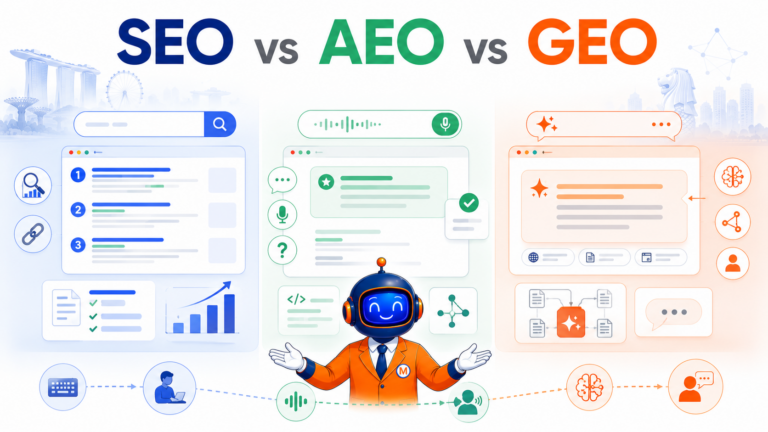
A multi-location brand should feel like a network of strong local assets, not one website repeated across ten branches.

That is where many local SEO programmes lose momentum. Head offices publish near-identical pages, branch profiles sit half-updated, reviews stay generic, and each location ends up competing with weak local signals.
In Singapore, that approach fades quickly. Searchers compare options on mobile while commuting, during lunch breaks, or just before arriving.
Google also evaluates richer trust signals than it did a few years ago. Its own guidelines for representing your business on Google and the Official GBP Best Practices Playbook 2026 place accuracy, profile completeness, photos, reviews, and operational upkeep at the centre of local visibility.
Search Engine Land has also documented how AI is reshaping local discovery in AI and local search visibility and ROI in 2025.
At MediaOne, our view is simple. Multi-location local SEO functions as a branch-level trust system, in which each location earns visibility through its own local signals.
Key Takeaways
- Treat each branch as a distinct local asset. Every location needs accurate details, unique local signals, and clear proof of strong local service.
- Build branch pages around real Singapore search behaviour. Include local services, landmarks, transport details, reviews, and clear next steps.
- Optimise each branch’s Google Business Profile with accurate categories, updated hours, fresh photos, and active management.
- Keep review strategy focused on specificity, recency, and authenticity. Reviews that mention the actual service, branch, or customer experience give Google and potential customers stronger reasons to trust that location.
- Make mobile journeys fast and clear for quick action. When users cannot quickly see the phone number, directions, hours, or booking options, the branch loses enquiries.
Single-Location vs Multi-Location Local SEO in Singapore
Single-location local SEO and multi-location local SEO rely on the same core local ranking signals. Google still looks at relevance, distance, and prominence. The real difference lies in operational depth and local complexity.
A business with one main outlet can often perform strongly with one well-optimised Google Business Profile, one strong core service page, and a clear set of local trust signals.
A business with several branches needs a more structured system where each location earns visibility through its own profile quality, landing page depth, reviews, and branch-specific proof.
In our experience, single-location local SEO is about strengthening one local entity. Multi-location local SEO is about coordinating several local entities without flattening them into the same message.
That means the challenge shifts from basic visibility to branch differentiation, governance, reporting, and local trust at scale.
| Area | Single-location local SEO | Multi-location local SEO |
| Core objective | Build visibility for one main outlet or service area | Build visibility for multiple branches or distinct service areas |
| Website structure | One strong service page or a small local site can be enough | Dedicated location pages are usually needed for each branch |
| Google Business Profile | One profile with complete local signals | One profile per branch with branch-specific optimisation |
| Content approach | Focus on one catchment area and one main local audience | Tailor content by branch, district, service mix, and search behaviour |
| Review strategy | Build strong reviews around one outlet | Build branch-level review quality, recency, and response ownership |
| Reporting | One profile and one local conversion path | Branch-level reporting across calls, directions, enquiries, and rankings |
| Operational complexity | Lower | Higher, especially for governance and consistency |
For a single-location business, the local SEO question is usually straightforward. Why should a nearby customer choose this business?
For a multi-location brand, that same question needs to be answered for every branch, in every catchment area, with enough local depth for Google and users to trust each outlet on its own.
That is why businesses with multiple outlets, clinics, stores, or service areas require a tailored approach to local SEO in Singapore, rather than repeating the same SEO strategy across every location page.
Why Multi-Location Local SEO Has Changed in Singapore
Singapore has always been a high-intent local search market, but the current version of local SEO is more demanding because it sits at the intersection of search, maps, mobile behaviour, and AI discovery.
First, Google Business Profile quality carries more weight in everyday visibility. Google’s guidance says your business should be represented exactly as it is recognised in the real world, with precise addresses or service areas, the fewest appropriate categories, local phone numbers, and customer-facing hours.
That creates very little room for loose naming conventions, central switchboards passed off as local contacts, or vague service areas.
Second, Singapore users expect fast local confirmation. A person searching for a clinic in Novena, a tuition centre in Bishan, or an aircon servicing company nearby does not evaluate options in the same way as someone searching in Tampines, Orchard, or Jurong.
Convenience shifts by district. MRT proximity, nearby landmarks, parking friction, and travel time can influence the final choice as much as price or brand familiarity.
Our own examples of Singapore local intent include queries such as “dentist in Orchard”, “tuition centre near me”, and “aircon servicing in Singapore”.
Third, AI-assisted discovery is expanding the number of places where a branch can be evaluated. Brands now need to monitor visibility beyond the traditional local pack because AI Overviews can cite business websites and third-party sources while also introducing tracking complexity and potential misinformation.
That shift creates four angles that many generic guides still miss.
- Commuter intent is a ranking and conversion issue: In Singapore, “near me” often means “easy for me right now”. Branch pages that surface MRT access, nearby landmarks, parking, and clear next steps reduce friction faster.
- Branch governance is now a competitive edge: Brands with several outlets need central control over naming, categories, hours, landing pages, and profile access. That operational discipline feeds directly into visibility.
- Review specificity is stronger than review volume alone: A branch with fewer reviews that mention treatment quality, speed, staff professionalism, or convenience can outperform a branch with more generic praise.
- Internal linking supports both local discovery and AI understanding: Branch pages work better when they sit inside a clear internal structure with related service pages, mobile-first local SEO guidance, and Singapore local ranking factor content.
Why Most Branch Pages Fail to Rank
Most weak branch pages lack the local depth that users and search engines expect.
They reuse copy, swap district names, and expect Google to treat them as distinct local assets. That rarely holds up in competitive sectors such as healthcare, legal, tuition, home services, fitness, and F&B.
Here is the usual gap between low-performing branch pages and pages that rank better and convert more strongly.
| Weak branch page | Strong branch page |
| Reused copy with area names inserted | Location-specific copy shaped around real branch demand |
| One central phone number for every outlet | Direct branch contact details, where operationally possible |
| Generic service list | Branch-specific service details and exceptions |
| No transport or landmark guidance | MRT, parking, landmark, and accessibility details |
| Old or stock imagery | Recent branch photos that reflect the real location |
| Generic testimonial block | Reviews that mention the branch, staff, or service delivered |
| One website-wide CTA | Clear call, booking, WhatsApp, or directions action for that branch |
This is where a well-structured multi-location local SEO strategy proves useful. The goal is to publish stronger branch pages and give each location enough local proof to justify its own visibility.
How to Build Location Pages for Multiple Locations
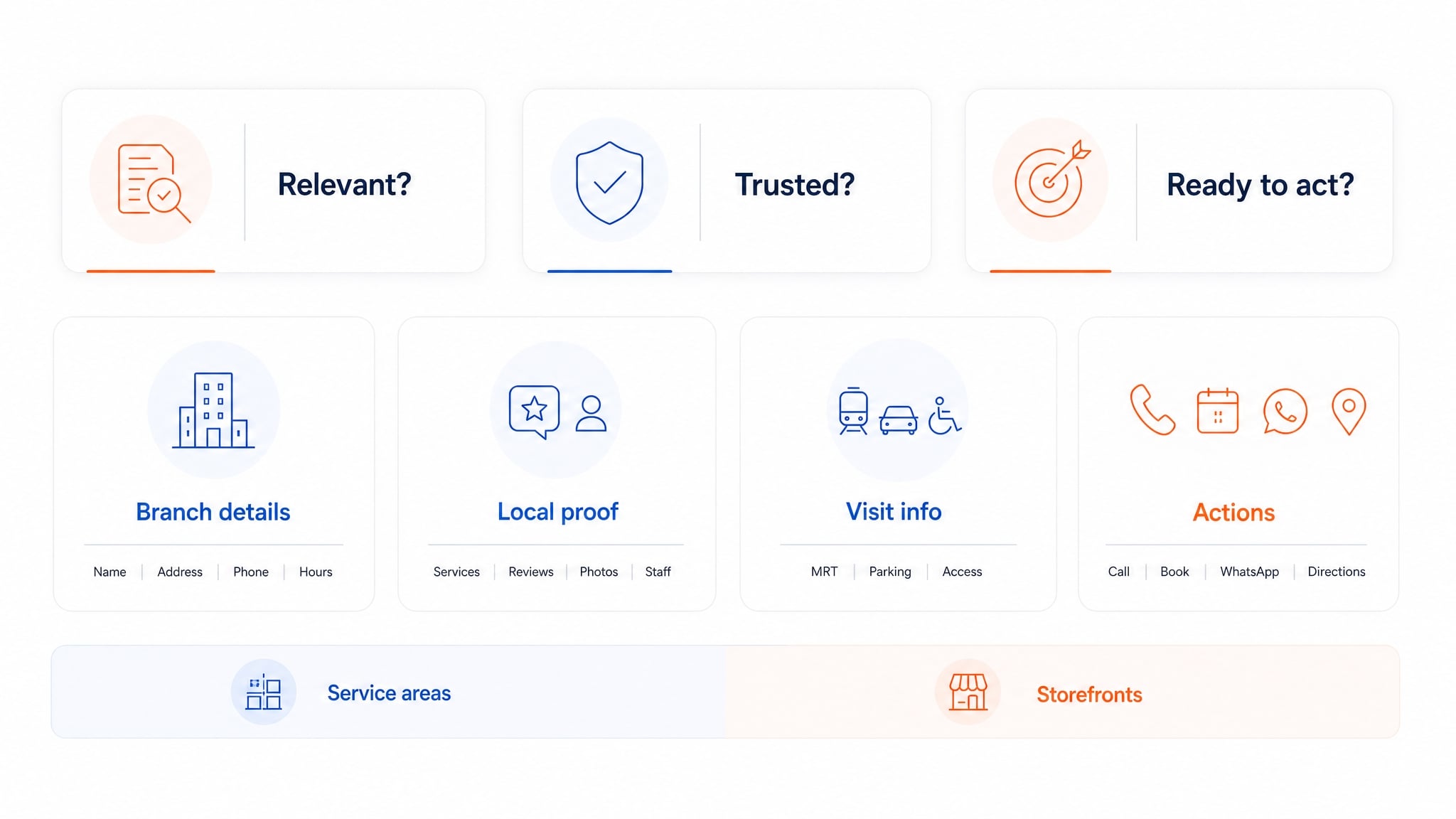
A location page should help a searcher answer three questions quickly.
- Is this branch relevant to me?
- Can I trust this branch?
- Can I act now
Every branch page should go beyond basic information, including details that match how people make local decisions in Singapore.
Strong location pages usually include:
- Branch name, address, phone number, and opening hours
- Clear service coverage for that branch
- Nearby MRT stations, parking notes, and accessibility details
- Local testimonials or review excerpts
- Branch photos
- Staff or practitioner details where relevant
- FAQs based on branch-specific search intent
- Direct call, booking, WhatsApp, or directions actions
For service-area brands, the page should explain how the branch serves nearby estates, districts, or industrial areas. For storefront brands, the page should reduce friction around getting there and deciding quickly.
A branch page should also sit inside a stronger internal linking structure. Related guides, such as mobile local SEO for mobile-first local search and local SEO ranking factors in Singapore, support relevance and next steps.
Google Business Profile Optimisation for Every Branch
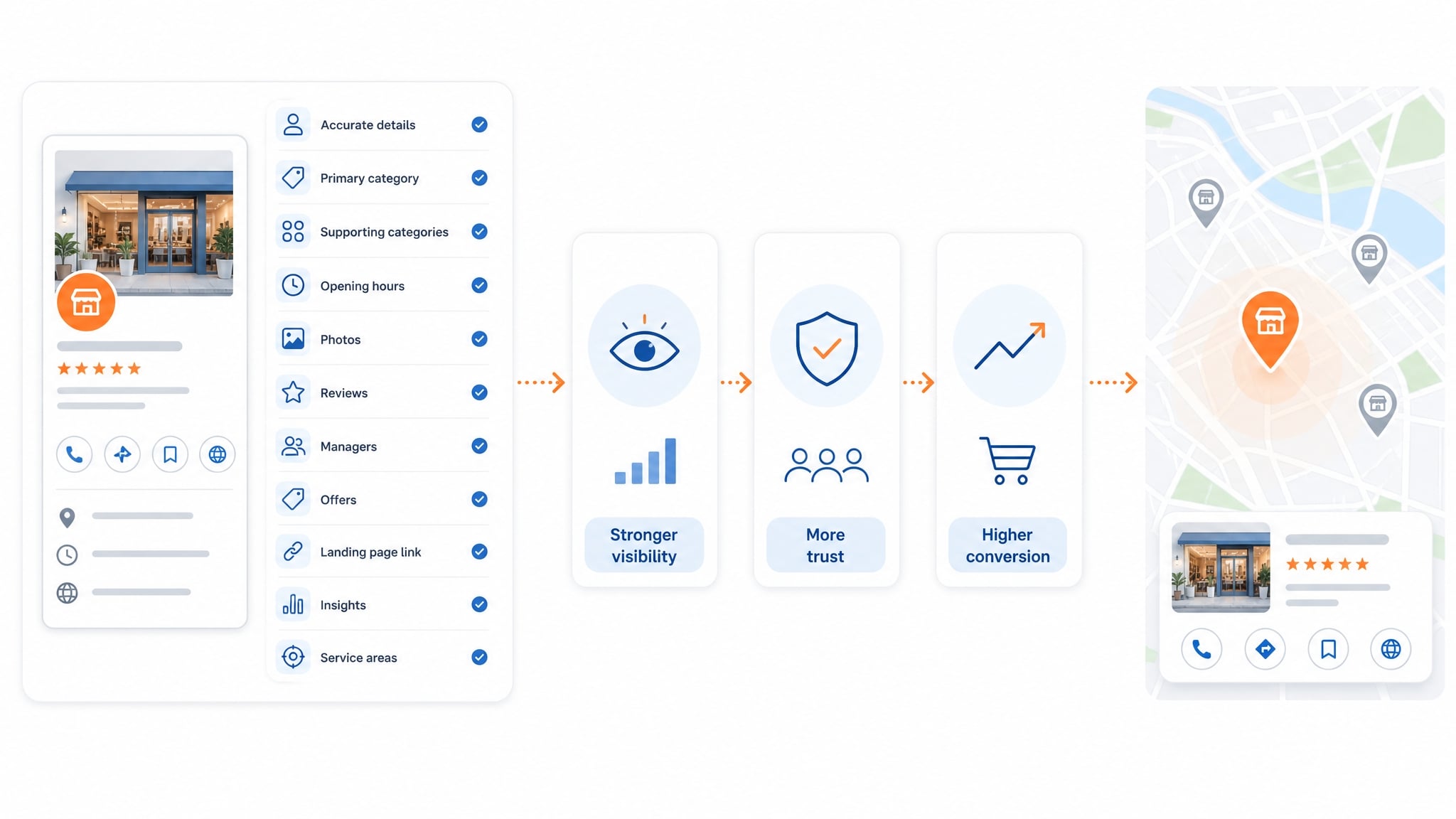
Branch profiles serve as active local assets that strengthen visibility, trust, and conversion.
Each branch needs its own Google Business Profile with accurate details, a suitable primary category, relevant supporting categories, current opening hours, fresh photos, and a review response workflow.
Brands with multiple outlets should also carefully control ownership and manager access. Google’s 2026 playbook recommends assigning multiple managers and regularly reviewing access, which is especially useful for larger organisations.
Core branch profile tasks include:
- Keeping the business name and category logic consistent across equivalent branches
- Updating special hours and holiday hours promptly
- Uploading new photos regularly
- Publishing relevant updates or offers
- Checking that the correct landing page is linked
- Reviewing branch insights and query patterns
- Defining service areas accurately for mobile teams and field services
This is where many multi-location businesses lose visibility in quiet ways. One branch links to the right page. Another link to the homepage. One branch has current holiday hours. Another does not. One branch has active reviews and new photos. Another looks dormant.
The same discipline applies to multi-location examples from MediaOne’s published work. Extra Space Asia is featured on MediaOne’s International SEO page with 2,000+ keyword ranking improvements and a 94% increase in website traffic across Singapore, Malaysia, and Korea.
It is also featured on our GEO agency page with 42.3% AI Share of Voice, an 88.0% AI Visibility Score, and 221 out of 251 AI responses mentioning the brand.
While those published results relate to international SEO and AI visibility rather than branch-level GBP reporting, they illustrate the same operating principle.
Once a location-based brand scales, visibility improves when the system behind the locations is structured, consistent, and actively managed.
For brands that rely heavily on map discovery, this connects directly with Google Maps SEO for multiple locations. Map visibility is often won or lost on profile quality, branch accuracy, and how well the landing page supports the listing.
Review Strategy for Multi-Location Local SEO
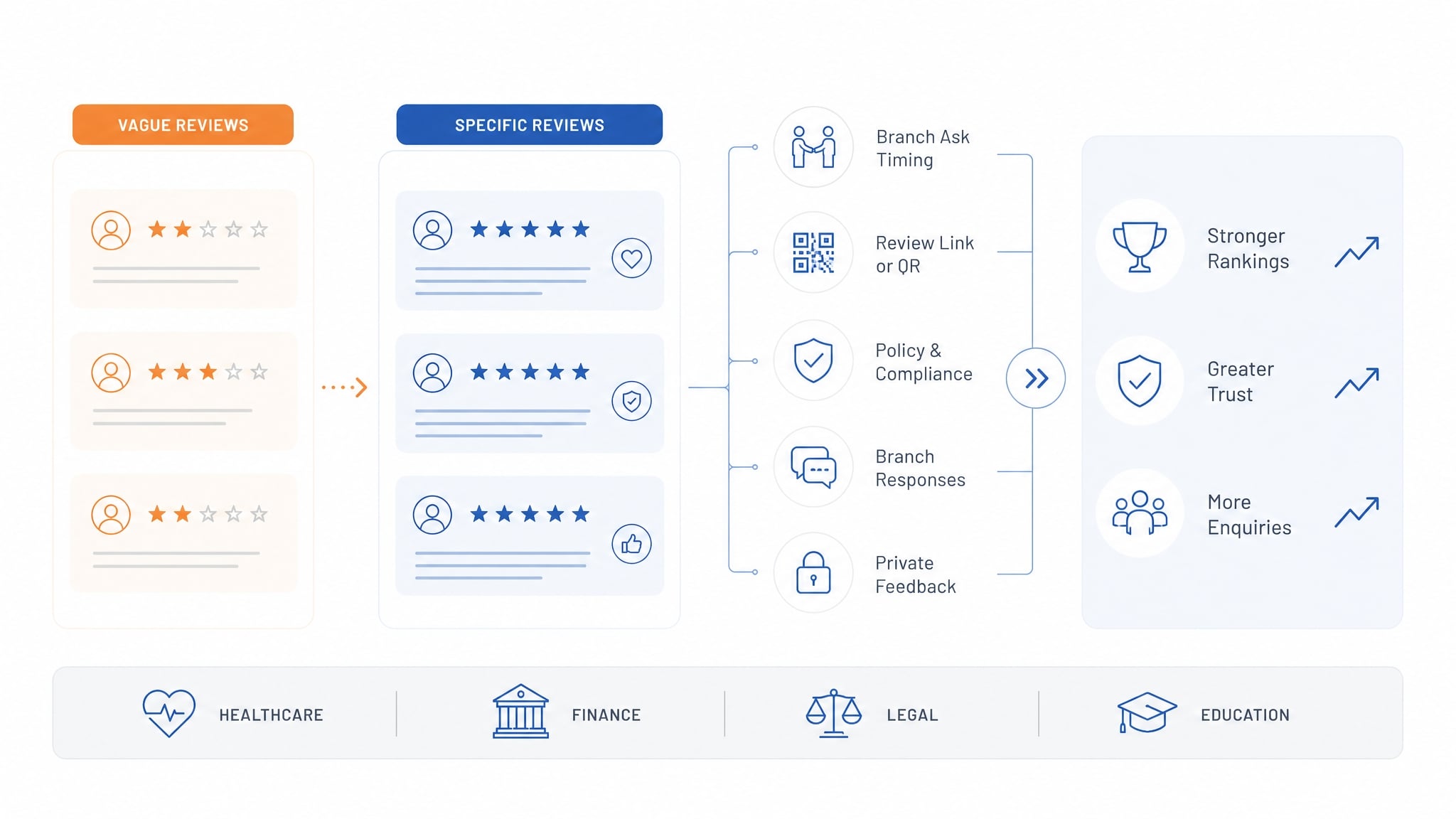
Review quantity helps, but review quality carries greater weight.
A branch with fifty vague reviews can lose to one with thirty reviews mentioning treatment, service speed, staff professionalism, or local convenience. Reviews shape Google’s sense of prominence and relevance while also influencing conversion.
A stronger review system usually includes
- Branch staff asking at the right point in the customer journey
- Direct review links or QR codes tied to the correct location
- Central policy on tone, timing, and compliance
- Branch-level responsibility for responses
- Early capture of private feedback before issues become public complaints
Our Google reviews SEO guide for Singapore businesses goes deeper into this, but the core principle stays simple. Treat reviews as a commercial growth asset that supports rankings, trust, and enquiries.
For regulated sectors, response discipline is especially important. Public replies should never reveal personal data or over-explain sensitive issues. That point is highly relevant for Singapore businesses with healthcare, finance, legal, or education branches.
Mobile Local SEO for Singapore Searchers
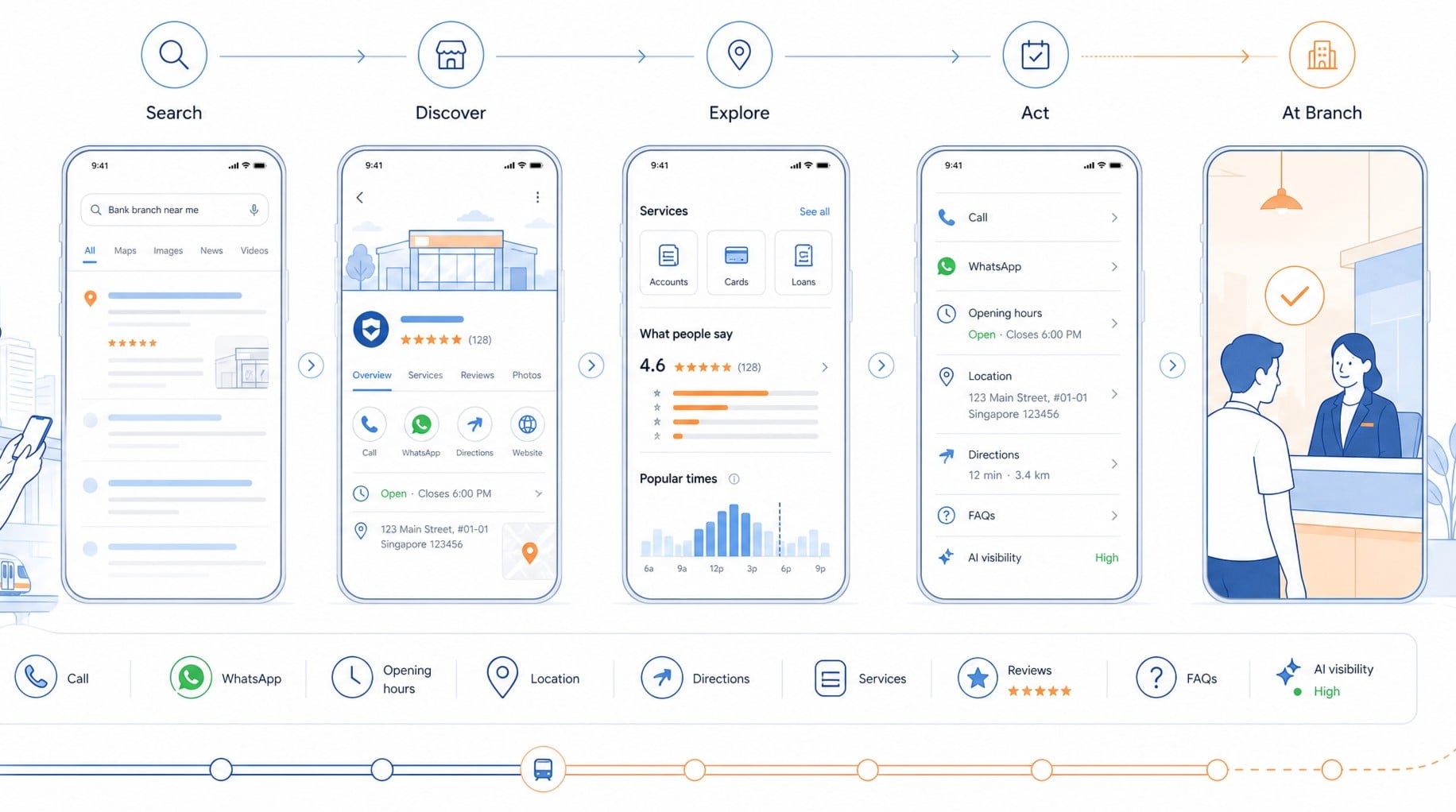
Singapore local search is mobile-led by default.
People search while walking, travelling on the MRT, waiting for an appointment, or comparing options between errands. They want the shortest route from search to action.
A branch page that hides essentials on mobile loses attention and enquiries. Core details should stay visible without complicated navigation.
A mobile-ready branch page should show:
- Tap-to-call or WhatsApp access
- Opening hours
- Exact location and directions
- Concise service summaries
- Local reviews
- FAQs that remove last-minute hesitation
For brands that want stronger local and AI visibility together, there is also a growing overlap between local SEO and AI discovery.
Our GEO services in Singapore help brands appear in AI-driven search tools, such as ChatGPT and Google AI Overviews. This is key when branch pages, clinic locations, and service pages must work together.
Multi-Location Local SEO Checklist
Use this checklist before launching or refreshing any branch page.
Branch page checklist |
|
| 1 | Unique title tag and meta description for the branch |
| 2 | Accurate branch name, address, phone number, and opening hours |
| 3 | Branch-specific copy rather than reused templates |
| 4 | Nearby MRT, parking, landmark, and accessibility details |
| 5 | Current branch photos |
| 6 | One clear conversion action for the branch |
| 7 | Local review excerpts or testimonials |
| 8 | Internal links to relevant service pages |
| 9 | Mobile layout that keeps key details visible |
| 10 | Branch-level FAQ content |
Google Business Profile checklist |
|
| 1 | Correct business name with no keyword stuffing |
| 2 | Best-fit primary category |
| 3 | Consistent category logic across equivalent branches |
| 4 | Accurate holiday and special hours |
| 5 | Fresh photos and updates |
| 6 | Correct website link and booking link |
| 7 | Multiple approved managers |
| 8 | Active review response workflow |
Governance checklist |
|
| 1 | Head office controls templates and quality. |
| 2 | Branch teams supply photos, updates, and local details. |
| 3 | Reviews are requested through a standard process. |
| 4 | Profiles and pages are audited quarterly. |
| 5 | Reporting is tracked by branch. |
KPIs for Multi-Location Local SEO
Rankings show only part of the branch performance. A branch can rank reasonably well and still underperform commercially.
This is the branch-level KPI set we recommend tracking.
| KPI | Why it helps | Review cadence |
| Google Business Profile views | Tracks local visibility by branch | Monthly |
| Calls from profiles and branch pages | Shows direct intent | Weekly and monthly |
| Direction requests | Strong indicator of visit intent | Weekly and monthly |
| Form leads or bookings | Connects SEO to enquiries | Weekly and monthly |
| Review growth and average rating | Tracks trust and sentiment | Monthly |
| Local pack rankings by catchment area | Shows competitive movement | Monthly |
| Citation accuracy score | Flags inconsistent branch data | Quarterly |
| Mobile conversion rate on branch pages | Shows whether users can act quickly | Monthly |
For larger brands, budgeting and prioritisation should also be tiered.
| Tier | Priority | Typical branch type |
| Tier 1 | Highest investment | Flagship outlets and highest-revenue branches |
| Tier 2 | Growth focus | Competitive branches with clear upside |
| Tier 3 | Maintenance | Stable branches with lower search pressure |
Build Stronger Branch Visibility with Multi-Location Local SEO in Singapore
Build every location page as a tailored local asset rather than a recycled template.
That means cleaner profiles, stronger branch pages, fresher reviews, clearer mobile journeys, and tighter location-based reporting.
If your brand needs a coordinated rollout for profiles, reviews, branch pages, citations, and reporting, MediaOne can help.
As a trusted local SEO agency in Singapore, we work with multi-location brands to strengthen branch visibility, sharpen local search performance, and build long-term digital foundations. Get in touch with us today!
Frequently Asked Questions
Should I use subfolders or subdomains for multiple location pages?
For most brands, subfolders are the stronger option because they keep authority consolidated within a single domain. That usually makes branch page governance, internal linking, and reporting easier as well.
Can a service-area business rank without a physical shopfront in every district?
Yes, but the setup needs to be honest and precise. Google’s guidelines do not allow fake addresses or virtual offices presented as staffed branches. Service areas should be configured accurately, and landing pages should explain how each area is served.
Do separate branches need separate schema markup?
Yes. Each branch page should reflect its local entity, with the correct business details, location data, and supporting structured information. That helps Google connect the page, the branch, and the profile more clearly.
How many location pages should a brand publish at one time?
That depends on operational readiness. Launching 20 thin pages at once often creates more problems than it solves. It is usually better to publish fewer pages with stronger branch detail, then roll out in phases.
Can one review workflow work across every branch?
The policy can be centralised, but execution should still be branch-led. Timing, customer journey, and service context vary by location. A rigid one-size-fits-all script often results in lower review quality.
How long does multi-location local SEO take to show results?
Early improvements often appear within 2 to 4 months, especially when profiles are incomplete or branch pages are weak. Stronger gains usually take longer in competitive sectors and dense catchment areas.