Executive Summary
A Google algorithm update is a modification to Google’s ranking systems designed to reward high-value content, reduce web spam, and align search results with evolving user intent. Modern core updates evaluate web pages using multi-faceted signals, including E-E-A-T guidelines, Information Gain concepts, and entity clarity/consistency.

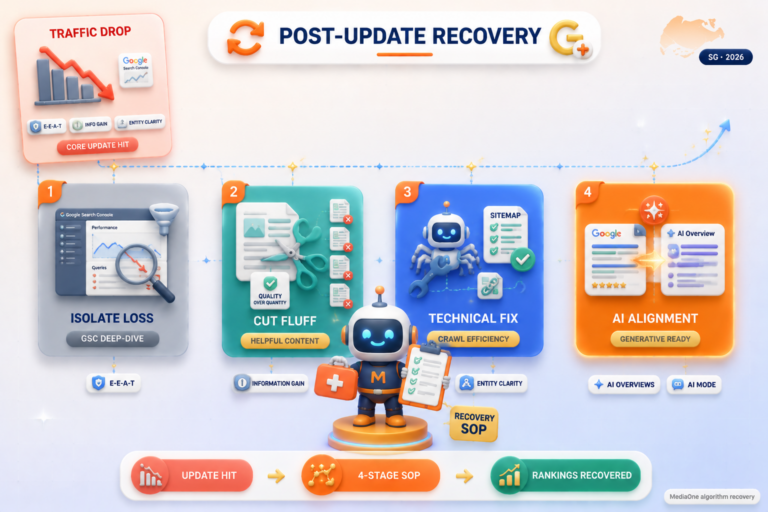
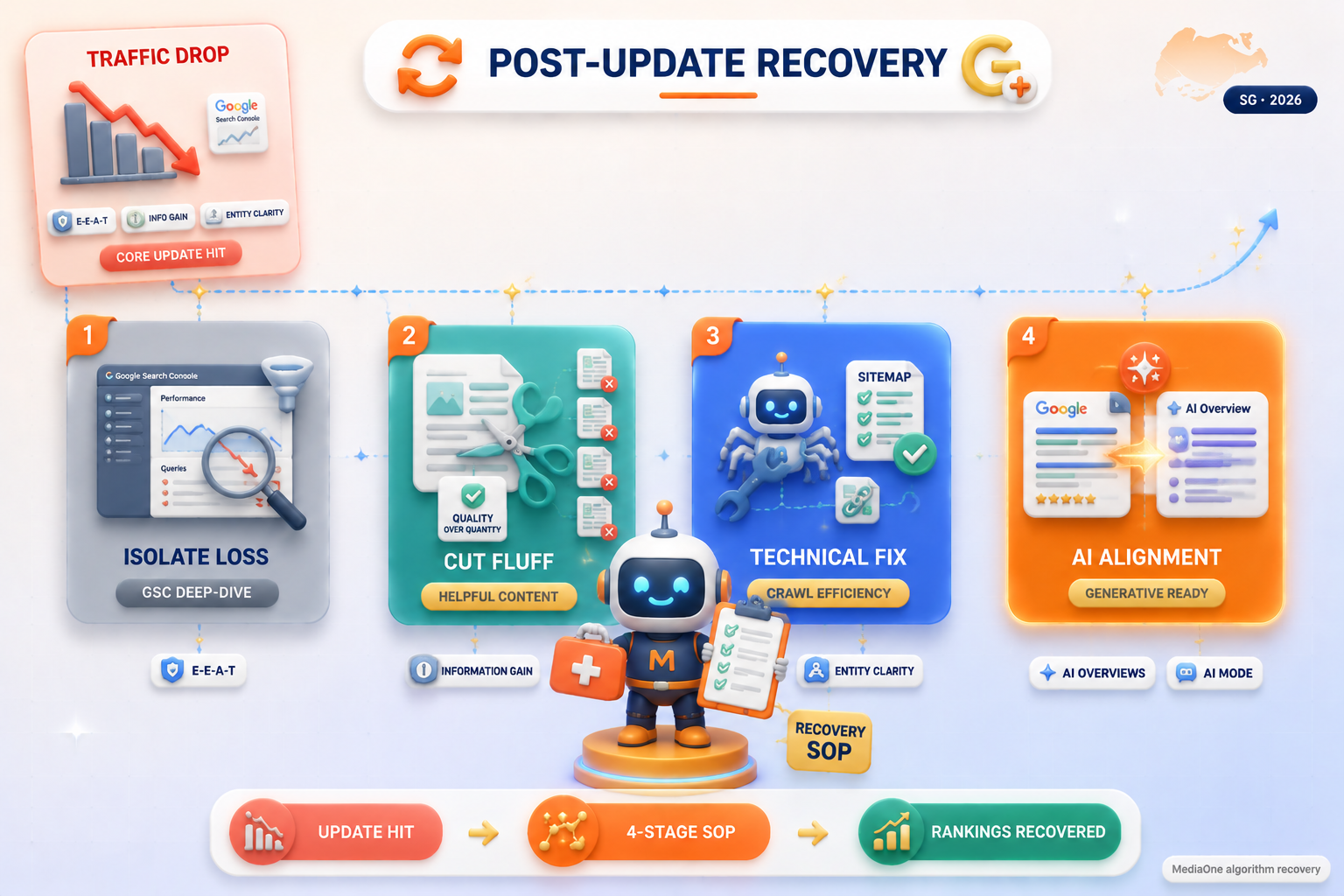
To recover from a core update drop, site owners must isolate traffic loss in Google Search Console, eliminate unhelpful fluff, resolve technical crawl issues, and align content for both Google Search and generative AI search features.
About This Article
- The New Search Reality: Why Google Updates Feel Different Now
- Types of Google Algorithm Updates: Broad Core, Specialized Systems, and Web Spam
- The MediaOne Quality Framework: Evaluating E-E-A-T, Information Gain, and Entity Clarity
- Step-by-Step Diagnostic SOP: A 5-Step Action Plan for Traffic Loss Recovery
- Case Study: Recovery of a Core Update Organic Drop
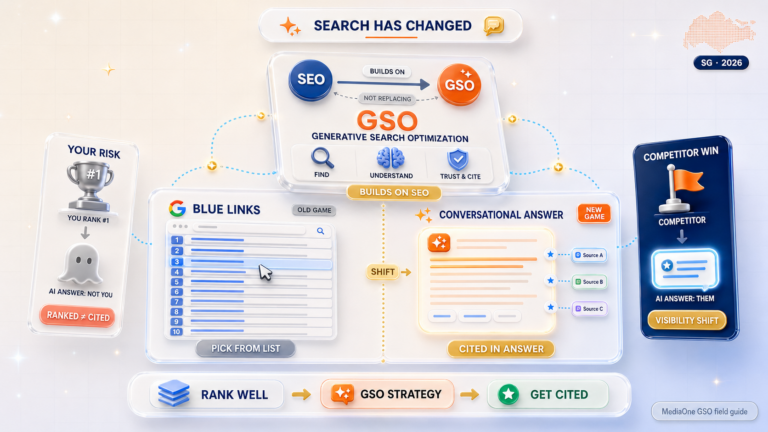
- Search Engine Architecture vs. AI Answer Engines: The SEO + GEO Bridge
- Future-Proofing Checklist: Publishing Checklist for Brands and Content Teams
- Frequently Asked Questions: Recovery Timelines, AI Content Policies, and Penalty Types
- About the Authors: Professional Credentials and Reviewer Attribution
The New Search Reality: Why Google Updates Feel Different Now
Imagine waking up, grabbing your morning coffee, and opening your analytics dashboard, only to find your organic traffic chart plunging off a cliff. There was no warning, no server outage, and no technical glitch. A new Google algorithm update just rolled out, and overnight, page-one rankings you built over years vanished.
If your organic search traffic took a sudden downward turn during a recent algorithm rollout, you are far from alone. Search Engine Optimization has fundamentally shifted.

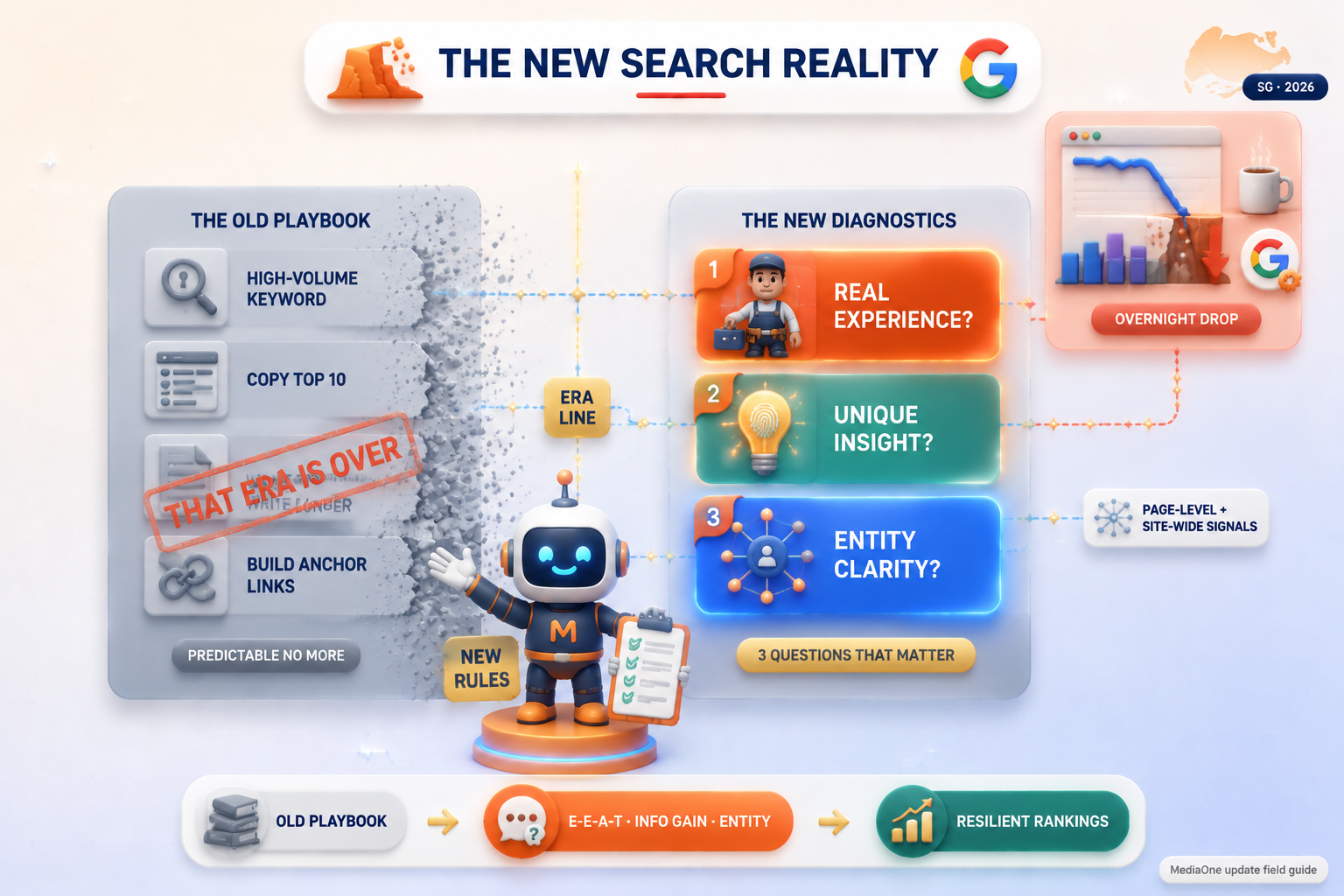
For over a decade, SEO followed a predictable playbook:
- Identify a target keyword with high search volume.
- Analyze the top 10 results on Google.
- Write a longer version of those articles, rephrasing the same subheadings.
- Build backlinks with targeted anchor text.
That era is over.
Google deploys automated search quality updates to ensure search results remain helpful. As outlined in Google’s ranking systems guide, ranking systems operate primarily at the page level, though site-wide signals also exist. When diagnosing a site-wide decline, these are three useful questions to ask across affected pages and sections:
- Experience & Expertise: Does someone with actual, real-world experience write this content?
- Information Gain: Does this page offer unique insights for the reader not found elsewhere on the web?
- Entity Clarity & Consistency: Is the brand and author entity information structured clearly for search engines to interpret?
Types of Google Algorithm Updates (And How They Impact You)
Not all updates carry the same weight or target the same site elements. Broadly speaking, Google pushes updates across three major categories:
A. Broad Core Updates
Broad core updates refine how Google’s machine learning systems evaluate overall site authority, relevance, and user satisfaction web-wide. As detailed in Google’s core update guidance, core updates do not target specific niches or individual pages.
- Key Sign: Traffic shifts occur across dozens or hundreds of keywords simultaneously within 24 to 48 hours of rollout.
B. Specialized System Updates
These focus on specific site behaviors or page types, such as reviews system updates or spam protection systems woven directly into primary core ranking systems.

- Key Sign: Specific page types suffer drops (e.g., affiliate reviews or thin roundup posts), while core brand content remains stable.
C. Web Spam & Quality Updates
Target deliberate attempts to game search rankings, including scaled content abuse, expired domain abuse, and link manipulation as defined in Google Search Spam Policies.
- Algorithmic Spam Impact: Google’s automated systems (such as SpamBrain) can demote or omit sites automatically without any manual notification appearing in Google Search Console.
- Manual Actions: A separate enforcement path where a human reviewer inspects the site. This results in an explicit notification under “Security & Manual Actions” in Google Search Console.
The MediaOne Core-Update Quality Framework
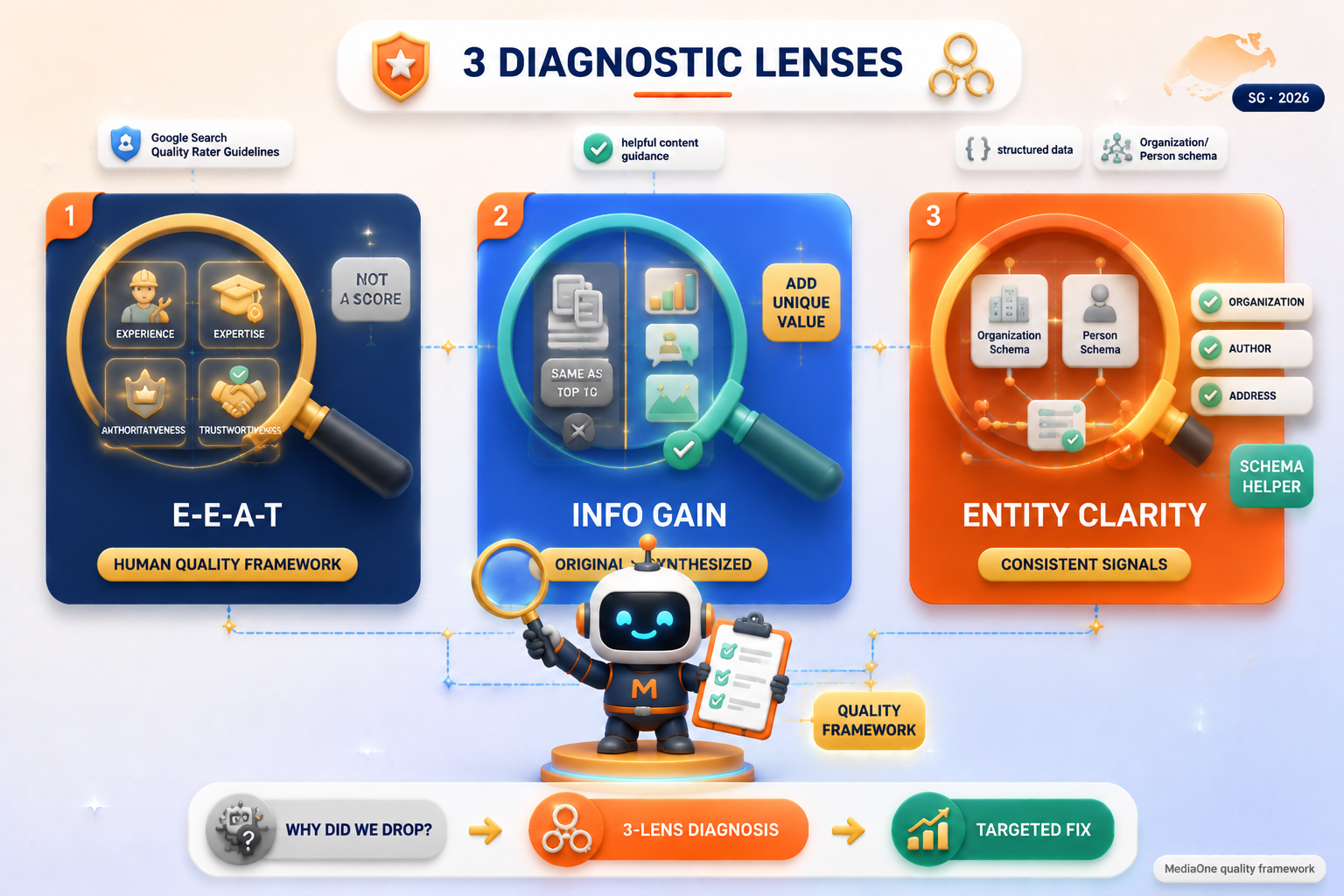
To diagnose why a site drops during an algorithm update, MediaOne applies three useful diagnostic lenses:
1. E-E-A-T (Experience, Expertise, Authoritativeness, Trustworthiness)
Derived from Google’s Search Quality Rater Guidelines, E-E-A-T is not a direct algorithmic score, but a human quality framework that reflects what Google’s automated systems aim to reward.
2. Information Gain for the Reader
When a user visits multiple pages on the same topic, Google encourages unique value and first-hand expertise, as noted in Google’s helpful content guidance. If an article merely synthesizes top-ranking results without adding original data, expert commentary, or proprietary visual assets, it provides minimal information gain.
3. Entity Clarity & Consistency
Make important entities unambiguous. Keep organization, author, address, and other factual information consistent across the web. Using appropriate structured data (such as Organization and Person schema) helps Google understand page and entity information and enables eligible search features; it acts as a structural helper rather than a direct credibility certificate.
Step-by-Step Diagnostic SOP: What to Do When Your Traffic Drops
When a core update rolls out, avoid panic-driven conclusions from volatile data while rankings fluctuate. Follow this 5-step SOP to isolate and diagnose drops:
Step 1: Verify Rollout Status & Give Data Time
Monitor the Google Search Status Dashboard to confirm whether an update has finished rolling out. Confirm the rollout has fully completed and wait at least one full week after completion before concluding.
Step 2: Isolate Traffic Loss in Google Search Console

Open Google Search Console and navigate to the Performance tab. Compare 28 days post-update against the 28 days before the update.
- Standard Search Performance: Evaluates traditional web search clicks, impressions, and positions.
- Generative AI Performance: If available in your Search Console account, review impressions accumulated specifically inside AI Overviews and AI features (refer to Google’s Search Console AI reporting docs).
Step 3: Categorize the Drop Type
| Observed Pattern | Possible Interpretation | What to Investigate |
| Impressions stable, Clicks & CTR drop | Intent shift or SERP feature change | Inspect query mix, layout changes, and whether users now prefer interactive tools, tables, or video formats. |
| Impressions and Clicks collapse sharply | Possible relevance, quality, competitive, or technical shift | Inspect indexation, competitor content improvements, thin content, and information gain gaps. |
| Sudden drop across specific subdirectories | Potential technical or structural issue | Audit recent site changes, canonical tags, noindex directives, and server timeout errors. |
Step 4: Perform an Information Gain Audit
Compare top-performing pages side-by-side with current top-ranking results:
- Unique Assets: What specific data, chart, quote, or workflow do we have that competitors don’t?
- Demonstrable Expertise: Is the author demonstrably an expert with clear credentials and verified author bios?
- User Experience: Is the experience damaged by intrusive ads, layout shifts, or popups?
Step 5: Execute Content Re-Engineering
Focus on substantive improvements: prune or consolidate thin content, inject primary data, and structure for scannability.
Case Study: Recovery of a Core Update Organic Drop
The Challenge
Following a major Google core update, an enterprise B2B service site experienced a 42% decline in organic sessions over a 14-day window.
The Diagnosis
Using Google Search Console directory segmentation, MediaOne confirmed technical crawl issues were not present. Comparing the affected URL cluster against new top-ranking competitors revealed that the site’s content primarily restated industry consensus without primary data or author attribution.
The Execution
- Content Consolidation: Merged 12 thin, overlapping articles into 3 comprehensive guides, implementing 301 redirects for redundant URLs.
- Information Gain Injection: Added original survey data, proprietary workflow diagrams, and direct expert quotes.
- Entity Clarification: Implemented updated Person and Organization schema markup, linking author profiles to external verified credentials.
The Outcome
Within 8 weeks following the completion of the re-engineering process, organic impressions stabilized. By week 12, organic traffic recovered to 108% of pre-update levels.
Search Engine Architecture vs. AI Answer Engines (The SEO + GEO Bridge)
Brands must distinguish between Google’s integrated search ecosystem and third-party AI platforms:
- Google Search & AI Features (AI Overviews): Standard foundational SEO practices remain the primary path to appearing in Google’s AI features, as highlighted in Google’s AI Search guidance.
- Third-Party AI Answer Engines (ChatGPT, Perplexity): These platforms use independent web crawlers and retrieval architectures.
- Content Optimization Principles: Google explicitly warns against over-focusing on artificial formatting hacks. Focus on clear hierarchy, structured data, and helpful content first.
Future-Proofing Checklist for Brands and Content Teams
Content Quality & E-E-A-T
- [ ] Is the author clearly identified with credentials?
- [ ] Does the article demonstrate first-hand experience?
- [ ] Do outbound links to primary sources back key claims?
Information Gain & Value
- [ ] Does the article provide original insight or data missing from competitor results?
- [ ] Are proprietary diagrams, structured tables, or step-by-step frameworks included?
- [ ] Is filler removed and the piece written concisely?
Technical & AI Search Readiness
- [ ] Are appropriate Schema markups validated via the Rich Results Test?
- [ ] Have you reviewed visibility inside Search Console’s Generative AI Performance Report (if available)?
- [ ] Is page experience optimized?
Need Help Recovering Your Organic Search Growth?
Navigating search updates requires a data-backed, systematic approach. If your business experienced a sudden drop in organic visibility, claim your free SEO growth audit with MediaOne today.
Frequently Asked Questions
How long does it take to recover from a Google algorithm update?
Recovery timelines vary. While some page-level fixes can be reflected as search engines recrawl individual URLs, broader site-wide assessments typically take longer as ranking systems continuously re-evaluate quality signals.
Can I use AI tools to assist in content creation and still rank?
Yes. As stated in Google’s guidance on AI-generated content, AI-assisted content can rank if it is helpful, accurate, and original. Using large-scale, low-value automation primarily to manipulate search visibility violates Google’s spam policies.
What is the difference between a manual action and an algorithmic drop?
An algorithmic drop happens automatically through Google’s ranking code without any explicit notification in Search Console. A manual action occurs when a human reviewer inspects your site and applies an enforcement action, which is explicitly reported under “Security & Manual Actions” in Google Search Console.