The Productivity Solutions Grant has been running since April 2018, and somewhere along the way it stopped being a strategic decision and started being a tick-box exercise. Most SMEs in Singapore now apply for the productivity solutions grant the same way they renew their business registration: paperwork first, thinking second.
That sequence is backwards, and it is the single biggest reason businesses receive funding for solutions that quietly underperform for the next 12 months.
Across more than 400 PSG-supported engagements we have run as a pre-approved PSG digital marketing grant vendor since 2019, a clear pattern emerges. The businesses that treat the productivity solutions grant as a strategic lever extract roughly 3 to 5 times the commercial value of businesses that treat it as free money. The grant amount is identical. The outcome is not.
This guide covers what the official documentation does not: how to apply PSG digital marketing funding properly, how to evaluate vendors before you sign, which solutions actually deliver returns within the 12-month holding period, where applications typically get rejected, and how to structure your PSG digital marketing Singapore investment so the funding produces measurable business outcomes instead of dormant software subscriptions.
Key Takeaways
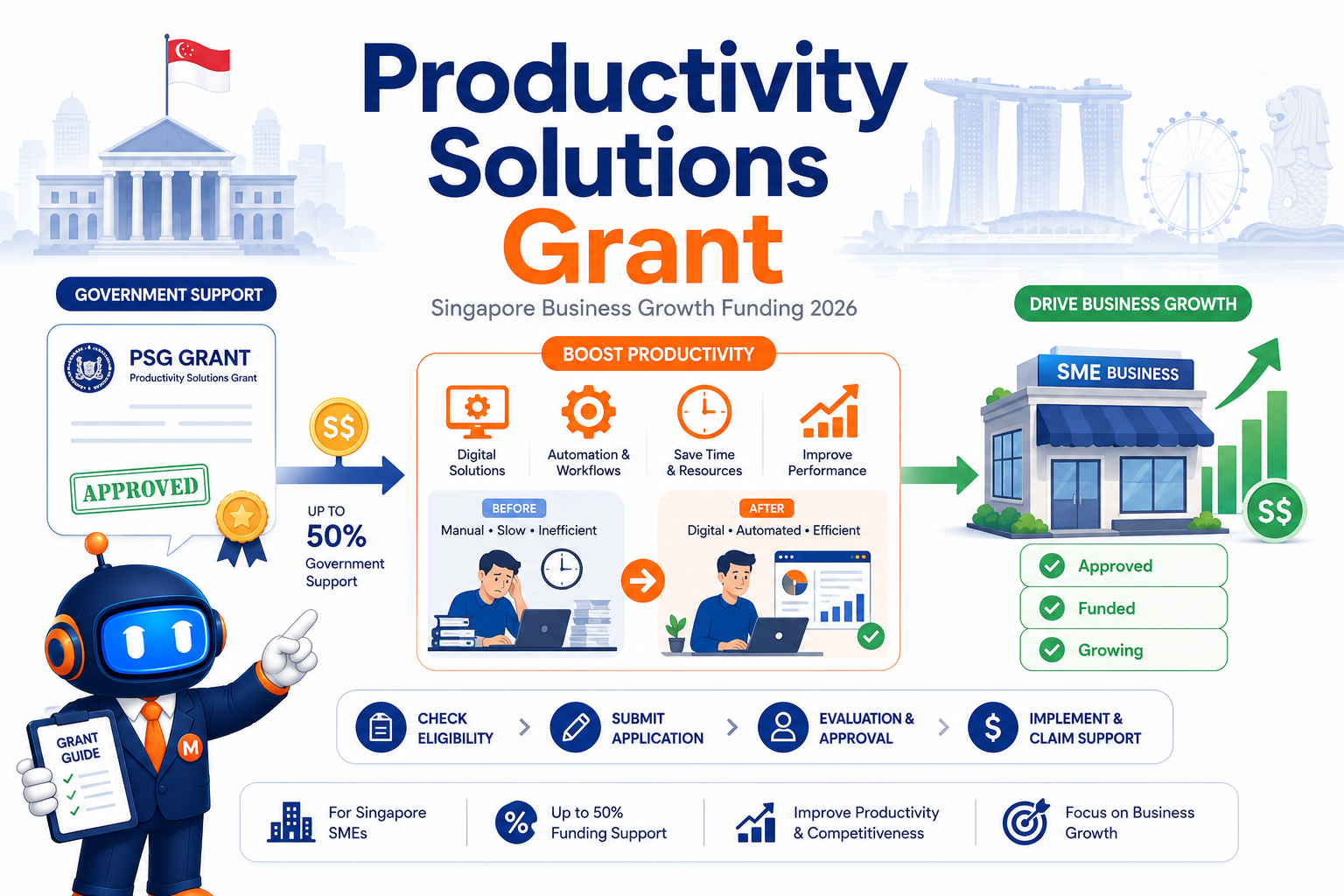
- The productivity solutions grant funds up to 50% of qualifying costs, capped at S$30,000 per company annually
- Vendor selection determines roughly 70% of the eventual ROI, while most SMEs spend less than two hours on this decision
- Common rejection reasons sit outside the official eligibility list and rarely get discussed publicly
- The mandatory 12-month holding period creates strategic implications most applicants do not consider until month four
- Sector-specific solutions outperform generic ones for businesses with clear industry alignment
- Job redesign consultancy under PSG-JR receives up to 70% funding, a higher rate than most IT solutions
What The Productivity Solutions Grant Actually Funds In 2026
The productivity solutions grant is administered by Enterprise Singapore and supports Singapore SMEs adopting pre-scoped IT solutions, equipment, and consultancy services that align with national Industry Transformation Maps and Industry Digital Plans. What is the productivity solutions grant used for in Singapore comes up constantly during our discovery calls, and the honest answer is broader than most business owners assume.
The grant covers three categories:
| Category | What It Funds | Funding Cap |
| Sector-Specific Solutions | Industry-aligned IT solutions selected by sector lead agencies | Up to 50% |
| Generic Solutions | Cross-industry tools: HRMS, accounting, digital marketing, e-commerce, cybersecurity | Up to 50% |
| Job Redesign Consultancy | Workforce and process transformation consulting under PSG-JR | Up to 70% |

The annual grant cap of S$30,000 applies across all EnterpriseSG-supported solutions within a 1 April to 31 March cycle. This cap resets annually, which most applicants do not realise creates planning opportunities we will cover further down.
Official guidance lives on the GoBusiness Singapore portal and the Enterprise Singapore PSG page. Both are useful for verification. Neither will tell you which solutions are worth choosing.
Eligibility: The Requirements Nobody Reads Carefully Enough
Am I eligible for the productivity solutions grant in Singapore is the right starting question, but the official eligibility list hides several friction points that catch applicants out late in the process.
Official Eligibility Requirements
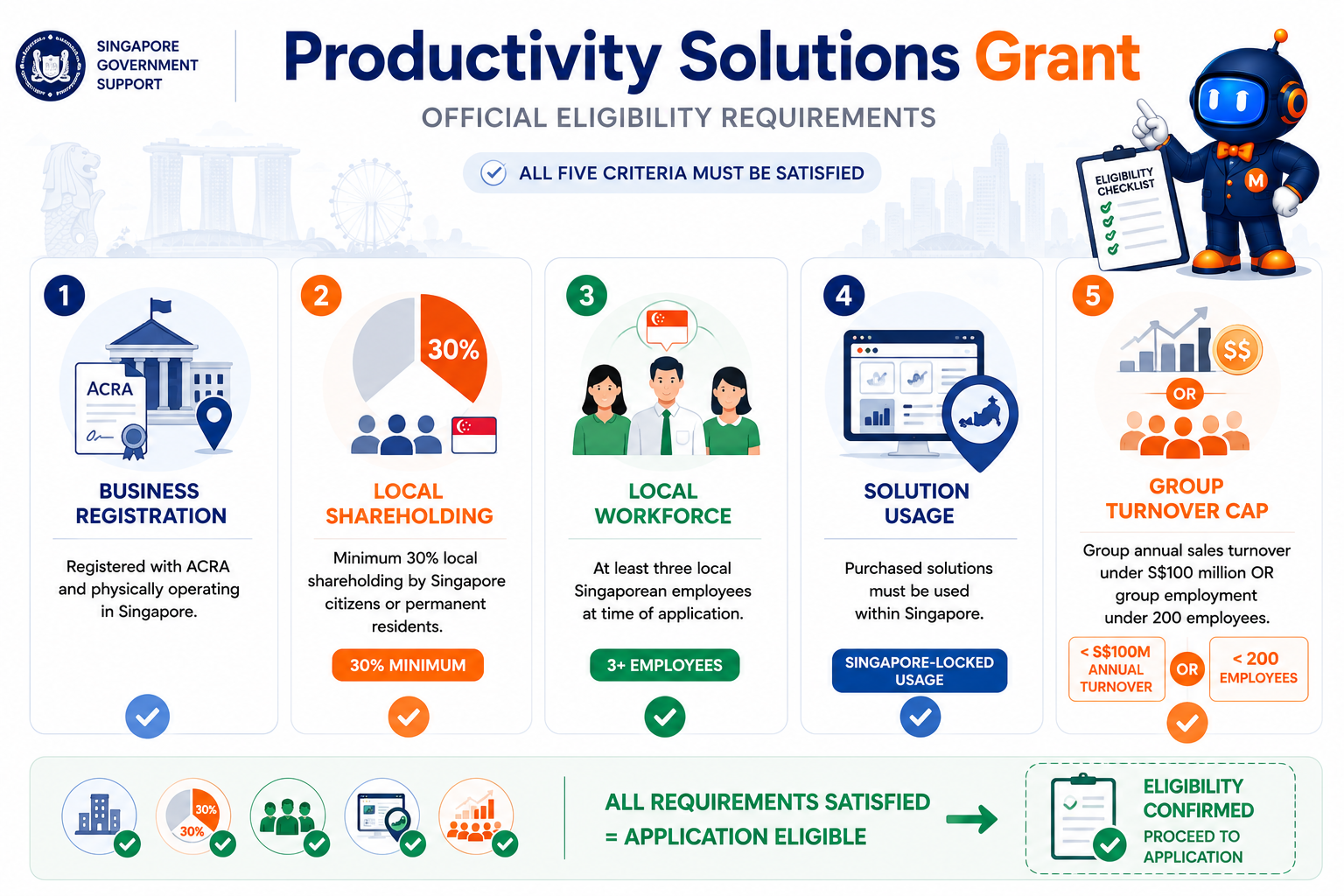
To apply for the productivity solutions grant, your business must satisfy all of the following:
| Requirement | Detail |
| Business Registration | Registered with ACRA and physically operating in Singapore |
| Local Shareholding | Minimum 30% local shareholding by Singapore citizens or permanent residents |
| Local Workforce | At least three local Singaporean employees at the time of application |
| Solution Usage | Purchased solutions must be used within Singapore |
| Group Turnover Cap | Group annual sales turnover under S$100 million OR group employment under 200 employees |
Who Cannot Apply
The following organisations are explicitly excluded:
- Charities and Institutions of Public Character (IPCs)
- Government agencies and subsidiaries
- Religious organisations
- Societies and Voluntary Welfare Organisations (VWOs)
The Hidden Eligibility Friction Points
A direct observation from running PSG applications since 2019: the rejections we see most frequently are rarely about the headline criteria. They sit in the operational details.
Common friction points that delay or reject applications:
- CPF contributions for the three local employees must be active and current.
Businesses with recent hires whose CPF contributions have not been processed for at least one full cycle frequently get flagged for verification, adding 2 to 4 weeks to the timeline.
- The 30% local shareholding test applies to ultimate beneficial ownership, not just first-layer ownership
Holding structures with foreign parent entities get scrutinised more carefully than the simplified guidance suggests.
- Contracts signed before application submission disqualify the application entirely
This catches businesses that get excited by a vendor pitch and sign a letter of intent before submitting on the Business Grants Portal.
- Payments made before approval cannot be reimbursed retroactively.
Even partial deposits to vendors before grant approval typically void the claim.
The fourth point is the most expensive mistake we see. SMEs sometimes pay deposits to vendors during the “exciting” stage of evaluation and only discover the disqualification when the claim gets rejected six months later. By then, the cash is gone and the recourse is limited.
The MediaOne PSG Decision Framework
Most articles about the productivity solutions grant stop at the eligibility checklist. The strategic question, the one that determines whether the grant actually grows your business, is what to do with the funding once you qualify.
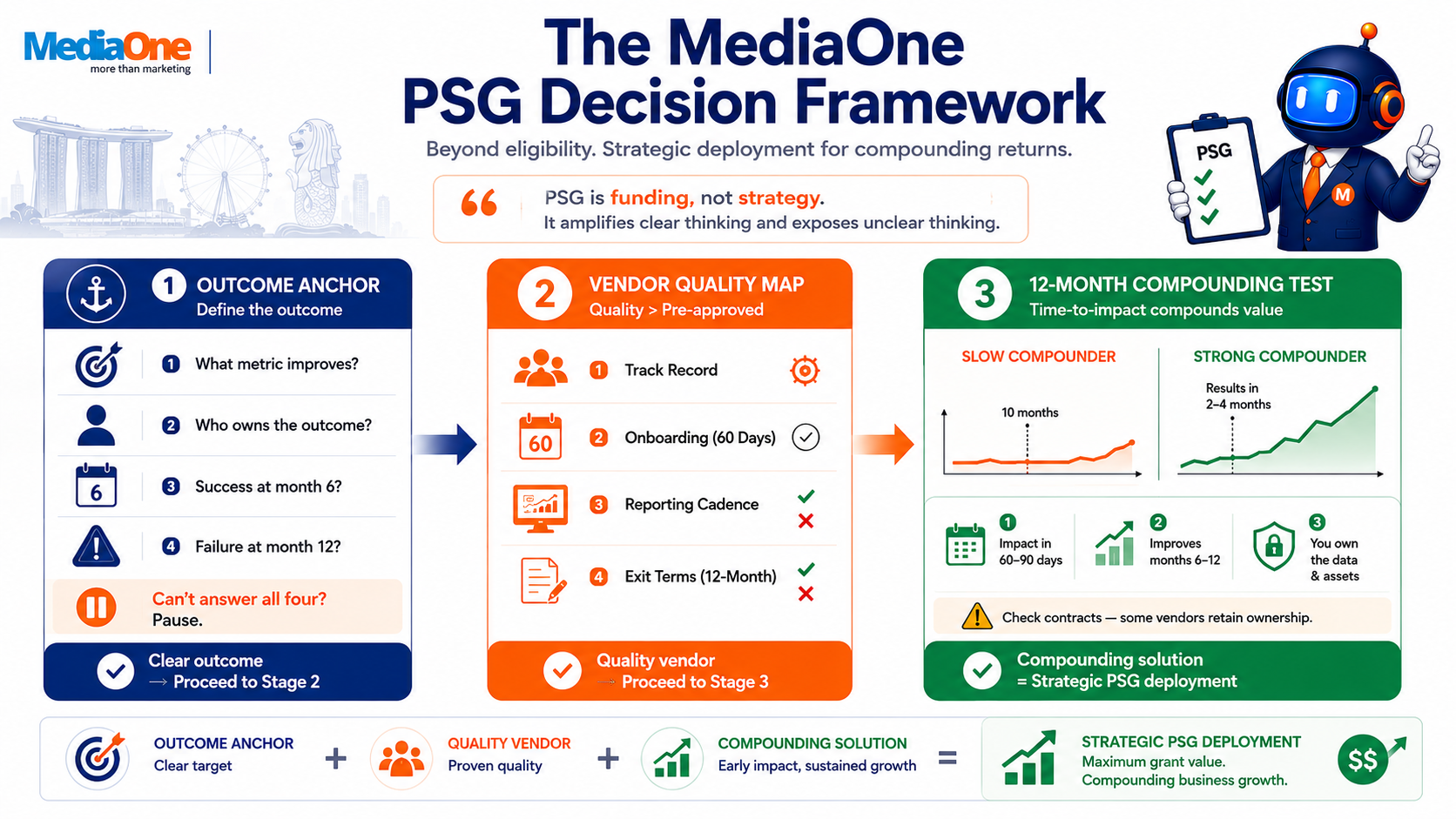
We use a proprietary three-stage framework with every client considering a PSG-supported engagement. How do I choose the right PSG vendor in Singapore is the question we answer dozens of times each year, and the framework below is the same one we apply internally before recommending any solution.
Stage One: The Outcome Anchor
Before evaluating any vendor or solution, define the specific commercial outcome the grant should produce within 12 months. This is the holding period for the equipment or IT solution, so anything that cannot demonstrate value within that window is the wrong choice.
| Outcome Anchor Question | What It Tests |
| What measurable metric improves? | Forces specificity beyond “improve productivity” |
| Who in the business owns the outcome? | Tests internal accountability for adoption |
| What does success look like at month 6? | Creates a midpoint checkpoint |
| What does failure look like at month 12? | Surfaces commitment to the solution |
Businesses that cannot answer these four questions clearly should pause the application. The productivity solutions grant is funding, not strategy. It amplifies clear thinking and exposes unclear thinking.
Stage Two: Vendor Quality Mapping
Pre-approved vendor status confirms baseline eligibility. It does not confirm quality. There is genuine variation in vendor capability within every supported solution category.
When evaluating vendors, weight these factors:
- Track record with businesses of your size and sector.
A vendor delivering well for 200-employee logistics firms may struggle with 8-employee professional services firms. The skill profile is genuinely different.
- Onboarding intensity in the first 60 days.
Solutions that get implemented and then left to operate independently rarely outperform. Look for vendors with structured onboarding and accountability touchpoints.
- Reporting cadence and transparency.
Vendors who provide monthly performance reviews with raw data outperform those who provide quarterly summary slides.
- Exit terms after the 12-month holding period.
Vendors confident in their work offer flexible commitments. Vendors locking SMEs into 24-month or 36-month contracts often do so because retention through pure performance is not their strength.
Stage Three: The 12-Month Compounding Test
The holding period is 12 months. Solutions that take 10 months to produce results provide only 2 months of independent commercial value before the holding obligation ends. Solutions that produce results in months 2 to 4 compound for 8 to 10 months under the grant period and create a foundation for self-funded continuation.
Prefer solutions where:
- Initial impact is observable within 60 to 90 days
- The improvement curve continues through months 6 to 12
- The data and assets created during the grant period remain owned by your business, not the vendor
This last point catches more SMEs than expected. Some vendor arrangements technically retain ownership of audiences, content, or workflows built during the engagement. Read the contract before signing.
Generic Solutions Available Under The Productivity Solutions Grant
What solutions are covered by the productivity solutions grant is the most common search query during the evaluation stage. Generic solutions apply across all sectors and represent the bulk of approved applications.
| Solution Category | Function | Funding Support |
| Human Resource Management System (HRMS) | Streamlines employee administration | Up to 50% (SMEs only) |
| Accounting, Inventory and Sales Management | Integrates financial and operational data | Up to 50% (SMEs only) |
| Fleet Safety Management | Driver assistance and fleet monitoring | Up to 50% (SMEs only) |
| Document Management and Mobile Access | Document synchronisation and access | Up to 50% (SMEs only) |
| Digital Marketing Packages | SEO, SEM, social media, and content strategy | Up to 50% (SMEs only) |
| E-Commerce Online Shop (B2C) | Secure B2C online store setup | Up to 50% (SMEs only) |
| Managed Detection and Response | Continuous cybersecurity monitoring | Up to 50% (SMEs only) |
| Job Redesign Consultancy (PSG-JR) | Workforce and process transformation | Up to 70% (SMEs and non-SMEs) |
Sector-specific solutions are listed by industry on the GoBusiness portal and selected by the relevant sector lead agency. They tend to outperform generic solutions for businesses with clear industry alignment, because the pre-scoping matches sector workflows more precisely.
What Most SMEs Get Wrong About Solution Selection
A direct opinion, formed across hundreds of PSG-supported engagements: most SMEs select the wrong solution category for their stage of business. Common selection errors include:
- Choosing HRMS before headcount justifies it.
HRMS delivers compounding value above 20 to 25 employees. Below that, manual processes with templates outperform expensive software almost every time.
- Choosing e-commerce platforms before product-market fit is established.
A funded online shop that nobody visits is more demoralising than no online shop at all.
- Choosing digital marketing packages without defined commercial outcomes.
A budget allocation looking for purpose rarely produces the same return as a purpose looking for a budget allocation.
- Treating cybersecurity as optional until it becomes urgent.
According to the Cyber Security Agency of Singapore, SMEs accounted for a disproportionately high share of cybersecurity incidents in recent reporting cycles. Managed detection and response is one of the few solutions where the value is preventative and therefore invisible until tested.
The PSG Application Process
How to apply for the productivity solutions grant in Singapore is well documented, but the practical timing requires attention.
| No. | Step | What Happens | Typical Duration |
| 1 | Identify Solution | Browse the GoBusiness portal for pre-scoped solutions matching your business needs | 1 to 2 weeks |
| 2 | Obtain Vendor Quotation | Request formal quotations from pre-approved vendors | 1 week |
| 3 | Set Up Corppass | Required for transactions on the Business Grants Portal | 3 to 5 working days |
| 4 | Submit Application | Lodge complete application on the Business Grants Portal | 1 day |
| 5 | Application Review | Enterprise Singapore evaluates the application | 4 to 6 weeks |
| 6 | Approval Letter | Formal approval received | 1 day |
| 7 | Engage Vendor | Sign contract and proceed with implementation | Variable |
| 8 | Use Solution For 30 Days | Mandatory minimum usage period before claim | 30+ days |
| 9 | Submit Claim | Lodge claim on the Business Grants Portal | 1 day |
| 10 | Disbursement | Funds released via PayNow Corporate (from 1 February 2023) | 2 to 4 weeks |
Total time from initial research to disbursement typically runs 4 to 6 months. Businesses planning quarterly marketing or operational launches need to factor this into their cash flow planning, because the grant reimburses cost after spend, not before.
Documents Required For Submission
The Business Grants Portal application requires:
- Company contact details and ACRA business profile
- Vendor quotation with itemised cost breakdown
- Implementation proposal outlining business impact
- Project timeline with milestones
- Statement of business need and expected outcome
Do not sign vendor contracts or make payments before receiving the approval letter. This single error voids more PSG claims than any technical eligibility issue.
After Approval: The Mandatory Holding Period
Once approved and disbursed, the productivity solutions grant carries a 12-month holding period from the date of final claim approval. During this period:
- The equipment or IT solution must remain in use by your business
- The solution cannot be transferred, sold, or shared with related parties or subsidiaries
- Records of usage may be requested for verification
This holding period is the reason vendor quality matters so much. A solution that underperforms for 12 months still has to stay in your business for 12 months. Switching costs during the holding period are commercially painful and may create compliance issues.
The Strategic Use Of PSG Most SMEs Miss
This is the section that does not exist in any other article about the productivity solutions grant, and it is the single most valuable insight we share with clients during strategy sessions.
The annual S$30,000 cap resets every 1 April. Businesses planning multi-year transformation can sequence solutions across financial years to access significantly more total funding than a single application allows.
Example: Phased Transformation Approach
| Year | Solution Category | Grant Amount | Cumulative Value |
| Year 1 (Apr 2026) | Digital Marketing Package | S$30,000 | S$30,000 |
| Year 2 (Apr 2027) | E-Commerce Online Shop | S$30,000 | S$60,000 |
| Year 3 (Apr 2028) | Job Redesign Consultancy (70%) | S$30,000 | S$90,000 |
Across three years, an SME with structured planning can access up to S$90,000 in grant funding, supporting up to S$180,000 of qualifying expenditure, while building capability that compounds across the transformation timeline.
This sequencing requires discipline. Each solution still needs to satisfy the Outcome Anchor test independently. The grant is not a reason to adopt solutions you do not need. It is an accelerant for solutions you would adopt anyway, with proper sequencing turning a single subsidy into a multi-year capability programme.
Mistakes That Can Delay or Jeopardise Your PSG Application
Across applications we have observed, supported, or recovered for clients, the most frequent failure patterns are:
- Insufficient business case clarity.
Generic statements about “improving productivity” without measurable outcomes trigger requests for additional information that delay approval.
- Vendor quotations lacking itemisation.
Lump-sum quotations without clear breakdowns by solution component slow review.
- Contracts signed before submission.
Disqualifies the application entirely.
- Eligibility documentation gaps.
Missing CPF contribution evidence, unclear shareholding structures, or expired ACRA documents.
- Solution not matching pre-scoped categories.
Custom configurations falling outside approved vendor packages cannot be funded.
- Multiple grant overlap conflicts.
Solutions already supported under other EnterpriseSG schemes may not be eligible for additional PSG support.
Applications submitted with strong supporting business cases get processed faster than the official 4 to 6 week timeline suggests. Officers are human, and clarity reduces evaluation time.
How MediaOne Supports PSG-Funded Digital Marketing
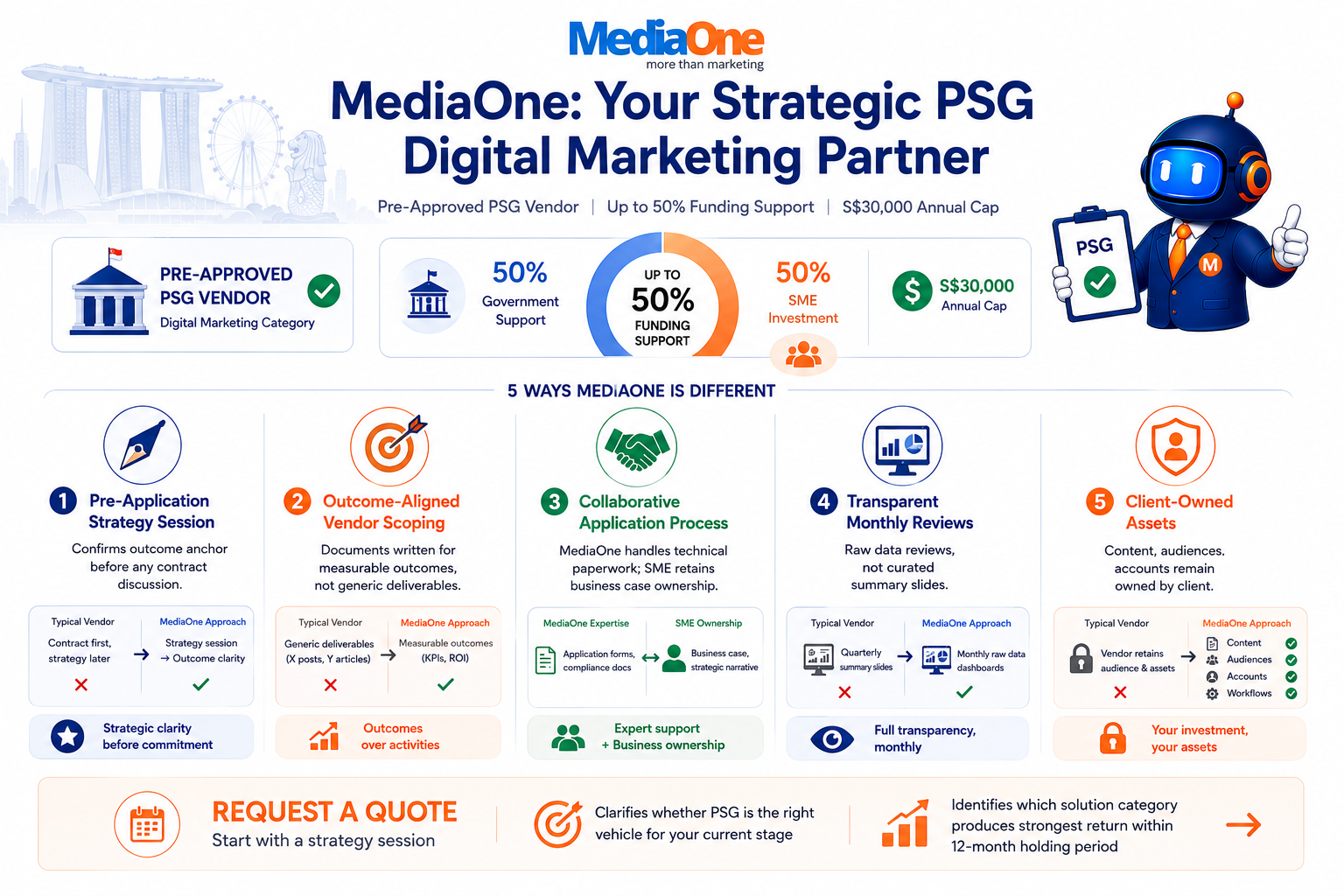
MediaOne is a pre-approved PSG digital marketing grant vendor in Singapore for the productivity solutions grant under the digital marketing category. SMEs working with us on PSG-supported engagements receive up to 50% funding support on qualifying digital marketing packages, subject to the S$30,000 annual cap.
Where our approach differs from typical PSG vendor engagements:
- We run a pre-application strategy session to confirm the outcome anchor before any contract is discussed
- Vendor scoping documents are written to align with measurable business outcomes, not generic deliverables
- We handle the technical aspects of the application paperwork, while ownership of the business case remains with the SME
- Monthly performance reviews include raw data, not curated summaries
- Assets created during the engagement (content, audiences, accounts) remain owned by the client
We have supported businesses across professional services, e-commerce, B2B technology, healthcare, and education sectors. Pattern recognition across these engagements is the reason we built the Outcome Anchor framework in the first place.
If your business is evaluating the productivity solutions grant and considering a digital marketing package as the funded solution, our team at MediaOne supports the full process from outcome anchoring to application submission to ongoing performance management.
Request a quote to start with a strategy session that clarifies whether PSG is the right vehicle for your current stage, and which solution category will produce the strongest commercial return within the 12-month holding period.
Frequently Asked Questions
Can I apply for the productivity solutions grant if my business is registered overseas?
No. To qualify for the productivity solutions grant, your business must be registered with ACRA, physically operating in Singapore, and meet the minimum 30% local shareholding requirement. Plans to expand into Singapore do not satisfy the eligibility criteria; the business entity must already exist locally.
How long does it take to receive funding from the productivity solutions grant?
The complete cycle from application to disbursement typically takes 4 to 6 months. Application review takes 4 to 6 weeks, the solution must be in active use for at least 30 days before a claim can be submitted, and disbursement via PayNow Corporate occurs 2 to 4 weeks after claim approval. Cash flow planning should account for the full timeline since the grant reimburses after spend.
Are non-listed solutions and equipment eligible for the productivity solutions grant?
No. Only solutions and equipment included in pre-scoped packages from pre-approved vendors are supported. The pre-scoping ensures consistency, quality, and ease of deployment. Custom configurations outside approved packages do not qualify, which is one of the most common reasons SMEs find their preferred solution ineligible.
What happens if I sign a contract before getting PSG approval?
The application becomes ineligible. The productivity solutions grant requires that no contracts are signed and no payments are made before formal application approval. This rule is strictly enforced, and exceptions are not granted retroactively. Always submit the application and wait for the approval letter before engaging the vendor commercially.
Can my business apply for the productivity solutions grant multiple times?
Yes. The annual S$30,000 cap applies per financial year (1 April to 31 March). Businesses can apply for different solutions across years, and structured sequencing of applications across multiple financial years is a legitimate way to support multi-stage transformation.
What is PSG-JR and how does it differ from regular PSG?
PSG-JR refers to job redesign consultancy support introduced in Budget 2020. It funds up to 70% of qualifying costs (versus 50% for most IT solutions) up to S$30,000, and supports businesses redesigning roles and workflows to drive workforce transformation. Applications are submitted via the Business Grants Portal, with consultancy provided by approved providers. More information is available through the Singapore National Employers Federation.
Do I need to keep the equipment or IT solution after PSG funding ends?
Yes. There is a mandatory 12-month holding period from the date of final claim approval. During this period, the solution must remain in use by your business and cannot be transferred, sold, or shared with related parties. After 12 months, the holding obligation ends and the business is free to continue, switch, or discontinue the solution.