
Most brands in Singapore are still treating YouTube like a billboard. They sponsor a video, drop their logo in, cross their fingers, and wonder why the results feel flat. Here is the truth: YouTube influencer marketing is not a media buy. It is a relationship at scale.
When you hand a creator your brand’s story and give them the trust to tell it in their own voice, something different happens. The audience leans in. They watch for 15 minutes. They click. They buy. And they remember you the next time they are standing in a Suntec City store deciding between two products.
If you are serious about making that kind of impact, working with a specialist YouTube influencer marketing agency in Singapore is one of the highest-leverage moves you can make in your current marketing mix.
Key Takeaways
- YouTube influencer marketing allows brands to reach highly engaged audiences through trusted creators who explain products in depth and influence purchasing decisions.
- Effective campaigns begin by selecting creators whose audiences match the brand’s target market, rather than focusing solely on subscriber counts.
- Content formats such as reviews, tutorials, and product demonstrations help audiences understand value and build stronger trust.
- Tracking performance through views, engagement, referral traffic, and conversions helps businesses determine whether influencer collaborations generate measurable results.
Why YouTube Influencer Marketing Delivers Long-Form Brand ROI for Singapore Businesses
Singapore is one of the most YouTube-saturated markets in the region. A staggering 89.2% of Singapore’s internet users access YouTube regularly, translating to roughly 4.8 million active users across a nation of 6.11 million people.
What is especially telling for brands is this: the average Singaporean YouTube session lasts 18.5 minutes, which is notably longer than the Southeast Asian regional average of 15.2 minutes.
That number matters because duration is where brand trust is built. When someone commits 18 minutes to a video, they are not passively scrolling past your ad. They are invested. They are listening. And they are far more receptive to a brand message woven into a narrative they actually chose to spend time with.
The compounding effect of that trust is real. According to AnyMind Group’s Singapore Digital Landscape 2025 report, Singaporeans are 62% more likely to respond to sponsored influencer content than consumers in comparable regional markets. That single stat reframes the entire conversation about where your marketing budget should go.
To see what this looks like in practice, consider AIA Singapore’s campaign to launch its Absolute Critical Cover (ACC) insurance product. Rather than running conventional digital ads, AIA partnered with local celebrity musicians like Benjamin Kheng to create YouTube-anchored content that blended genuine storytelling with product education.
The results were concrete and measurable: Benjamin Kheng’s video alone generated over 400,000 views, 2.6 million impressions, and a reach of 1.7 million people.
These were not vanity numbers. They were achieved because the creators were trusted voices speaking to audiences who already chose to follow them, not interruptive ads served to people who were trying to watch something else.
The Trust Economy: Why Your Brand Cannot Buy What a Creator Has Already Earned
Most brands are comfortable measuring reach, impressions, and cost per click. Those metrics are easy to track and easy to optimise. What is harder to quantify, but far more valuable, is trust.
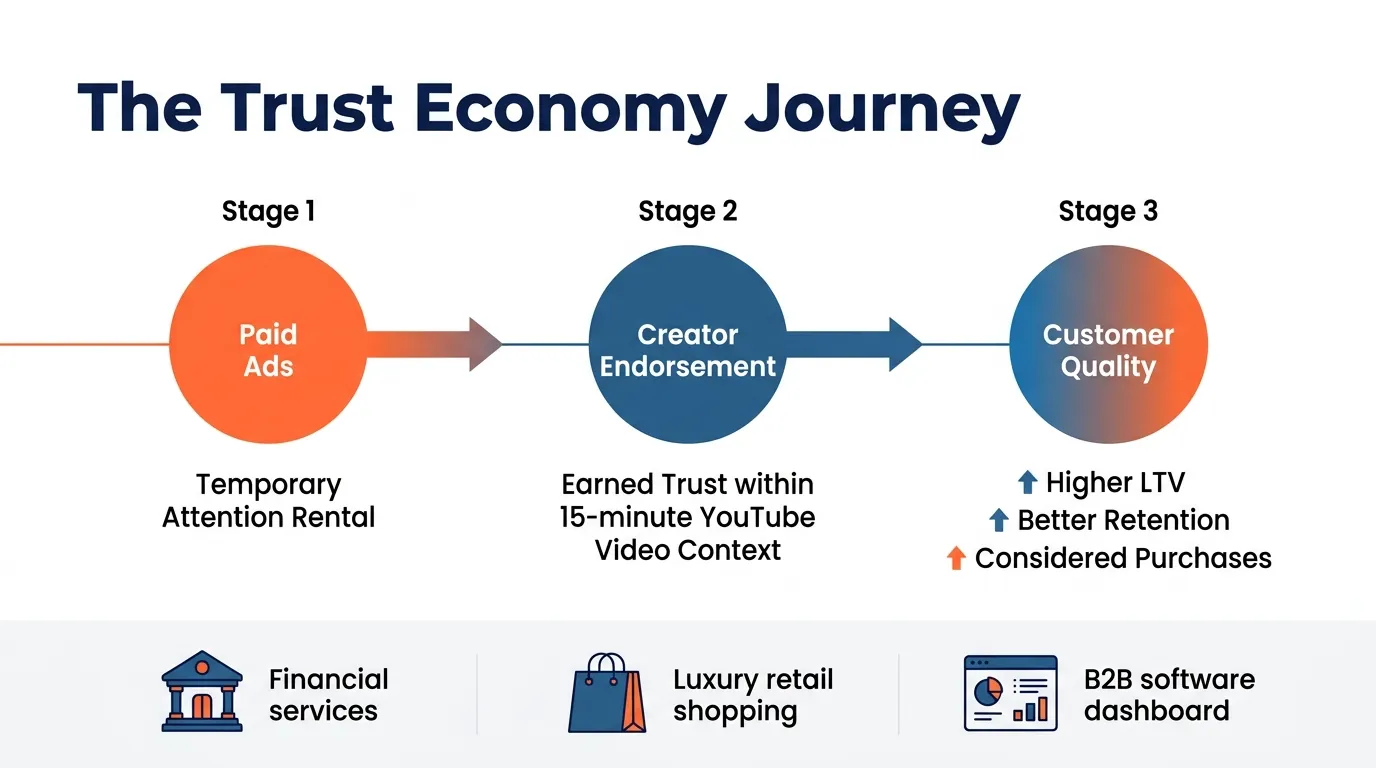
Here is the underlying reality: Paid media buys exposure. It places your message in front of an audience. It does not guarantee belief, and it rarely builds lasting affinity on its own. Creator-led content operates differently. It is built on a relationship that already exists, shaped by consistency, familiarity, and earned credibility over time.
That difference may sound abstract, but it has clear commercial implications.
Paid Attention vs Earned Trust
Paid ads interrupt. Even well-targeted campaigns rely on inserting a message into someone’s feed, often competing with dozens of other promotions.
Creator content, especially from micro influencers, does not function as an interruption. It is part of what the audience chose to consume in the first place. When a creator integrates a product into their content:
- The message is delivered within a familiar voice
- The audience is already receptive, not defensive
- The recommendation feels contextual rather than forced
This is not simply a matter of tone. It changes how the message is processed. People are more likely to consider, remember, and act on something that feels like a natural extension of content they trust.
Why Context Shapes Perception
A product mentioned in isolation is easy to ignore. A product explained within a story is harder to dismiss.
Long-form content, particularly on platforms like YouTube, allows creators to:
- Demonstrate how a product works in real scenarios
- Share personal experiences that build credibility
- Address potential objections in a way that feels unscripted
This added context matters. It gives the audience enough information to move from awareness to consideration without leaving the platform or seeking external validation.
In contrast, shorter paid formats often rely on compressed messaging. They create awareness, but they rarely provide the depth needed for more complex or higher-value decisions.
Why Micro Influencers Drive Higher-Quality Customers
Brands in Singapore often observe that customers acquired through micro influencer campaigns behave differently from those acquired through paid ads. They tend to stay longer, engage more, and convert with greater intent.
There are a few reasons behind this pattern:
- First, the audience is pre-qualified. Micro influencers attract followers who already share a specific interest, whether that is skincare, finance, or productivity tools.
- Second, the recommendation carries trust. It is not evaluated as a standalone claim but as part of an ongoing relationship.
- Third, the decision process is smoother. The audience has already seen the product in use, heard an explanation, and absorbed social proof through comments and engagement.
Together, these factors lead to:
- Higher likelihood of conversion
- Stronger retention over time
- Increased lifetime value per customer
For brands, this shifts the focus from volume to quality. A smaller number of well-qualified customers can outperform a larger pool of low-intent traffic.
Where This Matters Most
The impact of trust becomes even more pronounced in categories where decisions require more consideration.
This includes:
- Financial services targeting professionals in areas like the CBD
- Skincare and aesthetics, where results and credibility are critical
- B2B solutions are sold to specialised teams, such as operations or procurement
In these cases, the audience is not just looking for awareness. They are evaluating risk, value, and relevance. Micro influencers are effective here because they can:
- Break down complex ideas into understandable insights
- Share lived experiences that reduce uncertainty
- Create a narrative that helps the audience see how the product fits into their own context
The Compounding Effect of Creator Trust
Trust is not built in a single post. It accumulates. Each piece of content reinforces the creator’s credibility. Each interaction strengthens the relationship. Over time, the audience becomes more responsive, not less.
This creates a compounding effect:
- Future recommendations require less persuasion
- Engagement remains consistent or improves
- Brand associations become stronger with repeated exposure
Paid campaigns, by comparison, often reset this process each time. Once the budget stops, so does the visibility. There is little residual trust carried forward.
What This Means for Your Strategy
If your current approach is heavily weighted towards paid acquisition, it is worth reassessing how much of your budget is actually building long-term value.
A more balanced strategy often includes:
- Investing in micro influencers who align closely with your audience
- Prioritising depth of content over frequency alone
- Measuring success through engagement quality and customer behaviour, not just reach
The goal is not to replace paid media entirely. It is to complement it with channels that build credibility alongside visibility.
You can scale impressions quickly. Scaling trust takes longer, but it delivers returns that extend beyond a single campaign.
A micro influencer does not just promote a product. They transfer a portion of the trust they have already earned to your brand. That transfer cannot be bought in isolation. It has to be built, respected, and integrated into a broader strategy.
For brands operating in competitive markets like Singapore, this distinction is not theoretical. It is often the difference between campaigns that generate clicks and campaigns that generate customers who stay.
What Long-Form Brand Storytelling Actually Looks Like (and What Most Brands Get Wrong)
Many brands approach YouTube creator partnerships with the right intent but the wrong framework. The issue is not budget or platform choice. It is how the collaboration is structured from the start.
A common pattern among Singapore brands is over-controlling the brief. The document becomes overly detailed, prescribing exact lines, specific visuals, and rigid messaging sequences. On paper, this feels safe. In practice, it strips away the very thing that makes creator content work.
The result is easy to recognise. The video feels scripted. The tone shifts the moment the brand is introduced. Viewers pick up on it almost instantly, and engagement drops because the content no longer feels native to the creator.
Where Most Brands Go Wrong
The mistake is not in wanting brand consistency. That is necessary. The problem lies in trying to replicate traditional advertising within a creator-led format.
When brands over-direct, several things tend to happen:
- The creator’s natural voice is replaced with brand language that feels unfamiliar to their audience
- The pacing of the video becomes awkward, especially during brand mentions
- Viewers disengage because the content feels like an interruption rather than part of the story
This is particularly damaging in long-form content, where attention is earned over time. Once trust is broken, it is difficult to recover within the same video.
The Shift: From Control to Creative Alignment
Effective long-form storytelling on YouTube operates on a different kind of agreement. The brand brings clarity. This includes the product’s value, key messages, and any non-negotiables such as compliance or positioning.
The creator, on the other hand, translates that into a format their audience already trusts. Think of it as a division of roles:
- The brand defines what must be true
- The creator decides how that truth is expressed
When this balance is respected, the content does not feel like an advertisement. It feels like a continuation of the creator’s usual content, with the brand naturally integrated into the narrative.
What Effective Long-Form Storytelling Looks Like
When done well, brand storytelling in long-form content does not announce itself. It unfolds. Instead of a hard sell, the brand becomes part of a broader story. This could take different forms depending on the creator’s style and audience expectations:
- A day-in-the-life vlog where the product is used naturally throughout the day
- A deep-dive review that explores both strengths and limitations with honesty
- A behind-the-scenes or experiential video that shows real usage in context
- An ongoing series where the brand appears consistently across episodes
In each case, the audience is not being told what to think. They are being shown how the product fits into a real situation.
Formats That Consistently Deliver Results
Certain long-form formats tend to perform well because they align with how audiences consume content on YouTube. These formats create space for depth, which is where trust is built.
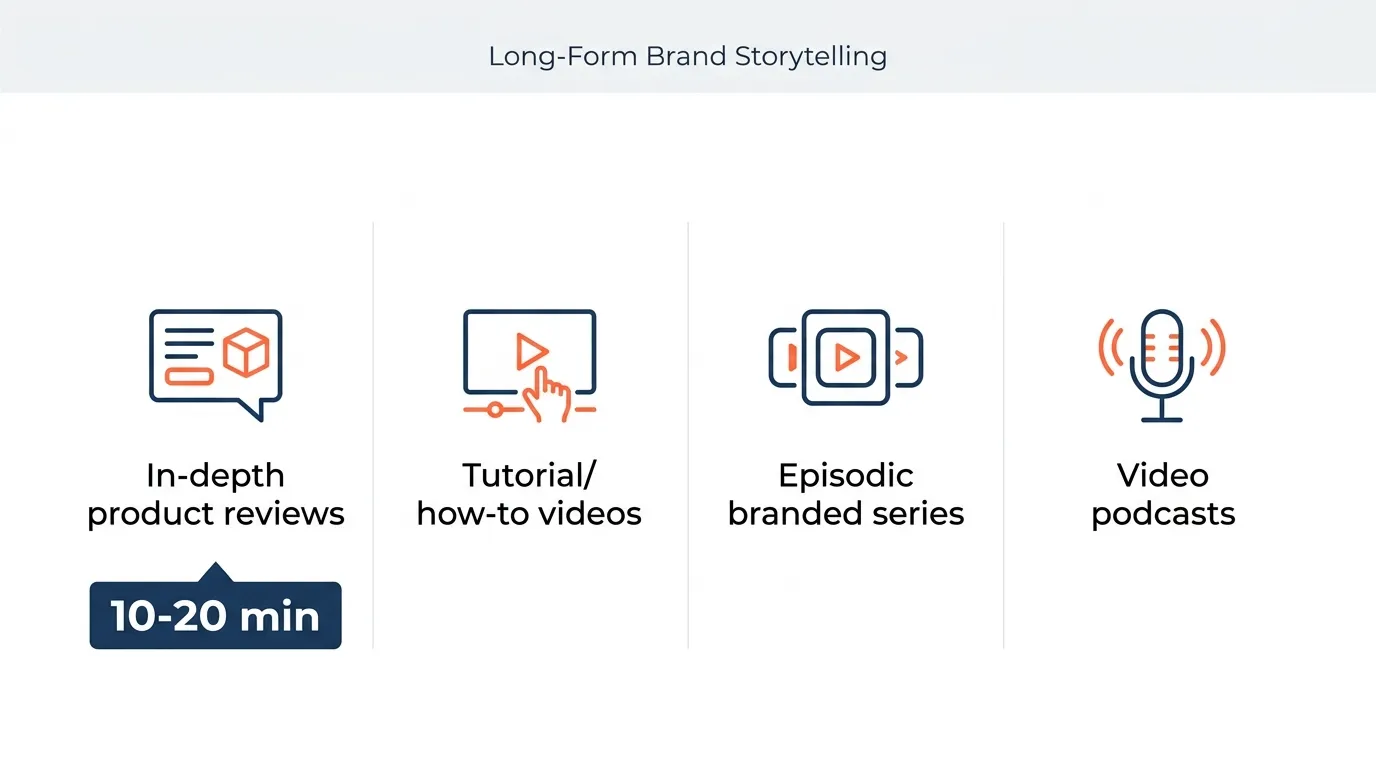
In-Depth Product Reviews (10 to 20 Minutes)
These videos allow creators to go beyond first impressions. They can explain features, test performance, and address common concerns. The extended format gives credibility to the recommendation because it reflects actual usage rather than surface-level promotion.
Viewers often watch these videos with intent. They are evaluating whether to buy, which makes engagement more meaningful.
Tutorial and How-To Content
This format is particularly effective for products that benefit from demonstration.
A well-structured tutorial does more than explain how something works. It shows why it matters in a real scenario. Whether it is a skincare routine, a financial tool, or a food concept, the brand is embedded within a useful experience.
The viewer stays for the value, and the brand becomes associated with that value.
Episodic Branded Series
This is one of the most underutilised formats, especially in the Singapore market. Instead of a single video, the brand is integrated across multiple episodes. Each instalment builds familiarity, and over time, the audience begins to associate the brand with the creator’s broader narrative.
This repeated exposure does not feel repetitive. It feels consistent. For brands looking to build recall rather than just awareness, this format offers a strong advantage.
Video Podcast Sponsorships
YouTube has become a major platform for podcast-style content. A significant portion of viewers now consume long-form conversations directly on the platform.
In this format, brand integration often happens through:
- Host-read segments
- Natural mentions within discussions
- Sponsored topics that align with the brand
Because the content is conversational and less structured, it tends to hold attention longer. Viewers are not just watching. They are listening, which creates a different kind of engagement.
Why Long-Form Works When Done Right
Long-form content gives creators time to build context, establish credibility, and guide the viewer through a complete experience. It mirrors how people make decisions in real life. They observe, compare, and reflect before taking action.
When brands allow this process to happen naturally, engagement becomes a byproduct rather than the goal.
The takeaway is not to reduce structure, but to apply it differently. A clear strategy should guide the collaboration, while creative execution remains in the hands of the creator. That balance is what turns branded content into something audiences are willing to watch, trust, and act on.
What You Should Expect to Pay, and What You Should Expect in Return
Budgeting for YouTube influencer marketing in Singapore requires a different approach than for Instagram or TikTok. Long-form video commands higher rates, but the return on that investment scales accordingly.
Here is a realistic breakdown of current market pricing by creator tier, based on 2025 benchmarks:
| Creator Tier | Followers | Typical Rate Per Sponsored Video |
| Nano | 1K – 10K | SGD 50 – SGD 300 |
| Micro | 10K – 50K | SGD 300 – SGD 1,000 |
| Mid-Tier | 50K – 200K | SGD 1,000 – SGD 5,000 |
| Macro | 200K – 500K | SGD 5,000 – SGD 10,000 |
| Celebrity / KOL | 500K+ | SGD 10,000 and above |
For context, the average ROI on influencer marketing spend globally is SGD 5.20 per SGD 1.00 invested, according to Influencer Marketing Hub’s 2025 benchmark data.
Top-performing eCommerce campaigns frequently reach 6x to 10x returns when attribution is set up correctly. And despite those numbers, only 38% of Singaporean brands currently include YouTube in their influencer strategy, indicating the competition for the best local creators has not yet reached saturation. The window for early-mover advantage is still open.
One note on budget planning: do not forget to factor in production costs, shipping if product seeding is involved, usage rights for content repurposing, and agency management fees if you are outsourcing the work.
A well-structured mid-tier YouTube campaign in Singapore typically runs between SGD 5,000 and SGD 15,000 all-in for a single video, but the compounding value of an evergreen long-form video can justify that investment many times over across the months following publication.
How to Measure What Actually Matters (Beyond Views)
Most long-form YouTube campaigns look successful on the surface. High views, strong impressions, steady reach. Yet those numbers only answer one question. Did people see the content? They do not explain whether the content held attention, built trust, or influenced action.
To properly evaluate performance, you need to shift your focus from visibility to impact. In practice, that means tracking two layers of data. First, how people engage with the content. Second, whether that engagement translates into measurable outcomes.
Engagement Quality: What Signals Real Attention
Engagement quality tells you how audiences interact with the video as they watch. It is a stronger indicator of influence than raw view counts because it reflects interest rather than just exposure.
The most useful signals tend to include the following:
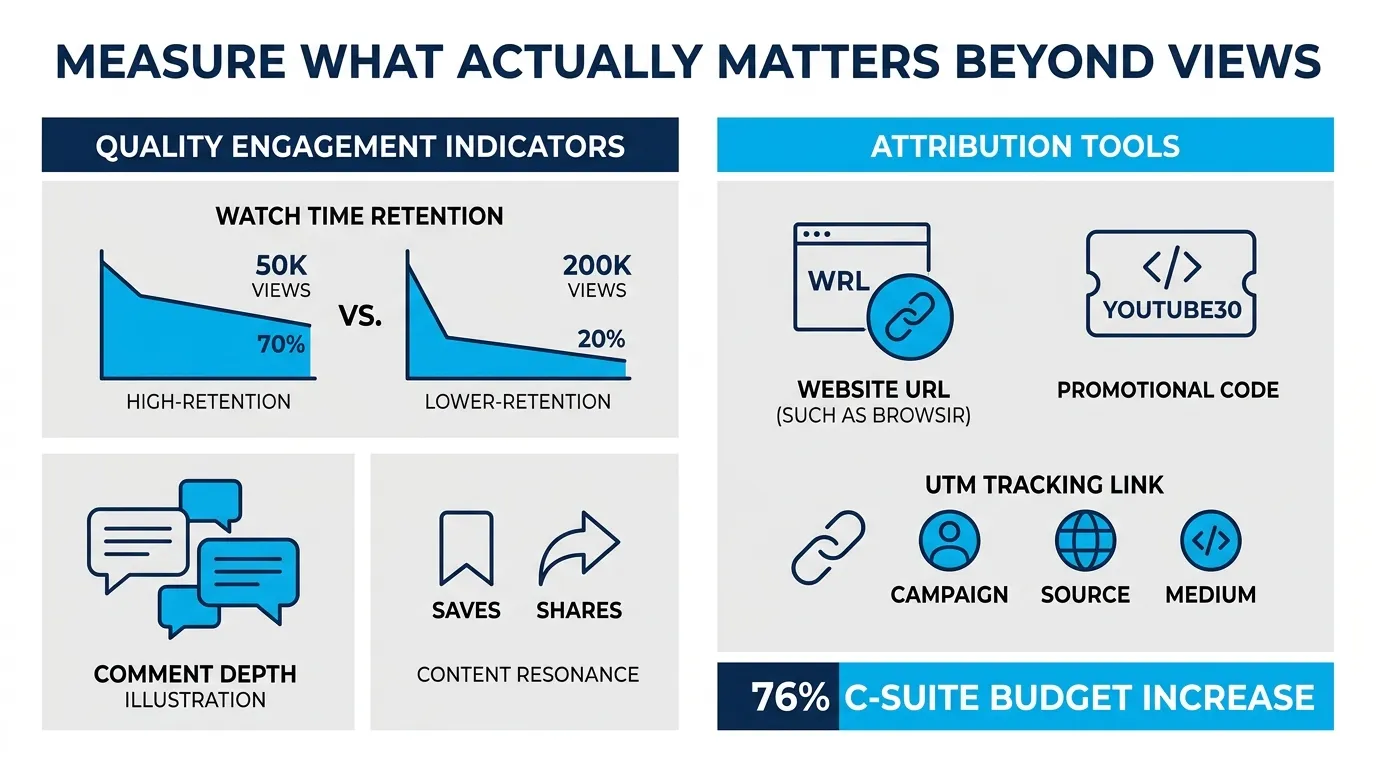
- Watch time and audience retention rate: These metrics show whether viewers stay with the content or drop off early. A video with moderate views but high retention often delivers more value than one with a large reach and rapid drop-off. Strong retention suggests that the content aligns with audience expectations and keeps them engaged throughout.
- Comment depth and sentiment: Not all comments carry the same weight. Short reactions offer limited insight, while detailed comments signal genuine interest. Look for viewers asking questions, sharing experiences, or referencing specific parts of the video. Reviewing sentiment over time helps you understand how the audience perceives both the content and the brand.
- Saves and shares: These actions indicate that viewers found the content useful enough to revisit or recommend. Unlike likes, which can be passive, saves and shares suggest a higher level of intent. They also extend the reach beyond the initial audience.
Taken together, these signals provide a clearer picture of whether your content resonates. A smaller video that performs strongly across these metrics often has greater long-term value than a high-view video with weak engagement.
Conversion Attribution: Connecting Content to Outcomes
Engagement alone is not enough, especially when campaigns are tied to revenue or lead generation. You need a way to connect content performance to actual business results. This is where structured attribution becomes essential. The most reliable tools for tracking conversions in YouTube campaigns include:
- Unique vanity URLs: Custom links such as yourbrand.com/creator-name make it easy to identify which creator drove traffic. They are simple for viewers to remember and provide clean attribution data.
- Personalised promo codes: These codes let you track purchases linked to a specific creator. They also encourage action by offering a clear incentive.
- UTM-tagged affiliate links: Placing tracked links in video descriptions enables detailed analysis of user behaviour, including clicks, sessions, and conversions. This data can be integrated into analytics platforms for deeper insights.
When used together, these tools allow you to map the full journey from content to conversion. You can see not only which videos perform well, but which ones drive tangible results.
Why This Level of Measurement Matters
As influencer marketing budgets continue to grow, expectations around accountability are rising. Decision-makers are no longer satisfied with broad performance indicators. They want clear evidence of return.

This makes precise measurement critical. A well-structured reporting approach allows you to:
- Demonstrate the value of long-form content beyond views
- Identify which creators and formats deliver the strongest results
- Optimise future campaigns based on real performance data
Bringing It Together
Measuring what matters requires a shift in mindset. Instead of asking how many people watched, you begin asking different questions. Did they stay? Did they respond? Did they act?
When you combine engagement quality with clear conversion tracking, you move from assumptions to evidence. That is what turns content from a visibility play into a performance channel.
What the Next 12 Months Look Like for YouTube Creator Marketing in Singapore

Singapore’s influencer marketing industry is valued at around SGD 143 million and continues to expand steadily. At the same time, sponsored YouTube content has seen a sharp increase globally, rising 54% between early 2024 and early 2025. Much of this growth is being driven by sectors such as technology and financial services, where longer-form content helps explain complex products.
In Singapore, this shift is even more pronounced in B2B environments. Companies operating in areas like Raffles Place, Marina Bay, and One-North are increasingly using YouTube not just for visibility, but for education, trust-building, and lead generation.
The next 12 months will not be defined by more creators. They will be defined by better collaboration, sharper targeting, and more disciplined use of data.
Creators Are Becoming Strategic Partners, Not Just Content Producers
The traditional model of influencer marketing treated creators as distribution channels. A brand would pay for a video, receive exposure, and move on. That approach is becoming less effective, especially on YouTube, where content has a longer shelf life and deeper audience engagement.
Creators are now playing a more strategic role in campaigns.
They bring:
- First-hand insight into audience behaviour and preferences
- Practical understanding of what performs well within the YouTube algorithm
- Experience in structuring content that holds attention over several minutes
Brands that recognise this shift are moving towards longer-term partnerships. Instead of one-off sponsored videos, they are co-developing content strategies with creators.
This often includes:
- Planning content series rather than isolated posts
- Aligning messaging across multiple videos
- Refining creative direction based on performance data
The result is more consistent engagement and a stronger narrative around the brand. When creators are treated as collaborators, the content tends to feel more natural and perform better over time.
AI-Powered Creator Matching Is Replacing Manual Selection
Finding the right creator has always been one of the most challenging parts of influencer marketing. Many campaigns still rely on surface-level metrics such as follower count or average views, which rarely tell the full story. This is changing with the adoption of AI-driven tools.
These platforms analyse multiple layers of data, including:
- Audience demographics and psychographics
- Engagement patterns and content quality signals
- Niche alignment between creator and brand
This allows brands to move beyond guesswork. Instead of choosing creators based solely on visibility, they can identify those whose audiences are more likely to convert. For example, two creators may have similar subscriber counts, but:
- One may attract passive viewers with low interaction
- The other may have a smaller but highly engaged audience with strong purchase intent
AI tools help surface these differences early in the selection process. For agencies and in-house teams, this shift introduces a clear expectation. Campaign decisions should be supported by data, not just intuition. Without this, brands risk investing in creators who generate reach but fail to deliver meaningful results.
Hyperlocal Storytelling Is Driving Higher Conversion Rates
Singapore’s market is compact, but highly segmented. Different communities respond to different types of messaging, and broad campaigns often miss these nuances. This is where hyperlocal creator marketing becomes more effective.
Instead of targeting the entire country, brands are working with creators who speak directly to specific communities, such as:
- Expat audiences in Holland Village
- Young professionals in Tanjong Pagar
- Families in Tampines, including Malay-speaking households
These creators may have smaller audiences, but their content resonates more deeply within those groups.
Hyperlocal storytelling works because:
- Cultural context is reflected in the content
- Recommendations feel relevant to daily life
- Audiences see themselves in the creator’s experience
On YouTube, where content is often longer and more detailed, this relevance becomes even more important. Viewers are more likely to stay engaged and act on recommendations when the content aligns closely with their environment and needs.
What This Means for Brands Planning YouTube Campaigns
The direction is clear. Success on YouTube in Singapore will depend less on scale and more on alignment.
Brands that perform well over the next 12 months are likely to:
- Invest in fewer but more strategic creator partnerships
- Use data to guide creator selection and campaign structure
- Prioritise audience relevance over broad reach
There is also a growing need to think beyond single campaigns. YouTube content continues to generate views long after it is published, which means each piece of content should contribute to a larger, ongoing strategy.
A More Disciplined Approach to Creator Marketing
The next phase of YouTube creator marketing in Singapore is not about experimentation alone. It is about refining what already works and applying it with greater precision.
This includes:
- Treating creators as long-term partners
- Using AI tools to improve decision-making
- Building campaigns around clearly defined audience segments
When these elements come together, YouTube becomes more than a content platform. It becomes a channel for sustained engagement, education, and conversion.
For brands willing to adapt, the opportunity is not just growth but more efficient, predictable marketing outcomes.
Make Your Brand Story Worth Watching Through YouTube Influencer Marketing

YouTube remains one of the most powerful platforms for long-form storytelling and product discovery. Viewers spend more time with video content than most other formats, which gives brands the opportunity to explain value, demonstrate products, and build trust through creators who already have loyal audiences.

When influencer collaborations are carefully planned, video content can influence purchasing decisions long after the campaign is published.
Brands that succeed on the platform tend to approach creator partnerships with a clear structure. They identify creators whose audiences match their ideal customers, develop content that delivers genuine insight rather than simple promotion, and measure performance across views, engagement, and conversions.
This process helps ensure influencer collaborations support broader marketing objectives rather than functioning as one-off promotions. For organisations seeking a structured approach, working with experienced strategists can make the process more efficient.
MediaOne works with brands that want to build measurable results through YouTube influencer marketing, from creator selection to campaign management and performance analysis. If you are evaluating how YouTube influencer marketing can support brand visibility and customer acquisition, contact MediaOne to discuss your objectives and explore potential campaign strategies.
Frequently Asked Questions
How do brands choose the right YouTube creators for influencer marketing?
Brands usually evaluate creators based on audience relevance rather than subscriber numbers alone. Reviewing the creator’s content style, audience demographics, and engagement patterns helps determine whether their viewers match the brand’s target market. Consistent engagement in comments and strong viewer retention often indicate a loyal audience that trusts the creator’s recommendations.
How long does it take to see results from YouTube influencer marketing?
Results can vary depending on campaign goals and content type. Some campaigns generate immediate traffic and sales when influencers include links or promotional codes in the video description. Other campaigns produce long-term value because YouTube videos remain searchable and continue attracting viewers months or even years after publication.
What industries benefit most from YouTube influencer marketing?
YouTube influencer marketing works particularly well for industries that require product explanation or demonstration. Technology, gaming, beauty, education, and consumer electronics often perform strongly because creators can show products in detail. Long-form video allows audiences to understand features, comparisons, and real-world usage.
How do brands collaborate with YouTube influencers on content?
Most collaborations begin with a campaign brief that outlines the product, messaging guidelines, and campaign goals. Influencers then develop content in their own style so the video feels authentic to their audience. Brands may review the content before publication to ensure key information is accurate and aligned with the campaign objectives.
Can YouTube influencer marketing support product launches?

Yes, many companies use YouTube influencer marketing during product launches to generate awareness and early reviews. Influencers often create first-impression videos, tutorials, or unboxing content to introduce the product to their audience. These videos can quickly drive interest while remaining searchable for future viewers researching the product.