
Getting hit by Google penalties can feel like your website suddenly vanished from search results. Traffic can plummet, rankings can drop and all your hard work can seem wasted overnight. In fact, reports claim that one site lost over 74% of its organic traffic after a recent update.

The good news? Most penalties are avoidable — and even if you do get hit, there are clear steps you can take to recover. Many businesses also choose to work with an experienced SEO agency to diagnose issues quickly, fix underlying problems and implement long-term solutions that keep their site compliant.
Knowing what triggers these penalties and how to stay on Google’s good side is key to keeping your website healthy and visible. This guide explains why Google penalties occur and how you can protect your site from a major setback.
Key Takeaways
- Google penalties are measures implemented by Google to limit a website’s presence in search results for violating its guidelines.
- There are two main types: manual penalties, issued by Google reviewers and algorithmic penalties, automatically applied by Google’s search algorithms.
- Common triggers include over-optimisation, low-quality content, spammy backlinks, cloaking, hidden content and doorway pages.
What Are Google Penalties?
Image Credit: Shutterstock
Google penalties occur when Google identifies content or practices on a website that breach its Webmaster Guidelines. These penalties reduce a website’s visibility in search engine results, which can directly impact traffic, leads and revenue. Essentially, a penalty signals that Google perceives your site as offering a poor user experience, lacking trustworthiness, or attempting to manipulate search results. There are different types of Google penalties you may encounter.
These are:
- Manual Penalties: Google’s team of human reviewers applies manual penalties. They investigate websites that may be using deceptive practices, such as purchasing backlinks, publishing spammy content, or manipulating search rankings. When a manual penalty is imposed, the website owner usually receives a notification in Google Search Console that explains the penalty and suggests corrective measures.
- Algorithmic Penalties: Algorithmic penalties happen automatically when Google’s search algorithms detect potential violations. These penalties can result from low-quality content, keyword stuffing, or unnatural link profiles. Unlike manual penalties, algorithmic ones do not come with direct notifications, making them harder to diagnose. Popular algorithmic updates such as Google Panda (for low-quality content) and Penguin (for spammy backlinks) illustrate how automated systems affect rankings.
Examples of Common Google Penalties
- Low-quality or duplicate content: Pages with thin content, little original value, or copied content from other sites may be downgraded. Google prioritises content that is informative, unique and useful to users, so low-quality or duplicate content can significantly hurt rankings.
- Spammy or unnatural backlinks: Excessive low-quality links, paid links, or links from irrelevant websites can trigger a penalty. Google views these as attempts to manipulate rankings rather than earn trust organically, which can harm a site’s credibility.
- Excessive keyword stuffing or hidden content: Overloading pages with keywords or hiding text for search engines is considered manipulative. Not only does this make content difficult to read, but it also signals that the website is trying to game the system rather than provide value.
- Cloaking or doorway pages: Showing different content to search engines than what users see, or creating pages solely to funnel traffic elsewhere, violates Google’s guidelines. Such tactics are intended to deceive users and manipulate rankings, which Google actively penalises.
Research shows that websites affected by Google penalties can experience up to a 50% drop in organic search traffic. With early detection and corrective action, you stand a much better chance of restoring search visibility, recovering lost traffic and implementing sustainable SEO practices to prevent future penalties.
Common Causes of Google Penalties
Understanding the causes of Google penalties is critical to avoiding them. The most frequent triggers include:
- Keyword stuffing and over-optimisation: Excessive or unnatural use of keywords can make content unreadable and signal manipulation to Google.
- Low-quality or duplicate content: Content that lacks depth, originality, or value for the reader is penalised. Duplicate content across pages or websites can also negatively affect rankings.
- Spammy backlinks or unnatural link building: Participating in link schemes, buying backlinks, or linking to irrelevant sites can harm your website’s credibility.
- Cloaking or hidden content: Displaying different content to users and search engines is considered deceptive and may lead to penalties.
- Thin content or doorway pages: Pages that provide minimal information or exist solely to redirect users elsewhere do not meet Google’s standards for quality.
Being aware of these triggers allows web admins to proactively improve their site and maintain compliance with Google’s evolving standards.
How to Identify and Recover From a Google Penalty
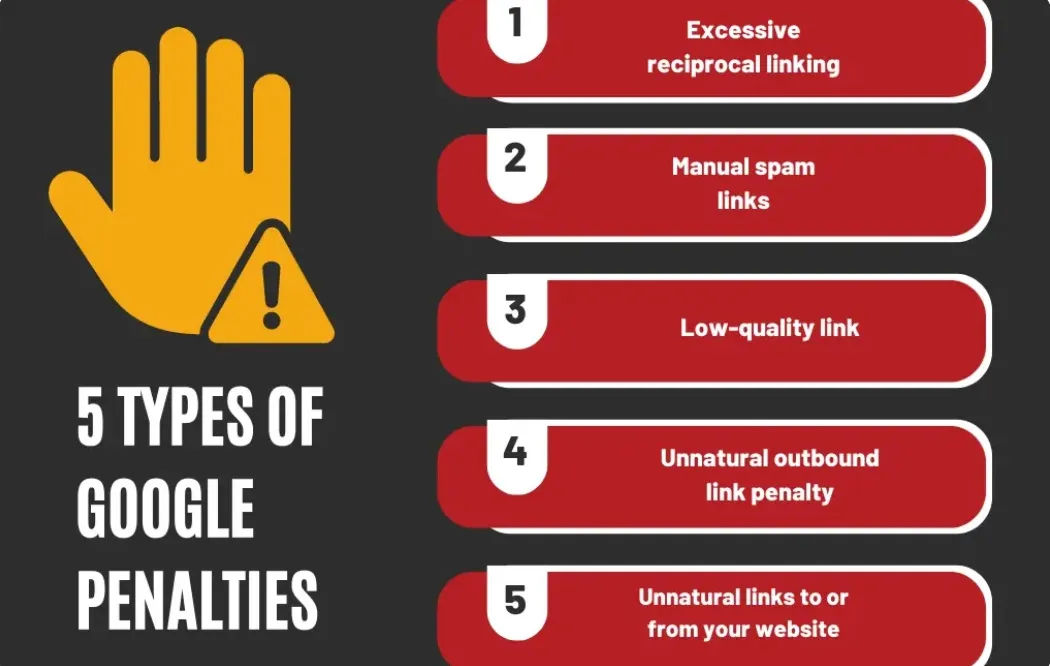 Image Credit: The Hoth
Spotting a Google penalty early is essential to minimise the impact on traffic and search visibility. Common signs include:
- Sudden drops in organic traffic or search rankings: A noticeable decline in traffic for high-performing pages can be a key indicator of a penalty. Such drops often happen suddenly and can affect multiple pages, signalling that Google has flagged certain aspects of your site.
- Loss of visibility for previously high-ranking keywords: Keywords that once consistently drove traffic may disappear from top search positions. This can make it harder for your audience to find your site and is often a sign that Google has downgraded your content.
- Alerts or notifications in Google Search Console: Manual penalties are typically communicated there, providing details on the penalty’s reason and which pages are affected. These alerts are invaluable for diagnosing and addressing issues quickly.
- Decline in click-through rates (CTR) or overall engagement: Reduced user interaction, such as fewer clicks, longer load times, or lower time-on-page metrics, can signal an underlying issue with content quality, usability, or site credibility. Monitoring these metrics can help identify potential penalties early.
Monitoring these indicators regularly helps ensure any issues are addressed before they cause long-term damage to your website’s performance.Determining whether your website has incurred a Google penalty and taking the proper steps to recover are crucial for maintaining search visibility and organic traffic.

Identifying a Google Penalty
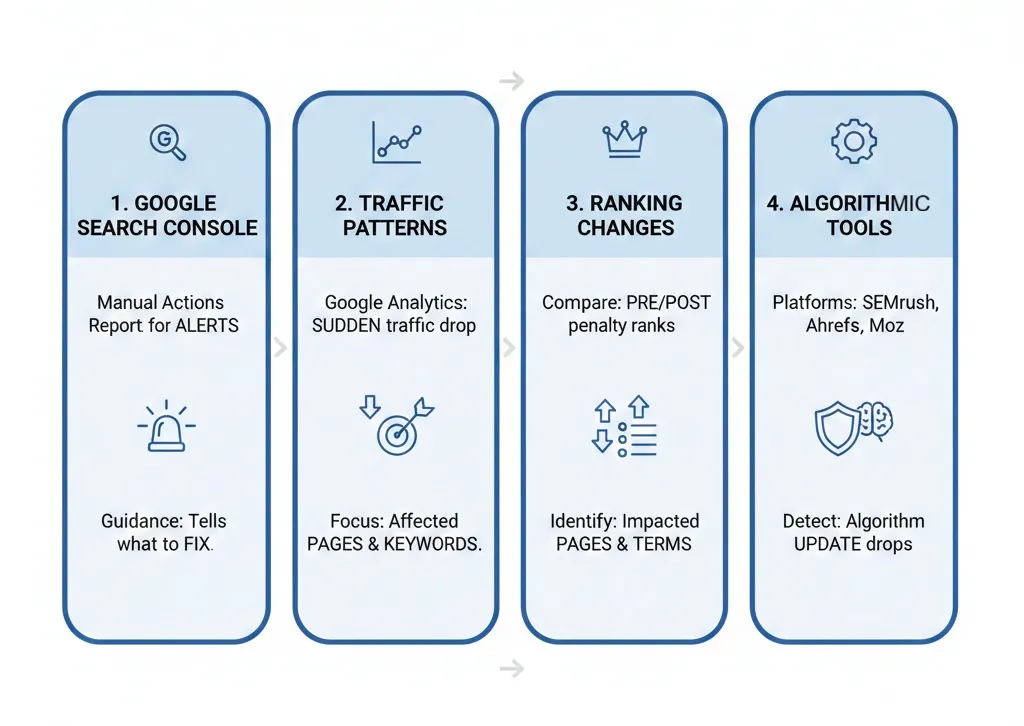
Image Credit: Generated by Gemini
Before taking steps to recover, it’s essential to determine whether your website has been affected by a Google penalty. To check if your website has been penalised, consider the following methods:
- Google Search Console manual actions report: Look for alerts regarding manual penalties and carefully review the reported issues. These notifications often guide what needs to be corrected.
- Analysing traffic patterns with Google Analytics: Sudden, unexplained drops in traffic can indicate either a manual or algorithmic penalty. Examine which pages and keywords are affected to pinpoint the problem.
- Comparing pre- and post-penalty rankings: Tracking changes in keyword positions over time can help identify pages impacted by a potential penalty.
- Tools for detecting algorithmic penalties: Platforms such as SEMrush, Ahrefs and Moz can help detect ranking drops caused by algorithm updates and provide insights into underlying issues.
Regular monitoring with these tools allows website owners to identify penalties promptly and take timely corrective action.
Steps to Recover From a Google Penalty
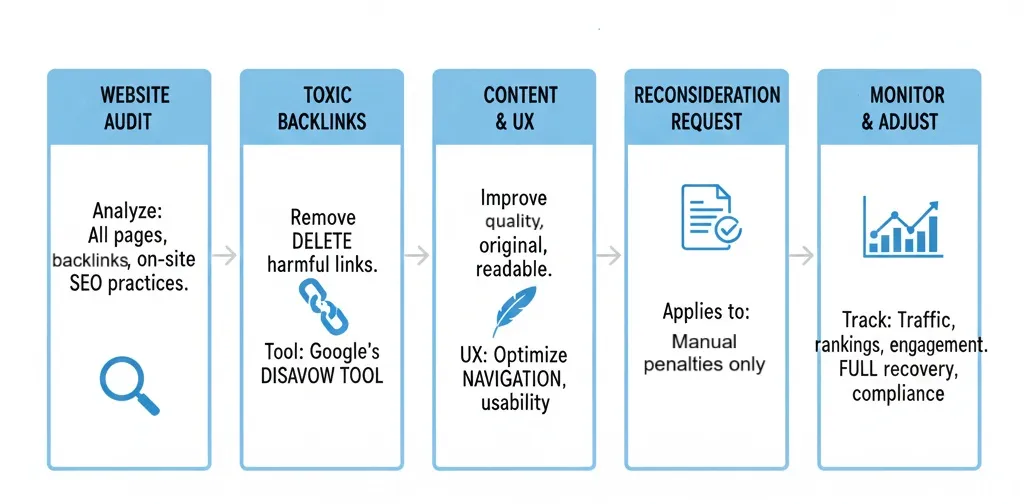
Image Credit: Generated by Gemini
Once a penalty is confirmed, recovery requires a structured approach that combines technical fixes, content improvement and compliance with Google’s guidelines:
- Conduct a website audit: Start by taking a good look at your whole site; every page, your backlinks and on-site practices. Check for thin content, duplicate pages, technical issues, or anything else that might have triggered a penalty. Think of it as a full health check for your website. It’ll give you a clear idea of what needs fixing.
- Remove or disavow toxic backlinks: Go through your backlinks and get rid of any spammy or harmful links you can. For links you can’t remove, use Google’s Disavow Tool to make sure they don’t hurt your site’s reputation. Keeping your backlink profile clean is a key step in earning Google’s trust back.
- Improve content quality and user experience: Take time to make your pages genuinely useful. Add original, valuable content, make it easy to read and format it so visitors can scan and digest it quickly. Don’t forget about navigation and internal links. A site that’s easy to use keeps people engaged and helps with rankings too.
- Submit a reconsideration request: If your site got a manual penalty, you’ll need to let Google know you’ve fixed the problems. Submit a reconsideration request and explain the steps you took to address the issues. Being clear and transparent makes it much more likely that the penalty will be lifted.
- Monitor recovery and tweak your strategy: Fixing things doesn’t guarantee instant results. Keep an eye on traffic, keyword rankings and user engagement to see how your changes are working. Use what you learn to fine-tune your SEO, avoid future penalties and keep your site in top shape.
Careful identification of penalties and systematic resolution of underlying issues allows website owners to restore search visibility, recover lost traffic and implement sustainable SEO practices that prevent future penalties.
Google Penalties Case Study
Here are some companies who have been penalised by Google.
Overstock.com
In 2011, global retailer Overstock.com was penalised by Google for incentivising backlinks from university (.edu/.org) websites, which is a clear breach of Google’s linking guidelines. As a result, the site suffered a significant drop in organic visibility and natural‑search referrals; during the penalty period, Overstock reported a 5% hit to sales.
After removing the manipulative links, cleaning up its backlink profile and aligning its SEO strategy with Google’s Webmaster Guidelines, Overstock had the penalty lifted within a few months.
The outcome: search rankings and visibility bounced back. This demonstrates that even major penalties can be reversed with systematic cleanup and ethical SEO practices.
BMW
In 2006, BMW (specifically its German site) was penalised for using “doorway pages” combined with cloaking. They created keyword‑heavy pages targeting searches like “used car,” but when users clicked, they were redirected to BMW’s main site instead of seeing those keyword pages.
The penalty was severe: BMW.de was completely removed from Google’s index (de‑indexed), effectively disappearing from search results. The removal lasted only a few days, but the backlash was public and showed that even major, well‑established brands are not immune to Google’s Webspam enforcement.
Genius
Another notable example is Rap Genius (now known as Genius.com). In December 2013 they were penalised when Google discovered they were offering to “promote” blog posts, via social shares or tweets, in return for backlinks to their site. As a result, Rap Genius dropped out of the first pages of search results, even losing ranking for its own brand name.
Traffic plunged dramatically: reports suggest unique visitor counts fell from ~700,000/day to ~100,000/day. After cleaning up the unnatural links and submitting a reconsideration request, the penalty was lifted about 10 days later.
Proactive Google Penalty Prevention Checklist
Stay ahead of Google penalties with these essential preventative steps:
- Identify and disavow spammy or low-quality links before they accumulate.
- Keep all pages valuable, comprehensive, and up-to-date.
- Spot emerging spammy tactics in your niche to avoid risky practices.
- Adapt your SEO strategies to align with algorithm changes.
- Check site health, page speed, crawl errors, and indexability to maintain compliance.
Tip: Review this checklist every quarter to ensure your website stays penalty-proof and maintains top search rankings.
Recover, Protect and Thrive in Search Rankings
Google penalties can have a profound impact on a website’s visibility, organic traffic and overall credibility. Whether imposed manually by Google reviewers or automatically through algorithmic updates, these penalties signal that certain practices on your site are not in line with Google’s guidelines.
To ensure your website remains fully compliant and performs at its best, consider partnering with MediaOne, a trusted digital marketing agency specialising in SEO strategies that keep your website safe from Google penalties. Contact us today!
Frequently Asked Questions
How long does it take to recover from a Google penalty?
The recovery period varies depending on the type and severity of the penalty. Manual penalties may be lifted within a few weeks after submitting a successful reconsideration request, while algorithmic penalties may take longer, often requiring consistent SEO improvements over several months.
Can a website be penalised more than once?
Yes. A website can incur multiple penalties if it repeatedly violates Google’s guidelines. For example, new spammy backlinks or low-quality content can trigger additional algorithmic penalties even after a previous penalty has been resolved.
Are Google penalties permanent?
Not necessarily. Most penalties are reversible if the underlying issues are fully addressed. Manual penalties require a reconsideration request and algorithmic penalties can be overcome by improving content, link profiles and overall site quality.
Do all drops in ranking indicate a Google penalty?
No. Not all ranking drops are due to penalties. Seasonal trends, increased competition, or regular algorithm updates can also affect rankings. It’s essential to carefully diagnose the cause using tools such as Google Search Console and SEO analytics platforms.
Can backlinks from bad websites automatically trigger a Google penalty?

Yes, low-quality or spammy backlinks can contribute to penalties, especially when part of a larger unnatural link pattern. However, one or two low-quality links alone usually won’t trigger a penalty. It’s the overall link profile that matters.