
An ecommerce website can look polished, have great products, and still struggle to convert. That is something we often see at MediaOne when businesses come to us asking why traffic isn’t translating into sales. The answer is rarely just about marketing spend or SEO alone. In most cases, the real issue sits inside the ecommerce website itself.

Research shows that the average ecommerce cart abandonment rate sits at nearly 70 percent globally, with usability issues during browsing and checkout cited as the leading cause rather than pricing or product quality.
In a high-speed digital market like Singapore, even small delays can signal inefficiency or unreliability. If any part of the experience feels slow, confusing, or uncertain, users abandon the purchase.
Trust plays an equally decisive role. In fact, 87 percent of consumers say they will take their business elsewhere if they do not trust a brand to handle their data responsibly. For ecommerce websites, this means that unclear policies, limited payment options, or inconsistent messaging can directly impact revenue, even if products and pricing are competitive.
This article breaks down what actually makes an ecommerce website sell, focusing on user experience, site speed, checkout design, and trust signals, the four pillars that quietly decide whether visitors become paying customers.
Key Takeaways
- A high-performing ecommerce website prioritises clarity and usability over visual flair, guiding users naturally towards purchase decisions.
- Site speed directly affects revenue; even small delays increase abandonment and reduce trust.
- Checkout design is one of the most common failure points, especially when it introduces friction, surprise costs, or unnecessary steps.
- Trust is not created by a single badge or review, but through consistent signals across design, content, policies, and payments.
- Ecommerce conversion improvements often come from fixing small experience gaps rather than complete redesigns.
Why Most Ecommerce Websites Fail to Convert
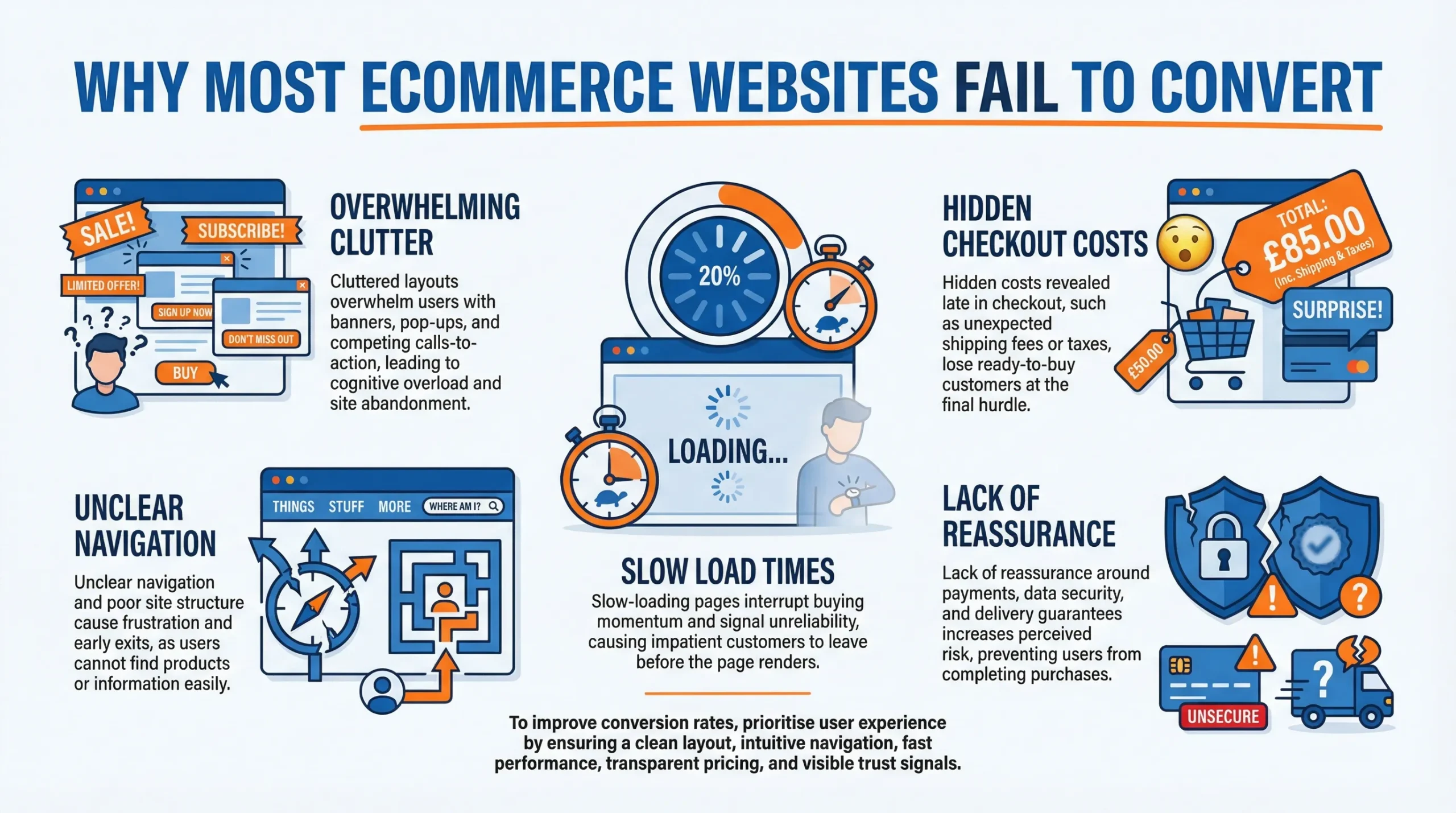
Many ecommerce websites are built with good intentions but poor prioritisation. Business owners often focus heavily on branding, product imagery, or adding more features, while overlooking how users actually move through the site and make decisions. As a result, the website may look impressive but feel difficult to use.
Several recurring issues tend to surface during conversion audits:
- Cluttered layouts that overwhelm users: Pages packed with banners, pop-ups, and competing calls to action make it harder for visitors to focus on the next step, increasing hesitation rather than confidence.
- Unclear navigation and site structure: When categories, menus, or filters are confusing, users struggle to find what they need quickly, leading to frustration and early exits.
- Slow-loading pages: Delays, even short ones, interrupt buying momentum and can create the impression that the site is unreliable or poorly maintained.
- Hidden costs revealed late in the journey: Unexpected delivery fees or taxes at checkout are one of the fastest ways to lose a ready-to-buy customer.
- Lack of reassurance around payments or delivery: Missing or unclear information about payment security, delivery timelines, or return policies increases perceived risk.
Individually, these issues may seem minor. Together, they create friction that quietly pushes users away before they reach checkout.
Successful ecommerce websites convert better because they actively remove uncertainty.
Every design and content decision is intentional, answering the unspoken questions users ask as they browse: What happens if I click this? How long will this take? Can I trust this business with my money and data?
Ecommerce Website User Experience as the Foundation of Sales
Before speed, checkout, or trust come into play, user experience (UX) shapes how visitors interact with an ecommerce website from the very first click. A well-designed UX reduces friction, builds confidence, and guides users toward completing a purchase.
UX Is About Decision Confidence, Not Just Design
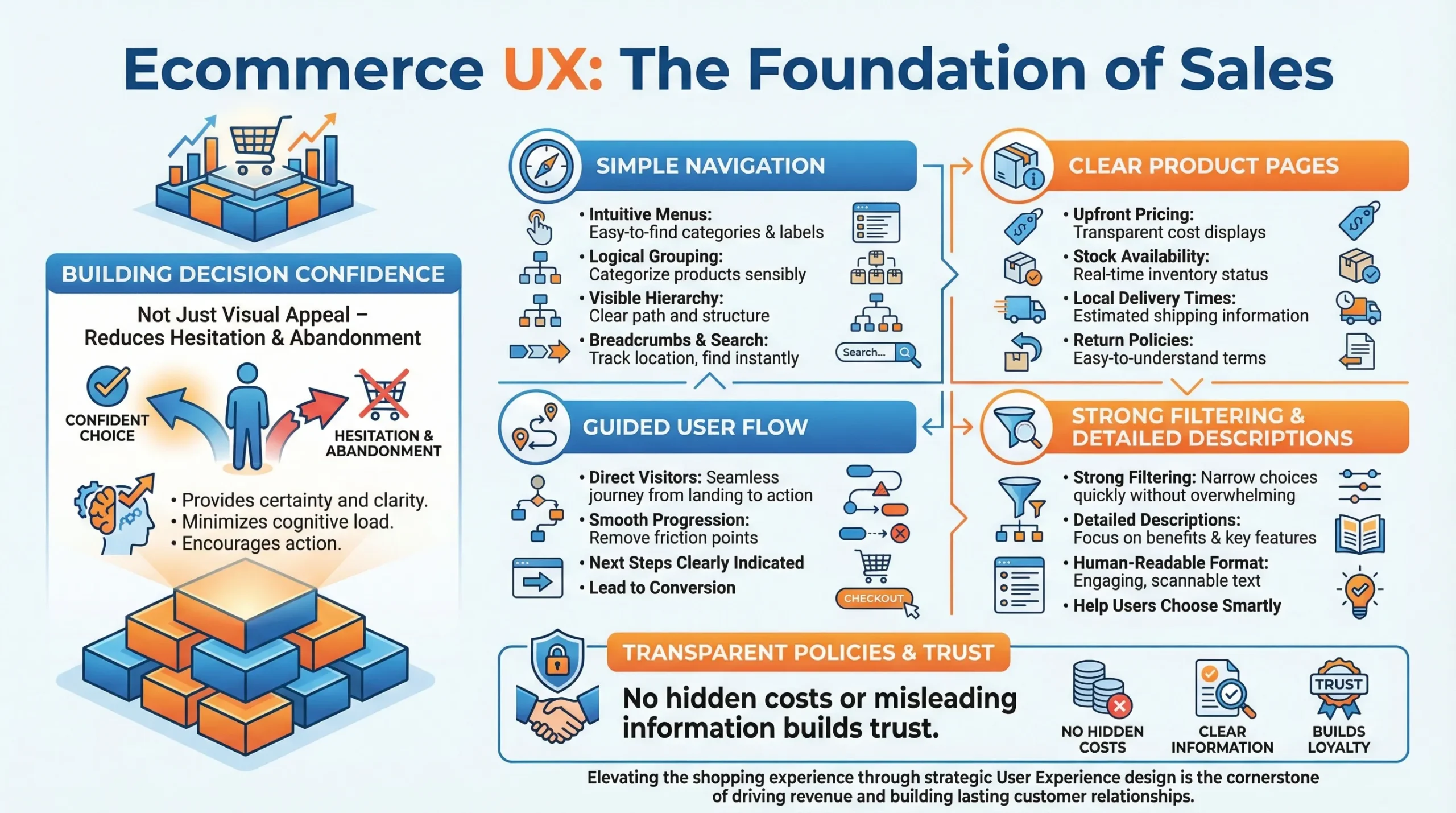
User experience is not about making a website look modern or flashy. It is about helping users make decisions quickly and confidently. A poor UX forces visitors to think too much, increasing hesitation and abandonment. High-converting ecommerce websites share common UX traits:
- Simple navigation: Menus and categories are intuitive and easy to scan
- Clear product pages: All necessary information is available without overwhelming the user
- Transparent pricing and policies: Nothing is hidden or misleading
- Guided user flow: Visitors feel directed rather than overwhelmed, increasing engagement and conversion
Many ecommerce websites fail because their menus are overcomplicated or their category structures are unclear. Users who cannot find what they need quickly are likely to leave. Effective navigation strategies include:
- Familiar language and logical grouping: Avoid clever labels in favour of clarity
- Visible hierarchy: Make categories, subcategories, and filters easy to scan
- Breadcrumbs and internal search: Support both casual browsing and goal-oriented shopping
- Clear filtering options: Allow users to narrow down choices quickly
Product Pages Should Reduce Doubt
Product pages are where most hesitation occurs. Strong ecommerce websites ensure that product pages provide enough detail to remove doubt without overwhelming users:
- Clear pricing: Show the total cost upfront, including taxes and shipping if possible
- Stock availability: Indicate whether items are in stock or backordered
- Singapore-relevant delivery timelines: Localise expectations to increase trust
- Return and refund policies: Clearly state terms to reduce perceived risk
- Concise, human-readable descriptions: Focus on benefits and key features, avoiding jargon
A website that optimises UX at every step, from navigation to product pages, reduces friction, builds confidence, and guides users naturally toward checkout, forming the foundation for higher conversions.

Speed as a Revenue Lever of an Ecommerce Website
Once users can navigate an ecommerce website with ease, speed becomes the next critical factor that determines whether momentum is maintained or lost. A fast website keeps users engaged, while delays can break the buying flow and increase abandonment.
Why Speed Is a Trust Signal
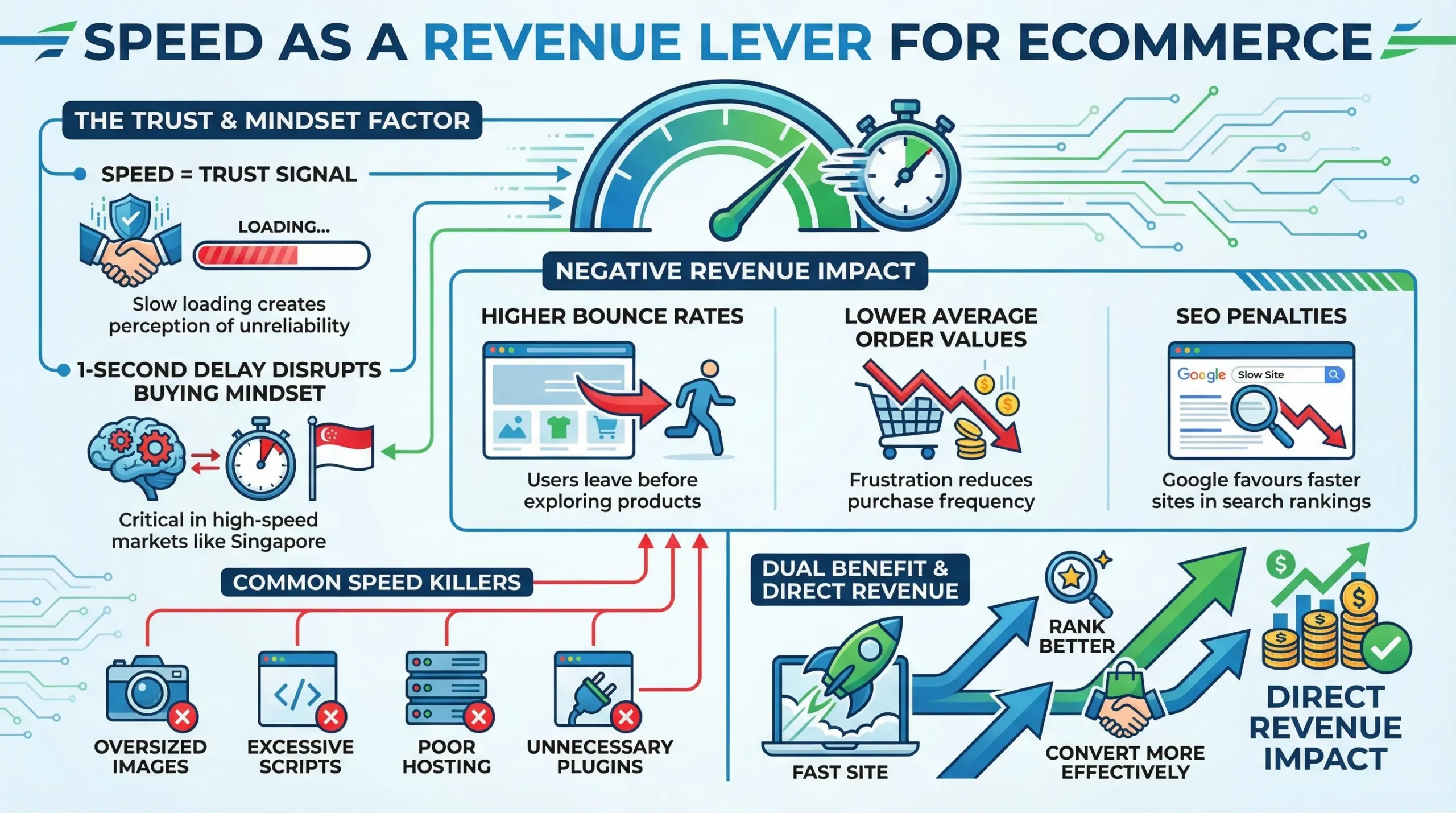
Speed is not just a technical concern. It is a psychological factor. When an ecommerce website loads slowly, users subconsciously associate that delay with unreliability. This effect is even more pronounced in Singapore, where internet speeds are high, and users expect fast digital experiences. Even a one-second delay can disrupt the buying mindset.
The Commercial Impact of Slow Load Times
Data consistently shows that slower ecommerce websites suffer from multiple negative outcomes:
- Higher bounce rates: Users leave before exploring products
- Lower average order values: Frustrated users make fewer purchases
- Reduced repeat visits: Slow experiences harm long-term customer loyalty
- SEO performance penalties: Google favours faster sites in search rankings
- Paid advertising inefficiency: Slow landing pages reduce conversions from ads
Fast ecommerce websites benefit twice. They rank better in search results and convert visitors more effectively, directly improving revenue.
Where Speed Issues Usually Hide
Common causes of slow load times include:
- Oversized or unoptimised images
- Inefficient or excessive scripts
- Unnecessary plugins or third-party integrations
- Poorly configured or underperforming hosting
- Technical debt from accumulated features added without performance checks
Regular speed audits and optimisations are essential for ecommerce websites that aim to scale. Monitoring page performance, compressing assets, and streamlining code help ensure users experience fast, smooth interactions that drive conversions and customer satisfaction.
Ecommerce Website Checkout Experience: The Point of No Return

The checkout stage is when purchase intent is highest and tolerance for friction is lowest. At this moment, users are ready to commit; even minor obstacles can cause them to abandon their carts.
Checkout Is Where Most Sales Are Lost
The checkout process is the most sensitive stage of the ecommerce journey. By this point, users have already decided to buy, so any friction feels amplified. Common mistakes that lead to abandoned carts include:
- Forced account creation instead of offering guest checkout
- Excessive form fields that require unnecessary information
- Unclear delivery costs or timelines, creating surprises at the last step
- Limited payment options that don’t match user preferences
- Confusing error messages that leave users unsure how to proceed
- Unexpected fees or taxes revealed too late in the process
Each additional step, confusion, or surprise increases the risk of abandonment, making the checkout process a critical conversion point.
What a High-Converting Checkout Looks Like
A strong checkout experience is simple, predictable, and transparent. It builds confidence and keeps users moving toward completion:
- Progress indicators: Clearly show the steps remaining in the checkout process
- Minimised input fields: Only request essential information to reduce friction
- Guest checkout options: No need to create an account to complete a purchase
- Flexible payment methods: Offer cards, local options (e.g., PayNow), and trusted digital wallets
- Transparent delivery costs and timelines: Show shipping information early in the process
- Error prevention and clear messaging: Ensure any mistakes are easy to correct without frustration
- Mobile-optimised experience: Ensure checkout works flawlessly on any device, as mobile abandonment rates are higher
A high-converting checkout makes the final purchase steps feel effortless and predictable, reducing anxiety and maximising completed sales. By addressing friction points and aligning with customer expectations, ecommerce websites can significantly increase conversion rates and revenue.
Comparing Weak vs Strong Ecommerce Checkout Experiences
The checkout stage can make or break a sale. Even small differences in its structure can significantly impact conversion rates, often without changing traffic volume. The table below highlights key differences between weak and high-converting ecommerce checkout experiences:
| Checkout Element | Weak Ecommerce Website | High-Converting Ecommerce Website |
|---|---|---|
| Account creation | Mandatory before checkout | Optional or guest checkout |
| Form length | Long, repetitive forms | Minimal fields with autofill |
| Delivery costs | Shown at the final step | Shown early and clearly |
| Payment options | Limited card-only options | Multiple trusted local options |
| Error handling | Generic or unclear messages | Clear, helpful guidance |
Key Takeaways:
- Mandatory account creation and long forms increase friction and cart abandonment.
- Hidden delivery costs create surprises and reduce trust.
- Offering multiple payment methods, especially local options, meets real customer expectations.
- Clear error messaging prevents frustration and ensures users can complete checkout smoothly.
By optimising these elements, ecommerce websites can maximise conversions and create a seamless, trustworthy buying experience.
Ecommerce Website Trust as the Silent Sales Driver
Even when usability, speed, and checkout flow are optimised, trust often determines whether a purchase is completed. Without trust, users hesitate, abandon carts, or choose competitors, no matter how seamless the experience is.
Trust Is Built in Layers
Trust in an ecommerce website is not established by a single element, like a badge or testimonial. It is built gradually through consistent reassurance at every stage of the customer journey. Users subconsciously evaluate trust based on:
- Design quality: Professional, consistent visuals signal reliability
- Clarity of information: Clear product descriptions, pricing, and policies reduce uncertainty
- Transparency of policies: Easy-to-find returns, shipping, and refund policies increase confidence
Anything that feels vague, hidden, or misleading can raise suspicion and reduce conversions.

Essential Trust Signals for Ecommerce Websites
Key trust elements that directly impact user confidence include:
- Clear contact information: Phone number, email, or chat options that make it easy to reach the business
- Visible return and refund policies: Transparent processes that reduce perceived risk
- Secure payment indicators: SSL certificates, trusted payment gateways, and recognisable payment logos
- Authentic customer reviews: Realistic testimonials that provide social proof
- Local presence (Singapore-specific): Local address, local delivery options, and realistic shipping timelines
- Well-written About page & FAQs: Honest company information and clear answers to common questions
Content That Builds Confidence
The tone of communication also affects trust. Overpromising, exaggerated claims, or vague guarantees often backfire. High-converting ecommerce sites focus on:
- Calm, clear, and honest messaging that sets realistic expectations
- Consistent reassurance across all pages, from product listings to checkout
- Avoiding aggressive sales tactics that might feel manipulative or insincere
By layering these trust signals throughout the website, merchants can create a dependable and credible shopping experience, encouraging users to complete purchases and return for future transactions.
The Role of SEO in Ecommerce Conversions
While SEO is primarily known for driving traffic, conversions are what actually generate revenue. An ecommerce website optimised solely for search rankings but neglecting usability, clarity, or trust will struggle to grow sustainably.
How SEO and UX Work Together
Good ecommerce SEO is integrated seamlessly with user experience (UX). When done correctly, it not only attracts visitors but also encourages them to convert. Key elements include:
- Fast page load times: Reduce bounce rates and keep users engaged
- Content that answers real questions: Helps users make informed purchase decisions
- Intuitive internal linking: Guides users to related products, categories, or information
- Clear navigation and structure: Makes it easy for visitors to find products and complete transactions
When SEO and UX are aligned, both traffic quality and conversion rates improve, creating a more sustainable growth loop for the business.
Real-World Impact
At MediaOne, we often observe that ecommerce websites can increase sales without increasing traffic simply by aligning SEO structure with user intent. This shows that:
- Optimised SEO isn’t just about ranking—it’s about guiding users effectively
- Conversion-focused SEO considers both discovery and decision-making
- Small UX and SEO adjustments can yield significant revenue gains
In short, successful ecommerce SEO goes beyond visibility; it ensures that visitors who arrive are more likely to buy, making every click count.
Optimising an Ecommerce Website Without a Full Redesign
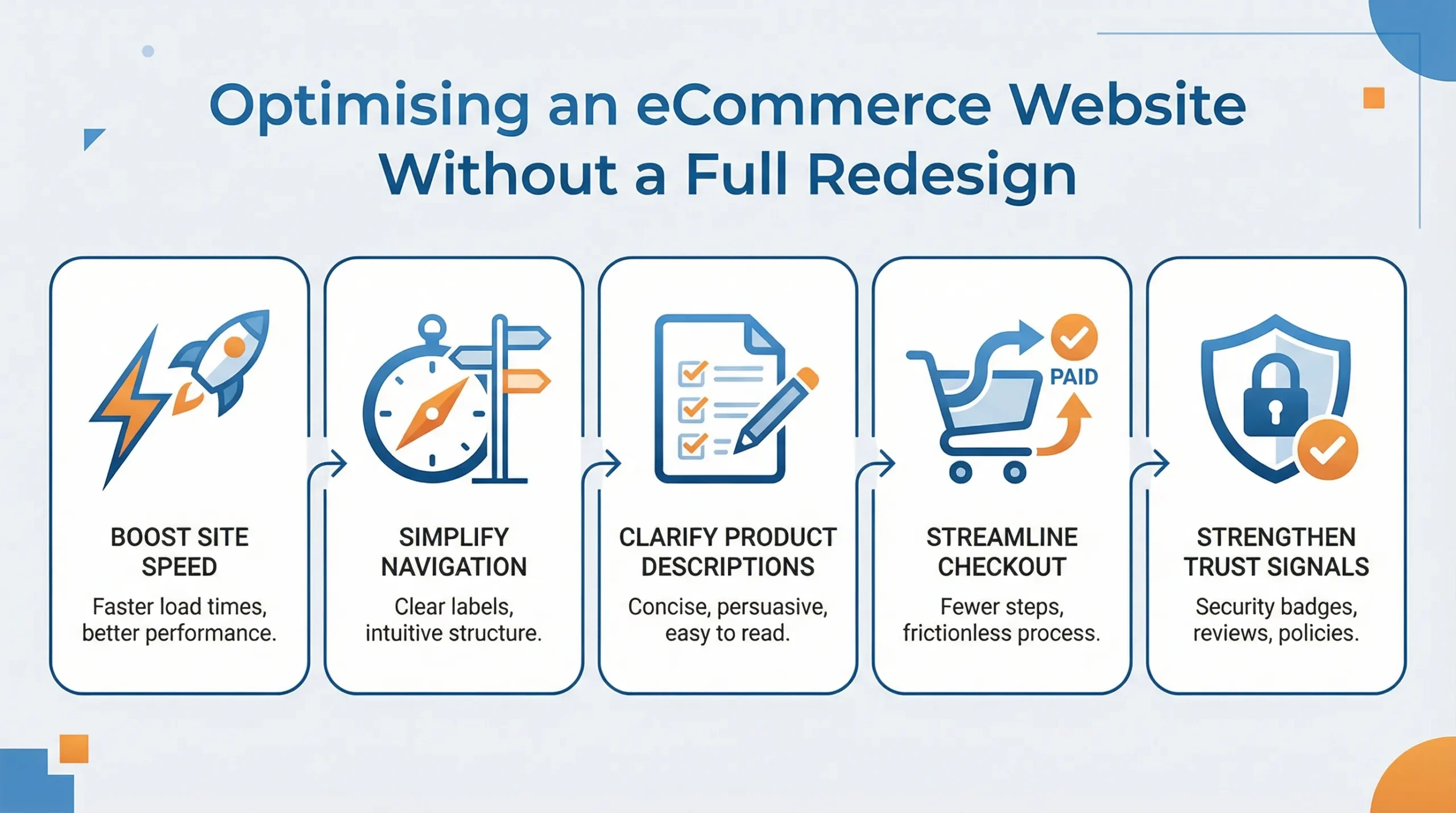
Many businesses assume that improving ecommerce performance requires a full rebuild. In reality, some of the most effective improvements come from targeted refinements that address friction points rather than changing the entire site.
Common high-impact optimisations include:
- Improving site speed by compressing images, cleaning up scripts, and reducing unnecessary plugins that slow down page load times.
- Simplifying navigation labels so categories and menus reflect how users actually search and browse, not internal product terminology.
- Rewriting product descriptions for clarity, focusing on benefits, delivery expectations, and key decision details rather than generic marketing language.
- Adjusting checkout flow to reduce steps, remove forced account creation, and surface costs and payment options earlier.
- Strengthening trust signals through clearer policies, visible contact information, and consistent reassurance around payments and data security.
The key is understanding where users hesitate and why, then prioritising changes that remove uncertainty at those exact moments.
Building a High-Converting Ecommerce Website for Real-World Audiences
Today’s ecommerce users are highly informed and comparison-driven. They often research products, read reviews, and check competitors before making a purchase. As a result, websites that feel inefficient, confusing, or untrustworthy are quickly abandoned. With countless alternatives just a click away, patience is short and first impressions matter more than ever.
Key factors that influence user confidence and conversion:
- Delivery expectations: Clear timelines, shipping costs, and tracking options reassure customers that their orders will arrive reliably.
- Customer support accessibility: Easily accessible help channels (chat, email, phone) increase trust and reduce hesitation during checkout.
- Payment preferences: Offering multiple familiar payment methods (cards, digital wallets, PayPal, local options) enhances customer convenience.
- Transparency around policies: Clear return, refund, and privacy policies reduce perceived risk and make users more comfortable completing a purchase.
An ecommerce website that converts effectively does more than display products—it communicates reliability at every step. This includes:
- Consistent branding and design that signals professionalism and builds trust.
- Intuitive navigation that enables users to find products and information quickly.
- Clear calls to action that guide users through the buying journey without confusion.
- Responsive performance on mobile and desktop, ensuring smooth, fast, and predictable interactions.
In short, a high-converting ecommerce site meets real-world user expectations consistently, creating a buying experience that feels dependable, predictable, and effortless, ultimately turning visitors into loyal customers.
Strengthening Your Ecommerce Website for Sustainable Growth
A successful ecommerce website is not defined by trends or tools alone, but by how smoothly it supports the buyer’s decision-making process. User experience, speed, checkout design, and trust are closely connected. When these elements work together, conversion becomes a natural outcome rather than an ongoing challenge. If an ecommerce website attracts visitors but struggles to generate consistent sales, it is often a sign that one or more of these pillars needs focused attention.
At MediaOne, we help ecommerce businesses identify where conversion gaps occur and refine their ecommerce websites based on real user behaviour, not assumptions.
As an official Shopline partner, we also support businesses using a platform designed for scalability, omnichannel selling, and seamless integration with payment and logistics systems. This allows optimisation efforts to go beyond surface-level improvements and support long-term ecommerce growth without compromising brand integrity.
Contact us today for an assessment of what is limiting your ecommerce website’s conversions and how targeted improvements can drive more sales.
Frequently Asked Questions
How long does it take to see improvements after optimising an ecommerce website?
Results vary depending on the changes made, but usability and checkout improvements often show measurable impact within weeks. SEO-related improvements may take longer as search engines recrawl and re-evaluate the site.
Do ecommerce websites need constant redesigns to stay competitive?
No. Most high-performing ecommerce websites evolve gradually. Regular optimisation based on user behaviour is usually more effective than frequent full redesigns.
Is mobile optimisation more important than desktop for ecommerce websites?
For many Singaporean ecommerce businesses, mobile traffic exceeds desktop traffic. Mobile optimisation is essential, especially for speed, navigation, and checkout usability.
Can trust issues affect repeat purchases even if the first sale succeeds?

Yes. If users feel uncertain or frustrated during their first purchase, they may complete the transaction but avoid returning. Long-term ecommerce growth depends heavily on post-purchase trust.
Should ecommerce websites prioritise SEO or conversion optimisation first?
Both should work together. SEO drives visibility, but conversion optimisation ensures that traffic delivers commercial value. Treating them separately often limits overall performance.