Singapore brands reaching Chinese-speaking consumers should take WeChat seriously: Tencent’s Q2 2026 results put the combined monthly active users of Weixin and WeChat at 1,439 million. Treat WeChat marketing in Singapore as a service ecosystem to plan and measure – official account, Moments ads, Mini Program, payments and CRM working as one bundle – not as another channel bolted onto the plan.

Key Takeaways
- Fit comes first. WeChat suits brands whose buyers are mainland Chinese or Chinese-speaking consumers; brands without those buyers gain little from the platform.
- Plan an always-on programme. With over 1.4 billion combined monthly active users per Tencent, sustained effort beats one-off bursts.
- Budget realistically. Singapore agencies quote always-on Xiaohongshu and WeChat programmes from about SGD 8,000 per month (per We Interactive), with Mini Program builds and media spend on top.
- Judge early results on engagement and other leading metrics, not sales.
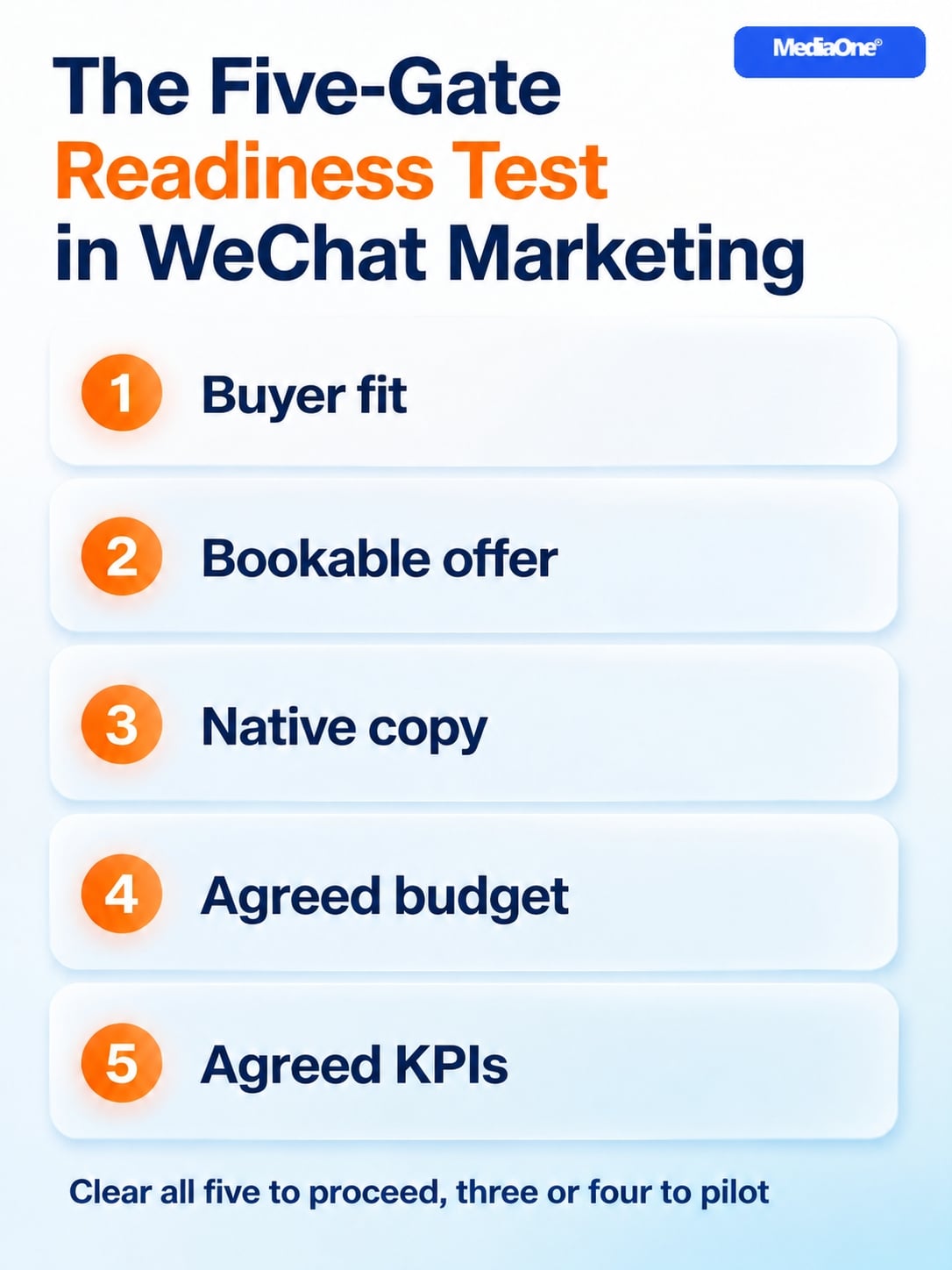
- Run the Five-Gate test before committing spend. It is this guide’s own framework, not an industry standard.
Why China and WeChat Matter to Singapore Marketers
China has remained the world’s largest online retail market for 13 consecutive years, and Singapore’s bilingual workforce makes reaching Chinese-speaking consumers practical for a Singapore brand.

WeChat combines messaging, publishing, payments and Mini Programs in a single app. That reach is why the platform anchors most China digital programmes: with 1.4 billion-plus combined monthly active users, Weixin and WeChat together touch the majority of Chinese consumers, and official accounts, Moments ads and Mini Programs give brands a way to publish, advertise and transact inside the same ecosystem.
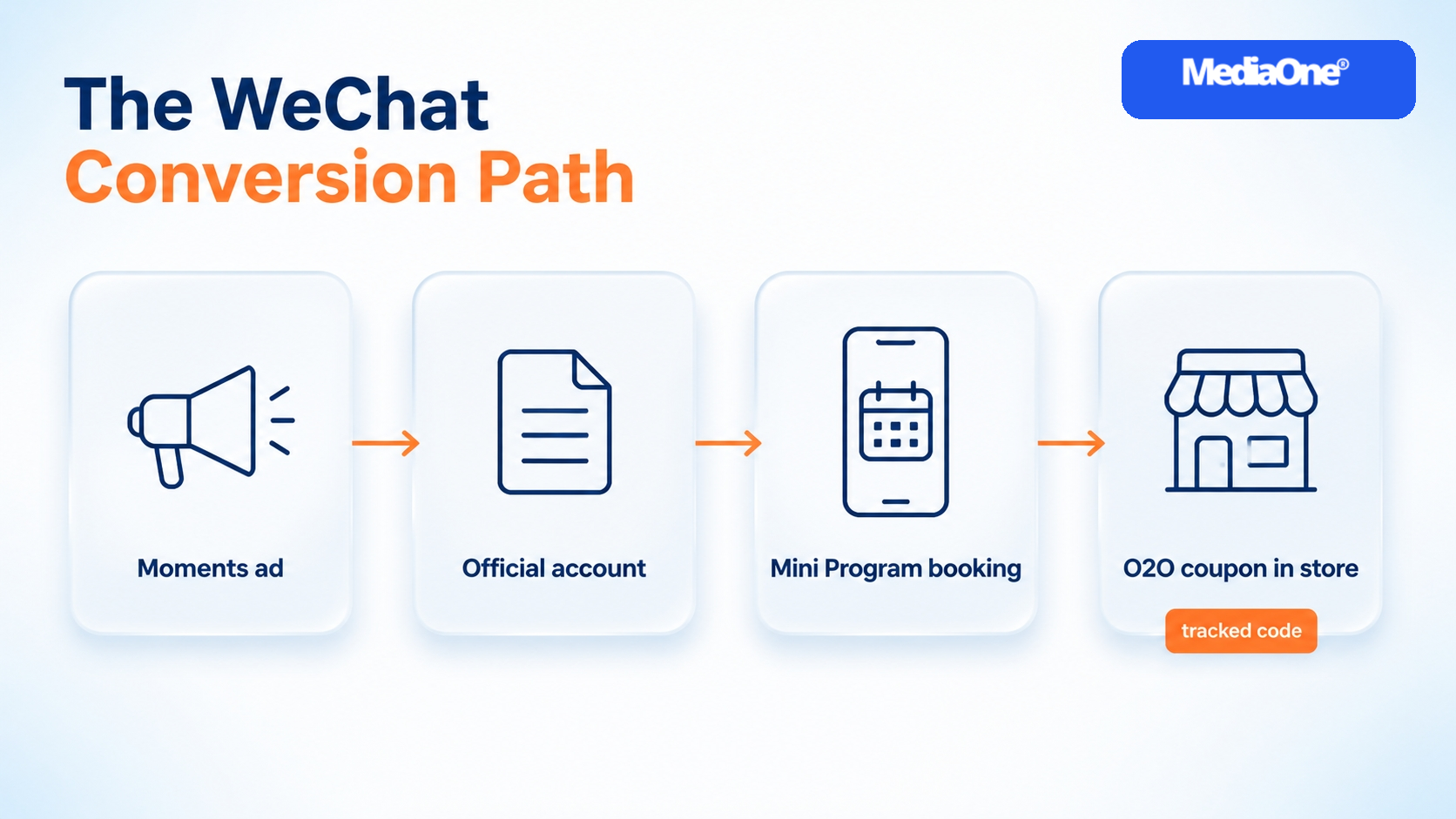
The value lies in the conversion path, from a Moments post to an official account to a Mini Program booking. That chain is where WeChat marketing in Singapore outperforms standalone awareness channels: every step is measurable, and the last step can end in a payment or a tracked in-store redemption.
China Market Entry Challenges and the Unfamiliar Platform Logic
Entering China through WeChat is not a matter of translating a Singapore marketing campaign. Three challenges catch most brands out.
China Market Entry Challenges
Foreign companies cannot register WeChat Subscription Accounts, but brands from over 200 countries and territories can apply for a WeChat Service Account using a foreign business licence, with a USD 99 annual verification fee. On payments, Weixin Pay and Alipay accept Singapore-issued Visa and Mastercard cards for individuals, though transaction limits and fees apply (WeChat’s help centre documents caps of 6,500 RMB per single transaction and 50,000 RMB per month). Accepting WeChat Pay as a merchant is a separate process: it requires business documentation such as a licence, as Stripe’s guide to WeChat Pay explains, and access modes for overseas merchants are set out in WeChat Pay’s official global documentation. Confirm eligibility and fees at set-up, and work with a local partner before committing budget. For how these wallets fit the wider region, see this look at how digital marketing in Asia is changing.
Platform Logic in the Chinese Digital Ecosystem
WeChat works as a bundle: official accounts publish content, Moments carries advertising, and Mini Programs handle booking and payment. A Moments ad without a Mini Program or redemption path wastes its reach, so every social media touchpoint should lead to a measurable service or growth step.
Cultural Adaptation for Chinese Consumers
Machine-translated English reads as foreign and loses trust. Native Chinese copywriters choose the tone, idiom and seasonal references that help audiences relate to the brand, and the same local voice should carry through email marketing and design. Budget for native copy from the start: on Xiaohongshu, where over 300 million monthly active users research products and nearly 70% of monthly active users use the platform’s search, discoverability rewards content that reads native. Brands that need help selecting partners can shortlist from this rundown of Xiaohongshu marketing agencies in Singapore, and MediaOne’s content marketing services include translation and localisation for exactly this job.
Building and Running a WeChat Marketing Programme
Treat WeChat marketing as an always-on programme, not a one-off campaign. Settle the planning inputs before spending, then judge progress against KPIs over three to six months. A digital marketing agency’s social media marketing team can structure this from the outset, acting as a long-term partner for sustainable growth in the market.

China Digital Strategy and Planning
Work through this checklist before committing budget:
- Objective: one primary goal, such as leads, bookings or store visits.
- Audience: a specific segment of Chinese consumers with clear purchase intent.
- Offer: a China-ready product, service or booking path, designed for mobile use.
- Channel: official account, Mini Program, Moments ads or O2O.
- KPIs: the metric that proves progress at each stage.
- Budget: covering the full programme, including account setup costs.
WeChat Advertising Options and Ad Formats
|
Format |
Best-fit use case |
|
Moments ads |
Awareness among a defined audience |
|
Official account placements |
Repeat engagement with existing followers |
|
Search and Mini Program ads |
Intent-led traffic to a booking or purchase flow |
Formats, targeting options and buying models for each placement are covered in AppInChina’s complete guide to WeChat Ads – worth reading before you agree to a media plan, because Moments placements carry minimum spend levels that differ from the familiar Meta logic.
Mini Program Development
A Mini Program earns its build cost when customers must book, order or pay inside WeChat. Payment-enabled Mini Programs require legal entity verification – WeChat Pay merchant onboarding asks for business documentation such as a licence, and overseas merchants follow the access modes in WeChat Pay’s global merchant documentation – so confirm this before development begins. Choose a partner with experience in Mini Program design and China services.

Social Media Management and CRM
Publish on a fixed calendar and reply quickly, since responsiveness drives repeat engagement more than post volume. Tag contacts by interest and funnel stage. Run Xiaohongshu alongside Weibo or WeChat Channels where relevant services are promoted, and treat Xiaohongshu’s trust-driven community as a social commerce channel in its own right. Where KOC seeding is part of the plan, a bilingual influencer marketing brief keeps Chinese-language content on-message – the template is built for Singapore teams running Xiaohongshu campaigns.
Search, Activation, Measurement and Cost
SEO, SEM and GEO for Chinese Search
Baidu still leads Chinese-language search but no longer dominates it: StatCounter put it at 46.65% of all-platform searches in China in September 2026, with about 60% on mobile. WeChat search surfaces content inside the app, and Xiaohongshu works as a product-research engine in its own right. Publish native-language content on all three and keep brand facts stable and dated so AI answer engines can cite them accurately – the same discipline behind generative engine optimisation in English-language search. For ranking tactics on Baidu itself, this Baidu SEO guide to ranking in China covers the 2026 landscape, and MediaOne provides dedicated Baidu SEO services for Singapore businesses entering the market.
O2O (Online-to-Offline) Activation
For a brand with a Singapore outlet, a WeChat coupon redeemed in-store is the strongest conversion path. Give each campaign a unique code to trace redemptions, so the business can see which marketing spend actually drives footfall.
Measurability and Results Tracking of Campaigns
Set up tracking and a monthly review before spend starts. Track engagement rate, cost per lead and redemption rate for every WeChat marketing campaign, and treat the first quarter as a leading-indicator period: early engagement and redemption behaviour predict the sales outcome far better than a premature revenue read.
|
Symptom |
Likely cause |
Fix |
|
Low engagement |
Content not native or off-timing |
Rewrite with native copywriters |
|
Low conversion |
Weak offer or broken booking path |
Simplify the Mini Program flow |
|
High cost per lead |
Poor audience targeting |
Tighten segments |
On cost discipline: whichever retainer level you agree on, keep the reporting monthly and the KPI baselines written down before the first invoice – the same setup phase the Five-Gate test requires. Agencies running China social programmes, including WE Interactive and the KOL specialists in MediaOne’s influencer marketing services, structure retainers around always-on content, media and reporting rather than one-off pushes.
Conclusion and Next Steps
WeChat marketing pays off for a Singapore brand when platform fit, localisation and measurement all hold. Platform fit means your buyers are Chinese-speaking consumers who can book or buy through a Mini Program or an offline (O2O) path. Localisation means native-language content, including Xiaohongshu and email marketing copy where those channels support the same campaign. Measurement means agreed KPIs before spend starts.
Run the Five-Gate readiness check: buyer fit, a bookable or purchasable offer, native copy, an agreed budget and agreed KPIs. Clear all five and proceed. Clear three or four and pilot first. Clear fewer than three and another channel is likely better value. To pressure-test the plan against MediaOne’s own checklist, request a WeChat channel audit through the contact page.
Frequently Asked Questions
Do I need a Chinese company registration to run WeChat marketing from Singapore?
Not always. Brands from over 200 countries and territories can apply for a Service Account using their foreign business licence, with a USD 99 annual verification fee. Mini Programs that process payments require legal entity verification, so confirm this with your agency first.
How long before a WeChat campaign shows results?
Expect early engagement before sales. According to We Interactive, first Xiaohongshu KOC engagement typically takes one to three months, so judge the first quarter on leading metrics such as engagement rate and coupon redemptions before reading the revenue line.